Before Claude Monet became famous for water lilies, haystacks, and the gardens at Giverny, Camille Doncieux stood at the center of his private life and much of his early art. She knew Monet before wealth and lasting recognition changed his circumstances. She was his model, companion, wife, and the mother of his two sons. Her face and figure appear repeatedly in paintings from the years when Monet was still struggling to establish himself.
Their relationship unfolded during a difficult and decisive period. Monet faced money problems, family resistance, war, professional uncertainty, and the pressures of supporting a growing household. Camille remained part of that story from the mid-1860s until her death in 1879. The surviving evidence does not give us every private detail of their courtship, and there is no reliable basis for inventing conversations or dramatic declarations. What does survive is more valuable: documented dates, letters, family events, and paintings that allow us to follow their shared life.
Camille was more than a convenient “muse.” She was one of the people closest to Monet during the years when his style was taking shape. She posed for major works, gave birth to Jean in 1867 and Michel in 1878, married Monet in 1870, and lived through some of the most unstable years of his career. Her place in Monet’s paintings gives their relationship a rare visual record.
How Claude Monet and Camille Doncieux Fell in Love
Camille Becomes Monet’s Model and Companion
By 1865, Camille Doncieux had become both Monet’s model and his companion. She was born in 1847, while Monet had been born in Paris on November 14, 1840. The exact circumstances of their first meeting are not securely documented, so they should not be romanticized. What is certain is that Camille entered Monet’s life when he was still a young painter fighting for recognition.
At the time, Monet was experimenting with ambitious figure paintings as well as landscapes. These works demanded money, time, and reliable models. Camille became one of the people he painted most often. Her presence gave Monet a familiar figure to place in outdoor settings where he could study the effects of sunlight, shade, fabric, and movement.
One of the strongest examples is Women in the Garden, painted by Claude Monet around 1866. The work is oil on canvas, measures 255 by 205 centimeters, and is now in the Musée d’Orsay in Paris. Camille posed for the three female figures on the left. The museum notes that the picture should not be treated as a conventional portrait, since Monet was primarily interested in figures within an outdoor setting.
Camille in Women in the Garden
Women in the Garden shows how ambitious Monet already was. The canvas is more than eight feet high. To work on such a large painting outdoors, Monet used a trench and pulley arrangement that allowed the canvas to be lowered as he worked. It was not a leisurely exercise. Painting on that scale required physical effort, planning, and persistence.
Camille’s repeated appearance in the composition also shows how closely Monet’s personal and professional lives were becoming connected. She was not simply sitting for a single portrait. Her figure became part of a major artistic experiment. Monet wanted his figures to appear naturally within the effects of daylight rather than look like studio models placed against a painted background.
The Salon jury rejected Women in the Garden in 1867. That rejection is important because it reminds us that Monet’s later fame was not guaranteed. He was still taking risks, spending money he could barely afford, and trying to find buyers. His friend Frédéric Bazille acquired the painting that same year.
At the same time, Camille was pregnant. The relationship was moving rapidly beyond the world of models and paintings. Their son Jean was born in 1867, and the pressures of family life soon became impossible to separate from Monet’s financial and professional difficulties.
Love Under Pressure: Poverty, Family, and Marriage
Jean’s Birth and Monet’s Family Difficulties
The year 1867 was difficult for Claude and Camille. Monet’s family did not approve of the situation surrounding Camille’s pregnancy. During the summer, Monet stayed with relatives at Sainte-Adresse near Le Havre while Camille remained in Paris. His correspondence shows that the separation was tied to family tensions and financial dependence.
Jean Monet was born in 1867. Claude and Camille were not yet married. Their son arrived nearly three years before the wedding that finally formalized their relationship. Monet was now responsible not only for himself but for Camille and their child.
These years exposed a less glamorous side of the artist’s life. Monet needed money for canvases, paint, rent, travel, and food. Large paintings were expensive to produce. Buyers were unreliable, and family support could come with conditions. Camille therefore shared a life in which artistic ambition and ordinary household worries were constantly mixed together.
Monet also painted his new family. In 1867 he produced The Cradle – Camille with the Artist’s Son Jean. The painting records Camille beside the infant Jean and shows how quickly family life entered his art. Camille was no longer simply the fashionable young woman who posed for ambitious figure paintings. She was now the mother of Monet’s child.
Claude and Camille Finally Marry
Claude Monet and Camille Doncieux married in Paris on June 28, 1870. Their wedding came almost three years after Jean’s birth. Camille had already shared years of uncertainty with Monet before she officially became Madame Monet.
The timing was difficult. The Franco-Prussian War began in July 1870, only weeks after their marriage. Monet left France and spent part of the conflict in London. After the war, he and his family returned to France and eventually settled at Argenteuil by the end of 1871.
Argenteuil became one of the most important places in Monet’s career. The town offered gardens, railway bridges, river traffic, pleasure boats, and views of the Seine. It was close enough to Paris for easy travel but still provided the outdoor subjects Monet wanted to paint.
For Camille, Argenteuil also meant a family home. Jean was growing up, and Monet’s circle included painters who would later become central to the story of Impressionism. Their friend Édouard Manet even painted the Monet family outdoors in 1874 in The Monet Family in Their Garden at Argenteuil. The work offers an outsider’s view of Claude, Camille, and Jean as a recognizable family unit.
Camille Monet in the Paintings of Family Life
Argenteuil and Domestic Life
Several paintings from the Argenteuil years show Camille in a more settled domestic setting. In Camille Monet (1847–1879) on a Garden Bench, painted by Claude Monet in 1873, she appears seated in a garden wearing a dark fashionable outfit. The oil on canvas measures 60.6 by 80.3 centimeters and is now in the Metropolitan Museum of Art in New York.
The picture has a subdued mood. Camille’s father died in September 1873, and Monet wrote that his wife had received bad news and that they were obliged to go into mourning. Camille holds a note in one hand, and a man in a top hat appears nearby. The Metropolitan Museum has suggested that the visitor may have come to offer condolences, but this remains an interpretation rather than an established fact.
Another verified work, Camille Monet (1847–1879) in the Garden at Argenteuil, was painted by Claude Monet in 1876. It is oil on canvas, measures 81.6 by 60 centimeters, and is also in the Metropolitan Museum of Art. Here Camille is almost secondary to the tall flowers and brilliant garden around her. The painting shows how Monet increasingly treated the human figure as one element within a larger study of light and color.
These pictures reveal something important about Camille’s role. Monet did not always paint her as a formal portrait sitter. Sometimes she became part of the garden, the weather, or the changing light. Her presence was personal, but Monet’s artistic interest remained focused on the way everything within the scene interacted.
Woman with a Parasol — Camille and Jean
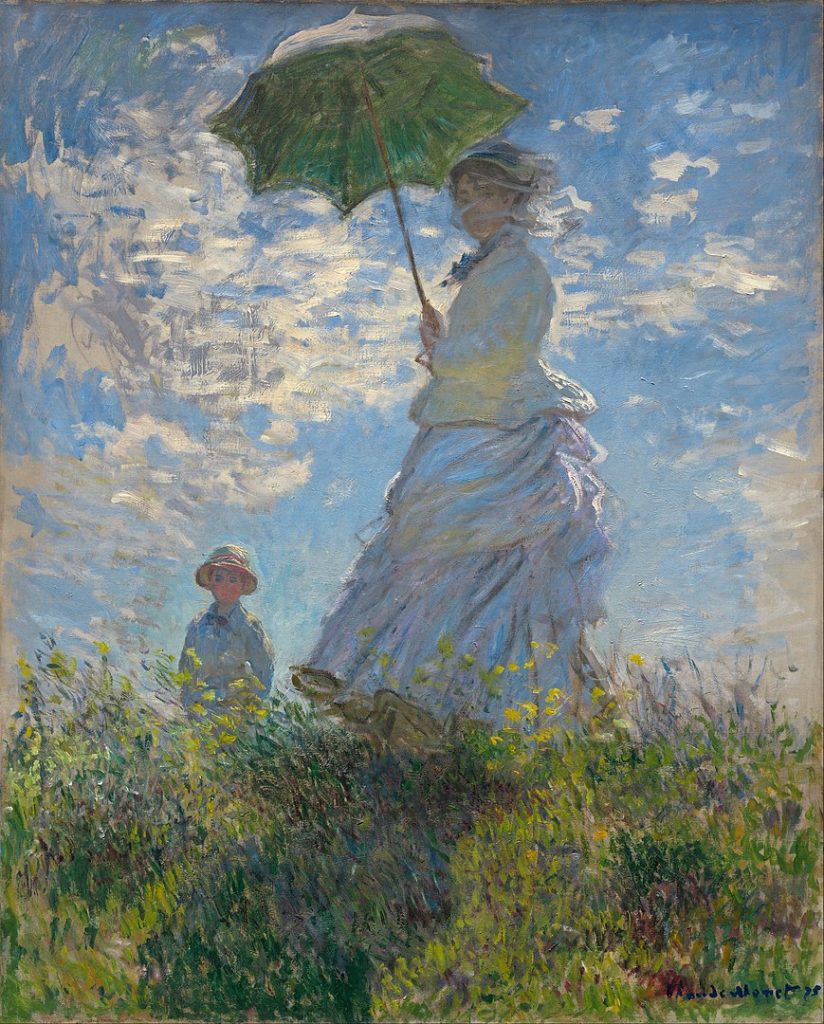
The best-known image of Camille is Woman with a Parasol – Madame Monet and Her Son, painted by Claude Monet in 1875. The work is oil on canvas, measures 100 by 81 centimeters, and is now in the National Gallery of Art in Washington, D.C. The figures are Camille and their son Jean.
Monet looks upward from a low viewpoint. Camille stands against a bright sky, holding a green parasol, while Jean appears farther back on the hill. Her dress and veil seem caught by the wind. The grass bends, the clouds move, and the entire picture gives the impression of a passing moment.
The painting is important because Camille appears not as a stiff society sitter but as someone caught outdoors in changing weather. She is recognizable, yet her identity is inseparable from sunlight, air, movement, and color. The picture also preserves a rare image of mother and son together during the family’s Argenteuil years.
Camille appeared in a very different form the following year. In 1876, Monet painted La Japonaise (Camille Monet in Japanese Costume). The oil on canvas measures 231.8 by 142.3 centimeters and is now in the Museum of Fine Arts, Boston. Camille wears a red kimono and a blond wig, surrounded by Japanese fans. The picture shows Monet returning to the challenge of a large figure composition nearly a decade after Women in the Garden.
These paintings trace Camille’s changing place in Monet’s life:
- Women in the Garden, circa 1866, shows her as a recurring model in Monet’s early ambitions.
- Camille Monet on a Garden Bench, 1873, places her in the domestic world of Argenteuil.
- Woman with a Parasol – Madame Monet and Her Son, 1875, presents Camille as both wife and mother.
Camille’s Final Years and Monet’s Last Portrait of Her
Michel’s Birth and Camille’s Illness
The family’s relative stability did not last. Claude and Camille’s second son, Michel, was born in 1878. That same year, the family left Argenteuil and moved to Vétheuil, a village on the Seine.
At Vétheuil, the Monets shared a house with Ernest Hoschedé, a former patron whose finances had collapsed, along with his wife Alice and their six children. The crowded arrangement reflected the financial strain affecting both households. Alice Hoschedé would later become Monet’s second wife in 1892, but during Camille’s lifetime the immediate problem was her worsening health.
By 1879, Camille was gravely ill with tuberculosis. Monet’s correspondence shows how serious the situation had become. On August 17, 1879, he wrote that Camille could no longer leave her bed and could not keep down food. He was also short of money and art supplies.
On August 31, Camille received the last rites. Five days later, on September 5, 1879, she died at Vétheuil. She was thirty-two years old. She was buried on September 7. Monet, who lived until 1926, survived her by forty-seven years.
Camille on Her Deathbed
Monet painted Camille after her death. Camille on Her Deathbed, painted by Claude Monet in 1879, is oil on canvas, measures 90 by 68 centimeters, and is now in the Musée d’Orsay in Paris.
The painting is one of the most intimate works of Monet’s career. Camille’s face emerges through cool tones and loose brushwork. Compared with Woman with a Parasol – Madame Monet and Her Son, the contrast is painful. In 1875, Camille stands outdoors under an open sky, with wind moving her clothes and Jean nearby. Four years later, everything is still.
There is no need to invent an elaborate explanation for why Monet painted her. The documented fact is powerful enough: after years of painting Camille as companion, wife, mother, and model, he painted her once more at the end of her life.
Camille’s place in Monet’s story is therefore much larger than the label “muse” suggests. She was with him before he became secure or famous. By 1865 she was his companion. In 1867 she became the mother of Jean. She married Monet on June 28, 1870. She helped build a family life at Argenteuil, gave birth to Michel in 1878, and died on September 5, 1879.
Monet’s career continued for decades after Camille’s death. He later settled at Giverny, married Alice Hoschedé in 1892, and produced the great series paintings that made him one of the best-known artists in the world. Yet Camille belongs to the crucial earlier chapter, when his future was uncertain and his experiments were still being tested.
Her presence in his paintings makes that chapter visible. She appears in gardens, beside her child, beneath a parasol, in fashionable dress, and finally in death. These works do not tell us every private detail of their relationship, but they preserve something more reliable than legend.
Camille was there while Monet was becoming the painter history remembers. Their life together was not a perfect romance, and the evidence should not be polished into one. It was a real relationship shaped by love, children, money problems, family conflicts, work, illness, and loss. That complexity is what makes the story worth remembering.
Key Takeaways
- Camille Doncieux was Claude Monet’s model and companion by 1865.
- Their first son, Jean Monet, was born in 1867.
- Claude and Camille married in Paris on June 28, 1870.
- Their second son, Michel, was born in 1878.
- Camille died from tuberculosis at Vétheuil on September 5, 1879.
Frequently Asked Questions
- When did Claude Monet meet Camille Doncieux? The exact circumstances are uncertain, but reliable evidence shows she was his model and companion by 1865.
- When did Claude Monet marry Camille? They married in Paris on June 28, 1870.
- How many children did Claude and Camille Monet have? They had two sons, Jean and Michel.
- Is Camille the woman in Woman with a Parasol? Yes. The 1875 painting shows Camille Monet with their son Jean.
- How old was Camille when she died? She was thirty-two when she died on September 5, 1879.