Stand before a Pictish stone in the Scottish landscape and something curious happens. You recognize animals, weapons, riders, crosses and familiar geometric shapes, yet the stone refuses to give up its whole story. A crescent is crossed by a mysterious V-shaped rod. A strange beast arches across the rock. A mirror appears beside symbols whose meanings disappeared more than a thousand years ago. Pictish art has this remarkable combination of familiarity and mystery, making it one of the most distinctive artistic traditions of early medieval Europe.
The Picts left around 300 carved stones across Scotland. Some carry relatively simple incised symbols. Others are magnificent sculptural monuments covered with crosses, interlace, animals and scenes of hunting or combat. Together, they provide a visual record of a society that left far fewer written sources than we might wish. The stones cannot answer every question about the Picts, but they tell us something important: these were skilled artists working within a sophisticated visual culture.
Pictish art also records a society in transition. Older symbols continued to appear as Christianity spread through Pictish territories. Instead of simply abandoning one artistic language for another, sculptors sometimes placed the Christian cross beside symbols that had been used for generations. The result is an art in which continuity and change can occupy the same piece of stone.
To understand the Picts, then, we need to look closely. Their carvings are not merely strange relics decorating the Scottish countryside. They are among the finest surviving achievements of early medieval Scotland.
Who Were the Picts?
The Picts were peoples who inhabited large areas of northern and eastern Scotland during the early medieval period. Their roots lay among the Iron Age populations of northern Britain. By the early medieval centuries, Pictish kingdoms had become important political powers north of the Forth. They were not an exotic population suddenly appearing from nowhere, despite the mysterious reputation later attached to them.
The name by which we know them comes from outside their society. Roman writers used Picti when referring to peoples in northern Britain. Later sources tell us something about Pictish rulers, warfare and relations with neighboring kingdoms, but the written evidence remains limited. Archaeology therefore carries an unusual amount of weight when reconstructing their world. Carved stones are among the most visible parts of that evidence.
Nor did the Picts simply disappear one morning, leaving everyone to wonder where they had gone. During the ninth and following centuries, political and cultural changes reshaped northern Britain. Gaelic language and identity became increasingly important in the kingdom of Alba, which formed part of the foundation of medieval Scotland. Pictish identity was transformed within that changing society rather than erased in a single dramatic event.
This matters when looking at Pictish art. The stones belong to a living society that changed over centuries. Their artists responded to political authority, religious conversion and contacts with neighboring cultures. What survives is therefore not one frozen “Pictish style,” but an artistic tradition capable of development and adaptation.
Pictish Symbol Stones: An Art We Still Cannot Fully Read
The most famous feature of Pictish art is its extraordinary vocabulary of symbols. Among the recurring designs are the crescent and V-rod, double-disc and Z-rod, serpent, mirror, comb and several animals. Perhaps the most intriguing is the so-called Pictish beast. Its curved body and elongated features have inspired generations of attempts to decide exactly what creature it represents.
Earlier examples were often created by cutting outlines into the surface of an upright stone. The resulting designs can appear deceptively simple. Look more carefully, however, and there is precision in their curves, proportions and positioning. The same recognizable motifs occur at different sites, which tells us that they belonged to an established visual language rather than being casual decorations invented by individual stone carvers.
The Picardy Stone in Aberdeenshire provides an excellent example. Dating to around AD 600, the roughly two-metre-high monument carries a double-disc and Z-rod, a tightly coiled serpent and Z-rod, and a mirror. It is especially valuable because it appears to remain where it was originally erected. Nineteenth-century excavation also suggested an association with a cairn and nearby burial, although the poor quality of those early records means that connection cannot be treated as certain.
What did the symbols mean? That remains the great unanswered question. Scholars have considered connections with personal identity, family relationships, status and political authority, but no complete Pictish dictionary has survived to settle the matter. It is safest to regard the symbols as meaningful signs whose precise messages are largely lost. Their repeated and carefully controlled appearance makes pure decoration unlikely, but certainty ends there.
That uncertainty is part of their fascination. Imagine recognizing every road sign in shape but having forgotten what any of them means. Something similar confronts us with the Pictish stones. We can identify the visual system without being able to translate it.
From Ancient Symbols to the Christian Cross
One of the greatest developments in Pictish art came with Christianity. From around the eighth century, magnificent cross-slabs became prominent within the sculptural tradition. On these monuments, a large Christian cross could dominate one face. Yet older Pictish symbols did not necessarily disappear.
The Dyce stones in Aberdeenshire demonstrate the change particularly well. The earlier stone, probably dating from around AD 600, carries a beast above a double-disc and Z-rod. A later cross-slab, probably made sometime after AD 700, presents a large cross filled with interlace. Around it appear traditional Pictish symbols, including a crescent and V-rod, mirror case, and double-disc and Z-rod. Two artistic languages have been brought together on the same Christian monument.
Aberlemno in Angus provides still more spectacular evidence. Four Pictish carved stones survive there, ranging from symbol stones to elaborate Christian cross-slabs. Aberlemno I appears to reuse a prehistoric standing stone and bears a serpent, double-disc and Z-rod, and mirror and comb. Reusing an already ancient stone gave a new visual message to a monument that had stood in the landscape long before the Picts carved it.
Aberlemno III belongs to a different artistic world. Its imagery includes a monumental cross accompanied by angels, traditional Pictish symbols, a hunting scene and a representation of the biblical David fighting a lion. The combination is important. Christianity did not require Pictish artists to forget everything their predecessors had carved. Instead, familiar symbols could survive within a new religious setting.
This makes the cross-slabs more interesting than a simple story of one culture replacing another. Conversion could be expressed through adaptation. A Pictish viewer might encounter a monument that was unmistakably Christian while also recognizing symbols rooted in local tradition. The cross was new in its religious dominance, but the artistic memory surrounding it remained Pictish.
Animals, Warriors and the Pictish Eye for Life
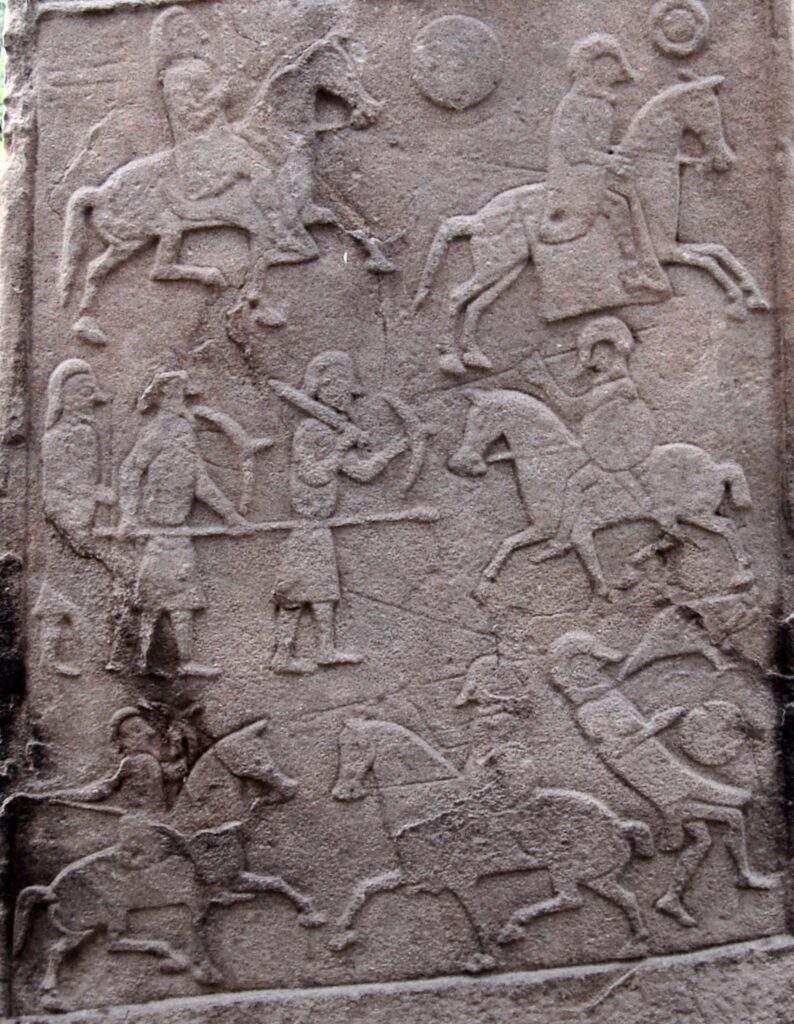
Symbols are only part of the story. Pictish sculpture contains an astonishing population of animals and human figures. Horses carry riders. Hunters pursue animals. Warriors carry weapons. Real creatures share stone surfaces with beasts that seem to belong to a more imaginative world.
These scenes are especially valuable because artists sometimes recorded details of contemporary life. The remarkable collection from St Vigeans in Angus includes evidence for clothing, riding equipment and hunting weapons. Thirty-eight Pictish stones from the village are now gathered there. Their number and quality indicate that St Vigeans was an important Pictish religious center.
Yet we should be careful about treating these carvings like medieval photographs. An artist showing a mounted figure might have been communicating status or authority rather than documenting an ordinary afternoon ride. Hunting itself carried elite associations in medieval societies. The animals and riders therefore belong to a world of meaning as well as observation.
That is precisely what gives Pictish sculpture its vitality. Its artists could move between recognizable life and abstract design with remarkable confidence. A horse and rider might occupy one part of a monument while interlace twists across another. Symbols appear beside biblical imagery. Order is imposed on this variety through carefully structured compositions.
The Skill of Pictish Sculptors
Calling Pictish carvings “primitive” would badly misrepresent them. Their makers worked stone with considerable skill. Earlier monuments could use controlled incised lines, while later sculpture employed relief carving and complex ornamental schemes. Crosses were filled with dense interlace, and surfaces were divided into carefully organized areas containing figures, animals and geometric designs.
Interlace is especially demanding. Bands appear to weave above and below one another, producing patterns that can seem almost endless. Knotwork, key-pattern and other geometric ornament required planning as well as technical control. One mistake could disturb the rhythm of an entire design. Stone is not famous for offering an undo button.
The carvings at St Vigeans demonstrate how accomplished these craftsmen became. Historic Environment Scotland regards some of the sculpture there as comparable in quality with contemporary carving elsewhere in Western Europe. The early ninth-century Drosten Stone is particularly notable. It carries an intricate cross on one side and figures and symbols on the other, together with a rare inscription.
Pictish art should therefore be understood within the larger artistic world of early medieval Britain and Ireland. Its sculptors participated in traditions that valued crosses, interlace, animals and elaborate surface decoration. Yet their recurring symbolic vocabulary remained distinctive. The result is art that belongs to its broader age while still being unmistakably Pictish.
The finest works reward close viewing because decoration rarely feels random. Patterns guide the eye. Figures occupy deliberate spaces. Symbols are positioned in relationships that probably mattered greatly to their original audience. Even where meaning escapes us, artistic control does not.
Ogham, Symbols and the Question of Pictish Literacy
The popular picture of the Picts as a people without writing also needs qualification. More than 30 ogham inscriptions have been found in areas occupied by the Picts, dating broadly between AD 500 and 1000. Ogham uses groups of strokes arranged along or across a line. It originated in Ireland and was adopted in Pictish contexts.
Brandsbutt Stone near Inverurie combines this writing with familiar Pictish imagery. The roughly one-metre-high stone carries a crescent and V-rod above a serpent and Z-rod, along with an ogham inscription. The inscription has been interpreted as a personal name, although its precise interpretation is uncertain. The important point is that image and writing appear together.
The later cross-slab at Dyce also carries ogham. Its long inscription has resisted secure interpretation, although part may contain a personal name. That uncertainty should warn against neat modern translations. We know enough to recognize writing, but not enough to understand every message.
These stones reveal a culture capable of combining three different ways of communicating: recognizable images, conventional Pictish symbols and written characters. To their original viewers, these elements may have reinforced one another. To us, the frustrating irony is that the stone survives while much of its message does not.
Why Pictish Art Still Matters
Pictish art matters because it brings us unusually close to a society whose own written voice is difficult to recover. A carved stone is not a history book, but it is a deliberate human creation. Someone selected the stone. Someone decided what should appear upon it. Skilled hands then turned those choices into a monument intended to be seen.
The surviving works also challenge old assumptions about cultural isolation. Pictish sculptors were capable of producing work of exceptional quality. Their Christian monuments place them firmly within the artistic world of early medieval Europe, while their distinctive symbols preserve a strong local identity. That combination makes Pictish art particularly compelling.
There is another reason the stones continue to fascinate us. Their mystery is genuine. We do not have to manufacture secret codes or romantic legends to make them interesting. The real historical problem is better: scholars can recognize a sophisticated symbolic system while admitting that its complete meaning remains unknown. Good history sometimes requires the confidence to say, “We do not know.”
Perhaps that is the best way to approach these monuments today. Look first at what actually survives: the confident curves, carefully ordered symbols, energetic animals, riders, interlace and monumental crosses. Then consider what has been lost. Between those two things lies the enduring power of Pictish art—a visual language that can still command our attention more than a thousand years after we forgot how to read it.
Key Takeaways
- Pictish art is a major source of evidence for Pictish society. Around 300 carved stones survive, giving us an exceptional visual record of early medieval Scotland.
- The famous Pictish symbols remain only partly understood. Crescents, V-rods, Z-rods, mirrors, animals and other motifs clearly carried meaning, but there is no secure translation system.
- Christianity transformed rather than immediately erased Pictish artistic traditions. Cross-slabs could combine Christian imagery with symbols rooted in an older visual vocabulary.
- Pictish sculptors were highly accomplished craftspeople. Their best relief carving, interlace, figurative work and monumental compositions compare impressively with contemporary early medieval sculpture elsewhere.
- The mystery should not overshadow the achievement. Even when we cannot decipher a symbol, we can recognize the planning, craftsmanship and visual intelligence behind it.
FAQs
- Who were the Picts?
The Picts were peoples of northern and eastern Scotland who became prominent during the early medieval period. Their society developed from earlier Iron Age populations and eventually became part of the political and cultural transformations associated with the emergence of Alba. - What do Pictish symbols mean?
Their precise meanings remain uncertain. Suggestions have included names, family or lineage identities, status and political affiliations, but no interpretation explains the entire symbolic system with certainty. - Why did the Picts carve standing stones?
There was probably no single purpose. Some appear to have served commemorative or funerary functions, while Christian examples could function as grave markers, grave covers or aids to worship. The purpose of many early symbol stones remains uncertain. - Was Pictish art Christian?
Some was, especially the elaborate cross-slabs produced after Christianity became established in Pictish territories. Earlier symbol stones do not display the same overt Christian imagery. Later sculptors often combined the cross with traditional Pictish symbols. - Where can Pictish art be seen today?
Important groups survive at sites and museums across Scotland, including St Vigeans, Aberlemno, Meigle, Inverurie and Dyce. The National Museum of Scotland also preserves important examples of Pictish sculpture and metalwork.