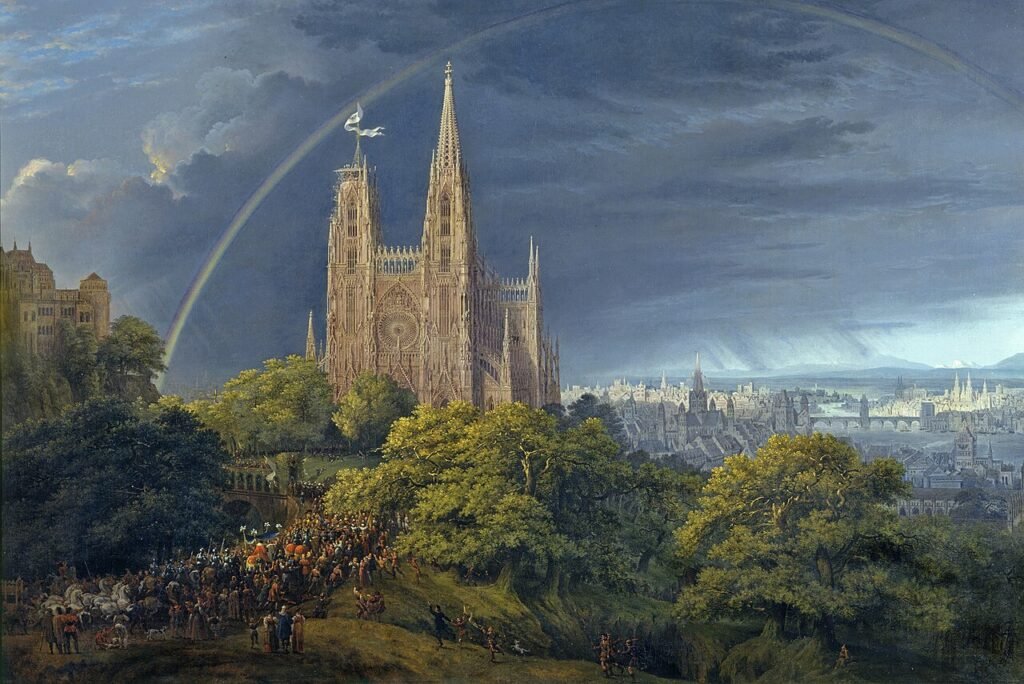
A Gothic cathedral catches the light while a storm retreats across a darkened sky. Below it, a ruler and his entourage approach a castle, a river winds through the countryside, and a medieval city stretches toward the horizon. Then there is the rainbow. It sweeps across Karl Friedrich Schinkel’s Medieval City on a River like a bridge between the storm and the brighter world emerging beneath it. Painted in 1815, when Europe was reaching the end of the Napoleonic Wars, the scene is far more than an attractive medieval fantasy.
Schinkel painted Medieval City on a River in oil on canvas. The work measures 95 × 140.6 centimeters and is now in the Alte Nationalgalerie, Staatliche Museen zu Berlin. Its German title is Mittelalterliche Stadt an einem Fluß. Schinkel did not depict an actual town. Instead, he assembled architecture, landscape, ceremony, and weather into an imagined city whose Gothic cathedral recalls several real medieval monuments, above all the unfinished Cologne Cathedral.
That combination tells us much about Schinkel. He was an architect who painted, a painter who thought architecturally, and a stage designer with a gift for dramatic light. In Medieval City on a River, all three talents meet. The result is one of his most compelling visions of architecture as part of history rather than merely a collection of stones.
Karl Friedrich Schinkel and the Road to 1815
From Architectural Student to Painter
Karl Friedrich Schinkel was born in Neuruppin on March 13, 1781. After his family moved to Berlin in 1794, he encountered the architectural world that would determine his career. An especially important early figure was Friedrich Gilly, the gifted young architect whose designs made a deep impression on Schinkel. He studied within the circle of Friedrich and his father, David Gilly, and entered Berlin’s Bauakademie in 1799. Friedrich Gilly died unexpectedly in 1800, but his influence remained important to Schinkel’s development.
Travel provided another education. Schinkel left for Italy in May 1803 and reached Rome that September. He later traveled to Naples and Sicily before returning north through cities including Florence, Genoa, Milan, Paris, Strasbourg, and Frankfurt. He arrived back in Berlin in February 1805. Buildings encountered during these journeys were not simply objects for him to copy. Schinkel studied how architecture occupied landscapes and how monuments, streets, terrain, and distant views worked together.
His architectural ambitions soon met harsh political reality. Prussia suffered disastrous defeats against Napoleon at Jena and Auerstedt in October 1806. Large architectural commissions became difficult to obtain. Schinkel consequently relied more heavily on painting and visual entertainment. His work included panoramas and perspective pictures designed to give spectators the illusion of entering distant landscapes.
That experience matters when looking at Medieval City on a River. Schinkel learned how to guide an eye through enormous imagined spaces. He understood perspective, changing light, theatrical revelation, and the dramatic potential of architecture. In 1815 he also began working intensively for the theater. His designs made around that time for Wolfgang Amadeus Mozart’s The Magic Flute were used when the Berlin production opened on January 18, 1816. Schinkel designed all twelve settings. Painting, architecture, and theatrical illusion had become closely connected parts of his creative world.
Prussia and the Importance of 1815
The date of Medieval City on a River is essential. Prussia had joined the struggle against Napoleon during the Wars of Liberation of 1813–1815. Napoleon abdicated in April 1814 but returned to power in France in March 1815. His final defeat came at Waterloo on June 18, 1815. Schinkel therefore painted at a moment when years of war and foreign domination were ending and Europe faced the difficult task of reconstruction.
The Staatliche Museen zu Berlin connects the picture directly with this atmosphere. Its interpretation identifies the ruler entering the castle as an allegorical reference to the victorious return of Friedrich Wilhelm III. The setting deliberately belongs to another age, however. Schinkel transformed recent events into an idealized medieval vision instead of recording a contemporary royal procession.
A few dates place the picture in perspective:
- 1781: Schinkel is born in Neuruppin on March 13.
- 1799: He enters Berlin’s Bauakademie.
- 1803–1805: He undertakes his formative journey to Italy and returns through France.
- 1813–1815: Prussia fights in the Wars of Liberation.
- 1815: Schinkel paints Medieval City on a River.
- 1816: His celebrated scenery for The Magic Flute appears on the Berlin stage on January 18.
The painting thus belongs to a turning point. The old political order had been shaken, Napoleon had been defeated, and reconstruction lay ahead. Schinkel answered that moment with an image centered not on battle but on building.
Inside Medieval City on a River
Cathedral, City, River, and Sky
The cathedral commands the composition. It rises from wooded high ground, towering over houses, trees, and human figures. Schinkel illuminates its western façade against blue-gray storm clouds, making the stone architecture seem almost to emerge from the weather itself. At the left stands a castle. To the right lies the city, while the river and surrounding countryside carry the eye deep into the landscape.
Look closer and perfection gives way to incompletion. One cathedral tower remains unfinished and surrounded by scaffolding. A white flag bearing the imperial eagle flies from the structure. This is not a picturesque ruin being surrendered to nature. It is a building site. Work remains to be done.
That detail transforms the mood. The cathedral belongs to the medieval world, but its incomplete state makes it point toward the future. Schinkel presents architecture as something inherited and continued across generations. The people below live beneath a monument whose final form has yet to be achieved.
Weather reinforces the idea of change. The storm appears to be moving away, while sunlight illuminates the cathedral. A rainbow extends from the vicinity of the palace across the cathedral toward the town. Whatever further meanings a viewer finds in it, its compositional purpose is clear. The rainbow visually connects the principal elements of Schinkel’s invented world.
An Imaginary City Built from Real Architecture
The city looks convincing enough to tempt viewers into searching for it on a map. They will not find it. Schinkel constructed an ideal medieval city rather than making a topographical portrait of one particular place.
The cathedral nevertheless contains recognizable architectural memories. The Alte Nationalgalerie notes similarities with the cathedrals of Strasbourg and Reims, while emphasizing its connection with Cologne Cathedral. The Cologne comparison is particularly important because that cathedral was still famously unfinished in Schinkel’s lifetime. Construction had begun in 1248, but the medieval building campaign eventually ceased. Its incomplete state gave Schinkel a real historical precedent for the building rising in his imaginary city.
His training helps explain why the fantasy feels so believable. Schinkel understood architecture from the inside out. He knew how buildings relate to terrain, how a monumental façade establishes scale, and how roads and approaches influence the experience of a structure. The city is invented, but it obeys an architect’s visual logic.
The river matters too. It creates distance, opens the landscape, and prevents the cathedral from overwhelming every other element. Castle, church, town, forest, water, and hills become parts of one ordered environment. Schinkel is not merely painting a large church with attractive scenery around it. He is designing an entire world for that church to inhabit.
The Prince’s Ceremonial Arrival
Small human figures provide the narrative. At the left, a prince enters the castle with his entourage. Their scale emphasizes the tremendous size of the cathedral, but their presence also turns the landscape into a public event.
The museum interprets this ceremonial arrival as an allegorical reference to King Friedrich Wilhelm III returning after the Wars of Liberation. Schinkel does not identify the imaginary city as Berlin, Cologne, or another actual place. Nor does he turn the king into the central figure of a conventional portrait. The event is translated into the language of an earlier age.
This distance from everyday reality gives the scene greater breadth. The ruler, cathedral, city, and citizens become connected parts of the same vision. Political authority appears beside religious architecture and civic life, while the unfinished cathedral introduces the idea of a task extending beyond a single individual.
Schinkel had already spent years creating large-scale illusions and would soon become celebrated for theatrical scenery. That background is easy to recognize here. He stages the prince’s arrival rather than simply recording it. Architecture supplies the scenery, weather supplies the drama, and the procession supplies the action.
What Schinkel’s Medieval City May Have Meant
The Unfinished Cathedral and Renewal
The scaffolding may be the most important detail in the painting. A completed cathedral could represent a glorious inheritance. An unfinished cathedral does something different. It makes inheritance a responsibility.
The Staatliche Museen zu Berlin interprets the unfinished cathedral as part of the painting’s allegory of Prussia after the Wars of Liberation. The country had survived a period of defeat and foreign domination and emerged victorious in 1815. Yet victory did not mean that every task was complete. Schinkel’s cathedral offered a striking visual parallel: a magnificent structure already existed, but another generation was required to finish it.
The Gothic setting also reflects the renewed interest in medieval architecture during Schinkel’s period. Medieval cathedrals could be admired not simply as remnants of a remote age but as evidence of extraordinary craftsmanship, religious conviction, civic ambition, and long-term effort. The unfinished Cologne Cathedral was especially powerful because past and present literally met in its incomplete fabric.
Schinkel avoids making the idea simplistic. Storm clouds remain in the sky. The cathedral remains unfinished. The ruler has only just arrived. The scene captures a moment of possibility rather than a completed triumph. That gives Medieval City on a River much of its enduring tension.
Gothic Architecture, Order, and Light
The cathedral dominates without standing alone. Below it are homes, civic spaces, a castle, roads, people, and cultivated land. Schinkel imagines architecture as the framework of a community.
This concern would become even clearer in his later architectural career. Between 1823 and 1830, he designed the building now known as Berlin’s Altes Museum. Its foundation stone was laid on July 9, 1825, and it opened on August 3, 1830. The building became the first public museum in Berlin and Prussia. Schinkel’s architecture repeatedly addressed the relationship between monumental buildings and public urban space.
Medieval City on a River shows that concern in imaginary form fifteen years earlier. The cathedral is visually supreme, yet it needs the town around it. The town, in turn, receives much of its identity from the monument above.
Light completes the arrangement. Schinkel lets illumination fall where it matters most. The cathedral appears against the darker storm rather than a blank blue sky. The contrast makes architecture the emotional focus without requiring exaggerated action from the human figures below. Stone becomes drama.
Why Medieval City on a River Still Matters
The Lost Companion: Greek City by the Sea
Schinkel did not originally conceive the medieval city entirely in isolation. In 1815 he also painted Greek City by the Sea, intended as its companion. The Staatliche Museen zu Berlin records that painting as a wartime loss. Its present absence makes the surviving Medieval City on a River even more important.
The pairing changes how the medieval picture should be understood. Schinkel was not simply arguing that Gothic culture should replace the classical tradition. The museum interprets the two works as complementary ideals. The medieval city stood beside an imagined Greek city, bringing two great architectural traditions into conversation.
That balance was characteristic of Schinkel’s larger career. He could admire Gothic architecture while becoming one of the outstanding architects of Neoclassicism. His Altes Museum, built from 1823 to 1830, uses a monumental screen of eighteen Ionic columns and a rotunda explicitly referring to Rome’s Pantheon. Schinkel did not need to choose between Greece, Rome, and the Middle Ages. He studied each for different architectural possibilities.
The lost companion therefore guards against an overly narrow interpretation. Medieval City on a River certainly reflects the historical concerns of 1815, but it also belongs to Schinkel’s larger investigation of what civilizations build, what they inherit, and what architecture can say about the ideals of a community.
Painter, Architect, and Builder of Worlds
Schinkel died in Berlin on October 9, 1841, aged sixty. By then his reputation rested heavily on architecture. Yet the approximately 5,500 drawings, watercolors, sketchbooks, and prints preserved in his artistic estate at Berlin’s Kupferstichkabinett demonstrate the extraordinary range of his visual thinking.
Medieval City on a River reveals why separating the painter from the architect can be misleading. Its buildings have structural authority because an architect imagined them. Its landscape has atmosphere because Schinkel could think like a painter. Its light and procession have dramatic force because he understood theatrical staging.
Five details are especially worth watching for:
- The unfinished cathedral tower and scaffolding, which make construction central to the picture.
- The white flag with the imperial eagle flying from the cathedral.
- The prince and his procession approaching the castle at the left.
- The rainbow crossing the dark sky, joining palace, cathedral, and city.
- The carefully arranged relationship between river, town, castle, landscape, and cathedral.
More than two centuries after 1815, those elements still make the painting feel strangely alive. Schinkel did not give viewers a comfortable medieval world sealed safely in the past. He gave them a city under construction beneath a changing sky.
That may be the most memorable quality of Medieval City on a River. The storm has not quite disappeared. The cathedral has not quite been finished. The ruler has not quite completed his arrival. Everything is caught between what has happened and what might happen next. Schinkel transformed architecture into a picture of historical time—and made an imaginary medieval city feel as though its future were just beginning.