The Great Sphinx of Giza has spent part of its extraordinary life disappearing. Desert sand repeatedly swallowed its paws and climbed its enormous limestone body, leaving later generations to uncover a monument already ancient beyond memory. Kings restored it. Worshippers regarded it as a god. Archaeologists dug around it. Arguments still rage over its age, its strangely small head, its missing nose, and whether the face we see today replaced an earlier image. After roughly 4,500 years—or perhaps longer, according to a disputed alternative theory—the Sphinx still refuses to surrender every answer.
The accepted archaeological case places the monument in Egypt’s Fourth Dynasty and connects it closely with Pharaoh Khafre, who ruled about 2520–2494 BC according to the chronology used by Ancient Egypt Research Associates. Yet there is no surviving Old Kingdom inscription explicitly stating that Khafre commissioned the Sphinx. That small but important gap has left room for debate. Some researchers have proposed other Fourth Dynasty kings. Others have argued for a far earlier date.
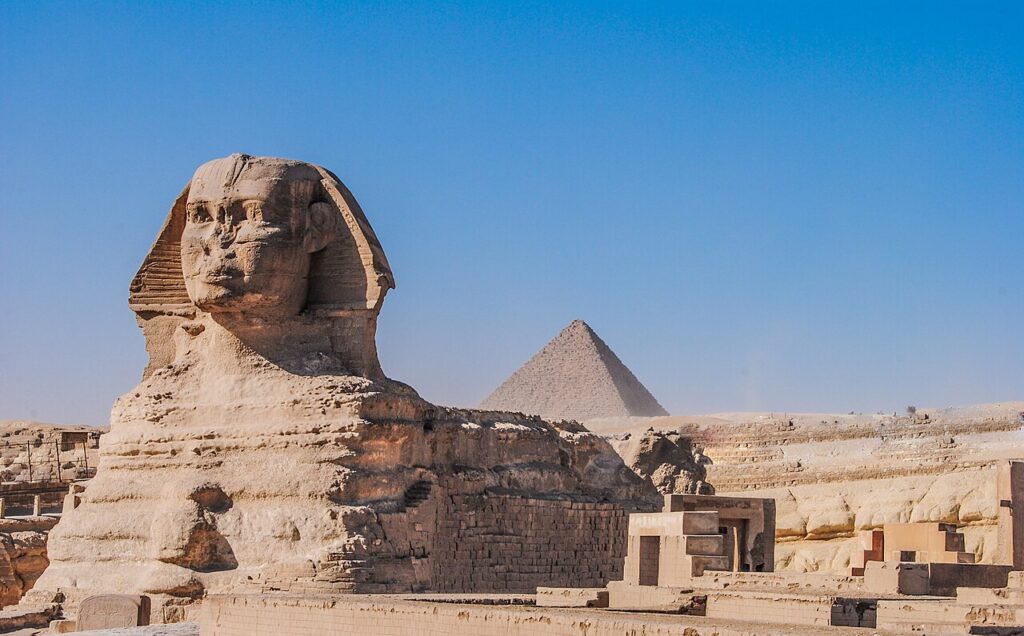
What is certain is impressive enough. The Great Sphinx was carved largely from the natural limestone of the Giza Plateau. Workers excavated a vast ditch around a reserved mass of bedrock, then shaped that rock into a recumbent lion with a royal human head. Blocks quarried from around it were used in neighboring monumental buildings. The Sphinx was therefore not simply placed at Giza. In a very literal sense, it emerged from Giza itself.
Who Built the Great Sphinx—and Why?
The Evidence Connecting the Sphinx to Khafre
Khafre remains the strongest candidate for the Sphinx’s owner because the monument is physically integrated with his pyramid complex. His pyramid, pyramid temple, causeway, Valley Temple, Sphinx Temple, and the Sphinx occupy a connected architectural landscape. Archaeological sequencing indicates that the Sphinx and its temple were among the last major elements added to Khafre’s program.
The stone provides particularly strong evidence. Between 1979 and 1983, Egyptologist Mark Lehner mapped the Sphinx, Sphinx Temple, and nearby Valley Temple stone by stone. Working with geologist Thomas Aigner from 1980, he compared geological layers in the Sphinx quarry with the enormous limestone blocks used in the temples. Some temple blocks preserve several geological layers and can be matched with strata running through the Sphinx enclosure. The evidence indicates that quarrymen cutting around the Sphinx supplied stone for the neighboring temples.
Several clues reinforce the Khafre connection:
- The Sphinx occupies the landscape of Khafre’s pyramid complex.
- Blocks in the Sphinx Temple match limestone layers in the Sphinx quarry.
- Khafre’s causeway appears earlier in the construction sequence than the Sphinx ditch.
- The Sphinx Temple and Khafre Valley Temple occupy the same prepared terrace.
- Work on both the Sphinx quarry and Sphinx Temple appears to have stopped before completion.
That last point is intriguing. Quarrymen left parts of the Sphinx enclosure unfinished, while enormous blocks apparently intended for the Sphinx Temple were abandoned. The temple never received all its intended granite casing. Rather than being the beginning of Khafre’s building program, the Sphinx may have been one of its final spectacular projects.
A King in the Body of a Lion
The Sphinx combines a royal human head with the immense body of a lion. The head wears the royal nemes headcloth, while the lion supplied an unmistakable image of physical power. Although the damaged face has often been compared with known images of Khafre, portrait resemblance is not the strongest evidence for attribution. Ancient Egyptian royal sculpture followed conventions, and thousands of years of damage make facial comparison particularly uncertain.
The name “Sphinx” can also create confusion. The famous Greek sphinx was normally female and winged. The Egyptian royal sphinx was different and considerably older. By the time Greek artists were depicting winged sphinxes during the first millennium BC, the giant monument at Giza had already stood for well over a thousand years.
The Sphinx also belonged to a carefully transformed landscape. Khafre’s causeway ran between his pyramid complex and valley structures, while the giant lion faced east. Temples, quarry cuts, massive walls, and ceremonial spaces surrounded it. Modern photographs can make the Sphinx look like a solitary guardian in an empty desert. Archaeology reveals something much more complicated: a colossal sculpture embedded in one of ancient Egypt’s greatest royal construction projects.
Yet Khafre is not proven beyond every doubt. Khufu, builder of the Great Pyramid, and Djedefre have also been proposed. AERA describes connections between Khufu and lion symbolism as intriguing but tenuous. Its archaeological conclusion is more cautious and more useful: the evidence links the Sphinx to Khafre with a high degree of probability, even though absolute proof is lacking.
How the Sphinx Disappeared Beneath the Desert
Sand, Thutmose IV, and a Royal Dream
More than a thousand years after the Fourth Dynasty, the Sphinx was already an ancient wonder. Sand had accumulated around its body. During the Eighteenth Dynasty, Prince Thutmose—later Pharaoh Thutmose IV—became associated with one of the most famous episodes in its history.
The story survives on the Dream Stele erected between the Sphinx’s paws. It recounts that the prince rested in the Sphinx’s shadow and fell asleep. The Sphinx appeared to him in a dream, promising kingship and asking to be freed from the sand. After becoming pharaoh, Thutmose IV cleared and repaired the monument. The dream is a royal account rather than independently verifiable supernatural history, but the restoration itself belongs securely to the Sphinx’s New Kingdom story.
By then, its identity had changed. The monument was revered as Hor-em-akhet, meaning “Horus in the Horizon.” What had originated in an Old Kingdom royal landscape had become a divine image in its own right. That transformation tells us something remarkable about Egyptian attitudes toward their past. Thutmose IV was restoring a monument roughly eleven centuries older than himself.
The Sphinx’s Lost Beard
One fragment makes this later transformation tangible. The British Museum preserves part of the Sphinx’s limestone beard, acquired from excavator Giovanni Battista Caviglia in 1818. The surviving piece measures 78.7 centimeters high, 51.5 centimeters wide, and 38 centimeters deep.
Crucially, the museum dates it to the Eighteenth Dynasty, not Khafre’s Fourth Dynasty. Its plaited form ends in the curved tip associated with a divine beard. The British Museum considers it likely to belong to Thutmose IV’s restoration, when the Sphinx was worshipped as Hor-em-akhet. A beard belonging to the original royal representation of Khafre would instead have been straight.
This means the familiar image of the Sphinx was not necessarily fixed forever when its first sculptors finished work. Ancient Egyptians themselves altered and restored it. The beard eventually broke away, and fragments were recovered between the forepaws during nineteenth-century excavation. The Sphinx is not one untouched Fourth Dynasty sculpture. It carries physical traces of several periods of Egyptian history.
Sand also repeatedly returned. The enclosure’s position below the surrounding plateau made it a natural trap for windblown deposits. The head remained exposed while lower portions disappeared. Clearance and restoration consequently became recurring parts of the monument’s history.
Excavation Revealed the Sphinx’s Forgotten Life
Digging a Colossus Out of the Sand
Modern exploration transformed the Sphinx again. Giovanni Battista Caviglia conducted important clearance around it in 1817 and 1818. His work exposed areas between the forepaws and recovered fragments associated with the beard. Several decades later, Auguste Mariette excavated Khafre’s Valley Temple in 1853 and again in 1858, revealing more of the architectural setting surrounding the Sphinx.
Photography arrived at precisely the right moment to record this transformation. John Beasley Greene, born in 1832, traveled through Egypt as a remarkably young photographer and archaeologist. In 1853, only fourteen years after photography was publicly introduced in 1839, he photographed excavation near the Sphinx. Greene died in Cairo in 1856, leaving an extraordinary body of work from a career cut short in his twenties.
His [Excavations near the Sphinx], dated 1853, is preserved by The Metropolitan Museum of Art in New York. It is a salted paper print from a paper negative, measuring 22.3 × 30.2 centimeters (8 3/4 × 11 7/8 inches). Rather than presenting Giza as a timeless desert fantasy, Greene recorded archaeology in progress: ancient architecture physically reappearing from beneath accumulated sand.
From Buried Monument to World Icon
Only five years later, Francis Frith created another important view. His The Great Pyramid and The Great Sphinx, dated 1858, is also held by The Metropolitan Museum of Art. It is an albumen silver print from a glass negative, with an image measuring 38.7 × 49.4 centimeters (15 1/4 × 19 7/16 inches).
Such photographs preserve something modern visitors can easily forget. The appearance of the Sphinx has changed dramatically even in recent centuries. Excavation exposed features that earlier travelers could barely see. Archaeologists mapped the surrounding temples and quarry. Conservation exposed another problem: once ancient limestone is uncovered, it must survive wind, moisture, salts, temperature changes, and continuing erosion.
The American Research Center in Egypt’s Sphinx Project, conducted from 1979 to 1983, produced exceptionally detailed documentation. The project created photogrammetric elevations, plans, geological maps, and close records of ancient masonry repairs. Its archive contains about 5,000 slides and 2,716 black-and-white photographs. These records allowed researchers to distinguish natural bedrock from layers of repair added during the Sphinx’s long history.
That work also helped establish a basic truth about the monument. The Sphinx is not simply a statue. It is an archaeological site containing evidence of quarrying, unfinished construction, ancient restoration, changing religious meaning, burial by sand, excavation, and modern conservation.
What Are the Real Secrets of the Great Sphinx?
Is the Sphinx Much Older Than Khafre?
The most controversial question concerns age. Geologist Robert M. Schoch argued publicly in the early 1990s that weathering around the Sphinx enclosure was consistent with substantial rainfall and that the monument’s origins could therefore be considerably older than the conventional Fourth Dynasty date. Geologist Colin Reader later published a geomorphological study proposing an earlier development of the Giza site, though his chronology and argument should not simply be treated as identical to Schoch’s.
The broader claim attracts attention because Egypt experienced wetter climatic conditions in remote prehistory. If major erosion on the Sphinx enclosure required rainfall substantially heavier than conditions during Khafre’s reign, an older date could follow. That is the heart of the geological argument. It is not simply the claim that the monument “looks old.”
The archaeological counterargument is formidable. Blocks removed from the Sphinx quarry are geologically tied to the Sphinx Temple, while architectural sequencing connects that temple with Khafre’s Valley Temple and causeway. The Sphinx ditch also appears to have been cut after Khafre’s causeway was already present. AERA therefore concludes with a high degree of probability that the Sphinx belongs late in Khafre’s building program.
No accepted archaeological evidence currently establishes a Sphinx thousands of years older than dynastic Egypt. At the same time, it is fair to explain why the debate arose. Archaeology works best when uncertainty is stated rather than hidden. Khafre remains the best-supported attribution; the much earlier chronology remains disputed.
Was the Sphinx’s Head Recarved?
Then there is the head. To almost anyone who studies a side view, it appears strikingly small compared with the enormous lion body. That disproportion has encouraged a fascinating proposal: perhaps the present royal head was carved down from an earlier, larger head, sometimes imagined as that of a lion.
The possibility is appealing because recarving would naturally reduce the volume of stone. It could therefore help explain why the finished head is comparatively small. But there is an important dividing line between possibility and proof. No surviving inscription states that an earlier lion-headed Sphinx was recarved into a pharaoh. Nor has archaeology established an original lion head beneath the existing sculpture.
The geology supplies another possible part of the explanation. The Sphinx was carved through different limestone strata rather than from one uniform block. The head occupies harder Member III limestone, while much of the body was cut through more vulnerable Member II layers. Mark Lehner and Thomas Aigner’s geological work demonstrates that the quarrying sequence itself was strongly influenced by those natural beds. The sculptors had to work with the rock nature provided.
There are therefore several genuine Sphinx mysteries, but their evidential strength varies:
- Who commissioned it? Khafre is the best-supported candidate, though no explicit commissioning inscription survives.
- Is it much older? An earlier date has been argued from geology, but the archaeological sequence strongly favors the Fourth Dynasty.
- Was the head recarved? The proportions make the proposal interesting, but an earlier lion head has not been demonstrated.
- What happened to the nose? Its loss predates the familiar story blaming Napoleon’s army; that popular tale is not supported by the chronology.
- Were there hidden chambers? Claims of vast secret archives or treasure rooms beneath the Sphinx have not been established by archaeological evidence.
The real secret life of the Great Sphinx is richer than any single sensational theory. It was born from the bedrock of Giza, probably during Khafre’s reign. Its neighboring temple was apparently left unfinished. Sand buried much of it. Thutmose IV restored it more than a thousand years later and helped establish its identity as Hor-em-akhet. Ancient repairs altered its appearance, its divine beard broke away, and nineteenth-century excavators uncovered features that had vanished beneath the desert.
Its unanswered questions remain important precisely because answers cannot simply be invented to fill the gaps. Perhaps future research will sharpen the date, explain the unusual proportions of the head, or reveal more about the sequence in which the sculptors worked. For now, the Sphinx stands somewhere more interesting than certainty or fantasy. Its stones preserve evidence, its missing pieces preserve questions, and its battered face continues to look east across a landscape that has been changing around it for thousands of years.
Key Takeaways
- The archaeological evidence connects the Great Sphinx most strongly with Pharaoh Khafre and his Fourth Dynasty building program.
- Geological matching links limestone removed from the Sphinx enclosure with blocks used in the neighboring Sphinx Temple.
- Thutmose IV restored the monument more than a thousand years later, when the Sphinx was worshipped as Hor-em-akhet.
- Claims that the Sphinx is thousands of years older remain disputed and conflict with the established archaeological construction sequence.
- The small head has encouraged theories of recarving, but no verified evidence proves that the monument originally possessed a lion’s head.
Frequently Asked Questions
- Who built the Great Sphinx? Khafre is the best-supported candidate, although no surviving Old Kingdom inscription explicitly identifies him as its commissioner.
- How old is the Sphinx? Mainstream archaeological evidence places its construction in the Fourth Dynasty, probably during Khafre’s reign around the middle of the third millennium BC.
- Could the Sphinx be much older? Some researchers have argued so, particularly from interpretations of weathering, but this has not displaced the Fourth Dynasty archaeological dating.
- Was its original head a lion? That is an intriguing recarving hypothesis, not an established fact. No inscription or surviving physical evidence proves an earlier lion head.
- Did Napoleon’s soldiers destroy the nose? No reliable evidence supports that famous story, and historical evidence indicates that the nose was already missing before Napoleon’s Egyptian campaign began in 1798.