Plenty of artists painted the sea. A smaller and more interesting group actually knew what it felt like to work on it.
Some served in navies, some crossed oceans as working seamen, some commanded boats, and some used ships as floating studios. That practical knowledge changed what they noticed: rigging, weather, waves, horizons, labor, danger, and the strange psychology of being surrounded by water.
Here are nine secrets from artists who didn’t just look at the sea from shore.
1. Winslow Homer Learned the Sea by Living Beside It
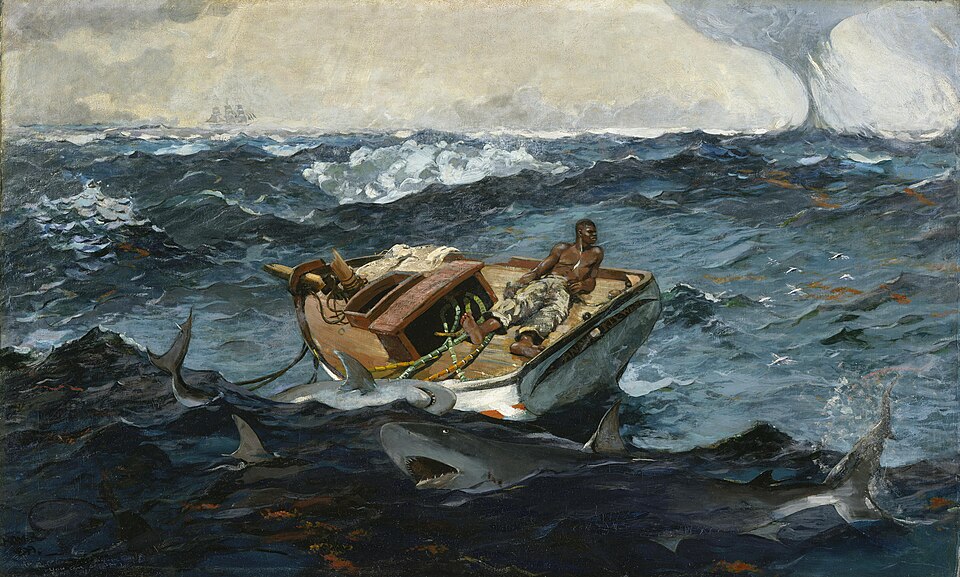
Winslow Homer wasn’t a professional sailor, but he became deeply immersed in maritime life. After spending time in the English fishing village of Cullercoats in the early 1880s, he eventually settled at Prouts Neck on the coast of Maine, where the Atlantic became one of his central subjects.
His mature seascapes rarely treat the ocean as pleasant scenery. In paintings such as The Gulf Stream, The Herring Net, and The Fog Warning, water is something people must read, work with, and survive. Boats feel small because Homer understood that the sea is the larger force in the picture.
He made maritime drama convincing by paying attention to conditions rather than decorating the scene with waves.
When painting nature, spend enough time with your subject to notice how it actually behaves instead of relying on the visual shorthand you already associate with it.
2. Joseph Conrad Sketched Before He Became a Novelist
Joseph Conrad is remembered as a writer rather than a visual artist, but his years as a merchant seaman are a useful reminder that creative observation can begin in another profession entirely. He spent roughly two decades at sea and eventually earned his master’s certificate in the British merchant service.
His later fiction transformed maritime experience into psychological material: confined crews, distant horizons, dangerous weather, hierarchy, boredom, fear, and isolation. The sea wasn’t merely a setting because Conrad understood the systems and personalities operating inside it.
That principle transfers directly to visual art. Knowledge produces details that imagination alone often misses.
If you want to depict a specialized world convincingly, learn its routines, vocabulary, tools, and inconveniences before worrying about making it picturesque.
3. Fitz Henry Lane Knew What Ships Were Supposed to Look Like
Fitz Henry Lane became one of America’s great painters of harbors and ships. Growing up in Gloucester, Massachusetts, surrounded him with maritime culture, and he worked early in life around shoemaking before training in lithography and becoming known for extraordinarily precise marine subjects.
Lane’s ships aren’t generic triangles of sails floating on attractive water. Hulls, masts, rigging, sails, docks, and harbor activity have structural credibility. That specificity makes the quieter atmospheric effects—the glowing horizon or glassy water—feel even more convincing.
Accuracy and poetry aren’t enemies. Sometimes accuracy is what allows poetry to work.
When your subject contains complicated machinery or structure, learn enough about how it works that you can simplify it deliberately rather than accidentally drawing it wrong.
4. Arthur Rimbaud Shows That Adventure Can Replace Art
Arthur Rimbaud isn’t a painter, but his story belongs in any discussion of artists drawn toward travel and the sea because he did something almost unimaginable: he essentially abandoned poetry while still extraordinarily young.
After his explosive teenage literary career, Rimbaud traveled widely and eventually became involved in trading in places including Aden and Harar. His later life was radically different from the artistic identity that made him famous.
There is a useful contradiction here. Artists often romanticize experience as fuel for art, but experience can also consume the time and attention required to make art at all.
When you pursue adventure for inspiration, decide beforehand how the experience will return to the studio—through sketches, notes, photographs, objects, or scheduled working time—so living doesn’t quietly replace making.
5. Rockwell Kent Turned Boats Into Transportation to Solitude
Rockwell Kent was an artist, illustrator, writer, traveler, and accomplished sailor whose appetite for remote places repeatedly took him toward water.
He lived and worked in places including Monhegan Island, Newfoundland, Alaska, and Greenland. Boats weren’t merely subjects for Kent; they helped him reach the stripped-down landscapes he wanted to experience and depict. His work often reduces mountains, water, ice, and human figures into bold, almost monumental shapes.
The travel wasn’t separate from the style. Removing himself from crowded urban environments gave him access to a visual world with fewer elements and larger forms.
If your work feels cluttered, don’t automatically change your style first; spend time somewhere that forces you to look at a completely different vocabulary of shapes.
6. John James Audubon Used Ships as Moving Observation Posts
John James Audubon is famous for birds, but his work depended heavily on travel, including extensive journeys by river and sea. His 1830s expedition toward Labrador took him aboard a schooner, giving him opportunities to observe seabirds and coastal environments far from his usual surroundings.
Travel changed what was available to draw. Instead of waiting for interesting subjects to arrive at the studio, Audubon repeatedly moved himself toward them.
That sounds obvious, but it reverses a common creative habit. Artists often keep searching for new ideas while continuing to occupy exactly the same physical and social environment.
When your subject matter starts repeating itself, change where you gather information before trying to force originality out of the same surroundings.
7. Edward Lear Drew While Moving Through the World
Edward Lear is best remembered for nonsense poetry, but he was also a prolific landscape artist and traveler. His journeys took him around the Mediterranean and farther afield, often involving sea travel between the places he documented.
Lear made large numbers of rapid observational drawings, frequently annotating sketches with notes about color and landscape features that could be useful later. He understood something every traveling artist eventually discovers: you rarely have enough time to finish everything on location.
The sketch doesn’t have to be a miniature finished artwork. It can function as stored information.
When working on location, record the details your memory is most likely to lose—color, direction of light, weather, movement, scale—rather than wasting limited time polishing every line.
8. Irving Johnson Drew and Filmed the Life He Was Actually Living
Irving Johnson was primarily a sailor, writer, lecturer, and filmmaker rather than a conventional fine artist, but his visual documentation of sailing culture demonstrates an important creative principle.
Johnson and his wife, Electa, famously sailed around the world aboard the Yankee, documenting voyages through writing, photography, and film. The camera became part of the expedition rather than something applied afterward.
This produces a different kind of visual authenticity. When the person making the image is also participating in the difficult reality being documented, the work naturally notices things an outside observer might miss.
When documenting a world you belong to, photograph or draw the ordinary procedures insiders take for granted; those overlooked details are often what outsiders find most revealing.
9. Bas Jan Ader Took the Romantic Idea Too Far
Dutch conceptual artist Bas Jan Ader created works involving gravity, falling, vulnerability, and disappearance. In 1975 he began In Search of the Miraculous, a project that included an attempted solo Atlantic crossing from Massachusetts to Europe in an extraordinarily small sailboat.
Ader disappeared at sea. His empty boat was later recovered off the coast of Ireland, but his body was never found.
Because disappearance, risk, and romantic longing already existed in his art, his death has become almost inseparable from interpretations of the work. But that can make danger seem more artistically meaningful than it really is. A compelling concept doesn’t make physical risk symbolic once you’re actually inside it.
When a project involves genuine danger, separate the artistic necessity from the romantic story you’re telling yourself and redesign anything where the risk is doing more work than the art.
Artists who knew boats understood something painters standing safely on shore could easily miss: the sea is not simply blue space. It is weather, navigation, machinery, work, isolation, distance, and constant change.
That’s the larger lesson these maritime lives offer. If you want to make convincing work about a world, getting closer to the reality of that world will usually teach you more than collecting more images of it.