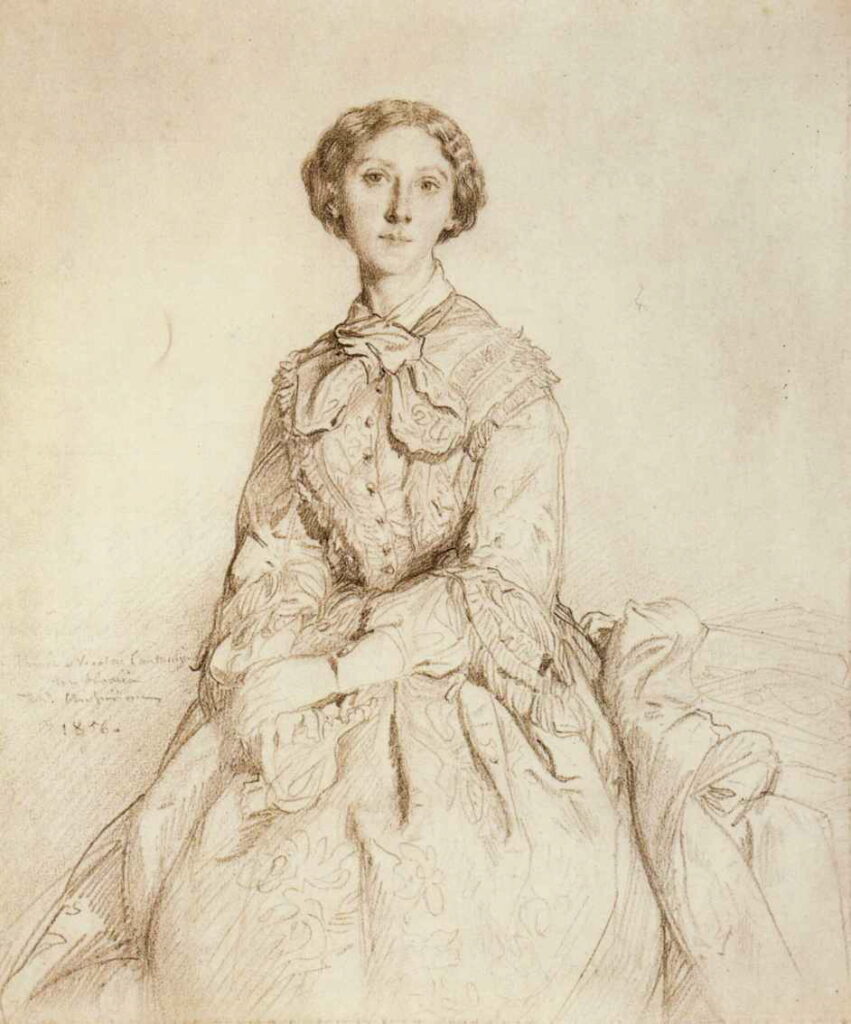
Few relationships in the history of European art lasted as long or unfolded as quietly as the bond between Pierre Puvis de Chavannes and Marie Cantacuzène. While many celebrated painters lived turbulent private lives filled with short-lived romances and public controversy, Puvis found lasting companionship with a woman who remained at his side for more than four decades. Their story is remarkable not because it was dramatic, but because it was enduring. Long before they finally married in the summer of 1897, they had already shared most of their adult lives.
Their partnership developed during one of the most eventful periods in French history. Between the time they met in the mid-1850s and their deaths in 1898, France experienced the reign of Emperor Napoleon III, the rebuilding of Paris under Baron Haussmann, the Franco-Prussian War of 1870–1871, the Paris Commune, and the rise of the Third Republic. Through every political upheaval and changing artistic fashion, Puvis steadily built a reputation as France’s leading painter of monumental decorative murals, while Marie remained his closest companion.
Unlike the sensational romances often associated with artists, the lives of Puvis and Marie are documented through official records, museum collections, correspondence, and contemporary accounts rather than colorful legend. Some aspects of their private lives remain uncertain, particularly why they postponed marriage until late in life. Responsible historians acknowledge those uncertainties instead of filling the gaps with speculation. Even without embellishment, the verified facts tell an extraordinary story of loyalty, patience, and mutual devotion.
Today, Pierre Puvis de Chavannes is remembered as one of the great pioneers of Symbolism and a profound influence on artists ranging from Georges Seurat to Maurice Denis and Pablo Picasso. Marie Cantacuzène occupies a quieter place in history, yet her importance should not be underestimated. She witnessed the painter’s transformation from a struggling young artist into one of the most respected cultural figures in France and remained beside him until the final months of their lives.
A Young Painter Meets a Romanian Princess
Pierre Puvis de Chavannes Before Fame
Pierre Cécile Puvis de Chavannes was born in Lyon on 14 December 1824 into a prosperous Burgundian family whose wealth came largely from mining and engineering. His father expected him to pursue a respectable commercial career, and there was little indication during his early education that he would become one of France’s most admired painters. Like many young men from comfortable families, he was encouraged to choose stability over artistic ambition.
A serious illness changed the course of his life. During his recovery, Puvis traveled in Italy, where he encountered the frescoes of the Renaissance and the monumental art of cities such as Florence. The experience left an impression that never faded. Instead of being drawn to highly polished academic painting, he admired the calm dignity, balanced compositions, and architectural harmony of early Italian masters.
Returning to France, Puvis committed himself to painting. He studied with Henri Scheffer and later spent a brief period in the studio of Eugène Delacroix. Although he respected both artists, he resisted becoming a mere follower. His style evolved independently, favoring simplified forms, muted colors, and timeless landscapes rather than dramatic theatrical scenes. Critics initially found his work unusual, but the very qualities that puzzled them would later define his greatness.
His first years as a painter were marked by persistence rather than immediate success. Several early submissions to the Paris Salon failed to gain significant attention, forcing him to refine both his technique and artistic vision. Rather than abandoning his ambitions, Puvis continued to develop a style perfectly suited to large public decorations, believing that painting should complement architecture instead of competing with it.
Marie Cantacuzène’s Aristocratic Background
Marie Cantacuzène was born on 20 July 1820 into the distinguished Cantacuzène, or Cantacuzino, family, one of Romania’s oldest noble houses. The family claimed descent from the Byzantine imperial tradition and had played an important role in the political and cultural life of southeastern Europe for centuries. Although such ancestry carried prestige, Marie herself became known less for rank than for her intelligence, elegance, and quiet self-possession.
Before her relationship with Puvis, she married Prince Alexandru Cantacuzino. Much of her early married life remains imperfectly documented, but by the middle of the nineteenth century she had become part of Parisian society, where artists, collectors, writers, and musicians gathered in private salons to exchange ideas. These gatherings were more than fashionable entertainments. They helped shape artistic careers, introduced patrons to painters, and fostered friendships that often lasted a lifetime.
Marie possessed qualities that contemporaries repeatedly admired. She was well educated, multilingual, and comfortable discussing literature, music, and painting with some of the leading cultural figures of the day. Unlike many women remembered only because they inspired artists, she earned respect through her intellect and gracious manner. Friends described her as calm and dignified, characteristics that complemented Puvis’s own reserved personality.
Because Marie avoided public attention, relatively few personal letters or diaries survive. Historians therefore reconstruct her life through official documents, museum records, family histories, and the recollections of contemporaries. While this leaves some questions unanswered, it also discourages the romantic myths that have attached themselves to many nineteenth-century artistic relationships.
A Chance Meeting in Paris
Pierre Puvis de Chavannes and Marie Cantacuzène are generally believed to have met around 1856, most likely through the artistic circle surrounding the painter Théodore Chassériau. Paris was then the undisputed artistic capital of Europe. Every spring, the official Salon attracted thousands of visitors eager to see the newest paintings and sculptures. Around the exhibitions flourished an energetic world of studios, cafés, publishers, critics, and private salons where artists and patrons met almost daily.
When Puvis first encountered Marie, he was still seeking recognition. Although talented and determined, he had yet to receive the prestigious public commissions that would make his reputation. Marie, by contrast, moved comfortably among cultivated circles where conversation ranged from politics and literature to archaeology and music. Their shared appreciation for culture provided common ground, and what began as an acquaintance gradually developed into an enduring companionship.
No contemporary account records the exact moment they met or the words they exchanged. That absence of evidence is important. Many later writers embroidered their story with dramatic scenes or instant romance, but none of those tales can be verified. The surviving historical record instead reveals something quieter and perhaps more remarkable: a relationship that deepened steadily over time rather than exploding into immediate passion.
As the years passed, Marie became a constant presence in Puvis’s life. She saw him persevere through criticism, celebrate professional successes, and establish himself as one of France’s foremost painters of monumental decoration. While fashions changed around them, their partnership remained remarkably consistent. That stability would prove invaluable as Puvis entered the most productive period of his career.
An Artist Finding His Voice
During the late 1850s and early 1860s, Puvis began to distinguish himself from other painters working in Paris. At a time when many artists competed to produce highly detailed historical scenes or dramatic portraits, he pursued an entirely different vision. His figures appeared serene and contemplative, his landscapes idealized rather than literal, and his compositions intentionally simplified. Instead of overwhelming viewers with detail, he sought to create harmony between painting, architecture, and public space.
This approach eventually attracted important commissions. His decorative paintings for the Musée de Picardie in Amiens demonstrated that monumental art could communicate dignity without excessive ornament. Civic leaders appreciated his ability to create images that celebrated learning, peace, labor, and national ideals without relying on theatrical effects. These qualities soon brought further commissions from museums, universities, libraries, and government buildings.
Marie witnessed this gradual rise firsthand. Rather than sharing only the rewards of success, she experienced the years of uncertainty that preceded it. She knew the painter before he became an academician, before foreign collectors sought his work, and before younger artists hailed him as a master. Their relationship therefore rested on shared experience rather than celebrity or social advantage.
By the middle of the 1860s, Puvis was no longer merely a promising artist. He had become a painter with a distinctive vision whose quiet originality was beginning to reshape French decorative art. At the same time, the companionship that had begun around 1856 had matured into a partnership that would endure for the rest of their lives.
A Partnership That Endured Through Changing Times
A Quiet Life in an Extraordinary Age
By the early 1860s, Pierre Puvis de Chavannes and Marie Cantacuzène had settled into a relationship that would outlast many of the friendships and artistic rivalries surrounding them. Paris was changing at a breathtaking pace. Under the direction of Baron Georges-Eugène Haussmann, ancient streets disappeared to make way for wide boulevards, spacious public squares, elegant bridges, and landscaped parks. The rebuilding of the capital created opportunities for architects, sculptors, and painters whose work could help define the appearance of modern France.
For Puvis, these changes arrived at exactly the right moment. His artistic vision was especially well suited to large public buildings. Rather than producing paintings meant only for private collectors, he specialized in monumental decorations designed to become part of the architecture itself. His murals did not dominate a room. Instead, they created an atmosphere of quiet reflection that complemented libraries, museums, universities, and civic halls.
Marie accompanied him through these years of growing opportunity. Although she seldom appeared in newspaper reports or exhibition reviews, contemporaries increasingly regarded her as an inseparable part of the painter’s life. Visitors who met Puvis frequently encountered Marie as well, and friends recognized the deep trust that existed between them. Their relationship appears to have rested on companionship rather than public display, a quality that distinguished them from many better-known artistic couples of the nineteenth century.
The historical record offers only scattered glimpses into their daily routine, but those glimpses reveal remarkable consistency. They entertained friends, traveled when circumstances allowed, and shared the long periods of disciplined work required to complete monumental commissions. Puvis was known for careful planning and patient execution, qualities that found a natural counterpart in Marie’s steady and discreet presence.
Recognition at the Paris Salon
Although Puvis never fit comfortably within the artistic establishment, the annual Paris Salon gradually became the stage upon which his reputation was built. During the 1860s, his work began attracting increasing attention from critics who appreciated the originality of his decorative vision. Some viewers admired the simplicity of his compositions, while others found them strangely austere when compared with the polished realism then favored by many academic painters.
Rather than responding to criticism by changing his style, Puvis remained remarkably consistent. He believed that monumental painting should communicate timeless ideals instead of fleeting emotion. His figures move with deliberate calm, and even scenes representing history or mythology possess an atmosphere of quiet contemplation. This distinctive approach eventually became one of his greatest strengths.
Among the important works that established his reputation was Ave Picardia Nutrix, completed in 1865 for the Musée de Picardie in Amiens. The monumental decoration celebrated the province of Picardy through idealized allegorical figures rather than literal historical scenes. Its restrained composition demonstrated Puvis’s growing confidence and helped convince public officials that he possessed the rare ability to create paintings suited to civic architecture.
Success at Amiens led to further commissions throughout France. Museums, municipal buildings, educational institutions, and libraries increasingly sought his services. Instead of producing isolated masterpieces for wealthy collectors, Puvis was helping shape the visual identity of public France. His murals became part of the everyday experience of students, scholars, and ordinary citizens who visited these buildings.
Marie’s Influence Behind the Scenes
Unlike some artists’ companions who actively managed careers or cultivated influential patrons, Marie Cantacuzène appears to have exercised her influence quietly. No surviving documents suggest that she directed Puvis’s artistic decisions or negotiated his commissions. Her importance lay elsewhere. She provided continuity, encouragement, and emotional support during decades that included both critical disappointment and professional triumph.
Friends consistently referred to Marie with respect rather than curiosity. She was not treated merely as a model or decorative companion but as an intelligent woman whose judgment carried weight within Puvis’s circle. Their relationship developed at a time when Parisian salons brought together painters, musicians, writers, historians, archaeologists, and collectors. Marie moved comfortably within this cultured world, contributing to conversations that extended far beyond painting alone.
The painter Odilon Redon later admired Puvis’s ability to convey profound emotion through apparent simplicity, while younger artists such as Maurice Denis looked to him as a pioneer of Symbolism. Marie witnessed these changing artistic attitudes firsthand. She saw Puvis evolve from an artist whose work puzzled critics into one whose influence reached well beyond France. Although she rarely appeared in historical accounts of these developments, she experienced every stage of that transformation beside him.
It would be easy to exaggerate Marie’s direct impact on Puvis’s art, but responsible history requires restraint. There is no documentary evidence that she conceived compositions or advised him on technical matters. The evidence instead points to something equally significant: she created a stable private world that allowed one of France’s greatest mural painters to devote himself fully to his work over more than forty years.
A Rare Glimpse Through Art
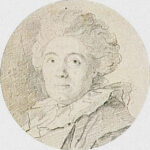
One of the most personal surviving images associated with Marie Cantacuzène is Study of Madame Marie Cantacuzène; Study of Standing Female Nude, created around 1883. Preserved today in the Cleveland Museum of Art, the drawing is executed in black chalk on laid paper and measures 29.4 × 22.6 centimeters (11 9/16 × 8 7/8 inches). Unlike Puvis’s vast decorative murals, this intimate study offers a direct encounter with the woman who shared his life.
The sheet is divided into two related studies. One presents a portrait of Marie, while the other explores the standing figure of a nude woman. Together they reveal the artist’s disciplined working method. Puvis rarely began large decorative paintings without extensive preparation. Individual heads, hands, drapery, and figures were studied repeatedly before being incorporated into finished compositions. The drawing therefore serves both as a portrait and as evidence of the careful planning behind his monumental works.
Museum scholars regard drawings such as this as essential to understanding Puvis’s artistic process. His finished murals often appear effortless, yet they resulted from months of careful observation and refinement. Every gesture and every arrangement of figures was considered in advance. The portrait of Marie belongs within this tradition of thoughtful preparation while also preserving the likeness of the woman closest to the artist.
Older publications sometimes claimed that Marie served as the model for numerous allegorical figures throughout Puvis’s career. Modern museum catalogues are considerably more cautious. While she undoubtedly sat for him on occasion, only documented identifications should be accepted as historical fact. That careful distinction strengthens rather than diminishes her importance. The verified evidence alone demonstrates that she occupied a unique place in both the painter’s life and his artistic practice.
Milestones in a Lifetime Together
Several important events marked the decades that Pierre Puvis de Chavannes and Marie Cantacuzène shared before their marriage.
- Around 1856 — Pierre Puvis de Chavannes and Marie Cantacuzène met in Paris, probably through the artistic circle surrounding Théodore Chassériau.
- 1865 — Puvis completed Ave Picardia Nutrix for the Musée de Picardie, one of the commissions that established his reputation as a monumental decorative painter.
- 1880 — He completed The Sacred Grove, Beloved of the Arts and Muses (Le Bois sacré cher aux arts et aux muses) for the Musée des Beaux-Arts de Lyon, one of his greatest masterpieces.
- 29 January 1882 — Puvis was elected to the Académie des Beaux-Arts, confirming his position among France’s leading painters.
- Circa 1883 — He produced Study of Madame Marie Cantacuzène; Study of Standing Female Nude, one of the few securely documented artistic representations of Marie.
By the early 1890s, Pierre Puvis de Chavannes had achieved international recognition. Honors arrived from France and abroad, younger painters acknowledged his influence, and his murals decorated some of the nation’s most important public buildings. Through every stage of that long ascent, Marie Cantacuzène remained his closest companion. Their wedding still lay a few years in the future, but by then their partnership had already become one of the most enduring relationships in the history of nineteenth-century European art.
Art, Marriage, and the Closing Chapter of Their Lives
Marriage at Last
On 21 July 1897, after more than forty years together, Pierre Puvis de Chavannes and Marie Cantacuzène were married at Neuilly-sur-Seine, just west of Paris. The ceremony was a quiet civil occasion rather than a grand social event, fitting the reserved nature of a couple who had spent decades avoiding unnecessary public attention. By the time they exchanged vows, both were in their seventies. Their marriage did not mark the beginning of their partnership but the formal recognition of a relationship that had already stood the test of time.
Exactly why they waited so long remains one of the few unanswered questions in their story. Official records confirm the marriage, but they do not explain the reasons for its timing. Some later writers have offered theories involving legal or personal circumstances, yet none can be supported conclusively by surviving documentary evidence. For that reason, historians generally limit themselves to the verified facts. Whatever the explanation, the marriage itself stands as a matter of public record.
Their wedding came at a moment when Puvis enjoyed extraordinary prestige. Once dismissed by some critics as overly restrained, he had become one of the most respected painters in France. His murals adorned museums, universities, municipal buildings, and government institutions, and his name carried weight well beyond the country’s borders. Recognition had arrived gradually, earned through decades of disciplined work rather than sudden fame.
For Marie, the ceremony represented the culmination of a lifetime of devotion. She had stood beside Puvis through years of uncertainty, professional disappointment, and eventual triumph. Friends had long regarded them as partners in every meaningful sense. Their marriage simply acknowledged publicly what those closest to them had understood for many years.
An Artist at the Height of His Reputation
By the late 1890s, Pierre Puvis de Chavannes occupied a unique position in French art. His style differed sharply from that of the Impressionists, whose interest in fleeting light and atmospheric effects transformed landscape painting. Puvis instead pursued permanence. His figures appear timeless, his landscapes idealized, and his compositions carefully balanced to complement the architecture they inhabit. Rather than recording a passing moment, he sought to express enduring ideas through simplicity and harmony.
His influence reached artists with remarkably different styles. Georges Seurat admired the calm order and structural clarity of Puvis’s murals while developing Neo-Impressionism. Maurice Denis, one of the leading Symbolists, praised Puvis as a master who demonstrated that painting could communicate profound ideas through suggestion rather than literal description. Even Pablo Picasso, during his early years, studied Puvis’s monumental compositions while exploring new directions in modern art.
Among Puvis’s best-known public decorations is The Sacred Grove, Beloved of the Arts and Muses (Le Bois sacré cher aux arts et aux muses), completed in 1884 for the Musée des Beaux-Arts de Lyon. The expansive composition presents an ideal landscape inhabited by allegorical figures representing artistic inspiration. Instead of dramatic action, the painting conveys serenity and intellectual contemplation, qualities that became hallmarks of Puvis’s mature work. Its success confirmed his reputation as the foremost decorative painter of his generation.
Another important commission was Summer (L’Été), completed in 1873, one of a series celebrating the seasons. Like many of Puvis’s paintings, it rejects elaborate detail in favor of broad forms and harmonious color. Such works demonstrated that simplicity could possess immense expressive power. Younger painters recognized that his restraint was not a limitation but a deliberate artistic choice that opened new possibilities for modern art.
Their Final Year Together
The happiness of the couple’s marriage proved heartbreakingly brief. Just over a year after their wedding, Marie Cantacuzène died on 29 August 1898. Having spent more than four decades together, the separation must have been devastating for Puvis, although he left few personal reflections describing his grief. His naturally private character makes it difficult to know precisely how he experienced those final weeks.
Marie was seventy-eight years old at the time of her death. She had witnessed nearly every important stage of Puvis’s career, from his uncertain beginnings in the 1850s to his election to the Académie des Beaux-Arts and his recognition as France’s leading mural painter. Her quiet presence had become so closely associated with the artist that contemporaries found it difficult to imagine one without the other.
Pierre Puvis de Chavannes survived his wife by less than two months. He died in Paris on 24 October 1898, at the age of seventy-three. His death marked the end of a career that had transformed the possibilities of monumental painting and influenced generations of artists across Europe. Newspapers and artistic societies throughout France paid tribute to his achievements, recognizing him as one of the nation’s foremost painters.
The closeness of their deaths has naturally invited romantic interpretation. Yet the documented facts speak eloquently enough without embellishment. After sharing more than forty years together, husband and wife died within fifty-six days of one another. Their partnership had endured almost until the very end.
A Lasting Legacy of Loyalty and Art
Remembering Their Partnership
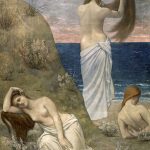
Today, Pierre Puvis de Chavannes is celebrated not only for the beauty of his murals but also for the originality of his artistic vision. At a time when many painters competed for attention through dazzling technique or dramatic storytelling, he pursued calm, balance, and permanence. His work helped lay the foundations of Symbolism and influenced artists whose styles eventually differed greatly from his own. Museums throughout France and beyond continue to preserve his paintings, drawings, and preparatory studies as milestones in the history of nineteenth-century art.
Marie Cantacuzène remains a less familiar figure, yet her contribution to this story is unmistakable. She was neither a professional painter nor a public patron, but she offered something no commission or honor could provide: steadfast companionship. Their relationship demonstrates that creative achievement often depends not only on talent but also on the quiet support of trusted individuals whose names receive far less recognition than those of the artists themselves.
The surviving evidence also reminds us to distinguish carefully between documented history and appealing legend. Historians sometimes inherit stories repeated so often that they seem unquestionable, yet careful research frequently reveals that the supporting evidence is thin or absent. In the case of Puvis and Marie, the verified facts are more than sufficient. A relationship lasting over forty years, concluded by marriage in old age and ending with two deaths only weeks apart, requires no embellishment to capture the imagination.
Their story continues to resonate because it reflects virtues that transcend changing fashions. Patience, loyalty, mutual respect, and shared purpose remain as meaningful today as they were in nineteenth-century Paris. In an artistic world often remembered for rivalry and controversy, Pierre Puvis de Chavannes and Marie Cantacuzène left behind a different example—one built on constancy rather than drama. It is a legacy worthy of remembrance alongside the paintings that first brought the artist lasting fame.
Key Takeaways
- Pierre Puvis de Chavannes and Marie Cantacuzène began their relationship around 1856 and remained together for more than forty years.
- They were legally married at Neuilly-sur-Seine on 21 July 1897.
- Marie is securely identified in the drawing Study of Madame Marie Cantacuzène; Study of Standing Female Nude (circa 1883), now in the Cleveland Museum of Art.
- Puvis became one of France’s greatest mural painters, influencing artists including Georges Seurat, Maurice Denis, and Pablo Picasso.
- Marie died on 29 August 1898, and Puvis followed on 24 October 1898, only fifty-six days later.
Frequently Asked Questions
Were Pierre Puvis de Chavannes and Marie Cantacuzène really married?
Yes. French civil records confirm that they married on 21 July 1897 at Neuilly-sur-Seine.
How long were they together before marrying?
They had been companions for approximately forty-one years before their marriage.
Did Marie model for Puvis’s paintings?
She is securely identified in Study of Madame Marie Cantacuzène; Study of Standing Female Nude (circa 1883). Claims that she modeled for numerous major allegorical paintings are not consistently supported by museum evidence.
What made Puvis de Chavannes important as an artist?
He revolutionized monumental decorative painting through simplified forms, harmonious compositions, and an idealized style that strongly influenced the Symbolist movement.
When did Pierre Puvis de Chavannes die?
He died in Paris on 24 October 1898, less than two months after the death of his wife, Marie Cantacuzène.