For centuries, people have carved mysterious circles, stars, intersecting lines, and letters into the timbers and stones of homes, churches, and farm buildings. At first glance these marks appear to be little more than idle scratches left by forgotten hands. A closer look reveals something far more compelling. These symbols were created with deliberate purpose, serving as visual guardians placed where danger was believed most likely to enter. Today they are studied by archaeologists and architectural historians, but they also deserve appreciation as a remarkable form of anonymous artistic expression. Their simple geometry, careful placement, and handmade character make them some of the most fascinating examples of vernacular art to survive from the medieval and early modern world.
Unlike paintings displayed in galleries or sculptures commissioned for wealthy patrons, apotropaic marks were never intended to impress viewers. Their creators sought protection rather than admiration. Yet in pursuing that practical goal, they produced designs of surprising beauty. Repeated circles flow across oak beams with graceful precision. Compass-drawn rosettes resemble intricate floral patterns. Deeply incised lines catch changing light in ways that transform ordinary building materials into textured works of art. The carvings are modest in scale, but their visual impact has endured for centuries.
What Are Apotropaic Marks?
The Meaning of “Apotropaic”
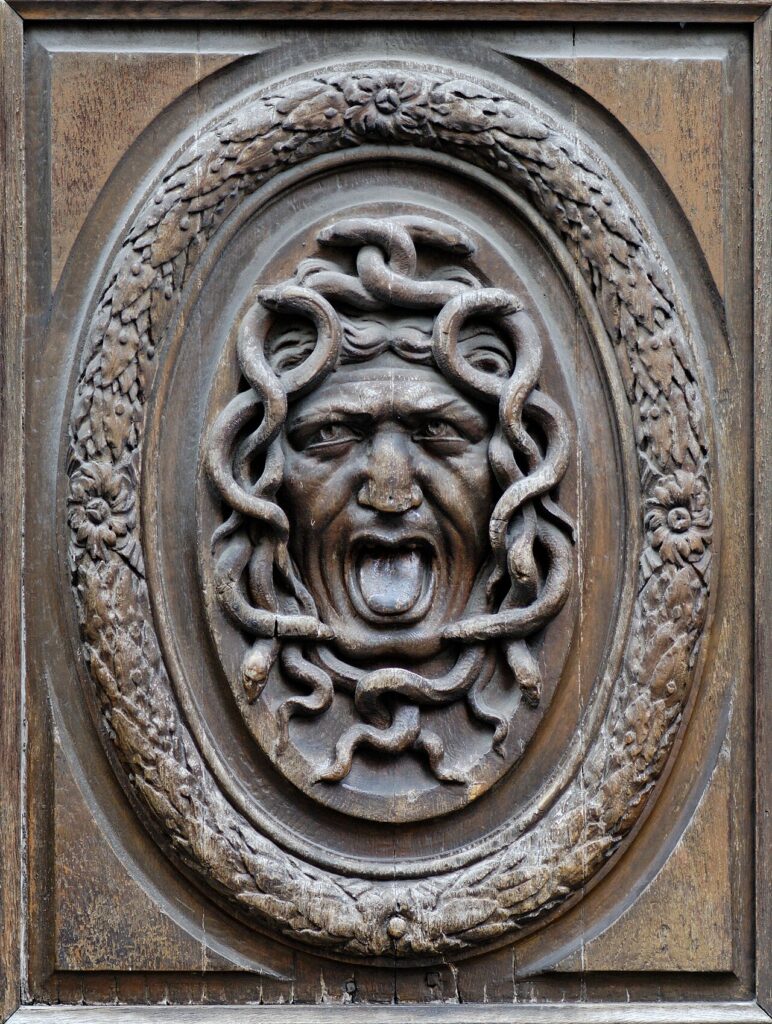
The word apotropaic comes from the ancient Greek verb apotrépein, meaning “to turn away” or “to avert.” In the ancient Greek world, images of fierce faces, staring eyes, and mythological creatures were placed on temples, shields, and pottery to ward off danger. The concept spread through many cultures, although the symbols themselves varied considerably. By the Middle Ages, protective imagery had become deeply woven into the architecture of Europe, taking forms that reflected local customs and religious traditions.
The carved marks found in Britain are among the best documented examples. Most date from the late medieval period through the seventeenth century, although some continued to be added well into the eighteenth and early nineteenth centuries. They appear on churches, manor houses, humble cottages, mills, barns, inns, and even public buildings. Their locations are rarely random. Doorways, fireplaces, chimneys, windows, staircases, and roof spaces were all regarded as vulnerable thresholds where unseen forces might gain entry.
Modern researchers often refer to these carvings as ritual protection marks, a term that better reflects their intended purpose than the older nickname “witch marks.” While fear of witchcraft certainly formed part of the historical background, the carvings were meant more broadly to guard against misfortune, evil spirits, disease, unexplained accidents, and other supernatural dangers. They represented hope as much as fear, expressing the belief that simple acts performed with conviction could help protect families and communities.
Not every carved symbol belongs in this category. Historic buildings contain countless marks left by masons, carpenters, merchants, pilgrims, and ordinary visitors. Construction marks helped builders assemble complex timber frames. Masons developed personal symbols to identify their work. Pilgrims sometimes scratched crosses into church walls after completing a journey. Distinguishing ritual protection marks from these other carvings requires careful attention to their form, placement, and repeated patterns across many buildings.
From Practical Belief to Artistic Expression
From an artistic perspective, apotropaic marks occupy a unique place in history. They were not created for display, commercial value, or personal fame. Their makers were almost always anonymous. Many were skilled craftsmen who spent their lives building houses, raising barns, or repairing churches rather than producing objects intended to be called art. Yet the visual language they developed possesses remarkable sophistication.
One reason these carvings remain so compelling is their balance between order and spontaneity. A compass might first establish a perfect circle, after which the maker divided the space into petals, arcs, or interlocking loops. Small inaccuracies reveal the pressure of the hand and the resistance of the wood beneath the blade. These imperfections give each design its individuality. Rather than diminishing the image, they remind us that every mark records a physical action performed by a living person hundreds of years ago.
The carvings also demonstrate an intuitive understanding of composition. Many occupy relatively small areas, yet they create striking visual rhythms through repetition. Several circles placed side by side form patterns that naturally guide the viewer’s eye. Deep cuts alternate with shallow ones, producing subtle contrasts of light and shadow. Empty space becomes as important as the carved lines themselves. Long before modern artists explored abstraction, anonymous craftsmen were creating geometric compositions that depended entirely upon balance, proportion, and repetition.
Because these marks were rarely meant to be noticed by outsiders, they avoided unnecessary ornament. Their economy of line gives them an almost modern appearance. Looking at a well-preserved hexafoil carved into an oak lintel, it is easy to understand why contemporary artists often compare them to minimalist drawing or abstract design. Their beauty lies not in elaborate decoration but in clarity of form.
The Artistic Language of Protection
Geometry as a Universal Design Language
Perhaps the most recognizable apotropaic design is the hexafoil, sometimes called the daisy wheel. Created by drawing a series of overlapping circles with a compass, it forms six rounded petals radiating from a common center. Although the finished design resembles a flower, it is fundamentally geometric. Every curve arises from precise mathematical relationships established by the compass point. The result is a figure that combines symmetry, movement, and balance within a remarkably simple construction.
Hexafoils appear throughout medieval and early modern England, particularly on wooden doorframes, fireplaces, church doors, and roof timbers. Their popularity suggests that people found reassurance in ordered geometry. Unlike freehand drawings, compass-made circles implied precision and permanence. The endless nature of the circle itself may also have contributed to its protective symbolism, representing continuity without beginning or end.
Other common motifs include concentric circles, intersecting arcs, simple crosses, overlapping diamonds, and repeated VV symbols. The paired letters have often been interpreted as an abbreviation for Virgo Virginum, a medieval title honoring the Virgin Mary meaning “Virgin of Virgins.” While scholars continue to debate the meaning of some individual examples, the repeated appearance of these forms across numerous buildings suggests that they carried recognizable significance for those who created them.
The pentangle also appears occasionally, although far less frequently than popular culture sometimes suggests. In medieval Christian symbolism the five-pointed figure represented themes including the Five Wounds of Christ. Its later association with entirely different belief systems should not be projected backward onto every historical example. Context always matters. A symbol carved into a sixteenth-century church doorway cannot be understood solely through modern assumptions.
Artists are often struck by how naturally these designs achieve visual harmony. Most rely upon a limited vocabulary of circles and straight lines, yet the possible combinations are almost endless. By repeating familiar elements in slightly different arrangements, craftsmen produced works that feel simultaneously ordered and individual. The designs invite close observation because each variation reveals subtle choices made by its anonymous creator.
Composition, Rhythm, and Repetition
Although many apotropaic marks were completed quickly, they display a remarkable sensitivity to composition. The maker had to work within the existing architecture, adapting each design to the size and shape of a beam, lintel, or stone block. Rather than forcing the carving to dominate its surroundings, the design often complements the proportions of the building itself.
Repetition became one of the artist’s most effective tools. A doorway might contain several hexafoils carved in sequence, each slightly different from the last. Multiple circles reinforced both the visual rhythm and the symbolic intention. The accumulation of marks suggested persistence, as though repeated acts of carving strengthened the desired protection. Even where individual carvings are worn almost smooth, their combined effect remains striking.
Light plays an equally important role in the appearance of these works. Freshly carved grooves would originally have produced crisp shadows across the wood. As centuries passed, oxidation darkened the cuts while handling polished the surrounding surface. Sunlight entering through an open doorway or firelight flickering across an old hearth still reveals details that disappear under flat modern illumination. The changing quality of light gives the carvings a subtle vitality, allowing them to shift throughout the day without altering their physical form.
Unlike paintings, which separate image from surface, apotropaic marks become inseparable from the material into which they are carved. Oak, elm, limestone, sandstone, and brick each respond differently to the cutting tool. Grain, texture, hardness, and weathering influence the final appearance. The building itself becomes both canvas and sculpture, making these carvings an unusually intimate collaboration between architecture and artistic expression.
Architecture as the Canvas
Why Thresholds Matter
The placement of apotropaic marks is one of their most distinctive artistic qualities. Unlike decorative carvings, which are often arranged to impress visitors, these symbols were concentrated at points where people believed danger might cross from one space into another. Medieval and early modern builders regarded thresholds as places of transition. A doorway separated the safety of the home from the uncertainty of the outside world. A fireplace connected the household with the chimney above, while windows admitted both light and whatever unseen forces people feared might accompany the night.
Door frames are among the most common locations for surviving marks. As every visitor entered through the same opening, the doorway became a natural focus for protective symbolism. Rather than carving broad decorative panels, craftsmen often tucked circles and intersecting lines into the corners of lintels or the edges of posts. These discreet placements suggest that the effectiveness of the symbol mattered more than its visibility. Many remained hidden beneath later paint, plaster, or wallpaper until modern conservation work uncovered them.
Fireplaces formed another important setting. During the sixteenth and seventeenth centuries the hearth served as the center of domestic life. Families cooked, gathered for warmth, and spent long winter evenings around the fire. At the same time, the chimney represented a mysterious vertical passage between the house and the outside world. Folklore associated chimneys with supernatural visitors, making the mantel beam and fireplace surround natural places for protective carvings. It is no coincidence that many of the finest surviving examples appear within a few feet of the hearth.
Roof spaces also contain significant numbers of ritual marks. Hidden among rafters and tie beams, they were invisible during normal use of the building. Their concealed locations indicate that these carvings were never intended as decoration. Instead, they formed part of the structure itself, silently accompanying the building throughout its working life. For today’s observer, discovering such a mark in a dusty attic creates an immediate sense of connection with the anonymous hand that carved it centuries ago.
Churches preserve some of the richest collections of apotropaic marks. Medieval worshippers frequently carved symbols into doorways, fonts, and porch timbers, particularly at places associated with movement into sacred space. These marks remind us that formal religious practice and popular belief often existed side by side. The same individual who attended Mass and observed the Church calendar might also carve a protective symbol into a familiar doorway, seeing no contradiction between faith and traditional custom.
Time, Wear, and Material Beauty
Time has become an unintentional collaborator in the appearance of apotropaic marks. Few carvings remain as sharp as the day they were made. Generations of weather, repairs, smoke, polishing, and simple daily use have softened their edges. Yet this gradual erosion often enhances rather than diminishes their visual appeal. The shallow grooves acquire a quiet elegance that would have been impossible when they were freshly cut.
Oak, the material used in many English timber-framed buildings, ages with exceptional character. Fresh oak begins as a pale golden brown, but centuries of oxidation transform it into rich shades of amber and deep chocolate. Carved lines darken at different rates from the surrounding wood, increasing their visibility. Even where the surface has become worn smooth through repeated handling, the underlying geometry remains remarkably clear.
Stone responds differently. Limestone gradually softens under the effects of rain and changing temperatures, producing rounded edges that catch light in subtle ways. Sandstone develops delicate textures as individual grains weather at different speeds. These natural processes create a dialogue between human intention and the passage of time. The original craftsman established the design, but nature completed the composition over succeeding centuries.
Modern artists often celebrate visible traces of process, whether in rough brushstrokes, exposed chisel marks, or unfinished surfaces. Apotropaic marks embody this principle naturally. Every cut reveals the movement of a blade through resistant material. Hesitations, corrections, and slight deviations remain permanently recorded. Far from appearing crude, these qualities give the carvings warmth and authenticity. They remind viewers that beauty can emerge from practical work carried out with care rather than from artistic ambition alone.
The relationship between light and texture becomes especially striking in historic interiors. Morning sunlight grazing an old beam emphasizes details invisible at midday. Candlelight or the glow of a fireplace causes carved circles to appear and disappear as shadows shift across the surface. This changing appearance lends the marks an almost living quality. Their forms never truly change, yet the viewer’s perception of them changes constantly.
Why Apotropaic Marks Still Fascinate Artists Today
Inspiration for Contemporary Art
Contemporary artists frequently search for ways to communicate profound ideas through simple forms. Apotropaic marks demonstrate that this approach has deep historical roots. Their makers reduced complex hopes and fears to circles, intersecting lines, and repeated symbols that could be carved in only a few moments. The economy of means is one of their greatest artistic strengths. Nothing is unnecessary, yet every line contributes to the whole.
Their geometric language also speaks to modern interests in abstraction. During the twentieth century, artists increasingly explored the expressive possibilities of shape, rhythm, and repetition without relying on realistic imagery. Although separated by hundreds of years and vastly different cultural contexts, apotropaic carvings share this emphasis on pure form. They prove that abstract visual thinking is far older than modern art movements.
Many contemporary woodcarvers, printmakers, ceramic artists, and textile designers have drawn inspiration from historical geometric motifs. The appeal lies not in copying individual symbols but in understanding the principles behind them. Repetition creates rhythm. Symmetry provides stability. Small variations prevent monotony. Handmade marks convey personality in ways that mechanically perfect lines often cannot. These lessons remain as relevant in a modern studio as they were in a medieval workshop.
The carvings also challenge conventional ideas about authorship. Museums traditionally celebrate named masters, yet apotropaic marks owe much of their power to anonymity. Their creators expected neither fame nor financial reward. Instead, their work served family, neighbors, and community. This perspective offers a refreshing reminder that artistic achievement is not measured solely by reputation. Anonymous craftsmanship has shaped the visual history of countless buildings and deserves recognition alongside more familiar artistic traditions.
Finally, apotropaic marks encourage a slower way of looking. They are rarely dramatic. Many are only a few inches across and almost disappear into weathered timber or stone. Appreciating them requires patience and careful observation. In an age dominated by large-scale images and instant communication, their quiet presence offers a welcome contrast. They reward those willing to pause, examine surfaces closely, and notice beauty hidden in unexpected places.
Seeing Beyond Superstition
It is easy to dismiss apotropaic marks as relics of superstition, but doing so overlooks the broader human story they tell. Every civilization has developed symbols intended to offer comfort in uncertain times. Ancient Egyptians wore protective amulets, Romans placed guardian figures in their homes, and medieval Europeans carved geometric designs into their buildings. While the beliefs surrounding these practices differed, the underlying impulse remained remarkably consistent. People sought reassurance by leaving visible signs that expressed hope, faith, and the desire to protect those they loved.
From an artistic standpoint, these carvings reveal that meaning does not depend upon complexity. A single compass-drawn circle, executed with confidence, can possess extraordinary visual strength. The repetition of simple forms creates rhythm, while their placement within a building gives them purpose beyond decoration. Unlike ornamental carving designed to impress visitors, apotropaic marks were integrated into daily life. They became part of the architecture itself, quietly accompanying generations of occupants without demanding attention.
Their survival also highlights the value of preserving historic buildings. Many marks remained hidden for centuries beneath layers of plaster, wallpaper, or paint. Others escaped destruction only because old beams were reused when houses were altered or repaired. As conservation work continues, previously unknown examples still come to light, expanding our understanding of how widespread the practice once was. Every newly discovered carving adds another small piece to the story of ordinary people whose creativity rarely found its way into written records.
Perhaps their greatest artistic achievement is their honesty. They were never created to satisfy patrons, critics, or collectors. They were made because someone believed they mattered. That sincerity gives them an emotional authenticity that continues to resonate. Whether viewed as expressions of faith, tradition, craftsmanship, or simple human optimism, they remind us that art often grows from everyday experience rather than extraordinary circumstances.
Conclusion
Apotropaic marks occupy a fascinating place between history, architecture, folklore, and art. Their creators intended them to protect homes, churches, barns, and workplaces, yet in doing so they produced enduring works of geometric design. Carved with simple tools into wood, stone, and plaster, these symbols demonstrate that artistic expression has never been confined to celebrated painters or sculptors. Anonymous craftsmen and householders contributed their own visual language, one rooted in tradition, careful observation, and skilled hands.
The beauty of these carvings lies in their restraint. A few carefully cut circles, intersecting lines, or repeated initials could transform an ordinary beam into something meaningful. Their appeal does not depend on elaborate decoration or expensive materials. Instead, it arises from balance, rhythm, texture, and the intimate relationship between mark and material. Centuries of weathering have only strengthened this character, allowing light, age, and use to become part of the finished work.
Studying apotropaic marks from an artistic perspective also broadens our understanding of art itself. They remind us that creativity often flourishes outside formal workshops and royal commissions. Throughout history, ordinary men and women have expressed their beliefs through objects made for practical purposes. In these modest carvings, function and beauty became inseparable. The resulting designs continue to captivate because they communicate through universal visual principles rather than elaborate imagery.
The next time you visit a medieval church, a timber-framed farmhouse, or a preserved historic building, take a moment to look closely at the doorways, fireplaces, beams, and windows. What first appears to be little more than an old scratch may instead be a carefully considered composition carved hundreds of years ago. These quiet symbols have outlived the fears that inspired many of them, but they remain powerful reminders of humanity’s enduring instinct to create meaning through line, shape, and craftsmanship.
Key Takeaways
- Apotropaic marks were protective symbols carved into buildings, particularly around vulnerable architectural features such as doors, windows, fireplaces, and roof timbers.
- Their geometric designs—including hexafoils, concentric circles, crosses, and compass-drawn rosettes—possess striking artistic qualities despite being created for practical rather than decorative purposes.
- The anonymous craftsmen who made these carvings contributed an important tradition of vernacular art that reflects both skilled workmanship and deeply held beliefs.
- Age, weathering, and the natural character of wood and stone have enhanced the visual appeal of many surviving examples, making time an unintended collaborator in their appearance.
- Appreciating apotropaic marks as works of artistic expression offers a richer understanding of historic architecture and the creativity of ordinary people.
Frequently Asked Questions
What is an apotropaic mark?
An apotropaic mark is a carved or incised symbol placed on a building with the intention of protecting its occupants from perceived supernatural harm or misfortune.
Why are hexafoils so common?
The hexafoil, often called a daisy wheel, could be created quickly with a compass and produced a balanced geometric design that was widely associated with protection.
Were apotropaic marks only found on churches?
No. They are found on churches, cottages, manor houses, barns, mills, inns, and many other historic buildings, particularly those dating from the late medieval and early modern periods.
Are all mysterious carvings in old buildings apotropaic marks?
No. Historic buildings also contain masons’ marks, carpenters’ assembly marks, graffiti, merchants’ symbols, and devotional carvings. Archaeologists examine placement, design, and context before identifying a carving as a ritual protection mark.
Why do artists find these marks inspiring today?
Their simple geometry, handmade quality, close relationship with architecture, and ability to communicate meaning through minimal forms continue to inspire artists, designers, woodcarvers, and historians alike.