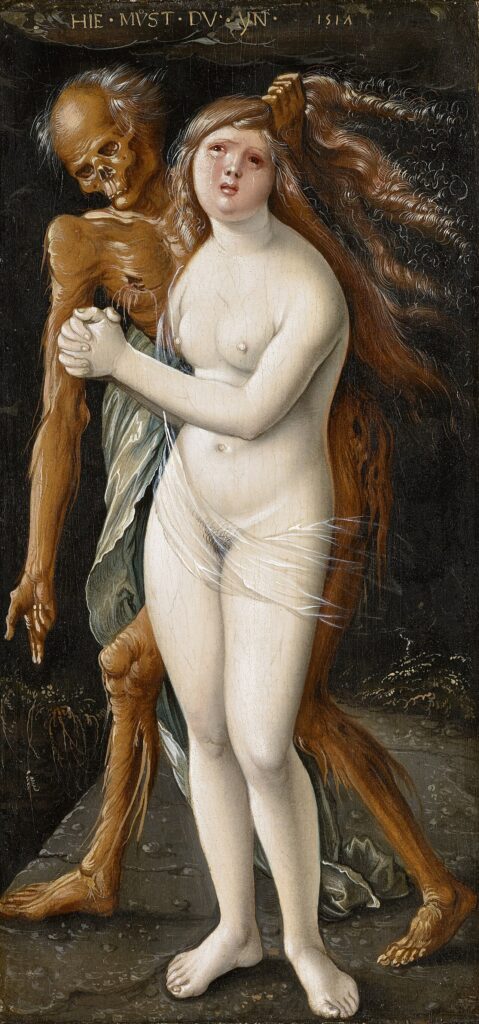
Few Renaissance paintings confront viewers as directly as Hans Baldung Grien’s Death and the Maiden. At first glance, the work appears simple: a beautiful young woman recoils as a skeletal figure of Death seizes her by the hair and points toward the grave. Yet the longer you look, the more unsettling it becomes. Baldung transforms a familiar moral lesson into an intensely personal encounter, forcing us to witness the moment when youth, beauty, and earthly confidence collide with the one certainty that no one can escape. More than five centuries after it was painted, the image continues to captivate audiences because it speaks to fears that remain universal.
Created in 1517, Death and the Maiden belongs to a long artistic tradition known as memento mori, a Latin phrase meaning “remember that you must die.” Medieval and Renaissance artists frequently reminded viewers of life’s fragility through symbols such as skulls, extinguished candles, wilting flowers, and decaying bodies. Baldung, however, approached the subject with unusual intensity. Rather than presenting death as an abstract idea, he turned it into a dramatic confrontation between a living woman and an animated skeleton. The result is one of the most memorable and psychologically charged images of the Northern Renaissance.
Hans Baldung Grien: An Artist Drawn to Life and Death
Hans Baldung Grien was born around 1484 or 1485 in either Schwäbisch Gmünd or Strasbourg. He became one of the most talented pupils of the German Renaissance master Albrecht Dürer, whose workshop in Nuremberg exposed him to the highest standards of drawing, printmaking, and painting. Although Dürer’s influence can be seen in Baldung’s technical skill, the younger artist soon developed a style that was entirely his own. His work became more emotional, more imaginative, and often more provocative than that of his famous teacher.
The nickname “Grien”—meaning “green” in German—was adopted during Baldung’s early career, probably while he worked in Albrecht Dürer’s busy workshop, where several assistants shared the name Hans. Art historians generally agree the nickname helped distinguish him from the others, but its exact origin remains uncertain. One long-standing theory is that it referred to his fondness for the color green, whether in his clothing, personal emblem, or artistic identity, though no contemporary source explains the name with certainty.
Unlike many of his contemporaries, Baldung repeatedly explored themes that others treated only occasionally. Witches, supernatural visions, aging, mortality, and the passage of time appear throughout his paintings, drawings, and woodcuts. These recurring subjects reveal an artist fascinated by the tensions between physical beauty and inevitable decay. Rather than celebrating idealized perfection, Baldung often reminded viewers that every beautiful face would eventually age and every healthy body would one day perish.
His interest in mortality reflected the world around him. Early sixteenth-century Europe was marked by recurring outbreaks of plague, high infant mortality, political unrest, and religious uncertainty. Death was not a distant concept but a familiar presence in everyday life. Families often lost children, disease spread quickly through crowded towns, and life expectancy was far lower than it is today. Artists responded by creating works that encouraged viewers to reflect on their own mortality, and Baldung proved especially gifted at giving those reflections dramatic visual form.
Understanding the Death and the Maiden Tradition
The theme of Death and the Maiden existed long before Baldung picked up his brush. During the late Middle Ages, artists, poets, and writers frequently portrayed Death as an unavoidable companion who visited people regardless of age, wealth, or social status. Kings, bishops, merchants, peasants, and children all appeared in images reminding audiences that earthly rank offered no protection from mortality.
One of the most influential visual traditions was the Dance of Death, or Danse Macabre. In these images, skeletal figures led people from every walk of life in a grim procession toward the grave. The message was simple but powerful: death comes for everyone. Whether a person lived in luxury or poverty, no one escaped the final journey.
Baldung transformed this familiar idea by narrowing his focus. Instead of showing an entire procession, he concentrated on a single encounter between Death and a young woman. This change dramatically increased the emotional impact. Rather than observing humanity in general, viewers witness an intensely personal moment. The painting invites us to imagine ourselves in the maiden’s place, making its lesson impossible to ignore.
The choice of a young woman was equally significant. Youth has always symbolized vitality, hope, and future possibilities. By placing Death beside someone in the prime of life, Baldung challenged the comforting illusion that mortality belongs only to old age. His painting reminds viewers that death is governed neither by fairness nor by timing. It arrives according to no human schedule.
A Closer Look at the Painting
At the center of the composition stands the young woman, whose graceful form immediately captures the viewer’s attention. Baldung portrays her with pale skin, flowing blond hair, and an idealized figure characteristic of Renaissance beauty. Her body appears healthy and vibrant, emphasizing everything associated with life. There is no hint of illness or physical weakness. She seems to embody youth itself.
The skeleton behind her creates an unforgettable contrast. Every rib, bone, and hollow eye socket reminds viewers of the body’s eventual fate. Unlike the smooth flesh of the maiden, Death possesses no softness, warmth, or vitality. Baldung exaggerates this difference to heighten the emotional tension. The contrast is so sharp that the figures almost seem to belong to different worlds, yet they occupy the same physical space.
Perhaps the painting’s most striking gesture is Death’s grip on the maiden’s hair. Hair has long symbolized youth, femininity, and beauty. By seizing it so firmly, Death demonstrates complete control over qualities that people often believe define them. The maiden twists away instinctively, her expression filled with alarm. The viewer senses both physical resistance and emotional disbelief, as though she cannot comprehend what is happening until it is already too late.
Equally important is Death’s pointing gesture toward the grave. Rather than simply dragging the maiden away, the skeleton deliberately directs her attention to the destination awaiting every human being. The gesture transforms the painting from a dramatic scene into a visual sermon. Death is not merely claiming another victim; he is reminding both the maiden and the viewer of the unavoidable conclusion of every earthly life.
Symbolism Beyond the Surface
One reason Death and the Maiden continues to fascinate viewers is its rich symbolism. Every element contributes to a carefully balanced message about beauty, time, and mortality. The painting rewards slow observation because seemingly small details reinforce its central themes.
The contrast between living flesh and exposed bone forms the heart of the composition. Renaissance audiences would have immediately recognized this as a reminder that physical beauty cannot endure. However healthy or attractive a person may appear today, time eventually transforms every body into the same skeletal structure. Baldung visualizes that truth with remarkable directness.
The maiden’s nudity has also generated considerable discussion among art historians. While modern viewers may focus on its sensual qualities, Renaissance audiences often understood the unclothed body as representing vulnerability and the transient nature of earthly existence. Baldung undoubtedly recognized the visual power of the nude figure, yet his purpose extends beyond simple eroticism. The exposed body emphasizes that nothing—not clothing, wealth, or social status—can shield humanity from death.
Scholars have also noted the emotional ambiguity of the painting. The skeleton appears active and determined, while the maiden reacts with fear and surprise. There is little indication of violence beyond the grip on her hair, yet the psychological tension is intense. Baldung understood that terror often arises not from visible bloodshed but from the realization that resistance is ultimately futile.
This emotional complexity helps explain why the painting has remained influential for centuries. Rather than relying on dramatic action alone, Baldung captures the instant when certainty gives way to understanding. It is the moment when youth recognizes mortality, beauty confronts decay, and life meets its inevitable conclusion. That frozen instant continues to resonate because every viewer, regardless of time or culture, knows that the same encounter awaits us all.
Why the Painting Still Speaks to Modern Audiences
More than five hundred years after Hans Baldung Grien completed Death and the Maiden, the painting continues to attract scholars, museum visitors, and art lovers. Its lasting appeal comes from its honesty. While artistic styles, religious beliefs, and cultural values have changed dramatically since the early sixteenth century, the reality of mortality has not. Every generation must eventually confront the same questions about life, aging, and death.
Modern viewers may not interpret the painting exactly as Baldung’s contemporaries did, but its emotional power remains intact. Today, many people see the work as a meditation on the fleeting nature of youth rather than as a purely religious warning. In an age dominated by social media, cosmetic procedures, and a constant pursuit of youthful appearance, Baldung’s message feels surprisingly relevant. The painting reminds us that beauty, while worth appreciating, is temporary.
Another reason for its enduring popularity is its psychological depth. Baldung avoids turning Death into a grotesque monster. Instead, the skeleton behaves with calm certainty. The maiden’s fear comes not from an attack but from the sudden realization that her life can change in an instant. That emotional truth makes the painting feel remarkably modern. It explores the shock of confronting something we know intellectually but rarely accept emotionally.
The work also encourages viewers to reflect rather than despair. Although the image is unsettling, it is not entirely hopeless. The reminder of mortality invites us to value the present, appreciate relationships, and recognize that time is limited. In this sense, Death and the Maiden becomes less a celebration of death than an affirmation of life.
Baldung’s Unique Artistic Vision
Hans Baldung Grien returned to themes of mortality throughout his career, producing several paintings, drawings, and prints that explored the relationship between youth and death. His repeated interest suggests that this subject fascinated him on both an artistic and philosophical level. Rather than treating death as a single event, he viewed it as a constant companion to life.
His style also distinguished him from many Renaissance artists. While Italian painters often emphasized ideal beauty, balance, and classical harmony, Baldung embraced emotional intensity and dramatic contrasts. His figures possess expressive gestures, elongated forms, and vivid personalities that immediately engage the viewer. Even when depicting familiar religious or moral themes, he infused them with striking originality.
Color plays an important role in Death and the Maiden. The warm tones of the woman’s flesh contrast sharply with the cold, lifeless appearance of the skeleton. This visual opposition reinforces the painting’s central idea without requiring lengthy explanation. Baldung understood that color could communicate emotion as effectively as facial expressions or symbolic objects.
Composition further strengthens the image. The twisting movement of the maiden creates tension, while Death’s firm grip prevents any possibility of escape. The viewer’s eye naturally follows the skeleton’s pointing hand toward the grave, completing the narrative within a single frame. Every element works together to create a powerful visual statement about the inevitability of mortality.
Historical Context and Renaissance Beliefs
To fully appreciate Death and the Maiden, it helps to understand the world in which it was created. Europe in 1517 stood on the threshold of enormous religious and political change. The Protestant Reformation began that same year when Martin Luther challenged the practices of the Catholic Church. Although Baldung’s painting is not directly about the Reformation, it emerged during a period of deep spiritual reflection and uncertainty.
Disease also shaped everyday life. Recurrent outbreaks of plague and other illnesses reminded people that life could end suddenly. Medical knowledge remained limited, and even wealthy families had little protection against epidemic disease. Under these conditions, reminders of mortality were not considered morbid curiosities but practical lessons about preparing for the future.
Artists often responded by creating works that encouraged moral reflection. Images of skulls, skeletons, hourglasses, and decaying bodies served as visual reminders that earthly achievements were temporary. Baldung adopted these familiar ideas but presented them with exceptional emotional force. Rather than relying on symbols alone, he staged a dramatic encounter that demanded the viewer’s attention.
His painting also reflects the Renaissance fascination with the human body. Baldung possessed remarkable anatomical skill, allowing him to depict both youthful flesh and skeletal structure with convincing detail. Ironically, the same artistic knowledge that enabled him to celebrate beauty also allowed him to portray its inevitable disappearance. That tension gives the work much of its lasting power.
A Masterpiece That Refuses to Be Forgotten
Today, Death and the Maiden remains one of Hans Baldung Grien’s most celebrated works. It appears regularly in discussions of Renaissance art, Northern European painting, and the long tradition of memento mori. Art historians continue to study its symbolism, technique, and cultural significance, while museum visitors often find themselves lingering before the painting longer than expected.
Its influence extends beyond the visual arts. Writers, composers, photographers, and filmmakers have repeatedly returned to the theme of Death confronting youth and beauty. Although each generation interprets the subject differently, Baldung’s version remains one of the most memorable because of its emotional immediacy. The painting captures a universal experience in a single unforgettable moment.
Perhaps the greatest achievement of Death and the Maiden is that it refuses to provide easy answers. It does not explain why death comes when it does, nor does it promise fairness or comfort. Instead, it asks viewers to acknowledge a truth shared by every human being. That honesty gives the work an enduring dignity that continues to resonate centuries after it was painted.
Standing before Baldung’s masterpiece today, it is easy to understand why it has never lost its power. The painting is beautiful, disturbing, elegant, and deeply human all at once. It reminds us that while beauty may fade and life may be brief, great art has the remarkable ability to preserve a single moment forever. In that sense, Hans Baldung Grien achieved something extraordinary: he transformed one fleeting encounter into an image that continues to speak across the centuries.
Key Takeaways
- Hans Baldung Grien painted Death and the Maiden in 1517, creating one of the Northern Renaissance’s most powerful memento mori images.
- The painting contrasts youthful beauty with skeletal death to emphasize the inevitability of mortality.
- Death’s grip on the maiden’s hair and his gesture toward the grave form the emotional and symbolic center of the composition.
- Baldung frequently explored themes of aging, mortality, and the fragile nature of earthly beauty throughout his career.
- The painting remains relevant because it addresses universal questions about life, time, and the certainty of death.
Frequently Asked Questions
1. When was Death and the Maiden painted?
The best-known version was painted in 1517 by Hans Baldung Grien.
2. What does the painting symbolize?
It serves as a memento mori, reminding viewers that beauty, youth, and life itself are temporary.
3. Why is the woman depicted nude?
Her nudity emphasizes vulnerability, the ideal of youthful beauty, and the transient nature of physical existence.
4. Was Hans Baldung Grien influenced by Albrecht Dürer?
Yes. Baldung trained in Dürer’s workshop before developing his own distinctive style and thematic interests.
5. Why is this painting still famous today?
Its striking composition, emotional intensity, and timeless meditation on mortality continue to resonate with modern audiences.