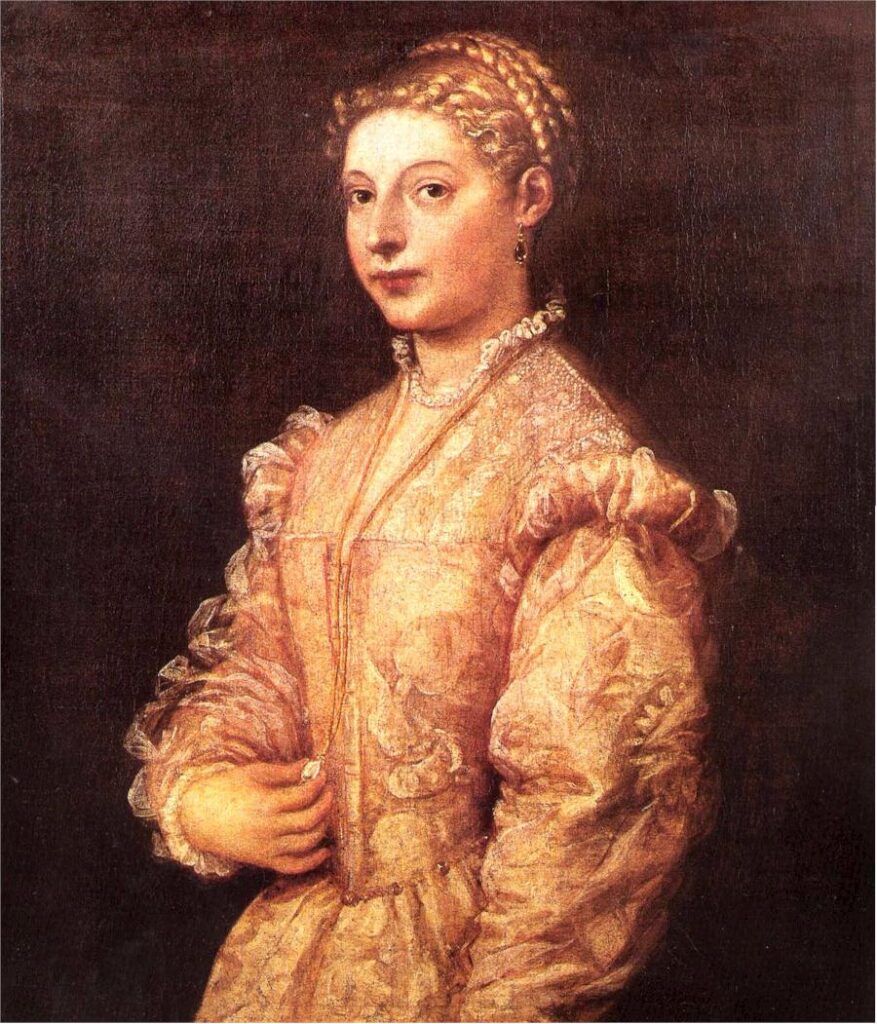
The history of Renaissance art is filled with famous patrons, powerful rulers, and celebrated masterpieces, yet some of its most compelling stories unfolded far from courts and palaces. One of those stories belongs to Titian and Cecilia, a couple who built a family together while the painter rose to become the most sought-after artist in Venice. Their love story was not preserved in letters or grand public declarations. It survives in quieter facts: a long relationship, children, marriage during illness, recovery, domestic life, and deep grief after death.
When Titian Met Cecilia
A Young Artist on the Rise
Tiziano Vecellio, known in English as Titian, was born around 1488–1490 in Pieve di Cadore, a mountain town in Venetian territory. As a boy, he moved to Venice, one of the richest cities in Europe. There he trained in the world of Venetian painting and became linked with the artistic legacy of Gentile Bellini, Giovanni Bellini, and Giorgione.
By the 1510s, Titian was no ordinary young painter. His talent was being noticed in a city crowded with ambition. After Giovanni Bellini’s death in 1516, Titian came to dominate painting in Venice. That meant more patrons, more commissions, and a growing reputation that would eventually reach princes, emperors, and kings.
Cecilia entered his life during this rising period. The surviving record does not tell us exactly when they met. It does not give us their first conversation, their courtship, or her private thoughts. What it does show is that she became part of his household before marriage and remained with him through important years of his career.
The Woman from Cadore
Cecilia came from Cadore, the same region as Titian. Some later accounts identify her as the daughter of a barber. That detail matters because she was not a duchess, princess, or noble patron. She belonged to the more ordinary world from which Titian himself had risen.
Sometime in the early 1520s, Titian brought Cecilia into his home in Venice. Their relationship was already serious before it became official. Their first son, Pomponio, was born in 1524. Their second son, Orazio, was born in 1525.
Those dates tell us something important. Titian did not simply marry first and begin a family later. He and Cecilia had already built a household before their wedding. That made their eventual marriage less like the beginning of the relationship and more like the public sealing of a bond already tested by real life.
A Love That Became a Family
The Marriage of 1525
In 1525, Cecilia became gravely ill. During that illness, Titian married her. The marriage gave formal standing to a relationship that had already produced two sons. It also helped secure the family’s position at a moment when Cecilia’s life seemed in danger.
Cecilia recovered. That fact gives this part of the story a brief but powerful turn toward hope. The couple then had several more years together as husband and wife. In those years, Titian’s professional life continued to grow, while his home life centered on Cecilia and their children.
Their daughter Lavinia was born around 1529 or 1530. Another daughter was born as well, but she died in infancy. So the family record includes four children: Pomponio, Orazio, Lavinia, and a daughter whose life was tragically brief.
The Children of Titian and Cecilia
Family was not a side note in Titian’s life. His children shaped his household, his plans, and his later years. Pomponio, born in 1524, was intended for a church career and became a priest. Orazio, born in 1525, followed his father into painting and became Titian’s chief assistant.
Lavinia, born around 1529 or 1530, remained important in Titian’s family story. Her life, marriage, and place in the household kept her closely tied to her father’s later concerns. The unnamed daughter who died in infancy reminds us how fragile family life could be, even in a prosperous home.
Key members of the family included:
- Cecilia
- Titian, or Tiziano Vecellio
- Pomponio Vecellio
- Orazio Vecellio
- Lavinia Vecellio
- An unnamed daughter who died in infancy
Life Inside the Vecellio Household
Titian’s home was not only a private residence. It was also connected to a working artistic enterprise. Renaissance painters often lived close to their workshops, assistants, materials, and patrons. A successful painter’s household could be busy from morning to night.
Cecilia’s exact daily duties are not recorded. Still, a household with children, servants, visitors, studio demands, and business concerns needed order. The practical side of success can be easy to overlook, but it mattered. Paintings did not emerge from silence and empty rooms.
While Titian built his reputation in Venice, Cecilia helped form the family life behind that public success. She was present during the years when his career moved from strong local fame toward international renown. That does not mean we should invent her influence over specific paintings. It does mean she belonged to the foundation of his private world.
Happiness Interrupted by Tragedy
Cecilia’s Final Illness
Cecilia’s recovery after the illness of 1525 gave the family more time together, but it did not last long. In 1530, only five years after the marriage, she died. Historical sources place her death in that year, and many accounts give August 1530.
Her death came when Titian was still in the prime of life and at a powerful stage of his career. He had young children in the household. Lavinia was likely still an infant. Orazio and Pomponio were still boys.
Renaissance families knew illness well. Even wealth and talent could not keep death from the door. In Cecilia’s case, the loss ended a partnership that had carried Titian through some of the most important years of his rise.
Titian’s Grief
After Cecilia’s death, Titian was described as disconsolate. That is one of the strongest surviving clues to the emotional weight of the marriage. The record does not give us a private diary, but it does preserve the fact that her death struck him hard.
He never remarried. That fact is important and should not be passed over. Widowers in Renaissance Italy could remarry, especially when children and property were involved. Titian did not.
His life did not stop. His career continued with extraordinary force. Yet the family Cecilia had helped create had to be reorganized without her. The public artist went on; the private man had lost his wife.
Life After Cecilia
After Cecilia’s death, Titian relied on family help to manage his household. His children remained central to his life. Orazio eventually became his close assistant, working within the artistic world his father had built.
In 1531, Titian moved with his two sons and infant daughter to a new house in the Biri Grande district on the northern edge of Venice. This move came soon after Cecilia’s death and marked a new stage in family life. The household continued, but without the woman who had helped hold it together.
The years after 1530 brought more fame, more commissions, and more contact with powerful patrons. Still, Cecilia’s absence remained part of the story. Titian’s public triumphs did not erase the private loss.
Why Their Love Story Still Matters
A Marriage with a Quiet Record
The love story of Titian and Cecilia is not dramatic in the usual sense. There are no surviving love letters to quote. There are no verified portraits that can safely be called Cecilia’s likeness. There are no recorded speeches, secret meetings, or theatrical scandals.
That actually makes the story more honest. What remains is enough: they lived together, had children, married during a crisis, recovered hope for a time, and were separated by death. Titian’s grief and his choice not to remarry give the story its emotional weight.
It is a love story built from facts rather than decoration. That makes it quieter, but not weaker. Sometimes the strongest evidence of devotion is not a poem. Sometimes it is a household, a marriage, children, and a loss remembered.
Cecilia’s Legacy Through Her Children
Cecilia’s legacy lived on through her children. Pomponio, Orazio, and Lavinia carried the family story beyond her short life. Orazio’s role as Titian’s chief assistant was especially important because it tied the son directly to the father’s workshop.
Lavinia also remained part of the family’s later history. Her place in Titian’s life shows that Cecilia’s influence did not vanish in 1530. A mother’s legacy often survives in the children she leaves behind.
The unnamed infant daughter also deserves mention, even though little is known about her. Her brief life reminds us that Renaissance family histories were often marked by sorrow as well as success. Cecilia’s world was not made of marble and gold. It was made of ordinary human hopes.
The Human Side of a Master
Titian became one of the greatest painters in European history. He worked for elite patrons and shaped the course of Venetian art. His name belongs beside the masters of the Renaissance.
But Cecilia’s story brings him closer to earth. She shows us Titian as a companion, husband, father, and widower. That side of him matters because great art is made by human beings, not legends.
Cecilia remains only partly visible in the historical record. Yet the facts that survive are meaningful. She shared Titian’s home, bore his children, became his wife, recovered once from grave illness, died young, and left him grieving. For a love story, that is enough.
Lasting Elements of Cecilia’s Legacy
- Longtime companion and wife of Titian
- Mother of Pomponio, Orazio, Lavinia, and an infant daughter who died young
- Central figure in Titian’s household during his rise in Venice
- Part of the family story that shaped Orazio’s later role in the workshop
- Remembered through the grief Titian felt after her death and his choice not to remarry