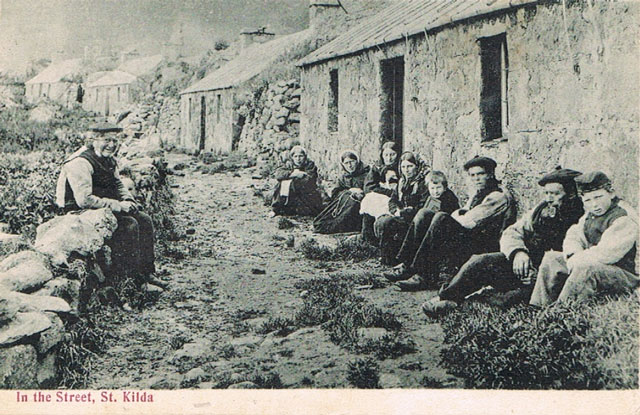
Far beyond the western edge of the Outer Hebrides, where the Atlantic Ocean dominates every horizon, lies St. Kilda. Few places in Britain have inspired such fascination among artists, photographers, writers, travelers, and historians. The archipelago’s towering sea cliffs, restless weather, and extraordinary isolation created a landscape that seemed almost detached from the modern world. For generations, visitors arrived expecting to see a remote island community. What they found instead was a place that appeared timeless, dramatic, and unlike anywhere else in Scotland.
The artistic story of St. Kilda is inseparable from the history of the people who lived there. Human occupation stretches back thousands of years, and for centuries the islanders developed a distinctive way of life shaped by seabirds, steep cliffs, and the challenges of survival in the North Atlantic. By the nineteenth century, improvements in transport and growing public curiosity brought increasing numbers of visitors to the islands. Artists and photographers followed, eager to record a community that many mainland observers regarded as one of the last truly isolated societies in Britain.
Unlike many celebrated landscapes, St. Kilda was never famous solely because of scenery. The islands attracted attention because of the relationship between people and place. Artists found visual drama in the cliffs and sea stacks, but they also found compelling stories in stone cottages, bird hunters, crofting fields, and daily routines that seemed unchanged for generations. The result was a body of imagery that documented both nature and human endurance.
Today, St. Kilda remains one of Scotland’s most powerful artistic subjects. Although permanently inhabited life ended in 1930, the islands continue to inspire photographers, painters, filmmakers, and visitors who encounter their remarkable combination of beauty, history, and solitude.
Why St. Kilda Captured the Artistic Imagination
A Landscape Unlike Anywhere Else in Britain
St. Kilda occupies a remote position in the Atlantic Ocean roughly forty miles west of North Uist. The archipelago consists principally of Hirta, Soay, Boreray, and Dun. Rising dramatically from the sea, these islands possess some of the highest sea cliffs in Europe. The visual impact is immediate. Sheer rock faces rise hundreds of feet above crashing waves, while sea birds circle constantly overhead.
For artists accustomed to the gentler landscapes of mainland Britain, St. Kilda offered a different experience altogether. The islands presented a world of vertical cliffs, narrow bays, and constantly changing weather. Light could transform the scene within minutes. Sunlit slopes might suddenly disappear beneath mist, while storms rolling in from the Atlantic altered colors and textures across the landscape.
The islands also fit comfortably within the artistic tradition known as the Sublime. During the eighteenth and nineteenth centuries, artists and travelers increasingly sought landscapes capable of inspiring awe, wonder, and even fear. Mountain ranges, waterfalls, and rugged coastlines became popular subjects. St. Kilda possessed all these qualities in concentrated form. The landscape appeared both beautiful and intimidating.
Visitors frequently described their first sight of Hirta from the sea as unforgettable. The approach emphasized scale and isolation. Long before reaching land, travelers encountered towering cliffs emerging from the Atlantic. Artists recognized that this sense of distance and remoteness could not easily be found elsewhere in Britain, making St. Kilda an exceptionally attractive subject.
Isolation, Community, and Cultural Fascination
The visual appeal of St. Kilda was enhanced by its unusual social history. For centuries the islanders maintained a way of life heavily dependent on seabirds. Fulmars, gannets, and puffins provided food, feathers, and oil. Harvesting these resources required remarkable climbing skills and intimate knowledge of the cliffs.
By the nineteenth century, mainland audiences became increasingly fascinated by remote communities. Newspapers, travel books, and illustrated publications described St. Kilda as a place where traditional customs survived far longer than elsewhere in Britain. Such accounts sometimes exaggerated differences, yet they undoubtedly increased public interest in the islands.
Tourism began to grow during the Victorian era. Regular summer cruises reached St. Kilda from 1877 onward, bringing visitors who wished to see the famous island community for themselves. These excursions expanded awareness of the islands and increased demand for images that documented both the landscape and its inhabitants. The arrival of photographers proved especially significant.
Artists found themselves drawn to contrasts. They encountered a community living in one of Europe’s most dramatic landscapes while maintaining traditions shaped by generations of adaptation. The visual relationship between cottages, cultivated ground, and surrounding cliffs became one of the defining themes of St. Kilda imagery.
Photography and the Visual Record of St. Kilda
Early Photographers and the Documentation of Island Life
Photography transformed the way St. Kilda was represented. Earlier illustrations often depended on sketches made during brief visits. Photographs, by contrast, offered viewers a more direct encounter with the islands and their people. During the second half of the nineteenth century, advances in photographic technology made it increasingly practical to record distant locations.
Photographers arriving on St. Kilda documented a wide range of subjects. They captured village streets, stone houses, agricultural activity, fishing practices, and the dramatic coastal scenery. Their images preserved details that written descriptions often overlooked. Clothing, building techniques, tools, and social gatherings all became part of the visual record.
The importance of these photographs extends far beyond aesthetics. Many images now serve as historical evidence for scholars studying island life. Because the community was evacuated in 1930, photographs preserve a world that no longer exists. They provide an irreplaceable record of architecture, customs, and everyday experience.
Photography also altered public perceptions of remoteness. Viewers who would never travel to the Outer Hebrides could now see St. Kilda for themselves. Images circulated through albums, publications, exhibitions, and commercial prints. The islands became increasingly familiar to audiences across Britain even while remaining geographically isolated.
George Washington Wilson and the Popular Image of St. Kilda
No photographer played a more important role in shaping Victorian views of Scotland than George Washington Wilson. Born in 1823, Wilson originally trained as a portrait miniaturist before establishing himself as a photographer in Aberdeen. Over time he built one of the most successful photographic businesses of the nineteenth century. His firm produced tens of thousands of images and became internationally known.
Wilson’s photographs helped define how many people imagined Scotland. He recorded landscapes, towns, castles, and coastal scenes across the country. His work combined technical excellence with a strong sense of composition, making his images attractive both as documents and as works of art.
Among the surviving photographs associated with St. Kilda is St. Kilda, A Group, produced during the period between the 1860s and 1880s. The albumen print measures 18.8 by 28.7 centimeters and is held by the National Galleries of Scotland. The image forms part of a broader visual record that introduced Victorian audiences to the islands and their inhabitants.
Wilson’s photographs reached audiences far beyond Scotland. Through commercial distribution, his images helped transform St. Kilda from a distant curiosity into a recognizable symbol of Scottish island life. His work remains among the most valuable visual sources for understanding the islands during the nineteenth century.
Photography Before and After the 1930 Evacuation
The final decades of permanent habitation generated some of the most poignant images associated with St. Kilda. Photographers documented a community facing growing challenges. Population decline, changing economic conditions, and increasing contact with the mainland gradually altered traditional ways of life.
Several developments accelerated these changes. Young people increasingly left the islands. Disease outbreaks caused hardship. Crop failures created additional difficulties. By 1930 the remaining residents concluded that continued occupation was no longer sustainable. On 29 August 1930, the final thirty-six islanders departed Hirta aboard HMS Harebell after requesting evacuation.
Photographs taken before evacuation possess unusual emotional power because they capture the final years of a living community. Images that may once have seemed routine now appear as records of a disappearing world. Stone cottages, village gatherings, and working landscapes acquired new significance once permanent habitation ended.
After 1930, photographic attention shifted. The focus moved from documenting a community to preserving memory. Empty buildings, abandoned settlement patterns, and traces of former lives became recurring themes. The islands remained visually compelling, but the mood changed. Photographers increasingly explored absence, heritage, and the passage of time.
Key themes frequently seen in St. Kilda photography include:
- Village life and community gatherings
- Traditional stone architecture
- Seabird hunting and harvesting
- Atlantic cliffs and coastal scenery
- Evacuation and cultural memory
St. Kilda in Painting, Printmaking, and Artistic Interpretation
From Topographical Record to Artistic Expression
Not every artist approached St. Kilda as a documentary subject. While photographers often emphasized factual recording, painters and printmakers enjoyed greater freedom. Many sought to communicate atmosphere rather than precise description. The result was a broad range of artistic responses.
The islands encouraged interpretation because their character changes constantly. Weather can transform the appearance of cliffs and sea within minutes. Mist softens distant forms. Sunlight creates dramatic contrasts between illuminated slopes and dark shadows. Such conditions naturally invite artistic experimentation.
Painters frequently emphasized emotional responses to the landscape. Instead of recording every geographical detail, they highlighted scale, color, and mood. Storms, sunsets, and turbulent seas became opportunities to explore themes of nature’s power. The landscape served as both subject and symbol.
This approach connected St. Kilda to wider traditions in Scottish landscape art. Artists throughout the nineteenth and twentieth centuries explored remote environments as expressions of national identity, natural beauty, and human resilience. St. Kilda offered an especially dramatic version of these themes.
The Influence of the Sublime in Scottish Art
The concept of the Sublime remained important long after its initial popularity in the eighteenth century. Artists continued to seek subjects capable of inspiring wonder and emotional intensity. St. Kilda possessed many characteristics associated with this tradition.
Scale played a crucial role. Human structures appeared tiny against immense cliffs and open ocean. Such contrasts encouraged reflection on humanity’s relationship with nature. The islands seemed both magnificent and indifferent, beautiful yet potentially dangerous.
Weather contributed to this effect. Atlantic storms could transform calm seas into violent waters. Clouds cast shifting shadows across hillsides. These conditions created visual drama that appealed strongly to landscape artists. The islands rarely appeared static or predictable.
For many artists, St. Kilda represented a meeting point between civilization and wilderness. The presence of a long-established community within such a challenging environment heightened the emotional impact of the landscape. Human persistence became part of the visual story.
Twentieth-Century and Modern Artistic Responses
Interest in St. Kilda did not end with evacuation. In many ways, artistic fascination increased. The islands became symbols of memory, resilience, and cultural change. Artists increasingly explored what had been lost as well as what remained.
Twentieth-century creative responses often focused on traces of former habitation. Empty houses, abandoned cleits, and weathered stone walls became powerful visual motifs. These structures suggested continuity with the past while highlighting the absence of former residents.
Printmakers found particular value in the islands’ strong shapes and dramatic contrasts. Cliffs, ridges, and village remains translated effectively into graphic forms. The starkness of the landscape encouraged bold compositions and expressive mark-making.
Contemporary artists continue to visit and interpret St. Kilda. Some focus on environmental themes. Others explore cultural memory, conservation, or the relationship between history and place. Despite changing artistic styles, the islands remain a source of inspiration because their fundamental qualities have not changed. The cliffs still dominate the horizon. The Atlantic still shapes every experience of the landscape.
St. Kilda’s Legacy in Contemporary Art and Cultural Memory
The Evacuation as an Artistic Subject
The evacuation of 29 August 1930 occupies a central place in modern interpretations of St. Kilda. The event marked the end of a community that had endured for generations under extraordinary conditions. Artists, filmmakers, and historians continue to revisit this moment because it combines human drama with historical significance.
Accounts of the evacuation often emphasize both sorrow and practicality. The islanders did not leave because they abandoned their heritage. They left because maintaining life on the islands had become increasingly difficult. Population decline, health concerns, and economic challenges made continued occupation uncertain.
This complexity gives artists rich material to explore. The story is not simply one of loss. It is also a story of adaptation, survival, and difficult decisions. Such themes continue to resonate with modern audiences.
Visual representations of the evacuation frequently focus on departure. Boats leaving Village Bay, empty cottages, and fading traces of occupation all serve as symbols of transition. The emotional force of these images remains powerful nearly a century later.
Heritage, Conservation, and Visual Culture
The significance of St. Kilda extends beyond art. The archipelago is recognized internationally for both natural and cultural importance. Its cliffs support vast seabird colonies, while archaeological remains preserve evidence of long-term human occupation. UNESCO recognizes the exceptional value of the islands and their heritage.
Conservation efforts have helped protect the landscape and surviving structures. As a result, artists today can still encounter many of the features that attracted earlier visitors. The relationship between preservation and artistic inspiration remains strong.
Books, documentaries, exhibitions, and photographic projects continue to feature St. Kilda. Each generation discovers the islands anew. While methods of representation have changed, the central themes remain remarkably consistent. Isolation, endurance, and natural beauty continue to dominate artistic responses.
Modern visual culture often treats St. Kilda as a symbol of Scotland’s maritime heritage. Images of Hirta’s village, steep slopes, and surrounding cliffs appear frequently in discussions of national history and identity. The islands occupy a unique position in the Scottish imagination.
Why Artists Still Return to St. Kilda
Few places combine natural drama and human history as effectively as St. Kilda. Artists arrive expecting spectacular scenery and discover a much deeper story. Every ruined building and cultivated patch of land hints at generations of effort and adaptation.
The islands also encourage reflection. Their distance from the mainland creates a sense of separation from ordinary routines. Visitors often describe feeling more aware of weather, landscape, and time itself. Such experiences naturally inspire creative work.
Environmental concerns have added another dimension to contemporary interest. St. Kilda’s bird colonies, marine environment, and fragile ecosystems attract researchers as well as artists. Many modern works explore the relationship between people and nature through the lens of the islands’ history.
Nearly a century after the evacuation, St. Kilda continues to inspire artistic imagination. The reasons are clear. Few landscapes possess such visual power. Few communities left such a distinctive historical record. Together they created a subject that remains as compelling today as it was to Victorian photographers arriving by steamer more than a hundred years ago.
Lasting Artistic Themes Associated with St. Kilda
- Isolation and remoteness
- Human resilience
- Community and tradition
- The power of nature
- Memory and heritage
Key Takeaways
- St. Kilda’s dramatic Atlantic landscape made it a compelling artistic subject.
- Photography played a crucial role in documenting island life during the nineteenth century.
- George Washington Wilson helped shape public understanding of St. Kilda through widely distributed photographs.
- The evacuation of 29 August 1930 transformed the islands into a powerful symbol of cultural memory.
- Contemporary artists continue to draw inspiration from the archipelago’s unique combination of history and scenery.
Frequently Asked Questions
- Where is St. Kilda located?
St. Kilda lies in the Atlantic Ocean west of the Outer Hebrides of Scotland. - When was St. Kilda evacuated?
The final thirty-six residents left on 29 August 1930. - Why is St. Kilda important to art history?
Its landscape, isolation, and distinctive community attracted photographers, painters, and later filmmakers. - Who was George Washington Wilson?
He was one of Scotland’s most important nineteenth-century photographers and created influential images associated with St. Kilda. - Why do artists still visit St. Kilda?
The islands offer dramatic scenery, rich history, and themes of memory, resilience, and environmental change.