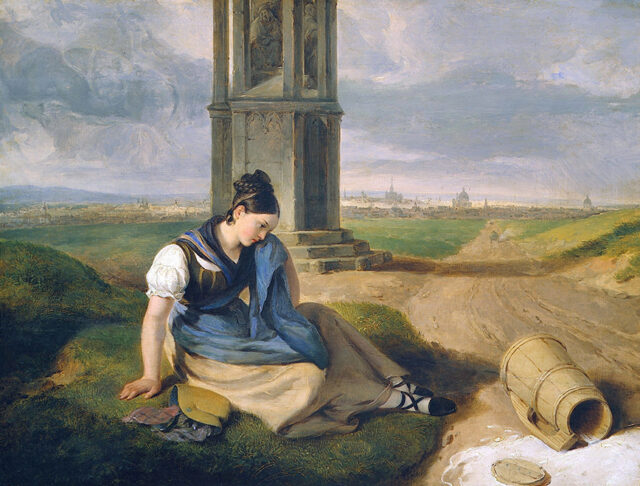
Peter Fendi’s The Milkmaid from 1830 is not a peaceful celebration of orderly rural labor. It is something more human and far more interesting. The small painting captures the aftermath of a mishap. Milk has been spilled across the ground, the container lies overturned, and the young milkmaid sits beside the mess staring downward at what has happened. Instead of triumph, grace, or ideal beauty, Fendi gives the viewer a moment of frustration and embarrassment that almost anyone can understand immediately.
The work is small in size, measuring only 21.6 by 29 centimeters, yet it feels emotionally direct because of that intimacy. Fendi painted it in oil on wood rather than canvas, a surface that allowed him to create smooth detail and controlled texture. The painting is signed “Fendi 1830” and today belongs to the Wien Museum in Vienna. The modest scale suggests the painting was intended for close private viewing rather than public display in a grand hall.
The milkmaid herself sits low in the composition, becoming the emotional center of the scene. She does not appear theatrical or exaggerated. Her attention is fixed on the spilled milk before her. That downward gaze changes everything about the mood. The painting becomes less about labor itself and more about the fragile unpredictability of ordinary life. One small accident has interrupted the rhythm of daily work.
That tiny narrative moment is exactly what makes the painting memorable. Many nineteenth-century genre scenes fall into sentimental clichés or exaggerated moral lessons. Fendi avoids both traps. He neither mocks the girl nor transforms her into a saintly symbol of peasant virtue. Instead, he paints her as an ordinary person caught in an ordinary failure. The result feels surprisingly modern in emotional honesty.
The Scene Fendi Actually Painted
A Moment After the Accident
The most striking feature of The Milkmaid is the spilled milk itself. The overturned vessel immediately tells the viewer that something has gone wrong. This is not a posed portrait of a servant carrying out her duties calmly and efficiently. The central event has already occurred before the viewer arrives. Fendi paints the aftermath rather than the action.
That choice creates subtle tension. The milk cannot be recovered. The task has failed. The girl appears caught in the brief pause after realizing the mistake. It is a deeply recognizable human moment. Nearly everyone knows the feeling of staring at an accident seconds after it happens, before deciding what to do next.
The emotional restraint of the scene is important. Fendi does not exaggerate the girl’s reaction into melodrama. She is not crying, collapsing, or gesturing wildly. The quietness makes the scene more believable. Her stillness suggests resignation more than panic. In many ways, the painting is about disappointment contained within ordinary daily life.
This approach reflects one of Fendi’s greatest strengths as a painter. He understood how small incidents could reveal character. Instead of grand historical drama, he focused on modest emotional truths. The painting works because the accident remains small, temporary, and entirely human.
The Milkmaid Herself
The young woman is dressed plainly, consistent with rural working life in early nineteenth-century Austria. Her clothing appears practical rather than decorative. Fendi avoids aristocratic elegance or romantic fantasy. The figure belongs to the working world, and her clothes reflect that reality.
Her seated posture matters psychologically. Rather than leaping into action, she pauses. The viewer senses the moment immediately after realization. Her downward focus pulls attention toward the spilled milk and reinforces the emotional center of the composition. The scene becomes introspective rather than active.
Fendi also avoids idealized beauty. The milkmaid is attractive in a natural way, but she is not transformed into an artificial symbol. This realism separates the painting from many sentimental rural scenes popular during the nineteenth century. She feels like a real person rather than a decorative invention.
The figure’s physical presence also reflects Fendi’s broader artistic interests. Throughout his career, he painted ordinary Austrians with sympathy and careful observation. Servants, children, laborers, and middle-class families all appeared in his work with similar emotional seriousness. The Milkmaid fits comfortably within that larger body of genre painting.
Small Scale, Strong Intimacy
The painting’s size plays a major role in its emotional impact. At just over twenty centimeters high, it invites close viewing. This is not a picture meant to dominate a room from a distance. It rewards attention at intimate range, where viewers can study facial expression, textures, and the arrangement of objects.
Small paintings often create stronger emotional identification because they resemble private experience rather than public spectacle. Fendi understood this instinctively. The viewer feels almost physically near the milkmaid and the spilled milk. The compact composition increases the sense of immediacy.
The oil-on-wood surface also contributes to the painting’s appearance. Wood panels allow for controlled detail and smooth transitions. Fendi used that precision well. Surfaces appear carefully observed without becoming rigid or overly polished. The scene retains warmth despite the controlled technique.
Because of its scale, the painting also reflects the culture of Biedermeier collecting in Vienna during the 1820s and 1830s. Middle-class collectors increasingly purchased intimate genre scenes for domestic interiors. Paintings were meant to be lived with quietly rather than displayed as monuments of status or political power.
Peter Fendi and Biedermeier Realism
The World Fendi Knew
Peter Fendi was born in Vienna in 1796 and lived during a period of enormous political change across Europe. Austria emerged from the Napoleonic Wars determined to preserve social stability and conservative order. During the Biedermeier period, artists often turned inward toward domestic life, ordinary work, and familiar routines instead of revolutionary politics or heroic warfare.
Fendi became one of the defining painters of this cultural environment. His works consistently focused on small moments of human experience. Children studying, families praying, workers resting, and servants performing daily tasks all became worthy artistic subjects in his hands.
Unlike some academic painters, Fendi rarely aimed for grandeur. His strength lay in emotional precision and close observation. He understood how ordinary gestures and expressions could carry emotional weight without theatrical exaggeration.
The Milkmaid reflects this artistic philosophy perfectly. Nothing dramatic happens in the painting by historical standards. No battle unfolds. No ruler appears. No religious miracle occurs. Yet the scene feels emotionally complete because Fendi understood the quiet drama of ordinary disappointment.
Humor and Humanity
One overlooked quality in Fendi’s work is gentle humor. The Milkmaid may contain more of it than many viewers initially realize. The spilled milk introduces a touch of irony into the scene. The title promises milk, yet the milk is now wasted on the ground.
The humor remains compassionate rather than cruel. Fendi does not ridicule the girl. Instead, the painting recognizes the universal nature of accidents and frustration. Everyday life contains clumsiness, mistakes, and interrupted routines. The painting quietly acknowledges that truth.
This balance between sympathy and realism helped distinguish Biedermeier genre painting from sentimental fantasy. Fendi’s world is warm, but it is not perfect. People fail, objects break, and work goes wrong. Yet life continues quietly afterward.
The emotional modesty of the scene also feels distinctly Austrian in character. Rather than explosive emotion, the painting offers restraint, patience, and reflection. The milkmaid appears absorbed in thought rather than dramatic self-pity.
Dutch Influences and Austrian Character
Fendi’s genre scenes show clear awareness of earlier Dutch painting traditions. Seventeenth-century Dutch artists often painted servants, kitchens, taverns, and domestic mishaps with realism and subtle humor. Johannes Vermeer’s The Milkmaid from around 1658–1661 remains the most famous milkmaid image in European art.
Yet Fendi’s painting differs significantly from Vermeer’s approach. Vermeer presents labor as calm, orderly, and almost timeless. Fendi instead captures interruption and failure. His milkmaid is not serenely pouring milk. She is confronting the consequences of spilled milk after an apparent accident.
That difference reveals changing artistic priorities between the seventeenth and nineteenth centuries. Fendi’s realism is more psychological and narrative. The painting centers not on the task itself but on the emotional pause afterward.
At the same time, the painting remains distinctly Biedermeier rather than Dutch Baroque. The mood is quieter, more intimate, and more emotionally restrained. Fendi transforms a simple accident into a small study of human reaction.
Why the Painting Still Works Today
Ordinary Failure Is Timeless
One reason The Milkmaid remains compelling is its honesty about small failures. Most people experience life not through epic events but through ordinary mistakes, interruptions, and frustrations. Fendi understood that truth deeply.
The spilled milk becomes symbolic almost accidentally. The phrase “don’t cry over spilled milk” would later become widely recognized in English-speaking culture, but the emotional idea already existed long before the phrase became common. Some losses are small yet immediately painful because they interrupt routine and responsibility.
Fendi captures that emotional space precisely. The accident matters enough to upset the milkmaid, but not enough to become tragedy. Life will continue. The mess will eventually be cleaned. Yet the brief emotional pause still feels real and important.
Modern viewers still recognize themselves in moments like this. That emotional accessibility explains why small genre paintings often outlast more fashionable artistic trends. They remain connected to ordinary human experience.
The Power of Restraint
Contemporary audiences often encounter art built around spectacle, shock, or exaggerated emotion. The Milkmaid achieves its effect through the opposite approach. The scene is quiet, controlled, and understated.
That restraint creates authenticity. The painting trusts viewers to understand the emotional situation without excessive explanation. Fendi leaves room for interpretation and reflection rather than forcing a single emotional response.
The modesty of the work also gives it unusual charm. Nothing in the painting demands attention aggressively. Instead, its emotional power grows gradually through observation. The viewer notices the overturned vessel, the spilled milk, and the milkmaid’s gaze. The story unfolds softly rather than dramatically.
This kind of subtle narrative painting requires confidence from the artist. Fendi understood that emotional truth often becomes stronger when presented quietly.
A Window Into Another World
The painting also preserves details of early nineteenth-century Austrian life that have largely disappeared. Clothing, labor, household tools, and rural routines all belong to another era. Yet the emotions remain recognizable despite historical distance.
That combination of historical specificity and emotional universality gives the painting lasting value. It functions both as art and as cultural memory. The viewer encounters not only a milkmaid, but also the rhythms of Biedermeier Austria.
Unlike heavily idealized rural paintings, Fendi’s work feels grounded in lived reality. The accident itself contributes to that realism. Perfectly posed scenes often feel artificial. Spilled milk feels believable.
In the end, The Milkmaid succeeds because it transforms a trivial mishap into something quietly meaningful. Peter Fendi recognized that ordinary life contains its own small dramas. A broken routine, an overturned container, a moment of disappointment — these experiences reveal human character just as clearly as great historical events.
Key Takeaways
- Peter Fendi painted The Milkmaid in 1830 during the Austrian Biedermeier period.
- The painting shows the aftermath of spilled milk rather than calm routine labor.
- The work is oil on wood, measuring 21.6 × 29 cm, and belongs to the Wien Museum.
- Fendi emphasized ordinary human experience instead of grand historical drama.
- The painting’s emotional power comes from restraint, realism, and intimate scale.
FAQs
Where is Peter Fendi’s The Milkmaid located?
The painting is in the Wien Museum in Vienna.
What medium did Fendi use?
The work is painted in oil on wood.
What makes the painting unusual?
Instead of idealized labor, Fendi depicts the aftermath of a small accident involving spilled milk.
What artistic movement does the painting belong to?
It belongs to the Austrian Biedermeier movement.
Why does the painting still appeal to viewers?
Its emotional realism and portrayal of ordinary human frustration remain relatable today.