On a sunbaked ridge in southwestern Minnesota, the wind passes over ancient red stone—Sioux quartzite—as if skimming the surface of memory. Beneath one’s feet, carved into the bedrock, lie thousands of figures: bison, humans, thunderbirds, turtles, bows, hands. These are the Jeffers Petroglyphs, a site where more than 5,000 carvings span millennia, some dating as far back as 3000 BC. The surface is worn smooth in places, scoured by glaciers long before the carvings were made, and yet the markings remain. Here, the land itself is the archive, and the art predates writing by thousands of years.
These carvings were not made for gallery walls or passing admiration. They were placed carefully, purposefully, often near seasonal water sources or along high ridges used as travel routes. Many scholars believe the petroglyphs functioned as ceremonial markers—linked to hunting rituals, seasonal migration, or sacred geography. Others argue for a more personal reading: individual experiences etched into stone as part of vision quests or spiritual journeys. Still others may have recorded the movement of stars, animals, or intertribal encounters. What unites them is the deliberate, confident incision into some of the oldest rock in North America.
Water and Rock: Symbols in Motion
To the north, in what is now the Boundary Waters Canoe Area, a different tradition took root—not carving, but painting. On the face of a cliff above Hegman Lake, figures in red ochre gaze out across still water: a moose, a human, canoes in profile. This composition, likely created between AD 1000 and 1700, floats over the lake like a memory preserved in pigment. No signature, no inscription, no boast—just a cluster of images, simple and magnetic, silent but never mute.
Unlike the petroglyphs, which are scratched or pecked into stone, these pictographs were painted using natural red iron oxide mixed with animal fat or fish oil, then applied with fingers or brushes made from sticks or fur. Their survival is remarkable given Minnesota’s brutal winters and freeze-thaw cycles. It’s possible they were periodically refreshed by generations who recognized their spiritual or social importance.
They are not decorative. They are not illustrative in the Western sense. Instead, they function as living emblems of continuity—symbols anchored in oral tradition, landscape, and seasonal ritual. They appear near portage routes and canoe landings, suggesting that they were seen not only as sacred but practical: markers for safe passage, caution, or spiritual preparation.
Bark, Bone, and Balance
Beyond rock and pigment, much of the early art in Minnesota was perishable—designed to move with its makers. Unlike European traditions that favored permanence, early art among Dakota, Ojibwe, and other peoples was often bound to use and rhythm: made from birchbark, hide, root, and sinew, materials that could be shaped, adorned, and returned to the earth.
Birchbark containers, sometimes stiffened with cedar slats or lined with pitch, were decorated with porcupine quills dyed with earth pigments or plant extracts. Intricate quillwork patterns often mirrored natural forms—stars, flowers, and geometric borders—embedded with meaning. While baskets and boxes might seem domestic, their aesthetic care reveals an environment where beauty and utility were not opposites.
Equally refined were the wooden spoons, ladles, and ceremonial items carved from maple, ash, or birch. Often they featured fine incising along the handles, sometimes with abstract motifs, sometimes with animal figures, like otters or birds. One 18th-century example in the Minneapolis Institute of Art collection shows a shallow spoon carved from a single piece of wood, the handle arching into the head of a loon. It is a gesture of elegance folded into daily life.
- Some works were never meant to last, but did:
- Spruce root bindings on canoes outlasting their paddlers
- Quill-decorated moccasins preserved in burial sites
- Birchbark scrolls, used for memory aids, still decipherable today
Canoe as Canvas
Few objects were as culturally dense as the birchbark canoe, a perfect fusion of technology, environment, and aesthetic clarity. Constructed without nails or metal, a typical canoe was made from a single large sheet of birchbark, stitched with spruce root, sealed with pine pitch, and reinforced with cedar ribs. Lightweight, fast, and strong, it was the vessel of trade, travel, and ceremony. And it was beautiful.
The bark itself, scraped clean and often bleached, formed a luminous, pale shell over dark water. Makers sometimes decorated the bow with carvings or added pictorial markings linked to clan identity or tribal symbolism. Though made to glide across lakes and rivers, the canoe was also deeply tied to storytelling—both in the objects themselves and in the oral traditions they carried from one encampment to another.
One recorded tale from the Rainy River area tells of a canoe that “sang” as it neared shore, not with voice but with the sound of wind echoing through carved slits near its prow. Whether literal or legendary, this detail reveals how form and function merged with poetic intuition.
A Map of Memory
Before Minnesota was a state, before it was a territory, it was a mapped environment in a different sense—mapped not with borders but with stories, spirits, and signs. Art was not separated from religion, history, or environment. It was woven into the pattern of life. The carvings at Jeffers were not meant to be seen in isolation; they lay near trails, buffalo jumps, and rivers. The pictographs above Hegman Lake were visible from the waterline, where paddlers would pause in silence or prayer. A decorated bark box might hold wild rice, but also memory.
These objects and images were not anonymous in their own time. They belonged to people with names, lineages, clans. But time, climate, and conquest have erased many specifics, leaving us with forms detached from their creators. What remains is not emptiness but enigma—an enduring presence embedded in the landscape itself.
- Three locations where early art still speaks:
- Blue Mounds State Park, where petroglyphs and prairie grasslands coexist
- Lake Vermilion, home to painted rock faces and seasonal camps
- Mississippi Headwaters, a sacred confluence long before maps gave it a name
The Ground Beneath Later Art
The art of Minnesota did not begin with colonization or European oil paints. It began in stone and bark, pigment and wind. These early traditions did not vanish; they persisted in hidden forms, in adapted techniques, and later in revitalization movements. But more than that, they laid the foundation for what art could mean in this region: not only depiction, but communion with place, memory, and rhythm.
Even the most refined 19th-century landscape painter would, knowingly or not, walk upon land already marked with symbol and sign. What was recorded in ink and oil had already been mapped in ochre and quartzite. The state’s artistic story begins not in a studio, but on a cliff, a ridge, a lake—with hands pressing image into stone.
Chapter 2: Brushes in the Wilderness—Early European and American Explorers
Sketchbooks Along the River
When George Catlin boarded a keelboat in 1835 to travel up the Mississippi River, he did so not as a soldier or a settler, but as an artist on a mission. He had already spent years painting what he called the “manners and customs” of Native tribes along the Missouri, but Minnesota—then an unnamed corner of American frontier—offered a new kind of visual terrain: dense forest, open prairie, and the looming promontories that lined the northern riverbanks. His goal was ambitious: to record not only people but place, a vanishing world before it succumbed to what he called “the march of civilization.”
During his 1835–1836 journey, Catlin traveled as far north as Fort Snelling, then a remote military outpost near the confluence of the Mississippi and Minnesota Rivers. It was here he painted figures like Cáh-be-múb-bee, He Who Sits Everywhere, a Brave—a portrait of quiet intensity, with the subject posed against a backdrop of stylized sky and open land. Alongside these portraits, Catlin created panoramic landscapes like View on the Upper Mississippi, Beautiful Prairie Bluffs, emphasizing scale, light, and the uncanny balance between wilderness and order.
His sketchbooks from this period are littered with marginalia: notes on the clarity of the light, the colors of the cliffs, the stillness of the water. These were not quick tourist impressions. Catlin saw himself as a kind of recorder—part ethnographer, part topographer, part artist-historian. His work, though romanticized and inevitably shaped by his own era, remains one of the earliest sustained visual records of what would become Minnesota.
Fort Snelling’s Painter-in-Residence
But the man who would most thoroughly map Minnesota’s early visual identity wasn’t a traveling artist like Catlin. It was a soldier: Seth Eastman, a West Point graduate, skilled draftsman, and officer stationed multiple times at Fort Snelling in the 1830s and 1840s. Eastman, unlike Catlin, was rooted. He knew the seasonal patterns, the rhythms of the garrison, and the visual architecture of the land. His work, often more restrained than Catlin’s, focused as much on setting as on subject.
In Fort Snelling on the Mississippi Near the Falls of St. Anthony, Eastman depicted the post from a distance: low buildings nestled against the bluff, with boats along the river’s curve. The composition is orderly, observational, almost architectural in its precision. But Eastman’s work extends beyond forts. In pieces like Indian Sugar Camp or Gathering Wild Rice, he captured activities central to Native life—boiling sap, harvesting wild rice from canoes—scenes rendered with delicacy and a cool-toned palette reflective of the region’s subdued light.
Eastman’s watercolors, many of which now reside in the collection of the Minneapolis Institute of Art and the Minnesota Historical Society, show a mind as interested in systems as in spectacle. He painted what he saw: Dakota dwellings, canoe portages, military parades, and seasonal labor. In doing so, he built a pictorial ledger of pre-territorial Minnesota.
- Three features that distinguish Eastman’s Minnesota work:
- Accurate renderings of structures and topography based on military training
- Repeated observation of local customs without overt romanticism
- Balanced compositions that merge reportage with aesthetic restraint
Artists in Uniform
The U.S. Army, despite its pragmatic mission, became an unexpected vehicle for early American art in Minnesota. Officers were often trained in topographical drawing—a discipline that emphasized accurate rendering of terrain, elevations, and rivers for military maps and survey reports. But these same skills lent themselves to artistic production. Officers stationed at forts like Snelling, Ripley, and Ridgely sometimes kept private sketchbooks, many of which survive today in fragmented form.
These drawings, while less polished than Eastman’s or Catlin’s paintings, offer a valuable perspective. In their sparse lines and hurried pencil work, we see the immediacy of a place not yet gridded by roads or parcelled into townships. A typical sketch might show a river bend at dawn, a winter encampment under snow, or the silhouette of a bluff rising from mist. The fact that these works were often unsigned or unattributed only sharpens their historical texture—they are documents made for utility, later revealed to hold quiet beauty.
Eastman, in particular, blurred the boundary between this official cartographic role and private artistic ambition. He was commissioned in the 1850s to create a series of paintings for the U.S. Capitol illustrating “Indian life.” Many of those larger works were based directly on his Minnesota observations. Though the resulting images were shaped by Washington’s expectations, their origins trace back to cold mornings on the Mississippi or summer evenings near Lake Harriet.
A Visual Record Without a Studio
There was no art academy, no patrons’ club, no studio network in Minnesota during the first half of the 19th century. Painters like Catlin and Eastman worked from riverbanks and military posts, their materials often limited by what they could carry or order by mail. Yet their images endure because they record not only place, but moment—the cusp of great change. The landscapes they captured were, within decades, altered by railroads, logging camps, and platted towns.
There’s something quietly heroic in these early images—not in their subjects, necessarily, but in the effort itself. These were artists working at the edge of comfort, often in extreme weather, sketching with cold hands and watching the light shift over a river that had no bridges. Theirs was not the art of nostalgia, because there was no settled past to mourn. It was the art of presence—of marking what was, before it disappeared.
- Unusual details found in early expedition sketches:
- Accurate depictions of snow cover and winter architecture, such as log chinking
- Early attempts to capture local light conditions, especially flat overcast
- Repeated inclusion of landmarks like Pilot Knob, Pike Island, and St. Anthony Falls
Echoes and Erasures
By the 1850s, artists who followed in Catlin’s and Eastman’s wake would find a different Minnesota: surveyed, settled, and increasingly industrialized. But the images these men made—especially when viewed together—offer more than antiquarian curiosity. They are reminders that Minnesota began its art history not in cities or galleries, but on foot, in canoes, from observation towers and outpost porches.
They also remind us how quickly landscapes can vanish. Fort Snelling still stands, but much of the world these artists painted is gone or transformed beyond recognition. And yet their works hold a faint but durable fidelity: not just to what was seen, but to what was felt—to the scale of sky, the chill of dawn, the vertical rhythm of pine and bluff. In that, they offer a kind of continuity. The wilderness they painted is not entirely lost. It still echoes in a certain slant of light over the Mississippi, or in a bluff’s shadow stretching east at dusk.
Chapter 3: From Territory to Statehood—Minnesota’s Emerging Identity
Landscapes to Legitimize a New State
Minnesota entered the Union in 1858, but long before official borders were drawn, it had already begun to take shape in the American imagination. What emerged during these early decades was a visual identity built around natural spectacle: vast skies, pine-covered hills, glacial lakes, and the thunderous sweep of the Mississippi River. For artists—especially those traveling from the East—Minnesota represented a kind of untouched grandeur, waiting to be rendered in oil and watercolor. In doing so, they weren’t just capturing nature; they were helping to define a place.
The most iconic image to come out of this era may well be Albert Bierstadt’s The Falls of St. Anthony, painted around 1880, though based on much earlier sketches from his 1859 visit to the area. Saint Anthony Falls, then a dramatic cascade on the Mississippi (later diminished by industrial diversion), was a kind of Midwestern Niagara. Bierstadt, known for his sweeping canvases of the Rockies and Sierra Nevada, lent the same romantic light and vast proportions to his depiction of the falls, emphasizing their symbolic and visual power. The painting is not topographically precise—it’s an idealization—but it captures the way Minnesota was marketed in the mid-19th century: a land of sublime water and wild promise.
A Sketchbook Nation
Long before Bierstadt’s studio work, however, a different kind of image-maker was active on the frontier: the sketch artist. These were often surveyors, naturalists, or amateur painters who traveled as part of government expeditions or private ventures. Their work rarely found its way into museums, but it circulated in prints, journals, and public lectures, helping shape Eastern perceptions of the upper Midwest.
Many of these images focused on recognizable landmarks—Minnehaha Falls, Pike Island, the confluence of the Mississippi and Minnesota Rivers. One of the earliest popular scenes was Minnehaha Falls in Winter, painted and printed dozens of times by various artists in the 1850s and 1860s. The frozen falls, wrapped in steam and icicles, seemed to echo Longfellow’s romanticized vision of the region in The Song of Hiawatha (1855), though the poet himself never visited Minnesota.
Prints of the falls became a kind of visual shorthand for Minnesota’s identity: northern, dramatic, natural but not entirely savage. They were often included in railroad brochures, land company promotions, and settlers’ guides. In this way, even modest sketches took on a larger role—helping sell a vision of Minnesota that was both scenic and settled.
- Common subjects in pre-statehood Minnesota art:
- Saint Anthony Falls as symbol of energy and commerce
- Minnehaha Falls as romantic and literary motif
- The Mississippi River bluffs for scale and horizon
Fournier and the Rustic Ideal
By the 1880s, Minnesota had established towns, railroads, and a rising class of civic patrons eager to cultivate a regional art culture. Into this environment stepped Alexis Jean Fournier, a Minneapolis-based painter born in Wisconsin in 1865 and trained in both technical illustration and fine art. Fournier brought a lyrical sensibility to his depictions of Minnesota—especially the mills, bluffs, and wooded paths around Minneapolis and Saint Paul.
His painting Farnham’s Mill at St. Anthony Falls is a good example: a quiet scene of a timber mill along the river, set against a golden afternoon sky. The composition balances industry and nature, reflecting a common mood among Minnesotans of the era—that progress and beauty could coexist. Fournier would later become associated with the Arts and Crafts movement and the Roycroft community in New York, but his early work remains rooted in Midwestern themes.
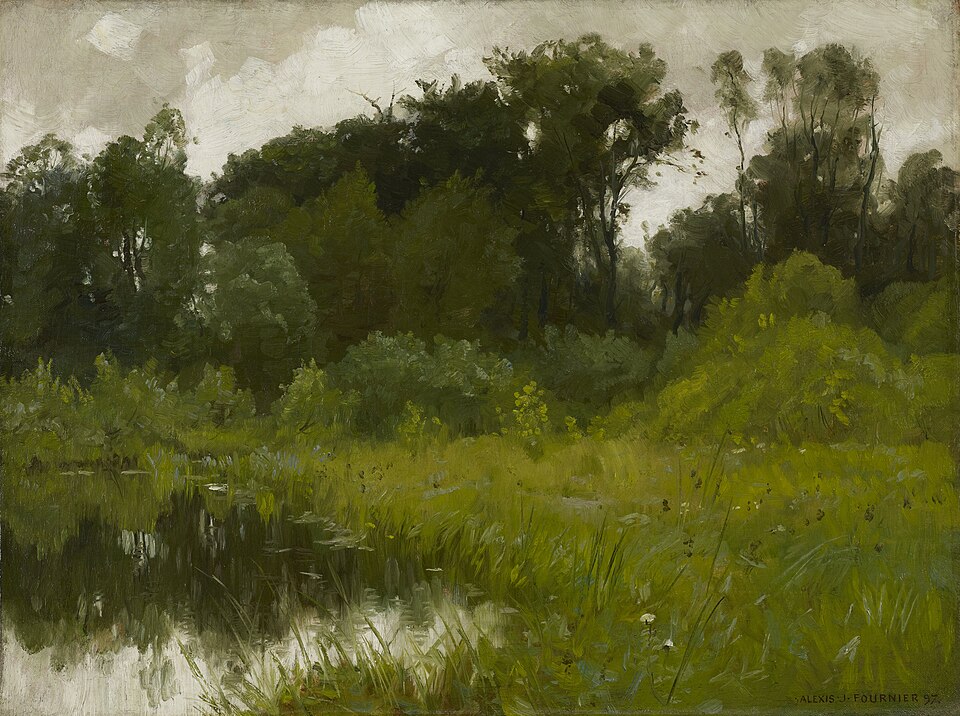
What’s striking about Fournier’s landscapes is their tone: neither grandiose like Bierstadt’s nor strictly documentary. They carry a soft focus, an attention to mood and light rather than topographic detail. His skies, in particular, reflect Minnesota’s transitional light—often overcast, silvered, or warm in a quiet way. In doing so, Fournier offered an alternative to the Hudson River School’s heroic wilderness, proposing instead a more inhabited, more human-scaled nature.
Drawing the Borders of Culture
With statehood came civic ambition. Minnesota’s leaders in the late 19th century began to invest in cultural institutions alongside railways and grain elevators. Art clubs, libraries, and lecture halls appeared in St. Paul and Minneapolis, often supported by business elites who saw cultural refinement as part of progress. Though still modest by Eastern standards, these efforts laid the groundwork for Minnesota’s later museums and schools.
In 1894, the St. Paul School of Fine Arts was founded, offering training in drawing, painting, and sculpture. It would later become the nucleus of the Minnesota Museum of American Art. The school drew instructors from Chicago and New York, bringing academic realism to a region still largely defined by folk and frontier traditions. Students painted still lifes, copied plaster casts, and, increasingly, turned outdoors to sketch the local landscape.
The growth of these institutions paralleled a growing sense of regional pride. Minnesota’s artists, collectors, and civic leaders no longer looked exclusively to the East Coast for models. They began to see their own land—its lakes, forests, and towns—as worthy of serious depiction. And in doing so, they helped bind together a disparate state, giving visual form to a shared identity.
- Markers of cultural infrastructure by 1900:
- Private art collections in Minneapolis mansions, often with European works
- Artist clubs and sketch societies active in both Twin Cities
- Civic exhibitions hosted in state fairs, banks, and city halls
Reflections on a Forming Identity
In the decades after statehood, Minnesota’s art was not yet modern, but it was confident. It reached for something permanent—a visual language that could match the aspirations of a young and growing place. Artists like Bierstadt and Fournier painted the same rivers and falls but for different reasons: one to awe, the other to belong.
What they shared was an understanding that landscape was more than scenery. It was memory, economy, and promise. Minnesota’s emerging art, like its statehood itself, was both rooted in land and open to ambition. The wildness of the frontier was still present, but so too was the desire to cultivate, to build, to define.
The river, in all these works, remains central—not just as subject, but as metaphor. It is movement and boundary, history and renewal. And as Minnesota moved from territory to state, it was the river, more than any single painter, that carried its image forward.
Chapter 4: Immigrant Traditions—Craft and Culture from Scandinavia, Germany, and Central Europe
Housepaint and Hymns
When Norwegian settlers arrived in Minnesota in the mid-19th century, many came from rural valleys where painting was not reserved for galleries or portraits, but for walls, trunks, and spoons. Their tools were simple: brushes cut from coarse hog hair, pigments ground from mineral powders, binders mixed with linseed oil or egg. But the results—scrolling vines, curling tulips, floral medallions—transformed even the most utilitarian furniture into an object of joy. This was rosemaling, the folk painting tradition that would come to define the visual signature of Norwegian immigrant communities across Minnesota.
In the small town of Milan, Minnesota, a house once belonging to painter Karen Jenson stands enshrined as an unofficial shrine to this decorative legacy. Every interior surface—walls, ceilings, shelves—was hand-painted in swirling Norwegian motifs, layering history over drywall. Jenson, born to immigrant parents, absorbed the tradition through community classes and family instruction, adding her own personal variations. Though her work dates from the 20th century, it reflects the continuity of an older instinct: to bring beauty into daily life, not as ornament, but as rhythm.
- Common forms of immigrant folk decoration in rural Minnesota:
- Rosemaling on trunks, chests, and walls
- Stenciling and grain painting on church pews and altars
- Polychrome carving on headboards, pulpit rails, and cabinetry
These traditions were not fossilized. They evolved with available materials and American influence. Colors changed—earth reds gave way to factory greens and cornflower blues—but the intent remained the same: to soften the austerity of frontier life with pattern, to transform rough boards into vessels of memory.
Cathedrals of the Prairie
Nowhere did immigrant art reach greater scale and unity than in the Lutheran and Catholic churches of rural Minnesota. In small towns across the state—Otisco, Brandrup, Aitkin, Minneota—congregations built sanctuaries that served both spiritual and cultural functions. Their architecture followed the forms of home: Carpenter Gothic steeples, clapboard siding, and locally quarried stone. But inside, they became palimpsests of ethnic heritage, layered with decorative painting, carved woodwork, and stained glass.
At Stiklestad United Lutheran Church, built by Norwegian immigrants in 1898, the sanctuary walls are whitewashed, but the altar and pulpit are richly carved in stylized arches and rosettes. It is a humble space, but proportioned with care, its symmetry echoing centuries of Scandinavian church design. At Vista Lutheran Church, founded by Swedish settlers in 1908, hand-painted stencils and delicate trim work soften the vertical lines of the nave. The craftsmanship was not imported—it was communal, done by farmers and carpenters who had carried their skills across an ocean.
Equally striking are the stained-glass windows found in churches like Augustana Lutheran in Minneapolis, where tall lancets depict biblical scenes surrounded by Nordic knotwork. These windows, often ordered from Midwestern studios in Chicago or Milwaukee, were chosen by committee, funded through bake sales and quilt raffles, and installed by hand. They reflect not only faith but belonging—a visual declaration that this new land had become home.
The Brush of Herbjørn Gausta
While most folk art in immigrant churches was anonymous—crafted by community hands—some works bear the mark of known artists. Among the most prolific was Herbjørn Gausta, a Norwegian-born painter who studied in Oslo and Paris before settling in Minnesota. Gausta’s style straddled the line between realism and folk tradition. He painted portraits, altarpieces, and landscapes, many of which remain in churches across the state.
His altarpieces often depict Christ in Scandinavian settings: Nordic facial features, pine forests in the background, winter light falling across snow. These were not ethnographic choices—they were attempts to root the sacred in the familiar. For congregations worshipping in a second language, in a new land, such imagery provided quiet reassurance.
Gausta’s best-known works survive in small churches where congregants still recognize the hands that made them. At Bethlehem Lutheran Church in Aitkin, Gausta’s influence is visible in the balance of image and architecture: the way light falls on the altar, the way carved scrolls echo rosemaling curves, the way hand-painted borders frame the central cross. It is not grand art, but it is deeply integrated—woven into the structure of belief.
- Elements common to Gausta’s ecclesiastical paintings:
- Cool Scandinavian lighting even in interior scenes
- Modest human expressions, devoid of theatrical gesture
- Iconography adapted to rural, Lutheran sensibilities
Carving Culture into the Land
Immigrant art in Minnesota wasn’t limited to churches. It was carved into gateposts, painted on barn gables, and stitched into quilts. The decorative became documentary—a record of arrival, adaptation, and survival. Even something as simple as a carved butter mold carried symbolic weight. German settlers brought woodworking patterns from Bavaria and the Black Forest; Bohemians from what is now the Czech Republic brought lace and painted ceramics; Icelanders etched poetry into wooden hymn boards.
One surviving example of Icelandic immigrant craft can be found in St. Paul’s Evangelical Lutheran Church and Parsonage, built in 1895 in Minneota. The design is simple but unmistakably northern: steep rooflines, heavy trim, and painted interiors that reflect Icelandic restraint. The church served not only as a house of worship but as a language school, cultural archive, and artistic beacon for the community.
These churches, homes, and community halls became living museums—not of nostalgia, but of continuity. The art was not preserved as heritage, but practiced as life. Even today, rural counties across Minnesota host rosemaling workshops, quilt guilds, and woodworking clubs that trace their lineage back not to art schools, but to kitchen tables and winter evenings.
A Quiet but Enduring Legacy
Immigrant art in Minnesota is not loud. It does not dominate museum walls or auction houses. But it persists—in painted ceilings, in hand-lettered hymnals, in the carved finials of pews rubbed smooth by generations. It offers a counterpoint to the heroic landscapes and institutional canvases of other chapters in the state’s art history. Where those sought scale and grandeur, this art sought intimacy and use.
Its greatest achievement is not its preservation, but its persistence. These traditions survived not because they were curated, but because they were loved—passed from grandmother to granddaughter, from craftsman to apprentice, often without ceremony. They remain not in vaults, but in use.
As Minnesota moved into the 20th century, these folk traditions would intersect with modernism, education, and commercial design. But they never fully disappeared. They remained in the corners of sanctuaries, in the drawers of farmhouse kitchens, and in the communal memory of a state that understood, early on, that culture is not something added after survival—it is how people survive.
Chapter 5: The Birth of Institutions—Art Academies and Civic Museums
A City Worth Painting
In 1880, Minneapolis was no longer a frontier post. It was an industrial engine driven by flour, timber, and rail—its mills roaring along the Mississippi, its avenues lit by gas and electricity, its civic leaders flush with ambition. In that atmosphere, the idea of a formal art institution no longer seemed extravagant. It seemed necessary.
That year, a group of local artists and patrons formed the Minneapolis Society of Fine Arts, planting the seed of what would become the region’s leading art school. By 1886, the Minneapolis School of Fine Arts had opened its doors. The school—later renamed the Minneapolis College of Art and Design (MCAD)—was modest in size but rich in vision. Its early curriculum echoed East Coast academies: rigorous drawing from casts, life study, still life, and eventually painting in oil. But its location, tucked into the grainy urban texture of a Midwestern city, gave it a different temperament. It wasn’t elite. It was practical, civic-minded, and inclusive—drawing students from clerical backgrounds, immigrant neighborhoods, and farm towns.
By the early 20th century, MCAD had become more than a school. It was a workshop for the visual identity of Minnesota—training painters, illustrators, and designers who would go on to fill the city’s galleries, newspapers, and public buildings. Even today, its foundational philosophy—art rooted in discipline, relevance, and public engagement—remains a defining feature.
The Private Collector Who Built a Modern Icon
While art schools shaped artists, museums shaped audiences. No figure looms larger in this regard than Thomas Barlow Walker, a lumber magnate who began collecting art in the 1870s and opened his personal gallery to the public in 1879—a rare act for the time. Walker’s collection focused on 19th-century American and European paintings: landscapes, historical scenes, and genre works. He believed that art had civic value, that it could uplift and educate, and he often welcomed visitors into his home-gallery free of charge.
In 1927, Walker formalized this collection into the Walker Art Galleries, the institutional ancestor of today’s Walker Art Center. The galleries were traditional in taste, but the seeds of modernism were already stirring. Over the next decades, the Walker would undergo a radical transformation—becoming, by the mid-20th century, one of the nation’s leading institutions for modern and contemporary art. That story would unfold in later chapters. For now, what matters is this: Minnesota’s most experimental museum began as a private man’s sense of public duty.
Walker’s influence was not only aesthetic but architectural. He set the precedent that art should have a home—not just a wall, but a building. That principle would guide the next wave of cultural development in the Twin Cities.
- Three pivotal institutional founding dates:
- 1886: Minneapolis School of Fine Arts (MCAD) founded
- 1915: Minneapolis Institute of Art opened
- 1927: Walker Art Galleries formally established
A Museum on the Prairie
While Walker built his gallery, other civic leaders were planning something more encyclopedic. The result was the Minneapolis Institute of Art (Mia), which opened in 1915. Its mission was broad: to collect, exhibit, and educate across cultures and time periods. Unlike the Walker, Mia was never focused on the new—it was built to offer permanence, to place Minnesota in dialogue with the world.
From the beginning, the museum’s collection spanned continents: Chinese bronzes, Egyptian sarcophagi, Rembrandt portraits, and American decorative arts. But it also emphasized education. Children’s tours, print rooms, and lectures became central activities. The museum’s neoclassical building—set on a rise in south Minneapolis—symbolized seriousness, order, and civic pride. It was not a playground for taste. It was a monument to culture.
Over time, Mia would develop one of the most respected encyclopedic collections in the Midwest. But its roots remain in that early 20th-century vision: that a city with industry and ambition must also build cathedrals of reflection. Where grain elevators rose along the river, marble colonnades rose along the avenues.
The Twin City Counterpart
Meanwhile, across the river in St. Paul, another institution was forming under quieter circumstances. The St. Paul School of Fine Arts, founded in 1894, began as a teaching institution much like its Minneapolis counterpart. But over time, it evolved into a collecting and exhibiting body—eventually becoming the Minnesota Museum of American Art (The M).
The M would go through several transformations—relocations, renamings, even closures—but its commitment to American art, particularly regional work, became its hallmark. While the Walker veered toward international conceptualism and Mia remained encyclopedic, The M maintained a closer connection to local artists and the mid-century American tradition. Even today, it serves as an anchor for contemporary Minnesotan painters, printmakers, and sculptors whose work might not fit the frameworks of the larger institutions.
This three-part constellation—Mia, Walker, The M—remains the backbone of Minnesota’s museum ecosystem, each with its own logic, each rooted in this period of early civic imagination.
A Gallery Inside the University
Art education also took root in the state’s major land-grant university. In 1934, the University Gallery opened on the Minneapolis campus of the University of Minnesota. It was modest at first—rotating exhibitions, faculty shows, traveling prints—but it laid the groundwork for what would become the Weisman Art Museum, housed since 1993 in a dramatic stainless-steel structure by Frank Gehry.
But long before Gehry’s angular spectacle, the university’s art programs had already become a crucible for modernism. Faculty and students explored abstraction, design, and conceptual practices even as the rest of the state clung to landscape and realism. The university’s role was not just to teach art, but to challenge its boundaries. And from the 1930s onward, it did just that.
- Institutions formed from education:
- Weisman Art Museum grew from University Gallery (est. 1934)
- MCAD evolved from Minneapolis School of Fine Arts
- Handicraft Guild merged into U of M’s broader arts curriculum post-WWI
The Handicraft Guild and the Applied Tradition
Less known, but no less influential, was the Handicraft Guild, founded in the early 20th century as an arts education center focused on design and applied arts. Influenced by the Arts and Crafts movement, it offered instruction in bookbinding, ceramics, illustration, and metalwork. The Guild emphasized harmony between beauty and function—a principle deeply resonant with Minnesota’s practical culture.
Though its building still stands in downtown Minneapolis, the Guild as an institution was eventually absorbed into other educational frameworks. But its ethos—craft, purpose, community—shaped generations of artists who saw no distinction between fine and applied arts. Its graduates became illustrators, interior designers, and artisans whose work filled Minnesota’s homes, churches, and civic buildings.
Drawing at a Distance
No survey of Minnesota’s art institutions would be complete without mention of the Art Instruction Schools, founded in 1914. Though headquartered in Minneapolis, its reach was national—offering correspondence courses in drawing, cartooning, and commercial illustration. Its ads, famously placed in the back pages of comic books (“Can You Draw This?”), helped thousands of aspiring artists access structured training, often for the first time.
The school trained illustrators, animators, and technical artists, many of whom never set foot in a formal studio. Its alumni include Charles Schulz, creator of Peanuts, whose gentle lines and emotional economy influenced American cartooning for decades. Though the school closed in 2018, its model—accessible, pragmatic, focused on skill—reflected the larger values of Minnesota’s art culture: democratized, hard-working, and unpretentious.
Institutions Rooted in Intention
Minnesota’s art institutions were not accidents. They were acts of intention—founded by citizens who believed that culture was not a luxury, but a necessity. Whether it was a lumber baron collecting Hudson River paintings, a public university hosting abstract installations, or a Scandinavian parish hand-painting an altar, the motive was the same: to place art where people lived.
By the end of the 1930s, Minnesota had a mature cultural infrastructure: schools for training, museums for viewing, societies for organizing. The artists who would emerge in the following decades—painters, muralists, modernists—would be shaped by these foundations. And in turn, they would reshape them.
Chapter 6: Prairie Impressionism and the Rise of Regional Landscape Painting
Light Over the Cornfields
There is a kind of light in Minnesota that does not belong to any other place. It is not theatrical like California’s, nor soft like Tuscany’s. It is flat, clear, at times severe—diffused by humidity in summer, sharpened by snow in winter, and stretched thin across the horizon in fall. This light became both a challenge and a source of inspiration for the artists who began to paint the Minnesota landscape seriously in the late 19th and early 20th centuries. These painters did not inherit a codified school or style. What they made instead was a slow, quiet emergence—a regional idiom that came to be known, much later, as prairie impressionism.
Though not a formal movement, this current was shaped by artists who shared a set of concerns: fidelity to observation, a lyrical approach to natural forms, and a fascination with atmosphere. Many of them had studied abroad—especially in France and Germany—but returned to find the Midwestern landscape worthy of sustained attention. Their fields were not metaphorical. They were literal.
Fournier’s Fields and Riverbanks
At the center of this early regional style stood Alexis Jean Fournier (1865–1948), a Minneapolis-based painter trained in both decorative arts and classical painting. Fournier’s career spanned eras: from the influence of the French Barbizon school in the 1880s to the rise of American impressionism in the 1910s and 1920s. What remained constant was his attention to the land. While many of his contemporaries sought drama or grandeur, Fournier painted what he saw: the Mississippi River on a still morning, low barns surrounded by sunlit grain, the warm decay of October trees.
In paintings such as Pastoral Landscape or Sunset on the River, Fournier’s brushwork is loose but disciplined, his colors subdued but not muddy. The light in his canvases often seems filtered through mist or dust, capturing the way humidity bends the spectrum at dusk. These were not heroic scenes. There are no figures posed against destiny, no allegories of progress. Just land, water, trees—and a kind of honest quiet.
Fournier also played a curatorial role in regional art culture. He corresponded with Eastern collectors, lectured widely, and later became involved with the Arts and Crafts movement in New York. But his base remained Minnesota, and his landscapes remained distinctly local—not generic pastures, but recognizable terrain, marked by the horizontal logic of prairie and river.
- Fournier’s trademarks as a regional painter:
- Subdued palette emphasizing browns, ochres, and warm greens
- Balanced compositions with low horizons and steady rhythm
- Emphasis on transitional seasons, especially fall and spring
Koehler and the Weather of Thought
While Fournier painted nature’s calm, Robert Koehler (1850–1917) captured its complexity. Born in Germany and raised in Milwaukee, Koehler eventually settled in Minneapolis, where he became the first director of the Minneapolis School of Fine Arts (now MCAD). A trained academic painter, Koehler brought European discipline to a young art scene—but his own paintings reveal an unusual emotional range.
His Rainy Evening on Hennepin Avenue (c. 1910) is a masterwork of mood. Painted with a loose impressionist touch, it shows figures with umbrellas walking through glowing city light, reflections shimmering on wet cobblestone. The composition is urban, yet the treatment is weathered, atmospheric, inward-looking. This was not the sunny plein air impressionism of coastal painters. It was something darker, cooler—attuned to the subtle drama of a stormlit afternoon or a fogbound dawn.
Koehler’s presence as both painter and educator meant that his vision extended into classrooms. He encouraged observational study, tonal sensitivity, and a deep respect for the rhythms of the land. His students—many of whom would go on to paint Minnesota’s fields, lakes, and forests—absorbed his conviction that regional art was not second-tier. It was simply closer to home.
Painting in the Open Air
By the early 20th century, Minnesota had developed its own tradition of plein air painting, especially in the warmer months. Artists took their easels into the countryside—not just to capture detail, but to register the changing character of light across hours and seasons. While the French originators of plein air practice sought Mediterranean color and rapid brushwork, Minnesota artists adapted the method to a slower tempo.
In this region, plein air didn’t always mean speed. It often meant patience. Painters sometimes returned to the same site for weeks, observing subtle shifts in light over fields of corn or rows of poplar. What emerged were landscapes that hovered between realism and impressionism—firmly composed, yet vibrating with optical sensitivity.
A recurring motif was the field under transformation: plowed soil in spring, golden tassels in August, stubbled remains in November. The emphasis was rarely on dramatic peaks or scenic overlooks. It was on rhythm and repetition, the humbler aspects of the land that sustained life.
- Typical scenes in Minnesota plein air painting:
- Snow melt and thaw in early spring, with muddy roads and ice-fringed streams
- Hayfields under overcast skies, emphasizing texture over color
- Autumn stands of birch and oak, rendered in loose, pale strokes
The Regional Eye
What set prairie impressionism apart was not just its geography, but its temperament. These artists were not interested in novelty or spectacle. They wanted to understand the land on its own terms. Their work was rooted in observation but filtered through mood—more about how the light fell than what it fell on. And unlike their coastal counterparts, they rarely chased innovation for its own sake.
In many ways, their work anticipated themes that would later define the American regionalist painters of the 1930s: attention to place, affection for rural life, skepticism toward abstraction. But Minnesota’s early landscape painters avoided nostalgia. Their scenes feel lived in, not idealized. The houses sag slightly. The trees are windblown. The snow is dirty at the edges. This realism—tempered by beauty—gave their work durability.
Their art also served a civic function. As Minnesota’s cities grew, these paintings reminded viewers of the land beyond the streetcar lines. In banks, libraries, and private homes, the presence of a local field or river on the wall anchored a family, a business, a neighborhood to something larger and older.
A Continuity of Vision
Though many of these artists did not identify as part of a “movement,” their collective work forged a recognizable visual culture. It shaped how Minnesotans thought about their environment—not as wilderness, but as home. It linked farmers and city dwellers, studio painters and Sunday sketchers, under a shared horizon.
Today, these paintings are often overlooked—tucked into regional museums or inherited by descendants who may no longer know the name of the artist. But their influence endures. In the Minnesota light, filtered through storm clouds or sparkling over lake ice, their sensibility still lingers: attentive, modest, grounded.
They painted not just what they saw, but what they lived. And in doing so, they gave the land a voice that didn’t shout, but stayed.
Chapter 7: The Depression and the WPA in Minnesota
Murals for the People
In the depths of the Great Depression, when banks failed and breadlines grew, a quiet revolution in American art unfolded—not in galleries or salons, but in post offices, schools, and small-town auditoriums. In Minnesota, as across the country, this revolution was fueled by the Works Progress Administration’s Federal Art Project (FAP). Created in 1935, the FAP aimed to provide not only economic relief for unemployed artists, but cultural nourishment for a struggling nation. In Minnesota, it did both—and in doing so, it changed the direction of the state’s visual culture.
Artists were commissioned to paint murals, print lithographs, sculpt monuments, and document rural life. Their subjects were ordinary: road workers, grain elevators, snowbound streets, foundries, harvests. Their medium was often public: wall-sized temperas, block prints, even furniture design. The goal was not to flatter elite taste but to honor the dignity of daily life. In the process, Minnesota’s towns and cities became unexpected galleries of a distinctly American realism.
One of the clearest examples is the former Brandon Auditorium in Douglas County, which still houses Elsa Jemne’s WPA mural from the late 1930s. Jemne, a St. Paul–based artist and architect, painted scenes of rural life with quiet clarity: farmers harvesting wheat, women working at home, children walking through snow. The scale is intimate, the forms rounded, the palette warm but subdued. This was art not meant to dazzle, but to belong.
- WPA murals were often placed in:
- Post offices and local courthouses
- Public schools and auditoriums
- Municipal libraries and welfare buildings
The Granite in the Wall
In St. Cloud, another mural tells a different story. Commissioned under the Section of Fine Arts—a Treasury Department sibling to the WPA’s FAP—the 1938 mural by David and Lolita Granahan for the St. Cloud Post Office depicts workers in the granite industry, the economic backbone of Stearns County. Strong-backed men lift stones, guide oxen, and chip at massive slabs. There’s no sentimentality, no abstraction—just granite, both literal and symbolic.
The mural’s message was clear: labor is not to be romanticized, but recorded. The men are anonymous, but their work is honored. In a time when unemployment and displacement dominated national headlines, this kind of imagery was radical—not because it was political, but because it was honest.
This regional realism—sometimes called American Scene painting—found a natural home in Minnesota. The state’s economic life, tied to agriculture, mining, and timber, provided subject matter that resonated deeply with the WPA’s emphasis on working-class dignity. Artists were not inventing heroism; they were observing it.
The Hands that Drew the State
Not all WPA-era art took the form of murals. Printmaking—especially lithography and woodcut—became a major medium for Minnesota artists working under the FAP. Its modest cost and reproducibility made it ideal for both training and distribution. Dorothea Lau’s Workers (c. 1935–1941) is typical: a tight composition showing bundled figures laboring in cold weather, their bodies forming a rhythm of bent backs and bowed heads. There is no despair—just resolve.
Clara Mairs, a Minneapolis-based printmaker and painter, created FAP prints that often combined humor and gravity. Her scenes—children at school, people waiting at train stations, women doing laundry—reflected a society surviving with quiet routine. Similarly, Alexander Oja and Stanford Fenelle produced lithographs that chronicled the overlooked beauty of ordinary life: corner groceries, snowy alleys, and the mechanics of domestic labor.
These works served not only as artistic expression, but as a kind of visual census. In a time of uncertainty, they asked: Who are we, and what do we do each day? And the answers, printed in ink on thick paper, came back: We work. We endure. We build.
- Three common subjects in Minnesota WPA prints:
- Urban winter life, especially in Minneapolis and St. Paul
- Farm work and seasonal labor
- Childhood, school, and domestic interiors
Organizing the Artist
Behind the production of art stood organization. The WPA’s structure required oversight, advocacy, and logistics. In Minnesota, one of the key figures was Syd Fossum, a painter, teacher, and labor activist who helped organize local artists into a functioning unit under the FAP. Fossum’s own paintings, while rarely shown in major exhibitions, reflected the WPA ethos: ordinary people in familiar places, painted without embellishment.
Fossum also recognized that the art world could no longer be confined to salons and critics. Through union activity, public meetings, and cooperative galleries, he and others insisted that art had a place in civic life, not just private homes. It was this insistence—practical, democratic, and deeply Minnesotan—that helped ensure the lasting legacy of the WPA in the state.
Art and Utility
In addition to murals and prints, the Minnesota WPA supported applied arts: furniture design, bookbinding, textiles, even exhibition displays. These programs echoed the earlier Handicraft Guild ethos, but with broader reach. Tables, benches, and cabinets produced under WPA guidance can still be found in libraries and public buildings across the state. Each one is a quiet assertion that beauty and function can—and should—coexist.
Unlike many movements, the WPA did not produce a signature style. Its artists worked in realism, but their tones varied: some lyrical, some stoic, some wry. What unified them was purpose—to give the public access to art, and to give artists the ability to work.
From Relief to Permanence
When the WPA was shuttered in the early 1940s, many of its artists faded from national view. Some returned to teaching; others entered advertising or commercial art. But their influence remained. In Minnesota, the murals and prints of the 1930s did more than decorate walls. They shifted expectations. Art was no longer just a private luxury. It was part of the public environment—educational, affirming, and durable.
Many WPA works in Minnesota remain in place today. Others have been relocated or restored, their creators sometimes forgotten. Yet the works themselves still speak. They reflect a moment when the country believed that culture was a form of infrastructure—that it deserved scaffolding, wages, and space.
In that belief, the artists of Depression-era Minnesota created something enduring. Not masterpieces, perhaps. But monuments—to work, to survival, and to the idea that art belongs where the people are.
Chapter 8: Northern Light—The St. Paul School and Midcentury Modernism
A Modernism Born of Stillness
Midcentury Minnesota did not explode into modernism. It drifted. The shift was not violent, but gradual—like the slow retreat of winter ice or the unfurling of prairie grass in spring. As the 1940s faded into the 1950s, a new generation of artists emerged in the state’s capital, quietly turning away from regional realism and toward abstraction, experimentation, and psychological depth. These artists did not reject the past; they expanded it. Their modernism was not imported whole from New York or Paris. It was shaped by long winters, Lutheran restraint, and the muted light of northern skies.
At the center of this evolution stood the St. Paul School of Art—later known as the Gallery and School of Art—which became a magnet for young painters, sculptors, and printmakers seeking a space where formal training met aesthetic freedom. While Minneapolis developed institutions with international ambition, St. Paul fostered intimacy: a smaller, looser network of artists who gathered for critique, instruction, and camaraderie. The school’s teaching emphasized technique but allowed space for risk. Its ethos was neither doctrinaire nor doctrinal. It encouraged looking, then making.
Albinson’s Quiet Influence
Among the key figures in this transition was Dewey Albinson (1898–1971), a painter and teacher who had directed the school in the late 1920s and continued to influence the scene for decades. Albinson’s own work straddled two eras: rooted in landscape and labor themes from the WPA years, but increasingly abstracted in form and tone. His paintings, such as Red Hills or Quiet Trees, bear the hallmarks of a regionalist past—solid forms, simplified geometry—but they lean toward mood rather than message.
Albinson’s influence was pedagogical as much as visual. He taught students to look beyond subject matter—to consider structure, contrast, and negative space. Many of his pupils would go on to develop personal idioms of abstraction, collage, and gestural painting. But they carried his rigor with them, even as their styles diverged.
- Albinson’s contributions to Minnesota modernism:
- Bridged regionalist painting and postwar abstraction
- Trained a generation of artists in both observation and structure
- Anchored the St. Paul School’s transition into the modern era
Blanch and the Painter’s Dilemma
Another pivotal figure was Arnold Blanch (1896–1968), a Minnesota-born painter who, while primarily associated with the Woodstock art colony in New York, maintained connections to Midwestern art circles throughout his career. Blanch’s work in the 1930s had aligned with social realism, but by midcentury, he had embraced a semi-abstract style marked by flattened forms, ambiguous spaces, and a cool emotional palette.
Though Blanch lived much of his life outside Minnesota, his example loomed large. He proved that a painter rooted in modest places could engage with the leading ideas of modern art without self-caricature. His work did not shout. It listened. And that quality resonated deeply in the Twin Cities, where noise was rarely the goal.
The Three Decades Show
In 1957, the Gallery and School of Art mounted a retrospective titled Exhibition ’30, ’40, ’50: Three Decades of Painting in St. Paul, gathering works that traced the city’s evolving visual identity. The show included pieces by faculty and alumni—realist, modernist, and everything in between. The exhibition did not offer a manifesto. It presented a continuum. Viewers could see how the WPA muralists gave way to tonal minimalists; how the hand-drawn print yielded to the gestural wash; how perspective flattened but meaning deepened.
The show marked a quiet milestone. Without declaring itself, St. Paul had become a modernist city—not in skyscrapers or slogans, but in the way its artists painted thought, memory, and uncertainty. It was a kind of Midwestern modernism: serious, modest, grounded.
Institutional Memory
During these years, the Minnesota Museum of American Art—descended from the St. Paul School of Fine Arts—became a central venue for exhibiting midcentury painting. Though often overshadowed by the Walker and Mia, The M supported artists whose work lay outside national trends. It offered space for experimentation and retrospection alike, particularly favoring artists connected to the region.
Simultaneously, the Weisman Art Museum, still operating as the University Gallery until its later rebranding, began collecting and exhibiting modern American art. While its Gehry-designed building would not arrive until 1993, its curatorial activity in the 1950s and 1960s laid the foundation for a serious engagement with abstraction and modern design.
What’s notable is that none of these institutions adopted an avant-garde stance. They did not declare war on tradition. Instead, they expanded the room—allowing modernist currents to enter the local stream without drowning its older rhythms.
- Midcentury themes in Minnesota modernist painting:
- Abstracted landscape with minimal forms and tonal control
- Psychological interiors, often devoid of figures
- Muted palettes reflecting seasonal light and emotional restraint
The Conditions of the North
Minnesota’s modernism bore little resemblance to the angular aggression of New York’s Abstract Expressionists. Here, the modern was patient. Influenced by long winters, by the silence of snow-covered streets, by the diffused light of late afternoon, local painters tended toward mood rather than spectacle. Their abstractions often retained a whisper of landscape, a trace of structure, a memory of line.
Many of these artists were also teachers. They supported themselves by working at schools, colleges, or technical institutes. Their art emerged between classes, after grading, on weekends. It was not fueled by grants or galleries. It was made in kitchens, garages, and shared studios above storefronts. And this discipline—the slow work of integrating life and art—gave their work a gravity that has lasted.
Minnesota modernism was never fashionable. But it was durable. It absorbed influence without losing voice. It welcomed change without abandoning place.
A Light Without a Movement
By 1960, modernism in Minnesota had no formal school, no manifesto. But it had coherence. In the paintings, prints, and collages of artists connected to the St. Paul School, we see a shared respect for form, restraint, and clarity. These artists were not rebelling. They were refining.
The movement, if it can be called one, left its mark quietly—in museum storage rooms, in local collections, in university hallways. But its influence endures. It made space for later generations to experiment without irony. It proved that a modernist could be serious without being dramatic, abstract without being evasive.
In the stillness of the north, a different kind of modernism took root. It grew slowly, without noise. But it still casts long shadows in winter light.
Chapter 9: The Minneapolis Institute of Art — A Civic Cathedral to Art
From Flour to Frescoes
When the Minneapolis Institute of Art opened its doors in 1915, it was not a gesture of cultural vanity, but one of civic aspiration. Minneapolis was then a city of flour mills, rail yards, and timber yards—raw with ambition but yearning for refinement. The museum, with its columned façade and marble halls, was built to signal that the city had arrived—not only as a commercial power, but as a place that valued beauty, knowledge, and permanence.
Founded by the Minneapolis Society of Fine Arts—an organization established in 1883 by local citizens who believed that art should be accessible to all—the museum was housed in a neoclassical structure designed by McKim, Mead & White, the same architects behind the Boston Public Library and the original Penn Station. It rose on a hill overlooking what would become the city’s cultural corridor. Inside, it offered cool, white galleries arranged with quiet dignity: oil paintings in gold frames, marble torsos on pedestals, tapestries gently swaying in the filtered light.
But Mia, as it came to be known, was not modeled after a private European collection. From the beginning, it had a public mandate. Art was not a luxury here. It was infrastructure—part of what made a city civilized.
- Architectural timeline of Mia:
- 1915: Original building by McKim, Mead & White
- 1974: Modernist addition by Kenzo Tange
- 2006: Target Wing by Michael Graves
An Encyclopedic Vision
Unlike more narrowly focused museums, Mia pursued an encyclopedic mission: to present the full arc of global artistic expression, from ancient Egyptian sculpture to Japanese ink scrolls, from Renaissance oil painting to contemporary installation. Over the decades, the collection grew to more than 90,000 objects, representing 5,000 years of history and nearly every continent.
This was not a haphazard accumulation. It reflected both curatorial intent and civic vision. The museum’s early European collections focused on established canonical figures, including Rembrandt, whose 1666 painting Lucretia became one of Mia’s most treasured holdings. Later acquisitions expanded into Impressionism (works by Cassatt, Degas), postwar abstraction, and modern design. Yet equal care was given to African, Asian, Islamic, and Native American art, long before such departments became standard in American museums.
The goal was coherence, not dominance. A viewer could walk from a Roman marble into a Korean Confucian scholar’s room; from a Dutch still life into a Yoruba ceremonial mask. The effect was not to flatten difference, but to emphasize connection—how form, material, and meaning have traveled across time and cultures.
Minnesota’s Place in the Picture
Despite its global reach, Mia never neglected its local roots. Beginning in the 1970s, the museum launched the Minnesota Artists Exhibition Program (MAEP)—a groundbreaking initiative that offered exhibition space and curatorial collaboration to artists living and working in the state. This was not a token gesture. It embedded regional creativity into the heart of a major institution.
Over the years, MAEP has presented hundreds of shows—from painters working in barns to sculptors using salvaged iron, from abstract minimalists to documentary photographers chronicling Iron Range towns. These exhibitions did not always harmonize with the museum’s marble serenity—but they expanded its voice, reminding visitors that art is not only found in the past or in faraway places. It is being made, now, in garages, kitchens, and studios just beyond the museum’s steps.
- Hallmarks of Mia’s Minnesota commitment:
- MAEP’s democratic model, curated by artists, for artists
- Regular acquisition of regional works, especially mid-20th century
- Community partnerships for education, outreach, and dialogue
Not a Temple, but a City Hall of Art
There is a temptation to view a museum like Mia as a temple—quiet, elevated, austere. And to an extent, its architecture encourages this. The original building’s ionic columns, the hush of its galleries, the long marble corridors—all recall classical ideals. But Mia was never meant to intimidate. It was meant to invite.
Early museum documents describe its mission not in lofty academic terms, but in civic ones. It was to be “a place where every citizen might find something to love.” To that end, it has always prioritized accessibility: free general admission, school programs, docent tours, and multi-lingual guides.
Even its architectural expansions reflect a desire for openness. The 1974 modernist addition by Kenzo Tange created new gallery spaces while connecting the museum to adjacent cultural institutions. The 2006 Target Wing, designed by Michael Graves, added flexible exhibition space and visitor amenities—less monument, more forum.
This balance—between dignity and accessibility, between depth and breadth—defines Mia’s institutional character. It is not the most famous American art museum. But it may be one of the most quietly serious.
Global Scope, Local Ground
One of Mia’s most remarkable achievements is how it has woven global excellence into local consciousness. A family visiting for a day might encounter Egyptian sarcophagi, Bauhaus chairs, Dakota beaded moccasins, and a Joan Miró sculpture—all in the same hour. But more importantly, they are likely to encounter these works not in isolation, but in context: surrounded by thoughtful interpretation, comparative objects, and human-scaled design.
The museum’s collection of Asian art—particularly Chinese bronzes and Japanese period rooms—is among the best in the country. Its African art galleries, renovated in recent years, present ritual objects, masks, and textiles not as curiosities but as works of intentional design. And its Native American collection—with Plains garments, Ojibwe quillwork, and contemporary Indigenous paintings—anchors the region’s indigenous visual history within the global frame.
Mia’s exhibitions have likewise reflected this range: retrospectives of Käthe Kollwitz, Delacroix, and Art Nouveau jewelry, alongside shows on Somali craft, Midwestern printmakers, and Scandinavian design. The effect is cumulative: a sense that art is a continuity, not a competition.
A Civic Gift That Endures
More than a century after its opening, the Minneapolis Institute of Art remains a pillar of cultural life—not because it constantly reinvents itself, but because it refuses to become irrelevant. Its collections grow carefully, its programming evolves thoughtfully, and its architecture accommodates new needs without erasing its origins.
In a city often defined by practical ambition and quiet pride, Mia stands as a mirror. It reflects what Minnesota has always done best: build lasting things without boasting. A school becomes a museum. A collection becomes a civic treasure. A gallery becomes a classroom. A marble hall becomes a common good.
And every day, for free, anyone can walk inside and see it.
Chapter 10: Rural and Remote — Art Beyond the Cities
A Highway Between Pines and Paint
To drive north from Duluth toward Grand Marais is to enter a landscape that feels increasingly like abstraction. The trees become denser, the sky lower, the light sharper. Lake Superior appears and disappears like a sheet of polished stone. This is not just a road into the wilderness; it is a corridor of artistic activity that has quietly shaped Minnesota’s creative identity for nearly a century—far from the institutional heft of the Twin Cities.
While Minneapolis and St. Paul anchored the state’s early museums, schools, and collecting circles, the rural regions of Minnesota developed a parallel culture of art-making: seasonal, communal, often improvisational. These artists rarely had benefactors or grand buildings. What they had was time, solitude, and the unrelenting beauty of land and weather. Over time, their barns became studios, their lake cabins became workshops, and their quiet towns became the settings for one of the state’s most enduring creative traditions.
- Common traits of rural Minnesota art scenes:
- Plein air traditions rooted in landscape and season
- Studio-based craftwork with functional or decorative aims
- Artist-run spaces emphasizing collaboration over prestige
The Grand Marais Art Colony
In 1947, a Minneapolis painter named Byron Bradley drove to Grand Marais on the edge of the Canadian border and founded a summer school for artists. What began as a few classes held in a fish cannery grew over decades into the Grand Marais Art Colony, one of Minnesota’s most respected centers for studio and landscape art.
The colony’s appeal lay not only in its location—perched between the Sawtooth Mountains and Lake Superior—but in its spirit. It wasn’t a retreat in the luxury sense. It was a working art camp, where painters came to wrestle with weather, water, and the impossible color of boreal light. Students and instructors painted in the rain, argued about brushstroke and tone, and slept in bunkhouses or tents.
In time, the colony expanded its offerings: printmaking, ceramics, book arts, photography, and artist residencies. But its identity remained grounded in place. The North Shore was not just a backdrop. It was the subject, the method, and often the medium. For artists working in oil or charcoal or ink, the wind off the lake shaped everything—the drying time of pigment, the motion of a hand, the clarity of a line.
Today, the Grand Marais Art Colony is active year-round, offering classes and public events. But its foundation is unchanged: a belief that solitude, community, and geography can do more for an artist than a degree or a gallery.
Duluth: A Working Waterfront of Art
Further south but equally influential is the Duluth Art Institute, founded in 1907. Housed in the historic Carnegie Library building, the Institute has long served as the cultural anchor for Minnesota’s largest northern city. While not remote in the way Grand Marais is, Duluth sits in a liminal zone—industrial and scenic, shaped by shipping, steel, and Superior’s shifting moods.
The Institute balances tradition and experimentation. Its Arrowhead Biennial, a recurring regional exhibition dating back to the early 20th century, showcases a wide range of work from northeastern Minnesota and neighboring states. Some entries are formally rigorous; others are wild, improvised, deeply personal. The show reflects a core principle of the rural art ethos: diversity without hierarchy.
Duluth also hosts studios, artist collectives, and informal gallery spaces, particularly in the Lincoln Park and Canal Park districts. In contrast to Minneapolis’s gallery system, Duluth’s art scene feels improvisational—driven more by proximity and weather than by curatorial trends. Many artists work part-time in trades, education, or tourism, creating art in the hours carved out of practical life.
- What distinguishes Duluth’s art ecosystem:
- Mix of maritime and forest iconography
- Workwear aesthetics—seen in material choices like rust, rope, and timber
- Strong female leadership in arts education and curatorial projects
Sculpting in the Pastures
In Franconia, near the Wisconsin border, a vast open pasture has been transformed into a playground of steel, wood, and stone. The Franconia Sculpture Park, founded in 1996, occupies fifty acres of gently rolling land dotted with large-scale sculptures—abstract towers, spiraling ramps, floating barns. Visitors walk among them like ants through a giant’s toy box.
More than just a park, Franconia is a residency program, bringing artists from across the country to live and work on-site. Welders, carvers, and constructors camp in trailers, cook in shared kitchens, and build projects with the materials on hand. There’s no gallery here. The field is the frame. And the result is one of the most unusual art experiences in the state: modernist scale meets agrarian texture.
Franconia reminds us that not all rural art is small. Some of it is massive, experimental, and physically demanding. It requires backhoes, cranes, and welding torches. It also requires patience and grit—two traits Minnesotans possess in abundance.
Studio by Studio
Beyond the named institutions are the unnamed efforts: potters in Lanesboro, woodworkers in Ely, watercolorists in Red Wing. Towns like Two Harbors, New York Mills, and Winona sustain active art communities not through institutional support, but through coop galleries, studio tours, and weekend workshops. In these places, art is embedded in daily life.
One studio might be in a converted barn, another in a former grain elevator. Quilting circles double as art critiques. Painters take turns hosting exhibitions in local cafés or township halls. While these communities rarely make headlines, they often produce the most durable cultural habits—art that is made, shown, bought, and used.
The language used in these regions is often practical: “craft,” “handwork,” “good lines.” But behind the modesty lies an ethos of attention, of care, of form tested against function. And over time, these practices accumulate into regional identities.
A Map Without Borders
There is no single rural art movement in Minnesota. What exists instead is a network of small, local efforts, connected not by manifesto, but by weather, light, and economy. These artists do not seek validation from coastal critics. They seek mastery of their medium, engagement with their neighbors, and time to work.
And their audiences are not tourists or collectors. They are neighbors, teachers, mail carriers, and the occasional wandering visitor. In that context, art must communicate. It must earn its place on the wall, the shelf, or the side of the road.
This is not provincialism. It is proximity. And it gives Minnesota’s rural art scenes a kind of grounded authenticity that resists both fashion and cynicism.
Chapter 11: Sacred, Decorative, and Domestic — Ecclesiastical and Applied Arts
Sanctuaries of Sight
Minnesota’s sacred spaces are more than vessels for worship. They are environments of design—crafted, carved, painted, and built to elevate the eye as much as the spirit. In the cities, these churches rise in domes and spires. In the countryside, they settle low into the horizon, weathered but still luminous. Taken together, these spaces tell a parallel history of art in the state: one rooted not in galleries or academies, but in the continuity of ritual and devotion, expressed through stone, glass, wood, and light.
Some of the most ambitious decorative programs in Minnesota appear not in palaces or civic buildings, but in churches—where architecture, sculpture, stained glass, and painting converge into unified aesthetic experience. These environments are not meant to isolate the individual, but to orient the congregation—visually, acoustically, and spiritually. The result is often grandeur, but sometimes intimacy, and always design.
- Distinctive traits of Minnesota’s ecclesiastical art:
- Integration of architecture and ornament, rather than separate decoration
- Regional materials and artisans, working under tight budgets
- Community-based commissioning, often involving immigrant congregations
The Urban Cathedrals
In the early 20th century, as Minneapolis and St. Paul asserted their status among America’s rising cities, their religious institutions followed suit. The Cathedral of Saint Paul, completed in 1915, stands as one of the finest examples of Beaux-Arts sacred architecture in the country. Its interior is a gallery of scale and symbolism: vast granite pillars, coffered domes, and radiant chapels. But among its most impressive features are its stained glass windows, produced by Charles Connick, the famed Boston craftsman known for reviving Gothic-style stained glass in America. The windows in the cathedral’s ambulatory and transepts glow with blues, rubies, and golds, turning midday light into medieval illumination.
Across the river, the Basilica of Saint Mary—the first basilica in the United States, declared so by Pope Pius XI in 1926—offers a more Roman spirit: marble altars, tiled chapels, and statuary niches that combine high craftsmanship with visual order. Designed by Emmanuel Masqueray, its structure is both theatrical and coherent. The ceiling coffers and side chapels create a rhythm that pulls the eye toward the central altar. Here, the decorative is never ornamental alone. It serves space, voice, and time.
In both buildings, art serves as a cohesive environment, not just adornment. Every mosaic, grille, and sculpture exists in relation to architecture. These are not museums of religious art. They are functioning artworks in which ritual unfolds.
Wood, Light, and Reformation
Minnesota’s Protestant churches, particularly in rural and Scandinavian communities, take a different but equally deliberate approach to sacred art. At Vista Lutheran Church in Otisco Township (built 1908), the sanctuary reveals a blend of Carpenter Gothic structure and Scandinavian folk painting. Stenciled borders frame hymn boards. A carved pulpit anchors the sanctuary, shaped not by flourish but by proportion. The visual language here is restraint, not opulence—but never plainness. The decoration is devotional, embedded into the architecture with affection and purpose.
In Hennepin Avenue United Methodist Church in Minneapolis, another Protestant tradition finds grandeur in light. Its stained glass windows, also by Connick, form a sequence of biblical scenes, rendered not in detail but in color and tone. The carved woodwork around the chancel is restrained but intricate, revealing how Gothic ideals were translated into American materials by Midwestern craftsmen.
These churches underscore an important distinction: sacred art in Minnesota is rarely about replication. It is about translation—of theological values into material form, of immigrant memories into local stone, of abstract beliefs into tactile beauty.
A Monastery of Modernism
No single religious structure in Minnesota embodies the convergence of sacred purpose and modern design more than Saint John’s Abbey Church in Collegeville. Designed by Marcel Breuer, the Hungarian-born Bauhaus architect, and completed in 1961, the church is a massive concrete form punctuated by the world’s largest stained glass wall—a vibrant grid of geometric color designed by artist Bronislaw Bak.
At first glance, the structure seems almost brutal. The façade is dominated by a 100-foot bell banner; the interior is defined by vast expanses of unadorned concrete. But Breuer’s design draws on monastic tradition: proportion, repetition, light. The stained glass wall, composed of hundreds of non-figurative panels, transforms daylight into an ambient spiritual presence. The space needs no icons. It is icon itself.
Saint John’s is not an anomaly. It reflects a broader strain of mid-20th-century ecclesiastical modernism in Minnesota—rooted in theological reform, liturgical clarity, and a belief that beauty need not be nostalgic to be sacred.
- Key traits of Minnesota’s modern sacred architecture:
- Use of concrete and steel alongside traditional stained glass
- Abstract or geometric iconography, often non-narrative
- Spatial emphasis on clarity, proportion, and immersion
Tiffany in the Woods
In contrast to these monumental statements, Minnesota also holds quiet treasures in smaller towns. Pilgrim Congregational Church in Duluth, for instance, houses Tiffany stained glass windows produced between 1918 and 1923. The windows, designed for both memorial and liturgical function, glow with layered opalescent glass—purples, golds, and greens shifting as the light changes. Unlike Gothic windows, these do not rely on outlined figures. Instead, they evoke natural forms and emotional states: the grace of lilies, the melancholy of dusk, the joy of sunrise.
These works, along with others in churches across the state—such as Grace Memorial Episcopal Church in Wabasha and Trinity Episcopal Church in Litchfield—represent a less visible but deeply sustained tradition: small-scale sacred craftsmanship brought to remote places through faith and patronage. Their beauty is not in scale, but in detail.
Homespun Devotion
Beyond churches, sacred and decorative art found life in domestic interiors. In homes across Minnesota—particularly those built by immigrant families—walls were stenciled, panels painted, and corners carved. Devotional prints, hand-framed or pinned to the wall, often coexisted with rosemaling chests, woven hangings, and embroidered linens. The line between art and ornament blurred.
In this environment, applied arts became central. A wooden spoon carved with a cross, a quilt stitched with hymn lyrics, or a wall calendar bordered with floral motifs could all function as religious objects—objects of care and meaning. These works rarely bore names or signatures. They bore continuity.
While few of these domestic artifacts survive in museums, they persist in family homes, county fairs, and rural estate sales. They offer a quieter testimony: that art in Minnesota was not always institutional or public. It was lived with, passed down, and kept close.
Chapter 12: The Persistence of Landscape — Nature as Subject in the 21st Century
The Familiar Horizon
Even as digital media, conceptual installations, and global art markets reshape contemporary aesthetics, landscape remains a central subject in Minnesota art. It is not a romantic retreat or an ideological banner. It is a reality—a consistent, physical presence that continues to press against the frame of human experience. In Minnesota, the horizon still matters.
Across the state, from the North Shore to the southern prairie, painters, sculptors, photographers, and installation artists continue to confront nature—not as a nostalgic backdrop, but as a living, changing, often ambivalent force. In the 21st century, this engagement has evolved in form but not in importance. The light is still changing. The river still moves. Artists still look.
- Contemporary approaches to landscape in Minnesota:
- Plein air painting as disciplined observation
- Conceptual and environmental sculpture rooted in site
- Photographic documentation that merges realism with atmosphere
Painting in the Elements
The tradition of plein air painting—so central to Minnesota’s 19th- and 20th-century artistic identity—remains vibrant. Events like the Minneapolis Plein Air Festival and similar regional gatherings attract painters each summer and fall to work outdoors, capturing the nuances of seasonal change. These aren’t retro exercises. They are challenges: to work quickly, to respect light, to translate real weather into enduring form.
Many contemporary Minnesota landscape painters work not to romanticize, but to observe. They depict ice on lakes that no longer freeze solid, forests with creeping blight, farms in drought. Yet their tone is not despairing. It is measured, attentive. The act of painting becomes a form of testimony—bearing witness to the land as it is now.
The palette has shifted, too. Instead of rich Hudson River School hues, many painters now favor muted tones, atmospheric grays, and compressed light—reflecting not only modern taste, but real changes in weather and landscape color. Prairie golds give way to asphalt brown. Winter whites are touched with soot. Beauty remains, but it’s harder won.
Sculpture That Grows from Ground
In parallel to painting, contemporary sculpture in Minnesota has turned toward the land in more literal ways. At Franconia Sculpture Park, for example, artists from across the country create site-specific works that interact directly with the soil, slope, and skyline. These pieces often use natural or industrial materials: driftwood, rusted steel, granite offcuts, harvested branches.
One such work, constructed in recent years, consists of a series of towering, weathered beams arranged in a spiral—mimicking both crop circles and Indigenous trail markers. Another uses salvaged metal to create a kinetic piece that turns with wind speeds above 15 miles per hour. These works are not “about” nature. They are of it—dependent on sun, wind, and rain to function and change.
This form of landscape art rejects illusion. There is no picture plane. Instead, there is presence: the work must be walked through, felt, watched as it ages. In this way, Minnesota’s sculpture tradition—once rooted in public monuments and indoor galleries—has become deeply entwined with its geography.
The Lens and the Season
Minnesota’s contemporary photographers also engage with landscape, though often with a documentarian eye. Among the most notable is Alec Soth, whose photo essays frequently include stretches of Minnesota terrain: empty parking lots under vast skies, frozen lakes with solitary figures, suburban edges blurred by dusk. While Soth’s tone is often melancholic, the landscape is never secondary. It frames every human gesture.
Other photographers, both emerging and established, focus directly on environmental themes: forest encroachment, shoreline erosion, the changing footprint of agriculture. Their work often lives at the intersection of science and art—used in exhibitions, archives, and environmental education.
Digital photography, drone imagery, and time-lapse methods have expanded the possibilities for landscape work. But the impulse remains ancient: to record the interaction of light and land, to remember what it felt like to stand in a place at a certain hour and look.
- Key subjects in 21st-century Minnesota photography:
- Seasonal extremity—heat haze, frost smoke, mud thaw
- Abandonment and overgrowth—structures taken back by nature
- Juxtapositions of human and natural order—signposts in wetlands, fences in fog
Memory in the Grain
Even within major institutions, landscape continues to shape acquisitions and commissions. At the Minneapolis Institute of Art, recent additions to the contemporary collection include works that engage with rural architecture, seasonal cycles, and natural materials. One series of mixed-media panels uses dried plant matter to embed images directly into handmade paper. Another uses GPS data from canoe routes to shape sculptural maps of the Boundary Waters.
These pieces do not depict landscape. They derive from it—conceptually, materially, even spiritually. Their function is not decorative. It is investigative. What does it mean to live here, now? What do the forests know that we don’t? What will remain?
This mode of inquiry reflects a subtle shift. Where earlier generations sought to capture or idealize the land, today’s artists interrogate it. The results are sometimes elegiac, sometimes formal, sometimes critical—but always grounded.
The Unfinished Image
Landscape in Minnesota is not an escape. It is a condition—a force that shapes the tone of life, the limits of time, the choices of design. Artists who confront it today inherit more than a tradition. They inherit a set of urgencies: changing weather, depopulated rural towns, eroding banks, shrinking winters.
Yet despite—or because of—these shifts, artists continue to look outward. They still pack brushes and step outside. They still weld and carve. They still walk roads with cameras slung over shoulders. They make work that emerges from watching.
The landscape is no longer pristine. It never was. But it remains a subject—vital, complex, unresolved. And in Minnesota, it still commands a frame.