The story of Louisiana’s art begins not with brush or chisel, but with earth itself, shaped into monumental forms whose meaning still commands wonder. Long before Europeans set foot on the Mississippi Delta, communities here engineered vast landscapes of mounds and ridges, often in patterns so precise that their design suggests a vision of the world both spiritual and practical. These earthworks, some dating back over three millennia, remain among the most striking achievements of early North American art.
Mound-building as early spatial art
The most celebrated of these sites is Poverty Point, a complex near present-day Epps, Louisiana, that flourished between roughly 1700 and 1100 BC. Comprising concentric half-circles of ridges, punctuated by massive mounds, the site is extraordinary for its scale. Some embankments stretch nearly three-quarters of a mile across, built basket by basket from soil carried by hand. Though functional purposes—dwellings, gathering places—may have played a role, the precision of the arcs and the grandeur of the mounds reveal a society committed to transforming landscape into enduring form.
This commitment was not unique to Poverty Point. Across Louisiana, other mound sites—Watson Brake, Marksville, and later the Plaquemine culture’s works—demonstrate a long tradition of sculpting terrain into symbolic topographies. Watson Brake, dating to around 3500 BC, predates even Egypt’s earliest pyramids, making it one of the oldest earthwork complexes in the world. Taken together, these structures show that Louisiana was not a peripheral frontier but a central stage for monumental creation.
Patterns of ritual and daily life
Scholars continue to debate the exact functions of these earthworks. Were they ceremonial centers, astronomical observatories, or settlements designed for communal life? The truth may be a blend of all three. Evidence of trade in exotic stones, copper, and shells suggests that mound centers were hubs of exchange, connecting Louisiana’s peoples to networks stretching across the continent. The layout of ridges and causeways also hints at ritual calendars, with alignments that match solstice sunrises and lunar events.
For the people who built them, the act of shaping earth into precise forms may itself have been a form of art, a collaboration between human labor and natural cycles. The work left behind no painted canvas, but instead a sculptural landscape meant to be lived within. These spaces became theaters of ritual, where daily activities intertwined with sacred observance. A dwelling perched on a ridge may have been as much an artistic statement as a shelter.
Echoes of these forms in later Louisiana design
Though European colonists had little knowledge of the meaning behind these structures, the very presence of monumental earthworks impressed upon the region a sense of history and artistry long before colonial architecture took root. Later Louisiana art—whether in the careful geometry of French colonial urban planning or the rhythmic improvisation of Mardi Gras parades—bears a faint resonance of this deep past: the idea that art is not only an object but a space, not only an adornment but a communal act.
One surprising detail is how mound-building traditions persisted in subtle ways even after the decline of the great centers. Smaller burial mounds and localized earthworks continued into the historic period, suggesting continuity of symbolic landscape-making that bridged prehistory and early contact eras. These forms, though often overlooked, remind us that Louisiana’s art history does not begin with Europe’s arrival but with thousands of years of indigenous vision.
In the sweep of centuries, the mounds became overgrown, their builders’ names lost to time, yet their geometry still shapes the land. To walk their ridges today is to experience an art form measured not in strokes or pigments, but in horizons and sky-lines. They set the stage for every later chapter of Louisiana’s art, grounding the state’s creative history in soil, silence, and the enduring dialogue between people and the earth beneath their feet.
French Colonial Aesthetics in a Swampy World
When French colonists arrived in Louisiana in the early 18th century, they brought with them a vision of civilization steeped in Old World models but quickly altered by the demands of the New. The terrain—swamps, bayous, and a climate prone to flooding—forced aesthetic compromises that would leave a distinctive mark on architecture, urban design, and decorative art. Louisiana’s French colonial style emerged not as a pure transplant but as an adaptation, bending elegant European ideals to a setting that resisted easy conformity.
Imported styles meeting local conditions
New Orleans, founded in 1718, was conceived on paper in the manner of French rational urbanism: a tidy grid radiating from a central square. The plan itself was a kind of drawing—geometry imposed upon the wetlands. Yet the reality of climate soon reshaped practice. Buildings needed to rise above ground level on brick piers to avoid floodwaters, galleries and verandas were added for shade and ventilation, and wide eaves extended to shield interiors from the subtropical sun. In effect, the city became a hybrid between French Enlightenment order and Caribbean pragmatism.
Domestic interiors reflected a similar balancing act. Imported furniture from France—rococo armoires, carved chairs—stood alongside simpler, locally made pieces crafted from cypress, a wood abundant in Louisiana swamps. The material was resistant to insects and humidity, and its warm tones lent a distinct regional character to otherwise European forms. In this way, French Louisiana generated its own vocabulary: elegant in outline, resilient in material.
Religious art in mission churches
Religion provided another strong channel for visual expression. Jesuit and Capuchin missionaries introduced sacred images, vestments, and liturgical objects meant to anchor Catholic devotion in unfamiliar territory. Painted altarpieces and statues of saints arrived by ship from Europe, often smaller and less elaborate than their Old World counterparts but no less significant to local communities. These works embodied the cultural authority of Catholicism, yet they also took on new meanings when placed within Louisiana’s frontier setting.
Mission churches, often modest wooden structures, framed these imported artworks in humble surroundings. A carved crucifix or a Madonna, illuminated by flickering candles, stood out starkly against rough-hewn walls. This contrast gave sacred images a heightened immediacy, transforming them into focal points not only of worship but of aesthetic experience. Religious art here was less about grandeur than about presence—the image as a marker of continuity between distant France and the swamps of the Gulf.
Creole adaptation of European decorative traditions
Perhaps the most distinctive development of French colonial Louisiana was the rise of a Creole decorative tradition. Creole society, shaped by the mixing of French, African, and Caribbean influences, cultivated a style that balanced refinement with exuberance. In domestic architecture, this meant brightly painted shutters, wrought-iron balconies with lacy designs, and the frequent use of color in both interiors and exteriors.
Within homes, imported porcelain and silverware mingled with locally produced pottery and textiles. Quilts stitched with bold geometric patterns sat atop beds framed by carved European headboards. The juxtaposition of polished refinement with handmade utility created an aesthetic of contrast—a visual reflection of a society built from multiple cultural strands.
A small but telling detail illustrates this blend: the use of brightly colored Creole faïence, earthenware pottery decorated with vivid glazes. Unlike the restrained tones favored in France, Louisiana faïence often embraced saturated blues, yellows, and greens, echoing the lush palette of the surrounding landscape. These objects, once functional items for daily use, stand today as emblems of a distinctly Louisiana style.
French colonial aesthetics in Louisiana thus formed a dialogue between place and tradition. Imported ideals of symmetry, refinement, and sacred beauty met the challenges of climate, material scarcity, and cultural diversity. The results were neither fully French nor entirely new but something between—an early chapter in Louisiana’s long history of creative adaptation.
Spanish Overlay and the Late Colonial Palette
When Spain assumed control of Louisiana in 1763, the province entered a new artistic chapter. Though the Spanish presence was shorter than the French, it left visible marks, especially in New Orleans. The transfer of power brought not just political change but also new approaches to architecture, urban planning, and visual expression. Fire, disaster, and rebuilding would play key roles in defining this phase of Louisiana’s artistic life.
The Baroque influence in architecture and interiors
The Spanish colonial style carried echoes of the Baroque, with its emphasis on dramatic contrasts, ornamentation, and solidity. After two devastating fires in 1788 and 1794 destroyed much of New Orleans, Spanish officials oversaw a rebuilding campaign that reshaped the city’s core. Wooden French-style houses gave way to sturdier brick structures with thick stucco walls, inward-facing courtyards, and heavy timber balconies.
Perhaps the most recognizable survivors of this era are the Pontalba Buildings flanking Jackson Square, begun under Spanish rule and later completed by Baroness Micaela Almonester de Pontalba. Their wrought-iron galleries, with swirling patterns of leaves and curls, exemplify the Spanish penchant for decorative ironwork. Interiors featured cool plaster finishes and tiled floors, a pragmatic response to the humid climate. These choices reveal a synthesis: Spanish aesthetics translated through local necessity into a uniquely Louisiana expression.
Public squares as stages of power and ceremony
Urban design under Spanish rule emphasized civic order. The Plaza de Armas, today’s Jackson Square, was more than a gathering place—it was a stage for authority, surrounded by the Cabildo (government building) and the Cathedral of St. Louis. Together, these structures formed a theatrical backdrop for religious processions, political proclamations, and military parades.
Artistic life in this period extended into public ceremony. Pageantry and festival, influenced by Spanish Catholic traditions, filled the streets with color and spectacle. These events blended sacred and civic themes, reinforcing the power of church and crown while offering moments of shared celebration. The square itself became a work of art in use: architecture, ritual, and performance woven into a single environment.
A hybrid visual identity emerging in New Orleans
Though the Spanish overlay was significant, it never erased French foundations. Instead, the two traditions fused into a hybrid identity that still defines New Orleans. A visitor walking through the French Quarter today sees this mixture clearly: French grid planning and Creole houses standing alongside Spanish-style courtyards, arcades, and plastered façades.
Objects within homes carried the same blend. Spanish religious art—polychrome wooden saints, gilded devotional objects—mingled with French portraits and Creole faïence. The city’s artists and artisans, many of them immigrants from Europe or the Caribbean, responded to a clientele eager for both refinement and resilience. A dining room might feature Spanish tile floors, French furniture, and local cypress woodwork all within a single space.
This late colonial palette of stone, iron, plaster, and tile gave New Orleans its enduring visual character. It also demonstrated Louisiana’s capacity to absorb influences without losing distinctiveness. By the end of the 18th century, the colony had become less a frontier outpost and more a crossroads of styles—an artistic character that would only deepen with the next century’s growth.
Creole Portraiture and the Art of Self-Presentation
As Louisiana moved into the late 18th and early 19th centuries, portraiture became a vital mode of cultural expression. The Creole elite—planters, merchants, and professionals who defined much of New Orleans society—sought painted likenesses to affirm status, family continuity, and ties to European tradition. These portraits were not only personal keepsakes but also public declarations, signaling refinement, wealth, and belonging within a transatlantic world of taste.
Plantation society’s hunger for European-style likenesses
Commissioning a portrait in this period meant more than vanity. It was a way of participating in a broader visual culture that stretched from Paris to Philadelphia. Creole families, eager to present themselves as cosmopolitan, employed artists to render them in the styles then fashionable in Europe. Sitter and painter alike understood the codes of clothing, pose, and background: a silk gown might emphasize prosperity, a book or instrument might suggest education, while a landscape backdrop could place the sitter within Louisiana’s fertile terrain.
The demand was not confined to grand plantation households. Merchants in the city also sought portraits, using painted likenesses to project solidity and respectability in a society where fortunes often shifted quickly. In both urban and rural contexts, portraits became visible markers of aspiration and achievement.
The role of traveling artists and itinerant painters
Louisiana lacked a large corps of established painters in its early decades, which meant itinerant artists filled the gap. Portraitists traveled along the Mississippi and through Gulf ports, offering their services to families eager for representation. Some stayed only briefly, moving on when commissions dwindled; others settled, becoming fixtures of the local art world.
One example is José Francisco Xavier de Salazar y Mendoza, a Spanish-born painter who made New Orleans his home and became one of the colony’s leading portraitists. His works reveal both European training and adaptation to Creole tastes. Faces are painted with careful attention, while backgrounds often remain minimal—placing emphasis on the sitter’s presence rather than elaborate settings.
This itinerant system produced a varied body of work. Quality ranged from masterful to modest, but the portraits, whatever their level of finish, carried meaning as anchors of family identity. Hanging in parlors or family chapels, they asserted continuity across generations.
A unique blend of formality and local informality
What distinguished Louisiana portraiture from that of Europe was its balance between formality and local informality. Sitters might be posed in elegant attire, yet artists often softened strict academic conventions, producing works that feel more intimate and direct. Children appear with playful expressions, women with slightly relaxed gestures, men with an unstudied air that suggests a life shaped as much by climate and colony as by European rules of etiquette.
These portraits also reflect the physical realities of Louisiana life. Artists frequently employed lighter palettes, avoiding heavy shadows that could appear oppressive in brightly lit Creole interiors. Fabrics were rendered with attention to texture—silks, cottons, and muslins carefully differentiated—hinting at the colony’s role in global textile trade. Even the choice of canvas and pigment often reflected availability, with local materials sometimes standing in for imported supplies.
Taken together, Creole portraiture reveals a society deeply invested in self-presentation, yet also open to adaptation. These images were not simple mirrors but carefully staged performances, announcing identity to both family and community. They remind us that art in Louisiana has always carried a dual purpose: to delight the eye and to stake a claim in the shifting landscape of cultural belonging.
African Traditions in Louisiana’s Material Culture
Beneath the portraits of Creole elites and the architectural overlays of France and Spain, another stream of artistic life coursed through Louisiana—one rooted in African traditions carried by enslaved people and their descendants. Though often overlooked in written records, these traditions shaped the colony’s material and cultural environment in lasting ways. They endured through adaptation, improvisation, and the quiet assertion of identity within a society that sought to suppress it.
Decorative arts, craft, and symbolic design
One of the most visible contributions was in the realm of craft. Enslaved artisans produced pottery, baskets, textiles, and ironwork, much of it for utilitarian use, yet often infused with aesthetic care. Basket weaving in particular carried strong continuities with West African forms: coiled patterns, geometric motifs, and practical designs that also served as subtle markers of cultural memory.
Quilt-making, though shaped by European and American traditions, absorbed African approaches to pattern. Bold contrasts, asymmetrical arrangements, and improvisational design gave many Louisiana quilts a distinct energy. These textiles served both as functional coverings and as visual statements—objects made in the domestic sphere that nevertheless embodied artistic invention.
Ironworkers, too, left an enduring mark. The wrought-iron balconies of New Orleans, while often attributed to European styles, were frequently executed by African and Afro-Creole craftsmen. Their hands translated ornamental sketches into curling vines and rosettes, giving the city’s streetscapes a beauty inseparable from their labor.
Music and performance as visual culture’s twin
Though music is often considered separate from visual art, in Louisiana the two were intertwined. African rhythmic traditions, carried into drumming and dance, were performed in places such as Congo Square, where enslaved and free people gathered on Sundays. These performances were visual spectacles as much as auditory ones: bodies moving in patterned steps, costumes adorned with shells or beads, circles of dancers forming living designs upon the ground.
Masks and costumes used in early celebrations also bore African resonances. Materials were adapted from what was at hand—feathers, cloth, beads—but the underlying impulse to combine sound, movement, and ornamentation into a single act reflected deep cultural memory. The line between visual art and performance blurred, creating traditions that would eventually feed into Louisiana’s carnival and festival culture.
Continuity of African design traditions in Louisiana life
Despite the trauma of slavery and forced displacement, elements of African design remained resilient. Everyday objects often carried symbolic resonances invisible to outsiders. Patterns scratched into pottery or woven into cloth could echo protective symbols or cosmological diagrams. Hairstyles, too, functioned as a form of artistry, with braiding patterns recalling African precedents while adapting to new environments.
Perhaps the most enduring legacy lies in the use of color and rhythm in design. African traditions favored bold contrasts, dynamic repetition, and layered textures—all qualities that later became hallmarks of Louisiana art. From quilts to carnival costumes, the emphasis on vibrancy and movement reflects a lineage of visual expression stretching across oceans and centuries.
What began as survival became foundation. African traditions in Louisiana did not remain isolated; they blended with French, Spanish, and Creole elements to create new forms. Yet their imprint is unmistakable. They remind us that Louisiana’s art history is not only a story of imported styles and elite commissions but also of endurance and creativity in the face of constraint. In baskets and balconies, in patterns and performances, African artistry took root in Louisiana soil and flourished in ways both subtle and spectacular.
The 19th-Century Crescent City Scene
By the early 1800s, Louisiana had entered a new era. The Louisiana Purchase of 1803 brought the territory under American rule, yet New Orleans remained a cosmopolitan city whose cultural life reflected French, Spanish, African, Caribbean, and now Anglo-American influences. This mix gave rise to a vibrant 19th-century art scene, one in which printmakers, landscape painters, and illustrators flourished. The Crescent City became not only a port of commerce but also a port of images—a place where art circulated as freely as goods and ideas.
Printmaking, lithography, and illustrated journalism
The expansion of print culture transformed the visual life of New Orleans. Lithography, a relatively new technology in the early 19th century, enabled mass production of images, making art more accessible than ever before. Print shops produced portraits, city views, maps, and sheet music covers, many of which were sold to a growing middle class.
New Orleans also became a center for illustrated journalism. Newspapers and magazines published engravings of public events, political figures, and cityscapes. These images both reflected and shaped civic identity, offering residents a sense of belonging to a modern, image-saturated world. Prints of steamboats on the Mississippi or bustling French Market scenes carried Louisiana’s image far beyond its borders, spreading the city’s reputation as a place of color and vitality.
One striking example of this culture was the work of firms like B. M. Norman and later Currier & Ives, who issued lithographs of Louisiana landmarks. Though sometimes idealized, these prints captured the grandeur of plantations, riverfronts, and public buildings, fixing them in the popular imagination.
Landscape painting of bayous and plantations
While printmaking served commerce, painting sought poetry. Louisiana’s landscapes offered rich subjects for artists, from the vast sweep of the Mississippi River to the shadowy intimacy of cypress swamps. Painters turned their attention to scenes of plantations, bayous, and rural life, often blending romanticism with documentary detail.
Traveling artists such as John James Audubon worked in Louisiana during this period, producing his famed studies of birds alongside portraits and landscapes. His “Birds of America” plates, many drawn from Louisiana specimens, combined scientific precision with dramatic composition, blurring the line between natural history and fine art.
Other painters focused on plantation grandeur, producing images that celebrated agricultural wealth. Yet alongside these idealized views were more nuanced renderings of the land’s mood: mist rising over a swamp, light filtered through Spanish moss, the quiet rhythm of boats on a bayou. Such works reveal Louisiana’s dual identity—as both a stage for prosperity and a place of mystery and beauty.
The cosmopolitan presence of French-trained artists
Throughout the 19th century, New Orleans attracted artists trained in Europe, especially France. Their academic techniques introduced sophistication to local art while also blending with Creole sensibilities. Portraitists, in particular, brought with them the precision of French ateliers, painting sitters in poses that balanced elegance with Louisiana warmth.
The city also supported institutions that fostered artistic life. The founding of the French Opera House in 1859, for example, provided not only music but also opportunities for set designers, costume makers, and artisans. Public exhibitions, often organized by artists’ associations, gave New Orleanians access to a wider range of styles and debates.
By mid-century, the Crescent City stood as one of the leading art centers of the American South. Its cosmopolitanism set it apart: while other cities leaned heavily on Anglo-American traditions, New Orleans retained its French and Spanish legacies, enriched by African and Caribbean contributions. The art of the period reflects this layered identity—a city where lithographs circulated like currency, where landscapes carried both grandeur and intimacy, and where portraiture and performance intertwined in a culture always eager to present itself with flair.
War, Memory, and Reconstruction Imagery
The Civil War and its aftermath reshaped Louisiana’s visual culture as profoundly as they did its politics and society. Artists and artisans, accustomed to depicting prosperous plantations or bustling city life, suddenly found themselves in a world marked by conflict, loss, and transformation. Art became a means of documenting events, memorializing the fallen, and negotiating the shifting meanings of identity in a fractured society.
Civil War battle maps and illustrations
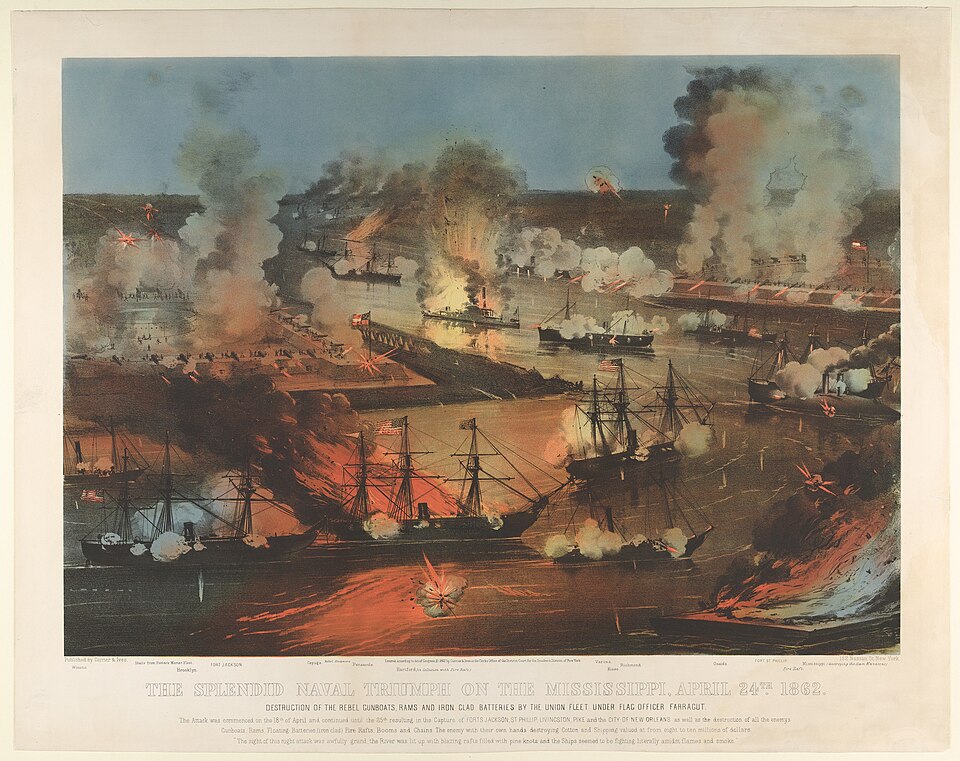
The war generated a flood of imagery, much of it produced for practical or journalistic purposes. Military engineers drew detailed maps of Louisiana’s terrain, from the winding bends of the Mississippi to the fortified banks around Port Hudson and Vicksburg. These maps, though primarily functional, carried their own aesthetic: precise linework, careful shading, and geometric clarity that echoed earlier traditions of cartography as art.
Illustrated newspapers such as Harper’s Weekly sent sketch artists to Louisiana, where they recorded battles, camps, and city scenes. Their engravings, later reproduced for national audiences, often dramatized events, presenting a blend of eyewitness accuracy and artistic flourish. To Northern readers, these images framed Louisiana as both battlefield and spectacle; to locals, they offered recognition of places and struggles familiar to daily life.
The war also produced more intimate forms of art. Soldiers sketched portraits of comrades, scrawled landscapes in the margins of letters, or carved small decorative objects from wood and bone during idle hours. These works, though modest, reveal a human impulse to create even amid destruction.
Public monuments and shifting meanings
In the decades following the war, the question of how to remember it found expression in public monuments. Statues, obelisks, and memorial plaques appeared in cemeteries and city squares, honoring generals, regiments, and fallen soldiers. In New Orleans, Confederate monuments once dominated key intersections, their bronze and stone forms shaping civic memory.
Yet these monuments were never static in meaning. To some, they stood as tributes to valor and sacrifice; to others, they embodied political claims about identity and power in the postwar South. Over time, as the social landscape shifted, so too did interpretations of these works. What began as commemoration gradually became sites of debate, their artistic qualities inseparable from the charged histories they represented.
The visual culture of remembrance extended beyond stone. Lithographs of heroic battles, paintings of generals on horseback, and decorative objects bearing military motifs circulated widely, embedding war memory in households as well as public squares. Together, these objects wove memory into both private and communal life.
Reconstruction-era artists navigating upheaval
The Reconstruction years (1865–1877) brought new challenges for artists. Political turmoil, economic hardship, and shifting patronage networks meant fewer opportunities for grand commissions. Yet the period also opened space for new voices. African American artists, though often excluded from mainstream institutions, began to assert themselves in portraiture, craft, and performance, leaving a quieter but vital record of resilience and creativity.
Meanwhile, white Creole and Anglo artists attempted to reconcile nostalgia with new realities. Some painted romanticized views of antebellum plantations, presenting an idealized past in contrast to present uncertainty. Others turned toward urban scenes, capturing the crowded markets, lively streets, and changing architecture of New Orleans.
Photography, still a relatively young medium, rose in importance during these years. Studios across Louisiana offered affordable portraits, democratizing likeness-making at a time when painted commissions had dwindled. These cartes de visite, small photographic prints exchanged among friends and family, became treasured keepsakes in an era of loss and dislocation.
In sum, the Civil War and Reconstruction left Louisiana with an artistic legacy both fragile and charged. Maps, monuments, and photographs carried forward the memory of conflict, while paintings and crafts revealed how individuals sought continuity amid upheaval. Art in this era did not provide easy resolution, but it offered a mirror to a society grappling with memory, loss, and the uncertain promise of renewal.
Modernism Comes to the Delta
By the early 20th century, Louisiana’s art world found itself caught between deep-rooted traditions and the sweeping changes of modernism. New Orleans remained a city proud of its French and Spanish heritage, yet artists were increasingly exposed to international movements—Impressionism, Cubism, and later Abstract Expressionism—that reshaped the vocabulary of visual culture. This period saw Louisiana art negotiating a delicate balance: staying faithful to regional identity while testing the boundaries of form, color, and subject.
New Orleans as a hub for avant-garde experimentation
The city’s cosmopolitan nature made it fertile ground for modernist experiments. Artists who had studied in Paris or New York returned to Louisiana with fresh ideas, eager to introduce them to a local audience. Exhibitions brought modern works to public attention, sometimes with enthusiasm, sometimes with suspicion. While many patrons still favored traditional portraiture and landscape, younger artists embraced bolder approaches.
The Newcomb Art Department at Tulane University played an important role in this evolution. Originally founded to provide women with vocational training, it grew into a center for design innovation. The famed Newcomb Pottery, with its stylized motifs of Louisiana flora—magnolias, live oaks, cypress—represented a distinctly modern response to local subject matter. The pottery combined Arts and Crafts ideals with regional themes, producing objects both functional and aesthetically striking.
New Orleans also hosted artist collectives that staged exhibitions of contemporary work, fostering dialogue between local and national movements. For a city long shaped by tradition, these efforts marked a significant step toward modern engagement.
Encounters between local craft and modern design
Louisiana’s craft traditions—pottery, textiles, ironwork—proved unexpectedly compatible with modernist ideals. Modernism, after all, valued clarity of form, honesty of material, and the blending of art with everyday life. Craftsmen and designers in Louisiana found that their regional practices could be recast in this light, lending them both local authenticity and contemporary relevance.
Furniture designers drew upon the simple sturdiness of cypress, crafting pieces that were both practical and elegant. Quilters and textile makers experimented with abstracted patterns, sometimes echoing European avant-garde geometry, sometimes pushing forward with designs rooted in African American traditions. The result was a subtle but significant fusion: modern design principles translated into regional idioms.
This interplay between modernism and craft allowed Louisiana artists to step into broader conversations without sacrificing distinctiveness. A vase decorated with stylized swamp irises, a quilt composed of asymmetrical blocks—such works demonstrated that Louisiana’s voice could be both local and modern.
Regionalist painting of Louisiana life
While some artists pushed toward abstraction, others embraced the Regionalist movement, which gained national traction in the 1920s and 1930s. Regionalist painters sought to celebrate local landscapes, industries, and communities, often with a populist spirit. In Louisiana, this meant vivid portrayals of bayou life, cotton fields, shrimp boats, and bustling New Orleans streets.
Artists like Clarence Millet captured the French Quarter with atmospheric brushwork, while others turned their attention to rural parishes, documenting labor and landscape with equal care. The Louisiana bayou, with its shifting light and tangled vegetation, offered endless opportunities for experimentation in color and form.
At the same time, government programs like the Works Progress Administration (WPA) provided commissions for murals, sculptures, and public art during the Great Depression. Murals in post offices and schools across the state depicted scenes of agriculture, industry, and folklore, embedding Louisiana’s visual identity into civic spaces. These works gave artists a platform while also shaping public perception of the state’s culture and history.
In this era, Louisiana’s art world became a meeting ground: traditionalists, modernists, and regionalists all found room to work, sometimes in harmony, sometimes in tension. Together, they expanded the scope of what Louisiana art could mean—no longer bound only to portraits and landscapes of the past, but part of a broader dialogue with the modern world.
Mardi Gras as a Total Work of Art
If one event embodies Louisiana’s fusion of artistry, spectacle, and community, it is Mardi Gras. More than a festival, it has long functioned as a vast collaborative artwork in motion—an ever-renewing theater of costume, music, sculpture, and performance. From the 19th century onward, Carnival in New Orleans evolved into an annual explosion of creativity, where artisans and amateurs alike contributed to a shared masterpiece that filled the streets with color and invention.
Floats, costumes, and ephemeral design
The heart of Mardi Gras lies in its parades, where towering floats move like mobile sculptures through the city. Each float is a collaborative creation, blending carpentry, painting, papier-mâché, and decoration into fantastical designs. Themes range from classical mythology to political satire, from fairy tales to topical humor. The transience of these works—constructed to dazzle for a single season—only heightens their impact.
Costumes extend the artistry further. Maskers appear in sequins, feathers, satin, and glittering beads, transforming the ordinary street into a stage. Some krewes commission elaborate designs from professional costumers; others rely on homemade ingenuity, producing outfits that surprise with wit and originality. The cumulative effect is overwhelming: the city itself becomes a living gallery, every participant both artist and artwork.
These creations share a paradoxical quality: they are made to be destroyed. After Fat Tuesday, floats are dismantled, costumes set aside, and beads swept from the streets. Yet this impermanence is part of their power, reminding participants that art can be both fleeting and unforgettable.
The economy of spectacle and artistry
Behind the scenes, Mardi Gras supports a thriving economy of artistic labor. Float builders, costume designers, sign painters, musicians, and choreographers devote months to preparation. Entire workshops specialize in parade construction, developing expertise in scale, perspective, and materials. The artistry is technical as much as imaginative: floats must be lightweight yet strong, costumes dazzling yet wearable.
The “throws”—beads, coins, trinkets—add another dimension of design. Originally simple favors, they have evolved into carefully crafted tokens, from hand-painted coconuts to decorated shoes. These small objects carry personal artistry into the hands of spectators, spreading the creative impulse beyond the parade route.
For many artisans, Mardi Gras provides a steady outlet for their craft, linking creative passion with economic livelihood. The festival’s scale sustains a year-round cycle of design, production, and reinvention. In this sense, Mardi Gras is both an artistic performance and an industry, intertwining culture and commerce in ways few other events can match.
Carnival as living visual culture
Mardi Gras also functions as a living form of visual culture, one in which tradition and innovation constantly interact. Historic krewes maintain time-honored rituals, parading in styles that recall 19th-century grandeur, while newer groups push boundaries with satire, social commentary, or radical experimentation in design. The juxtaposition of the old and new keeps the festival dynamic, a dialogue across generations and communities.
The festival’s African, Caribbean, and Creole influences surface most visibly in the tradition of Mardi Gras Indians—groups whose hand-sewn beadwork suits, often weighing hundreds of pounds, stand among the most extraordinary artistic achievements in the city. These costumes, with their blazing colors and intricate patterns, combine craft, performance, and cultural memory in a spectacle of resilience and pride.
Together, the parades, costumes, music, and rituals of Mardi Gras form a total work of art, uniting many disciplines into one immersive experience. It is an art of the people, sustained by collective energy, shaped by countless hands, and reborn each year in new forms. Unlike paintings locked in museums, Mardi Gras unfolds in streets, open to all, its artistry inseparable from the community that creates and celebrates it.
Mid-20th Century Movements in Louisiana
By the middle of the 20th century, Louisiana’s art world reflected both the turbulence and vitality of its society. The state, and New Orleans in particular, stood at a crossroads of tradition and experimentation, where artists absorbed national movements while continuing to draw upon local culture. From abstract canvases to socially conscious murals, from museum initiatives to grassroots studios, Louisiana became a place where modern art in America found a distinctly regional inflection.
Abstract expressionism and local adaptations
After World War II, Abstract Expressionism swept across the United States, with New York emerging as its primary center. In Louisiana, the movement’s emphasis on gesture and scale found fertile ground, though always filtered through local sensibilities. Some painters adopted the broad strokes and intense colors associated with Jackson Pollock or Willem de Kooning, but they infused their work with imagery drawn from bayous, marshes, and the shifting moods of the Gulf.
The environment itself seemed to invite abstraction. The tangled vegetation of swamps, the play of light on water, and the rhythms of storm and calm translated naturally into canvases that balanced structure with improvisation. Louisiana’s version of abstraction often carried an organic softness, a sense of motion that distinguished it from the harsher geometries developing elsewhere.
Institutions like the Delgado Museum (later renamed the New Orleans Museum of Art) gave these new forms a platform, staging exhibitions that introduced local audiences to avant-garde trends while showcasing regional contributions. Such efforts positioned Louisiana within the broader trajectory of American modernism, even as its artists resisted simple imitation.
African American modernists of New Orleans
The mid-20th century also witnessed the rise of African American artists in Louisiana who brought fresh perspectives to modern art. Working against barriers of segregation and limited institutional support, they developed styles that combined international movements with cultural traditions rooted in local life.
Painters experimented with abstraction while still drawing on imagery connected to music, folklore, or neighborhood scenes. Sculptors used found materials, turning everyday objects into expressive forms. Their work often carried a double resonance: on one hand participating in national dialogues about modernism, on the other asserting the presence of African American creativity within a city that had long marginalized it.
Community spaces became vital for this development. Churches, schools, and small galleries offered exhibition opportunities, while informal networks sustained mentorship and collaboration. These artists broadened the definition of Louisiana modernism, ensuring it included voices that might otherwise have gone unheard.
The growing presence of Louisiana in national art circuits
By the 1950s and 1960s, Louisiana artists were increasingly visible beyond the state. Traveling exhibitions circulated works to museums across the country, while New Orleans galleries attracted attention from collectors interested in Southern modernism. The city’s distinctive blend of tradition and innovation proved appealing: it offered something recognizably American yet distinctly its own.
At the same time, national institutions began to recognize Louisiana’s contributions. Major shows of regional art highlighted the state’s painters and sculptors, situating them within broader narratives of postwar creativity. For many artists, this exposure was transformative, offering opportunities to engage with critics, curators, and fellow practitioners from far beyond the Gulf.
Yet despite this growing prominence, Louisiana’s mid-century art scene never abandoned its sense of place. Whether in abstract forms echoing the rhythms of water and sky, or in community-based works rooted in shared experience, its artists insisted on making modernism speak in a local accent. The result was a body of art both nationally relevant and unmistakably tied to Louisiana’s unique cultural and natural environment.
Late 20th-Century Community and Landscape Art
From the 1970s through the end of the century, Louisiana’s art scene broadened in scope and audience. This was an era when murals appeared on neighborhood walls, performance traditions entered galleries, and environmental themes moved from the periphery to the center of artistic practice. Artists in Louisiana balanced community engagement with experimentation, creating works that reflected both the state’s cultural diversity and its fragile natural surroundings.
Mural painting and community-driven projects
Murals became a prominent form of public art across Louisiana, particularly in New Orleans. Painted on school walls, community centers, and neighborhood buildings, these works often celebrated local history, music, and cultural figures. Unlike private commissions of earlier centuries, murals were created for broad public audiences, designed to be accessible and enduring in daily life.
Community-driven art projects emphasized participation as much as finished form. Artists collaborated with residents, incorporating their stories and imagery into large-scale works. These projects did not aim only to beautify space but to affirm neighborhood identity. A mural of a jazz band in Tremé, or a painting of fishermen along the bayou, spoke directly to those who lived nearby, transforming ordinary walls into canvases of shared memory.
Government programs and local arts organizations supported some of this work, recognizing its role in civic pride. The result was an art form that wove together aesthetic ambition with social presence, embedding creative expression into the everyday fabric of Louisiana life.
The role of jazz funerals, second lines, and performance
Louisiana’s traditions of music and movement became increasingly recognized as art forms in their own right. Jazz funerals and second line parades, once seen mainly as community rituals, began to be appreciated for their visual artistry—the elaborate banners, decorated parasols, uniforms, and choreographed motion of participants.
Artists and photographers documented these events, while some performers crossed into gallery spaces, presenting costumes and regalia as works of art. The visual spectacle of a second line—bright feathers, shimmering sequins, rhythmic dance—blurred the boundaries between performance and visual design. These traditions demonstrated that art in Louisiana was never confined to canvas or sculpture but lived in motion, sound, and communal celebration.
This recognition also spurred new creative exchanges. Visual artists borrowed motifs from parade culture, incorporating its colors and rhythms into painting or installation. Conversely, costumers and parade leaders absorbed contemporary art influences, expanding the vocabulary of street performance.
Artists responding to Louisiana’s landscape and fragile coastline
By the late 20th century, environmental themes took on greater urgency. Louisiana’s wetlands, threatened by erosion, industrial development, and hurricanes, became subjects for painters, photographers, and installation artists. Works depicted the haunting beauty of disappearing marshes, the resilience of fishing communities, and the stark contrasts between natural abundance and ecological vulnerability.
Some artists embraced direct engagement with the landscape itself, creating site-specific installations that responded to water, vegetation, and shifting terrain. Others produced traditional landscapes with a sharper edge, highlighting not only scenic beauty but also loss and change.
The coastline became both muse and warning—a place where Louisiana’s identity was most vividly expressed and most precariously threatened. Artistic responses, whether subtle or dramatic, ensured that the land itself entered the gallery of Louisiana art, not merely as backdrop but as subject in its own right.
Taken together, the community murals, performance traditions, and environmental works of this era reveal Louisiana’s art at its most participatory and responsive. No longer confined to elite patronage or academic training, late 20th-century art in the state embraced the voices of neighborhoods, parades, and landscapes. It showed that art could be a shared act, one that binds communities and reflects the fragile balance of culture and environment.
Museums, Preservation, and Global Recognition
By the closing decades of the 20th century, Louisiana’s art was no longer confined to its neighborhoods, galleries, or festivals. Institutions—museums, archives, and preservation organizations—began to play a stronger role in both safeguarding the past and presenting Louisiana artists to international audiences. The process of institutional recognition helped transform local creativity into a heritage visible on the global stage.
The Louisiana State Museum and institutional collecting
The Louisiana State Museum, with its network of historic buildings in New Orleans and beyond, became a central player in preserving the state’s artistic legacy. Its holdings grew to encompass portraits, decorative arts, Carnival memorabilia, and craft traditions, creating a comprehensive archive of visual culture. Exhibitions placed Louisiana art in dialogue with broader histories, situating local painters, sculptors, and artisans alongside national and European counterparts.
Other institutions contributed to this collecting impulse. The Historic New Orleans Collection amassed works ranging from maps and prints to photography and manuscripts, ensuring that the visual history of the city was documented in depth. University galleries and regional museums likewise expanded their collections, often highlighting artists who might otherwise have remained overlooked.
Together, these efforts created a foundation for scholarship and public appreciation. Art that had once lived only in private homes, parade routes, or neighborhood walls now entered the protected space of the museum, where it could be studied, conserved, and presented to future generations.
Art fairs and the rise of New Orleans as an art market
Alongside preservation came commercialization. By the late 20th century, New Orleans had become a significant art market, with galleries in the French Quarter, Warehouse District, and Uptown attracting collectors from around the world. Annual art fairs, such as the New Orleans Jazz & Heritage Festival’s crafts fair, provided platforms for painters, sculptors, potters, and jewelry makers to reach wide audiences.
These markets created opportunities for emerging artists to make their livelihoods through creative work. Collectors sought both traditional subjects—bayou scenes, French Quarter courtyards—and contemporary experiments. The city’s reputation as a tourist destination also fueled this economy, as visitors carried home artworks that represented not only objects of beauty but also fragments of Louisiana’s identity.
The commercial side of art sometimes provoked tension with more experimental circles, but it undeniably broadened visibility. By buying and displaying Louisiana art, collectors and tourists helped disseminate its imagery far beyond the state’s borders.
Louisiana artists on the world stage
By the end of the century, Louisiana artists were no longer confined to regional recognition. Some exhibited in major national museums and international biennials, their works seen in contexts that placed them alongside global contemporaries. Others gained renown for specific mediums—jazz-related visual art, contemporary ceramics, or photography tied to Louisiana’s landscape.
At the same time, Louisiana itself became a subject of fascination abroad. International audiences looked to New Orleans as a cultural capital of the American South, and its artists benefitted from this attention. Exhibitions organized overseas featured Louisiana painters, sculptors, and craft traditions, placing them within narratives of global modern and contemporary art.
Museums and preservation efforts thus played a double role: protecting the fragile legacies of the past and promoting the dynamism of the present. By collecting Mardi Gras costumes alongside portraits, and displaying folk crafts next to modernist canvases, these institutions affirmed that Louisiana’s art could not be reduced to a single style or tradition. Instead, it was a spectrum, as complex and layered as the state’s history itself.
Digital, Street, and Post-Katrina Expression
The early 21st century introduced new challenges and new possibilities for Louisiana’s artists. Digital technology expanded the range of tools available, street art gained fresh prominence, and the devastation of Hurricane Katrina in 2005 forced both local and visiting creators to reckon with loss, memory, and resilience. Out of upheaval emerged a surge of expression that redefined the city’s relationship to art, space, and survival.
Graffiti, installation, and digital arts
Graffiti and street art, once dismissed as vandalism, gained recognition in New Orleans as powerful modes of public expression. Artists turned walls, abandoned houses, and even storm-damaged structures into canvases. Some pieces were bold political statements; others were playful, satirical, or purely decorative. Collectively, they transformed the urban landscape into a living gallery.
At the same time, digital media altered the possibilities for creation and distribution. Video art, projection mapping, and digital photography flourished in Louisiana’s art schools and experimental spaces. Artists used technology to document parades, remix traditional motifs, or create immersive environments that engaged audiences in new ways. Online platforms further extended their reach, allowing local voices to participate in global dialogues without leaving the Gulf.
Installations became increasingly common, often blending traditional craft with modern materials. A sculpture might incorporate recycled debris, electronic sound, or light projections, reflecting both Louisiana’s inventive spirit and its awareness of contemporary art trends.
Artistic responses after Hurricane Katrina
The flooding of 2005 stands as one of the defining moments in recent Louisiana history, and its impact on art was profound. In the months and years following the storm, murals, installations, and performances addressed themes of loss, displacement, and recovery. Some works memorialized neighborhoods erased by floodwaters; others expressed anger at political failures or celebrated the resilience of communities that rebuilt against the odds.
Debris itself became raw material for creation. Doors, shutters, and fragments of ruined houses were repurposed into sculptures and assemblages, each object carrying the weight of survival. Murals sprang up on boarded windows and cracked walls, turning devastation into canvas. Even temporary street shrines, adorned with photographs, flowers, and candles, carried an aesthetic dimension—acts of remembrance as well as mourning.
Beyond immediate responses, Katrina reshaped the artistic landscape long-term. Artists from outside the state came to New Orleans, drawn by its story of struggle and rebirth, while local voices insisted on narrating their own experiences. The result was a flood of work that blurred boundaries between documentation, protest, and creative renewal.
A city redefining its artistic future
In the years after Katrina, New Orleans re-emerged as a vibrant art capital, though forever marked by its ordeal. The storm accelerated the recognition of street art as a legitimate cultural force, cemented the role of community-driven projects, and expanded the scope of what Louisiana art could be. Festivals and biennials highlighted experimental practices, while grassroots collectives continued to use art as a tool for resilience and rebuilding.
Digital platforms amplified this energy. Artists posted images of their work online, connecting with audiences around the world. New Orleans’ distinct visual vocabulary—masks, feathers, flooded streets, brass bands—circulated globally, inspiring both fascination and solidarity. The city’s reputation as a crucible of creativity deepened, attracting new generations of artists who saw in its struggles a model of endurance and reinvention.
This period showed Louisiana art at its most adaptive: rooted in tradition, yet open to technology; scarred by disaster, yet capable of transforming loss into creativity. In graffiti tags, digital installations, and sculptures made from storm debris, Louisiana found ways to reinvent itself, reminding the world that its art is never static but always in motion, like the waters that have shaped its land and its history.
Louisiana Art Today and Tomorrow
In the 21st century, Louisiana’s art world stands at once deeply rooted and boldly experimental. The state’s artists continue to draw from centuries of cultural fusion, while also looking outward toward national and global networks. The present moment is marked by diversity of medium, voice, and vision—ranging from studio painters to street artists, from traditional craftspeople to digital innovators. Louisiana art today is not a single current but a confluence of many streams, each shaping the course of tomorrow’s culture.
Emerging artists and studios
Across Louisiana, young artists are forging careers that blend respect for heritage with a drive for innovation. Studios in New Orleans’ Bywater and Warehouse District neighborhoods have become incubators for painters, sculptors, and installation artists. In Baton Rouge and Lafayette, university programs nurture talent, with graduates frequently exhibiting both locally and abroad.
Emerging voices experiment freely with materials: recycled metals, digital projection, fabric, and found objects. Some artists reinterpret older traditions—quilting, ironwork, or Mardi Gras costuming—within contemporary frameworks. Others work abstractly, pulling inspiration from Louisiana’s atmosphere of water, music, and movement. This multiplicity reflects a confidence that Louisiana art need not follow a single path; it can thrive in many directions at once.
Cross-cultural collaborations in a globalized South
Today’s Louisiana is also a place of cultural convergence. Artists collaborate across genres and borders, linking visual art with music, theater, and dance. International exchanges bring visiting artists to Louisiana festivals and send local talent abroad, strengthening the state’s reputation as both regional and global.
In particular, cross-cultural collaborations have flourished around themes of migration, identity, and landscape. An installation might combine Cajun storytelling with contemporary video art, or a performance might weave together brass band traditions with modern choreography. These works highlight Louisiana’s ongoing role as a cultural crossroads—continuing the legacy of fusion that has defined its art since the colonial period.
Digital technology reinforces these connections. Online exhibitions, livestreamed performances, and global networks of creators ensure that Louisiana artists participate in conversations well beyond the Gulf. The state is no longer simply a receiver of outside influence; it is also a contributor to international trends.
The ongoing dialogue between tradition and innovation
Perhaps the most striking quality of Louisiana art today is its balance between tradition and innovation. Mardi Gras krewes still commission elaborate floats, but designers experiment with LED lighting and projection mapping. Quilters maintain generational patterns while exploring new abstract forms. Painters continue to depict bayous and courtyards, yet with palettes and techniques informed by modernism and beyond.
This dialogue is not a contradiction but a strength. Louisiana art thrives on layering old with new, ritual with improvisation. Its future likely lies in this interplay—where a digital mural might draw inspiration from Congo Square rhythms, or a sculptural installation might reinterpret the geometry of prehistoric mounds.
The story of Louisiana’s art has always been one of adaptation: from mound-builders shaping earth into sacred patterns, to French colonists modifying architecture for swamps, to post-Katrina artists transforming debris into beauty. Today’s creators inherit that legacy of resilience and reinvention. Their work ensures that Louisiana art remains dynamic, speaking not only to its own communities but to the wider world.
If history is any guide, tomorrow’s Louisiana art will continue to surprise—rooted in soil and song, yet open to the infinite possibilities of imagination.