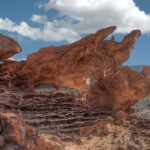
Tassili n’Ajjer is a vast plateau in southeastern Algeria, covering around 28,000 square miles of sandstone cliffs and canyons. Situated near the borders of Libya, Niger, and Mali, the region rises above the Sahara Desert like a fortress of stone. Its name means “Plateau of Chasms,” a fitting description for the labyrinth of rock formations created over thousands of years by wind and erosion. In 1982, UNESCO added Tassili n’Ajjer to its World Heritage List, citing both its geological beauty and its extraordinary wealth of prehistoric art.
Long before the Sahara became the barren desert it is today, Tassili n’Ajjer was a green savanna dotted with rivers, lakes, and fertile valleys. This environment supported elephants, giraffes, hippos, and cattle, animals that are still visible in the rock engravings and paintings left behind. Human communities thrived in this region, relying on hunting, herding, and eventually pastoral life. As the climate shifted to aridity, the plateau became a natural archive of the Sahara’s transformation, preserving both the memory of its lush past and the creativity of its inhabitants.
Prehistoric Occupation of the Plateau
Archaeological evidence shows that humans occupied Tassili n’Ajjer as early as 6000 BC. These early groups left behind stone tools, pottery, and elaborate burials that reflect their cultural complexity. The rock art charts their progression from hunter-gatherers to herding societies, recording the animals they pursued, the rituals they practiced, and the adaptations they made to survive. Each artistic style corresponds to a phase in this long story of survival and change.
The artwork is typically divided into four main periods that mirror these cultural transitions. The Archaic Period (6000–4000 BC) depicted large game animals in naturalistic form. The Pastoral Period (4000–1500 BC) emphasized cattle, herding life, and ceremonial imagery, including elongated human figures. The Horse Period (1500–300 BC) introduced chariots, mounted warriors, and scenes of conflict, while the Camel Period (after 300 BC) reflected adaptation to harsher desert conditions through caravans and nomadic travel.
- Archaic Period (6000–4000 BC): hunters, wild fauna, early abstract forms
- Pastoral Period (4000–1500 BC): herding, elongated figures, ceremonial scenes
- Horse Period (1500–300 BC): chariots, mounted warriors, conflict scenes
- Camel Period (after 300 BC): adaptation to desert, caravans, nomadic life
Importance in World Rock Art
The plateau preserves between 15,000 and 20,000 paintings and engravings, though some estimates suggest the number may be even higher. These images appear on cliff walls, cave shelters, and towering rock formations across hundreds of sites. Few places on earth provide such a continuous record of human life and climate over thousands of years. The diversity of themes and the sheer scale of the collection make Tassili n’Ajjer one of the greatest open-air museums of prehistory.
Scholars often compare Tassili to European sites such as Lascaux or Altamira, but the Algerian plateau represents a wholly different narrative. Whereas European caves recall Ice Age hunters, Tassili preserves the cultural memory of a Sahara that shifted from savanna to desert. The elongated figures, in particular, are without parallel in Europe, standing as a unique artistic expression. Their mystery and scale underscore why Tassili n’Ajjer remains a cornerstone in the global study of prehistoric art.
The Elongated Figures: Description and Features
Artistic Characteristics
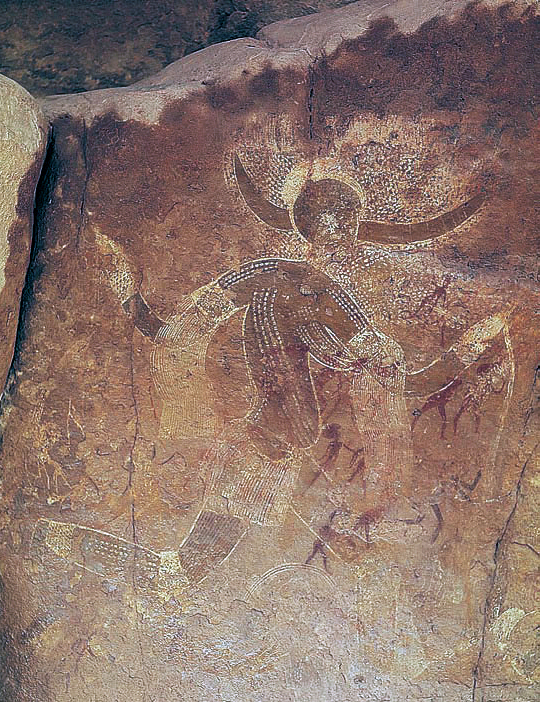
The elongated human figures of Tassili n’Ajjer are striking for their tall, slender proportions. Often painted larger than life, their bodies stretch upward with thin limbs, while their heads are rounded or helmet-like. Facial features are rarely detailed, giving them an abstract or symbolic quality rather than a literal human likeness. Their unusual proportions suggest that they represented more than ordinary people, perhaps embodying supernatural or ritual significance.
Some panels depict these figures standing in groups, while others appear to float or extend their arms toward the sky. The absence of detailed clothing, jewelry, or tools makes them stand apart from the more naturalistic depictions of daily life. Their visual power lies in their strangeness: simplified yet monumental, earthly yet otherworldly. This deliberate style has ensured their place as some of the most enigmatic images in the prehistoric world.
Distinct Categories
Researchers often place these works within the “Round Head” style, dating roughly from 8000 to 6000 BC. The name comes from the circular heads characteristic of this period, sometimes painted in solid colors. Within this group, the elongated beings are among the largest and most dramatic, often dominating the compositions in which they appear. Their exaggerated height contrasts with smaller human figures shown alongside them, as though marking them as figures of higher status.
Some elongated figures interact with animals, guiding herds or standing near wild species, while others appear in ceremonial postures. Certain scenes suggest processions, dances, or ritual gatherings. These variations indicate that the elongated beings were not a single type of figure but rather a category used for different symbolic purposes. Their prominence in the Pastoral and Round Head phases makes them central to understanding the cultural life of early Saharan societies.
Materials and Techniques
The figures were painted using natural pigments derived from minerals and soils. Red ochre was the most common, producing shades that have endured for thousands of years. White pigments were occasionally applied to highlight features or create contrast, though these have faded more quickly. Some images were also carved into the sandstone, leaving outlines that remain visible even as pigments eroded.
Placement was just as important as technique. Many elongated figures appear high on cliff walls or inside shelters that required effort to reach, suggesting a deliberate choice to elevate them above ordinary space. Their survival owes much to these protected positions, as well as to the desert’s dryness, which slowed the natural decay of pigments. Even today, despite weathering, the elongated beings continue to command attention across the plateau.
Theories and Interpretations
Spiritual or Religious Significance
One of the most enduring interpretations is that the elongated figures held religious or spiritual importance. Their monumental size and abstract form may have marked them as depictions of gods, spirits, or mythical ancestors. The way they dominate compositions suggests reverence, with smaller humans perhaps shown in positions of worship or subordination. Some scholars connect them to shamanic practices, where ritual leaders entered trances and depicted the visions they experienced.
The setting of these works also supports a ceremonial interpretation. Many of the paintings appear in secluded rock shelters that would have been difficult to access, limiting them to select individuals. Such restricted placement implies that the figures were not meant for daily viewing but for sacred use. In this view, the elongated beings symbolized connections between the human and the divine.
Symbolic and Cultural Meanings
Another line of interpretation is that the figures represented fertility, protection, or cosmic order. In a once-fertile Sahara, ensuring the health of herds and crops would have been essential, and symbolic figures may have embodied those concerns. Their great height could signify guardianship, with their towering forms watching over communities and animals. Abstract shapes may have been a way to express ideas that were spiritual rather than literal.
Other scholars argue that the figures express altered states of vision experienced during ceremonies. The floating or stretching quality of the figures mirrors descriptions of visions where boundaries between the body and the spirit world blur. By painting such forms, early Saharan peoples may have sought to capture their encounters with forces beyond ordinary life. These interpretations, grounded in anthropology, emphasize the symbolic power of the images rather than their literal form.
Modern Speculation
In modern times, the strange appearance of the elongated beings has led to sensational claims. Some writers have proposed that the figures represent alien visitors, pointing to their abstract heads and unusual height as evidence. Such theories gained popularity after the French explorer Henri Lhote published his studies in the 1950s. While they captured public imagination, scholars stress that there is no evidence for these claims, and that the figures are better understood within the cultural and religious life of prehistoric peoples.
Still, the alien interpretation shows how powerfully these figures resonate even today. Their mystery and abstraction invite speculation, a testament to their enduring strangeness. By separating serious archaeological study from modern fantasy, it becomes possible to appreciate both the fascination they inspire and the cultural truths they reveal. Tassili n’Ajjer’s elongated figures remain part of serious scholarship even as they echo through popular culture.
Legacy and Preservation Today
Discovery and Documentation
Although local Tuareg communities were long aware of the rock art, it became widely known to the outside world in the mid-20th century. Henri Lhote, a French ethnographer, led expeditions to the plateau in the 1950s and brought back copies and photographs of the paintings. His 1958 book, The Search for the Tassili Frescoes, introduced the elongated beings to global audiences. While his interpretations were sometimes controversial, his work ensured that Tassili n’Ajjer gained international recognition.
Since Lhote’s expeditions, scholars have documented thousands of images using photography, tracing, and later digital technology. These records are critical, since natural erosion and human interference threaten the preservation of the art. By building archives, researchers seek to ensure that the meaning and beauty of the elongated figures are not lost even if the originals fade.
Role in Algerian and African Heritage
For Algeria, Tassili n’Ajjer is both a cultural treasure and a source of national pride. The art represents an African heritage that predates written history, linking modern people to ancestors who lived in a radically different environment. It stands as evidence that North Africa was once a cradle of creativity and ceremony, not merely a desert. The figures remind viewers that the Sahara was once home to thriving cultures whose visions continue to inspire.
In broader African art history, Tassili is a touchstone that rivals sites from Egypt or Nubia in significance. Its paintings expand the understanding of prehistoric creativity beyond the Nile Valley, showing that artistic expression flourished across the continent. Contemporary African artists sometimes draw upon Tassili’s forms, reinterpreting them for modern audiences. In this way, the elongated figures continue to influence art thousands of years after they were created.
Preservation Challenges
The plateau faces significant threats from natural erosion, climate shifts, and human impact. Tourists, though limited by the remote location, have damaged some panels through touching or trampling. Climate change and desert winds continue to erode sandstone surfaces, gradually fading pigments that have survived for millennia. Without careful management, many of the images could disappear within a few generations.
Efforts to preserve the site include protective regulations enforced by Algerian authorities and UNESCO-supported projects. Digital documentation has become a vital tool, creating replicas and archives for future study. Some figures have been reproduced in museums to allow wider access without risking the originals. These measures, while imperfect, are part of a global recognition that Tassili n’Ajjer’s elongated beings are irreplaceable treasures of human history.
Conclusion: The Enduring Mystery of Tassili’s Figures
The elongated rock figures of Tassili n’Ajjer remain among the most mysterious creations of prehistoric art. Painted thousands of years ago during a time when the Sahara was fertile and alive with wildlife, they reflect both the spiritual imagination and the lived experiences of early African societies. Their size, abstraction, and placement suggest that they carried great symbolic power, standing as guardians, spirits, or ceremonial presences.
Today, they continue to fascinate scholars, travelers, and artists alike. While theories about their meaning range from shamanic visions to fertility symbols, their true significance may never be fully known. What is certain is that they preserve a glimpse of human creativity at a time of dramatic change, as people adapted to a desert world. Tassili n’Ajjer’s elongated beings remind us of the depth of human history, the fragility of cultural heritage, and the enduring power of art to inspire awe across millennia.