To understand the trajectory of Singaporean art, it is necessary to begin not with the modern city-state, but with the littoral world it once inhabited—a nodal point within the maritime circuits of the Malay Archipelago. Before the arrival of the British in 1819, what is now Singapore was not an artistic void, but a culturally complex environment interwoven with regional currents of trade, religion, and craftsmanship. The very notion of “art” in this pre-colonial setting must be disentangled from Western categories of fine art, which had little bearing on the ways aesthetic production functioned in Austronesian societies. It is in this earlier world, defined more by ritual, utility, and ornament than by gallery walls, that Singapore’s visual and material culture begins.
Evidence of artistic activity prior to British colonization is fragmentary, but nonetheless suggestive. Archaeological findings from sites such as Fort Canning and Empress Place—once the grounds of the 14th-century settlement of Temasek—reveal ceramics, bronze objects, and glassware, attesting to the island’s participation in the commercial and cultural flows that linked Java, Malacca, Siam, and beyond. These objects were not necessarily local in manufacture, but they formed part of a visual lexicon that residents would have seen, handled, and perhaps even replicated. Art here was not autonomous; it was entwined with trade, status, and cosmology.
One must consider the broader regional art historical milieu to which early Singapore belonged. Malay woodcarving traditions—revered for their arabesque intricacy and deep symbolic meanings—likely influenced any vernacular architecture or ritual objects produced locally. Similarly, the Islamic art of the wider Malay world, characterized by vegetal motifs, calligraphy, and aniconism, would have permeated the artistic sensibility of Muslim inhabitants. Yet Singapore, even in its earliest forms, was never mono-ethnic. Tamil Muslim traders, Chinese merchants, and Bugis seafarers all left their mark. The artistic life of the island was one of plural forms, situated within a world of port cities and transient populations. Here, cultural cross-pollination was not a novelty—it was the rule.
The arrival of Sir Stamford Raffles and the British East India Company in 1819 ushered in a different mode of visual engagement, one defined by documentation, classification, and imperial gaze. Raffles himself was a collector of Javanese antiquities and a committed amateur orientalist. Under his influence, and that of his successors, Singapore became both a depot and a laboratory for colonial knowledge. The Raffles Museum—now part of the National Museum of Singapore—was founded in the 19th century not as a space for artistic contemplation, but as a repository of ethnographic specimens. The very act of collecting, cataloguing, and displaying native arts and crafts as “specimens” placed Southeast Asian material culture within a hierarchy, one in which European art occupied the apex of civilization.
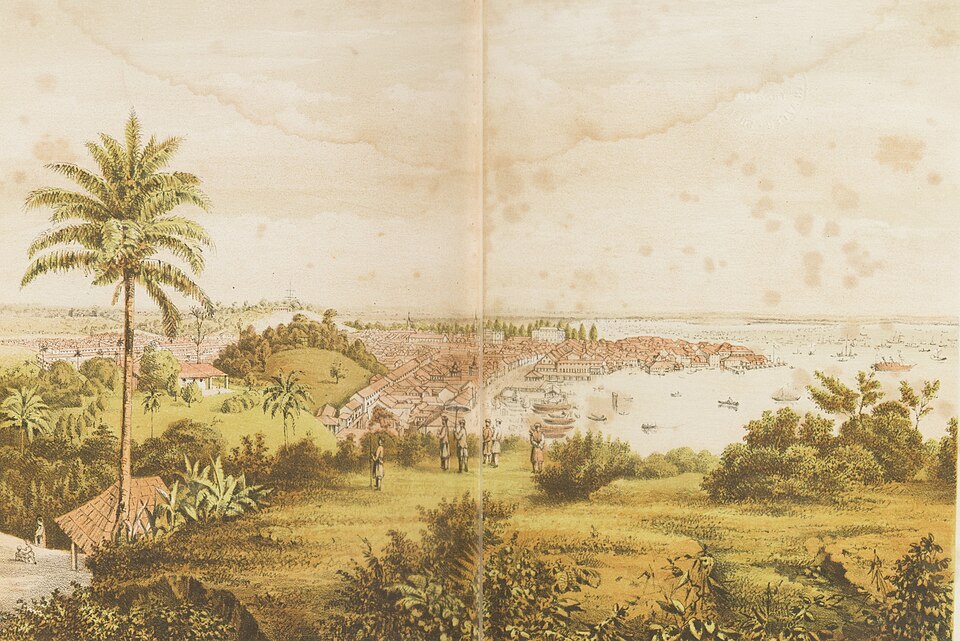
It is within this colonial matrix that Singapore’s first formal artistic representations emerged. These were not produced by locals, but by European officers, surveyors, and artists who sought to depict the unfamiliar tropics with a blend of scientific detachment and Romantic exoticism. Drawings, watercolors, and engravings by figures such as John Turnbull Thomson, Charles Dyce, and George Coleman show bustling markets, kampongs, mosques, and landscapes—scenes framed through the aesthetic conventions of the time. Their works serve today as valuable visual documents, but they also embody the distortions of a colonial gaze: selective, aestheticized, and often sanitized.
The colonial period also saw the introduction of Western artistic conventions through missionary and educational institutions. The introduction of drawing as a component of a British-style education served dual purposes: it was a tool of discipline and observation, and a means of cultural acclimatization. Local students were taught to see through the lens of perspective, proportion, and realism—values alien to the decorative traditions of Malay or Chinese craft. This pedagogical shift was not merely technical, but ideological: it aimed to replace the collective, symbolic aesthetics of the region with the individualistic and mimetic model of European art.
Yet this process was neither total nor uncontested. Many Chinese immigrants brought with them their own robust artistic traditions. Literati painting, calligraphy, and ink wash landscapes—steeped in Confucian ideals and Daoist metaphysics—were sustained in clan associations, schools, and private studios. These were not merely decorative arts but expressions of cultivated identity and moral refinement. Though they remained largely within the confines of the Chinese community, they provided an alternative aesthetic cosmology to both Malay craft and colonial representation.
Similarly, Indian artisans, many of whom arrived as laborers or traders from Tamil Nadu, Ceylon, or Bengal, contributed to the visual texture of early Singapore. Hindu temple architecture, such as that of Sri Mariamman Temple (established 1827), introduced vivid, polychrome sculptural forms depicting deities, epics, and rituals. These temple reliefs were not only religious icons, but complex visual narratives embedded in the everyday life of their communities. Their presence underscored a crucial point: in colonial Singapore, art remained deeply tied to religious and communal structures, not yet severed into a specialized category of secular creativity.
By the late 19th century, Singapore had become a cosmopolitan entrepôt, its population swelling with Chinese, Malay, Indian, and Eurasian residents. Art during this period existed in parallel tracks. On one hand, colonial society cultivated a Eurocentric taste for oil painting, watercolors, and portraiture, genres reinforced by exhibitions at institutions like the Singapore Art Society (founded in 1949, though its seeds were planted earlier). On the other hand, vernacular forms—signboard carving, opera costume design, temple mural painting—continued to flourish within ethnic enclaves, largely unacknowledged by colonial aesthetic discourse.
These forms did not easily fit the taxonomies of “high art” as defined by Europe, and thus were seldom preserved or studied. The modern museum, as a colonial apparatus, often neglected them. Yet they formed the visual language of the streets, the festivals, the rituals of the living city. They were Singapore’s unarchived art history—vibrant, ephemeral, and mostly invisible to the administrators cataloguing civilization.
Thus, Singapore’s artistic foundations before the nation-state are best understood as a contested terrain: between indigenous craft and imported models, between religious devotion and bureaucratic display, between plural vernaculars and the centralizing force of imperial aesthetic ideology. It is not a neat prelude to modernism, but a layered palimpsest—one in which art was never purely autonomous, and beauty always carried with it the weight of context.
When Singapore would later seek to define its own artistic identity in the mid-20th century, it would do so not from a vacuum but from this sedimented history—partially remembered, selectively preserved, and frequently overwritten. The past was never fully past; it lingered in materials, motifs, and methods, waiting to be reanimated or rejected by the generations to come.
Colonial Institutions and the Birth of Formal Art Education
The colonial administration that took root in Singapore after 1819 brought with it not merely a new economic order but an entire epistemic framework. British rule did not only reorder the island’s infrastructure, laws, and commercial practices—it restructured its intellectual and cultural horizons. Among these shifts, the implantation of colonial institutions played a decisive role in shaping the early contours of art education, aesthetic hierarchy, and cultural legitimacy in Singapore. The question of how art was taught, and by whom, is not ancillary to the development of a national artistic tradition; it is foundational. For within the classroom—its techniques, curricula, and biases—the principles of what counted as “art” and who could produce it were quietly established.
The early colonial approach to culture in Singapore was ambivalent. While the British authorities fostered public institutions such as libraries and botanical gardens, these were largely scientific or bureaucratic in character. Art, insofar as it was institutionalized, was initially a subsidiary pursuit—useful for cartography, illustration, and ornamentation, but rarely a focus of dedicated policy. The practical utility of drawing, however, ensured its presence in the early educational system, which was itself modeled on British pedagogical values. Drawing was seen as a tool of order and rationality, a discipline capable of refining hand-eye coordination, instilling observational habits, and preparing pupils for technical professions.
This utilitarian model was reflected in early missionary and government-aided schools. Institutions such as Raffles Institution (founded 1823) and St. Joseph’s Institution incorporated drawing into their syllabi not for the cultivation of artistic sensibility, but to serve the economic machinery of empire. Students learned to depict botanical specimens, architectural plans, and mechanical forms with scientific precision. The aesthetic was subordinated to the measurable and the accurate. Beauty, if acknowledged at all, was located in symmetry, proportion, and fidelity to nature—values derived from Enlightenment rationalism rather than any local visual tradition.
The figure of the colonial surveyor or draughtsman became emblematic of this period. Men such as John Turnbull Thomson, who served as Government Surveyor of the Straits Settlements, exemplified the dual role of artist and technician. His watercolors and sketches of landscapes and infrastructure were not intended for galleries but for reports, exhibitions, and archival storage. Yet these images did more than record—they imposed a visual order on a space considered unruly or illegible by colonial logic. In rendering the tropics picturesque, they transformed environment into possession.
It was only toward the late 19th and early 20th centuries that more structured art instruction began to emerge, paralleling the rise of an educated local elite. The introduction of the Cambridge School Certificate Examination in Singapore in 1891 marked a turning point: drawing became a formal examinable subject, tethered to an imperial standard. This credentialing mechanism further entrenched a Western canon of artistic excellence, while simultaneously limiting the scope of what could be taught and assessed. What did not conform to these imported models—Chinese brush painting, Malay batik, Indian kolam—was excluded, rendered marginal or folkloric.
In this period, amateur art societies began to form among the colonial and Eurasian populations. The Singapore Amateur Drawing Association, for example, offered a forum for expatriates and acculturated locals to display their watercolors and sketches. Yet these organizations remained largely informal and exclusive, functioning more as social clubs than incubators of a broader artistic culture. The art they promoted—typically landscapes, still lifes, and portraits—echoed British sensibilities, drawing from the traditions of Constable, Turner, and the Pre-Raphaelites. Local scenery became the exotic backdrop for European aesthetics.
The institutional shift began to accelerate in the interwar period. The opening of the Technical Education Department in the 1920s expanded vocational training in design and drafting, and by the 1930s, the British colonial administration had established art teaching as a specialist profession within schools. Figures such as Richard Walker, appointed Inspector of Art in the Straits Settlements, played a critical role in formalizing the curriculum. Walker’s pedagogy emphasized watercolor, perspective, and nature study—skills that mirrored the needs of both empire and middle-class respectability.
Concurrently, the emergence of Chinese-medium schools, particularly those affiliated with clan associations and religious organizations, provided a parallel track of artistic education. Here, students were often introduced to ink painting, calligraphy, and traditional Chinese aesthetics under the tutelage of scholar-artists who had emigrated from mainland China. These schools represented not simply an ethnic or linguistic alternative but an aesthetic one—one rooted in literati ideals, cyclical notions of history, and a philosophical approach to the natural world. The Chinese educational network thus preserved a counter-narrative to colonial artistic norms, even as it occasionally borrowed from them.
A crucial inflection point occurred during and after World War II. The Japanese occupation (1942–1945) disrupted all formal education, but its aftermath provided the context for a new cultural reawakening. Amid the broader currents of decolonization and nationalism sweeping across Asia, there arose a desire among local intellectuals and artists to reclaim cultural agency. Art was no longer to be an imported ornament but a means of self-definition. This impulse found expression in newly formed schools and societies.
In 1946, the Nanyang Academy of Fine Arts (NAFA) was established by Lim Hak Tai, a Chinese émigré and art educator. NAFA represented a seminal moment in Singapore’s art history—it was the first major institution founded with the explicit aim of nurturing local artistic talent through a synthesis of Eastern and Western traditions. Lim’s vision was rooted in the belief that Chinese artists in Southeast Asia should forge a new idiom by integrating classical Chinese techniques with the visual vitality of the tropical environment and the structural principles of Western painting. This would come to be known as the “Nanyang” style, which will be explored in depth in the next section.
NAFA’s founding signaled a shift in the geography of art education: away from colonial officialdom and toward locally driven initiatives. It challenged the monopoly of Western aesthetic authority and opened the door for a generation of Singaporean artists to develop distinctive voices. Yet it also exemplified the hybrid condition of Singaporean art education—never purely Western, never purely local, but always negotiating the in-between.
The colonial institutions that once framed drawing as an imperial tool had inadvertently laid the groundwork for a more complex artistic infrastructure. In standardizing instruction, introducing public exhibitions, and creating mechanisms of artistic legitimacy, they built the scaffolding upon which later generations would inscribe their own meanings. Art education in colonial Singapore was not neutral; it was a site of contestation, hierarchy, and negotiation. But it also produced an archive of skills and habits that artists would later appropriate, subvert, or reinvent in pursuit of an identity not yet legible within the colonial frame.
What emerged by mid-century was a landscape marked by dual inheritances: the pedagogical rigour of colonial draftsmanship and the spiritual resonance of Chinese ink traditions; the institutional authority of European academies and the communal intimacy of vernacular instruction. It is in this charged space—between imposed system and indigenous adaptation—that Singapore’s modern art history would take root.
Nanyang Style and the Invention of a Regional Aesthetic
The emergence of the Nanyang style in the mid-20th century stands as one of the defining moments in the art history of Singapore—not simply as a stylistic development, but as a cultural proposition. In its most visible form, it was a visual synthesis: Chinese ink traditions fused with Western oil techniques, rendered through the lens of Southeast Asian subject matter. But more profoundly, it marked the first serious attempt by artists in Singapore to articulate a regional aesthetic—a modern visual language that neither replicated the past nor wholly borrowed from the West, but sought instead to respond to the specificities of tropical light, migrant memory, and hybrid geography. The term “Nanyang”—a Chinese word meaning “South Seas,” long used to refer to Southeast Asia—became the ideological anchor for this movement. It was an aesthetic not of the nation-state (which had not yet formed) but of place: the humid, plural, visually dense world of postwar Malaya and the Straits Settlements.
The founding of the Nanyang Academy of Fine Arts (NAFA) in 1946 by Lim Hak Tai created the institutional conditions for this transformation. Lim, a graduate of the Xinhua Academy in China, arrived in Singapore in the 1930s, driven by both political instability and a sense of artistic mission. NAFA’s early faculty included a number of other émigré artists, many trained in Chinese art academies that had themselves undergone processes of reform and modernization in the early Republican period. These were men and women schooled in the ink painting tradition but open to Western innovations—perspective, oil paint, life drawing—which had been increasingly adopted in China’s own urban centers.
This openness to formal hybridity found fertile ground in Singapore, where colonial infrastructure, Chinese diaspora networks, and Southeast Asian environment collided. Lim Hak Tai actively encouraged his students and colleagues to engage with their surroundings—not simply as backdrop, but as aesthetic substance. His premise was radical in its simplicity: that the lived textures of Southeast Asia could, and should, inform the very construction of an artistic identity. He sent students on study trips to kampongs, fishing villages, and plantation towns. They painted batik makers, coconut trees, market scenes, and fishermen not merely as ethnographic specimens but as part of a new visual idiom, one that resisted both the nostalgic classicism of Chinese tradition and the sterile academicism of British pedagogy.
At the core of this vision were several pivotal artists whose work came to define the Nanyang aesthetic. Cheong Soo Pieng, perhaps the most iconic of the group, arrived in Singapore in 1946 after having studied at the Xiamen Academy of Fine Arts and later in Chongqing. He brought with him an experimental sensibility, already interested in abstraction and modern form. His works from the 1950s and 1960s—slender figures with almond eyes, elongated limbs, often depicted against a stylized tropical backdrop—are not mimetic portraits but modernist interpretations of Southeast Asian life. His canvases display an economy of line and a warmth of palette that merge Chinese brushwork with the coloristic explorations of Matisse and Gauguin. In particular, his images of Balinese women and Malay villagers reflect both admiration and stylization, teetering between homage and appropriation.
Another central figure, Chen Wen Hsi, exemplified a more restrained, scholarly approach. Known for his masterful ink paintings of gibbons and landscapes, Chen also produced oil works that fused Chinese brush technique with a Cubist sensibility. Trained in Shanghai, he brought to Singapore a deep knowledge of Chinese art history but sought to render it contemporary through fragmentation, spatial experimentation, and a meditative engagement with form. His compositions, whether depicting animals or rural life, carried a formal elegance that transcended literal representation.
Georgette Chen, though often grouped with the Nanyang artists, stood somewhat apart in her training and outlook. Born in China, raised in Paris and New York, and married to a Chinese diplomat, Chen was cosmopolitan in the truest sense. Her education at the Académie Colarossi and Art Students League exposed her to Western modernism at its source. Yet when she settled in Singapore in the 1950s and began teaching at NAFA, she embraced the idea of local subject matter with quiet conviction. Her still lifes—rambutans, rambutans, durians, bananas—rendered tropical fruit with Cézanne-like deliberation, while her portraits of street hawkers and kampong children exuded a tender realism. In her hands, modernist brushwork did not abstract the subject into alienation; it humanized it.
What united these artists was not a formal doctrine but an ethos: to forge a pictorial language adequate to their environment. The “Nanyang style,” though frequently invoked as a category, was never a school in the rigid sense. It was, instead, a shared impulse to resolve the contradictions of exile and arrival, tradition and modernity, memory and place. It was a style born not from manifesto but from negotiation—with medium, with geography, with identity. That the artists were largely ethnic Chinese working within a multiracial society further complicates the narrative. Their art, though often depicting non-Chinese subjects, did not pretend to ethnographic neutrality. It was selective, stylized, and, at times, romanticized. But it was also an earnest engagement with the unfamiliar, a visual attempt to belong.
This engagement extended beyond the canvas. Exhibitions of Nanyang art were held not only in Singapore but in Kuala Lumpur, Penang, and Jakarta. The artists traveled—most famously on a 1952 study tour to Bali that included Cheong Soo Pieng, Chen Chong Swee, Chen Wen Hsi, and Liu Kang. The Bali trip became mythologized as a kind of aesthetic pilgrimage, a moment of deep encounter with a non-Chinese Southeast Asia. The paintings that emerged from it were suffused with warmth and exoticism, but also marked by a stylistic confidence. Bali, with its rituals, colors, and rhythms, became a site of visual plenitude—a Southeast Asia imagined through the eyes of diasporic painters.
Critics of the Nanyang style have since raised questions about its representations. Some see in it a form of Orientalism in reverse—a Sinic gaze cast upon the Malay world, framing its subjects as timeless, picturesque, and unthreatening. Others view it as a genuine attempt at syncretism, a rare moment in which modernist aesthetics opened toward rather than away from the local. Both readings hold truth. What cannot be denied is the central role Nanyang art played in the formation of Singapore’s postwar visual culture. It dominated the art scene from the 1950s through the 1970s, shaping public taste, institutional acquisition, and pedagogical standards.
The Nanyang style also influenced the architectural and decorative arts of the period. Its aesthetic logic—tropical modernism, vernacular motifs, color saturation—resonated with broader attempts to define a regional identity amid decolonization. As Singapore moved toward independence in 1965, the Nanyang painters stood as cultural pioneers, even as their work began to seem, to some younger artists, too comfortable, too depoliticized, too steeped in nostalgia. The seeds of critique were already present, and a new generation would soon begin to question the assumptions that undergirded this regional romanticism.
Yet the legacy of the Nanyang movement is enduring. It established that art in Singapore need not merely imitate metropolitan centers. It could emerge from encounter, adaptation, and rootedness. It could draw from multiple traditions without collapsing into eclecticism. Most importantly, it offered a model—however incomplete—of what it might mean to see Southeast Asia not through the lens of the empire or the ancestral homeland, but as a place to be inhabited, interpreted, and made anew.
Modernism and the Rise of National Identity in Art (1965–1980s)
The proclamation of Singapore’s independence in 1965 was not merely a political act—it marked a profound epistemological rupture. The island, long defined by external powers and diasporic movements, now faced the imperative to define itself. What did it mean to be Singaporean in a city where nationhood had been an afterthought, grafted onto a trading post of migrants and merchants? This question, at once existential and administrative, reverberated across the cultural sphere. In the realm of art, it gave rise to a new phase marked by the search for a national identity through visual form—a phase in which modernism, long considered the preserve of aesthetic innovation, became entangled with the ideological project of state-building.
Modernism in Singaporean art did not arrive abruptly. It had been gestating in the work of Nanyang artists who experimented with Western techniques and abstraction, albeit filtered through figurative and regional motifs. What changed after 1965 was the context and urgency of this experimentation. The new government, led by Prime Minister Lee Kuan Yew, sought to construct a cohesive national identity out of an ethnically diverse population. Art, while not prioritized in the earliest years of industrial and infrastructural development, was nevertheless enlisted to support this narrative. The early decades of independence were defined by a tension between individual expression and collective identity, formal innovation and social utility.
In this climate, modernism became a vessel for multiple and sometimes conflicting ambitions. For a generation of younger artists—many of whom had studied abroad, particularly in Britain and Australia—modernism offered a means of transcending ethnic or regional idioms in favor of universal forms. Abstraction, in particular, gained prominence. In the eyes of its practitioners, it held the promise of neutrality, of a language that could rise above the racial compartmentalization of Singapore’s social fabric. The grid, the field, the gesture—these formal devices spoke not of the kampong or the market, but of the mind, the psyche, the metaphysical. In this way, modernism became aligned with cosmopolitanism, a refusal of parochial identity politics in favor of a larger, more ambiguous subjectivity.
Artists such as Anthony Poon, Thomas Yeo, and Goh Beng Kwan became central to this movement. Poon, trained in London at the Byam Shaw School of Art, developed a practice rooted in geometric abstraction, producing works that explored optical rhythm, spatial ambiguity, and chromatic harmony. His “Wave” series, executed in the 1970s, exemplifies this tendency: clean, undulating forms that evoke movement without representation. These were not images of Singapore, but they were, in a sense, images for Singapore—works that projected an image of modernity, rationality, and refinement compatible with the state’s self-image as a technologically advanced, forward-looking society.
Thomas Yeo, similarly trained in London, produced mixed-media abstractions that incorporated organic textures and calligraphic marks, evoking both the landscape and the unconscious. His work, while less systematic than Poon’s, retained a formal sophistication that resisted easy categorization. Goh Beng Kwan, a key figure in the evolution of Singaporean abstraction, brought a collagist sensibility to the fore, using torn paper, sand, fabric, and pigment to build surfaces that were both tactile and symbolic. Educated at the Art Students League in New York, Goh absorbed Abstract Expressionist influences but adapted them to his own materials and memories, including allusions to Chinese scrolls and Southeast Asian textures.
What unites these artists is a commitment to a modernist idiom that sought autonomy from both the state and the street. Their art did not depict Singaporean life in any literal sense; rather, it mirrored the aspirations of a newly independent nation seeking to align itself with international standards of culture and sophistication. In this sense, modernism functioned not as an escape from politics but as its aesthetic corollary—a form of cultural engineering by which Singapore could assert itself as part of a global, civilized world.
Yet this alignment was not without friction. The Singaporean government, while supportive of culture in principle, remained wary of art that appeared disconnected from the populace or critical of the status quo. The state’s utilitarian approach to culture—manifested in institutions such as the Ministry of Culture (established 1959)—favored works that could reinforce national values: harmony, hard work, multiracialism, and economic progress. As such, realist and figurative works that celebrated ethnic diversity, labor, or historical events were more likely to receive official endorsement, grants, and exhibition space. Abstraction, despite its intellectual cachet, was often perceived as elitist, obscure, or foreign.
This ideological fault line shaped the institutional landscape of the time. The Singapore Art Society, the principal exhibition platform in the 1960s and 70s, was dominated by older artists, many affiliated with the Nanyang Academy of Fine Arts, whose works remained rooted in figuration and regional themes. Younger modernists, by contrast, found it difficult to exhibit their work or gain critical attention. There were few independent galleries, and no major contemporary art museums. The infrastructure to support modernism was largely absent, forcing artists to rely on foreign venues, traveling shows, or self-organized exhibitions.
Despite these obstacles, the period saw the emergence of artist collectives and informal networks that sustained a modernist ethos. The Alpha Gallery, founded in 1971 by artist and gallerist Ho Ho Ying, was a crucial platform for non-figurative work, as was the Modern Art Society, which organized group exhibitions and forums. These spaces allowed for the articulation of a new critical vocabulary—one that prioritized materiality, form, and aesthetic inquiry over nationalist themes. They also fostered debate about the role of the artist in society: was the artist a mirror of national values, or a prophet of individual vision?
Not all artists answered this question in the same way. Some, like Chua Ek Kay, began to explore hybrid forms that merged Chinese ink painting with Western modernist composition, retaining a sense of cultural specificity while embracing formal innovation. Others, like Teo Eng Seng, developed new mediums entirely—Teo’s “paperdyesculp” technique, created in the late 1970s, involved molded paper pulp dyed with pigment, forming sculptural reliefs that combined painting, collage, and low-relief sculpture. These experiments suggest that modernism in Singapore was never monolithic; it was continually adapted, questioned, and localized.
Meanwhile, state efforts to institutionalize culture began to gather momentum. The 1979 Report of the Advisory Council on Culture and the Arts laid the groundwork for more systematic support of the arts, culminating in the formation of the National Arts Council in 1991. But during the 1965–1980s period, the state’s role remained cautious, pragmatic, and often ambivalent. While it funded national competitions and overseas exhibitions, it was also wary of politically charged or socially critical art, which could disrupt the image of cohesion so carefully cultivated.
This ambivalence extended to education. While schools introduced art classes, these remained focused on technical skills and exam preparation, rarely encouraging critical or conceptual thinking. Art as a profession was still stigmatized, and few avenues existed for advanced study beyond the diploma level. The infrastructural gaps—lack of dedicated museums, journals, and critical institutions—meant that modernist art remained a niche pursuit, driven more by personal conviction than public acclaim.
And yet, out of this tension emerged a body of work that pushed the boundaries of form, medium, and meaning. Modernism in Singapore during this period was not a seamless movement but a field of contested positions—between East and West, individual and state, form and function. It laid the groundwork for the more radical experiments of the 1990s, while also reflecting the contradictions of a society in the throes of rapid transformation.
In retrospect, the art of this era reveals both the possibilities and the limits of modernism as a national project. It aspired to universality, yet struggled with relevance. It sought purity of form, yet existed in a society that demanded purpose. It was both a product of its time and a critique of it—a mirror turned inward, reflecting the struggle to define selfhood not just as an individual, but as a people.
The Emergence of Contemporary Art: Dissent, Identity, and Experimentation (1990s)
The 1990s marked a profound rupture in the trajectory of Singaporean art. It was during this decade that the term “contemporary art” became meaningful—not merely as a chronological designation but as a conceptual, political, and aesthetic orientation distinct from the modernist ideals that had dominated the post-independence decades. This was a period of accelerated transformation: economic liberalization, globalization, the rise of the internet, and the consolidation of state-led cultural policy. Singapore had become prosperous, disciplined, and globally integrated. But for a new generation of artists, these very developments demanded interrogation. In this atmosphere, art ceased to be a vehicle for national identity or formal innovation alone—it became a medium of dissent, a mode of critical inquiry, and a platform for exploring questions of subjectivity, sexuality, ethnicity, and state power.
To understand the emergence of contemporary art in Singapore, one must first grasp the broader social and institutional backdrop. The 1980s had ended with a growing awareness within the government that cultural development was not merely decorative but economically and diplomatically strategic. The 1989 Report of the Advisory Council on Culture and the Arts recommended stronger state support for the arts, viewing culture as part of the larger project of positioning Singapore as a “global city.” This culminated in the formation of the National Arts Council in 1991 and the Singapore International Festival of Arts in 1977 (earlier known by various names), alongside a slew of new initiatives aimed at fostering a “Renaissance City.” Yet, this state interest in culture was not simply benevolent; it was managerial. Art was expected to serve the objectives of excellence, international branding, and social cohesion.
It is precisely within—and against—this technocratic environment that a new generation of artists began to operate. Educated in newly professionalized institutions like LASALLE College of the Arts and overseas programs in London, New York, and Sydney, they returned with a vocabulary that eschewed painting for performance, installation, video, and conceptualism. Their works were not objects to be collected but provocations to be encountered. Art was no longer confined to easels and gallery walls; it unfolded in public spaces, ephemeral gestures, and symbolic transgressions.
The most notorious flashpoint of this era came in 1994, when artist Josef Ng performed “Brother Cane” at the Artists’ General Assembly (AGA), an event organized at 5th Passage, an artist-run initiative housed in Parkway Parade Shopping Centre. Ng’s performance, a protest against police entrapment of gay men in public toilets, culminated in a symbolic act: he turned his back to the audience, snipped his pubic hair, and scattered it on the floor. The performance was immediately vilified in the media. The state responded swiftly and decisively: 5th Passage’s funding was revoked, performance art and forum theatre were de facto banned from receiving public funding for the next ten years. The event remains a watershed in Singaporean art history—a moment that exposed the limits of state tolerance and crystallized the tensions between artistic autonomy and political control.
But “Brother Cane” was not an isolated incident. It was symptomatic of a broader movement in which artists were rethinking their relationship to society, history, and the body. Amanda Heng, a foundational figure of feminist and performance art in Singapore, staged works that interrogated gender norms, filial piety, and the invisibility of women’s labor. In “Let’s Walk” (1999), she invited participants to walk with her in high heels through public space while holding mirrors—an act that reclaimed the female body from objectification while challenging the boundaries between private and civic life. Heng’s practice was marked by an economy of gesture, but it was this very restraint that lent her performances their poignancy.
Similarly, Lee Wen—who would become synonymous with performative endurance—used his body as a site of resistance. His “Yellow Man” series (initiated in the early 1990s) involved painting his entire body yellow and appearing in public places, drawing attention to issues of ethnic stereotyping, national identity, and the absurdities of social categorization. These performances, often spontaneous and unannounced, dissolved the line between artwork and social encounter. Lee’s practice emphasized vulnerability and absurdity as critical tools—forms of defiance that eschewed polemic for presence.
The rise of independent spaces was instrumental to this ferment. Artist-run initiatives such as The Artists Village (founded by Tang Da Wu in 1988) provided a counter-institutional platform for experimentation and collectivity. Located initially in rural Lorong Gambas, The Artists Village sought to create a communal context for art-making, free from market or state imperatives. Its members engaged in collaborative projects, site-specific works, and public interventions that defied commodification. Tang Da Wu’s own practice, combining performance, installation, and pedagogy, was emblematic of this ethos. In “Don’t Give Money to the Arts” (1995), he used a self-mocking signboard to critique both the precarity of artistic labor and the paternalism of state patronage.
While painting did not disappear during this period, its function shifted. Artists such as Chua Ek Kay and Milenko Prvački integrated abstract and gestural languages into explorations of memory, migration, and urban space. The canvas became a site of archaeology rather than representation—a surface in which temporal strata could be embedded and excavated. Younger painters like Ho Tzu Nyen, who would later work extensively in film and installation, began to approach image-making as a conceptual problem rather than a formal exercise.
Video and multimedia also came to the fore. Charles Lim Yi Yong, trained as an Olympic sailor, created works that addressed surveillance, national boundaries, and the metaphysics of water. His “SEA STATE” series, initiated in the early 2000s but rooted in research begun in the 1990s, used cartography, film, and photography to document Singapore’s attempts to control and redefine its maritime borders through land reclamation. His practice reflects a broader tendency among contemporary artists to blur the lines between art, research, and activism.
The 1990s also witnessed a turn toward curatorial practice as an artistic intervention. Curators like Ahmad Mashadi and Eugene Tan began to develop critical frameworks that positioned Singaporean art within larger regional and theoretical conversations. Exhibitions such as “Trimurti” (1997), which featured cross-disciplinary collaborations, and “Spellbound” (1993), which explored contemporary mythologies, provided discursive platforms for emerging artists and ideas. The role of the curator evolved from that of custodian to that of interlocutor, and curating itself became a form of authorship.
These developments occurred amid an uneasy détente between the state’s desire for cultural excellence and its intolerance for political risk. The post-“Brother Cane” funding ban created a climate of self-censorship, yet it also forced artists to devise more oblique, poetic, and coded strategies. Irony, allegory, and displacement became tools of survival. Works that might be censored in overt terms could still circulate through metaphor, indirection, or durational practice. This necessity produced a distinct idiom of Singaporean contemporary art—one marked not by overt confrontation but by what might be called aesthetic cunning.
By the end of the 1990s, contemporary art in Singapore had undergone a paradigm shift. It had moved from object to process, from representation to inquiry, from identity affirmation to identity complication. It had also begun to attract international attention. Artists participated in biennales, residencies, and exhibitions abroad, positioning Singapore not merely as a site of production but as a node in the global art network. Yet the local terrain remained fraught. The autonomy of the artist was always conditional, and the infrastructures of support—funding, criticism, archiving—remained uneven.
What the 1990s established, however, was the irreversibility of a new artistic condition. Singaporean art could no longer be reduced to painting, heritage, or national image-making. It had become conceptual, performative, interventionist. It had become uncomfortable. And in doing so, it had become contemporary.
Institutions and the Politics of Display: SAM, NAFA, and the National Gallery
The question of who gets to show what, and where, is never a neutral one. Nowhere is this more apparent than in the institutional history of Singapore’s visual art landscape. In a city-state where the visual field is rigorously managed—urban signage, architecture, public murals, even the color schemes of housing blocks—the domain of art has long been entangled with the protocols of display, authority, and state vision. In this section, we examine how Singapore’s major art institutions—the Singapore Art Museum (SAM), the Nanyang Academy of Fine Arts (NAFA), and the National Gallery Singapore—have variously functioned as sites of aesthetic education, cultural legitimation, and ideological containment. Their mandates may differ, but each has played a crucial role in shaping the public face of art in Singapore, determining what is seen, how it is framed, and to what end.
The story begins with NAFA, the oldest and most foundational of these institutions. Founded in 1946 by Lim Hak Tai, NAFA was never merely an art school. From its inception, it was a cultural project: an attempt to forge a modern artistic consciousness in the Nanyang, distinct from both the Chinese metropole and the colonial order. For decades, NAFA operated as the primary training ground for Singapore’s artists, particularly those from Chinese-speaking backgrounds. It provided instruction in Western and Chinese art techniques, blending life drawing, watercolors, and oil painting with calligraphy and ink painting. The academy’s ethos was one of synthesis—cultural and technical—which mirrored the aspirations of the Nanyang style itself.
Yet NAFA’s pedagogical prominence also produced a particular visual orthodoxy. For much of the 1950s through the 1980s, the “NAFA style” was synonymous with formal competence, regional subject matter, and medium-based craftsmanship. Its alumni dominated the art societies, state commissions, and early gallery circuits. In this sense, NAFA was not just a school but a gatekeeper, shaping both the visual language and public expectations of Singaporean art. While its role in the formation of local modernism is indisputable, its centrality also contributed to a certain aesthetic conservatism—an emphasis on formalism and figurative painting that, by the 1990s, began to seem increasingly at odds with the conceptual and performative directions of contemporary art.
This tension between past and present came to the fore with the founding of the Singapore Art Museum (SAM) in 1996. Housed in a restored 19th-century mission school building on Bras Basah Road, SAM was Singapore’s first museum dedicated entirely to contemporary art. Its establishment marked a significant institutional shift: a recognition that contemporary practice required its own platform, distinct from the encyclopedic mandate of the National Museum. SAM’s opening was part of a broader state-led initiative to position Singapore as a “global city for the arts”—a cultural ambition aligned with economic liberalization and global branding.
In its early years, SAM was both ambitious and cautious. Its initial exhibitions focused on Southeast Asian art, presenting Singaporean artists alongside their regional peers from Indonesia, Thailand, Malaysia, and the Philippines. This curatorial strategy reinforced the idea of a shared regional modernity, while also asserting Singapore’s centrality within it. Yet the museum’s efforts to embrace conceptual and time-based work were hampered by institutional limitations: a lack of archival infrastructure, an underdeveloped critical discourse, and a lingering anxiety about political content.
One of the most defining features of SAM was its balancing act between curatorial experimentation and bureaucratic accountability. As a state-funded institution under the National Heritage Board, SAM was expected to fulfill public education mandates, attract tourist interest, and maintain decorum. This often led to self-censorship or the preemptive exclusion of works deemed too controversial. For example, in the wake of the 1994 performance art funding ban (discussed in the previous section), SAM initially avoided showing live or explicitly political performances, even as it claimed to represent contemporary practice. Over time, however, its curators—many of whom came from independent or academic backgrounds—pushed the boundaries of acceptable content. Exhibitions like “Art of the Underground” (2000) and “Interrupted Histories” (2004) gestured toward more critical terrain, though always within the limits of institutional framing.
In this regard, SAM exemplified what might be termed Singapore’s institutional paradox: the desire to be globally relevant and culturally sophisticated, while maintaining a tight grip on narrative, display, and funding. This paradox extended to the museum’s architectural symbolism as well. The colonial-era building, with its arched corridors and classical façade, offered a veneer of continuity and legitimacy, even as the art within sought to disrupt tradition. Visitors were thus constantly negotiating between old and new, authority and subversion, monumentality and marginality.
The most consequential institutional development of the 2010s was the opening of the National Gallery Singapore in 2015. Occupying the former Supreme Court and City Hall buildings—two of the most symbolically charged colonial structures in the city—the Gallery was conceived on a grand scale, both spatially and ideologically. With over 64,000 square meters of exhibition space, it became one of the largest visual arts institutions in the region. Its stated mission was equally expansive: to present the development of art in Singapore and Southeast Asia from the 19th century to the present.
The Gallery’s formation marked the culmination of decades of nation-building through culture. Its dual emphasis on Singaporean and Southeast Asian art was a strategic move, allowing it to function both as a national museum and a regional hub. But beneath this apparent inclusivity lay a series of critical tensions. The transformation of colonial courthouses into a temple of art was a potent act of rebranding—imperial authority repurposed as cultural capital. Yet the very scale and grandeur of the Gallery also risked institutionalizing the art it sought to elevate, smoothing out the ruptures and complexities of Singapore’s visual history into a coherent, palatable narrative.
Indeed, the Gallery’s curatorial strategy often veered toward historicization and consensus. Its permanent exhibitions, such as “Siapa Nama Kamu?” and “Between Declarations and Dreams,” presented Singaporean art as a linear progression from colonial depictions to Nanyang painting, modernist abstraction, and finally, conceptual experimentation. This teleological arc, while pedagogically effective, risked flattening the discontinuities, omissions, and conflicts that defined much of the actual history. Artists who did not fit neatly into this developmental schema—particularly those working in politically charged or non-object-based practices—found themselves underrepresented or miscontextualized.
Moreover, the Gallery’s embrace of Southeast Asian art, though laudable, often reproduced the gaze of the regional survey: one that emphasized cross-cultural commonalities while eliding local particularities. In seeking to build a canon, the Gallery necessarily engaged in acts of exclusion—choosing which artists, movements, and media to monumentalize, and which to defer. This process of canon formation was not unique to Singapore, but in a city where state narrative and cultural production are closely linked, it carried particular weight.
None of this is to suggest that these institutions have failed in their missions. On the contrary, they have provided crucial platforms for education, exposure, and professionalization. They have collected, preserved, and exhibited works that might otherwise have disappeared. They have facilitated dialogue between local and international audiences. But they have also functioned as ideological apparatuses, curating not only art but meaning—filtering what can be said, how, and by whom.
The politics of display in Singapore, then, are not reducible to censorship or approval alone. They operate through subtler mechanisms: through funding priorities, architectural symbolism, curatorial framing, and the rhythms of acquisition and omission. The role of the museum or academy is never merely to show art; it is to organize memory, produce value, and project identity.
As Singaporean artists continue to push against formal boundaries and engage with social, environmental, and historical questions, the challenge for institutions is to remain responsive without becoming reactive, open without becoming incoherent. The risk, as always, is that the very structures meant to support artistic freedom may also constrain it—by professionalizing, branding, or narrativizing the unruly into the presentable.
The task ahead for Singapore’s art institutions is not simply to expand their collections or attract international attention, but to foster a curatorial and pedagogical ethos equal to the complexity of the art they claim to represent. This means not only showing more—but showing better, and showing otherwise.
Art and Multiculturalism: Aesthetic Strategies in a Multiethnic Society
Singapore’s national ethos has long been anchored in the principle of multiculturalism—an official commitment to the co-existence of four major racial categories: Chinese, Malay, Indian, and “Others.” Enshrined in policies ranging from education and housing to media representation, this framework has shaped not only the sociopolitical life of the country but also its aesthetic imagination. In the realm of art, multiculturalism has exerted a dual pressure: it has compelled artists to engage with issues of ethnic identity, heritage, and cultural coexistence, while also circumscribing how those engagements are framed, interpreted, and institutionalized. The result has been a complex, often uneasy negotiation between creative autonomy and ideological containment.
The early decades of Singaporean visual art were marked by a relative homogeneity of representation. The dominance of Chinese-educated artists from institutions like NAFA, many of whom were émigrés from southern China, meant that Chinese idioms—both pictorial and philosophical—prevailed. While Malay kampongs and Indian street vendors appeared as subjects, their depictions were often filtered through a Chinese visual sensibility or the lens of regional romanticism. The Nanyang style, despite its inclusive iconography, was undergirded by a Sinocentric worldview that seldom grappled with the interiorities of its non-Chinese subjects.
It was only in the post-independence era, as state multiculturalism hardened into doctrine, that questions of ethnic representation began to take on sharper aesthetic and political stakes. The government’s racial policies, articulated through the CMIO (Chinese, Malay, Indian, Others) model, functioned as both administrative convenience and social engineering. In the arts, this framework found expression in cultural festivals, heritage grants, and community arts initiatives—all aimed at affirming ethnic distinctiveness while suppressing dissent or hybridity. Artists were often encouraged to explore their “roots,” but within the parameters of celebration rather than critique.
For many Malay artists, this structure proved limiting. As the indigenous people of the region, Malays occupied a paradoxical position: recognized as one of the core races, yet frequently marginalized in the national narrative and the visual arts ecosystem. The early generations of Malay painters, such as Abdul Ghani Hamid and Sarkasi Said, often engaged with Islamic motifs, batik traditions, and rural landscapes, producing works that affirmed cultural identity within acceptable bounds. Batik, in particular, emerged as a favored medium—textile-based, ornamental, and legible as “heritage” to both state and market. But this aestheticization of Malayness also risked flattening it into motif, stripping it of political and spiritual depth.
In the 1990s and 2000s, a younger cohort of Malay artists began to challenge these constraints. Salleh Japar, for instance, used conceptual installations to interrogate the epistemologies of Islamic cosmology, colonial ethnography, and cultural memory. His “Trimurti” (1997), a collaboration with S. Chandrasekaran and Goh Ee Choo, deconstructed the CMIO model through a performative and sculptural language that exposed its artificiality. Using materials such as rice, turmeric, and hair, the work gestured toward ritual and embodiment, but also toward the violence of categorization. Salleh’s practice marked a critical turn in Singaporean multicultural aesthetics—away from representation, toward deconstruction.
Similarly, Malay artists like Suzann Victor began to explore themes of invisibility, trauma, and marginality. Victor, co-founder of 5th Passage, responded to both personal and structural exclusions in her performance and installation works. Her “Expense of Spirit in a Waste of Shame” (1994), performed in the aftermath of the 5th Passage crackdown, used her body suspended from the ceiling to dramatize the condition of artistic and gendered constraint. Though not explicitly “ethnic” in content, Victor’s work challenged the unmarked universalism of the Chinese male artist in the national imaginary. Her Malayness, though often backgrounded, haunted the space of performance as a spectral presence.
Indian artists in Singapore have faced their own set of representational difficulties. While Indian classical arts—Bharatanatyam, Carnatic music, temple sculpture—have long been celebrated in cultural festivals and heritage showcases, Indian visual artists have often struggled to gain institutional traction. The visual field has not afforded them the same visibility, in part due to smaller demographic representation, but also due to entrenched hierarchies within the art world itself. S. Chandrasekaran stands as one of the few Indian artists to break through this barrier, developing a transdisciplinary practice that incorporates performance, installation, and philosophy. His works often explore the metaphysics of the body, ritual practice, and the instability of identity—resisting reduction to mere ethnic representation.
Chandrasekaran’s “Bioalloy and the Body” series, for example, used biomedical materials and technologies to question the limits of corporeality and the fetishization of difference. His art resists essentialism not by denying cultural specificity but by complicating it—showing that Indianness, like all identities, is neither singular nor stable, but formed at the nexus of history, science, and embodiment.
Eurasian artists, though statistically fewer in number, have also challenged the CMIO framework. The Eurasian identity, often elided in the state’s quadrilateral schema, resists easy classification. Artists such as Jimmy Ong have foregrounded this ambiguity through queer, diasporic, and autobiographical lenses. Ong’s charcoal drawings and installations explore themes of masculinity, exile, and hybridity, frequently invoking Eurasian genealogies without reducing them to cultural display. His practice exemplifies a broader trend among contemporary artists: the move away from static ethnic categories toward fluid, intersectional modes of identification.
In recent years, some Chinese artists have also begun to question their positionality within Singapore’s multicultural imaginary. Jason Wee, Zhao Renhui, and Ho Tzu Nyen, among others, have used photography, installation, and video to explore questions of memory, historiography, and epistemic violence. Their work suggests that to be Chinese in Singapore is not a position of normative invisibility, but one that carries its own burdens—of dominance, of assimilation, of historical complicity. These artists reject both celebratory Chineseness and the myth of neutrality, using their practices to probe the limits of state narratives and aesthetic consensus.
What emerges from this complex field is not a stable multicultural aesthetic, but a series of strategies—appropriation, irony, opacity, abstraction—through which artists navigate and contest the racial regime of representation. Some choose to embrace traditional motifs and recontextualize them; others reject ethnic legibility altogether. Some turn to the archive to recover suppressed histories; others to the body as a site of resistance. The diversity of approaches reflects not merely the heterogeneity of Singaporean society, but the inadequacy of official multiculturalism as an artistic paradigm.
Indeed, the state’s version of multiculturalism, while rhetorically inclusive, is underpinned by a desire for harmony and manageability. It tends to reward art that affirms difference in sanitized, decorative terms, while discouraging work that probes the structural inequalities or historical wounds beneath that difference. Yet contemporary artists have repeatedly refused this bargain, insisting that identity is not a festival but a problem, not a resource but a site of struggle.
Institutions, for their part, have begun to adjust—slowly and unevenly. Curators now speak of “post-multiculturalism,” “transnational identity,” and “intersectionality,” signaling a shift in vocabulary if not always in structure. The inclusion of critical ethnic art in biennales and museum surveys marks progress, but often raises questions about tokenism, context, and curatorial authority. The challenge remains: how to exhibit ethnic specificity without folklorizing it, how to honor cultural heritage without essentializing it, how to critique power without reifying the categories one seeks to dismantle.
Singaporean art’s engagement with multiculturalism thus reveals both the possibilities and the pitfalls of identity-based aesthetics. It shows that ethnicity can be a medium of memory, a site of resistance, a language of beauty—but also a cage, a spectacle, a bureaucracy. The task of the artist, then, is not to represent the multicultural nation, but to think beyond it—to make visible what the census cannot count, and to imagine forms of belonging that have not yet been institutionalized.
The Market and the Museum: Art as Asset, Art as Diplomacy
In Singapore, where scarcity of land and surplus of strategy define much of national life, art has been drawn into an increasingly instrumental role. The late 1990s and early 2000s witnessed a dramatic reconfiguration of the art world, driven not only by artistic innovation or institutional reform, but by the convergence of economic liberalization and cultural policy. Art became asset. Art became soft power. This section examines how the art market and museum ecology in Singapore have evolved under the dual imperatives of capital accumulation and diplomatic projection. It also considers the effects of this instrumentalization on artists, audiences, and the very ontology of art within the city-state.
The roots of this transformation lie in the state’s cultural turn following decades of pragmatism and suspicion toward the arts. Having established itself as a global finance and shipping hub by the 1980s, Singapore began, in the words of then-Prime Minister Goh Chok Tong, to pursue the ambition of becoming a “Renaissance City.” The 2000 Renaissance City Report issued by the Ministry of Information and the Arts (MITA) marked a formal commitment to integrating the arts into national development. It proposed investments in museums, scholarships, cultural districts, and most notably, the positioning of Singapore as a regional and global arts market. Culture, once tolerated, was now envisioned as a competitive advantage.
The economic rationale was clear. The global art market had become a multibillion-dollar industry. Asia, flush with new wealth and rising patronage, was viewed as the next frontier. Singapore, with its political stability, low tax regime, and logistical infrastructure, seemed ideally poised to become a regional art hub. In pursuit of this vision, the government inaugurated Art Stage Singapore in 2011, a major contemporary art fair modeled on Art Basel. It attracted collectors, dealers, and curators from across Asia and the West, presenting Singapore as the linchpin between East and West.
Yet the art fair model—commercial, ephemeral, exclusive—did not develop organically in Singapore. Unlike Hong Kong, which already had a robust gallery scene and deep collector base, Singapore’s art market remained relatively shallow. The number of serious collectors was limited, and the relationship between artists and dealers often tenuous. Art Stage’s early success—buoyed by state subsidy, international hype, and imported prestige—masked a fragile ecosystem. When the fair abruptly shut down in 2019, it revealed the structural hollowness of the market: there was money, but not momentum; image, but not infrastructure.
Nonetheless, the logic of commodification persisted. Private galleries proliferated, some with regional ambitions, others more narrowly focused. Auction houses such as Christie’s and Sotheby’s staged high-profile sales in Singapore, while art investment funds began to emerge. Artworks were marketed not only as objects of beauty or meaning, but as hedges against inflation, trophies of cultural capital, or tools of portfolio diversification. Artists, once marginal figures, found themselves recast as brand-makers or “cultural entrepreneurs,” encouraged to align their practices with market demands.
This shift had profound implications for the kind of art that could be seen, sold, and sustained. Works that were visually striking, medium-friendly, and digestible to transnational collectors gained visibility. Conceptual, performance, or politically ambivalent work struggled to find commercial footing. Even within public institutions, acquisition policies began to reflect an awareness of market value. The museum became not only a site of display but an arbiter of future worth, its acquisitions as much investments as curatorial decisions.
The National Gallery Singapore, inaugurated in 2015, epitomizes this dynamic. As both the nation’s flagship visual arts institution and a key player in regional diplomacy, it embodies a dual mandate: to construct a national canon and to position Singapore as a global art destination. Its collections of Southeast Asian art—vast, meticulously archived, and often exhibited with academic rigor—signal cultural seriousness. Its architecture, programming, and high-profile exhibitions court international acclaim. And its institutional partnerships with museums in France, Japan, and the United States underscore its role in art diplomacy.
Indeed, culture has become one of Singapore’s most visible instruments of soft power. Traveling exhibitions, overseas residencies, and intercultural dialogues are now part of a calculated strategy to enhance national prestige. The Singapore Pavilion at the Venice Biennale, established in 2001, is a case in point: a sovereign presence on the most prestigious stage of contemporary art, curated with care to reflect both artistic excellence and diplomatic poise. While the works exhibited often challenge or critique local realities, their inclusion in an official platform renders them part of the national narrative—an endorsement of pluralism, even when the works themselves are subversive.
Yet this very proximity between art and diplomacy introduces contradictions. When art is used to signal cosmopolitan openness, it may also be defanged—its radical potential absorbed into the machinery of state legitimacy. The state’s investment in cultural infrastructure—museums, fairs, scholarships—has undoubtedly expanded opportunities for artists, but it has also created a field of expectations. Artists must now navigate not only aesthetic concerns but strategic positioning: Will the work travel? Will it represent the nation well? Is it fundable?
This convergence of artistic practice and national interest creates a new kind of pressure: not censorship in the traditional sense, but incentivized consensus. Even curatorial decisions are increasingly shaped by market metrics—attendance figures, media coverage, funding returns. Blockbuster exhibitions attract larger grants; avant-garde installations must justify their spatial and financial footprint. The museum becomes a stage not only for culture but for performance metrics.
Moreover, the financialization of art raises ethical and epistemological concerns. When art is treated as an asset, what happens to its ability to critique the conditions of value itself? Can a work interrogate capitalism while circulating within its elite markets? Can a museum champion critical discourse while depending on corporate sponsorship and tourism footfall? These are not new questions, but in Singapore’s tightly managed economy, where art, land, and labor are all subject to optimization, they acquire particular urgency.
Some artists have responded by embracing market visibility while retaining conceptual integrity. Others have retreated into more hermetic practices, cultivating smaller audiences and resisting the art-fair circuit. A few have turned the market itself into a subject of critique—creating installations that parody art world vanity, or performances that expose the absurdities of institutional ritual. But for most, the choice is not binary. They operate within a terrain of compromise, negotiation, and ambivalence.
Meanwhile, the audience for contemporary art has grown more cosmopolitan. Educational initiatives, social media, and regional travel have exposed a new generation of Singaporeans to the global art conversation. Yet the question remains: is this exposure translating into deeper engagement, or merely broader consumption? Are museums nurturing critical spectatorship, or staging spectacles? And can the museum, under the shadow of state funding and market logic, remain a site of genuine inquiry?
Ultimately, the entanglement of art, market, and diplomacy in Singapore reflects the broader condition of contemporary culture under global capitalism. Art is no longer outside the system; it is one of its idioms. In Singapore, this condition is particularly stark, precisely because the system is so efficient, so deliberate, so visibly strategic. The challenge is not how to resist the market entirely—that would be futile—but how to operate within it without being consumed by it. How to make art that speaks not only to the metrics of value, but to the conditions that produce them. How to remember, in a city of futures, that art is also a record, a critique, and—at its most irreducible—a refusal.
The Role of Women in Singaporean Art
The history of art in Singapore, like the broader history of the nation, has often been told through a male-centric lens—framed by the narratives of founding figures, formal innovation, and institution-building, most of which bear masculine names. From the émigré masters of the Nanyang style to the modernist abstractionists of the post-independence era, the canon has largely reflected the careers, aesthetics, and ideologies of men. Yet women have been present throughout Singapore’s artistic development—not as peripheral participants but as vital contributors, often working against the grain of institutional bias, social expectation, and aesthetic exclusion. To consider the role of women in Singaporean art is not merely to append a missing chapter to an otherwise complete story; it is to reconsider the terms of that story itself: what counts as art, who is allowed to make it, and how its histories are written.
The early decades of Singaporean art included several notable women artists, but few achieved the recognition accorded to their male peers. The most prominent exception is Georgette Chen (1906–1993), whose name has become nearly synonymous with the legitimization of women’s artistic practice in Singapore. Born in China and trained in Paris and New York, Chen brought to Singapore a cosmopolitan sensibility rooted in French post-Impressionism. Her works—still lifes, portraits, and landscapes—exhibit a refined balance of form and color, grounded in direct observation yet attuned to the tropical palette of Southeast Asia. But beyond her canvases, Chen played a crucial role as an educator at the Nanyang Academy of Fine Arts, where she influenced generations of students through both technical instruction and personal example.
Yet Chen’s legacy is complicated by her exceptionalism. She was recognized in part because she was singular, non-threatening, and aligned with the formal values already dominant in the art world. Her femininity was often aestheticized—tied to the gentleness of her subjects or the refinement of her technique—rather than understood as a critical dimension of her work. The broader field of female artistic labor during this period—particularly in crafts, teaching, and community practice—remained largely undocumented, deemed marginal or supplementary to the main currents of Singaporean art.
It was not until the 1980s and 1990s that women artists began to organize more deliberately against this marginalization. The advent of contemporary art, with its emphasis on concept, performance, and the body, created new possibilities for feminist inquiry and critique. Amanda Heng emerged as a pivotal figure in this shift. Trained at LASALLE and active in the independent arts scene, Heng developed a performance-based practice that addressed gender roles, filial piety, aging, and the invisibility of women’s labor. Her seminal work Let’s Chat (1996), in which she invited members of the public to engage in conversation while shelling beans together, reconfigured the site of art as a space of social interaction and domestic labor. Here, intimacy became political, and the feminine sphere—long dismissed as private—was reasserted as a terrain of knowledge and resistance.
Heng’s work is notable not only for its content but for its refusal of spectacle. In contrast to the high-octane performances that defined much of global contemporary art at the time, her gestures were quiet, sustained, and grounded in everyday experience. This ethos extended to her role as a co-founder of Women in the Arts (WITA), a collective established in the 1990s to provide support and visibility for female artists across disciplines. WITA’s exhibitions and dialogues created a platform for feminist discourse that had been largely absent in Singaporean cultural life. It also laid the groundwork for subsequent generations of women artists to explore issues of gender, sexuality, and power without deference to institutional gatekeepers.
Another important voice from this era is Suzann Victor, whose work confronts themes of trauma, marginality, and embodiment with visceral force. Victor, who co-founded 5th Passage in the early 1990s, was at the center of the state’s crackdown on performance art following Josef Ng’s controversial Brother Cane (1994). Her own performances—often involving suspended bodies, blood, or ritualized movement—foregrounded the female body as both subject and site of rupture. In Expense of Spirit in a Waste of Shame (1994), Victor hung upside down in a gallery space, slowly rotating as blood-red liquid dripped onto the floor—a haunting meditation on constraint, spectacle, and sacrifice. The performance, staged in the aftermath of the state’s cultural censorship, can be read both as a lament and an indictment: a refusal to be rendered invisible, even under surveillance.
Victor’s later installations, often monumental and architecturally integrated, continued to probe the intersections of gender, spatial politics, and institutional critique. Her work challenges the viewer not only to see but to position themselves: where does one stand in relation to power, to fragility, to spectacle? This spatial awareness—of how bodies move through, occupy, or are excluded from space—is a recurring concern among Singaporean women artists, many of whom have turned to installation, video, and performance as means of disrupting normative viewing positions.
In more recent years, artists such as Lynn Lu, Loo Zihan, and Erika Tan have expanded the vocabulary of feminist and queer aesthetics in Singapore, each through different strategies. Lynn Lu’s durational performances, often involving acts of endurance or mutual vulnerability, explore intimacy, care, and the limits of empathy. While not exclusively focused on gender, her work invariably questions the norms of touch, exposure, and relational ethics—areas deeply inflected by social conditioning around femininity.
Loo Zihan, while identifying as a queer male artist, has collaborated with and drawn from the work of feminist predecessors, particularly in his re-performances and archival interventions. His project Artists’ General Assembly: The Langenbach Archive (2013) revisited the events surrounding the 1993–94 performance art ban, inserting the feminist and queer histories of that period back into public consciousness. Erika Tan, working primarily in film and installation, has examined the colonial legacy of museological practices, often centering forgotten or silenced female figures—such as the ethnographic subject Halimah binti Abdullah—in order to critique the ways women’s bodies and histories have been objectified, collected, and erased.
Beyond the realm of fine art, women in Singapore have also been central to the development of community art, arts education, and social practice. Figures such as Hazel Lim, Donna Ong, and Tan Zi Hao have contributed significantly to pedagogy and mentorship, often working behind the scenes of institutional development. Their influence may not always be captured in exhibition catalogues, but it is deeply felt in the shaping of artistic ecosystems and critical discourse.
Importantly, the conversation around women in art in Singapore cannot be reduced to gender identity alone. Class, language, ethnicity, and migration status all intersect with artistic visibility and opportunity. For example, while Chinese women have had relatively greater access to institutions and grants, Malay and Indian women artists have often faced compounded exclusions—rendered doubly invisible in both national and feminist narratives. Addressing this requires not just representational inclusion, but structural change: in funding, curation, pedagogy, and canon formation.
Institutional attitudes have begun to shift, albeit unevenly. Major retrospectives, acquisitions, and academic studies now increasingly recognize the contributions of women artists, and feminist curatorial frameworks have emerged within the National Gallery and SAM. Yet tokenism remains a risk—especially when inclusion is framed as correction rather than transformation. The deeper task is to rethink the categories, timelines, and evaluative criteria by which art is judged: to ask not only where are the women, but what kind of art-making has been excluded because it did not conform to dominant norms of medium, scale, or ambition.
In this light, the role of women in Singaporean art is not simply additive. It is disruptive. It challenges linear histories, singular geniuses, and disembodied aesthetics. It brings into view the labor of care, the poetics of refusal, the politics of the intimate. And in doing so, it redefines what art can be—not only as a product, but as a process of living, remembering, and imagining otherwise.
Education and the Artist: LASALLE, NAFA, and Pedagogical Lineages
Art education in Singapore has never been a neutral pursuit. Its institutions have served not only to transmit technical skill or theoretical knowledge but to shape the very conception of what an artist is, and what art is for. To examine the pedagogical lineages of the Nanyang Academy of Fine Arts (NAFA), LASALLE College of the Arts, and related institutions is to trace the genealogies of style, ideology, and institutional politics that have defined Singapore’s artistic development. These schools have produced the nation’s artists, yes—but also its artistic norms, blind spots, and critical ruptures.
NAFA, founded in 1946 by Lim Hak Tai, occupies a foundational position in this story. As Singapore’s first formal art academy, it was built upon the idea that Southeast Asia could become a fertile ground for a new kind of modern art—one informed by both Chinese cultural heritage and Western pictorial methods. NAFA’s early curriculum reflected this synthesis. Students were taught traditional Chinese ink painting alongside oil painting and life drawing. The method was rigorous, skill-based, and structured around the mastery of form. Its pedagogical philosophy emphasized discipline, observation, and cultural pride, producing generations of artists who carried with them a deep respect for craftsmanship and continuity.
In practice, however, NAFA’s training often aligned with the pictorial conventions of the Nanyang style, which came to dominate mid-century Singaporean visual culture. Teachers, many of whom were émigré artists from China, favored figurative painting, plein air technique, and the idealized representation of Southeast Asian subjects. The aesthetic atmosphere was one of regional romanticism—a commitment to surface fidelity, decorative harmony, and visual accessibility. While this tradition produced works of lasting technical and cultural value, it also established a kind of orthodoxy. Abstraction, conceptualism, or time-based media found little institutional support in NAFA’s early decades.
This began to change in the 1980s and 1990s, when a new generation of artists returned from overseas studies, often in Australia, the United States, or Britain, bringing with them unfamiliar vocabularies of minimalism, performance, and postmodern critique. These artists found NAFA’s curriculum—and by extension, its ideological commitments—insufficient. It was in this moment of generational and aesthetic disjuncture that LASALLE College of the Arts began to emerge as a counterpoint.
Founded in 1984 by Brother Joseph McNally, a Lasallian educator and Irish Catholic missionary, LASALLE was designed to offer an alternative model of art education: less encumbered by tradition, more oriented toward innovation. Its very architecture—a Brutalist complex of concrete and steel—signaled its intention to be different. LASALLE’s curriculum prioritized critical theory, contemporary practice, and interdisciplinary exploration. It offered courses in installation, video art, performance, and digital media long before these were accepted in the mainstream. And unlike NAFA, it explicitly positioned itself within an international framework, recruiting faculty with Western academic backgrounds and cultivating ties with institutions abroad.
The result was a radical shift in artistic formation. LASALLE students were encouraged to question, to deconstruct, to theorize. Their projects often eschewed pictorial beauty in favor of conceptual rigor. Studio critique, rather than technical demonstration, became the pedagogical core. This new ethos produced a cohort of artists who would define the experimental edge of Singaporean contemporary art: Amanda Heng, Loo Zihan, Jason Wee, and many others cut their teeth on the discursive intensity of LASALLE classrooms.
Yet LASALLE’s ascent was not without contradictions. Its critical stance, while intellectually liberating, often detached students from local traditions. Critics noted a tendency toward internationalism that could border on aesthetic mimicry—projects that felt more at home in a London or Berlin gallery than in the social and material textures of Southeast Asia. The risk was that in rejecting the provincialism of NAFA’s heritage-based model, LASALLE artists would adopt a new orthodoxy: that of global conceptualism, with its own unexamined assumptions about what constitutes radicality, seriousness, or value.
Despite these tensions, the dichotomy between NAFA and LASALLE has gradually softened in recent years. NAFA, now a polytechnic institution, has expanded its curriculum to include contemporary art practices, curatorial studies, and new media. It has shed much of its stylistic rigidity while retaining its strength in foundational skills. LASALLE, now a university of the arts in partnership with Goldsmiths, has begun to re-engage local histories and materials, embedding critical theory within regional context. The result is not a convergence, but a more dialogic landscape—one in which students can move between technical proficiency and conceptual experimentation, heritage and critique.
The role of faculty in shaping this landscape cannot be overstated. In both NAFA and LASALLE, teachers have acted not only as instructors but as cultural figures—often doubling as practicing artists, curators, and public intellectuals. Their own practices become part of the hidden curriculum: a demonstration of how to navigate artistic production, institutional politics, and cultural legitimacy. Pedagogy in the arts is always more than syllabus; it is a modeling of attitude, ethics, and sensibility.
It is also, increasingly, a site of contestation. Students today are more politically attuned, more skeptical of institutional authority, and more willing to question the premises of their training. The rise of social media, independent platforms, and alternative art spaces has created new vectors of learning and dissemination. Artists no longer rely solely on formal education to acquire skills or visibility. Workshops, residencies, and online networks have begun to supplement—and in some cases, supplant—the academy’s role.
Nevertheless, formal education remains crucial for most artists in Singapore, particularly given the absence of a robust gallery system or market-driven support. The art school provides not only training but community, infrastructure, and access to grants or residencies. It is often through institutional affiliation that artists gain the credentials required to navigate Singapore’s tightly structured cultural economy. And with the state’s continued investment in higher education as a soft-power strategy, art schools have become sites of national aspiration as well as personal development.
Yet this institutionalization brings its own risks. The professionalization of the artist—through degrees, CVs, and public programming—can create a homogenizing effect. Artists may feel pressure to conform to curatorial trends, funding frameworks, or discursive fashions. Risk-taking, failure, and long-form exploration can become secondary to visibility and strategic positioning. The art school, once a space of creative unruliness, risks becoming an apparatus of optimization.
Still, within this apparatus, there remain spaces of resistance and reinvention. Independent educators, adjuncts, and visiting artists continue to disrupt established hierarchies, introducing students to alternative genealogies and critical frameworks. Collaborative projects between institutions and communities have begun to erode the wall between the academy and the street. And students themselves, through their work and interventions, continually reassert the unpredictable vitality of art education.
Singapore’s art schools are thus not merely training grounds—they are battlegrounds, laboratories, and archives. They produce not only artists but ideas: about value, identity, discipline, and freedom. To trace their pedagogical lineages is to understand how Singaporean art has come to be—and to glimpse how it might yet be undone, reimagined, and remade.
Singapore Biennale and Internationalism
In the contemporary art world, the biennale has become a ubiquitous structure—both a platform for experimental practice and a mechanism for cultural branding. Since its emergence in the 1990s as a dominant exhibition format, the biennale has served as a barometer of global art discourse, a site for curatorial experimentation, and a stage on which nations assert their cultural sophistication. The Singapore Biennale, inaugurated in 2006, entered this landscape with distinct ambitions: to project Singapore as a serious player in the global contemporary art arena, to catalyze local art scenes, and to deepen regional engagement with Southeast Asian practices. But the biennale’s evolution has been marked by persistent tensions between its internationalist aspirations, its curatorial autonomy, and the political pragmatism that defines cultural policy in Singapore.
The inaugural edition of the Singapore Biennale, held in conjunction with the 2006 IMF-World Bank meetings, was organized by the National Arts Council and curated by Fumio Nanjo, a Japanese curator with extensive international experience. Titled BELIEF, the exhibition was ambitious in scale, spanning multiple venues across the city—from museums to religious sites—and included 95 artists from around the world. The theme, ostensibly broad, offered a platform to explore questions of faith, ideology, and conviction, but also reflected a strategic positioning: Singapore as a global crossroads of ideas, religions, and cultures. The inaugural biennale was generally well received, praised for its logistical sophistication and thematic breadth. It marked a visible departure from earlier national exhibitions, signaling a commitment to contemporary art as both an intellectual and diplomatic project.
Yet from the outset, the Singapore Biennale operated under unique constraints. Unlike Venice or Kassel, whose biennales arose from art-world initiatives, Singapore’s was state-initiated, and deeply embedded in national policy frameworks. It had to perform multiple functions at once: to educate the public, attract international visitors, support local artists, and align with the government’s broader vision of becoming a “Global City for the Arts.” These overlapping agendas created an inherently conflicted mandate. While curators were tasked with presenting cutting-edge art, they were also expected to maintain public decorum, avoid political controversy, and produce quantifiable returns in terms of attendance and press coverage.
Subsequent editions of the Biennale reflected these tensions. The 2008 edition, curated again by Nanjo, bore the title Wonder, and focused on works that inspired awe, curiosity, and spectacle. While visually arresting, it was criticized for lacking intellectual depth and for sidelining critical engagement in favor of aesthetic immediacy. Critics noted that the Biennale risked becoming a “festival of form,” designed more to impress than to provoke. Moreover, local artists—though included—often found themselves overshadowed by better-known international names. The question of who the Biennale was for—Singaporean publics, global collectors, or cultural policymakers—remained unresolved.
A significant shift occurred in 2011, when the Singapore Art Museum (SAM) assumed curatorial leadership of the Biennale. This transfer signaled a move toward greater institutional specialization and the integration of the Biennale into Singapore’s museum ecology. The 2013 edition, If the World Changed, curated by a team of Southeast Asian curators including Khairuddin Hori, Tan Boon Hui, and others, marked a decisive turn toward regionalism. It emphasized Southeast Asian artists, thematics, and historiographies, attempting to rethink the Biennale not as an imitation of Western formats but as a platform for intra-regional dialogue. The exhibition included works that addressed memory, trauma, and postcolonial transformation—issues often marginalized in earlier editions.
This regionalist approach was further developed in the 2016 Biennale, An Atlas of Mirrors, curated by SAM’s Susie Lingham. Drawing on cartographic metaphors, the exhibition explored how different cultures understand time, space, and cosmology. It featured a predominance of artists from Asia, and sought to destabilize Western-centric narratives of modernity and progress. Though conceptually ambitious, the edition drew mixed reactions. Some praised its poetic density and curatorial integrity; others felt its refusal of didacticism made it inaccessible to wider publics. The persistent question lingered: could the Biennale be both critically rigorous and publicly engaging?
The 2019 edition, Every Step in the Right Direction, curated by Patrick Flores and a regional team, marked another inflection point. It explicitly rejected spectacle and market-driven curation, focusing instead on socially engaged practices, long-term research, and micro-political gestures. The Biennale foregrounded projects that emerged from communities, archives, and marginal geographies. In doing so, it challenged the very premise of the biennale as a temporal event and proposed a slower, more durational model of artistic engagement. The inclusion of artists such as Vandy Rattana, Zai Kuning, and Amanda Heng signaled a renewed commitment to Southeast Asian voices and conceptual practices grounded in lived contexts.
However, the Biennale’s structural limitations remained. Budgetary constraints, bureaucratic oversight, and venue limitations continued to shape what could be shown and how. Moreover, its episodic nature—occurring every two or three years—made sustained critical discourse difficult. There was little infrastructure for archiving, publishing, or research continuity between editions. Each curatorial team essentially began from scratch, often without institutional memory or long-term strategic vision.
In 2022, the Singapore Biennale was renamed Natasha, a title chosen by the curatorial team to disrupt the institutional and bureaucratic tone that had characterized past editions. It was a move toward personalization, affect, and intimacy. The name functioned not as a theme but as an invitation—to consider the Biennale not as a series of exhibitions, but as a network of relations, encounters, and processes. Artists were encouraged to develop new works that evolved over time, often involving community collaborations or offsite projects. The Biennale stretched beyond gallery walls and standard timelines, blurring the line between exhibition and social practice.
This experimental approach, while praised by some, also generated confusion and debate. What did it mean to name a Biennale after a fictional person? Could the public connect with such a diffuse structure? And more fundamentally, what was the Biennale’s purpose: to document, to provoke, to heal, to brand? The Natasha edition crystallized the paradoxes of internationalism in Singapore’s art scene: the desire to participate in global avant-garde discourse, while operating within a managed, pragmatic cultural system that prioritizes harmony and accountability.
Ultimately, the Singapore Biennale reflects the broader contradictions of contemporary art in a city-state that is both highly globalized and tightly governed. Its internationalism is real, but calibrated. Its experimentation is sincere, but circumscribed. Its regionalism is necessary, but never free from the gravitational pull of Western validation. And yet, despite these constraints—or perhaps because of them—the Biennale continues to offer a space where critical energies can surface, however provisionally.
For Singaporean artists, the Biennale remains one of the few platforms that offers international visibility, curatorial engagement, and institutional support. For audiences, it is a rare encounter with art that resists commodification and linear interpretation. And for the state, it is a delicate balancing act: between openness and control, innovation and coherence, art and diplomacy.
In the long run, the value of the Singapore Biennale may not lie in individual editions or headline works, but in its cumulative effect: as a site of contestation, a pedagogical experiment, and a mirror—however imperfect—of Singapore’s evolving cultural psyche.
Digital Media, New Frontiers, and the Aesthetics of the Network
The emergence of digital technologies has not only altered the means by which art is produced and disseminated in Singapore—it has also redefined its spatial, temporal, and epistemological parameters. What was once confined to the studio, gallery, or museum now unfolds across screens, databases, and distributed networks. The artist, once anchored in national or regional identity, now operates within a planetary system of data, image circulation, and algorithmic mediation. In Singapore—a city defined by its infrastructural sophistication, surveillance capacities, and digital governance—the shift toward the networked condition has been particularly pronounced. Art here does not merely use digital media; it thinks through it, against it, and sometimes within its very logic.
The early engagements with digital art in Singapore were exploratory, often formalist, and largely marginal to the mainstream art discourse. In the 1990s and early 2000s, as the internet became more widely accessible and video art began to mature, artists like Lim Tzay Chuen, Charles Lim, and Heman Chong began incorporating digital elements not simply as tools but as conceptual provocations. Their works did not celebrate technology as a new medium; rather, they used it to question systems of knowledge, authorship, and control.
Lim Tzay Chuen’s practice exemplifies the conceptual turn that accompanied the rise of digital thought. In Alter #10 (2005), originally conceived for the Singapore Pavilion at the Venice Biennale, Lim proposed relocating an entire segment of Singapore’s urban infrastructure—a military tank—to Venice. The work never materialized in physical form, but its existence as a conceptual file, a bureaucratic proposal, and a speculative gesture revealed the complexities of state approval, logistical systems, and cultural diplomacy. In this way, digitality was not simply a technical medium but a discursive field—an arena in which systems, permissions, and simulations supplanted the material artwork.
Charles Lim Yi Yong, by contrast, approached digital media through the aesthetics of the archive and the interface. His SEA STATE project (2005–ongoing) blends cartography, photography, film, and digital mapping to document Singapore’s relationship with the sea—its reclamation projects, legal boundaries, and ecological implications. The works, often presented in multi-channel video or interactive installations, render visible the submerged infrastructures of national development. Here, the digital is not merely a surface but a diagnostic tool, a way of making power legible through data, image, and scale.
Heman Chong’s oeuvre, which spans text, installation, curation, and digital typography, similarly interrogates the infrastructures of meaning-making. His use of standardized fonts, monochrome surfaces, and web-derived text reflects a deep engagement with the aesthetics of bureaucracy and code. Works like Calendars (2020–2096), consisting of thousands of photographs of public spaces devoid of human presence, suggest an eerie temporal compression—an archive of absence, mediated by the camera and curated by algorithmic logic.
Younger artists have further extended these inquiries into the aesthetics and politics of the network. Debbie Ding’s practice, for example, is grounded in digital archaeology. Her works often use gaming engines, 3D rendering, and data visualization to reconstruct lost or speculative urban spaces. The Library of Pulau Saigon (2010), a virtual reconstruction of a now-vanished island in the Singapore River, blurs the line between documentation and imagination. By embedding fictive narratives within digital topographies, Ding challenges the authority of official maps, archives, and histories. Her work suggests that the digital is not only a space of precision but of invention—a site where suppressed memories and alternative realities can be simulated and shared.
The ubiquity of social media has also reshaped artistic practice. Instagram, TikTok, and YouTube are no longer mere promotional tools; they are platforms for performance, intervention, and critique. Artists like ila, who works primarily in performance and video, use social media as both distribution channel and conceptual frame. Her works, often dealing with gender, intimacy, and Islamic identity, are designed for intimate, screen-based encounters. This shift reflects a broader movement in Singaporean art: from the white cube to the feed, from the monument to the moment.
But the digital turn is not without its ambivalences. The very technologies that enable artistic experimentation are also instruments of surveillance, commodification, and distraction. In a city where state surveillance is normalized—through ubiquitous CCTV, biometric tracking, and centralized digital IDs—artists must navigate the paradox of visibility. To be seen is to exist; but to be seen is also to be watched. This dynamic has spurred a wave of works that engage with opacity, encryption, and disappearance as aesthetic strategies.
For instance, artists such as Zachary Chan and Weixin Quek Chong have explored the aesthetics of the encrypted image. Quek Chong’s sculptural and digital works often involve the distortion of skin, fabric, and screen, creating tactile surfaces that resist optical resolution. Her 2019 Venice Biennale work, sft crsh ctrl, evoked both the allure and violence of digital touch—an interface that seduces even as it controls. These works suggest that to engage the digital is not to celebrate it, but to inhabit its contradictions: its capacity for intimacy and exposure, connection and erasure.
Education institutions have begun to respond to these shifts, with LASALLE and NAFA offering courses in digital media, interaction design, and new materialism. Yet the pedagogical frameworks are still catching up to the speed of technological change. While students are fluent in digital tools, critical literacy around platform politics, algorithmic bias, and data ethics remains uneven. Moreover, the art world’s infrastructure—grants, exhibitions, archives—remains largely object-centric, ill-equipped to support ephemeral or networked practices that resist commodification.
The marketplace, too, has been slow to adapt. While there has been some interest in digital art through NFT platforms and online exhibitions, the speculative frenzy of blockchain art has been met with skepticism by many Singaporean artists, who view it as a distraction from deeper inquiries. Still, the possibilities of decentralized distribution, collective ownership, and cryptographic authentication have not gone unnoticed. Some artists and collectives are exploring alternative models of circulation and value, using smart contracts not to monetize spectacle but to rethink artistic labor and relational economies.
The Covid-19 pandemic accelerated many of these transformations. With physical exhibitions cancelled or restricted, artists and institutions turned to digital programming, live-streamed performances, and virtual galleries. While these efforts were often improvised, they revealed both the potential and the limitations of digital mediation. Some works gained wider visibility through online access; others lost their material or performative impact. More importantly, the pandemic highlighted the infrastructural inequalities within the digital realm: who has access, who controls the platform, whose data is being mined, and for what ends.
In response, a new wave of digital artists in Singapore has begun to focus not just on aesthetics but on infrastructural critique. Projects now engage with the politics of broadband, the ecological cost of cloud computing, the labor behind content moderation. The artist is no longer simply a user of technology, but a theorist of its conditions. This is perhaps the defining feature of Singapore’s digital turn—not a technophilic embrace of new media, but a critical inhabitation of the networked world, shaped by the city’s unique convergence of efficiency, opacity, and control.
In this context, the digital is not a medium but a milieu—a space of aesthetic production, social interaction, and ideological contestation. It offers new forms of visibility, but also demands new strategies of resistance. The most compelling digital art in Singapore does not simply reflect the network; it intervenes in it, scrambles it, makes it strange. It reminds us that in an age of total connectivity, to make art is also to make choices: about attention, about agency, and about what it means to be seen.
Public Art, Urban Planning, and the Aesthetic of Order
In Singapore, the visual landscape is not merely the consequence of organic growth or creative accident. It is a designed environment—deliberate, legible, and strategically ordered. Public art, within this context, does not stand apart from urban planning; it is woven into its logic, regulated by its terms, and instrumentalized by its ambitions. To understand the role of public art in Singapore is therefore to understand how aesthetics function within the broader apparatus of the planned city. Art in public space is rarely spontaneous; it is commissioned, approved, maintained. It exists at the nexus of policy, architecture, and ideology—aestheticized order rendered visible.
The origins of public art in Singapore can be traced to the 1970s and 1980s, when the state began to turn its attention from industrialization to cultural enrichment. In tandem with the clean-and-green campaigns that shaped the civic consciousness of the period, artworks were introduced into parks, housing estates, and civic buildings. Yet these early gestures were largely decorative, designed to beautify rather than to challenge or engage. Murals, sculptures, and mosaics were integrated into the built environment as enhancements—accents to otherwise utilitarian infrastructure. Their function was not to provoke thought but to provide visual relief.
This ethos began to shift in the 1990s with the formation of the Public Art Programme by the National Arts Council (NAC). The aim was to integrate contemporary art into public life through site-specific commissions and permanent installations. Works were placed in MRT stations, civic plazas, and business districts, often in conjunction with new architectural developments. The programme’s premise was that art could humanize the city, foster cultural literacy, and signal modernity. Yet these interventions were still subject to the protocols of planning. Artworks had to adhere to guidelines of scale, safety, and thematic appropriateness. Proposals were vetted not only for artistic merit but for public acceptability.
One of the key sites for such interventions has been the Mass Rapid Transit (MRT) system, whose stations now host a variety of commissioned artworks under the Art in Transit programme. Works by artists such as Lim Mu Hue, Chua Ek Kay, and Tan Swie Hian are integrated into station design, offering commuters a moment of visual engagement amid their daily routines. These pieces, often executed in mosaic, relief, or etched glass, reflect local history, community themes, or abstract design principles. While laudable in their ambition to democratize access to art, they also exemplify the aesthetic of order: art that is unobtrusive, didactic, and harmoniously embedded within the environment.
The Marina Bay district, Singapore’s most prominent example of total urban planning, has become a crucible for another kind of public art—monumental, corporate, and photogenic. Sculptures by international artists such as Anish Kapoor, Antony Gormley, and Roy Lichtenstein dot the landscape of glass towers and manicured promenades. These works, often acquired by developers or the government-linked Marina Bay Sands complex, signify cultural sophistication and global integration. Yet their presence also reveals the performative function of public art: not to articulate local identity or communal memory, but to index prestige, to provide backdrop, to signal capital.
More critically engaged public art exists, but often at the margins. Artists such as Tang Da Wu have long explored the possibilities of ephemeral, performative interventions in public space. In the 1980s, his collective The Artists Village staged events in semi-rural and urban fringe zones, where regulation was looser and encounters more intimate. Their works—installations in drains, performances in empty fields—resisted the fixity and polish of institutional public art. They treated space not as canvas but as participant, foregrounding contingency, transience, and improvisation.
This tradition has been continued by a younger generation of artists working in socially engaged modes. Projects such as Both Sides, Now, organized by ArtsWok Collaborative, brought theatre, installations, and participatory art into heartland spaces to explore themes of aging and end-of-life care. The emphasis here was not on the monument but on dialogue: temporary structures, mobile exhibitions, conversations with residents. These interventions sought not to adorn the city but to reanimate it—to turn urban space into a site of collective reflection.
Yet such projects, while valuable, operate within a tightly regulated framework. Permissions must be obtained, content vetted, risks mitigated. The possibility of truly spontaneous or oppositional public art remains limited. Street art and graffiti, for example, are still largely illegal, unless sanctioned through mural projects or community initiatives. This legal boundary has shaped the very form of visual dissent in Singapore, which tends to be subtle, symbolic, or displaced. The street artist might become an illustrator, the interventionist a socially engaged curator. The public realm, while dense with visual material, remains a space of managed creativity.
Urban planning in Singapore further shapes the conditions under which public art can emerge. The Urban Redevelopment Authority (URA) enforces strict zoning and design guidelines, ensuring that public art complements the built environment rather than disrupts it. This has produced a visual regime in which order is paramount. Even avant-garde installations, once installed, become part of the city’s logic of flow: landmarks, backdrops for Instagram, points on a curated map. The radical potential of public art is thus often absorbed into a system that values harmony over dissonance.
Nonetheless, some artists continue to probe the edges of this system. The late Lee Wen, best known for his Yellow Man performances, often used public space in ways that eluded capture or sanction. His walks through city streets, body painted in neon yellow, were not officially sanctioned artworks but acts of presence. They challenged the city’s visual grammar not through confrontation but through incongruity—a silent, absurd figure inserted into the order of the everyday.
Others, like Post-Museum, have turned to alternative spaces—vacant shops, alleyways, community centers—as sites of artistic activation. Their work blurs the line between art and social practice, questioning not only what public art is, but what public space itself could become. In a city where space is commodified, controlled, and optimized, such gestures reclaim the right to unplanned experience.
Public art in Singapore, then, must be understood as a spectrum. At one end are commissioned sculptures and murals that reinforce the city’s image as a livable, cultured metropolis. At the other are ephemeral, relational, or illicit practices that resist assimilation. Between these poles lies a contested terrain: art that seeks to engage publics meaningfully while navigating institutional constraints. This is not simply a question of aesthetics but of politics—of how visibility is regulated, how space is policed, and how art can function within or against the logic of the planned city.
The aesthetic of order is not merely a style; it is an ideology. It values clarity, legibility, integration. But it also marginalizes ambiguity, interruption, and friction—qualities essential to critical art. To imagine a more vital public art in Singapore is to imagine a public space less bounded, less preordained, more open to risk and encounter. It is to see the city not as a finished product but as a process, always in formation, always contestable.
Archiving and Remembering: Memory, Heritage, and the Artist as Historian
In a city-state as forward-oriented as Singapore, memory has long occupied a paradoxical place. The national narrative emphasizes progress, innovation, and futurity—yet this orientation often entails the erasure or sanitization of the past. In such a context, the task of remembering falls increasingly to artists. Where official histories flatten complexity, the visual arts offer spaces for mourning, speculation, and re-inscription. Artists in Singapore have become not merely image-makers or cultural producers, but historians in their own right—custodians of forgotten narratives, critics of hegemonic memory, and architects of alternative archives.
Singapore’s rapid urban development has left in its wake a trail of vanished landscapes and unrecorded lives. Kampongs razed, cemeteries exhumed, buildings repurposed, communities dispersed—these losses are often celebrated as necessary sacrifices for modernity. The language of development is one of inevitability, technocracy, and optimization. Yet the psychological and cultural cost of such transformation is profound. Artists have responded by constructing works that recall, resist, or reimagine what has been erased.
One of the earliest and most sustained efforts in this mode comes from Koh Nguang How, whose Singapore Art Archive Project (SAAP) has, since the early 1990s, amassed a trove of documentation—flyers, press clippings, photographs, ephemera—charting the trajectory of Singapore’s art scene from the 1980s onward. SAAP is not merely a collection; it is a conceptual artwork in itself, an attempt to preserve the unofficial, the marginal, the fleeting. Koh’s practice blurs the line between archivist, curator, and artist, foregrounding the idea that what is remembered is always a function of what is kept—and that what is kept is itself a form of authorship.
Other artists have turned to installation and site-specific works to materialize memory. Zai Kuning’s decades-long engagement with the Orang Laut—the sea-dwelling communities displaced by urbanization—combines research, performance, and sculpture to tell stories absent from textbooks. His installations often feature boats, organic materials, and fragments of oral history, invoking a maritime culture that predates the modern nation. Zai’s work does not romanticize the past; rather, it insists on its presence as an unacknowledged substratum of the contemporary. His role is not to preserve tradition but to expose the fractures and silences that haunt progress.
This method—part anthropological, part poetic—has gained traction among a new generation of artists who treat the archive not as a repository but as a field of contest. Charles Lim’s SEA STATE series, discussed previously, assembles legal documents, cartographic data, and underwater photography to explore how Singapore’s maritime borders have been continuously redrawn through reclamation. The archive here is not inert; it is a battlefield, where sovereignty, ecology, and memory collide.
The turn to archival practice in Singaporean art reflects a deeper anxiety about the fragility of cultural memory in a hyper-regulated environment. Official heritage policies, while well-funded and institutionally robust, often produce a sanitized past—one that privileges racial harmony, economic success, and architectural preservation over social conflict or dissent. Heritage trails, museums, and public history campaigns tend to monumentalize selective narratives, leaving out labor struggles, political dissent, or subaltern voices. In response, artists have produced works that resurface the repressed, the inconvenient, the difficult.
One potent example is Ho Tzu Nyen’s The Cloud of Unknowing (2011), a film installation that uses allegory, historical reference, and speculative fiction to meditate on Southeast Asian historiography. Drawing on figures such as the mystic poet Jacob Boehme, the Javanese ghostly character Wewe Gombel, and British colonial figures, Ho’s work collapses historical time into a fog of symbols and associations. The piece does not provide answers but conditions—moods, atmospheres, uncertainties—in which history must be rethought. Here, the archive is spectral, unstable, and profoundly political.
Other artists have adopted more intimate approaches. Shubigi Rao, through her long-term project Pulp, explores the destruction and preservation of knowledge systems. Her interest lies not only in libraries and texts, but in the people who risk their lives to preserve them. While not always focused on Singapore per se, Rao’s work underscores the global stakes of memory and the ethical dimensions of archiving. Her installations combine video, books, and performative lectures, creating immersive environments in which the act of remembering becomes experiential.
In tandem with these individual practices, there has been a rise in artist-run archives and independent initiatives that resist institutional monopolies. soft/WALL/studs, Grey Projects, and Post-Museum have hosted exhibitions and publications that excavate alternative histories—of LGBTQ communities, migrant workers, or vernacular architecture. These spaces function as both archive and agora: sites of preservation, but also of debate, collaboration, and reinvention.
Memory, for these artists and initiatives, is not a static thing to be kept but a dynamic process of re-activation. It is performative, contested, and necessarily partial. It often involves the recovery of non-official forms of knowledge: oral testimony, rumor, folklore, gesture, atmosphere. These forms may lack the evidentiary force of the state archive, but they carry emotional and political truths that are no less real.
Yet the role of the artist as historian is fraught. The very act of remembering can become commodified, instrumentalized, or fetishized. Nostalgia, when untethered from critique, risks aestheticizing loss without addressing its causes. There is also the danger of treating trauma as content, of mining histories of suffering for artistic capital. The most compelling works in Singapore avoid these traps by foregrounding the ethics of their methodology—by asking not only what is remembered, but who remembers, how, and why.
Importantly, the archive is also a medium of futurity. In reclaiming lost histories, artists do not simply restore the past—they make it available for re-imagination. The ghostly kampong, the erased cemetery, the suppressed political tract—these become materials not of melancholia, but of possibility. They open pathways for different social contracts, different forms of belonging, different futures.
In this sense, the artist as historian does not merely document; they fabulate, reassemble, transgress. They produce counter-narratives not only to resist forgetting, but to re-inscribe agency. In a nation where history is often a tool of governance, art becomes a tool of remembering otherwise.
Contemporary Voices and the Future of Singaporean Art
As Singapore enters its sixth decade of independence, the shape of its art scene has become increasingly plural, expansive, and contradictory. What was once a marginal sector—culturally cautious, institutionally fragile, and politically timid—has evolved into a vibrant, if still uneven, field of practices that span mediums, ideologies, and modes of address. Today’s Singaporean artists are no longer confined by national borders, medium-specific training, or inherited narratives of identity. They operate within a dense ecology of residencies, regional networks, digital platforms, and hybrid collaborations. Yet even as these artists look outward—engaging transnational issues, participating in global circuits—they remain tethered to the particularities of the Singaporean condition: its regulatory structure, its infrastructural efficiency, its unresolved anxieties about memory, space, and citizenship.
A central feature of contemporary Singaporean art is its refusal of fixed categories. Artists are increasingly working across disciplines—combining sound, performance, installation, text, and digital media in ways that resist classification. The genre boundaries that once defined the modernist and postmodernist generations—between painting and sculpture, between artist and curator, between art and activism—have collapsed. This collapse is not merely formal; it is epistemological. Artists no longer claim to speak on behalf of the nation or its identities. Instead, they articulate specific, often provisional, positions—emerging from bodies, histories, and contexts that are themselves fractured and mobile.
This shift is evident in the work of artists like ila, whose performances and installations explore gender, vulnerability, and intergenerational trauma. Often staged in nontraditional spaces—rooftops, warehouses, the internet—her works create encounters that are intimate, affective, and difficult to archive. Through the use of video, scent, fabric, and the body, ila crafts experiences that resist both spectacle and commodification. Her aesthetic is one of gentle disturbance: a kind of sensory archaeology that foregrounds what is often excluded from institutional narratives—emotions, care, bodily knowledge.
Such practices resonate with broader currents in contemporary art that prioritize process over product, relation over representation. The rise of socially engaged art in Singapore reflects a growing interest in how art can function within communities—not as moral instruction or heritage preservation, but as dialogue, co-production, and shared inquiry. Initiatives like ArtsWok Collaborative, Community Theatre, and Bridging Home involve artists working alongside social workers, educators, and migrant communities to explore issues of belonging, precarity, and home-making. These practices are not always visible in the gallery system, nor do they always produce commodifiable outcomes, but they have reshaped the social function of the artist in profound ways.
At the same time, other artists are turning toward the speculative. The climate crisis, artificial intelligence, biopolitics, and surveillance technologies have entered the thematic core of Singaporean art. Ezzam Rahman’s use of ephemeral materials—dead skin, dust, salt—highlights the fragility of human life and the instability of matter. His works decay, disintegrate, vanish, challenging the fetish of permanence that underlies both market and museum. Likewise, Kin Chui’s explorations of Southeast Asian Marxist histories, collective memory, and labor activism draw attention to the ideological frameworks often excluded from Singapore’s sanitized official history.
Younger artists, emerging from institutions like LASALLE, NAFA, and the newly minted University of the Arts Singapore, are increasingly attuned to global discourses while maintaining a critical awareness of local constraints. Many of them embrace interdisciplinary approaches, use the internet as both medium and subject, and reject the heroic individualism that shaped earlier modernist narratives. They work collaboratively, often anonymously, across continents and identities. Their work is less about the production of finished objects and more about the generation of conditions: environments, platforms, situations.
This condition has prompted curators and institutions to rethink their own roles. The Singapore Art Museum’s temporary relocation and reimagining as a nomadic institution reflects a broader shift away from the monumentality of the museum toward more flexible, dialogic models of engagement. Independent spaces—Grey Projects, soft/WALL/studs, Instinctive, Post-Museum—continue to play vital roles in nurturing emerging voices, experimenting with alternative pedagogies, and resisting institutional cooptation. These spaces often operate on shoestring budgets, outside of mainstream visibility, but they incubate the most radical and intellectually rigorous work in the country.
Internationally, Singaporean artists are now regular participants in major biennales, residencies, and exhibitions. Yet their presence is not always framed in national terms. Increasingly, these artists are positioned not as emissaries of Singaporean identity but as contributors to global conversations on migration, technology, ecology, and memory. This decoupling from the nation is both liberating and fraught: while it allows for greater autonomy and experimentation, it also raises questions about sustainability, relevance, and home.
Indeed, the issue of sustainability—both ecological and economic—has come to the fore in contemporary artistic discourse. The Covid-19 pandemic exposed the fragility of Singapore’s arts infrastructure: the dependency on state funding, the lack of a strong collector base, the vulnerability of independent spaces. In response, artists have begun to explore alternative economies of art-making: bartering, time-banking, informal networks. Some have returned to craft, not as nostalgia, but as a slow, ethical mode of production. Others are experimenting with virtual platforms and distributed authorship, challenging the very notion of artistic property.
Amid these transformations, the relationship between art and the state remains complex. The government continues to fund, regulate, and shape the conditions of artistic practice through grants, institutions, and public initiatives. But the newer generation of artists is less deferential, more adept at navigating this system without being subsumed by it. They use the language of bureaucracy—proposals, KPIs, impact statements—strategically, while developing parallel circuits of discourse and resistance.
The future of Singaporean art will likely be shaped by this tension: between state-led infrastructure and grassroots experimentation, between global ambition and local specificity, between memory and speculation. It will depend not only on artists, but on critics, curators, educators, and publics—on whether a genuinely critical and diverse ecosystem can be sustained amid pressures of conformity, commodification, and soft power diplomacy.
What distinguishes contemporary Singaporean art today is not a shared style, ideology, or identity. It is a shared condition: of working within a space that is at once hyper-modern and historically amnesiac, globally connected yet locally surveilled, culturally ambitious but structurally conservative. In this paradoxical terrain, art becomes not merely expression, but navigation—a way of finding space, carving time, creating relation.
The future, in such a context, is not a destination but a practice. And the artists of Singapore—restless, reflexive, undeterred—are practicing it already.