Arnold Böcklin was born on October 16, 1827, in Basel, Switzerland. His early education at the Düsseldorf Academy of Art placed him within a traditional German academic setting, but it was his extensive travels in Italy that profoundly shaped his artistic worldview. Böcklin developed a fascination with classical antiquity and the ruins of Rome, often sketching in the Roman Campagna, where the natural world and ancient history coexisted. He spent most of his life in southern Europe, favoring its landscapes and cultural traditions over the industrialized north.
His life was marked by personal hardships and artistic triumphs. He survived a cholera outbreak in 1854 and endured the deaths of several of his children, which cast a somber shadow over many of his paintings. Böcklin died on January 16, 1901, in Florence, Italy, having produced over 170 works that were admired by patrons across Europe. His burial in the Cimitero Evangelico degli Allori reflects his lifelong affinity for the Italian world and its enduring spiritual and aesthetic traditions.
Böcklin’s Conservative Romanticism
Böcklin rejected the chaos and alienation of the industrial modern age. While contemporaries leaned toward Realism and early forms of abstraction, he held firmly to the Romantic ideal that beauty, myth, and nature could elevate the human soul. He viewed art as a sanctuary—a place where timeless truths were preserved against the encroaching darkness of materialism and social upheaval. His paintings stand in stark contrast to the more cynical or disjointed approaches that would come to dominate art in the 20th century.
Though often associated with Symbolism, Böcklin did not embrace abstraction or the esoteric for their own sake. His symbols were rooted in classical and Christian traditions, designed to illuminate, not obscure. He brought to his canvases an ordered vision of the cosmos, one where mythological figures were not empty forms but embodiments of universal principles. This made his work attractive to those seeking beauty with moral weight and spiritual depth.
Key Works That Shaped His Reputation
Böcklin’s most famous painting, Isle of the Dead (first version painted in 1880), encapsulates his worldview. The work shows a small boat approaching a quiet, cypress-lined island—a poignant allegory for death that speaks not of despair but of solemn passage. This painting alone inspired composers like Sergei Rachmaninoff, who wrote a symphonic poem in 1909 after seeing a reproduction. Another significant piece, Villa by the Sea, painted in 1865, captures a similar mood of melancholy and romantic solitude.
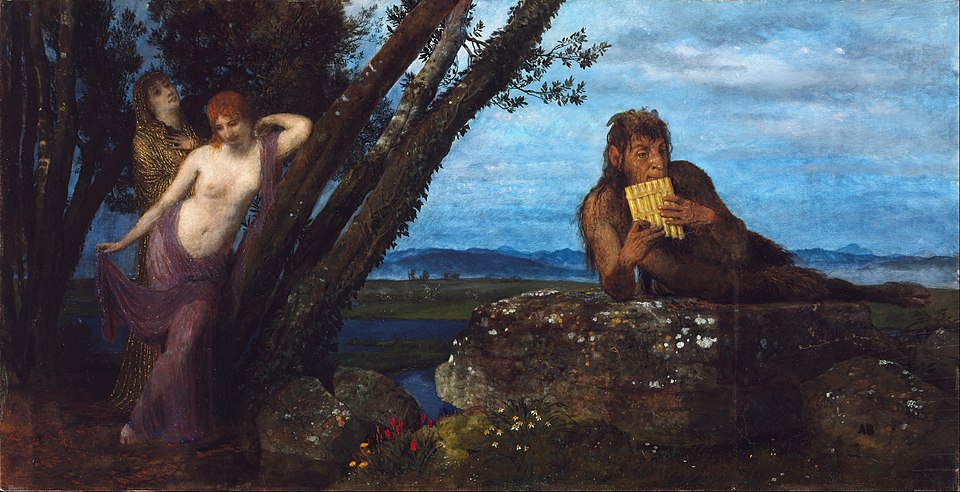
Works such as War (1896) and Pietà (1890) reflect his darker, theological side, confronting sin, judgment, and redemption. Yet Böcklin was equally capable of portraying peace and joy, especially in his more pastoral paintings like Spring Evening. Completed around 1879, Spring Evening showcases his gentler vision—an idyllic, musical gathering under twilight skies. It holds a special place among his oeuvre, illustrating his unique ability to merge the sacred and the sensual without descending into either sentimentality or vulgarity.
Key Milestones in Böcklin’s Artistic Journey
- 1827: Born in Basel, Switzerland
- 1845–1847: Studied at the Düsseldorf Academy
- 1850–1857: Lived and worked in Rome and the Italian countryside
- 1879: Painted Spring Evening during his Florence period
- 1901: Passed away in Florence after a life of prolific creation
Unpacking Spring Evening: Composition & Mood
Imagery Rooted in Pagan and Christian Motifs
Spring Evening is a delicate convergence of classical mythology and Christian symbolism. At its center is a faun-like figure, loosely identifiable with the god Pan, playing a flute beneath a canopy of blossoming trees. Around him dance several nymphs, rendered with grace and innocence rather than eroticism. Their movements are choreographed in a quiet circle, evoking ancient rituals of spring and fertility without losing a sense of decorum or harmony.
Böcklin often drew upon Greco-Roman imagery not to glorify paganism itself but to harness its archetypal power. The mythological figures in Spring Evening appear more as timeless ideals than literal beings. Their placement within a calm, Eden-like landscape bridges classical and Biblical allusions. In this twilight gathering, one can almost sense echoes of the Garden before the Fall—purity, joy, and divine order at play in the natural world.
Color Palette, Lighting, and Atmosphere
Böcklin was known for his painterly ability to evoke mood through subtle shifts in color and lighting. In Spring Evening, he bathes the scene in the warm pastels of early twilight—soft violets, dusky rose, and gentle golds that filter through the tree canopy. The fading light serves not only a visual function but a symbolic one, representing the passage of time, the beauty of transition, and the hopeful stillness of early evening.
There is a dreamlike serenity to the scene that draws the viewer into a contemplative state. Böcklin’s brushwork here is confident but restrained, allowing texture and tone to carry much of the emotional weight. The balanced use of natural elements—trees, sky, meadow—adds to the overall sense of order and beauty. Every detail is placed with intent, leaving nothing jarring or dissonant to disrupt the painting’s quiet melody.
Musical Themes and Pastoral Harmony
One of Böcklin’s hallmarks was his ability to translate musical rhythm into visual art. This is especially apparent in Spring Evening, where the painting’s composition feels almost like a silent sonata. The flutist, clearly central, becomes the painting’s conductor, orchestrating the gentle rhythm of the scene. The nymphs’ circular dance is suggestive of harmonic motion—each figure flowing naturally into the next, echoing musical repetition and refrain.
The use of a flute rather than a more raucous instrument underlines the scene’s peaceful intent. It’s not a Bacchic frenzy, but a pastoral celebration of life, art, and rebirth. Böcklin’s belief in art as a source of elevation is clear here. The visual melody invites not ecstasy, but reverence. In this painting, music and nature join together in service of beauty, as understood through a traditional lens of moral and aesthetic harmony.
Symbolism, Mythology, and Conservative Values
The Role of Classical Myth in Böcklin’s Worldview
Böcklin’s use of classical myth was never merely decorative. For him, figures like Pan, the nymphs, or centaurs represented eternal truths about human nature, the cycles of life, and the balance between the physical and spiritual. In Spring Evening, the mythological elements are refined, restrained, and integrated into a coherent vision of ordered joy. There is nothing anarchic or hedonistic here—only the memory of a world in which man, nature, and the divine shared harmony.
He understood the moral weight carried by ancient stories. Myths were not tales of excess or rebellion but frameworks for understanding virtue, vice, and consequence. This is one of the reasons his art resonated so deeply with conservative thinkers and patrons. Rather than glorify novelty or chaos, Böcklin’s mythological allusions upheld continuity, rootedness, and moral reflection.
Nature as Ordered, Not Chaotic
In Spring Evening, nature is portrayed not as wild or threatening, but as perfectly ordered and deeply intelligible. The trees arch gracefully over the scene, as though bowing to a greater authority. The meadow is tranquil, untouched by industrial blight or social unrest. Even the characters in the painting move within clear boundaries, suggesting a celebration governed by respect and tradition.
Böcklin’s vision of spring is not one of upheaval or revolution. It is a return to form, a seasonal renewal that reaffirms, rather than overturns, the natural and spiritual order. This distinguishes his work from the darker or more experimental depictions of nature that would come to dominate later in the 20th century. For Böcklin, beauty had structure. Harmony required restraint. The spring of Spring Evening is joyful, yes—but never lawless.
Contrast with Modernist Disillusionment
As modernism took hold in Europe after Böcklin’s death, many artists began to reject tradition outright. The early 20th century saw a rise in themes of alienation, fragmentation, and despair. But Böcklin remained a beacon for those who resisted this trend. His work affirmed life rather than negating it. Where modernists often mocked or abandoned the past, Böcklin revered it.
He believed art should point upward—to truth, to beauty, to the divine. His mythology was not escapism, but realism in the highest sense: a recognition that man thrives within limits, that art must have meaning, and that nature is best approached with reverence. Spring Evening stands as a clear contrast to the coming storm of nihilism and artistic chaos that followed the upheavals of the early 1900s.
Mythological Elements with Spiritual or Moral Significance
- Pan/flutist: Symbol of natural harmony and artistic inspiration
- Nymphs: Represent joy, renewal, and the innocence of creation
- Twilight setting: A metaphor for life’s transitions and quiet reflection
- Circle dance: Symbolic of eternal recurrence and divine order
- Pastoral setting: Image of prelapsarian peace and beauty
Legacy and Influence of Spring Evening
Influence on Artists, Poets, and Composers
Böcklin’s work, including Spring Evening, left a lasting impression on both his contemporaries and future artists. The Russian composer Sergei Rachmaninoff was famously inspired by Böcklin’s Isle of the Dead to write his 1909 symphonic poem of the same name. In Germany, the painter Franz von Stuck and members of the Munich Secession looked to Böcklin as a spiritual forefather. His blend of romantic mood, mythological reference, and technical skill made him a bridge between the 19th and 20th centuries.
Poets like Stefan George and writers in the German-speaking world admired Böcklin’s ability to capture emotional depth without abandoning form. His work resonated deeply with those seeking a counterpoint to industrial modernity and social upheaval. In this sense, Spring Evening carried forward the best of the Romantic tradition—a sense that beauty and truth are intertwined, and that myth still matters.
The Painting’s Journey and Current Location
Spring Evening was painted around 1879, during Böcklin’s productive Florence period. The painting exemplifies his mature style, and though not as widely reproduced as Isle of the Dead, it remains an important work within his Symbolist canon. Today, it is housed in the Kunsthaus Zürich, one of Switzerland’s premier museums. The institution holds several of Böcklin’s works and has frequently displayed them as part of their 19th-century collections.
This particular painting has appeared in multiple retrospectives on Symbolism and Romanticism in European museums, including exhibitions in Munich and Vienna. It is often cited in scholarly discussions as one of Böcklin’s most lyrical and life-affirming works, offering a window into his pastoral and poetic sensibility. Visitors often remark on the painting’s peaceful resonance and masterful use of color.
Why Spring Evening Still Matters Today
In an age where much of contemporary art traffics in irony, shock, or nihilism, Spring Evening offers a needed return to order, beauty, and meaning. Its vision of spring is not just seasonal—it is spiritual. The figures dance not for entertainment, but for celebration of life as it should be: grounded, joyful, reverent. For those who value tradition, faith, and the sanctity of nature, Böcklin’s painting remains a beacon.
It is a reminder that art can still aspire to the eternal. Böcklin did not seek fame through controversy, but through mastery and devotion. Spring Evening invites viewers to contemplate a better world—not by inventing one, but by returning to truths long known. In a culture increasingly distant from its roots, Böcklin’s vision is both timely and timeless.