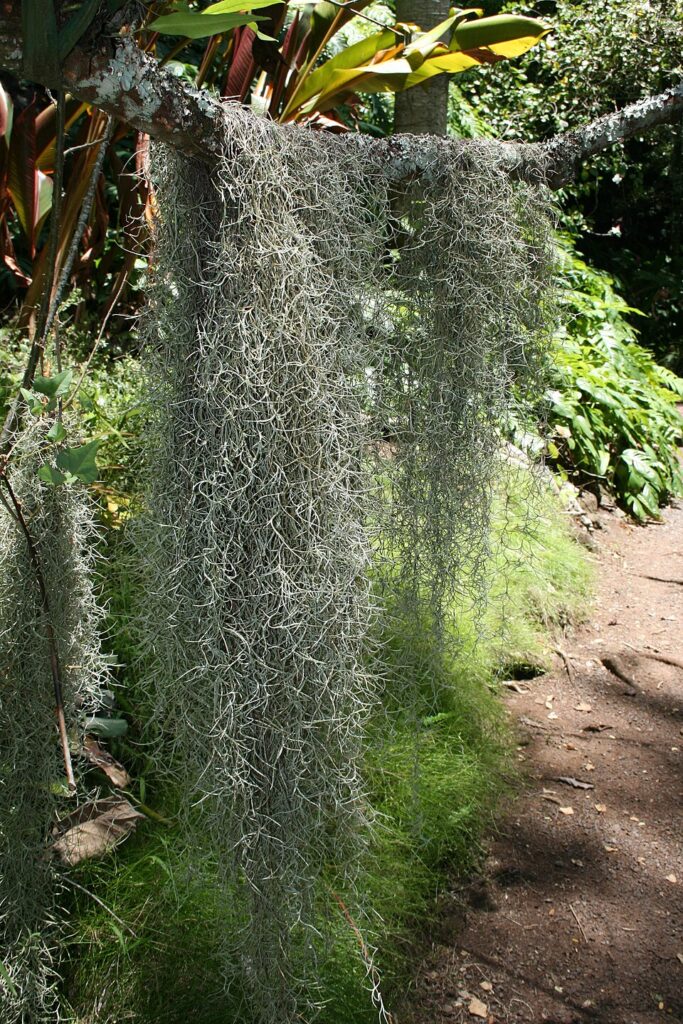
Spanish moss (Tillandsia usneoides) is one of the most instantly recognizable features of the Southern landscape, yet its role in art history is often overlooked. This delicate, silver-gray epiphyte drapes over the branches of live oaks and cypress trees, moving gently with the wind and light. Native to the warmer climates of the Americas, it thrives from the southeastern United States down through Central and South America. Artists have been fascinated by its texture and ethereal presence since the earliest days of European exploration.
By the 17th century, European naturalists had begun to record the plant in detailed drawings, marveling at its ability to survive without rooting in the ground. It is not a moss at all, but a flowering plant in the bromeliad family, related to pineapples. The French explorers called it barbe espagnole, or “Spanish beard,” in reference to the bearded appearance of Spanish settlers. Native American tribes had their own names for it, using it for practical purposes such as weaving and insulation.
Early Scientific Illustration of Spanish Moss
One of the first major figures to bring Spanish moss into the artistic realm of science was the English naturalist Mark Catesby (1683–1749). Born in Essex, England, Catesby traveled to the American colonies in 1712, where he studied the flora and fauna of Virginia and the Carolinas. His Natural History of Carolina, Florida and the Bahama Islands (1729–1747) contains some of the earliest published illustrations of Spanish moss. These works combined scientific accuracy with painterly skill, making them as much works of art as botanical records.
Catesby’s illustrations often showed moss hanging in soft arcs from live oaks, providing a sense of depth and place. His career bridged the worlds of science and art, and his collaborations with collectors and botanists ensured that his work would influence both disciplines. Through his legacy, Spanish moss entered the European imagination not only as a botanical curiosity but as a visual motif, ready to be adapted by landscape artists in the centuries to come.
Colonial Eyes: Spanish Moss in Early American Landscape Art
During the 18th century, Spanish moss began appearing in art depicting the early settlements of the American South. Painters and engravers working for patrons in Europe sought to capture the exotic look of the new world, and moss-laden live oaks offered a perfect subject. The plant became a marker of fertility, abundance, and natural grandeur. In paintings of coastal plantations and trading posts, moss often framed the scene, suggesting a land rich with untamed beauty.
One of the earliest artists to document such imagery was John White (c. 1540–c. 1593), governor of the Roanoke Colony and skilled watercolorist. White’s surviving works show detailed studies of plants and landscapes from his voyages. Although predating many formal colonial settlements, his art set a precedent for including botanical elements in depictions of the New World. His influence would echo in the work of later colonial-era painters who viewed Spanish moss as a defining feature of the southern environment.
Depictions in 18th-Century Settlement Art
By the mid-to-late 1700s, settlement art increasingly incorporated moss to enhance the realism of Southern scenes. Engravings for colonial propaganda often emphasized fertile fields bordered by trees dripping with moss, suggesting agricultural potential. This was not mere decoration; it was a visual argument for colonization and investment. The symbolism appealed to European investors who valued the idea of abundance in the colonies.
Artists also collaborated with surveyors, cartographers, and naturalists to produce illustrated maps that included moss-covered landscapes. Such works blended the practical with the aesthetic, and they reinforced the idea that Spanish moss was as much a part of the Southern identity as the land itself. By the end of the 18th century, moss had taken root not just in nature but in the artistic representation of the American South.
Romanticism and the Hudson River School’s Southern Sojourns
The 19th century brought Romanticism to the forefront of American art, and with it came a renewed fascination with regional landscapes. The Hudson River School, known primarily for its northern and western scenes, occasionally turned its gaze southward. Spanish moss became a visual shorthand for mystery, history, and an almost spiritual connection to the land. The plant’s trailing forms were ideal for Romantic compositions, creating atmospheric depth and enhancing dramatic lighting effects.
Painters like Thomas Moran (1837–1926) and Albert Bierstadt (1830–1902) are best remembered for their grand western vistas, but they also explored Southern imagery. Moran, born in Bolton, England, immigrated to the United States with his family in 1844 and later became known for his Yellowstone landscapes. Bierstadt, born in Solingen, Germany, in 1830, traveled extensively, painting both American and European scenes. While their visits to the South were brief, sketches and paintings from these journeys reveal moss-draped trees bathed in golden light.
The Southern Landscape as a Romantic Ideal
Romantic artists were drawn to contrasts—light and shadow, life and decay, civilization and wilderness. Spanish moss provided a perfect motif for these themes. In paintings where a crumbling plantation stood against a backdrop of moss-laden oaks, the plant symbolized both beauty and the passage of time. It was a natural prop for meditations on history and destiny.
Exhibitions of these works in New York and Boston introduced Northern audiences to the Southern aesthetic. The moss became part of a visual vocabulary that marked the South as a place of both grace and melancholy. Through these depictions, Spanish moss was elevated from a botanical feature to a cultural emblem within the national imagination.
The Southern Gothic Imagination in Visual Culture
In the early 20th century, the rise of the Southern Gothic aesthetic transformed how Spanish moss was used in art. No longer just a sign of natural beauty, it became a symbol of haunting, decay, and lingering history. Artists drew from the same mood found in Southern Gothic literature, where moss-covered landscapes framed tales of mystery and tragedy. This darker interpretation gave the plant a new artistic life, steeped in mood and symbolism.
John McCrady (1911–1968), born in Canton, Mississippi, exemplified this shift. Educated at the University of Mississippi and the Arts Students League of New York, McCrady combined regional themes with modernist techniques. His WPA-era murals often depicted Southern life with a mix of romanticism and realism, and moss frequently appeared in the backgrounds as a framing device. His work bridged fine art and narrative illustration, making him a key figure in defining the Southern Gothic visual style.
Moss as a Symbol of Decay and Mystery
In Southern Gothic painting, moss often hangs heavy in scenes of abandoned houses, overgrown gardens, and quiet riverbanks. Its texture and color can suggest neglect, but also resilience. For illustrators designing book covers for authors like William Faulkner or Flannery O’Connor, moss became an easy way to communicate setting and tone.
The use of moss in Southern Gothic art was often collaborative. Painters worked alongside photographers, set designers, and costume artists to create immersive visual worlds. In this way, Spanish moss was not just a subject but a visual tool—a shorthand for an entire cultural mood that continues to influence Southern art today.
Spanish Moss Through the Camera Lens
Photography brought a new level of realism to depictions of Spanish moss. During the Civil War, photographers documented landscapes not just for art but for historical record. George N. Barnard (1819–1902), born in Coventry, Connecticut, became known for his images of Sherman’s campaign through Georgia and the Carolinas. His 1866 publication, Photographic Views of Sherman’s Campaign, included haunting images of moss-laden landscapes, showing the South in transition after years of war.
These early photographs emphasized texture and contrast, making the silvery strands of moss pop against darker tree bark and sky. They also captured the stillness and gravity of the Southern environment, qualities that painters could only approximate. Moss in photography was both a literal and symbolic presence, reflecting the weight of history and the endurance of the land.
Photography from the Civil War to Modern Fine Art
In the late 20th century, photographers like Clyde Butcher (b. 1942) carried on the tradition of using Spanish moss as a focal point. Born in Kansas City, Missouri, Butcher moved to Florida and became celebrated for his large-format black-and-white images of Southern wetlands. His compositions often place moss-laden cypress trees in the center, their reflections shimmering in still water.
Mentorship has played a role in passing this tradition forward. Butcher often credits his artistic philosophy to Ansel Adams, whose focus on environmental preservation resonates in his own work. Modern fine art photographers continue to explore the interplay of light, texture, and symbolism that moss offers, ensuring that the plant remains a relevant subject in visual storytelling.
Contemporary and Environmental Art Uses
Today, Spanish moss has moved beyond paintings and photographs to find a place in contemporary art installations and environmental sculpture. Some artists use real moss to create site-specific works, while others employ synthetic materials to mimic its forms. These pieces often highlight the plant’s fragility and connection to its environment. Moss is no longer just a picturesque element; it is part of conversations about ecology and conservation.
One artist who bridged nature and human experience was Ana Mendieta (1948–1985). Born in Havana, Cuba, Mendieta fled to the United States in 1961 and studied at the University of Iowa. Known for her “earth-body” works, she sometimes incorporated natural materials like moss, leaves, and branches into her art. Though her life was tragically cut short in New York City, her work continues to inspire environmentally conscious artists.
Installations and Mixed Media Featuring Spanish Moss
Collaborations between artists and environmentalists have led to projects where moss serves both aesthetic and ecological purposes. In some public art installations, Spanish moss is used to create living walls that provide habitat for insects and birds. These works blur the line between landscape architecture and fine art, bringing moss into urban settings where it is rarely seen naturally.
By including moss in mixed media and environmental art, creators are making statements about climate change, habitat loss, and the human relationship to nature. The plant’s delicate, trailing form becomes a metaphor for both vulnerability and resilience. This contemporary usage continues to expand the meaning of Spanish moss in the artistic lexicon.
Symbolism, Memory, and the Future of Spanish Moss in Art
The symbolism of Spanish moss has shifted dramatically over the centuries. Once a sign of exotic abundance, it later became a marker of decay, and today it often symbolizes ecological awareness. In the modern South, it appears in tourism materials, branding, and cultural heritage campaigns. These uses tap into a sense of nostalgia, but they also look forward, emphasizing preservation.
Living artists are increasingly using moss in works that address environmental themes. For example, some create sculptures with sustainably harvested moss to comment on the impact of deforestation and urban development. Others incorporate it into community art projects aimed at restoring natural habitats. These works carry forward the centuries-old tradition of seeing moss not just as a plant, but as a cultural signifier.
From Nostalgia to Environmental Commentary
As the South changes, Spanish moss remains a visual constant. It appears in art schools as a subject for drawing and painting classes, valued for its challenging texture and subtle color variations. In this educational role, moss helps train the next generation of artists to observe nature closely.
The future of Spanish moss in art will likely combine the old and the new—honoring its place in romantic and gothic imagery while embracing its role in environmental storytelling. Its draping, ethereal form will continue to inspire, reminding artists and viewers alike of the enduring beauty of the Southern landscape.
Key Takeaways
- Spanish moss has been a subject in art since at least the 17th century.
- Early depictions often came from botanical illustrators like Mark Catesby.
- Romantic and Gothic artists used moss for mood, symbolism, and depth.
- Photography preserved moss-rich landscapes from the Civil War onward.
- Contemporary art uses moss for ecological and symbolic purposes.
FAQs
- Is Spanish moss actually moss?
No, it is an epiphytic flowering plant in the bromeliad family. - When did Spanish moss first appear in art?
It appeared in European botanical illustrations in the early 1700s. - Why is Spanish moss associated with the South?
It thrives in the warm, humid climate of the southeastern United States. - Do artists still use real moss in their work?
Yes, especially in environmental and installation art. - What does Spanish moss symbolize in art?
It has symbolized abundance, decay, mystery, and environmental awareness.