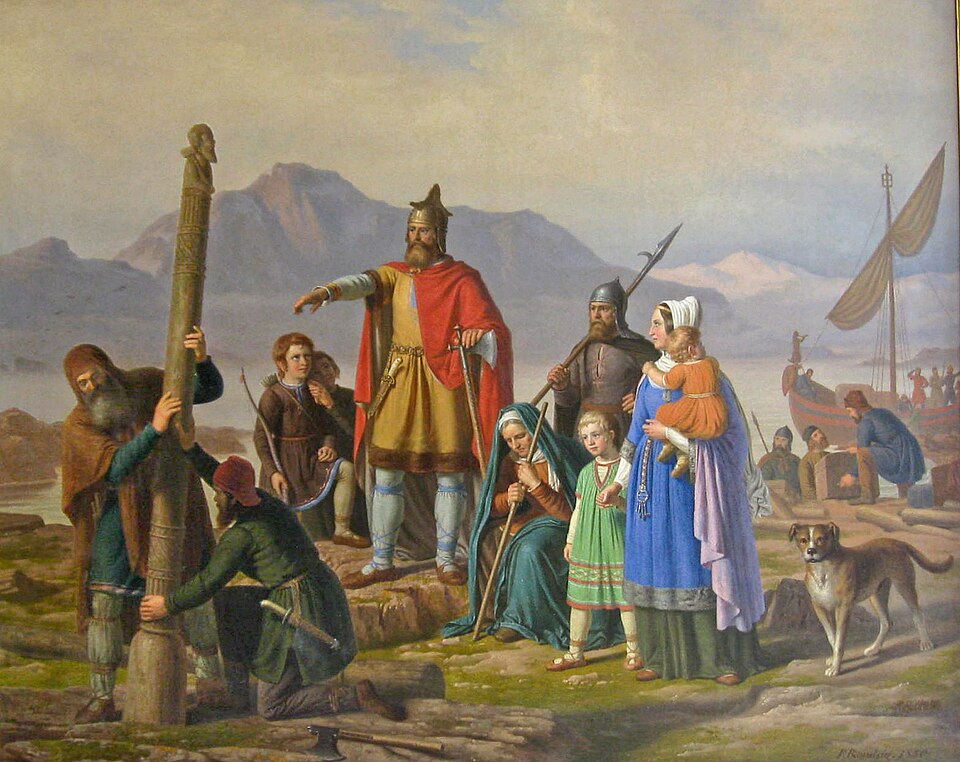
Before Icelandic art found its way into museums and galleries, it was already inscribed in lava fields, glacial valleys, and volcanic cliffs. The island’s stark geography did not merely inspire art—it structured the very logic of visual expression. For the Norse settlers who arrived in the 9th century, this land was not neutral territory; it was animate, volatile, and divine. Every mountain had a mood, every geyser a voice. The earliest Icelanders, though not visual artists in the formal sense, responded with a visual-spiritual grammar: runes carved into bone and wood, boundary markers etched with pagan symbols, and ritual objects buried with the dead in longboats or cairns.
These gestures were not decorative. They were communicative, invoking protection, fate, and continuity in a place that defied survival. Runes—both alphabet and magic—provided a visual system that straddled writing and image. The “Younger Futhark” symbols carried more than linguistic meaning; they encoded belief and embodied ritual. The act of carving a rune was part creation, part invocation. In this sense, early Icelandic mark-making functioned like proto-painting: bounded by symbolic structure, directed toward the supernatural, and meant to endure across time.
Yet unlike the monumental stonework of mainland Europe or the polychrome temples of Byzantium, Icelandic early visual culture was small, portable, and often ephemeral. Materials were dictated by environment: fish skin, driftwood, walrus ivory. These constraints fostered a visual austerity that would echo centuries later in the country’s modern and contemporary minimalism.
Norse Myth, Runes, and Proto-Artistic Expressions
The Icelandic sagas—so central to the nation’s cultural identity—were not initially visual texts, but their narrative force shaped the visual imagination deeply and permanently. From Snorri Sturluson’s Prose Edda to the anonymous Volsunga saga, these mythic epics created a cosmos of giants, gods, and fates that demanded visualization, even if only mentally. While the manuscripts that eventually preserved these stories in the 13th century did not carry elaborate illustrations, their marginalia and rubrication offer subtle visual cues: flourishes around capital letters, vegetal motifs, stylized dragons. In some copies, tiny faces peek from corners or strange beasts spiral between lines—a restrained but clear attempt to bring myth to sight.
The absence of early large-scale painting in Iceland is not due to aesthetic deficiency but cultural conditions. Iceland had no indigenous nobility to commission grand murals, no major urban centers to sponsor public artworks, and no native tradition of religious iconography comparable to that of Catholic Europe. After Christianization in AD 1000, religious art arrived piecemeal and often secondhand, filtered through Danish or Norwegian intermediaries. Still, a visual vocabulary emerged, blending Norse and Christian imagery. Christ could appear alongside Thor in carved church doors. The dragon Fáfnir found kinship with serpentine depictions of the devil. Sacred and profane intertwined visually, as they had in myth.
Three small, striking artifacts from this period suggest a visual culture rich in hybrid imagination:
- A carved walrus ivory gaming piece showing a crowned warrior biting his shield, possibly an early depiction of berserkers.
- A painted wooden altarpiece from around 1300 with a faintly smiling Christ surrounded by Icelandic saints, including Jón Ögmundsson.
- A runestone fragment inscribed with both pagan and Christian symbols, suggesting a period of ideological overlap rather than rupture.
These were not merely items of devotion or utility—they were vessels of image-making in a land where the line between story, symbol, and sight was porous.
Isolation, Imagination, and Visual Invention
Geographic isolation did not mute Icelandic artistic expression; it intensified it. Cut off from European cultural centers by ice and distance, the Icelanders developed a visual mode anchored in memory and mental imagery. This fostered a culture in which visual expression was tightly braided with storytelling. The sagas, although literary, contain detailed visual cues: clothing described stitch by stitch, landscapes rendered with exacting spatial logic, the gleam of weapons or the turn of a whale’s tail caught in vivid, pictorial prose. These passages trained the Icelandic mind to think in images, even when no images were drawn.
That visual imagination extended into textiles, one of the earliest domestic art forms in Iceland. Tapestries, though few survive, played a key role in household decoration and narrative memory. The most famous example, the Valthjófsstaður door, dating from the 13th century, shows a lion fighting a dragon—a motif with Continental origins but Icelandic inflection. Its carved surfaces, deeply grooved and expressive, reveal a culture capable of absorbing foreign styles and transmuting them into its own stark aesthetic.
Much later, this tradition of visual substitution—the idea that images could be summoned rather than shown—would resurface in modern Icelandic conceptual art. But its roots are here, in the interplay of image, idea, and memory. Icelandic art began not with walls of frescoes or schools of painters, but with the notion that art could be carried in the mind, imagined in the smoke of a turf fire, or spoken into being beside a glacier.
This early visual culture was one of restraint and intensity, born of necessity and belief. It prized endurance over elaboration, clarity over flourish, myth over spectacle. And it laid a foundation that would continue to shape Icelandic art for centuries: a vision forged in the elements, and tempered by the imagination.
Sagas in Skin and Stone: Medieval Art in a Literary Society
Illuminated Manuscripts and Marginalia
In a land where books were more precious than gold and memory more enduring than stone, the manuscript became Iceland’s most significant visual object of the medieval period. Unlike the elaborate miniatures of French or Italian scriptoria, Icelandic manuscript illumination was restrained—almost austere—but no less telling. Decoration was typically limited to initials, borders, and sparse illustrations. Still, the care with which these manuscripts were copied, embellished, and preserved signals the deep reverence Icelanders held for visual culture encoded in language.
The vellum codices of the 13th and 14th centuries—written on calfskin painstakingly scraped and stretched—often feature rubricated letters and subtle ink drawings in the margins. The Flateyjarbók, for instance, includes over 200 illuminations, many of them small, functional, and nearly schematic. Yet within these narrow confines, Icelandic scribes developed a visual idiom rooted in clarity, economy, and narrative drive. Human figures are often stiff and frontal, with elongated limbs and stylized gestures. Horses, ubiquitous in saga tales, are depicted with almost heraldic simplicity—four legs splayed, manes flowing like streamers.
This restraint was not merely the result of limited materials or skill. It reflected a cultural attitude: text came first, image served it. Iceland’s high literacy rate among the elite and clergy meant that visual embellishment did not need to replace narrative—it needed only to support it. As scholars have noted, even in decorated manuscripts like the Codex Regius, which contains the Poetic Edda, the visual accents function more like mnemonic aids than artistic flourishes. They guide the eye, mark transitions, and emphasize structure—closer to musical notation than painting.
What Icelandic manuscript art lacks in opulence, it makes up for in conceptual subtlety. Marginal drawings often include symbolic cues or humorous interjections—a monk urinating behind a tree, a tiny demon hiding in a letter’s loop, or a snarling beast guarding the break between chapters. These details provide a rare glimpse into the mindset of Icelandic scribes: pragmatic, pious, and not without wit.
Church Art and the Modesty of Devotion
After the island’s conversion to Christianity in AD 1000, visual art found its primary venue in churches. But unlike the great Gothic cathedrals of Europe, Iceland’s religious architecture was modest—wooden stave churches with turf-covered walls, their interiors lit dimly by whale-oil lamps. Within these small, earthy sanctuaries, visual adornment took on an intimate and often makeshift quality.
Altarpieces, painted panels, carved crucifixes, and liturgical textiles became the primary expressions of sacred art. Most were imported from mainland Europe—particularly Germany and the Low Countries—but over time, local artists began to copy and reinterpret these works in a distinctly Icelandic idiom. The famed altar retable of Hólar Cathedral, likely painted in the late 15th century, shows Northern Renaissance influence in its composition but retains a provincial stiffness. Christ and the apostles are rendered with exaggerated features, elongated limbs, and Icelandic faces—angular, solemn, weather-worn.
One of the most touching examples of Icelandic church art is the painted pulpit of Viðey Church, depicting scenes from the Passion in rudimentary but expressive style. The artist—anonymous, as nearly all Icelandic medieval artists were—used strong outlines, flat planes of color, and sparse backgrounds. The result is not sophistication but sincerity. These images do not dazzle; they instruct, console, and accompany the viewer in prayer.
Textile arts also flourished within ecclesiastical settings. Clerical vestments, altar cloths, and liturgical banners were often embroidered by nuns or female lay artisans, blending devotional labor with domestic skill. A surviving chasuble from the Skálholt diocese bears intricate stitching of lambs, crosses, and Nordic floral motifs, its visual language both universal and local.
In this period, Icelandic art was not about innovation but endurance. It occupied a fragile niche between imported grandeur and homemade humility—always negotiating its relationship with a wider world of images, yet never quite assimilating into it.
Oral Storytelling and the Aesthetic of Memory
Perhaps the most radical feature of medieval Icelandic art history is the prominence of memory over material. Unlike Italy or France, where art was defined by visible, tangible works, Iceland placed enormous value on the unseen: stories remembered, genealogies recited, battles recalled in rhythm and verse. This oral aesthetic—rooted in performance, repetition, and communal imagination—shaped how Icelanders thought visually, even when no physical art existed to see.
The sagas themselves—particularly the Íslendingasögur or “family sagas”—function as image-rich texts. Their authors often described gestures, expressions, architecture, and costume with cinematic precision. In Njáls saga, we see blood spurting from a decapitated head onto the snow, a sword glinting across a frozen fjord, a house engulfed in flames with a man praying quietly inside. These are not merely literary flourishes; they are crafted to conjure vision. The saga reader—or listener—sees as much as hears.
This tendency toward internal visualization is echoed in funerary culture. Burial mounds were often accompanied by carved stones, but more often, the remembrance of the dead was sustained through verse. The Eddic and skaldic traditions functioned as both eulogy and image: naming the deeds of the departed, recounting the weapons they carried, the wounds they suffered, the expressions on their faces as they died. These poems were recited beside the grave like visual chants.
This kind of art—imagined, recited, internal—defies traditional frameworks of art history. It challenges the primacy of the visual object and instead asks: what happens when a culture chooses to remember its images rather than build them? In Iceland, the answer is a tradition where art lives as much in the mind as in the eye.
By the end of the medieval period, Iceland’s visual culture had become a quiet marvel: modest in materials, yet profound in function. Its manuscripts taught readers to see through words. Its churches held intimate, handmade treasures. And its sagas—arguably the most visual literature ever composed—ensured that even in the absence of grand canvases or bronze statues, the Icelandic imagination remained vividly, stubbornly, irreducibly visual.
From Reformation to Restraint: Iceland Under Danish Rule
Imported Aesthetics and Ecclesiastical Censorship
The Lutheran Reformation arrived in Iceland not with a bang but with a slow, grinding torque that twisted the island’s cultural trajectory for centuries. By 1550, after the violent execution of Catholic bishop Jón Arason and his sons, Lutheranism was imposed with decisive finality by the Danish crown. This religious pivot did more than alter theology; it redefined the visual terms of Icelandic culture. Altarpieces were repainted or destroyed. Saints vanished. Narrative imagery gave way to text-heavy panels. The human figure, once a central expressive tool in sacred art, was now a site of discomfort.
Unlike in Lutheran Germany, where some forms of religious imagery persisted within reformed guidelines, Denmark exported a stark iconoclasm to its dependencies. Iceland, already artistically peripheral, was now pushed into visual silence. Church walls were stripped bare. Imported art became moralizing, didactic, and typographically dominated—often featuring long passages of Scripture inscribed over minimal decoration. The visual culture of the post-Reformation period became one of instruction, not inspiration.
A surviving example from this era is the Hvalsneskirkja altar panel, dated to the late 17th century. Rather than scenes from the life of Christ, it presents a tightly arranged display of text and symbolic motifs—grapevines, doves, and the occasional cross—surrounding a Calvinist moral poem. The colors are subdued, the symmetry rigid, the overall effect closer to a page of scripture than a painting. This reflects a deliberate suppression of pictorial abundance in favor of moral clarity.
As Danish control solidified, art in Iceland took on a colonial cast. Visual decisions were made in Copenhagen, not Reykjavík. Church furnishings, hymnals, and even gravestones were often imported or dictated by Danish standards. Icelandic artisans, if they existed at all, were relegated to copying foreign models. This was a period in which art was not merely censored—it was outsourced.
Folk Art as Resistance and Ritual
Yet within the home and the body, a quieter, more resilient visual tradition flourished. Women embroidered cushions, stitched altar cloths, and carved wooden spoons with rosettes and geometric bands. Men painted coffers with stylized horses, birds, and mythical beasts. In these modest objects, folk art carried forward Iceland’s deep intertwining of image, memory, and craft.
In a period of political subjugation and visual suppression, folk art became a subtle form of autonomy. Icelanders decorated their world not through public monuments or grand canvases, but through household ritual: the carving of a marriage chest, the careful knitting of patterned mittens, the incising of a binding rune onto a shepherd’s stave. These objects were not frivolous or merely pretty. They carried coded meanings—sometimes religious, sometimes protective, sometimes deeply personal.
Three common elements of Icelandic folk art during the early modern period reveal its quiet visual vocabulary:
- Rosemaling-inspired floral motifs, adapted from Continental designs but rendered with Icelandic restraint, often limited to red, blue, and black pigments.
- Magical staves (galdrastafir) such as Ægishjálmur, etched into tools, amulets, or even skin, designed to ward off harm or induce strength and courage.
- Carved narrative scenes on wooden panels or bedposts, telling family stories or biblical episodes in compressed, almost hieroglyphic style.
These traditions provided continuity. In a time when formal art was increasingly mediated by foreign authority, the home became a site of visual resistance and remembrance. A woman’s loom or a farmer’s knife became tools not only of utility but of quiet visual assertion.
Craft Traditions in a Cold Climate
Iceland’s climate imposed limits that were not only physical but aesthetic. Paint was expensive, canvas rare, and paper a luxury. In this constrained context, Icelandic artisans developed a craft culture that prized durability, symbolism, and ingenuity over fine finish. Wool—abundant, versatile, and warm—became the medium through which visual patterns were most consistently developed.
Knitting, though often dismissed as utilitarian, was in Iceland a form of decorative language. Mittens, socks, and sweaters bore intricate patterns—diamonds, crosses, zigzags—that varied subtly by region, clan, or personal whim. These designs, passed down through generations without formal documentation, became a kind of wearable folklore. Each stitch carried both warmth and identity.
Woodwork, too, developed a distinct Icelandic flavor. The scarcity of trees meant that driftwood was often the only available timber. Artists made the most of it, carving low-relief decorations into doorframes, headboards, and hymnbook stands. One of the finest examples is the altar screen of Laufás Church, built in 1698. Though the structure is small, the carving is intricate, its surface crowded with vines, birds, and scriptural inscriptions—every inch testifying to both piety and perseverance.
The cold also shaped behavior. Artistic gatherings were rare, and the absence of an urban elite meant there were few patrons. Yet long winters fostered a contemplative culture, where storytelling, craft, and visual imagination flourished within the home. Children learned to carve before they could write. Stories were told in near-darkness, lit by the flicker of seal oil. In these spaces, Icelandic art persisted—not as a profession, but as a condition of life.
By the 18th century, Iceland remained visually humble but internally rich. Its churches offered didactic austerity, its households bursts of color and pattern, and its landscape—still unmarred by industrialization—a kind of perpetual visual anchor. Art, though muted by foreign rule and religious restraint, was not extinguished. It went underground—into pattern, object, gesture, and word—waiting for the next awakening.
National Romanticism and the Invention of Icelandic Identity
The Painter-Poets of Independence
The 19th century brought a tectonic shift to Icelandic art—not through sudden innovation, but through a slow, insistent cultural reawakening. After centuries of colonial subordination to Denmark and a visual culture constrained by Lutheran austerity, Iceland began to see itself anew. This self-recognition was not merely political. It was poetic, mythic, and—crucially—visual.
The stirrings of Icelandic independence in the mid-1800s coincided with the rise of Romanticism across Europe. While the French and Germans looked to medieval chivalry or Alpine ruins for their sublime, Iceland looked inward: to the sagas, the mountains, the glaciers, and the ancient sense of a people shaped by stone and storm. Visual art became a means of reclamation. The image of Iceland—literally and symbolically—had to be painted back into existence.
Enter Þórarinn B. Þorláksson (1867–1924), widely considered the father of Icelandic painting. Trained in Copenhagen, he returned home in the early 20th century with a palette tuned not to Danish neoclassicism but to the light and mood of his own country. His paintings were modest in scale but monumental in intent. In works like Þingvellir (1900), he transformed a historical site into something almost mythic: low-angled sunlight bleeds across basaltic ridges, and the land itself seems to brood and remember.
Þorláksson was not alone. Other artists—Ásgrímur Jónsson, Jón Stefánsson, and Guðmundur Thoroddsen—joined in forming a nascent visual canon. Though trained abroad, their ambition was to cultivate a style that felt Icelandic in soul. They were not just painters; they were visual nationalists, reconstructing the image of a country that had long been rendered mute by foreign eyes.
Landscape as Allegory and Homeland
Nowhere was this nationalist impulse more vivid than in the Icelandic landscape painting of the late 19th and early 20th centuries. The land was no longer merely setting—it was symbol. Painters did not simply document mountains or coastlines; they staged them like characters. A glacier became a guardian. A volcanic plain hinted at latent power. These images offered a visual manifesto of Icelandic endurance, beauty, and sovereignty.
Consider Þorláksson’s recurring focus on Þingvellir, the site of Iceland’s ancient parliament and a locus of historical memory. By painting it again and again, he made it not just visible but central to the modern Icelandic imagination. His rendering is not lush or decorative. The terrain is craggy, subdued, almost severe. There are no peasants, no harvests—just geology and light. It is a painting about presence.
Similarly, Ásgrímur Jónsson brought an almost mystical reverence to his depictions of mountains and fjords. In Reykjavík Seen from the East (1906), the city is dwarfed by the surrounding hills, barely interrupting the natural forms. Human structures seem tentative, temporal—while the land is eternal. This inversion of perspective reflects a deeper ethos: Iceland is not defined by its buildings or wealth, but by its landscape, which endures when institutions crumble.
These painters absorbed the visual strategies of Romanticism—dramatic lighting, scale, and expressive brushwork—but turned them inward. Rather than glorifying conquest or empire, they elevated solitude, memory, and weather. Their landscapes do not celebrate dominion over nature; they dramatize the soul’s immersion in it.
Þórarinn B. Þorláksson and the Visual Claim to Nationhood
Þórarinn’s importance cannot be overstated. Before him, Icelandic art existed mostly in textiles, folk objects, and manuscript ornament. After him, painting became a vehicle for national definition. His 1900 exhibition—the first solo show by an Icelandic artist in Iceland—was a revelation. Organized in Reykjavík and featuring twenty works, it was less a cultural event than a quiet revolution. The audience saw, for the first time, their own country filtered through oil, canvas, and artistic intention.
He refused to exaggerate. His work is devoid of Romantic melodrama or continental grandeur. In Esja in Winter, he paints the iconic mountain not as a sublime spectacle but as a subdued, contemplative form beneath a slate sky. Snow falls without sentimentality. The composition is spare, the emotion restrained. Yet the national feeling is undeniable. This is Iceland seen by an Icelander—neither exoticized nor diminished.
Þórarinn’s influence extended into education and public policy. He advocated for state support of the arts and helped establish the first art schools in Reykjavík. He envisioned not just an artistic movement but an artistic infrastructure—an Iceland that could sustain its own visionaries without reliance on Danish or foreign models.
His legacy was carried forward by his students and peers, many of whom turned from pure landscape to incorporate figures, narrative, and myth. Yet the principle remained: Iceland must be seen, known, and claimed through image. Art became part of the independence project, not as propaganda, but as perception. To paint the land was to defend it. To draw the volcano was to remember its power. To depict the fjord was to assert that it was ours.
By the time Iceland achieved full independence in 1944, it had already won a cultural independence through its painters. They had given form to the invisible nation—one mountain at a time.
The Reykjavík Awakening: 20th-Century Modernism
Jón Stefánsson and the Avant-Garde North
The early decades of the 20th century saw Reykjavík transform from a fishing village into a nascent capital—not just politically, but culturally. Where once Icelandic visual art was largely confined to landscape painting and folk tradition, now a new generation of artists, energized by travel, education, and the convulsions of modern Europe, began to explore bolder, more experimental modes. Among them stood Jón Stefánsson (1881–1962), the first Icelandic painter to fully engage with modernist abstraction.
Stefánsson studied in Copenhagen and later in Paris, where he encountered the work of Cézanne and the early Cubists. But it was in Norway that his synthesis took shape. Influenced by Edvard Munch’s psychological expressionism and the decorative stylization of Scandinavian art nouveau, Stefánsson developed a style that pushed Icelandic painting beyond naturalistic landscape into the realm of formal composition and emotive structure.
His work from the 1910s and 1920s—such as Vík í Mýrdal and Blue Mountains—demonstrates a striking departure from the tonal realism of Þorláksson. Planes of color break the surface into rhythmic blocks. Lines oscillate between contour and gesture. The land is still present, but now it feels filtered through emotion and memory rather than pure observation. Stefánsson’s paintings offer not just views of Iceland, but experiences of it—fragmented, refracted, reshaped by the act of seeing.
Though many of his peers found his approach disorienting or even foreign, Stefánsson was not importing European modernism wholesale. He was testing its boundaries against Icelandic content. His palette retained the cool, limited tones of the North—blues, greys, ochres. His subjects remained local: valleys, farms, sea-cliffs. What changed was the frame. The picture became an arena, not a window. And in that arena, Icelandic modernism was born.
Cubism, Abstraction, and the Local Turn
Following Stefánsson, Icelandic artists began to embrace—and reshape—modernist techniques on their own terms. Cubism, abstraction, and expressionism filtered slowly but definitively into Reykjavík’s studios and classrooms. But the question lingered: how to be modern without ceasing to be Icelandic?
Gunnlaugur Scheving, active in the 1930s and 40s, provided one answer. Though trained in Copenhagen, Scheving rejected the passive, observational stance of traditional landscape painting in favor of energetic, human-centered narratives. In works like The Herring Era and Women on the Shore, he depicted scenes of labor, community, and survival with dynamic brushwork and sculptural bodies. The influence of Diego Rivera and Käthe Kollwitz is evident, but so too is the blunt reality of Icelandic life under economic hardship and social flux. Scheving’s figures are not idealized—they are tough, weary, grounded. His work marked a shift from national idealism to social realism.
Meanwhile, Kristín Jónsdóttir, one of the first Icelandic women to study art abroad, brought a more intimate modernism. Her interiors, portraits, and domestic scenes—often quiet and spatially compressed—bear comparison to the Scandinavian intimists like Carl Larsson. But her emotional tone is distinct: less cozy, more restrained, often tinged with melancholy. In Woman in Blue and Interior with Red Cloth, space folds inward, and the subject’s inner life becomes the real terrain.
By the 1950s, abstraction began to take root more confidently. Svavar Guðnason and Nína Tryggvadóttir both engaged with European postwar trends, particularly lyrical abstraction and geometric construction. Yet their work never fully severed ties with Icelandic landscape and atmosphere. Guðnason’s biomorphic forms echo lava flows and glacial patterns. Tryggvadóttir’s color fields evoke the Northern Lights or the pink haze of Reykjavík at dusk.
This generation did not pursue modernism as rebellion. Rather, they used it as a method to translate Icelandic experience into contemporary visual language. The goal was not to erase tradition but to transmute it—to show that even in a country of few cities and fewer museums, the modern could take root, twist through basalt, and bloom in the dark.
Art Schools and the Rise of Professionalism
The evolution of Icelandic modernism would have been impossible without institutional support. Until the mid-20th century, aspiring artists had to study abroad—usually in Denmark. But with the founding of the Icelandic College of Art and Crafts in 1939, Reykjavík gained its first real hub for artistic education. Initially focused on applied arts, the school gradually expanded to include painting, sculpture, and later photography and new media.
This shift catalyzed a new kind of artist: professional, networked, and increasingly international. Icelandic art was no longer the province of solitary visionaries or national allegorists. It was becoming a system: exhibitions, critics, pedagogies, debates. By the 1960s, the local art scene was dense enough to support rival movements and generational conflicts. Abstract versus figurative. Social versus formal. Native versus cosmopolitan.
The emergence of galleries—such as Listamannaskálinn (The Artists’ House) and Gallerí Fold—provided platforms for younger artists to challenge their elders. Public art commissions, often driven by state infrastructure projects, allowed sculptors and muralists to leave a visible mark on the built environment. Even art criticism began to professionalize, with journals and newspapers treating visual culture as part of national discourse.
This growing infrastructure did not mean uniformity. On the contrary, the 1950s and 60s produced one of the most stylistically diverse periods in Icelandic art history. Some artists turned to surrealism; others to hard-edge abstraction. Some clung to the landscape; others banished it. But all shared a common inheritance: a country now fully in possession of its own visual vocabulary, ready to speak in multiple tongues.
The Reykjavík Awakening was not a moment. It was a convergence—of place, education, politics, and personality. It transformed Icelandic art from a narrow tradition into a plural field. And it laid the groundwork for the international emergence of Icelandic artists in the late 20th century—not as exotic outsiders, but as peers and participants in the global conversation.
The Spirit in the Mountain: Nature Mysticism in Icelandic Art
Geology, Weather, and Sublime Encounter
Few countries confront the raw forces of nature as directly as Iceland. Earthquakes, volcanic eruptions, sudden blizzards, shifting coastlines, and the seasonal oscillation between endless light and near-total darkness shape not only daily life but imaginative life. Icelandic artists, responding to this elemental theatre, have long cultivated a form of visual mysticism—one in which nature is not background or subject matter but a sentient, shaping presence. The mountain watches. The glacier speaks. The land remembers.
This approach, often described as animistic but best understood as experiential, distinguishes Icelandic landscape art from its European counterparts. Where Romantic painters like Caspar David Friedrich sought the sublime as a visual crescendo—man dwarfed by storm—Icelandic artists depicted the sublime as ambient, pervasive, and inhabited.
Einar Hákonarson, working from the late 1960s onward, offers a vivid case in point. Though associated with expressionism, his use of light and weather evokes older spiritual currents. In works like Volcanic Earth, the land is not portrayed for its geology but for its temperament: it steams, seethes, and pulses with life. Mountains rise not as inert forms but as avatars of memory and myth. Hákonarson’s brushwork is agitated, his color palette volatile—full of ochres, umbers, and electric whites. The effect is not tranquility, but reverence laced with apprehension.
This mysticism is not necessarily religious, though it often parallels religious feeling. It emerges from direct, bodily encounters with place: climbing a ridge in a snowstorm, watching magma spill from a fissure, crossing a black sand desert under a green-lit sky. These experiences—dangerous, transcendent, unrepeatable—have fostered a visual culture that resists neat genre classification. It is landscape, but also symbol. It is realism, but filtered through vision.
Huldufólk and the Invisible Subject
A defining strand of Icelandic nature mysticism is its fascination with the unseen. Huldufólk—the “hidden people”—occupy a complex position in both folklore and visual culture. Though belief in them is often half-joking, surveys suggest that a significant portion of Icelanders do not entirely dismiss their existence. This ambiguity has fueled a rich visual exploration of absence, suggestion, and layered reality.
Contemporary artists have seized on this liminality. Magnús Pálsson, active since the 1970s, often incorporates sound, performance, and installation to conjure presence without visibility. His 1980s works with “sound sculptures”—plaster castings of hands, mouths, and ears—evoke communication across unseen distances, echoing the elusive nature of huldufólk who are said to dwell within rocks, hills, or beneath waterfalls.
In painting, Louisa Matthíasdóttir stands apart for rendering landscape not as a site of hidden beings, but as a being itself. Her bold, simplified forms—green hills cut into flat geometric masses, blue fjords rendered with near-abstract clarity—seem animated, conscious. There are rarely people in her work, but the land itself feels peopled. Her mountains lean. Her fields breathe. These are not metaphors, but visual convictions.
Some artists take a more literal approach. Photographer Ragnheiður Gestsdóttir documented sites associated with huldufólk folklore—boulders that could not be moved, roads rerouted to avoid sacred stones, homes built with gaps to accommodate invisible neighbors. Her images, stark and matter-of-fact, underscore how belief continues to shape physical reality. The unseen remains visible in its consequences.
This obsession with what cannot be seen—whether spiritual, psychological, or folkloric—has become a distinguishing thread in Icelandic art. It encourages a visual subtlety: suggestion over assertion, trace over image. The land holds secrets, and the artist’s role is not to expose them but to listen.
Ragnheiður Jónsdóttir and Elemental Symbolism
In the postwar period, few artists embodied the mystical strain of Icelandic art more fully than Ragnheiður Jónsdóttir (1928–2017). Her work, spanning painting, textile, and sculpture, fused elemental forms with symbolic intensity. Deeply influenced by both Icelandic folklore and Christian iconography, she developed a personal visual language in which fire, water, rock, and air became spiritual agents—forces as expressive as any saint or god.
Her Fjallkonan series, loosely inspired by the personification of Iceland as a female figure, reimagines the mountain not as background but as body. Peaks rise like shoulders. Valleys suggest hips. The earth becomes maternal—protective but also wounded. These are not allegories in the traditional sense. Jónsdóttir’s forms are too ambiguous, too textured for direct decoding. They operate on the border of abstraction, inviting reflection rather than resolution.
One of her most celebrated works, Eldfjallkona (“Volcano Woman”), exemplifies her approach. Rendered in dark reds, deep blacks, and pearlescent greys, it shows a looming, humanoid shape bursting with molten color at the core. It is both a mountain and a mother, both eruption and embrace. Critics have likened it to the Black Madonnas of Catholic art, but its power feels rooted in the volcanic specificity of Iceland itself. Jónsdóttir offers not archetype, but geology made flesh.
Her interest in textile was not incidental. Like many Icelandic women artists of her generation, Jónsdóttir moved fluidly between “high” and “applied” arts. She viewed weaving, embroidery, and dyeing not as secondary crafts but as parallel languages. In her hands, a tapestry could hold as much mystery as a painting, and color could carry the weight of prayer.
Through her work, the mystical strand of Icelandic art reached one of its most refined articulations: a vision where nature, myth, and femininity converged in forms that were symbolic yet grounded, spiritual yet unflinching.
Icelandic nature mysticism remains, to this day, a defining current in the nation’s art—not because it offers easy answers, but because it dares to imagine the land as more than scenery. It imagines it as a presence, a participant, a voice. And in doing so, it continues to shape the images that Icelanders make—and the images they believe.
Cold War, Hot Paint: Iceland’s Midcentury Flux
Cultural Diplomacy and American Influence
During the mid-20th century, Iceland found itself an unlikely yet crucial node in the geopolitical tensions of the Cold War. Strategically located in the North Atlantic, it became a NATO member in 1949 and soon hosted an American military base in Keflavík—a presence that would come to define much of its cultural and economic life for decades. Though ostensibly remote from the ideological battlegrounds of Berlin or Washington, Iceland became a symbolic frontier between East and West. And with it came a new wave of visual influence.
For Icelandic artists, the American cultural presence was both jarring and liberating. The U.S. brought consumer goods, jazz, Hollywood cinema, and—perhaps most crucially—abstract expressionism. Through exhibitions organized by the United States Information Service and ICA-sponsored cultural programs, Reykjavík artists encountered the gestural freedom of Jackson Pollock, the introspective gravity of Mark Rothko, and the icy rigor of Barnett Newman. These were not just paintings; they were declarations of a new kind of artistic freedom—one that resonated in a country emerging from centuries of stylistic modesty.
Yet American modernism was never adopted wholesale. Icelandic artists remained skeptical of grand gestures untethered from local experience. Instead, many experimented cautiously, filtering expressionist techniques through their own traditions of landscape, myth, and restraint. Svavar Guðnason, though already aligned with Scandinavian abstraction, deepened his engagement with gestural form in the 1950s, his canvases now evoking both Arctic weather and psychic weather. Drips, swirls, and chromatic fractures recall Pollock, but their rhythm follows the march of glaciers or the churn of coastal fog.
Other artists, like Kristján Davíðsson, absorbed the color field sensibility of American painters but used it to evoke Icelandic luminosity. In Northern Lights Over Kirkjubær, large areas of saturated color bleed and collide—not as pure formalism, but as a visual rendering of celestial events. American techniques, Icelandic content. This hybridization was not assimilation. It was a negotiation.
Sigríður Björnsdóttir and Icelandic Expressionism
Amid this swirl of external influences, one of the most distinctive voices to emerge was that of Sigríður Björnsdóttir (1914–1992), a painter whose expressionist vocabulary was entirely her own. Trained in Paris during the 1930s and exposed to both fauvism and surrealism, she returned to Iceland with a keen eye for psychological depth and formal distortion. But rather than indulge in European cosmopolitanism, she turned her gaze inward—both literally and metaphorically.
Björnsdóttir’s paintings from the 1950s and 60s confront the viewer with a claustrophobic intensity. Faces loom close, their features stretched and shadowed. Rooms bend around figures. Color pulses with unease—deep purples, raw sienna, feverish yellows. In Mother at Night (1961), a solitary figure sits in a narrow room, her hands clenched in her lap, her body rigid as if braced against something unspeakable. The image is domestic, but its atmosphere is apocalyptic.
Unlike many of her male contemporaries, Björnsdóttir rarely painted landscape. Her terrain was the mind—specifically, the Icelandic psyche under pressure. She once described her work as “trying to find the shapes of silence,” a phrase that captures both her ambition and her restraint. There is little joy in her paintings, but there is truth, distilled and unsentimental.
Her influence, though often underacknowledged in her lifetime, became central to the development of Icelandic expressionism. She proved that emotion need not be loud, and that distortion could be a form of fidelity. While others sought grandeur in glaciers, Björnsdóttir mined the volcanic fragility of the self.
The Tension Between Urbanization and Tradition
The midcentury decades in Iceland were also marked by unprecedented urbanization. Reykjavík’s population tripled between 1940 and 1970, transforming the capital from a modest fishing port into a modern administrative and cultural center. This shift produced a crisis of identity. What did it mean to be Icelandic when one no longer lived close to the land? When turf houses gave way to concrete? When traditions that had persisted for centuries began to feel like museum pieces?
Artists responded to this tension in varied and often contradictory ways. Some, like Karl Kvaran, embraced the city’s new geometries, producing works of hard-edged abstraction that mirrored Reykjavík’s evolving skyline. His canvases from the 1960s—flat planes of color arranged in interlocking forms—echo both the international language of modern design and the pragmatism of Icelandic architecture. Kvaran’s work is cool, ordered, urban. It marks a break from the organic forms of earlier nature mystics.
Others, like Jóhannes Geir Jónsson, recoiled from modernity. His paintings revisited Iceland’s rural past with a surreal, almost hallucinatory nostalgia. Ghostly farmers, spectral livestock, and skeletal churches populate his canvases, rendered in browns, greys, and smudged reds. In The Old Homestead, the house seems to sink into the ground, as if being absorbed by memory itself. It is a lament for a vanishing world, but also a refusal to let it go.
This dialectic—between modernist formalism and mythic regression—defined Icelandic art in the postwar period. It mirrored the country’s broader social uncertainty: a people caught between stone and concrete, folklore and electricity, seclusion and geopolitics.
For many artists, the solution was to synthesize. To take the new tools offered by abstraction, expressionism, and global dialogue, and aim them at Icelandic questions. How do you paint a nation in flux? How do you represent a place that is both ancient and adolescent? These were not theoretical puzzles. They were daily, intimate, and inescapable.
By the late 1960s, Icelandic visual art had become as volatile and charged as its geology. New materials, new formats, new ideologies. But beneath the change, certain constants endured: the primacy of place, the pull of myth, and a deep, often mystical engagement with what it means to be Icelandic—whether in Reykjavik’s suburbs or under a storm on Snæfellsnes.
Sculpting the Silence: Icelandic Public Art and Monuments
Einar Jónsson and the Heroic Form
Before Iceland had a parliament building, a symphony orchestra, or even paved roads in most of its towns, it had Einar Jónsson (1874–1954)—the country’s first sculptor of real consequence and, in many ways, the founding figure of Icelandic monumental art. While painters like Þórarinn B. Þorláksson turned to canvas to define the nation, Jónsson carved it directly into stone and bronze, fusing mythology, moral allegory, and national aspiration in a singular, often haunting vocabulary.
Trained in Copenhagen, Jónsson refused to remain within the strict confines of Danish neoclassicism. Instead, he developed a style that blended Symbolist introspection with Nordic myth and Christian mysticism. His early works—Outlaws (1901), The King of Atlantis (1919)—resemble fevered dreamscapes more than conventional statues. Bodies twist and strain in unnatural postures, robes cascade like waterfalls, and facial expressions suggest moral crises rather than heroic calm. His figures are never simply noble or tragic; they are burdened, ecstatic, visionary.
Jónsson believed sculpture should instruct and elevate. In a country with little tradition of monumental form, he envisioned statues not as commemoration, but as sculpture in the highest sense: communicative, moral, and symbolic. His great legacy is not only his body of work but the Einar Jónsson Museum, completed in 1923 on Skólavörðuholt hill in Reykjavík, adjacent to what would later become Hallgrímskirkja. He designed the museum himself, with rooftop gardens and narrow chambers that feel more like a mausoleum than a gallery. It remains one of the most distinctive art spaces in the country—part temple, part archive, part dream.
Among his most iconic pieces is The Spell Broken, depicting a blindfolded figure awakening as shackles fall from his wrists. The symbolism is overt—national awakening, personal liberation—but the mood is ambiguous, even eerie. Jónsson’s genius lay in combining the monumental with the psychological. His sculptures do not just memorialize; they brood, they warn, they beckon.
The Modernist Interventions of Ásmundur Sveinsson
If Jónsson is Iceland’s romantic sculptor of myth and morality, Ásmundur Sveinsson (1893–1982) is its modernist challenger—the man who broke apart the figure and rebuilt it in steel, stone, and stylized rhythm. Born into a working-class family and trained first in Sweden and later under Charles Despiau in Paris, Sveinsson brought to Iceland a bold formalism that echoed the experiments of Brancusi and Le Corbusier. But like Jónsson before him, he remained deeply rooted in Icelandic themes.
Sveinsson’s early work—such as The Blacksmith (1937) or The Water Carrier (1938)—retains the human figure but flattens and simplifies it. Muscles become masses; faces are reduced to arcs and slits. These were not exercises in pure abstraction, but reimaginings of Icelandic labor, legend, and land through modernist structure. His Sæmundur and the Seal (1941), installed at the University of Iceland, depicts a legendary priest astride a demonic seal—an image drawn from medieval folklore, rendered in compressed, almost cartoonish geometry.
Where Jónsson was mystical, Sveinsson was architectural. His sculptures often seem like buildings in miniature: heavy, stable, geometric. He worked extensively in concrete and metal, materials rarely used in Icelandic art before him. His studio—now the Ásmundarsafn museum in Reykjavík—is itself a work of sculpture, a dome-and-cube complex of whitewashed concrete modeled partly on Mediterranean and North African architecture. It remains one of the capital’s most original and beloved cultural spaces.
Sveinsson also believed in public art’s role as educator and equalizer. He argued that sculpture should be accessible, installed in parks, schoolyards, and squares—not sequestered in museums. His legacy is visible throughout Reykjavík, where his works dot the landscape like visual punctuation marks: smooth, silent, strange.
Reykjavík’s Changing Urban Skin
As Iceland urbanized through the second half of the 20th century, public art began to take on new meanings and forms. Monuments no longer served only to memorialize great men or mythic deeds. They began to speak about urban identity, modern anxieties, and the interplay between nature and structure.
In the 1980s and 90s, Reykjavík’s public spaces became sites of experimentation. Sculptors like Sigurjón Ólafsson, a contemporary of Sveinsson, introduced fluid, organic abstraction into civic settings. His Wave of the Sea (1984), located in Hljómskálagarður park, mimics the motion of water in stylized marble—a marriage of elemental theme and refined form. His approach, less didactic than Jónsson and less architectural than Sveinsson, brought a lyricism to urban Icelandic sculpture.
Meanwhile, artists such as Rúrí and Kristinn E. Hrafnsson began integrating installation and conceptual strategies into public spaces. Rúrí’s Rainbow (1991), a massive multicolored arc over the Elliðaá river valley, combines ecological awareness with aesthetic whimsy. It is temporary, playful, and site-responsive—a new mode of monumentality that gestures toward experience rather than permanence.
Perhaps the most internationally recognizable work of public art in Reykjavík today is Sólfar (Sun Voyager, 1990) by Jón Gunnar Árnason. Though often mistaken by tourists for a Viking ship, it is in fact a dream vessel—an abstracted skeleton of polished steel pointing west over Faxaflói Bay. Designed as a tribute to the sun, it evokes movement, longing, and optimism. Its placement is perfect: at the sea’s edge, with nothing behind it but water, wind, and horizon. It has become a new kind of national symbol—not heroic, not martial, but visionary.
As the capital has grown, so too has its visual skin. Glass buildings now reflect sculpture; sidewalks thread between installations. Art is no longer a frame for history, but a part of daily navigation. Reykjavík today functions as an open-air gallery—not because of grandeur or scale, but because of how deeply art has been woven into the fabric of public life.
Icelandic sculpture began with myth and ended—at least for now—with metaphor. From the moral allegories of Jónsson to the streamlined abstractions of Sveinsson, from monumental bronze to ephemeral light, the country’s public art has always moved in counterpoint to its political life: slower, quieter, more ambiguous. And in doing so, it has captured something essential in the national character—a preference for introspection over declaration, and for images that endure not by shouting, but by standing still in the wind.
The Feminine North: Gender, Body, and Reclamation
Guðný Magnúsdóttir and Mythic Femininity
In a country shaped by geological violence and cultural resilience, the visual portrayal of femininity has often oscillated between absence and abstraction. Early Icelandic art, steeped in masculine heroism and nature-as-mother metaphors, left little room for the female body as subject or author. That began to change dramatically in the second half of the 20th century. Artists like Guðný Magnúsdóttir (b. 1945) broke new ground by reclaiming female archetypes—not as passive muses or symbols of national virtue, but as mythic agents with interior worlds and elemental force.
Magnúsdóttir, one of the first Icelandic women to fully integrate feminist thinking into visual art, emerged from the post-1968 wave of conceptual and political upheaval. Yet her work did not align neatly with second-wave feminism’s iconoclasm. Instead, she sought a more subtle reweaving of myth and gender, often invoking the Fjallkonan—the symbolic “Lady of the Mountain” representing Iceland—but reframing her not as a statue of stoic virtue, but a volatile, vulnerable, and richly ambiguous figure.
In paintings such as The Waiting Earth (1983) and Skessur (“Ogresses,” 1991), the female figure fuses with volcanic landscapes: torsos cracked like cooled lava, breasts rising like twin peaks, faces partly submerged in mist. These are not portraits in any conventional sense. They are mood-beings—forms that resist objectification by asserting both their presence and their concealment. The sensuality is there, but it is not decorative. It is geological, ancestral, and haunted.
Her palette reinforces this tension. Deep greys, iron reds, and ice blues dominate her canvases, evoking the primal Icelandic elements. Texture is layered—paint becomes crust, shadow, sediment. Even when the female figure is visible, she is never wholly seen. She is glimpsed, buried, erupting. In this, Magnúsdóttir does not simply depict women; she reveals how Icelandic land and Icelandic womanhood have both been mythologized, claimed, and misunderstood.
Performance, Fertility, and the Nordic Body
By the 1970s and 80s, a new generation of Icelandic women artists began turning to performance, installation, and video to explore the body not as symbol but as material. In these works, the body is not heroic or picturesque—it is cyclical, erotic, fractured, and real. Central to this wave was Hrafnhildur Arnardóttir, also known by her artist moniker Shoplifter, whose later work with synthetic hair and sensorial installation would make her internationally recognized. But her roots lie in a longstanding Icelandic concern with visibility, ornament, and bodily estrangement.
While Shoplifter’s early installations often challenged consumer femininity through parody and excess, other artists like Rósa Gísladóttir took a quieter, more archaeological approach. In her work, the female form appears as fossil, votive, or vessel. Her 1994 series Reykjanes Figures features hollow forms suggestive of pelvic bones, cocoons, or burial urns—objects of containment and echo. They do not perform femininity; they entomb it, incubate it, and occasionally let it breathe through a crack.
Another key figure is Gudný Rósa Ingimarsdóttir, who works extensively with delicate, labor-intensive materials such as tracing paper, sewing thread, and cut-out forms. Her works resemble x-rays of emotional and anatomical states—nervous systems drawn in thread, uterine structures mapped in graphite. There is a medical intimacy to her approach, but it avoids clinical distance. The body is treated with reverence, as a site of time, memory, and loss.
Three recurring visual strategies characterize this wave of work:
- Fragmentation: the body appears in parts—hands, hips, breasts, bones—refusing the wholeness of traditional representation.
- Repetition and ritual: works often rely on slow, repetitive actions—stitching, washing, layering—invoking domestic labor as creative force.
- Material transformation: feminine-coded materials like hair, textile, and skin-like surfaces are repurposed to unsettle rather than decorate.
These artists were not only resisting dominant representations of the female body; they were also redefining what Icelandic art could feel like. They introduced tactility, vulnerability, and slowness into a tradition that had often prized monumentality, masculinity, and the heroic.
Art as Hearth, Home, and Haunt
If the dominant image of the Icelandic nation had long been the lone male figure in a vast landscape—farmer, fisherman, warrior—then these artists replaced him with something quieter, stranger, and more interior. Domestic space, traditionally the domain of women, became a site of metaphysical exploration and political critique. Home was no longer sanctuary; it was stage, studio, and sometimes trap.
Elísabet Kristín Jökulsdóttir, primarily known as a writer and performance artist, blurred the line between narrative and ritual. In her early works from the 1980s, she used her own body as both protagonist and prop—wrapping herself in wool, reciting lullabies, or enacting small domestic gestures to exhaustion. Her performances invoked the warmth of hearth and the monotony of routine in equal measure. There was no catharsis, only duration and accumulation.
Other artists turned to photography to haunt the domestic. Hallgerður Hallgrímsdóttir, in her Housewife Series (1997), staged herself in various absurd poses around the home: vacuuming in a gas mask, baking in a wedding dress, staring at a washing machine full of soil. The humor is sharp, but beneath it lies a deep discomfort—a sense that the roles assigned to women in postwar Iceland were both sacred and absurd, constraining and inescapable.
This emphasis on the domestic was not regressive. It was radical precisely because it made visible what had been ignored. Icelandic art had long wandered across lava fields and fjords; now it turned inward, to kitchens, wombs, rituals of care and constraint. And in doing so, it unearthed new aesthetic languages—tender, uncomfortable, and distinctly Icelandic.
What emerged from this feminist awakening was not a manifesto but a multiplicity: of voices, methods, and bodies. These artists reclaimed the right not only to depict the female body, but to define what kinds of art counted as serious, sacred, or national. They expanded the possibilities of Icelandic visual culture—quietly, insistently, and irrevocably.
Postmodern Glacial: Irony, Identity, and Globalization
Erró and the Pop Collage Rebellion
By the final decades of the 20th century, Icelandic art had begun to fracture—deliberately. The earnest mysticism, landscape solemnity, and nationalist introspection of previous generations gave way to a new attitude: ironic, globalized, and at times aggressively unserious. Leading this cultural shift was Erró (b. 1932), Iceland’s most internationally recognized and commercially successful visual artist. Born Guðmundur Guðmundsson, Erró abandoned the aesthetics of local restraint in favor of riotous excess. He traded fjords for sci-fi, glaciers for comic books.
Settling in Paris and later working in New York and Havana, Erró embraced collage as his core method. His paintings are kaleidoscopic riots of cultural detritus: Mao Zedong high-fives Wonder Woman, Disney characters cavort with dictators, Picasso nudes crash into supermarket ads. His large-scale canvases gleam with acrylic polish and visual noise, blending satire with critique, play with menace. The Icelandic landscape is nowhere in sight—and that’s the point.
For Icelanders accustomed to subdued palettes and reverent treatment of myth and nature, Erró’s work was both alienating and exhilarating. His 1980 retrospective at the National Gallery of Iceland sparked fierce debate. Was this art or spectacle? Political commentary or kitsch? A betrayal of Icelandic tradition or its logical mutation?
Erró himself remained indifferent to the controversy. His view of art was cosmopolitan, transgressive, and defiantly impure. In the context of postmodernism, his work resonated precisely because it violated boundaries. High and low. Native and foreign. Sacred and profane. He did not critique consumer culture from above; he rolled in it gleefully, dragging the Icelandic viewer into its fluorescent tide.
And yet, even in his global exuberance, Erró remains recognizably Icelandic in one key respect: his obsession with storytelling. His collages are visual sagas—fragmented, violent, absurd. They speak not with moral clarity but with narrative energy. He is a saga-teller in acrylic, albeit one who replaces trolls and warriors with robots and tyrants.
The Crisis of Authenticity in the 1990s
Erró’s irreverence opened a space for younger Icelandic artists to question not just tradition, but the very idea of authenticity. What does it mean to be an “Icelandic” artist in an era of international art fairs, global capital, and mass tourism? By the 1990s, these questions had become unavoidable, particularly as Iceland began to export a carefully curated image of itself: pristine nature, quirky creativity, Viking heritage softened by Nordic modernism.
Artists responded with skepticism. Steingrímur Eyfjörð’s conceptual installations poked at national myths with deadpan humor. His Landslag I (1993), a photographic lightbox featuring a rolling countryside overlaid with a supermarket barcode, reduced the sacred landscape to a commodified SKU. The tension is sharp but quiet: beneath the visual gag lies a deep unease about the role of art in a country increasingly consumed by its own image.
At the same time, artists like Ólafur Elíasson, though technically working from Berlin and Denmark, began to reshape Iceland’s place in the global art conversation. Elíasson, born to Icelandic parents and deeply influenced by the country’s elemental drama, made light, ice, water, and space his materials. His installations—most famously The Weather Project (2003) at Tate Modern—evoke Icelandic conditions without representing them. They are experiential, immersive, and ambiguous.
Elíasson’s success raised a paradox: could Icelandic art be global without becoming generic? His installations drew on the language of minimalism and architectural spectacle, but their emotional tone—cool, ethereal, precise—remained recognizably Nordic. His 1998 work Your Waste of Time, which displayed massive chunks of Vatnajökull glacier in a refrigerated gallery, was both ecological memento mori and national artifact. The ice glistened under fluorescent light—real, fragile, melting.
Back home, younger artists began to engage these contradictions head-on. The Icelandic Love Corporation, a feminist art collective formed in 1996, deployed humor, costume, and performance to explode national clichés. In one piece, they donned silver Viking helmets and floated down the Reykjavík harbor on a floral raft. It was parody, pageant, and protest in one—a postmodern gesture wrapped in sequins and sarcasm.
By the end of the millennium, the pursuit of a stable Icelandic aesthetic had collapsed. In its place emerged a self-aware, fragmented, and often playful sensibility. Art no longer asked what Iceland was; it asked who was asking, and why.
Play, Parody, and the Icelandic Image Abroad
The global explosion of Icelandic music and design in the late 1990s—especially through figures like Björk and Sigur Rós—reshaped how Iceland was seen abroad. Art began to reflect this new, exported self-image: eccentric, elemental, emotionally expansive. Yet visual artists often treated this phenomenon with irony, mistrust, or bemusement.
Ragnar Kjartansson, perhaps the most internationally celebrated Icelandic artist of the postmodern period, embodies this ambivalence. His work flirts constantly with cliché, emotion, and theatricality—but never commits without critique. In The Visitors (2012), a nine-screen video installation featuring musicians performing a single melancholic refrain across different rooms of a crumbling mansion, he creates something deeply moving and carefully artificial. It is about artifice, about duration, about loneliness performed with such sincerity it becomes true.
Kjartansson’s earlier works—like Me and My Mother, a video series in which his mother repeatedly spits in his face—draw on both Icelandic humor and familial intimacy. They are absurd, uncomfortable, and strangely tender. He understands Iceland’s reputation for eccentricity, but rather than reject it, he stretches it to its breaking point.
Other artists took subtler approaches. Egill Sæbjörnsson combined installation, sound, and digital projection to conjure imaginary beings—such as his infamous troll duo Úgh & Bõögâr, who starred in the Icelandic Pavilion at the 2017 Venice Biennale. These trolls don’t just dance and mock the audience—they speak about globalization, artistic ego, and cultural caricature. It’s Icelandic folklore reprocessed through internet absurdity.
By the 2000s, Icelandic art had become a game of masks: sincere one moment, parodic the next. It no longer tried to resolve contradictions between local and global, tradition and irony, nature and simulation. Instead, it used those contradictions as raw material. Identity wasn’t fixed—it was a performance, an echo, a remix.
Postmodern Icelandic art did not abandon the land, the myth, or the memory. It distorted them. It laughed at them. It mourned them. And in doing so, it created a new kind of visual language: playful, self-questioning, and free. A glacial surface under which something still burned.
Lava, Loop, and Lens: Contemporary Icelandic Art Since 2000
Video Art, Sound, and the Arctic Psyche
By the early 21st century, Icelandic visual art had undergone another transformation—not a rupture, but a slow expansion into new media, new forms of temporality, and new ways of engaging the body. Video, sound, performance, and immersive installation became central modes of expression. The shift was not just technological. It marked a growing interest in process, presence, and sensory duration—qualities deeply resonant with Iceland’s own landscape and rhythm.
Leading this shift were artists who blurred the boundaries between disciplines. Steina Vasulka, born in Reykjavík but long based in the United States, was a pioneer of video art in the 1970s alongside her husband, Woody Vasulka. Though her early work developed abroad, Steina’s sensibility remained anchored in Icelandic space. Her Machine Vision series—a set of meditative, semi-autonomous video environments—evokes glacial time: slow, hypnotic, shifting. In her more Iceland-specific works, such as Violin Power and Orka (2005), natural forces and electronic feedback loops become twin energies—lava and data, volcano and waveform.
Another artist deeply attuned to sound and duration is Sigurður Guðjónsson, whose loop-based video installations draw on the textures of machines, industrial decay, and elemental pattern. In Infra-Supra (2017), he captures the rhythmic pulse of geothermal infrastructure—pipes thumping, steam rising—until the viewer feels less like an observer than a participant in some arcane ritual. His visual vocabulary owes more to physics and acoustics than to traditional image-making, yet the emotional tone is unmistakably Icelandic: austere, immersive, oddly comforting.
Artists like Margrét H. Blöndal and Björk Viggósdóttir explored sound as sculptural material. Blöndal’s installations of thread, paper, and whispered audio create delicate environments where viewers must slow down to perceive meaning. These works do not declare. They hum. They evoke not Iceland the postcard, but Iceland the daydream: fog, wind, murmur.
This movement toward loop, repetition, and slowness paralleled Iceland’s growing global profile as a destination of awe. Yet rather than exploit that visual fame, many artists turned inward, asking how time itself could become a material. Their answer was often durational and meditative. Art became less a picture and more an event unfolding, like fog over lava.
The Legacy of the Financial Crash in Visual Culture
The 2008 financial collapse—catastrophic, sudden, and deeply humiliating for a nation that had recently styled itself as an entrepreneurial success story—left a lasting imprint on Icelandic cultural life. Trust in institutions eroded. The myth of innocent smallness shattered. For visual artists, the crash was not just an economic trauma; it was a symbolic implosion, a reckoning with fantasy and illusion.
Artists like Libia Castro & Ólafur Ólafsson responded with biting political critique. Their video works, installations, and public interventions exposed corruption, hypocrisy, and the fragile spectacle of national identity. In Constitution of the Republic of Iceland (2011), they transformed the proposed (but ultimately shelved) post-crisis constitution into a choral performance, with singers intoning the document’s lofty ideals in public spaces. The result was both absurd and profound—a fusion of civic ritual, artistic parody, and genuine mourning for what might have been.
Others took a more oblique route. Hrafnhildur Arnardóttir / Shoplifter, whose colorful, synthetic-hair environments had often been dismissed as playful or decorative, began to evoke economic absurdity through scale and excess. Her massive installations—like Chromo Sapiens (2019)—swallow the viewer in synthetic abundance. The viewer wanders through neon fur caves, bombarded by color and sound. It’s both euphoria and satire—a sensory metaphor for unchecked desire and collapse.
Photographers also chronicled the crash’s aftermath, often indirectly. Pétur Thomsen’s stark images of unfinished developments, empty tourist hotels, and disrupted landscapes document the material consequences of overreach. In his Imported Landscape series, earth-moving equipment reshapes glacial terrain, revealing the violence beneath Iceland’s polished image as a green and ethical paradise.
One of the crash’s more subtle artistic legacies was a shift in tone: away from playfulness toward melancholy and moral inquiry. Even artists not overtly political began to question the ethics of spectacle, the authenticity of national branding, and the value of slowness in a hyper-capitalized world. Iceland, long a site of visual fantasy, now had to look at itself.
Environmentalism and the Aesthetic of Survival
As climate change moved from abstraction to immediacy, Icelandic artists found themselves in a unique—and precarious—position. The country had always dramatized natural power. Now it faced the disappearance of its defining elements: melting glaciers, rising seas, unstable ecosystems. Art, once concerned with mythic nature, turned toward threatened nature.
Rúrí, whose work had long explored disappearance and memory, became a crucial voice in this shift. Her 2003 installation Archive – Endangered Waters, presented at the Venice Biennale, featured rows of steel plates inscribed with the names of Icelandic waterfalls—many of which were threatened by hydroelectric development. Viewers walked between the plates like mourners at a cemetery. The sound of falling water filled the space. It was both archive and elegy.
More recent artists—such as Anna Líndal and Andri Snær Magnason—use performance, photography, and cross-media collaboration to engage directly with environmental science. Líndal’s fieldwork-based installations incorporate tools of measurement and observation: thermometers, soil samples, journal entries. Her work feels like science turned inward, as if the earth were being studied not only physically but emotionally.
This environmental engagement often manifests in formal restraint. The land is not aestheticized—it is documented, monitored, grieved. Icelandic artists have become both archivists and prophets, recording what is still there and warning what is fading. In this, their work speaks to a broader Arctic consciousness—shared with artists from Greenland, Canada, and northern Scandinavia—rooted not in nationalism, but in fragility.
Three key visual themes have emerged from this ecological turn:
- Vanishing scale: glaciers, rivers, and birds appear in photographs as shrinking presences, dwarfed by the camera or overwhelmed by weather.
- Temporal tension: artworks incorporate slow decay or transformation, mimicking geologic and climatic time.
- Sublime erosion: beauty is not denied, but tempered—made uneasy by knowledge of loss.
These works avoid hysteria or propaganda. Their power lies in stillness, attention, and a kind of aesthetic mourning. Iceland’s sublime is no longer heroic—it is wounded.
Contemporary Icelandic art has become global, experimental, and politically aware. But it remains tethered to its origins: landscape, time, and the mysteries of perception. Today, the country’s artists do not seek to represent Iceland. They use Iceland to think, to listen, to warn. Their work unfolds like weather—gradual, changeable, and, increasingly, prophetic.
Beyond the Edge: Iceland in the Global Art Imagination
Biennales, Residencies, and Exported Myths
By the 2010s, Iceland had emerged as a small nation with an outsized footprint in global contemporary art. Its presence at international biennales—Venice, São Paulo, Liverpool—was no longer an anomaly but an expectation. Artists like Ragnar Kjartansson, Libia Castro & Ólafur Ólafsson, and Hrafnhildur Arnardóttir (Shoplifter) were no longer just “Icelandic artists” but international figures whose work happened to emerge from Iceland’s artistic ecology.
This rise was not accidental. It was fostered through deliberate investment in cultural diplomacy, the establishment of artist residencies like the widely influential SIM Residency in Reykjavík, and a wave of state support for exporting Icelandic culture. But with international attention came new tensions. Iceland became a brand: a country of lava fields, ethereal music, radical fashion, and visionary art. The line between myth and marketing began to blur.
Residencies played a double role. On one hand, they fostered cross-pollination, attracting global artists drawn to Iceland’s stark beauty and atmospheric drama. On the other, they risked aesthetic homogenization: glaciers rendered in pastel, endless aurora selfies, a near-constant echo of Björk’s early iconography. Iceland became not just a site, but a setting—a place where international artists performed the sublime.
Icelandic artists, aware of this dynamic, began to both critique and manipulate it. The Icelandic Pavilion at the 2015 Venice Biennale—converted into a functioning mosque by Christoph Büchel as a commentary on religious absence and cultural exoticism—was shut down by Venetian authorities but succeeded in its deeper aim: to unsettle, to confront, to provoke.
Other artists turned the Iceland-as-mythic-edge narrative on its head. In Scenes from a Wilderness (2021), video artist Elín Hansdóttir recorded empty tourist hotspots during the COVID-19 lockdown—depopulated, silent, eerie. The work became not just a document of absence, but a disenchantment ritual, a way of scrubbing off the spectacle to see what remained.
Tourism, Aesthetic Commodification, and Resistance
The tourism boom that followed Iceland’s 2008 crash was a double-edged sword. It revitalized the economy but saturated the island with cameras, clichés, and cruise ships. For artists, the question of how to engage with this shift—without capitulating to it—became urgent.
Katrín Sigurðardóttir tackled this tension head-on. Her sculptural installations recreate domestic Icelandic spaces—rooms, porches, decorative motifs—but recontextualize them in distorted scale or dislocated settings. In Foundation (2013), presented in Venice, she reconstructed an ornate tile floor modeled after 18th-century Icelandic interiors, suspended above steel scaffolding. Viewers could walk across it, but the structure revealed itself as fragile and provisional. It was beauty atop burden, heritage atop absence.
Artists also began responding to the aesthetic flattening of their homeland. Landscape, once a site of intimacy or spiritual projection, became a commercial product. Þorgerður Ólafsdóttir, a sculptor and land-based artist, began to work with geological processes in real time—incorporating erosion, sedimentation, and decay into her pieces. Her sculptures are not inert objects, but collaborations with entropy. They resist spectacle. They insist on duration.
Photographers like Ingvar Högni Ragnarsson documented the banal edge of the tourist boom: selfie sticks, chain-link fences around waterfalls, drones hovering over moss. These images are neither condemnations nor laments; they are reckonings, evidence of what happens when place becomes image.
Many artists began to ask whether Iceland’s fame had come at the price of its mystery. Could art still summon wonder in a landscape now saturated with Instagram filters and cinematic drone footage? The answer, increasingly, was to turn away from beauty, or to define beauty in new terms—quietness, damage, awkwardness, resilience.
The Future of Art at the Edge of the World
As Iceland enters its next artistic chapter, the old coordinates no longer apply. The binaries—local vs. global, landscape vs. concept, myth vs. critique—have broken down. Today’s Icelandic artists move fluently across media, continents, and thematic registers. But certain undercurrents remain: a sensitivity to weather, a reverence for time, and an ongoing dialogue with what it means to endure.
Emerging artists like Bryndís Björnsdóttir (Dísa) are forging new paths that combine performance, social science, and ecological theory. Her work addresses colonial narratives, racial invisibility in Iceland, and the environmental future of the North Atlantic. Using plants, textiles, and spoken word, she reframes Iceland not as isolated, but as entangled—a node in global systems of exchange, extraction, and survival.
Digital art and AI-generated imagery are also gaining ground, particularly among younger artists born after the internet. Yet even here, a distinctly Icelandic tone persists: glitchy weather data visualizations, uncanny cartographies, digitally manipulated stone textures. The tools are new, but the impulse is familiar—to take fragments of the world and render them strange, slow, and vivid.
And the land itself—long a muse, now a collaborator—continues to assert its presence. Volcanic eruptions in 2021, 2023, and 2024 drew not just scientists and tourists but also artists, who installed cameras, created sound works from seismic data, and danced on new lava fields. Iceland remains one of the few places where earth-making is visible in real time. That fact alone ensures its enduring relevance to global art: not as a fantasy, but as a process.
Three qualities may shape the next phase of Icelandic visual art:
- Non-linearity: works that unfold in time, resist narrative closure, and embrace loop, echo, and drift.
- Material humility: a renewed focus on the tactile, the decaying, the small-scale—art that listens more than it speaks.
- Ecological ethics: not as a theme, but as a method—slowness, attention, interdependence.
The “edge of the world” is no longer a limit. It is a vantage point. From that margin, Icelandic artists continue to scan not just the horizon, but the ground beneath their feet—lava still warm, ideas still forming, silence still full of meaning.