The Arctic has long been a place of myth and mystery, but few images grip the imagination like the sight of a ghost ship—abandoned, icebound, and perfectly preserved amid the frozen silence. These vessels, some of which vanished without a trace, have returned to haunt us centuries later, locked in the ice like relics of an age that pushed the limits of man against nature. The term “ghost ship” conjures images of skeletal masts piercing the fog and cabins echoing with the past, but beyond folklore, these ships often had very real stories of tragedy and exploration. Their influence has been profound, particularly in the realm of maritime art, where desolation and drama meet brushstroke and canvas.
Ghost ships in the Arctic are more than mere seafaring legends—they are historical artifacts with a visual and cultural legacy. From the 19th century onward, their sudden appearances and eerie intactness have sparked global intrigue. Artists, fascinated by both the silence of the frozen wastelands and the stories behind the vessels, have captured the chilling serenity of these ships with a combination of reverence and dread. Through oils, watercolors, and even modern installations, ghost ships became a muse for those interested in nature’s dominion over man.
The question of what makes a ship a “ghost” extends beyond whether it’s manned or drifting. In the Arctic context, a ghost ship often refers to those found abandoned in extreme conditions, sometimes decades or centuries after their disappearance. These ships are locked in a glacial embrace, sometimes appearing as if they could set sail again if the ice ever released them. This liminal state—between life and death, function and ruin—gives the subject its gripping artistic power.
The Art World’s Obsession with Arctic Enigma
Maritime art has always included shipwrecks and dramatic ocean scenes, but Arctic ghost ships introduced a new motif: the cold, silent passage of time. Unlike storm-tossed vessels in Romantic paintings, these frozen hulks embody stillness rather than chaos. Their stories are told not through waves and motion, but through decay, snowdrifts, and the shadows of what once was. They invite artists and historians alike to ask: What was left behind? And who will tell the story?
Legendary Shipwrecks in the Arctic — Tracing the Truth Behind the Ice
The most infamous of all Arctic ghost ships are undoubtedly the HMS Erebus and HMS Terror, lost during the ill-fated Franklin Expedition of 1845. Commanded by Sir John Franklin, the ships departed England with 129 men and never returned. For over 170 years, their fate was the subject of speculation, until the Erebus was discovered in 2014 and the Terror in 2016, remarkably well-preserved in the icy waters near King William Island. These rediscoveries confirmed long-held suspicions about the crew’s fate, including starvation, hypothermia, and even cannibalism—a chilling reminder of nature’s merciless power.
Another striking case is the SS Baychimo, a cargo steamer abandoned in 1931 off the coast of Alaska after becoming trapped in ice. Unlike the Franklin ships, the Baychimo was sighted multiple times over the following decades, drifting along the coast like a literal ghost ship. It was last officially sighted in 1969 and has never been found since, although several expeditions continue to search for it. The image of a ship wandering the Arctic alone for nearly 40 years has inspired countless works of fiction, photography, and conceptual art.
The Tegetthoff, launched in 1872 during the Austro-Hungarian North Pole expedition, was another vessel that met its end in the ice. Unlike the Franklin or Baychimo stories, the Tegetthoff was deliberately abandoned after becoming hopelessly frozen, with its crew surviving by trekking southward. The haunting sketches and early photographs of the wreck, stuck like a splinter in the ice, became iconic in both scientific and artistic circles. They remind us that sometimes, survival itself is the most remarkable part of the story.
Shipwrecks That Inspire and Haunt
These legendary wrecks are more than cautionary tales—they’re foundational myths in the world of Arctic exploration and maritime visual culture. Each carries its own aura of tragedy and resilience, feeding the artistic imagination for generations. Whether discovered by Inuit hunters, modern archaeologists, or sailors who stumbled upon them, these vessels reflect a particular moment when human ambition collided with the planet’s harshest frontier. Their frozen decks, corroded instruments, and decaying flags become visual metaphors for loss, ambition, and the passage of time.
Death, Desolation, and Discovery — Why Ghost Ships Fascinate Artists
Ghost ships resonate with artists not simply because of their eerie appearance, but because of what they symbolize. In them, we see the human condition laid bare: ambition, hubris, isolation, and mortality. A ship locked in Arctic ice is not just a failed expedition; it’s a tomb, a time capsule, and a monument to both technological pride and divine humility. This duality offers a rich vein for artistic interpretation, blending realism with allegory.
For Romantic and modern artists alike, ghost ships represent nature’s final word—a reminder that, for all our progress, man remains vulnerable to the forces of the world. The silence surrounding these wrecks contrasts sharply with the noise of modern life, pulling viewers into an almost sacred stillness. Artists have long used these themes to explore questions of faith, destiny, and the unknown. In this way, Arctic ghost ships are not only historical footnotes but spiritual parables rendered in timber and frost.
Their discovery often triggers a cultural and emotional chain reaction. In addition to historical curiosity, there’s something intimate about knowing exactly where and how people met their end—especially in an environment as unforgiving as the Arctic. Artists who tackle this subject tend to do so with restraint, favoring subdued palettes and minimal compositions to reflect the overwhelming emptiness. These works often rely on suggestion rather than spectacle, which enhances their emotional and intellectual impact.
The Arctic as Allegory
In maritime art, the frozen ship becomes more than a subject—it becomes an allegory for ambition, loss, and eternity. It is a floating sarcophagus, a cathedral of solitude, and a mirror reflecting our own search for meaning. These themes resonate deeply with those who value the eternal truths of nature, mortality, and the soul’s journey, themes often cast aside in today’s fast-paced, relativistic world. Conservative artists, in particular, find in these wrecks a potent symbol of man’s striving within God’s created order—and the consequences of pride unmoored from providence.
Romanticism and the Frozen Frontier — 19th Century Maritime Art
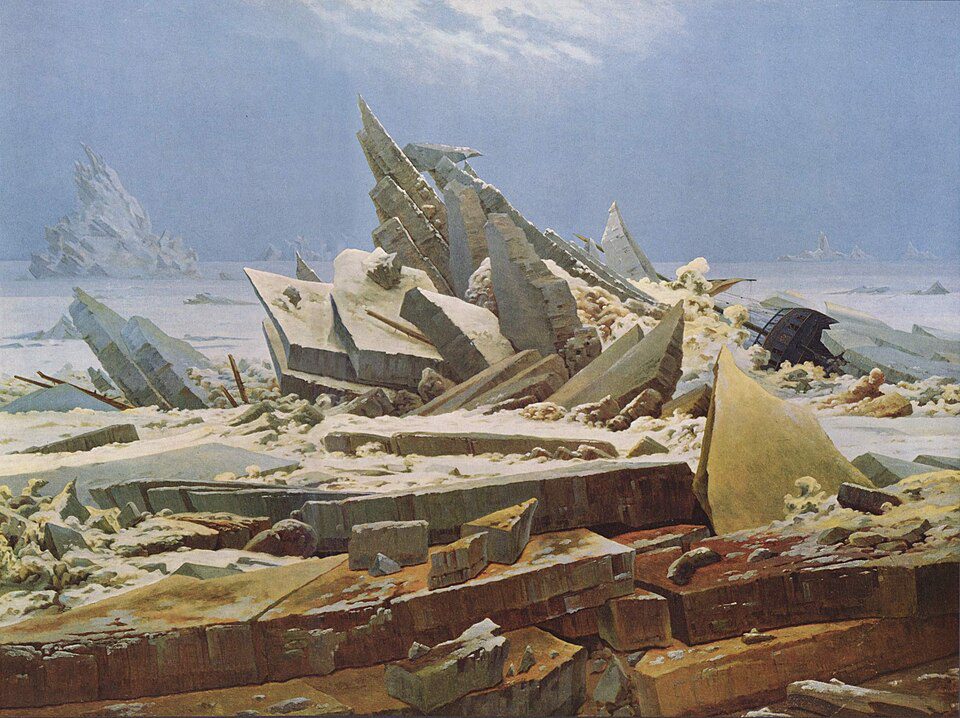
The 19th century was the golden age of maritime Romanticism, and artists of that era found fertile ground in the tragedies of Arctic exploration. Among the most iconic representations of a ghost ship in ice is Caspar David Friedrich’s 1824 masterpiece The Sea of Ice (also called The Wreck of Hope). Though Friedrich was German and had no direct ties to Arctic expeditions, his work captured the same emotional weight—jagged shards of ice crushing a broken ship amid a bleak, frigid expanse. His imagery anticipated real-life scenes that would occur decades later with the Franklin expedition and others.
British artists like William Bradford (1823–1892) also delved into the Arctic theme. Bradford traveled to the Arctic multiple times and painted frozen seascapes and ice-cloaked ships with photographic precision. His work, such as The Arctic Regions (1873), offered a blend of documentary realism and sublime awe. Bradford’s paintings were often used to promote the moral and scientific importance of polar exploration, particularly in an era when empire and virtue were tightly intertwined.
Friedrich and Bradford were hardly alone. Artists like Frederic Edwin Church (1826–1900), a member of the Hudson River School, also painted the Arctic after traveling to Newfoundland and Labrador. His painting The Icebergs (1861) reflected not only the visual strangeness of polar environments but also the spiritual gravity such scenes imposed on the viewer. Church’s approach was almost biblical, portraying nature not as a nurturing force but as a holy terror, capable of both awe and annihilation.
Romantic Visions of Arctic Doom
What all these artists shared was a belief in the sublime—the notion that true beauty often involves fear, scale, and the recognition of man’s fragility. Arctic ghost ships, encased in glittering death, became central to this vision. Their ruins were not just wrecks; they were monuments, frozen testimonies to the limits of human ambition. Romantic art didn’t just reflect the world; it interpreted it, and few subjects were as evocative as the stranded ships of the far north.
Eyewitnesses and Art — Explorer-Sketchers of the Arctic
While Romantic painters captured the essence of Arctic shipwrecks from a distance, many firsthand observers documented these eerie sights in the field. The 19th century saw the rise of explorer-artists—men who were not only expedition members but also trained draftsmen. Their role was to record what photography couldn’t yet capture: the day-to-day struggles, the unforgiving landscape, and the haunting fate of ships left behind. Artists such as Edward Adrian Wilson (1872–1912), who accompanied Captain Scott to Antarctica, and Frederick Whymper (1838–1901), who traveled through Arctic Russia and Alaska, created invaluable visual records.
These sketches and watercolors served a dual purpose. On the one hand, they were scientific documentation—recording ice formations, wildlife, and ship conditions for research and posterity. On the other, they were personal testimonies, often laced with emotional weight. A watercolor of a sunken hull, half-encased in ice, was not just a visual note—it was a prayer, a memory, a silent scream into the cold void. These works often reached Victorian drawing rooms, where the public consumed them as both education and entertainment.
Field Artists in the Frozen North
One notable figure was Lieutenant Edward Hood of the Franklin search party, who sketched scenes in the Canadian Arctic around 1851. His simple pencil drawings of abandoned tents and frostbitten gear tell of hardship more powerfully than many grand oil paintings. Others, like Admiral Sir Leopold McClintock, employed illustrators to document discoveries during his 1857–1859 search for Franklin. These included detailed drawings of the ghostly Erebus and Terror camps, where nothing remained but skeletal remains, shattered wood, and the occasional journal.
The honesty of these images made them especially compelling. They didn’t dramatize or embellish—they simply showed what was. This documentary quality gave them a quiet dignity that still resonates with modern viewers. Whether tucked into expedition reports or published in periodicals like The Illustrated London News, these sketches brought the Arctic home in stark, chilling clarity, making the ghost ships more real—and more tragic—than ever.
The Franklin Effect — From Tragedy to Cultural Icon
Few maritime tragedies have had the artistic ripple effect of the Franklin Expedition. After the disappearance of HMS Erebus and Terror in 1845, a global fascination took hold. Over 30 expeditions set out in search of the missing ships, bringing back relics, Inuit testimony, and eventually human remains. These pieces of the puzzle would eventually form a composite narrative—one filled with hardship, horror, and heroism. In the art world, Franklin’s ships became symbols of noble sacrifice, doomed ambition, and the high cost of conquest.
The earliest paintings in the wake of Franklin’s disappearance emphasized patriotism and stoicism. Sir Edwin Landseer’s 1864 painting Man Proposes, God Disposes, showing two polar bears scavenging shipwreck debris, shocked Victorian audiences with its brutal honesty. Other artists painted imagined scenes of the final moments on board—officers at prayer, men huddled in candlelight, and frozen decks bathed in moonlight. These artworks were not historical reconstructions, but emotional interpretations designed to stir public sentiment and reinforce national pride.
From Propaganda to Poetics
In time, Franklin-themed art shifted away from jingoism and toward introspection. Twentieth-century artists began exploring the psychological dimensions of the expedition—loneliness, fear, hope turned to despair. Artists like Robert Hodgins and contemporary Canadian painter John Hartman have used abstract forms and muted colors to evoke the internal rather than external world of the lost sailors. These works are more ambiguous, prompting viewers to reflect rather than simply mourn.
Today, the Franklin ships continue to inspire exhibitions and retrospectives, particularly in Canada and the United Kingdom. Museums such as the National Maritime Museum in Greenwich and the Canadian Museum of History have built entire wings dedicated to Franklin, featuring artworks both historic and modern. These institutions preserve not only artifacts but also the artistic legacy of the ghost ships—ensuring that the visual culture surrounding Franklin’s tragedy remains alive and evolving.
Modern & Contemporary Art Inspired by Arctic Shipwrecks
The fascination with Arctic ghost ships didn’t end in the 19th century—it evolved. Modern and contemporary artists have taken the themes of abandonment and ice and repurposed them using new media and new questions. British filmmaker and artist Tacita Dean, born in 1965, is one such figure. Her film Disappearance at Sea (1996) used the motif of a lighthouse and the sea to meditate on isolation and lost navigators. While not directly tied to Franklin, the thematic connections are unmistakable.
Other artists have approached ghost ships through a lens of environmental concern. The melting Arctic has revealed new wrecks, prompting reflections on time, decay, and climate change. John Akomfrah’s 2015 video installation Vertigo Sea includes imagery of shipwrecks and ice to explore the legacy of exploration, migration, and ecological loss. These modern interpretations maintain the core themes of doom and beauty but infuse them with new urgency and layered meanings.
New Media, Old Ghosts
Installations and conceptual works have also contributed to the ghost ship narrative. In 2007, Canadian artist Louie Palu traveled to the Arctic to photograph ice-locked relics and created haunting stills of ships barely visible through fog and frost. His work, displayed in both galleries and military museums, underscores the Arctic as both battlefield and burial ground. Others, like sculptor Douglas Coupland, have proposed public memorials to Franklin’s men, blending historical memory with modern form.
Contemporary maritime art now exists at a crossroads—part history, part activism, and part spiritual reflection. Today’s artists use ghost ships not just as subjects, but as stages for dialogue about what is lost—whether it be ships, lives, or even truth itself. The Arctic, once seen as a blank space to conquer, is now a reflective mirror, revealing not only the past but also what our future might look like when ambition outruns wisdom.
Artistic Techniques: Capturing Ice, Decay, and Isolation
Depicting ghost ships in the Arctic requires more than technical skill—it demands a deep understanding of how to visually render silence, cold, and the slow passage of time. Artists who tackle this subject often use subdued palettes dominated by blues, grays, and whites. This limited color range not only mirrors the Arctic environment but also heightens the sense of isolation and distance. The brushwork is often sparse, careful, and deliberate—capturing the hard geometry of ice and the soft decay of rotting timbers.
Lighting plays a crucial role in ghost ship imagery. Artists frequently use twilight or dim, indirect light to emphasize ambiguity and solitude. The play of shadows across jagged ice or rusted hulls communicates a mood of quiet mourning. Photographers and painters alike often feature a central void—an empty deck, a collapsed mast, or an unlit cabin—to draw the viewer’s eye and evoke absence. These visual decisions are not accidental; they are carefully chosen to express emotion through composition.
Tools of Cold Storytelling
Some artists even integrate natural materials into their work—ice, salt, driftwood—to make their creations physically embody the Arctic landscape. Others use high-resolution satellite images and drone footage to portray ghost ships in their actual resting places, bridging science and art. This blending of media offers a compelling realism that deepens the viewer’s emotional engagement. Whether through brush or lens, these creators aim not just to represent ghost ships, but to resurrect them as visual prayers.
For many traditionalist artists, the goal remains spiritual: to bear witness, to memorialize, and to warn. These artists reject abstract or ironic treatments, instead focusing on faith, loss, and redemption. Their paintings function almost like religious icons, inviting contemplation. In this way, even the simplest depiction of a ship trapped in Arctic silence becomes a meditation on what endures after we are gone.
Cultural Echoes: Ghost Ships in Film, Illustration, and Popular Imagination
While maritime painters and field artists first brought Arctic ghost ships to canvas, the broader culture soon adopted the imagery into storytelling mediums far beyond the gallery walls. Films, novels, television series, and graphic novels have all tapped into the chilling allure of ships trapped in polar ice. One of the most prominent examples is AMC’s acclaimed series The Terror (2018), based on Dan Simmons’ 2007 novel. It fictionalizes the Franklin Expedition, blending historical events with horror elements, and features eerie visual depictions of Erebus and Terror slowly swallowed by ice. The show’s brooding cinematography echoes 19th-century Romantic compositions, bringing ghost ship aesthetics to a modern audience.
H.P. Lovecraft’s novella At the Mountains of Madness (1936) also draws on the desolation of polar exploration, combining ancient ruins, lost expeditions, and alien terror in a frozen world. Though focused on Antarctica, its mood and motifs mirror the ghost ship mythos—abandonment, madness, and alienation. Artists and illustrators of Lovecraftian horror frequently incorporate imagery of ruined ships, shattered compasses, and frozen footprints disappearing into the void. These visual cues are not just decorative—they function as subconscious symbols of man’s limits.
The Ghost Ship Trope in Pop Culture
Graphic novels such as The North Passage and indie comics like Sea of Ice have also adapted Arctic ghost ship legends into visual storytelling, often using stark black-and-white drawings that highlight the contrast between man and nature. Even video games, such as The Long Dark (2014), borrow heavily from Arctic shipwreck imagery—using it to build immersive, lonely environments that recall the original visual art traditions. These digital successors to maritime paintings continue the conversation between the past and present, paper and screen.
What makes these popular interpretations powerful is that they preserve the emotional core of the Arctic ghost ship: mystery, tragedy, and reverence. Though stylized and fictionalized, they often maintain fidelity to the themes explored by traditional maritime artists. The result is a cultural continuity that keeps these stories alive—across generations and across formats. Whether in a painting, a series, or a comic strip, the ghost ships sail on, drifting ever forward through the collective imagination.
The Arctic Sublime — Where Nature Reclaims Art and Man
The Arctic, in all its frozen grandeur, has long served as a canvas upon which artists project humanity’s most profound fears and hopes. Ghost ships amplify this function by embodying the exact moment when human endeavor is eclipsed by natural forces. They become both subject and symbol: the Arctic sublime made manifest in decaying wood and fractured hulls. The viewer is confronted not only with loss but with beauty—icy light filtering through broken decks, the purity of snow hiding the machinery of failure.
This idea of the “sublime” originated in the 18th and 19th centuries and was central to Romantic art. It speaks to the emotional experience of awe tinged with terror—standing before something vast and eternal, and knowing one’s place within it. In ghost ship paintings, the sublime is unmistakable: the scale of the ice dwarfs the ship; the silence echoes louder than any cry. These artistic experiences, rich in theological and philosophical resonance, still speak powerfully to modern viewers searching for rootedness and meaning.
Where Art and Eternity Meet
For traditional-minded artists and audiences, Arctic ghost ships are not just dramatic images but reminders of eternal truths. They point to the folly of pride, the fleeting nature of earthly accomplishment, and the ultimate sovereignty of God’s creation. Whether painted in 1860 or filmed in 2020, these vessels serve as spiritual metaphors—testifying to the reality that man proposes, but God disposes. Such messages are rare in contemporary art, but in the realm of Arctic ghost ships, they endure.
As environmental change accelerates and once-locked wrecks emerge from melting permafrost, the symbolism only grows deeper. These ships, once lost to the ice, now return like prophets from a forgotten world. Artists have the chance to respond anew—to capture this reawakening not just as spectacle, but as sermon. The frozen dead are speaking again, and those who listen through brush and lens are not merely recording history—they’re preserving the moral imagination.
Key Takeaways
- Arctic ghost ships like HMS Erebus and SS Baychimo inspired generations of maritime artists with their eerie beauty and tragic backstories.
- 19th-century Romantic artists like Caspar David Friedrich set the tone for ghost ship iconography in Arctic settings.
- Explorer-sketchers and field artists captured firsthand images of icebound ships, offering documentary precision and emotional depth.
- Modern and contemporary artists continue the tradition, using installations, photography, and digital media to explore themes of memory, isolation, and climate.
- The Arctic ghost ship remains a powerful symbol of human ambition, divine sovereignty, and nature’s ultimate control.
Frequently Asked Questions (FAQ)
- What is the most famous Arctic ghost ship?
The most famous is likely HMS Erebus, lost during the 1845 Franklin Expedition and rediscovered in 2014 off King William Island. - Why do ghost ships inspire so much art?
They embody mystery, mortality, and the sublime—powerful artistic themes that provoke deep emotional and spiritual responses. - Did artists ever witness Arctic ghost ships firsthand?
Yes, many 19th-century explorer-artists sketched or painted icebound vessels during expeditions, providing accurate and moving portrayals. - How do modern artists depict Arctic ghost ships today?
Through a mix of photography, film, sculpture, and digital media, often emphasizing environmental and existential themes. - What techniques do artists use to portray ice and isolation?
They rely on muted palettes, indirect lighting, minimalism, and strategic emptiness to evoke cold, silence, and decay.