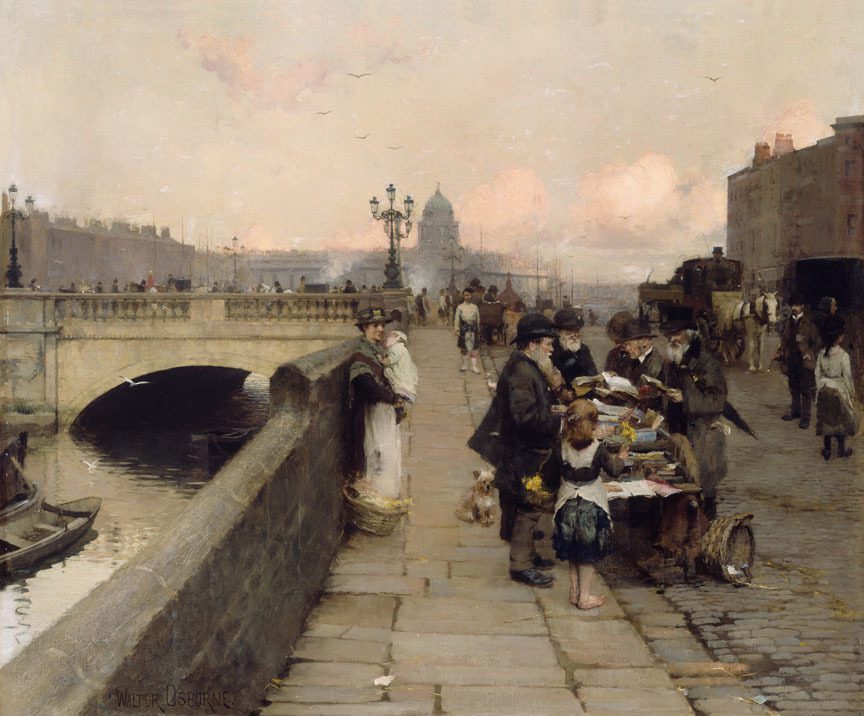
Dublin is a city that wears its history not only in its bricks and bridges, but in the brushstrokes of its artists, the chisel marks of its sculptors, and the layers of expression built up in its galleries and studios over centuries. To walk through Dublin is to move through a living exhibition—a landscape where art has always acted as both a mirror and a battleground for identity. In every era, Dublin’s art has not merely illustrated life; it has interrogated it, argued with it, and at times, tried to remake it entirely.
Art in Dublin has never existed in a vacuum. It has been tangled in religion, revolution, empire, and economics. Its artists have walked the line between tradition and rebellion, between the personal and the political. While the city’s artistic roots can be traced to monastic scribes and religious relics, its modern identity has been shaped by centuries of turbulence: colonization, resistance, independence, and globalization. Dublin’s creative life—its canvases, murals, sculptures, and installations—carry these histories within them.
This deep dive into Dublin’s art history is not just a catalog of names and institutions. Rather, it’s an excavation of how a city tells stories about itself through visual expression. The story begins with the illuminated manuscripts of the early Christian period, where scribes conjured swirling, interlaced visions of divinity that still echo in the national imagination. These early masterpieces, though created in monastic outposts, find their afterlives in Dublin’s museums, where they remain anchors of Irish cultural identity.
As the city became a colonial capital under English rule, art became entangled with empire. Dublin’s elegant Georgian façades, its grand portraiture, and neoclassical statues all speak to a time when art served the ruling class—yet even within those confines, subversion simmered. Beneath the surface of formal portraiture and commissioned allegories was the quiet emergence of distinctly Irish visual idioms. Artists began to inject national sentiment into landscapes and domestic scenes, hinting at a longing for something beyond imperial pageantry.
The 19th century brought institutions—schools, societies, and the National Gallery of Ireland itself—offering both structure and stage for Ireland’s developing visual voice. Yet this institutionalization often privileged a conservative vision, leaving bolder or more experimental artists, especially women, in the margins. Still, resistance grew. By the early 20th century, artists like Jack B. Yeats were pushing the boundaries of form and subject, painting not just what Ireland looked like, but what it felt like in moments of transformation.
Through rebellion, independence, and civil war, Dublin’s artists increasingly aligned themselves with cultural nationalism. But art also became a space for dissent and complexity. As the 20th century progressed, modernist and abstract impulses found their footing, challenging the old myths and offering new ways to see Irishness, identity, and the city itself.
The late 20th century brought another shift. Dublin, like much of Ireland, was rocked by economic collapse and then boom—each wave leaving traces in its creative life. Punk movements, underground art spaces, and feminist collectives began to form in the 1980s and ’90s, questioning everything from church authority to capitalist commodification of Irish culture. These weren’t just fringe phenomena—they redefined the scene. Dublin was no longer just preserving art history; it was actively rewriting it.
Today, Dublin’s art world is as diverse as the city itself. Immigrant voices, queer collectives, and postcolonial critiques all find space in contemporary galleries and public installations. Major institutions like the Irish Museum of Modern Art (IMMA) and the Hugh Lane Gallery sit alongside artist-run spaces and popup exhibitions, reflecting the hybrid, multifaceted identity of the modern city. And still, the ghosts remain—Viking ruins beneath streets, British monuments debated and removed, famine remembered in bronze, the Rising replayed in paint.
To understand Dublin’s art history is to understand the soul of the city itself. It is a history of rupture and repair, of silence and outcry, of sacred imagery and secular revolt. It is a history still unfolding on the walls, in the studios, and across the digital screens of a city that never stops reinventing itself.
This deep dive will follow that journey—from sacred manuscripts to subversive street art, from colonial aesthetics to radical reimaginings—tracing the tangled, beautiful, often conflicted story of how Dublin has made itself visible.
Illuminated Origins: Early Christian and Medieval Art
Long before Dublin was a city of galleries, auction houses, or artist-run spaces, it was a city of scribes and stone. The roots of Dublin’s visual culture stretch deep into the soil of early Christian Ireland, when art served sacred functions and the act of creation was considered an expression of devotion. Though the most famous masterpieces of this era—like the Book of Kells—weren’t made in Dublin itself, the city has become the keeper of their legacy, preserving, displaying, and interpreting Ireland’s early medieval visual brilliance.
To begin with, it’s important to recognize that art in early medieval Ireland was not separate from spirituality or daily life—it was woven into it. Monasteries were the creative engines of the time, producing not just manuscripts but intricately carved high crosses, metalwork reliquaries, and sacred objects that blended Christian symbolism with indigenous Celtic motifs. Art was a way to channel the divine, a form of communication that transcended the limitations of language. And while Dublin may not have been the monastic center that places like Clonmacnoise or Glendalough were, it quickly became the urban heart of this culture’s afterlife.
The most iconic artifact of this period, of course, is the Book of Kells, housed today in the Old Library at Trinity College Dublin. Created around 800 CE, likely on the island of Iona and later moved to Kells in County Meath, this illuminated Gospel book is a stunning fusion of text and image. Its pages—teeming with swirling Celtic knots, interlaced beasts, and vibrant symbolism—represent the pinnacle of Insular art. That it resides in Dublin today is both a reflection of the city’s cultural centrality and a testament to its role as guardian of Ireland’s visual heritage.
The Book of Kells is not simply beautiful; it is profoundly layered. Every decorative flourish serves a symbolic purpose. The Chi Rho page, for example, with its explosive treatment of the Greek letters chi and rho (the abbreviation for “Christ”), transforms a textual moment into an iconographic one, suggesting that visual impact is inseparable from spiritual meaning. In this way, early Irish manuscript art often did more than illuminate scripture—it elevated it, made it corporeal, made it holy. And Dublin, through its curation and scholarship, became the lens through which much of the world now experiences that legacy.
But the medieval art history of Dublin extends beyond illuminated pages. When Viking settlers established a longphort on the banks of the River Liffey in the 9th century—where Dublin would ultimately grow—they brought with them their own artistic traditions. These Norse newcomers contributed metalworking styles, wood carvings, and burial artifacts that began to blend with local Irish forms. Excavations in the area now known as Wood Quay, just west of Dublin Castle, have unearthed jewelry, weaponry, and domestic items that show the first signs of artistic syncretism—Viking design motifs marrying with Christian iconography.
By the 11th and 12th centuries, as Dublin grew in prominence under both Gaelic and Norse influence, ecclesiastical architecture began to dominate the artistic landscape. The construction of Christ Church Cathedral (originally founded in the early 11th century) and St. Patrick’s Cathedral (built in the 13th century) introduced Romanesque and later Gothic elements into the city’s visual vocabulary. Stone carving reached a new level of sophistication—capitals, corbels, and effigies all began to populate the sacred spaces of Dublin. These works, though architectural in function, were deeply expressive, linking earthly structures to heavenly ideals.
During this period, stone and manuscript were not the only media through which art flourished. Metalwork from the era, like chalices, crosses, and reliquaries, revealed the same devotion to intricate detail and symbolic resonance. Though many of these treasures are now housed in the National Museum of Ireland, located on Kildare Street in Dublin, they form part of a broader continuum—objects once used in rural monasteries and churches now preserved and interpreted in the urban core.
Perhaps most fascinating is how early medieval art in Ireland, and by extension in Dublin, refused to neatly separate the pagan from the Christian, the abstract from the figurative. The visual logic of Celtic knots, interlace, and spiral patterns was not abandoned but recontextualized. The result is an aesthetic that feels uniquely Irish—neither fully Roman nor wholly native, but a creative negotiation between worlds. This hybridity set the tone for much of what would follow in Dublin’s art history: a tension between tradition and innovation, between the spiritual and the secular.
By the end of the medieval period, Dublin was becoming more recognizably urban, and with urbanity came new pressures, new patrons, and new forms. But the legacy of early Christian art didn’t fade; it evolved. Manuscript illumination gave way to printed books; stone carvings gave way to public monuments; sacred art gave way to civic art. And through it all, the motifs of Ireland’s earliest artistic expressions—the spirals, the sacred animals, the intricate knotwork—continued to appear, reimagined, in later visual cultures.
Today, visitors to Dublin can still trace these medieval origins. At Trinity College, where the Book of Kells remains on permanent display, long lines form daily to glimpse the past made luminous. In the crypts of Christ Church Cathedral, one can see the remnants of early stonework and Viking artifacts. At the National Museum, reliquaries glitter under glass, their surfaces catching modern light just as they once shimmered by candlelight in darkened sanctuaries.
This enduring fascination is more than nostalgia. It speaks to something foundational—an understanding that Ireland’s earliest visual culture was not only technically accomplished but spiritually ambitious. And Dublin, as steward and storyteller, remains central to that heritage.
Gothic to Georgian: Art Patronage and Urban Transformation
Dublin’s transformation from a medieval stronghold to a refined Georgian city is one of the most visually striking chapters in its art history. The story begins in stone, with Gothic cathedrals and Norman castles, and ends in stucco, symmetry, and sweeping urban plans that turned the Irish capital into one of Europe’s architectural jewels. In this period—from roughly the 12th to the early 19th century—art and architecture became powerful tools of display, status, and ideology. Patronage shifted from church to court to colonial elite, and in the process, Dublin became a city where art both reflected and reinforced the stratified society of empire.
After the Norman invasion of Ireland in the 12th century, Dublin was established as the administrative center of English rule. The Normans brought with them not only a new political order but also new architectural styles—chiefly the Romanesque and later the Gothic. Christ Church Cathedral, originally founded by the Norse but reimagined under Norman influence, is a living palimpsest of this fusion. With its pointed arches, ribbed vaults, and elaborate stone carvings, it set a precedent for ecclesiastical art in the city. Later additions to St. Patrick’s Cathedral, such as the ornate Lady Chapel and soaring spire, further embedded the Gothic style into the urban fabric.
These buildings weren’t just places of worship; they were statements of power. Cathedrals stood as tangible expressions of the Church’s influence, yes, but also of the Anglo-Norman grip on Ireland. Their art—tomb effigies, stained glass, iconography—was part of a wider system of visual language that communicated authority and continuity. The monumental tomb of Richard de Clare (Strongbow) in Christ Church, for example, is less a memorial than a political icon, immortalizing the conqueror in marble and myth.
By the 17th century, religious patronage had begun to wane, replaced by a new form of elite-driven artistic influence. The Protestant Ascendancy, a ruling class of Anglo-Irish landlords, began to shape Dublin into a city worthy of their ambitions. Art and architecture became central to this transformation. As the capital of the Kingdom of Ireland (a semi-autonomous entity under British dominion), Dublin was envisioned as a grand and orderly metropolis—an outpost of refinement on the edge of empire.
It was during the 18th century that Georgian Dublin emerged in earnest, marking one of the city’s most profound artistic reimaginings. Inspired by classical ideals of balance, proportion, and restraint, Georgian architecture turned the city into a model of Enlightenment rationalism. Squares like Merrion Square, Fitzwilliam Square, and St. Stephen’s Green were laid out with mathematical precision, lined with terraced redbrick houses distinguished by elegant doorways and wrought ironwork.
This period wasn’t only about architecture—it shaped the visual arts in more intimate ways. The interiors of these Georgian homes were often filled with portraiture, landscapes, and decorative art. Artists such as Thomas Hickey and James Latham became sought-after portraitists, painting members of the Anglo-Irish elite in neoclassical poses that borrowed from European court traditions. These portraits weren’t merely likenesses; they were social instruments, asserting lineage, taste, and political loyalty.
The demand for skilled artists led to the establishment of key institutions. The Royal Dublin Society (RDS), founded in 1731, played a crucial role in fostering artistic education and appreciation. Its Drawing Schools, established in the mid-18th century, trained generations of Irish artists and craftsmen, many of whom went on to define Irish visual culture well into the 19th century. The RDS also organized exhibitions and competitions that brought art into public view, creating a more structured—and somewhat democratized—art world.
Yet, as refined as Georgian Dublin appeared, its cultural system was profoundly unequal. The grandeur of the period was built on the backs of a disenfranchised Catholic majority and deep economic divisions. Art during this time largely served the privileged; the subjects of most commissioned works were landlords, judges, and military officers. Dublin’s poorer classes appeared only occasionally—usually in moralizing genre paintings or as background figures in grand compositions. The city’s burgeoning tenement population, which would come to define much of Dublin’s social history in the 19th and 20th centuries, was largely invisible in Georgian art.
Despite these exclusions, cracks in the visual order began to appear. Some artists, notably Nathaniel Hone the Elder, began to challenge the prevailing norms. Hone’s work, while technically brilliant, also carried hints of satire and critique. His 1775 painting The Conjuror was a thinly veiled attack on the artificiality of contemporary academic art, leading to controversy within the Royal Academy in London, and signaling a restlessness within even the most elite circles.
As the 18th century drew to a close, political unrest stirred in the streets. The 1798 Rebellion and the Act of Union in 1801—when the Irish Parliament was dissolved and full legislative control moved to Westminster—ushered in a new era of decline for Dublin. Much of the Georgian grandeur began to decay. Homes fell into disrepair; fortunes crumbled; the city stagnated. But in a way, this very decline created space for a new generation of artists, who would begin to move beyond the formalism of Georgian aesthetics and into more experimental, personal, and eventually nationalist expressions.
Still, the visual legacy of this period remains etched into the city itself. The Georgian streetscape is not just a background—it’s a character in Dublin’s ongoing cultural drama. The rhythm of the redbrick façades, the repetition of doorways, the hidden symmetry of interiors—all of it continues to shape how the city sees itself, and how others see it.
In Dublin today, galleries like the Hugh Lane Gallery and the National Gallery of Ireland still host works from this era, alongside more radical and contemporary fare. Walking through Georgian Dublin is like entering a three-dimensional painting—its proportions whispering Enlightenment ideals, its elegance haunted by imperial contradictions.
In this period, art in Dublin became more than spiritual—it became civic, ideological, aspirational. It reflected a city trying to claim its place among the cultured capitals of Europe, even as it bore the contradictions of occupation and exclusion. These contradictions would only intensify in the decades to come, as art became increasingly entangled with Ireland’s quest for independence.
The Royal Dublin Society and the Rise of Institutional Art
By the mid-18th century, Dublin had matured into one of the largest and most architecturally ambitious cities in the British Isles. But while its Georgian terraces and civic buildings announced a city of sophistication, its art scene lacked the kind of infrastructure needed to sustain and develop a native school of artists. The formation of the Royal Dublin Society (RDS) in 1731 marked a turning point—a decisive move to institutionalize the arts in Ireland and, in doing so, to cultivate an Irish identity that could stand alongside the cultural achievements of London, Paris, and Rome.
The RDS began with a broad remit: to promote “the advancement of agriculture, arts, and manufactures.” At first glance, this mission might seem oddly diffuse, but it reflected Enlightenment ideals of improvement, progress, and reason. Art, in this vision, was not only for beauty or spiritual enrichment—it was a civilizing force, one that could elevate a people and a nation. In Ireland, still deeply shaped by colonial hierarchy, such a vision carried both promise and tension.
One of the most important achievements of the RDS was the establishment of its Drawing School in 1750. Located initially at Shaw’s Court, the school was open to both Protestant and Catholic students, a relatively rare gesture of inclusivity at the time. The curriculum was grounded in classical ideals: students copied from plaster casts of Greco-Roman statues, studied anatomy, and learned techniques in figure drawing and architectural draftsmanship. The aim was to produce artists and artisans who could contribute to everything from portraiture to book illustration, interior design, and even engineering.
This was a crucial development in Dublin’s art history. For the first time, young Irish artists had a formal setting in which to develop their craft, and crucially, to be seen. The school also hosted annual exhibitions, giving students and professional artists a rare platform to present their work to the public and to potential patrons. These shows were among the first public art exhibitions in the city, predating the establishment of the Royal Hibernian Academy (RHA) by nearly a century.
Among the RDS’s most famous alumni was James Barry, a fiery and ambitious artist born in Cork in 1741, who trained briefly in Dublin before heading to London and then Rome. Barry was a passionate believer in the power of art to shape civic virtue. His magnum opus, the massive series The Progress of Human Culture at the Society of Arts in London, owed much to the neoclassical principles instilled in him during his early training in Dublin. Though Barry often clashed with institutions—he was famously expelled from the Royal Academy—his work embodied the Enlightenment ambition that had given birth to the RDS.
The RDS didn’t stop at training artists. It became an influential patron in its own right, commissioning works and acquiring pieces to inspire Irish creators. It also played a key role in encouraging the decorative arts, which were often undervalued in academic circles but vital to the everyday visual culture of the city. Crafts like silverwork, furniture design, and glassmaking flourished under the society’s umbrella. This was especially significant in a city where class distinction was deeply encoded in material culture—wealth was displayed not only on canvas but in the detail of a carved mantelpiece or the design of a silver tankard.
Still, the RDS was not without its limitations. Though it welcomed Catholic students, the social networks of high art in Dublin remained dominated by the Protestant elite. Much of the patronage flowed from the Ascendancy class, whose tastes leaned toward conservative, Anglocentric styles. This created a disconnect between the art world and much of the Irish population, particularly rural communities or those invested in nationalist identity. As such, the art encouraged by the RDS often reinforced rather than questioned the status quo.
Yet the infrastructure laid down by the RDS was foundational. It fostered a generation of artists who would go on to teach, exhibit, and challenge conventions. It also laid the groundwork for more radical institutions and movements in the 19th and 20th centuries. Without the RDS’s early interventions, it’s hard to imagine the later flowering of Irish art, from Romantic landscape painting to the national modernist turn.
The influence of the RDS extended beyond the visual arts. It became a center for public lectures, scientific demonstrations, and cultural events. It hosted debates and published tracts on Irish agriculture, industry, and education. This holistic approach to societal improvement is key to understanding the Enlightenment-era ethos behind the society—it was a civic institution in the broadest sense, seeking to uplift the nation through knowledge and cultivation.
In the modern era, the RDS is perhaps best known for the RDS Arena and Horse Show, but its historical role in Irish art is profound. The society helped to shift art from a private, elite pursuit into a semi-public arena, where education, display, and dialogue could begin to flourish. It laid the foundations for art as a national project—a project that would take on new urgency in the 19th century, as Ireland moved closer to revolution and cultural reclamation.
By institutionalizing art, the RDS made Dublin not just a city of creators, but a city of viewers—a place where the visual could be debated, taught, purchased, and celebrated. This was a vital step in turning Dublin into an artistic capital, and one whose legacy is still visible today in its schools, its galleries, and the quiet persistence of its creative ambition.
Art and Empire: Dublin in the 18th and 19th Centuries
As the 18th century gave way to the 19th, Dublin stood at a crossroads of ambition and contradiction. On the surface, the city was a polished imperial outpost—Georgian facades lining orderly streets, grand buildings asserting a refined civic order. But beneath this architectural harmony was a society fractured by colonization, inequality, and unrest. In this context, Dublin’s art served dual masters. It was a mirror of the colonial elite’s tastes and aspirations, yet it also began, subtly and unevenly, to register the stirrings of an alternative vision—one that would eventually challenge the empire’s grip on Irish cultural life.
By the early 1800s, Dublin’s political status had been sharply diminished. The Act of Union in 1801 dissolved the Irish Parliament and merged it with Westminster, effectively making Ireland a province of the United Kingdom. For Dublin’s artistic community, this was a blow. The city lost many of its wealthiest patrons, who now relocated to London. The Georgian elite, who had once invested in portraiture, architecture, and cultural prestige, began to withdraw, and with them went crucial sources of artistic support.
But paradoxically, this period of political and economic decline was also one of growing artistic ambition. As Dublin receded in imperial importance, it became a space of reflection and resistance. Visual culture during this time functioned as both an instrument of British rule and a vessel for an emerging Irish consciousness.
The dominant artistic language of the early 19th century remained tied to British and European academic traditions. Artists trained in the Royal Academy in London, or through institutions like the Royal Dublin Society and later the Royal Hibernian Academy (RHA), founded in 1823. The RHA provided a formal platform for exhibiting Irish art, yet its early decades were shaped by conservative aesthetics: portraiture, historical scenes, and idealized landscapes, often devoid of overtly Irish themes.
Many of these works projected a colonial vision of Ireland—a land of picturesque ruins, pastoral calm, and quaint rural life. Painters like George Petrie, though deeply committed to Irish antiquities, often rendered the countryside through a romanticized lens. Petrie’s images of monastic ruins and Celtic crosses were beautiful, detailed, and technically accomplished, but they risked reducing Ireland to a melancholy, timeless backwater—a vision that served imperial narratives by implying stasis and dependency.
But Petrie’s work also carried another significance. As a founding member of the Royal Irish Academy’s antiquities committee, he helped launch the Celtic Revival—a movement that sought to reclaim and celebrate Ireland’s ancient artistic heritage. By documenting archaeological sites, medieval manuscripts, and native design motifs, Petrie and his contemporaries laid the groundwork for a visual nationalism that would come to the fore in the decades to follow.
Simultaneously, Dublin was the site of more overtly political visual culture. The 19th century saw the rise of illustrated newspapers, pamphlets, and satirical prints, many of which used imagery to comment on Ireland’s social conditions. Publications like The Nation, founded by Thomas Davis and other Young Irelanders in the 1840s, combined literature and visual art in service of cultural nationalism. Engravings of Wolfe Tone, Robert Emmet, and Daniel O’Connell circulated widely, turning revolutionary figures into icons. Art was no longer just about patronage—it was becoming a tool for mass communication, and with it, political education.
This democratization of imagery also found expression in public monuments. The O’Connell Monument, unveiled in 1882 at the base of O’Connell Street, was a dramatic statement in bronze. Designed by John Henry Foley, one of the most successful sculptors of the Victorian era, the monument depicted O’Connell flanked by allegorical figures representing virtues like Patriotism and Fidelity. Unlike earlier imperial statues in the city—of British monarchs or colonial governors—O’Connell’s was a statue by and for the Irish. It marked a shift: the language of monumentality, once used to reinforce empire, was now being reclaimed to celebrate nationalist leaders.
Still, the city remained visually dominated by imperial symbols. Statues of Queen Victoria, Prince Albert, and Lord Carlisle dotted public squares. The art collected in Dublin’s nascent galleries often came from British donors, reinforcing the sense that high culture was an import, not a native product. The National Gallery of Ireland, founded in 1854 and opened in 1864, housed a growing collection of European masterpieces, but it also began to include works by Irish artists—marking the beginning of a complex balancing act between global prestige and local identity.
One of the most important artists to navigate this tension was Daniel Maclise. Born in Cork but trained in London, Maclise produced grand historical paintings that graced public institutions in both cities. His work The Marriage of Strongbow and Aoife (1854), now in the National Gallery, is a perfect example of the visual complexity of the time. On one level, it depicts a foundational moment in Anglo-Irish history—the 1170 union between the Norman invader and the Irish princess. But Maclise’s treatment is far from celebratory. The painting is dark, almost funereal, filled with figures that appear anxious, grieving, or resigned. It is a tableau of conquest, not romance—a subtle but powerful critique of empire, rendered within a highly academic style.
By the late 19th century, Dublin’s art scene was beginning to change. A new generation of artists, many of them influenced by European modernism, began to question the classical training and colonial aesthetics of their predecessors. The seeds of rebellion were being sown—not just politically, but artistically. Painters like John Butler Yeats and Sarah Purser began to introduce more personal, expressive, and psychologically nuanced styles. Art was becoming less about reinforcing power and more about exploring the human condition.
This gradual transformation of Dublin’s art world mirrored the larger shifts occurring in Irish society. Cultural nationalism, the Irish Literary Revival, and growing dissatisfaction with British rule all created fertile ground for a reimagining of Irish identity through art. By the time the 20th century arrived, Dublin was no longer just an imperial city—it was becoming a crucible for revolution, not only in politics, but in the way Ireland saw itself and represented that vision to the world.
Rebellion on Canvas: Art and the Nationalist Movement
As the 19th century bled into the 20th, Dublin stood on the brink of profound political and cultural upheaval. The long-simmering tensions of colonial rule, land struggle, religious conflict, and cultural suppression erupted into a nationalist movement that would transform Ireland—and with it, Irish art. In Dublin, the visual arts became a battleground of identity, heritage, and rebellion. Artists, once confined to the conservative tastes of the Ascendancy or trained in British academies, began to forge a new, defiantly Irish visual language. Art was no longer merely representational—it was revolutionary.
The seeds of this transformation had been quietly growing for decades. The Celtic Revival, a cultural movement that sought to reclaim Ireland’s indigenous traditions, gained force in the late 19th century. Spearheaded by figures like W.B. Yeats, Lady Gregory, and Douglas Hyde, the Revival touched every form of creative expression—poetry, theater, music, and visual art. Though often romanticized and idealized, the Celtic Revival was a radical act of cultural self-definition. In the visual arts, it meant reviving medieval motifs, celebrating native craftsmanship, and, most importantly, rejecting the imposed aesthetics of British classicism.
Artists like Sarah Purser, Beatrice Elvery, and Jack B. Yeats became central to this movement. Purser, a pioneering woman in Irish art, not only painted portraits of nationalist leaders but also played a key role in reviving stained glass as a serious art form in Ireland. In 1903, she founded An Túr Gloine (The Tower of Glass), a stained glass studio based in Dublin that trained Irish artists and produced windows for churches and public buildings across the country. These were not merely decorative; they were part of a project to replace imported religious imagery with homegrown symbolism—turning visual space into political space.
Jack B. Yeats, brother of the poet, began his career illustrating nationalist pamphlets and children’s books. His early work had a whimsical, illustrative charm, but over time his style evolved into something far more expressive and emotionally charged. In many ways, Jack B. Yeats became the painter of the Irish soul. His work captured the dignity and drama of everyday Irish life—horse fairs, street performers, political meetings—with a sense of immediacy and color that was both modern and deeply rooted in Irish narrative tradition.
The intersection of art and politics reached a fever pitch in the years surrounding the Easter Rising of 1916. The rebellion, which took place largely in Dublin, marked a turning point in Irish history. In its immediate aftermath, the city bore the scars of war—burned-out buildings, destroyed infrastructure, and a shaken populace—but it also emerged as the symbolic heart of the revolution. Artists responded not only to the events of the Rising but to its myths, its martyrs, and its meaning.
Visual art became a powerful tool for memorialization. Prints and posters of leaders like Patrick Pearse, James Connolly, and Countess Markievicz proliferated, turning revolutionary figures into icons. Some were mass-produced lithographs; others were finely rendered oil portraits commissioned by families or nationalist societies. The language of Catholic martyrdom—halos, suffering, sacrifice—was often adapted to frame the rebels, creating a fusion of religious and political devotion that resonated deeply with the Irish public.
At the same time, Dublin’s streets became canvases for public memory. The destruction of the General Post Office (GPO) during the Rising was followed by efforts to preserve and commemorate the site. Monuments, plaques, and murals began to appear throughout the city, turning urban space into a visual history of resistance. The act of walking through Dublin became an act of remembrance.
One of the more symbolic episodes of this period was the fate of imperial statues in the newly formed Free State. In the years following independence, several monuments to British monarchs and generals were removed or destroyed. The toppling of the Nelson Pillar on O’Connell Street in 1966—on the fiftieth anniversary of the Rising—was not only a political act but a statement on visual space. What Ireland chose to display in public, and what it chose to erase, became part of the broader artistic conversation about identity.
In the decades immediately after independence, the Irish government took an ambivalent stance toward modern art. While there was state support for cultural institutions, much of the official art of the Free State was conservative, moralistic, and nationalistic in tone. Artists were often expected to contribute to a cohesive image of Irishness—rural, Catholic, heroic. Yet many resisted. The painter Seán Keating, for example, created iconic portraits of Irish independence fighters and Aran Islanders alike, but he also painted industrial scenes and explorations of modernity that challenged the pastoral idyll often imposed by state-sanctioned art.
Others, like Mainie Jellett and Evie Hone, took their rebellion even further—introducing modernist abstraction and Cubism to an Irish public that often viewed such styles with suspicion. Jellett, a former student of André Lhote in Paris, returned to Dublin in the 1920s and began to exhibit boldly non-representational works. She was often met with outrage—audiences accused her of importing “foreign” ideas—but her commitment to modernism helped open the door for later generations of Irish artists to experiment and push boundaries.
Throughout the early 20th century, the battle for Ireland’s political independence ran parallel to a battle for artistic independence. Dublin’s artists were not simply chronicling events—they were actively shaping how the nation saw itself. Their work bridged past and present, folklore and futurism, realism and abstraction. And while not all of them aligned with the nationalist movement in a straightforward way, they all contributed to a widening of the visual imagination, one that made space for complexity, contradiction, and change.
By mid-century, Dublin had established itself not only as the capital of a political republic, but as a city of contested and evolving artistic meaning. The legacy of rebellion lived not only in monuments and murals but in the ongoing tension between tradition and innovation. It was a city still finding its image, still wrestling with what it meant to be Irish, modern, and free.
The Birth of the National Gallery of Ireland
In 1864, Dublin witnessed the opening of an institution that would fundamentally reshape the country’s relationship to art: the National Gallery of Ireland. Located on Merrion Square, beside the stately Leinster House, the gallery was more than a museum—it was a symbolic declaration. For the first time, Ireland had a public space dedicated to the display, preservation, and study of visual art, accessible to all. In a city shaped by colonial structures, religious division, and cultural marginalization, the National Gallery became both a mirror and a maker of national identity.
The establishment of the gallery was the result of decades of lobbying, negotiation, and compromise. Ireland in the mid-19th century was still firmly under British rule, and its artistic infrastructure remained minimal compared to London or Edinburgh. While private collections flourished among the Anglo-Irish elite, and the Royal Dublin Society had long supported artistic education, there was no dedicated public venue for exhibiting fine art. Cultural reformers—many of them Protestant liberals—argued that such a space would elevate public taste, provide moral instruction, and promote a sense of civic unity.
Funding came partially from the British Treasury, reflecting imperial oversight, but Irish politicians and philanthropists also played key roles. The gallery’s founding board included members from both Catholic and Protestant backgrounds, and its earliest policies emphasized accessibility: admission was free, and the collection was intended to educate as well as inspire.
From the beginning, the National Gallery’s curatorial approach was deeply influenced by European models, particularly the National Gallery in London. Early acquisitions focused on the Old Masters—Italian Renaissance works, Dutch landscapes, Spanish religious paintings. These were considered the bedrock of any serious art institution, and they served to situate Ireland within the broader traditions of Western art. Notable early acquisitions included paintings attributed to Titian, Rubens, and Murillo, and their presence in Dublin reinforced the city’s aspirations to cultural sophistication.
But these works also raised complex questions. What did it mean for a colonized nation to construct its cultural identity using the aesthetic language of its colonizers and their continental peers? In the absence of a robust tradition of Irish painting comparable to that of England or France, the gallery inevitably leaned on imported heritage. This helped elevate the institution’s status, but it also meant that for many years, Irish artists remained peripheral within their own national collection.
That began to change gradually in the late 19th and early 20th centuries, thanks to the advocacy of figures like George Mulvany, the gallery’s first director, and later Walter Strickland and Thomas Bodkin, who championed the inclusion of Irish works. One of the most significant acquisitions during this time was Daniel Maclise’s massive historical painting The Marriage of Strongbow and Aoife (1854), a dramatic depiction of the 12th-century Norman invasion of Ireland. The painting’s complex emotional tone—a dark, almost theatrical rendering of a politically charged moment—stood in contrast to the smoother, more celebratory depictions of empire found in many British collections.
The inclusion of Maclise’s work signaled a shift. The gallery was no longer just a repository of European greatness; it was becoming a stage for the telling of Irish stories. Over the next several decades, more Irish artists were added to the collection: James Barry, Nathaniel Hone, Jack B. Yeats, John Lavery, William Orpen, and Sarah Purser among them. These were artists who had often trained abroad and worked within international styles, but who also grappled with Irish themes—identity, land, mythology, conflict.
Perhaps the most transformative moment in the gallery’s development came in 1957, with the donation of the Alfred and Clementine Beit Collection. This extraordinary gift included masterpieces by Vermeer, Velázquez, Frans Hals, and Goya, instantly catapulting the National Gallery of Ireland into the ranks of world-class institutions. For many, it was a point of pride that such treasures were housed not in London or New York, but in Dublin—a validation of Ireland’s cultural seriousness on the global stage.
Yet even as the gallery’s international holdings grew, so too did its commitment to Irish art. The appointment of Homan Potterton as director in 1980 marked another turning point. Potterton launched efforts to expand the Irish collection, improve the gallery’s public engagement, and modernize its displays. He oversaw important exhibitions that highlighted Irish portraiture, landscape painting, and modernism, reframing the narrative to place Ireland at the center, not the margins, of its own art history.
The Millennium Wing, opened in 2002, embodied this dual vision. Designed by architects Benson & Forsyth, the wing was a bold, contemporary addition that echoed the city’s Georgian rhythm while asserting a modernist clarity. It provided much-needed space for temporary exhibitions, educational programs, and contemporary art. In 2017, after an extensive refurbishment, the gallery unveiled a rehang of its permanent collection, giving new prominence to Irish artists and arranging the works not just by school or style, but by theme and dialogue.
Today, the National Gallery of Ireland is more than a museum—it’s a cultural landmark that speaks to Dublin’s evolving identity. Its collection spans centuries and continents, but its curatorial focus increasingly centers on questions that resonate deeply in modern Ireland: What does it mean to be Irish? How do we reckon with a colonial past? How do art and politics intertwine? What spaces are being included, and which ones are still excluded?
Perhaps most moving is the way the gallery has embraced its role as an educational space. Free public talks, family programs, artist residencies, and collaborations with schools and community groups ensure that the gallery is not a temple of taste, but a forum for dialogue. In a country still navigating the legacies of colonialism, religious conservatism, and cultural erasure, the National Gallery offers something rare and vital: a space to look, to question, and to imagine.
Its walls now contain not just the splendor of Vermeer’s Woman Writing a Letter, with her Maid, or Caravaggio’s The Taking of Christ, but also the luminous loneliness of Jack B. Yeats’ The Liffey Swim, and the abstract intensity of Mainie Jellett’s modernist compositions. It is a house of mirrors and memory—a place where Irish art no longer asks for permission to be seen, but demands it.
Modernism in Dublin: The 20th-Century Breakthrough
By the early 20th century, the streets of Dublin had already borne witness to revolution in politics, poetry, and the theatre. The city had declared itself the capital of a cultural renaissance, with the Abbey Theatre giving voice to Ireland’s literary soul and the GPO becoming a symbol of political rupture. But in the world of visual art, the revolution arrived more slowly, cautiously, and then—suddenly—with undeniable force. Modernism, with its fractured forms and restless energy, did not burst through the gates of Dublin with the same blaze it had in Paris or Berlin. Instead, it slipped in under the door, carried in sketchbooks, whispered in studios, and finally, boldly, declared itself on canvas.
In the years immediately following Irish independence, the artistic landscape in Dublin was, paradoxically, both free and confined. The colonial authority was gone, but cultural conservatism, dominated by Catholic values and a nostalgic vision of rural Ireland, cast a long shadow. Artists were encouraged—sometimes subtly, sometimes explicitly—to produce work that supported a cohesive, moral, and traditional Irish identity. This often meant pastoral scenes, religious imagery, and depictions of heroic nationalist moments. The state supported art, but it often defined what counted as acceptable art.
Yet, beneath this surface calm, a quiet revolution was underway. Irish artists, many of whom had studied in continental Europe, were beginning to push against the boundaries of realism and national romanticism. Chief among them was Mainie Jellett, a name now synonymous with Irish modernism. Born in 1897 to a prominent Dublin family, Jellett studied in Paris with André Lhote and Albert Gleizes, both influential Cubists. When she returned to Ireland in the 1920s with abstract works based on sacred geometry and Cubist principles, the response was swift and hostile.
Her 1923 exhibition at Dublin’s Society of Dublin Painters shocked the public. Critics dismissed her art as incomprehensible and un-Irish. Some accused her of desecrating the visual language of the nation. But Jellett stood her ground. She wrote and lectured widely on the intellectual and spiritual dimensions of abstraction, framing her work not as foreign intrusion but as a continuation of Celtic tradition—one that had long embraced symbolic pattern and spiritual form. Her courage opened the door for others, and her work now stands as a cornerstone of Ireland’s modernist canon.
Jellett was not alone. Evie Hone, her close friend and fellow student of Gleizes, also pursued abstraction, though she later transitioned into stained glass, producing some of the most luminous and spiritually resonant windows in Ireland. Her window in Eton College Chapel, and later in St. Patrick’s Church in Wicklow, fused modernist form with sacred narrative, continuing the legacy of An Túr Gloine while propelling it into new visual territory.
Meanwhile, the painter Jack B. Yeats, though often categorized apart from the international avant-garde, was crafting a modernism all his own. In the 1930s and ’40s, his style grew increasingly expressionistic—thick with impasto, vibrating with emotion. His scenes of Dublin streets, horse races, and lone figures walking along dark quays captured the psychological tension of a city caught between tradition and change. Yeats’ work was fiercely Irish in subject matter but European in spirit, drawing comparisons to Van Gogh and Munch.
This quiet flowering of modernism was made possible by institutions willing to take risks. The Society of Dublin Painters, founded in 1920 by Jellett, Paul Henry, Letitia Hamilton, and others, became a vital platform for non-academic art. It gave space to experimental artists who might otherwise have been shut out of the more conservative Royal Hibernian Academy (RHA). Although the Society often operated on the margins of public attention, its exhibitions were crucial in shaping Dublin’s slowly expanding visual imagination.
In the mid-20th century, Dublin also saw a growing engagement with international currents in art. Galleries like the Dawson Gallery, founded by Leo Smith in the 1940s and later managed by David Hendriks, introduced Dublin audiences to postwar European abstraction, surrealism, and conceptualism. The Dawson Gallery championed Irish modernists like Patrick Scott, whose minimalist gold leaf works blended spiritual meditation with formal experimentation, and Louis le Brocquy, whose “Head” series deconstructed human form in ways that felt both ancient and avant-garde.
Le Brocquy’s work, particularly his “Portrait Head” paintings of literary figures like James Joyce and Samuel Beckett, epitomized a new kind of Irish art: intellectual, experimental, and globally resonant. These weren’t sentimental depictions; they were psychological x-rays, haunting and cerebral, capturing the fractured self in a fractured age.
This period also saw an increasing institutional support for modern art. In 1943, the Irish Exhibition of Living Art (IELA) was founded in Dublin, as a direct response to the perceived conservatism of the RHA. The IELA, which continued until the 1980s, was a fiercely independent annual show that became a proving ground for emerging artists. It offered an alternative to the official canon and helped validate modernism as a legitimate, even necessary, form of Irish expression.
Still, modernist artists in Dublin faced significant obstacles. Public taste lagged behind artistic innovation, and many of the city’s critics, educators, and cultural authorities remained wary of abstraction. The Catholic Church, which wielded immense influence over Irish education and morality, was particularly suspicious of art that lacked clear narrative or spiritual guidance. Yet even within religious spaces, artists like Hone and Scott found ways to insert modernist aesthetics, slowly shifting the boundaries of the acceptable.
By the 1960s and ’70s, Dublin’s artistic scene had been transformed. Galleries such as the Project Arts Centre, founded in 1966, embraced interdisciplinary work and contemporary experimentation. Artists began working in film, performance, installation. The seeds planted by Jellett and her peers had grown into a diverse, if still precarious, ecosystem of modern art in the capital.
Modernism in Dublin wasn’t a movement in the traditional sense—it didn’t arrive with manifestos or collective declarations. Instead, it was a constellation of individuals, each responding in their own way to the tensions of modern Irish identity. They brought European techniques into dialogue with Irish myth, history, and emotion. They reimagined form, space, and selfhood in a city that was still reckoning with its past.
Today, the legacy of Dublin’s modernists is visible in every major cultural institution in the city. The Irish Museum of Modern Art (IMMA), opened in 1991, owes its existence to the groundwork laid by artists who insisted that Ireland needed its own contemporary voice. That voice—once whispered in backrooms and private studios—now echoes loudly through public galleries, installations, and the streets of the capital itself.
Women in Dublin Art: Visibility and Contributions
For much of its history, the Dublin art scene—like many others across Europe—largely reflected the tastes, priorities, and access of men in positions of influence. Nonetheless, women artists have made significant contributions to Irish visual culture, often working within limited institutional frameworks, restricted access to education, and fewer exhibition opportunities. Their persistence, output, and organizational efforts form a crucial part of the city’s cultural development.
In the 18th and early 19th centuries, women artists often worked within acceptable formats such as portraiture, miniatures, and decorative arts. Anne Mee, for example, was a successful miniaturist who painted members of the British and Irish nobility. While her work remained within the stylistic conventions of the period, it reflected both technical skill and market recognition.
Institutional access began to expand in the late 19th century. The Metropolitan School of Art in Dublin (later the National College of Art and Design) gradually opened its programs to more women. Among the most prominent figures of this time was Sarah Purser, a portraitist and patron who played a leading role in promoting Irish art. In 1903, she founded An Túr Gloine (The Tower of Glass), a stained-glass workshop in Dublin that produced ecclesiastical windows in a style rooted in the Celtic Revival. The studio trained and employed several artists, including women such as Catherine O’Brien and Wilhelmina Geddes, whose work contributed to a distinctly Irish religious and decorative aesthetic.
In the early 20th century, women artists played a notable role in introducing modernist approaches to Irish audiences. Mainie Jellett, educated in Paris under André Lhote and Albert Gleizes, brought Cubist and abstract styles to Dublin at a time when academic realism remained dominant. Her early exhibitions in the 1920s were met with skepticism but gradually gained recognition. Evie Hone, also influenced by modernist circles abroad, worked across media and later became one of the country’s leading stained-glass artists.
While women were exhibiting more regularly by the mid-20th century, recognition remained uneven. Artists such as Letitia Marion Hamilton and Mary Swanzy continued to develop personal and international styles but were often omitted from major critical narratives. However, retrospective assessments in recent decades have brought renewed attention to their achievements.
By the 1980s and 1990s, more women artists were active in Dublin’s growing contemporary art scene, particularly in new media, installation, and performance. Figures like Dorothy Cross emerged with work exploring memory, landscape, and symbolic form, using unconventional materials and mixed media. Her exhibitions in Dublin and internationally helped broaden the perception of Irish art beyond traditional themes and formats.
In parallel with changes in the art market and education, public institutions also began to support more diverse artistic practices. The founding of the Irish Museum of Modern Art (IMMA) in 1991, along with the expansion of programs at galleries such as the Douglas Hyde Gallery, provided new platforms for contemporary artists, including many women working in conceptual and experimental modes.
Academic research and curatorial efforts in the 2000s and 2010s began to reassess overlooked artists and include more women in permanent collections and exhibition programs. The National Gallery of Ireland, IMMA, and other major institutions have since hosted significant solo exhibitions for artists such as Alice Maher and Amanda Coogan, reflecting broader trends in reevaluating underrepresented work across historical periods.
Today, Dublin’s visual arts landscape includes a wide array of women artists working in painting, sculpture, video, installation, and public art. While challenges related to visibility and support persist, the infrastructure for exhibition and critical engagement has expanded significantly in recent decades.
The role of women in Dublin’s art history is not one of absence, but of steady contribution, adaptation, and professional growth across changing artistic, social, and institutional conditions. Their work, now more fully integrated into the narrative of Irish art, continues to shape both historical understanding and current artistic practice.
The 1980s and 1990s: Underground to Institution
By the 1980s, Dublin was a city teetering between crisis and creativity. The economy was in tatters, unemployment soared, and emigration was once again a defining narrative of Irish life. Yet amid the bleakness, something remarkable happened: a surge of underground cultural energy that would go on to redefine the city’s art scene. Out of squats, basements, repurposed warehouses, and tiny gallery spaces came a generation of artists, curators, and collectives determined to shake off the constraints of tradition and create something that spoke to the complexities of modern Dublin.
If the earlier half of the 20th century in Irish art was marked by cautious modernism and institutional conservatism, the 1980s blew that wide open. Influenced by international movements—punk, conceptual art, feminist performance, Situationism, postmodernism—Dublin’s artists began working in media that defied categorization. Installation, performance, video, graffiti, sound art, and zines flourished outside the walls of the academy and state-funded galleries.
Much of this new energy centered around artist-run spaces, which filled a void left by institutions slow to embrace contemporary practice. Project Arts Centre, originally founded in 1966 but reinvented in the ’80s, became a nucleus for multidisciplinary experimentation. It offered a platform for boundary-pushing performance artists like Nigel Rolfe, whose work combined body art, ritual, and political critique. In performances like The Rope That Binds Us Makes Them Free, Rolfe enacted the trauma of Irish history through physical endurance and confrontation—turning the artist’s body into a medium of national reckoning.
Other spaces—Temple Bar Galleries + Studios, City Arts Centre, and Pallas Studios—offered crucial support for emerging artists who didn’t fit neatly into the academic or commercial gallery circuits. These spaces were grassroots, precariously funded, often chaotic—and absolutely vital. They enabled experimentation, failure, risk, and community. In the face of limited state support, artists created their own infrastructures of support, exhibition, and dialogue.
The economic austerity of the 1980s was a key ingredient in this explosion. Cheap rents, vacant buildings, and a general lack of institutional oversight allowed artists to take over disused spaces and reimagine them as zones of creativity. Dublin’s urban fabric—at once decaying and underused—became a canvas for spontaneous intervention. Murals, street art, and ephemeral installations transformed how people experienced the city. The line between art and activism blurred.
As the decade wore on, feminist and queer voices grew louder and more visible. The rise of feminist collectives and explicitly political art created new critical frameworks. Artists like Alanna O’Kelly, Marie Hanlon, and Aideen Barry interrogated issues of domesticity, gendered labor, bodily autonomy, and state control. Their work—often combining performance, film, and sound—challenged the dominant narratives of Catholic morality and patriarchal nationalism that had long defined Irish visual culture.
At the same time, Ireland was reckoning with its position in a changing Europe. Membership in the European Economic Community (EEC), increasing globalization, and the emergence of a more outward-looking middle class began to influence cultural funding and priorities. Institutions could no longer ignore the vibrancy bubbling at the margins.
This set the stage for a major shift in the 1990s: the movement of contemporary art from underground to institution.
The founding of the Irish Museum of Modern Art (IMMA) in 1991 symbolized this transformation. Housed in the 17th-century Royal Hospital Kilmainham, the institution represented a monumental commitment to contemporary art by the state. IMMA was never a traditional museum—it opened with a mandate to challenge, engage, and reflect the cultural realities of a newly evolving Ireland. From its earliest exhibitions, the museum foregrounded installation, video, conceptual work, and politically charged pieces. It brought Irish audiences into direct contact with artists like Joseph Beuys, Marina Abramović, and Dorothy Cross.
Dorothy Cross, in particular, emerged in the 1990s as one of the country’s most influential contemporary artists. Her work—which often uses found materials like animal remains, domestic objects, and industrial detritus—deconstructs Irish identity, sexuality, and memory. In pieces like Virgin Shroud (1993), Cross layered Catholic symbolism with intimate, unsettling imagery, asking viewers to confront the taboos and silences at the core of national mythology.
Meanwhile, state agencies such as the Arts Council of Ireland began to shift their funding models, offering greater support to experimental and socially engaged art practices. Residencies, public commissions, and international collaborations became more common, allowing Irish artists to operate on a global stage while retaining their local grounding.
The media landscape also played a role. Alternative publications, critical essays, and artist-led archives documented this period of transformation. Zines, radio programs, and art journals gave space to conversations about censorship, sexuality, class, and marginalization—conversations rarely found in mainstream outlets. These texts became part of the artwork itself, expanding the definition of what art could be and who it was for.
By the end of the 1990s, Dublin was no longer a city clinging to outdated artistic ideals. It had become a dynamic cultural hub, where contemporary art was not only tolerated but increasingly celebrated. The scene remained fragile—subject to economic pressures, real estate speculation, and political shifts—but it had established its legitimacy.
Importantly, this legitimacy didn’t mean uniformity. The institutions that now embraced contemporary art didn’t erase the underground—they absorbed its energy, its ethics, and its commitment to dissent. Even today, the legacy of the 1980s and ’90s lives on in Dublin’s independent spaces, activist art, and the sense that creativity in this city often comes from the edges, not the center.
That paradox—of art moving from the periphery into the establishment without losing its radical heart—is one of Dublin’s great cultural achievements. It marked the start of a new chapter in the city’s art history, one in which power, identity, and tradition were not only questioned but actively remade.
Contemporary Dublin: Global Voices, Local Visions
Walk through Dublin today and you’ll see a city alive with visual contradiction. Street art sprawls across construction hoardings; international exhibitions open in repurposed Georgian buildings; digital installations flicker beside bronze statues of long-dead poets. The city hums with artistic multiplicity. It’s no longer just the seat of Irish tradition or rebellion—it’s a node in a global network of creative exchange. In the 21st century, Dublin’s art scene has become a conversation between the local and the global, the historical and the experimental, the center and the edge.
This transformation didn’t happen overnight. It’s the product of decades of grassroots persistence, increased state and EU funding, academic development, and the energy of a younger, more diverse generation of artists. If the 1980s and 1990s were about pushing art from the underground into institutional space, the 2000s and 2010s have been about expanding that space—and radically reimagining who gets to fill it.
One of the most important engines of this evolution has been the Irish Museum of Modern Art (IMMA). Since its opening in 1991, IMMA has shifted from being a somewhat cautious national institution to one of the most adventurous contemporary art venues in Europe. Under directors like Sarah Glennie and Annie Fletcher, IMMA has curated exhibitions that blend Irish and international artists, often placing them in thematic dialogue. Recent shows have explored trauma, ecology, postcolonial identity, and queerness—not as trends, but as central threads of contemporary experience.
Alongside IMMA, the Douglas Hyde Gallery at Trinity College continues to punch well above its weight. Its programming has long favored conceptual art and global perspectives, often bringing in major international figures—Danh Vo, Marina Abramović, Sophie Calle—while maintaining a strong focus on emerging Irish voices. Its white-walled austerity contrasts with the noise of the city around it, creating a contemplative space for challenging work.
Meanwhile, artist-led spaces remain the beating heart of Dublin’s artistic life. Pallas Projects/Studios, Temple Bar Gallery + Studios, The Complex, A4 Sounds, and Mart are just a few of the collectives and studio networks that host exhibitions, residencies, workshops, and open critiques. These spaces are vital incubators for risk-taking and collaboration. They often run on slim budgets and volunteer labor, but their impact is enormous. For many young artists, they offer the first chance to test out an idea in public, to fail, to start again.
And who are these artists shaping Dublin’s current art scene?
Jesse Jones has become a major figure in recent years, especially after representing Ireland at the Venice Biennale in 2017. Her work—part installation, part theater, part ritual—draws on feminist history, mythology, and state power. Tremble Tremble, her Venice piece, was a witch-like incantation against patriarchal law, steeped in Ireland’s post-repeal political moment. Her ability to fuse performance and protest has influenced a new generation of politically conscious artists.
Sarah Browne also works across disciplines—film, sculpture, publication—exploring bodily experience, often in the context of economics, disability, and gender. In works like Public Feeling, which examines pain and its relation to labor, she reflects a broader trend in Dublin art: an emphasis on embodied knowledge and affective politics.
Then there’s Dragana Jurišić, whose photography and video work investigate displacement, memory, and the female gaze. Born in the former Yugoslavia and now based in Dublin, her projects like YU: The Lost Country and 100 Muses demonstrate how migration and hybrid identity are reshaping what Irish art looks and feels like.
Indeed, immigration has transformed Dublin’s creative voice. Ireland is no longer monocultural, and neither is its art. The children of Nigerian, Polish, Brazilian, Chinese, and Middle Eastern immigrants are studying at NCAD, exhibiting in alternative spaces, and bringing new perspectives into dialogue with Irish history. Initiatives like Create, Ireland’s national development agency for collaborative arts, support projects that center community engagement and migrant voices, broadening the very definition of what counts as “Irish art.”
Technology has also played a role. The rise of digital media, social platforms, and virtual exhibition spaces has allowed artists to bypass gatekeepers and reach new audiences. Collectives like Algorithm and events like GLITCH Festival have explored the aesthetics and politics of the digital world—AI, surveillance, digital labor—through an Irish lens.
Yet even as Dublin’s art world globalizes, it remains deeply connected to local space. The housing crisis, gentrification, and the erosion of community infrastructure have all become recurring themes. Artists are responding not just with critique but with intervention. Urban interventions, temporary takeovers of derelict sites, and public installations have reasserted the city as a contested terrain.
In 2022, the collective EVA International commissioned works that spilled out from gallery walls into the streets, inviting residents to rethink their environment as a site of imagination and protest. Public sculpture, once the preserve of solemn bronze heroes, now includes neon signage, ephemeral constructions, and community-generated mosaics.
The role of the academic world has also expanded. Institutions like NCAD, Technological University Dublin, and IADT in Dún Laoghaire have become hubs for critical theory, curatorial studies, and practice-based research. These schools are turning out artists who are as comfortable writing essays on Derrida as they are welding steel or building interactive installations.
And the market? Still modest by international standards, but growing. Collectors are increasingly interested in emerging Irish artists, and Dublin galleries like Kerlin Gallery, Kevin Kavanagh, and Mother’s Tankstation have earned international reputations for representing bold, conceptually rigorous work. The challenge is ensuring that economic success doesn’t hollow out the experimental core that made Dublin’s art world so dynamic in the first place.
In short, contemporary Dublin art is not one thing. It’s many things, often at odds with each other. It’s a city of splintered traditions and bold convergences—where abstraction meets activism, where myth collides with machine, where the ghosts of empire rub shoulders with the urgency of now.
In the 21st century, Dublin’s artists are not waiting for permission to speak. They are reshaping the city in their own image—layer by layer, canvas by canvas, projection by projection.
Conclusion: Memory, Place, and the Future of Dublin Art (Revised)
Dublin’s art history is defined by its layers—historical, architectural, and cultural. From early illuminated manuscripts to contemporary installations, the city’s visual culture reflects centuries of change, continuity, and adaptation. It has been shaped by religion, politics, social transformation, and shifting artistic movements, and it continues to evolve in response to the city’s challenges and its creative ambitions.
Throughout its development, Dublin has produced and supported artists who navigated between local traditions and broader European influences. The city’s major institutions—from the Royal Dublin Society and the National Gallery of Ireland to the Irish Museum of Modern Art—have played central roles in collecting, exhibiting, and promoting Irish art at home and abroad. At the same time, independent studios, artist-run spaces, and informal collectives have contributed significantly to Dublin’s creative life, especially in periods when official support or recognition was limited.
The late 20th and early 21st centuries marked a shift in scale and visibility for Dublin’s art scene. International exhibitions, expanded funding opportunities, and a greater number of platforms for experimental work allowed new generations of artists to engage with a wider range of subjects and techniques. Digital media, installation, and interdisciplinary approaches became more prominent, often reshaping how art is made and where it is seen.
Today, Dublin’s visual culture is diverse in form and background. Artists work in a wide range of media and bring different cultural perspectives to the fore. Contemporary themes include historical memory, urban development, personal identity, and the changing landscape of the city itself. While some artists engage with global art trends, many remain closely tied to Dublin’s unique context—its history, geography, and evolving public spaces.
Ongoing challenges—such as rising studio costs, gentrification, and the availability of exhibition spaces—continue to impact the practical conditions for artists working in the city. Yet there remains a strong sense of continuity in Dublin’s creative infrastructure: from its art colleges and institutions to the informal networks that have always sustained the city’s cultural output.
As a city, Dublin continues to serve as a center for both preservation and innovation in the visual arts. Its history is not simply archived in museums—it is actively interpreted and reinterpreted by artists, curators, educators, and the public. That process ensures that Dublin’s art scene remains relevant and responsive to the present, even as it carries forward the weight and complexity of its past.