Vienna does not sit passively in the background of European art history—it commands a central role, exerting influence and absorbing currents from every corner of the continent. The city’s grandeur is not just architectural, it is intellectual, philosophical, and artistic. To understand why Vienna became a crucible for innovation in art, one must first appreciate its unique position at the intersection of cultures, empires, and ideologies. Vienna’s story is not one of isolation, but of synthesis: East and West, tradition and rebellion, courtly pageantry and avant-garde provocation. These tensions form the DNA of Viennese art.
As the capital of the Habsburg Empire, Vienna was for centuries not merely a city, but a symbol of imperial ambition and control. By the 18th century, it governed a vast and ethnically diverse empire that stretched from modern-day Italy to Ukraine. Artists from across Central and Eastern Europe passed through Vienna, bringing with them visual traditions, techniques, and sensibilities that would mingle with those of the city’s own growing artistic community. It is no accident that Vienna became a hub for eclecticism—it was built into the city’s political and cultural fabric.
Yet Vienna’s legacy is not just a matter of geography or empire; it is also philosophical. The city was a magnet for thinkers and dreamers, mystics and revolutionaries. From the salons of the Enlightenment to the radical psychoanalytic sessions of Sigmund Freud, Vienna has long been a site where big ideas took root and transformed the cultural landscape. These ideas found expression in the visual arts. The late 19th century saw the birth of the Vienna Secession, a radical movement that rejected conservative academic norms and embraced modernism. Gustav Klimt, Egon Schiele, and others created works that reflected a new, more psychologically attuned vision of human experience—sensual, anxious, symbolic.
Importantly, Vienna’s art history is not linear. It does not progress cleanly from one movement to the next. Instead, it pulses with contradiction. Baroque excess gave way to bourgeois modesty in the Biedermeier period. The grandeur of imperial patronage was challenged by the handmade aesthetics of the Wiener Werkstätte. Even today, Vienna’s artists toggle between nostalgia for its cultural past and a restless desire to reinvent.
The city’s institutions have been instrumental in both preserving and challenging its traditions. The Kunsthistorisches Museum and the Belvedere Palace house imperial collections that speak to Vienna’s past as a center of aristocratic taste. But institutions like the Leopold Museum, MUMOK, and the contemporary exhibitions at MuseumsQuartier reflect a more forward-looking, experimental side of the city’s art scene.
Vienna’s role as a cultural crossroads continues today, not only in the physical sense—serving as a link between Eastern and Western Europe—but also in the conceptual sense. It is a place where different epochs speak to one another, where history is not forgotten but interrogated, reinterpreted, and sometimes subverted.
This deep dive into the art history of Vienna will explore the city’s artistic evolution across centuries, tracing the shifting aesthetics, ideologies, and social forces that shaped it. We’ll follow the threads from medieval ecclesiastical art to the shimmering gold of Klimt’s modernism, from the domestic intimacy of Biedermeier painting to the raw expressionism of Schiele and Kokoschka, and into the fractured political and artistic landscape of the 20th century and beyond.
In Vienna, art is never merely decoration. It is inquiry, resistance, identity. And it has always been in conversation—with power, with philosophy, with the past, and with the rest of Europe. In this dialogue lies Vienna’s enduring contribution to the story of art.
Medieval Roots and Gothic Foundations
Before Vienna dazzled the world with golden mosaics and secessionist dreams, it was a frontier town—a modest outpost on the edge of the Christian world, facing eastward into lands ruled by pagan tribes and Muslim empires. Its artistic beginnings were humble, functional, and deeply entwined with the Church. In many ways, the visual culture of early medieval Vienna was shaped not by aesthetic ambition, but by survival, devotion, and the slow accumulation of power.
The earliest significant visual expressions in Vienna came through religious patronage. After the fall of the Roman Empire, Christian monasteries and bishoprics became key cultural institutions, responsible not only for spiritual guidance but also for literacy, education, and artistic production. Illuminated manuscripts created in monastic scriptoria—while none definitively attributed to Vienna survive from the early medieval period—were part of a wider network of artistic exchange in the Holy Roman Empire. Vienna’s growing ecclesiastical stature was part of a broader Germanic shift from oral to visual and textual authority in religious life.
It wasn’t until the 12th century, under the Babenberg dynasty, that Vienna began to emerge as a distinct cultural center. The Babenbergs established their court in the city, and while their patronage did not yet rival that of later Habsburg rulers, it set in motion the urban and spiritual development that would define Vienna’s identity. One of the clearest expressions of this transition is the founding of St. Stephen’s Cathedral (Stephansdom), a building that became both a literal and symbolic anchor for Viennese art.
The original Romanesque structure of St. Stephen’s was completed in 1147, but it was in the Gothic renovations of the 14th and 15th centuries that the cathedral took on its iconic form. The soaring south tower (Südturm), rising to over 136 meters, became a statement of spiritual and civic pride—a vertical gesture toward heaven and an assertion of Vienna’s growing political and economic weight. The cathedral’s façade and interior offered an evolving canvas for sculptural programs, stained glass, and architectural experimentation, aligning Vienna with the great Gothic centers of Europe like Chartres, Cologne, and Prague.
Vienna’s version of the Gothic style, however, was not a mere imitation of French or German precedents. It absorbed influences from the Danube Valley and Bohemia, incorporating regional motifs and local craftsmanship. The richly ornamented pulpit of St. Stephen’s, carved by Anton Pilgram around 1515, remains one of the masterpieces of late Gothic sculpture. Pilgram’s design blends the flamboyance of Gothic tracery with an almost proto-Renaissance sense of personality and expression. His self-portrait, peering out from beneath the stairs of the pulpit, is a quietly radical gesture—an artist claiming authorship and presence in an age where most remained anonymous.
Outside the cathedral, the medieval city grew around religious institutions. Dominican and Franciscan monasteries, parish churches, and guild halls shaped Vienna’s urban fabric. Artisans and stonemasons became increasingly organized into guilds, laying the groundwork for Vienna’s later artistic institutions. Sacred art dominated, but even within the confines of liturgical purpose, Viennese artists found ways to innovate. Wooden altarpieces, such as those attributed to the so-called Master of the Vienna Schotten Altar, display a late Gothic finesse in composition and color that foreshadows the emotional intensity of early modern Austrian art.
The broader geopolitical context of medieval Vienna must also be acknowledged. Situated along the Danube River, Vienna was both a trade hub and a military bulwark. The city’s fortifications were not just functional—they were symbolic, marking the boundary between the Christian West and the contested East. This tension manifested in religious art as a deep emphasis on protection, martyrdom, and divine order. Saints were not merely venerated; they were enlisted as spiritual guardians of the city.
By the late 15th century, as the Habsburg dynasty took control and the Renaissance began to stir in Italy, Vienna stood on the brink of transformation. The medieval period had given it a sacred identity and a powerful architectural presence. But the seeds of humanism, individualism, and a broader cultural awakening had already been sown, especially in figures like Pilgram, who dared to inscribe their own image into the divine order of things.
In many ways, the Gothic legacy of Vienna did not vanish but was layered over by subsequent periods. St. Stephen’s remains the city’s heart—not only geographically, but spiritually and aesthetically. The cathedral’s stone lacework, dramatic spires, and shadowed interior continue to remind visitors of Vienna’s medieval roots, even as they stand steps away from the polished symmetry of baroque palaces or the playful geometry of Jugendstil facades.
The medieval foundations of Viennese art were not static. They were living structures—adapted, renovated, and reinterpreted. In them, we find the first inklings of Vienna’s future: a city that would continually remake itself, never forgetting its past, yet never content to rest within it.
Baroque Splendor and the Habsburg Patronage
If the Gothic age gave Vienna its sacred foundations, it was the Baroque era that turned the city into a theatrical expression of power. Under the auspices of the Habsburgs—one of Europe’s most formidable dynasties—Vienna emerged in the 17th and 18th centuries as a glittering center of imperial spectacle, ecclesiastical drama, and urban grandeur. The Baroque was not merely an aesthetic preference; in Vienna, it was a political instrument, a visual language for absolutism and divine right, a manifesto in marble and stucco.
At the heart of this transformation was the Catholic Church, still reeling from the upheaval of the Protestant Reformation. The Habsburgs positioned themselves as defenders of the faith, and Vienna became their citadel. Art became a weapon of persuasion—grandiose, emotional, and imbued with the theatricality of counter-reformation zeal. Churches were no longer austere halls of worship; they became immersive, overwhelming spaces of awe, designed to transport the faithful into a heavenly realm.
Few architects embodied this spirit more fully than Johann Bernhard Fischer von Erlach and his rival-turned-successor Johann Lukas von Hildebrandt. Fischer von Erlach, trained in Rome and steeped in classical ideals, brought a learned grandeur to Viennese architecture. His Karlskirche (Church of St. Charles Borromeo), commissioned by Emperor Charles VI in 1713 after a devastating plague, stands as one of the greatest Baroque masterpieces north of the Alps. The church’s monumental dome, twin triumphal columns inspired by Trajan’s Column in Rome, and harmonious blend of classical and Eastern motifs speak to the Habsburgs’ ambition: to be the heirs of both Roman imperial legacy and divine providence.
Karlskirche was not merely a church—it was a political symbol. It proclaimed the emperor’s power to protect, heal, and intercede. Inside, the ceiling frescoes by Johann Michael Rottmayr, swirling with angels, saints, and clouds, enacted the drama of salvation as a spectacle for the senses. The faithful didn’t just attend mass—they were enveloped by a cosmic narrative that affirmed the righteousness of Church and Empire alike.
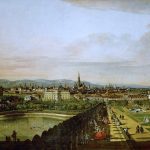
While Fischer von Erlach’s designs leaned toward classical restraint, Hildebrandt’s architecture embraced the ornamental exuberance often associated with the High Baroque. His Belvedere Palace, built as a summer residence for the military commander Prince Eugene of Savoy, fused French elegance with Viennese splendor. The palace’s cascading gardens, mirrored salons, and ornate stuccowork exemplified the synthesis of nature and artifice that defined the Baroque imagination. Today, the Belvedere houses one of Austria’s most important art collections—including Gustav Klimt’s The Kiss—but its architecture alone remains a masterclass in imperial pageantry.
Baroque aesthetics extended well beyond palaces and churches. Viennese interiors—chapels, salons, and private oratories—were adorned with illusionistic frescoes, gilded altarpieces, and rich tapestries. Ceiling paintings often employed trompe-l’œil techniques to dissolve architectural boundaries, lifting the eye toward imagined heavens. The effect was total: art that engulfed the viewer, designed to evoke emotion, devotion, and submission.
Sculpture, too, played a key role in Vienna’s Baroque vocabulary. The fountains, façade statues, and interior sculptural programs of the period often combined theatrical poses, dramatic gestures, and cascading drapery. Artists such as Georg Raphael Donner brought a refined expressiveness to marble and bronze, imbuing saints and allegorical figures with a vitality that blurred the line between human passion and divine ecstasy.
This Baroque explosion coincided with a cultural flourishing in music, theater, and philosophy. The Vienna of Maria Theresa and Charles VI was a court of enlightenment and etiquette, of composers like Haydn and Mozart, of court painters and decorative artists who participated in the elaborate rituals of aristocratic life. Art was inseparable from the political machinery of the Habsburg court—it adorned their processions, illustrated their genealogies, and decorated the theaters where dynastic mythologies were staged.
Crucially, the Baroque was not static—it adapted to local needs and evolved into the lighter, more ornamental Rococo style by the mid-18th century. But its foundations remained. Baroque art in Vienna left an indelible imprint on the city’s visual culture: the concept of Gesamtkunstwerk, or total work of art, was born here in these all-encompassing spaces of light, sound, and movement. Later artists of the Secession and beyond would resurrect this concept in new forms, but its origins lie in the stuccoed chapels and golden domes of Baroque Vienna.
Even today, to walk through Vienna’s first district is to move through a Baroque dream. The Hofburg, with its layered facades and ceremonial courtyards, still breathes imperial pomp. Churches like Peterskirche and Jesuitenkirche, rich with painted ceilings and twisting columns, continue to stage a kind of sacred theater. This is not nostalgia—it is persistence. The Baroque, in Vienna, never really ended. It became part of the city’s DNA, a deep structure that informs how space is used, how power is expressed, and how beauty is understood.
Rococo and Enlightenment Aesthetics
As the 18th century advanced, Vienna began to soften its imperial swagger. The colossal gestures of the Baroque—its soaring domes, dramatic shadows, and intense religious fervor—gave way to something more delicate, more sensual, and often more worldly. Rococo emerged not as a rejection of the Baroque, but as its evolution: a lighter, more refined mode of expression suited to a court culture increasingly focused on private pleasure, intellectual discourse, and secular sophistication.
Rococo art, with its curving lines, pastel palettes, and themes of love, leisure, and myth, found fertile ground in the palaces and salons of Vienna. While it retained the ornamental exuberance of the Baroque, it shifted the mood—from grandeur to grace, from monumentality to intimacy. This transformation mirrored a broader cultural pivot. The Enlightenment had arrived in Austria, and with it came an emphasis on reason, education, and the exploration of human nature—ideas that would subtly influence the aesthetics of the time.
The Habsburg court under Maria Theresa became both a preserver of Baroque tradition and a patron of Enlightenment refinement. While her politics were pragmatic and often conservative, she fostered an environment in which the arts flourished. Music, theater, and architecture remained central to court life, but with new undertones: elegance over excess, wit over weight.
This change in taste was nowhere more evident than in interior design. The Rococo reigned inside palaces and mansions, from the Schönbrunn Palace to aristocratic residences along the Ringstrasse’s precursor streets. Boiseries (carved wood paneling), arabesques, and ceiling frescoes featured not saints and martyrs, but frolicking cherubs, pastoral lovers, and allegories of the arts and sciences. Rooms were designed not for public display but for private amusement—intimate concerts, philosophical discussions, or card games beneath glittering chandeliers.
Viennese Rococo painting also embraced these gentler themes. Though the movement never reached the fever pitch seen in France or Bavaria, it had key proponents. Franz Anton Maulbertsch, often called the “Austrian Tiepolo,” infused his religious and allegorical scenes with a vibrant color palette and loose, painterly brushwork. His ceiling frescoes—like those in the Piaristenkirche Maria Treu—hover somewhere between heaven and theater, filled with dynamic compositions and a distinctly Rococo sense of movement and lightness.
In sculpture, artists such as Georg Raphael Donner began to blend Rococo sensuality with Enlightenment rationalism. His figures, while rooted in religious tradition, display an increasing attention to anatomical realism and emotional subtlety. His bronze fountain group at Neuer Markt, Providentia, exudes grace rather than awe—a civic monument that speaks to prosperity and harmony rather than divine wrath.
Parallel to these aesthetic changes was the rise of salon culture—spaces where the aristocracy and bourgeoisie gathered to exchange ideas, read poetry, debate philosophy, and enjoy chamber music. These salons, often hosted by educated women, became crucial incubators of Enlightenment thought in Vienna. They influenced taste and patronage, encouraging art that was not just beautiful, but intellectually stimulating.
Literature and theater, too, shaped artistic sensibilities. The works of Gotthold Ephraim Lessing, Christoph Willibald Gluck, and the young Mozart challenged traditional forms and brought new emotional depth to performance and narrative. These developments echoed in visual art, where narrative and psychological nuance began to take precedence over doctrinal clarity.
Perhaps most significantly, the Rococo era marked the beginnings of a shift in audience. Art was no longer solely for the Church or the court. An emerging middle class, enriched by trade and education, began to collect art, attend performances, and commission portraits. Vienna’s cultural production began to reflect this democratization. Portraiture became a major genre—not just for emperors and generals, but for merchants, scholars, and their families. These works often emphasized refinement, domestic virtue, and personal identity, themes that anticipated the more introspective tendencies of later Biedermeier painting.
While Rococo was, in many ways, an art of surfaces—glimmering golds, pinks, and greens, with frothy compositions—it was not without depth. In Vienna, it represented a nuanced negotiation between tradition and modernity. It retained the Catholic visual language while making room for Enlightenment ideals. It continued the imperial aesthetic while suggesting a gentler, more human-scaled world. It anticipated both the quiet interiority of 19th-century art and the radical sensuality of Klimt’s Vienna two centuries later.
By the end of the 18th century, as Neoclassicism began to rise and revolutionary rumblings echoed across Europe, the Rococo began to fade. But in Vienna, its spirit lingered in the city’s salons and concert halls, in its ornamented façades and frescoed staircases. It was not merely a style—it was a way of inhabiting the world with grace, curiosity, and aesthetic delight.
Biedermeier and the Art of Domesticity
In the years following the Napoleonic Wars, Vienna—still bruised from occupation and revolution—turned inward. The Congress of Vienna in 1815 had reasserted conservative order across Europe, and in Austria, the reign of Prince Klemens von Metternich brought not just political stability but an almost suffocating climate of censorship and restraint. Grand narratives and revolutionary dreams were discouraged. In their place emerged a new cultural focus: the home.
This pivot gave rise to the Biedermeier style, a uniquely Central European art movement that flourished roughly between 1815 and 1848. The term “Biedermeier,” originally a satirical reference to a fictitious bourgeois poet, evolved into a serious descriptor of an artistic sensibility grounded in modesty, clarity, and emotional sincerity. In Vienna, the Biedermeier period marked a withdrawal from courtly spectacle and religious drama, and a turn toward the quiet dignity of middle-class life.
At the center of this aesthetic shift was the interior—both physical and emotional. Biedermeier painters, designers, and architects celebrated the domestic sphere as a site of moral virtue, personal identity, and stability. Rooms were designed not to impress, but to comfort. Furniture was elegant yet functional, often made of light woods like cherry or birch, with clean lines and minimal ornamentation. The emphasis was on craftsmanship, simplicity, and the harmonious blending of utility and beauty.
These values translated directly into the visual arts. Ferdinand Georg Waldmüller, one of the most prominent painters of the era, captured the spirit of Biedermeier Vienna with extraordinary sensitivity. His portraits, genre scenes, and landscapes eschewed allegory and idealism in favor of realism and intimacy. In works like The Morning Hour of a Young Lady (1858), Waldmüller invites the viewer into a sunlit room where a woman sits reading, entirely absorbed in her own world. Nothing extraordinary is happening—and that is precisely the point. The beauty lies in the everyday.
Waldmüller’s portraits also reflect a growing emphasis on individual identity and psychological presence. Sitters are often shown against simple backgrounds, their expressions composed but introspective. These are not idealized figures of power or piety, but real people: merchants, musicians, housewives. They gaze out at the viewer with the quiet authority of the self-contained.
Other Biedermeier painters such as Friedrich von Amerling and Peter Fendi carried this ethos forward. Amerling’s portraits, often of aristocrats and intellectuals, struck a careful balance between elegance and realism. Fendi, meanwhile, was a master of genre painting—his scenes of children playing, families dining, and lovers exchanging glances are imbued with warmth and observational acuity. Yet even in their tenderness, these works often contain a subtle melancholy, a sense of time passing or innocence fading.
What made Biedermeier so distinctive in Vienna was its double identity: it was both an artistic style and a social mindset. It emerged in response to censorship, political conservatism, and the repression of public dissent. As a result, artists turned away from history painting and grand narratives, and toward scenes that could be interpreted as morally safe: domestic virtue, natural beauty, childhood, and family. But beneath the surface, many of these works carried emotional and philosophical depth. They were meditations on private life in a time of public constraint.
Nature also played a significant role in Biedermeier art. Landscapes became increasingly popular, often depicting the Austrian countryside with careful realism and a kind of serene detachment. These were not the sublime, stormy vistas of Romanticism, but calm, balanced views—nature as a refuge, a moral guide, and a space of quiet contemplation. Waldmüller’s plein-air technique and attention to natural light made his landscapes particularly luminous and psychologically resonant.
Vienna’s interior design during this period also reflected the Biedermeier ethos. Middle-class apartments and townhouses favored symmetry, comfort, and human scale. Color palettes were restrained, and decorative arts focused on utility and taste. This attention to interiority laid the groundwork for later movements such as the Wiener Werkstätte, which would also see the home as a site of artistic possibility.
Perhaps most tellingly, the Biedermeier period cultivated a new kind of viewer: one who looked closely, who valued restraint over spectacle, and who saw art not as a public display of power but as a mirror of personal and familial life. In this way, Biedermeier helped shape the sensibilities of Vienna itself, preparing the city for its later role as a laboratory of modernity, where interior spaces—whether domestic, psychological, or artistic—would become the stage for some of the most profound cultural experiments of the 19th and 20th centuries.
The revolution of 1848, which brought an end to Metternich’s order and signaled a new wave of liberal aspirations, would disrupt the Biedermeier calm. But its legacy endured—in the Viennese love of interiors, in the city’s attention to detail, and in its deep-seated belief that art can thrive in quiet, even constrained, circumstances.
Romanticism and National Identity
By the mid-19th century, a new mood was sweeping across Europe. The revolutions of 1848 had shaken monarchies and awakened a popular appetite for change. Though the uprising in Vienna was ultimately suppressed, it left behind a cultural undercurrent that would profoundly influence the arts. The introspective restraint of the Biedermeier era gave way to a reawakening of Romanticism—a movement that had already transformed literature and music, and was now infusing the visual arts with a renewed emphasis on emotion, the sublime, and the search for national identity.
In Vienna, Romanticism arrived somewhat cautiously, tempered by the still-powerful grip of imperial tradition and Catholic conservatism. But artists began to look beyond the bourgeois interior and into the past—toward historical episodes, legendary figures, and landscapes that could symbolize Austria’s uniqueness in an increasingly fractured Europe.
One of the central functions of Romantic art in this period was myth-making. Where Biedermeier art had focused on the present and the personal, Romantic art in Vienna reached backward, constructing a visual heritage that would give Austria—and especially the German-speaking world—a sense of continuity and grandeur. History painting experienced a revival. Artists like Leopold Kupelwieser and Moritz von Schwind began creating works that combined narrative clarity with emotional depth, drawing on medieval stories, national folklore, and chivalric ideals.
Schwind in particular played a key role in shaping the Romantic imagination of the German-speaking world. Though born in Bavaria, he spent much of his career in Vienna, where he became known for his lyrical, often whimsical illustrations of legends and fairy tales. His cycle of frescoes in the Vienna State Opera House and his paintings for the Ferdinandeum in Innsbruck offered not just decoration but cultural affirmation—images that connected modern Austrians with an imagined medieval past full of nobility, honor, and poetic sentiment.
Romanticism also reinvigorated landscape painting. While Biedermeier artists had depicted nature as calm and orderly, Romantic painters sought the dramatic, the mysterious, and the sublime. Josef Höger, Friedrich Gauermann, and later Rudolf von Alt captured the Austrian Alps, forested valleys, and ancient castles with a sense of grandeur that transcended mere topography. These landscapes were not just beautiful—they were symbolic terrains, expressions of the nation’s spirit, its depth of feeling, and its endurance.
Von Alt, though often grouped with the Realists, painted watercolors of Vienna and its surroundings with a tenderness that echoed Romantic sentiment. His attention to light, atmosphere, and aging architecture made him a chronicler of a city caught between tradition and transformation. In his views of city streets, rural churches, and noble ruins, one senses a wistful attachment to the past and an anxiety about the future.
This tension—between progress and nostalgia—was central to Viennese Romanticism. The Habsburg monarchy remained strong, but the Austro-Hungarian Empire was increasingly ethnically and culturally complex. The visual arts became a way to assert a unifying national aesthetic, even if it was largely idealized. Artists and intellectuals sought to define what it meant to be “Austrian” in visual terms: not just through images of emperors and saints, but through the romanticization of rural life, traditional costume, and regional folklore.
This cultural project extended beyond painting. In architecture, the Gothic Revival became a way to express both historical continuity and religious piety. The most prominent example in Vienna is the Votivkirche, commissioned in 1856 as a monument of thanksgiving after the attempted assassination of Emperor Franz Joseph. Designed by Heinrich von Ferstel, the church consciously evoked the medieval Gothic style, not as archaeology, but as ideology—a symbolic return to spiritual and dynastic roots at a time of social flux.
Romanticism also left its mark on decorative arts and illustration. The proliferation of illustrated books, theater programs, and popular prints brought Romantic themes to a broader public. The fascination with the Middle Ages, with rural customs, and with the sublime in nature created a shared visual vocabulary that would continue to influence Viennese culture well into the modern era.
Yet it is important to note that Romanticism in Vienna never fully embraced the radical, anti-rational edge it sometimes had elsewhere in Europe. It was more tempered, more integrated into the existing institutional frameworks of the Academy, the Church, and the monarchy. Where German or French Romanticism might revel in madness, ruin, or political defiance, Viennese Romanticism often leaned toward nostalgia, order, and sentimentality. It was less about rebellion than about emotional continuity—about finding ways to feel deeply within the bounds of empire and tradition.
Still, this reawakening of emotional depth, historical consciousness, and aesthetic ambition laid essential groundwork for what would come next. The very ideas Romanticism revived—of the artist as visionary, of art as national expression, of nature and myth as reservoirs of truth—would be turned inside out by the next generation. Schiele, Klimt, and Kokoschka would inherit this vocabulary and use it to explode the polite surfaces of Viennese culture in the early 20th century.
But that’s still to come. In the mid-19th century, Romanticism in Vienna offered a visual balm for a society in search of identity—a culture that longed to feel deeply, but without breaking the world that had been so carefully reconstructed after revolution. It was a longing that would define much of Vienna’s art for decades to come.
Academic Art and the Rise of Institutions
By the late 19th century, Vienna was at the height of its imperial confidence. The Austro-Hungarian Empire was a sprawling, multiethnic colossus, and its capital stood as a beacon of civility, science, and high culture. It was a city of opera houses and libraries, universities and imperial ministries. Art, too, was increasingly professionalized and institutionalized, centered around a rigid academic system that both cultivated and constrained artistic expression.
At the heart of this system was the Academy of Fine Arts Vienna (Akademie der bildenden Künste Wien), founded in 1692 but dramatically expanded and reorganized in the 19th century. The Academy was more than just a school—it was the gatekeeper of artistic legitimacy. Admission to its ranks was competitive, its pedagogy steeped in classical ideals, and its graduates often guaranteed access to prestigious commissions and state patronage. Its guiding principle was historicist classicism: students were trained to emulate the Old Masters, to master anatomical drawing, perspective, and composition, and to produce art that upheld academic standards of beauty, harmony, and moral instruction.
The Academy’s power was buttressed by other institutions: the Künstlerhaus, established in 1861 as a formal exhibition society; the Museum of Fine Arts (Kunsthistorisches Museum), opened in 1891 to house the Habsburgs’ imperial collections; and the Belvedere Gallery, which increasingly functioned as a repository for state-sanctioned art. These organizations formed a closed ecosystem—one that rewarded academic excellence but resisted experimentation.
Academic art in Vienna during this period was technically masterful. Painters like Hans Makart became cultural celebrities, celebrated for their opulent, theatrical canvases that merged mythological grandeur with contemporary luxury. Makart, in particular, was seen as the embodiment of the “painter-prince.” His large-scale historical paintings—such as The Entry of Charles V into Antwerp—were showcases of painterly bravado and allegorical complexity. His studio was a social salon, his style a visual shorthand for imperial decadence. He even designed pageants and interior décor, shaping Vienna’s self-image in velvet and gold.
Yet Makart’s success also revealed the limitations of academic taste. His paintings were rich, but formulaic. They appealed to courtly audiences but often lacked psychological depth. The Academy favored this kind of spectacle—art that impressed, but rarely disturbed.
Younger artists, particularly in the final decades of the century, began to feel suffocated by this world. They were trained to produce history paintings and idealized nudes, yet they were witnessing a world transformed by industrialization, urbanization, and shifting social mores. Realism and naturalism were gaining ground elsewhere in Europe, and even Impressionism was beginning to stir debate. In Vienna, however, these movements were still largely sidelined by the institutional preference for tradition.
This resistance to modernity created a quiet cultural standoff. Artists such as Eduard Charlemont, August von Pettenkofen, and Leopold Carl Müller tried to expand the subject matter of academic painting by incorporating genre scenes, Orientalist themes, and subtle realism. Their work, while still within the bounds of academic approval, hinted at a world outside the formal salon. Pettenkofen, for example, brought a lyrical sense of melancholy to his scenes of Hungarian peasant life, while Müller painted evocative views of North Africa, blending ethnographic detail with romantic allure.
Beyond painting, the academic system also shaped sculpture and architecture. Monuments, civic buildings, and decorative programs followed strict historicist guidelines. The Ringstraße, Vienna’s grand boulevard constructed in the second half of the 19th century, became a kind of open-air textbook of historicist styles: neo-Gothic for the City Hall, neo-Renaissance for the Opera, neo-Baroque for the Burgtheater. The idea was to visually represent the continuity and stability of empire, each style carefully chosen to reinforce civic or imperial identity.
Yet even in its grandeur, the academic system was creaking under its own weight. The world outside was changing faster than the Academy could absorb. Photography had emerged, challenging the very premise of mimetic art. The middle class was rising, and with it came new tastes, new markets, and new collectors who didn’t necessarily want another Roman general or Greek goddess on their wall. Psychology was shifting too—Freud’s theories, though still nascent, were beginning to frame the mind as a fragmented, subjective space. Art would need to respond.
The turning point came in the 1890s, when a group of artists—frustrated with the Academy’s conservatism and the Künstlerhaus’s monopoly on exhibitions—began to organize a revolt. Led by Gustav Klimt, they would go on to form the Vienna Secession, an act of radical institutional defiance that would transform Viennese art and propel it into the modern era.
But before that rupture, the academic tradition had laid both the groundwork and the gauntlet. It had trained generations of artists in technique and discipline, but it had also drawn tight the boundaries of acceptable taste. It had adorned the empire, but failed to reflect the anxieties of the age. And in doing so, it had created the very conditions that would lead to its own unraveling.
Vienna was a city on the brink—of modernism, of psychoanalysis, of political fracture. The next wave of artists would no longer be content with history painting and allegory. They would paint the soul, the body, the city—and they would do it in gold, blood, and abstraction.
The Vienna Secession: Revolution in Form
In the final years of the 19th century, the city of Vienna was a paradox: outwardly glittering, inwardly cracking. Its streets were grand, its institutions formidable, but beneath the polished surface of imperial culture, something restless was stirring. The rigid structures of academic art no longer satisfied a generation of young artists attuned to the psychological currents, political tensions, and aesthetic innovations sweeping across Europe. Vienna, long the stronghold of tradition, was about to become the staging ground for one of modernism’s most daring uprisings.
At the center of this transformation stood Gustav Klimt, a former darling of the academic establishment. Klimt had risen to prominence through his early allegorical and decorative work, which exemplified the grand traditions of Viennese historicism. But by the 1890s, his artistic ambitions—and those of many of his contemporaries—had outgrown the narrow confines of the Künstlerhaus and the Academy. They were no longer content to serve the tastes of the bourgeoisie or the crown. They wanted to create art that reflected modern life, inner experience, and a new visual language untethered from the rules of classical beauty.
In 1897, Klimt, along with artists Koloman Moser, Josef Hoffmann, Carl Moll, and others, formally broke away from the Künstlerhaus and established the Vienna Secession (Wiener Secession). Their motto, inscribed above the entrance of their new exhibition building designed by architect Joseph Maria Olbrich, was radical and succinct:
“Der Zeit ihre Kunst. Der Kunst ihre Freiheit.”
“To every age its art. To art its freedom.”
This was more than a slogan—it was a declaration of war against the stifling decorum of the art world, a call to liberate creativity from the twin chains of nationalism and nostalgia. The Secessionists aimed to create a new kind of art for a new era: an art that was interdisciplinary, international, and rooted in the artist’s subjective vision. They welcomed the influence of Symbolism, Art Nouveau, Japanese printmaking, and the arts and crafts movement. They rejected historical pastiche in favor of abstraction, ornament, and expressive line.
The Secession Building, with its stark white façade, golden dome of laurel leaves, and unadorned geometric form, embodied this aesthetic shift. It was like nothing else in Vienna at the time—neither Gothic, Baroque, nor Neoclassical. It was a building that spoke the language of the future. Inside, it hosted exhibitions that brought Viennese audiences into contact with international avant-gardes—Whistler, Rodin, Beardsley, and others.
Klimt quickly emerged as the movement’s public face. His “Philosophy,” “Medicine,” and “Jurisprudence” panels, commissioned for the University of Vienna, shocked audiences with their sensuality and ambiguity. Far from depicting academic virtues in the traditional allegorical style, Klimt’s works were swirling, erotic, and introspective, filled with disembodied figures, ambiguous symbols, and dark, cosmic landscapes. The academic and political backlash was intense—so much so that the works were never installed as planned. But for Klimt and his allies, this controversy only confirmed what they already knew: the old order was no longer sufficient.
Klimt’s “The Beethoven Frieze” (1902), created for the Secession’s tribute to composer Richard Wagner’s vision of a Gesamtkunstwerk (total work of art), remains a defining work of the movement. A monumental, immersive mural filled with gold leaf, mythological creatures, and abstract patterning, the Frieze portrays a spiritual and artistic journey—a quest for beauty and transcendence in a broken world. It encapsulates the Secessionist ideal: art as metaphysical experience, not just decoration or narrative.
But the Vienna Secession was never just about painting. It was a multi-disciplinary revolution. Artists like Koloman Moser and Josef Hoffmann extended Secessionist principles into design, furniture, textiles, and architecture. Their vision culminated in the founding of the Wiener Werkstätte in 1903, an applied arts collective that sought to erase the boundary between “fine” and “decorative” art. Every object—whether a teacup, a chair, or a business card—could be a work of art. This was modernism in its purest form: aesthetic totality and formal unity applied to everyday life.
The influence of the Secession was also felt in graphic design. The group’s magazine, Ver Sacrum, functioned as both manifesto and gallery, combining innovative typography with Symbolist imagery and poetic texts. It became one of the most striking examples of turn-of-the-century print culture, setting a new standard for the integration of visual and literary arts.
Despite its energy and vision, the Vienna Secession was not without internal tensions. By 1905, divisions within the group led Klimt and several others to withdraw. Some members wanted to embrace more international movements and abstract forms; others clung to a more decorative, stylistically unified vision. The split did not spell the end of the movement, but it signaled a fracturing of its utopian ideals—an acknowledgment that even artistic freedom has its limits when visions diverge.
Still, the impact of the Secession was immense. It redefined what art could be in Vienna. It forged a new relationship between art and society, between tradition and innovation. And it paved the way for the expressionism and psychological intensity of Egon Schiele, Oskar Kokoschka, and others who would soon push Viennese modernism even further into the personal, the painful, and the profound.
Today, the Secession Building still stands at the edge of Vienna’s historic center, a beacon of artistic insurrection crowned in gold. Inside, Klimt’s Beethoven Frieze still glimmers—an eternal reminder of that brief, brilliant moment when Vienna dared to break the mold.
Jugendstil and the Total Work of Art
While the Vienna Secession sparked the revolution, it was Jugendstil that carried its ideals out into the broader culture. Often equated with Art Nouveau, Jugendstil (named after the Munich magazine Die Jugend) was Vienna’s most sophisticated response to the challenges of modernity—an attempt to reconcile art, industry, and life. At its core was a radical notion: that everything, from the design of a spoon to the layout of a city block, could—and should—be art.
Jugendstil was the aesthetic flowering of the Secession’s ideological roots, but where the Secession was often symbolic and metaphysical, Jugendstil was tactile, functional, and immersive. It wasn’t about painting alone—it was about creating environments. This was the language of line, form, material, and unity. Every detail mattered, and every object could be elevated.
One of the most influential figures in this movement was Josef Hoffmann, co-founder of the Wiener Werkstätte (Vienna Workshop) alongside Koloman Moser. Established in 1903, the Werkstätte was not merely a collective—it was a design revolution. Inspired by the British Arts and Crafts movement but with a more streamlined, modernist bent, it aimed to eradicate the hierarchy between “high” art and applied design. The workshop employed artists, architects, silversmiths, ceramicists, textile designers, and more—all working collaboratively to produce objects of exceptional craftsmanship and stylistic harmony.
Their output was staggering: furniture, wallpaper, book covers, jewelry, flatware, textiles, even interiors for middle-class apartments and palaces alike. A chair designed by Hoffmann was not just a place to sit—it was a piece of sculpture. A tea set by Moser didn’t simply hold liquid—it communicated geometry, rhythm, and grace. Their work often featured clean lines, grids, and geometric abstraction, distinguishing Vienna’s Jugendstil from the more floral and organic forms found in French or Belgian Art Nouveau. Where Hector Guimard or Alphonse Mucha embraced curves and tendrils, Viennese designers favored rational elegance, bordering on early modernism.
Nowhere was this Gesamtkunstwerk philosophy more fully realized than in Hoffmann’s Palais Stoclet in Brussels (1905–1911), often considered the apotheosis of Wiener Werkstätte ideals. Commissioned by Belgian financier Adolphe Stoclet, this private mansion was entirely designed, down to the last detail, by Werkstätte artists. Klimt created friezes for the dining room, Moser contributed mosaics, Hoffmann shaped the entire architectural plan. It was the total unity of architecture, painting, sculpture, and interior design—a rare and opulent realization of the total work of art.
Meanwhile, in Vienna itself, architects such as Otto Wagner were reshaping the city’s infrastructure and aesthetic logic. Wagner had begun as a historicist, but by the turn of the century, he had become a leading advocate of modern functional architecture. His book Modern Architecture (1896) argued that form should follow function and that modern materials like glass, steel, and reinforced concrete were essential to shaping the future. He famously designed the Vienna Stadtbahn railway stations, infusing everyday public architecture with Jugendstil detailing—elegant ironwork, organic ornamentation, and clean geometry.
Wagner’s Majolica House (1898–99) remains a prime example of Viennese Jugendstil—its façade a grid of floral ceramic tiles, its balconies framed with sleek wrought iron, its structure rigorously balanced yet unmistakably decorative. Similarly, his Austrian Postal Savings Bank (1904–12) embraced minimalist lines, aluminum fixtures, and modern lighting—all while maintaining the meticulous attention to craftsmanship that defined the movement.
In all these examples, we see the push toward unity, coherence, and intentionality. Whether in a private dining room or a train platform, Jugendstil sought to elevate the visual environment to match the complexities and spiritual yearnings of modern life.
Graphic design flourished alongside these material innovations. The artists of the Werkstätte—and the broader Secessionist and Jugendstil community—helped pioneer a visual language of flattened forms, stylized typography, and asymmetrical composition that deeply influenced 20th-century design. Posters, exhibition catalogs, and stationery from this period often feel strikingly contemporary, with their sharp lines, bold color blocks, and dynamic spatial arrangements. The blending of text and image was seamless—a graphic Gesamtkunstwerk.
But for all its elegance, Jugendstil in Vienna was also under pressure. The very perfectionism that defined the Wiener Werkstätte would, in time, become its undoing. Its handcrafted objects were too expensive for the average consumer, and its rigid aesthetic philosophy left little room for mass production or improvisation. By the 1910s, the Werkstätte was already under financial strain, and its vision—once so radical—was beginning to feel overly refined in the face of growing political instability and cultural change.
Nevertheless, the legacy of Viennese Jugendstil is profound. It transformed Vienna from a seat of imperial nostalgia into a crucible of modern design. It redefined what art could be—not a separate, elevated object, but something lived with, something used. It laid the foundation for the Bauhaus, for modernist architecture, and for contemporary notions of branding, design, and spatial coherence.
Most of all, it fulfilled—if only briefly—the dream of the total work of art, in which life and aesthetics are seamlessly intertwined, where beauty is not the privilege of the elite but an ethical imperative woven into the very fabric of existence.
Expressionism and the Shadow of Modernity
By the 1910s, the Viennese dream of aesthetic unity—the total work of art envisioned by the Secession and Jugendstil—had begun to unravel. The Empire was fraying politically, socially, and spiritually. Beneath the polished veneer of Ringstraße elegance and philosophical discourse, a darker emotional current surged. It was in this space—of cultural fatigue, repressed desire, and identity crisis—that Viennese Expressionism took root.
Expressionism, as it emerged in Vienna, was not merely a style—it was a rupture. Where Jugendstil smoothed and stylized the world into perfect geometry, Expressionism tore it open. It rejected balance for chaos, harmony for distortion. In place of ornamental beauty, it offered raw emotion. The city’s cafes, once sites of polite intellectual exchange, were now incubators of radical thought, psychoanalysis, and inner turmoil. The canvas became a psychological battlefield.
Egon Schiele was its fiercest prophet. Trained at the Academy of Fine Arts under the conservative gaze of his instructors, Schiele quickly veered into territory they could neither sanction nor fully comprehend. His early works reflect Klimt’s influence—gold leaf, erotic symbolism, elongated forms—but by 1909, he had developed a visual language uniquely his own. It was anatomical, confrontational, and uncomfortably intimate.
Schiele’s figures are gaunt, contorted, and often naked. But their nudity is not celebratory—it is existential. In paintings like Self-Portrait with Raised Bare Shoulder (1912) or Seated Male Nude (Self-Portrait) (1910), he presents himself not as a hero or a dandy, but as a suffering, desiring, haunted being. The linework is jagged and expressive, the colors sickly or bloodlike. Flesh is not idealized but vulnerable, stained, and mortal. Schiele’s nudes, both male and female, embody the collapsing boundaries between eroticism, spiritual yearning, and death.
His drawings of women—often posed provocatively, sometimes disturbingly—elicited censorship and scandal. In 1912, he was even jailed on charges of obscenity (though ultimately acquitted of the most serious offenses). But for Schiele, these works were never pornographic. They were explorations of truth—brutal, erotic, psychological. His art was a mirror held up not to society, but to the self at its most unguarded.
In Oskar Kokoschka, Schiele found a fellow traveler. Kokoschka’s background was more literary—he studied at the Kunstgewerbeschule (School of Applied Arts) and wrote expressionist plays before turning fully to painting. His early works are filled with Symbolist and mythological overtones, but by the 1910s, Kokoschka had embraced an intense, psychological expressionism.
His brushwork is agitated and loose, his color palette clashing and unfiltered. In portraits like Portrait of Adolf Loos (1909) or The Bride of the Wind (1914)—his haunting, hallucinatory depiction of his tumultuous love affair with Alma Mahler—Kokoschka doesn’t aim to flatter. He dissects. Faces twist into grimaces, eyes blaze with fury or despair, and backgrounds dissolve into emotional atmospheres rather than physical spaces.
Like Schiele, Kokoschka used the body not to decorate but to narrate—to express what words could not. His works are emotional exorcisms, as influenced by Freud as they are by the Old Masters. And in this, we see the deeper context of Viennese Expressionism: the birth of the unconscious as an artistic subject.
Vienna in the early 20th century was the cradle of psychoanalysis. Freud’s ideas about repression, dreams, sexuality, and the fragmentation of the self were everywhere. Artists didn’t just read Freud—they embodied his theories in paint and ink. They abandoned realism not out of disdain for the visible world, but because it was no longer adequate to describe interior experience.
Expressionism also surfaced in sculpture and printmaking. Richard Gerstl, a tragic and lesser-known figure, painted anguished self-portraits with ghostly brushwork and vacant eyes before taking his own life in 1908 at age 25. His work prefigures Abstract Expressionism in its urgency and emotional directness. Meanwhile, artists like Albert Paris Gütersloh and Anton Kolig pushed expressionist themes into broader explorations of urban alienation, sexuality, and spiritual crisis.
Notably, this Viennese Expressionism differed from its German counterparts (like Die Brücke or Der Blaue Reiter) in tone and focus. While German expressionists often turned outward—to social critique, nature, and the metaphysical—Viennese expressionists turned inward, probing the psyche, the body, and the pathologies of bourgeois life. Their work is intensely autobiographical, even confessional.
World War I would soon shatter Vienna’s fragile cultural balance. Schiele, who had begun to receive widespread recognition, died of Spanish flu in 1918 at just 28—only days after his pregnant wife. Klimt had died earlier that year, and the empire they had both lived in was collapsing. Kokoschka survived the war but was deeply traumatized, both physically and emotionally. The fin-de-siècle dream was over, replaced by a Europe haunted by trenches, grief, and disillusionment.
But the legacy of Viennese Expressionism lived on. Its emphasis on psychological truth, its embrace of emotional intensity, and its willingness to confront taboo subjects helped shape the course of modern art—from post-war existentialism to later movements like Abstract Expressionism and Viennese Actionism. It shattered the myth of art as beauty and replaced it with a new imperative: art as revelation.
This was the shadow side of Vienna’s modernism—a vision less golden than feverish, less ornamental than obsessive. It was the moment when the city’s artists stopped trying to decorate the world, and began instead to diagnose it.
Interwar Avant-Garde and Political Unrest
The collapse of the Austro-Hungarian Empire in 1918 left Vienna a diminished capital of a much smaller republic. What had been the glittering center of a vast, multiethnic empire was now the anxious heart of a landlocked country grappling with poverty, political polarization, and the ghosts of its imperial past. In this uncertain terrain, a new generation of Viennese artists emerged—restless, experimental, and fiercely engaged with the world around them.
The interwar years were a time of artistic rupture and reinvention. The old systems—academic hierarchy, court patronage, even the established avant-gardes like the Secession—no longer held sway. The trauma of World War I had exposed the inadequacy of previous aesthetics. Beauty was no longer enough. Artists sought new forms, new materials, and new ideologies to make sense of a world fundamentally transformed.
One response was a turn toward critical realism and social commentary. Artists like Otto Rudolf Schatz and Franz Sedlacek embraced a form of magic realism or social grotesque that exposed the alienation and absurdity of urban life in the newly formed First Austrian Republic. Schatz, in particular, was associated with the Red Vienna movement—a period during which the socialist municipal government invested heavily in public housing, education, and culture. His linocuts and prints often depicted workers, tenement dwellers, and street life with expressive simplicity and political urgency.
At the same time, Vienna became a node in the international avant-garde network. The influence of Dada, Constructivism, and Surrealism was felt through traveling exhibitions, journals, and émigré artists passing through the city. Though not as dominant as in Berlin or Paris, these movements found fertile ground among Vienna’s leftist intellectuals, exiles, and radical students.
One of the most significant developments of this period was the emergence of Neue Sachlichkeit (New Objectivity), a style rooted in cold precision and social critique. Though more associated with Germany, its aesthetic—stark, clinical, and unsentimental—resonated with Viennese artists seeking to depict the contradictions of modern life. Painters like Albert Birkle and Herbert Boeckl employed a sharp, almost photographic realism to examine themes of war trauma, bureaucracy, and urban alienation.
Architecture, too, became a political and aesthetic battleground. Adolf Loos, already famous for his anti-ornamental manifesto Ornament and Crime, pushed modernist functionalism to new extremes. His buildings, with their stripped-down facades and austere interiors, offered a radical alternative to the decorative legacy of Jugendstil. Loos viewed modern architecture as a moral project—one that should reflect the rational, hygienic, and democratic needs of society.
This ethos found political support in Red Vienna’s municipal building programs, especially the design of massive public housing blocks like the Karl-Marx-Hof. These structures were not only social projects—they were visual symbols of a new socialist order. Architects such as Margarete Schütte-Lihotzky, one of the first female architects in Austria, contributed to this vision with designs like the Frankfurt Kitchen—a prototype of modern, efficient domestic space that treated the kitchen as a site of ergonomic and social reform.
Despite—or perhaps because of—its fragmentation, Vienna’s art scene in the 1920s and early 1930s pulsed with energy. Art was no longer confined to galleries or aristocratic salons; it appeared in political pamphlets, newspapers, trade union buildings, and workers’ festivals. Photography and graphic design gained prominence, as artists adapted to modern mass media and embraced typography, collage, and photomontage. Figures like Friedl Dicker-Brandeis, who studied at the Bauhaus and later taught in Vienna, brought Constructivist techniques and progressive pedagogies into Viennese classrooms and studios.
Yet this creative fervor unfolded against a backdrop of mounting political unrest. By the early 1930s, Austria was lurching toward authoritarianism. The rise of Austrofascism under Chancellor Engelbert Dollfuss, followed by the National Socialist annexation in 1938, cast a long shadow over artistic life. The cultural freedom of the interwar period began to constrict. Many artists, especially those who were Jewish, leftist, or avant-garde, were silenced, exiled, or worse.
For some, art became a mode of resistance. Posters, prints, and underground publications carried anti-fascist messages veiled in allegory or abstraction. Others turned inward, developing symbolic or abstract languages that could evade censorship while still addressing moral and existential themes.
The interwar avant-garde in Vienna was never a unified movement—it was too varied, too politicized, and too fractured by the rapid pace of historical change. But it was precisely this instability that made the period so vital. Artists were forced to grapple with a new reality in which empire was gone, ideology was contested, and the future was anything but certain.
In their experimentation, their political engagement, and their refusal to return to old certainties, these artists helped define modernism not as a style, but as a method of survival. Their work—often underrecognized—formed a crucial bridge between the gilded modernism of the Secession and the fragmented, traumatic, and urgent art that would emerge from the Second World War.
National Socialist Art Under the Occupation
When German troops marched into Vienna in March 1938 to carry out the Anschluss, the annexation of Austria into National Socialist Germany, the city’s cultural scene changed overnight. The new regime wasted no time dismantling the artistic freedoms and modernist experimentation that had flourished in the interwar years. National Socialist cultural policy demanded total conformity: art had to be “pure,” “heroic,” and “German.” Anything that did not fit this ideal was labeled Entartete Kunst—degenerate art—and was censored, destroyed, or stolen.
Vienna’s once-thriving artistic pluralism, already battered by Austrofascist repression in the early 1930s, was now subjected to full-scale ideological cleansing. Modernists, Jews, Communists, leftists, and anyone seen as politically or racially “undesirable” were targeted. The cultural apparatus that had once celebrated Klimt, Schiele, and Kokoschka was repurposed to promote romanticized rural scenes, classical nudes, and mythic Aryan imagery that reinforced National Socialist racial ideology.
Public institutions like the Künstlerhaus, the Academy of Fine Arts, and the Belvedere Gallery were purged of both artworks and curators. Private galleries were Aryanized—taken from their Jewish owners and handed over to National Socialist sympathizers or party members. The art market, particularly in Vienna, became a key site for National Socialist looting. Wealthy Jewish collectors, many of whom had assembled extraordinary holdings of modernist and classical art, were forced to sell under duress or had their collections outright confiscated.
Ferdinand Bloch-Bauer, for example, was one such collector. His wife Adele had been immortalized by Gustav Klimt in the iconic Portrait of Adele Bloch-Bauer I (1907), a glittering Secessionist masterpiece. After the Anschluss, their collection was seized, and Klimt’s painting was claimed by the Belvedere. It would take decades—and a historic legal battle by their niece Maria Altmann—for the portrait to be restituted in 2006. The case, dramatized in the film Woman in Gold, became a symbol of Vienna’s long, painful reckoning with its artistic and moral losses during the National Socialist era.
While official art was restricted to state-sanctioned styles—neoclassicism, pastoral idealism, and militarized allegory—many artists went underground. Some fled: Oskar Kokoschka, who had already left for Prague before the Anschluss, became an outspoken anti-National Socialist voice in exile, producing wartime paintings that raged against fascist brutality. Others, like Friedl Dicker-Brandeis, tried to keep modernist and Bauhaus-inspired practices alive even in the most horrific of circumstances. Deported to the Terezín (Theresienstadt) concentration camp, Dicker-Brandeis taught art to imprisoned children, encouraging them to draw their fears, dreams, and memories. These drawings—many of which survive—are among the most haunting and humanizing visual documents of the Holocaust.
Artists who remained in Vienna often faced impossible choices. Some adapted their work to survive, producing apolitical or ideologically conformist pieces. Others were silenced altogether. The painter Albert Paris Gütersloh, once a key figure in Vienna’s avant-garde, withdrew from public life. Many of his peers, especially those of Jewish descent, disappeared entirely from the city’s galleries, classrooms, and archives.
The National Socialist’s campaign against “degenerate art” was not just aesthetic—it was a weaponized erasure. Expressionism, abstraction, Surrealism, and anything influenced by psychoanalysis or Jewish culture were declared subversive. Artists like Egon Schiele—long dead by 1918—were posthumously condemned. Works by Kokoschka, Gerstl, and others were removed from collections, sold abroad, or destroyed. National Socialist curators organized “Degenerate Art” exhibitions to mock modernism, presenting mutilated and mislabeled works as symptoms of moral and racial decay.
Yet ironically, while condemning modern art in public, the regime quietly exploited it in private. National Socialist leaders—including Hermann Göring and Adolf Hitler—collected works of immense value, often stolen from Jewish owners. Vienna became a central hub in this trafficking, with complicit dealers, auction houses, and museum directors facilitating the plunder of cultural heritage.
Architecture, too, came under ideological control. Modernist design, like that promoted by Loos and the Wiener Werkstätte, was declared degenerate. In its place, monumental neoclassicism was favored—buildings designed to awe and intimidate. Urban plans envisioned a new, Aryan Vienna: sanitized of “foreign” elements, purified of modernist clutter. Thankfully, many of these visions were never fully realized.
Despite the terror, some acts of resistance persisted. Artists produced secret drawings, caricatures, and coded messages. Art students and teachers at great personal risk preserved banned works or smuggled them out. Even in hiding, art endured—not just as a form of documentation, but as a moral refusal, a quiet defiance of totalitarian control.
By the time the Red Army entered Vienna in 1945, the city’s art scene had been devastated. Hundreds of artists were dead, in exile, or lost to history. Collections had been scattered or destroyed. The avant-garde movements that once made Vienna one of the world’s cultural capitals were silenced or buried under the rubble of war.
The postwar period would require a profound reckoning—not just with the trauma of genocide and occupation, but with the complicity and silence of institutions that had once championed freedom and creativity. For decades, Austria cast itself as a “victim” of National Socialism, deflecting responsibility for its role in cultural and human atrocities. Only in recent decades has this narrative begun to shift, as museums, scholars, and families have worked to restore stolen artworks, recover lost names, and confront uncomfortable truths.
What remains from this period is both tragic and vital. It reminds us that art is not immune to ideology—that it can be both a tool of propaganda and a refuge for resistance. It shows us the cost of silence, the danger of aesthetic conformity, and the courage of those who continued to create in the face of unspeakable darkness.
Postwar Recovery and Modernism
The Vienna of 1945 was not the same city that had once nurtured Klimt, Schiele, and Kokoschka. Bombed, occupied, and morally shaken, it stood at a crossroads—not only in its politics and infrastructure, but in its cultural soul. Much of the physical damage could be repaired, but how would Vienna restore its place as a capital of artistic thought? And could it do so without returning to the aesthetic traditions that had both glorified empire and, in some cases, quietly served authoritarianism?
The postwar years in Vienna were shaped by contradiction. On the one hand, there was a desire to forget—to suppress the shame and destruction of the recent past and rebuild a stable, orderly society. On the other, there was a pressing need to confront the psychological and cultural wounds that fascism had left behind. Art in this period moved between these poles, swinging from denial to reckoning, from nostalgia to radical experimentation.
Initially, Austrian cultural institutions leaned toward reconstruction. Museums reopened, schools restructured, and traditional art education resumed. There was a renewed focus on 19th-century masters and the golden age of Austrian modernism, especially the Secessionists—seen as apolitical paragons of national style. Klimt, long viewed with suspicion during the National Socialist era, was rehabilitated as a national icon, his shimmering surfaces now stripped of their subversive psychological content and reframed as aesthetic heritage.
But for younger artists, the postwar cultural landscape felt like a vacuum. The Akademie and official galleries offered little room for innovation. The traumatic silence surrounding Austria’s role in the Holocaust and National Socialist atrocities only deepened the sense of cultural sterility. A new generation emerged that sought to break from this polite amnesia, exploring themes of memory, identity, and disfigurement in raw, confrontational ways.
One of the most distinctive and radical voices to emerge in this landscape was Friedensreich Hundertwasser (1928–2000), a painter, architect, and environmental thinker who infused postwar Austrian art with color, joy, rebellion, and ecological consciousness. His early work in the 1950s and ’60s rejected the clean lines of Bauhaus modernism in favor of curving forms, organic spirals, and radiant color fields. His paintings, often dense with symbolism, vibrant texture, and architectural motifs, evoked a world where nature and human creativity could coexist harmoniously.
Hundertwasser’s rejection of straight lines—what he famously called “the godless line”—was more than an aesthetic quirk. It was a philosophical stance against uniformity, totalitarianism, and lifeless modernism. To him, geometry represented the bureaucratic logic that had dehumanized architecture and paved the way for mass control. In contrast, his works celebrated irregularity, individuality, and the intuitive. His 1959 “Mould Manifesto Against Rationalism in Architecture” proclaimed a return to organic growth, uneven floors, and buildings shaped by human emotion rather than cold function.
Nowhere are Hundertwasser’s ideals more fully realized than in his architectural designs, most famously the Hundertwasserhaus (1983–85), an apartment complex in Vienna that stands as a surreal, eco-utopian antidote to urban monotony. With its uneven floors, forested rooftops, mosaic tiles, and asymmetrical windows, the building became a living symbol of postwar Vienna’s new creative spirit—playful, eccentric, and defiantly human.
While Hundertwasser’s colorful vision gained broad public appeal, other artists in postwar Vienna pursued more experimental or confrontational paths. Abstract expressionism and informel painting took root in the 1950s, with figures like Arnulf Rainer pushing the boundaries of gestural abstraction. Rainer’s early works layered paint obsessively, often to the point of obliteration, as if wrestling with the limits of form and meaning. His overpaintings—in which he defaced photographs, including religious imagery or portraits—suggest a deep ambivalence about the legacy of Austrian visual culture and the authority of images.
Parallel to this, Vienna saw the beginnings of what would become one of its most notorious artistic developments: Viennese Actionism. Though more fully realized in the 1960s (to be explored in the next section), its roots lie in the postwar rejection of aesthetic nicety. In performance and early conceptual art, the body became a site of truth and trauma, a canvas for unspeakable memories that painting alone could no longer carry.
Cultural institutions responded slowly to these developments. The Museum of Modern Art (MUMOK) and the Albertina began, cautiously at first, to integrate modern and contemporary works into their collections. But the true revival of Viennese modernism came not from institutions, but from artist-run spaces, underground publications, and grassroots exhibitions. A new critical culture emerged that connected Austrian artists to international conversations—from the American avant-garde to postwar European existentialism.
Vienna’s musical avant-garde, too, mirrored these shifts. Composers like György Ligeti and Friedrich Cerha introduced experimental sounds and electronic music, influenced by the rupture of tonality and the deconstruction of formal systems. The postwar era was no longer about harmony—it was about rupture, repetition, and raw sensation.
By the 1970s, Vienna was no longer recovering—it was reinventing. Hundertwasser’s global popularity, the rise of performance art, and the international recognition of Austrian abstraction signaled a new maturity. Art was no longer an instrument of empire or ideology—it had become a field of interrogation, experimentation, and healing.
And yet, the trauma lingered. Vienna’s postwar modernism, for all its optimism and innovation, never fully escaped the shadows of war and complicity. It continued to reckon—with the ghosts of its golden age, the atrocities of its recent past, and the unresolved tension between national pride and historical responsibility.
What emerged from this reckoning was an art scene that no longer took beauty or coherence for granted. Instead, it asked harder questions. It turned inward, outward, and sometimes upside down. It embraced contradiction as a core aesthetic. And in doing so, it laid the groundwork for Vienna’s contemporary art world—diverse, provocative, and deeply aware of its own complex inheritance.
Contemporary Art in Vienna
In the 21st century, Vienna is no longer just a city of Strauss waltzes and Klimt reproductions. It is a vibrant, complex, and often contradictory hub of contemporary art—a place where centuries of aesthetic tradition coexist with radical new practices. Today’s artists navigate a cultural landscape marked by a deep awareness of history, a sharp critical edge, and a hunger to redefine what art can mean in an era of global crisis and digital saturation.
The epicenter of this contemporary scene is the MuseumsQuartier, a sprawling cultural complex in the heart of the city. Built into the former imperial stables and opened in 2001, the MQ, as it’s known, houses some of Vienna’s most important modern and contemporary art institutions: MUMOK (Museum Moderner Kunst), Kunsthalle Wien, the Leopold Museum, and numerous artist studios, design spaces, and independent galleries. More than just a museum campus, the MQ functions as a public stage—a place where art spills out into courtyards, social spaces, and the city itself.
Here, Vienna’s artistic present grapples openly with its past. The Leopold Museum, for instance, continues to show the works of Egon Schiele and other early modernists, but with new contextualization: exhibits now often include historical materials related to National Socialist-era art theft, restitution efforts, and questions of cultural ownership. The museum has taken steps to confront the provenance of its collections, acknowledging Austria’s complex relationship with both art history and historical justice.
Elsewhere, Vienna’s artists have turned toward the political, the performative, and the post-digital. One of the defining features of the contemporary Viennese scene is its conceptual sharpness. Many artists here are not content to simply create images—they seek to provoke, question, and destabilize. The influence of Viennese Actionism, with its confrontational use of the body and abjection, still lingers—but now filtered through feminist, ecological, and postcolonial lenses.
A key example is Elke Krystufek, who emerged in the 1990s and has continued to challenge viewers with deeply autobiographical, explicitly sexual, and politically charged performances, videos, and installations. Her work often critiques not only the male-dominated canon of Austrian art but also the commodification of female identity. Like Valie Export before her (a pioneer of feminist performance art in Austria), Krystufek exposes how Vienna’s refined cultural heritage can be a facade masking systems of repression and exclusion.
Other contemporary artists such as Anna Jermolaewa, a Russian-born multimedia artist based in Vienna, use video, installation, and photography to explore themes of migration, surveillance, and state control. Her work draws from her own experience as a political refugee and speaks to Vienna’s changing demographics, particularly its role as a cultural crossroads for Eastern European, Balkan, and Middle Eastern communities.
At the same time, the city is home to a new generation of artists deeply invested in climate change, data politics, and digital aesthetics. Exhibitions at the Kunsthalle and independent spaces like TBA21 (Thyssen-Bornemisza Art Contemporary) and das weisse haus often center on themes like algorithmic bias, posthumanism, and ecological collapse. The influence of the global digital art movement is strong—but always inflected with Vienna’s distinctive sense of critique and irony.
Meanwhile, street art and urban interventions have grown more prominent, particularly in districts like the 7th and 15th, where young artists challenge the institutional focus of the MQ with more ephemeral, grassroots expressions. Murals, guerrilla exhibitions, and pop-up performances question who gets to speak in public space—and what counts as culture in a city so steeped in elite artistic tradition.
Vienna’s art schools remain vital engines of experimentation. The Academy of Fine Arts Vienna, once a bastion of conservative training (and infamously the institution that rejected a young Adolf Hitler), has reinvented itself as a progressive center of critical theory and post-disciplinary practice. Professors such as Marina Gržinić and Ashley Hans Scheirl guide students in media that range from AI-based installations to queer performance art, fostering a climate of intellectual rigor and political engagement.
And yet, Vienna’s identity as a “city of art” remains rooted in tension. Tourism continues to thrive on the legacy of the Secession, Klimt, and imperial splendor—feeding a cultural economy of nostalgia. But behind the souvenir shops and golden friezes, contemporary artists are reworking that legacy in deeply critical and often subversive ways. Klimt’s gilded surfaces are now sometimes referenced with irony. The motifs of Schiele—distorted bodies, interior anguish—are reclaimed and recontextualized by queer and feminist artists. Even Hundertwasser’s utopian forms are now revisited in relation to urban gentrification and sustainability politics.
Vienna’s art world today is neither unified nor easily categorized. It is a mosaic of contradictions: elite and grassroots, historical and hypermodern, institutional and insurgent. It thrives not on consensus, but on argument. That friction is, in many ways, its strength. Contemporary Viennese art does not shy away from discomfort—it embraces it as part of the city’s DNA.
In an era of rising authoritarianism, environmental anxiety, and cultural flux, Vienna’s artists ask what it means to inherit a tradition—and what it means to break it. They draw from the city’s long memory, not to preserve it, but to interrogate it, dismantle it, and rebuild it anew.
Legacy and Influence: Vienna in Global Art History
To walk through Vienna is to pass through overlapping layers of artistic history—each one distinct, yet inextricably linked. Romanesque stonework gives way to Gothic vaults, which yield to Baroque opulence, Neoclassical formality, Secessionist gold, and the fractured gestures of modernism. These are not just stylistic shifts; they are cultural tectonics. Few cities bear their aesthetic memory so visibly, so insistently.
And few cities have shaped global art history with such precision, passion, and paradox.
Vienna’s artistic legacy begins with its status as a crossroads, where Eastern and Western influences converged. In the medieval period, it became a sacred center, where ecclesiastical art grounded the city’s early identity. By the Baroque age, it had transformed into the heart of Habsburg spectacle, exporting its vision of Catholic grandeur across Europe. Through architects like Fischer von Erlach and Hildebrandt, and painters like Rottmayr, Vienna created a visual vocabulary of power—one that echoed in the palaces of Spain, Hungary, and Italy.
But it was in the 19th and early 20th centuries that Vienna made its most lasting imprint. The rise of the Vienna Secession marked a turning point in European modernism. Its founders—Klimt, Hoffmann, Moser—were not merely painters or architects; they were cultural philosophers, envisioning a society transformed through aesthetics. Their embrace of the Gesamtkunstwerk (total work of art) reverberated far beyond Vienna, influencing the Bauhaus, De Stijl, and modernist movements across Europe and America.
Even Vienna’s decorative arts—once dismissed as peripheral—were re-evaluated as essential to the history of design. The Wiener Werkstätte’s emphasis on craft, simplicity, and material integrity inspired everything from Scandinavian modernism to mid-century American interiors. Its focus on artist-led production prefigured contemporary discussions around sustainable design and anti-corporate aesthetics.
Then came Expressionism, and with it, a seismic shift. Vienna gave the world Egon Schiele and Oskar Kokoschka, whose explorations of the psyche, the body, and the fractured self anticipated postwar existentialism and even contemporary identity politics. Their visual language—unsettled, raw, emotionally exposed—still resonates today in contemporary art, particularly in performance, queer theory, and body politics.
And beneath all of this lay the Freudian revolution. While Sigmund Freud was not a visual artist, his ideas reshaped the intellectual terrain in which art was made and understood. The unconscious, repression, trauma, and desire became new subjects, not just of therapy, but of artistic inquiry. Modern art in the 20th century—particularly Surrealism, Abstract Expressionism, and performance art—owes an unspoken debt to Freud’s Vienna.
But Vienna’s impact is not just historical—it’s ethical. The city’s postwar reckoning with art theft, cultural erasure, and complicity in fascism has made it a central site in the ongoing global dialogue about restitution, provenance, and the politics of memory. The fight over Klimt’s Portrait of Adele Bloch-Bauer, for example, raised questions not only about stolen art, but about who gets to own beauty—and at what cost.
In the contemporary era, Vienna continues to influence through both legacy and resistance. It teaches that cultural heritage is not static, but alive—something to be examined, challenged, and reimagined. Artists working in Vienna today do not merely inherit Klimt’s gold or Schiele’s lines; they interrogate them, just as the Secessionists once interrogated academic art, and Hundertwasser interrogated functionalism.
Vienna’s influence, then, is not a straight line—it’s a spiral: recurring, evolving, folding back into itself. It is the embodiment of the Gesamtkunstwerk not just as a stylistic goal, but as a historical process. Each generation responds to the one before, breaking away, looping back, building new forms from old contradictions.
To study the art of Vienna is to study a city constantly negotiating the tension between order and chaos, tradition and rebellion, ornament and essence. It is to trace the long arc of European culture—from empire to exile, from monument to manifesto.
In the end, Vienna’s legacy is not confined to its museums or palaces. It lives on in every conversation about what art is for, how it should be made, who it serves, and what it remembers. It lives on in every artist who dares to imagine the world differently—and dares, too, to confront the past that brought us here.