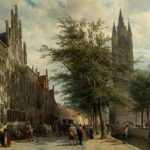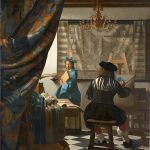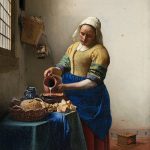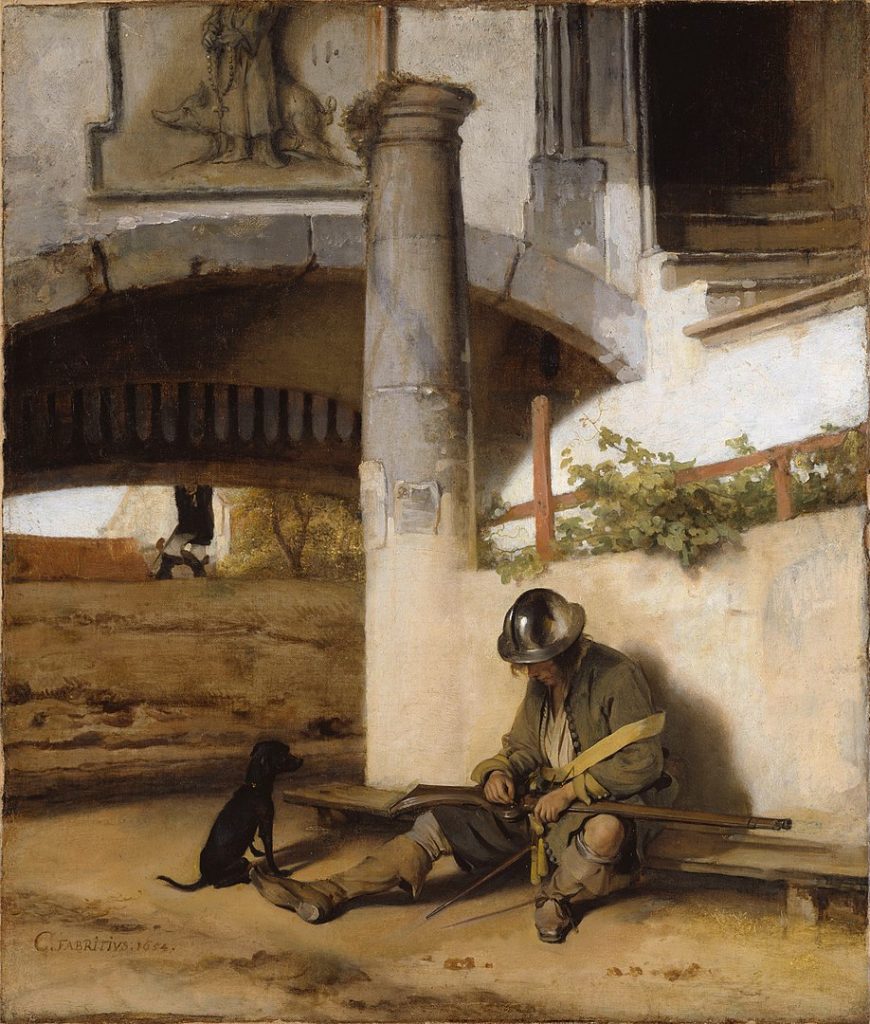
The Delft School refers to a group of Dutch painters active in the city of Delft during the 17th century, a time known as the Dutch Golden Age. These artists focused on realistic depictions of domestic life, intricate use of light, and masterful perspective, setting them apart from other Dutch painters of the time. Unlike the grand religious or historical themes seen in Southern European art, the Delft School emphasized serene interior scenes, quiet courtyards, and everyday moments that resonated with the growing Dutch middle class. This movement flourished during a period of economic prosperity when Delft became an important hub for trade, science, and the arts.
The most well-known artist associated with the Delft School is Johannes Vermeer, often celebrated as the “Master of Light” for his exceptional use of color and luminosity. However, he was not alone in shaping this movement. Pieter de Hooch, known for his meticulous perspective and architectural precision, was another leading figure. Additionally, Carel Fabritius, a student of Rembrandt, played a crucial role in bridging the dramatic lighting of Rembrandt’s style with the refined, delicate atmosphere later seen in Vermeer’s works. These painters contributed to a unique artistic identity that remains influential today.
The Delft School was shaped by its historical and cultural context, particularly the Protestant Reformation, which shifted artistic preferences away from religious iconography toward more secular subjects. With the rising prosperity of the Dutch Republic, art patrons increasingly sought paintings that reflected their daily lives, their homes, and their values. This demand encouraged Delft painters to develop a quiet, contemplative style that captured the essence of 17th-century Dutch life with remarkable precision. Their works were often small in scale but rich in symbolism, atmosphere, and technical mastery, making them some of the most admired paintings of the era.
Though the Delft School declined toward the end of the 17th century, its impact on Western art and realism has endured for centuries. Vermeer, once relatively unknown, became widely recognized in the 19th and 20th centuries as one of the greatest painters of all time. Today, Delft School masterpieces can be found in some of the most prestigious museums in the world, including the Mauritshuis, the Rijksmuseum, and the Louvre. The movement’s legacy of light, perspective, and realism continues to inspire contemporary artists and art lovers alike.
The Birth of the Delft School and Its Historical Context
The Delft School emerged in the mid-17th century, coinciding with the height of the Dutch Golden Age, a period of immense prosperity and cultural development in the Dutch Republic. Delft, a city known for its thriving trade, military significance, and renowned Delftware pottery, became an artistic center where painters experimented with light, perspective, and realism. The rise of Protestantism significantly influenced Dutch art, leading to a decline in large-scale religious commissions and an increased focus on everyday life. This shift encouraged artists to depict secular scenes, intimate domestic settings, and tranquil cityscapes, catering to the tastes of the growing middle class.
Unlike the grandeur of Baroque art seen in Catholic Europe, Delft painters sought to create subtle, introspective works that captured the quiet beauty of daily existence. The middle-class patrons of Delft preferred paintings that depicted scenes they could relate to—women reading letters, men engaged in trade, children playing in sunlit courtyards. These paintings reflected a sense of order, morality, and stability, all of which were deeply valued in Dutch society at the time. With the expansion of the Dutch East India Company (VOC), merchants and traders amassed wealth, allowing them to purchase artworks that celebrated their homes, families, and civic pride.
One of the key factors that contributed to the rise of the Delft School was the Guild of Saint Luke, the city’s primary artistic institution. Founded in 1611, the guild played a vital role in training young artists, regulating the art market, and ensuring high-quality standards among painters. Many Delft School artists, including Pieter de Hooch and Vermeer, were members of the guild, which provided them with valuable networking opportunities and commissions. The guild also connected painters with wealthy patrons who sought to invest in art that reflected their prosperity and refined tastes.
The Delft gunpowder explosion of 1654 had a significant impact on the city’s artistic community. This catastrophic event, which destroyed a large portion of Delft and killed hundreds—including the talented Carel Fabritius—temporarily disrupted artistic production. However, it also led to a rebuilding effort that created new artistic opportunities, as wealthy citizens sought paintings to adorn their newly constructed homes. The Delft School’s serene and meticulously composed works provided an aesthetic contrast to the chaos of the disaster, reinforcing the Dutch values of resilience and order.
Johannes Vermeer: The Master of Light
Born in Delft in 1632, Johannes Vermeer was one of the most remarkable painters of the Dutch Golden Age. His father, Reynier Jansz, was an art dealer and silk merchant, which likely exposed Vermeer to fine art from an early age. Little is known about his formal training, but scholars speculate that he may have studied under Carel Fabritius or was influenced by the Utrecht Caravaggisti, a group of Dutch artists who adapted Caravaggio’s dramatic use of light. By the time Vermeer joined the Guild of Saint Luke in 1653, he had begun developing a distinct style that emphasized soft, diffused light and unparalleled precision in his compositions.
Vermeer’s paintings often depict quiet, intimate moments in domestic settings, capturing a sense of stillness and contemplation. His subjects—usually women engaged in daily activities like pouring milk, writing letters, or playing instruments—exude an air of grace and introspection. He mastered the technique of optical realism, using delicate glazes and fine brushwork to create luminosity and texture. His ability to capture the effects of light on surfaces—whether the glow of sunlight on a wall or the reflection in a glass of wine—set him apart from his contemporaries.
Among his most famous works is Girl with a Pearl Earring (1665), often called the “Mona Lisa of the North.” This striking portrait features a young girl in a blue and gold turban, her lips slightly parted, and her gaze directed at the viewer. The painting’s simplicity, coupled with its remarkable use of chiaroscuro (light and shadow), has made it one of the most beloved paintings in the world. Other notable works include The Milkmaid (1658), which showcases his talent for depicting textures and natural light, and View of Delft (1660), a rare cityscape that captures the tranquil beauty of Vermeer’s hometown.
Despite his artistic genius, Vermeer struggled financially for much of his life. Unlike Rembrandt, who enjoyed widespread fame, Vermeer produced fewer than 40 known paintings, limiting his commercial success. Following his death in 1675, he fell into obscurity for nearly two centuries, only to be rediscovered in the 19th century by art historian Thoré-Bürger. Today, Vermeer is celebrated as one of the greatest painters of all time, with his works housed in prestigious collections, including the Mauritshuis in The Hague and the Louvre in Paris.
Pieter de Hooch: Architect of Space and Perspective
Born in Rotterdam in 1629, Pieter de Hooch was another significant figure of the Delft School, known for his masterful use of perspective, architecture, and light. He was the son of a bricklayer, which may have influenced his keen attention to geometric precision and spatial depth in his paintings. De Hooch trained as an artist in Haarlem, where he was apprenticed to Nicholas Berchem, a painter known for landscapes and Italianate scenes. By 1655, de Hooch had moved to Delft, where he joined the Guild of Saint Luke and became part of the thriving artistic community that included Vermeer.
De Hooch specialized in intimate domestic interiors and courtyard scenes, often featuring figures engaged in quiet, everyday activities. His paintings are notable for their exquisite use of perspective, guiding the viewer’s eye through carefully arranged doorways, windows, and passageways. He often depicted women engaged in household tasks, children playing in courtyards, or families gathered in sunlit rooms. Unlike Vermeer, who focused on soft atmospheric effects, de Hooch emphasized architectural structure and spatial organization, making his compositions feel orderly and harmonious.
One of his most famous works, Courtyard of a House in Delft (1658), showcases his ability to capture warm natural light and intricate brickwork, adding depth and realism to the scene. Another masterpiece, A Woman Peeling Apples (1663), highlights his talent for creating a sense of calm domesticity, with the figures bathed in gentle sunlight. De Hooch was particularly skilled at rendering textured surfaces, from the roughness of bricks to the smoothness of tiled floors, giving his paintings a remarkably tactile quality. His work often carried symbolic undertones, subtly reinforcing themes of domestic virtue and moral order.
Despite his artistic success, de Hooch’s later years were marked by tragedy. By the 1670s, his style became less refined, likely due to financial struggles and personal difficulties. Around 1684, he moved to Amsterdam, where he spent his final years in poverty and obscurity. He died shortly after, leaving behind a remarkable legacy of perspective, light, and domestic tranquility. Today, his works are housed in prestigious institutions, including the Rijksmuseum in Amsterdam and the National Gallery in London, where they continue to be admired for their technical brilliance and serene beauty.
Carel Fabritius: The Bridge Between Rembrandt and Vermeer
Born in 1622 in Middenbeemster, Carel Fabritius was one of the most talented and tragic figures of the Delft School. He originally trained as a carpenter before pursuing painting under Rembrandt van Rijn in Amsterdam, where he became one of the master’s most promising students. Unlike many of Rembrandt’s other pupils, Fabritius did not simply imitate his teacher’s style; instead, he developed a more delicate and luminous approach, setting the stage for the softer, more atmospheric qualities later seen in Vermeer’s work. Around 1650, he moved to Delft, where he became a key figure in the city’s artistic scene, bringing Rembrandt’s dramatic lighting techniques into a more refined and subtle form.
Fabritius was known for his innovative use of perspective and light, often creating compositions that experimented with illusionistic depth. Unlike Vermeer and de Hooch, whose works primarily depicted domestic interiors, Fabritius painted more varied subjects, including cityscapes, religious themes, and portraits. His most famous work, The Goldfinch (1654), is a small but exquisite painting of a chained bird, painted with a remarkable sense of texture and light. This piece has since become one of the most beloved paintings of the Dutch Golden Age, especially after its renewed fame following the publication of Donna Tartt’s Pulitzer Prize-winning novel, The Goldfinch in 2013.
Tragically, Fabritius’s career was cut short by the Delft gunpowder explosion on October 12, 1654, a disaster that devastated much of the city. The explosion killed hundreds, destroyed numerous buildings, and wiped out most of Fabritius’s paintings, leaving only a handful of his works surviving today. It is believed that Vermeer may have been influenced by Fabritius’s soft handling of light and space, inheriting some of his mentor’s artistic innovations. If Fabritius had lived longer, he might have become one of the greatest painters of his generation, bridging the gap between Rembrandt’s dramatic chiaroscuro and Vermeer’s introspective luminosity.
Despite his short-lived career, Fabritius’s impact on Dutch art remains significant. His ability to merge realism with atmospheric effects laid the foundation for many of Vermeer’s later masterpieces. Today, his surviving paintings, including The Goldfinch, can be seen in the Mauritshuis in The Hague and the National Gallery in London, where they continue to captivate audiences with their delicate beauty and masterful technique.
Key Themes and Techniques of the Delft School
The Delft School is distinguished by its mastery of light, perspective, and realism, creating a unique artistic identity that set it apart from other Dutch painters of the 17th century. One of the defining characteristics of Delft School paintings is the careful manipulation of natural light, which softly illuminates figures, interiors, and objects. Unlike the bold contrasts seen in Rembrandt’s dramatic chiaroscuro, Delft artists preferred subtle, diffused lighting, giving their scenes an air of tranquility. The interplay of sunlight filtering through windows, casting delicate shadows on tiled floors, creates a sense of depth and atmosphere that draws the viewer into the painting.
Another key feature of the Delft School is its focus on domestic life and everyday activities. Unlike the historical or religious themes dominant in Southern European art, Delft painters captured ordinary moments, such as a woman reading a letter, a servant pouring milk, or children playing in a courtyard. These seemingly mundane scenes were rich with symbolism, often conveying themes of virtue, morality, or the fleeting nature of time. Many of Vermeer’s paintings, for instance, feature maps, letters, or pearls, each carrying a deeper meaning related to knowledge, communication, or wealth.
The use of perspective and spatial arrangement was another hallmark of the Delft School. Painters like Pieter de Hooch excelled in creating precisely structured interiors, with open doors and passageways leading the eye deeper into the composition. This careful arrangement of space enhanced the sense of realism and three-dimensionality, making viewers feel as though they were looking into a real home or courtyard. Even in Vermeer’s paintings, where figures are often seen in isolated moments, the placement of windows, furniture, and objects is meticulously calculated to create balance and harmony.
Finally, the Delft School was known for its meticulous attention to detail, especially in the rendering of textures and surfaces. Every element in a Delft painting, from the gleam of a silver goblet to the softness of a lace collar, was painted with astonishing precision. This technical mastery, combined with subtle color gradations and carefully observed light effects, gave Delft paintings an almost photographic quality, making them some of the most admired works in art history.
Key Takeaways
- The Delft School was a 17th-century Dutch art movement known for realism and light mastery.
- Johannes Vermeer, Pieter de Hooch, and Carel Fabritius were key figures of this artistic style.
- Their paintings focused on domestic life, quiet interiors, and precise perspective.
- The Delft School’s influence declined in the late 17th century but remains highly revered today.
- Museums like the Mauritshuis and Rijksmuseum house Delft School masterpieces.
FAQs
- What defines the Delft School? – A focus on light, realism, and domestic scenes, popular during the Dutch Golden Age.
- Who was the most famous Delft School painter? – Johannes Vermeer, known for Girl with a Pearl Earring.
- Why did the Delft School decline? – The rise of Baroque styles and shifting artistic tastes led to its decline.
- What was the Delft gunpowder explosion? – A 1654 disaster that killed Carel Fabritius and damaged Delft’s art community.
- Where can I see Delft School paintings? – Museums like the Mauritshuis, Rijksmuseum, and The Louvre.