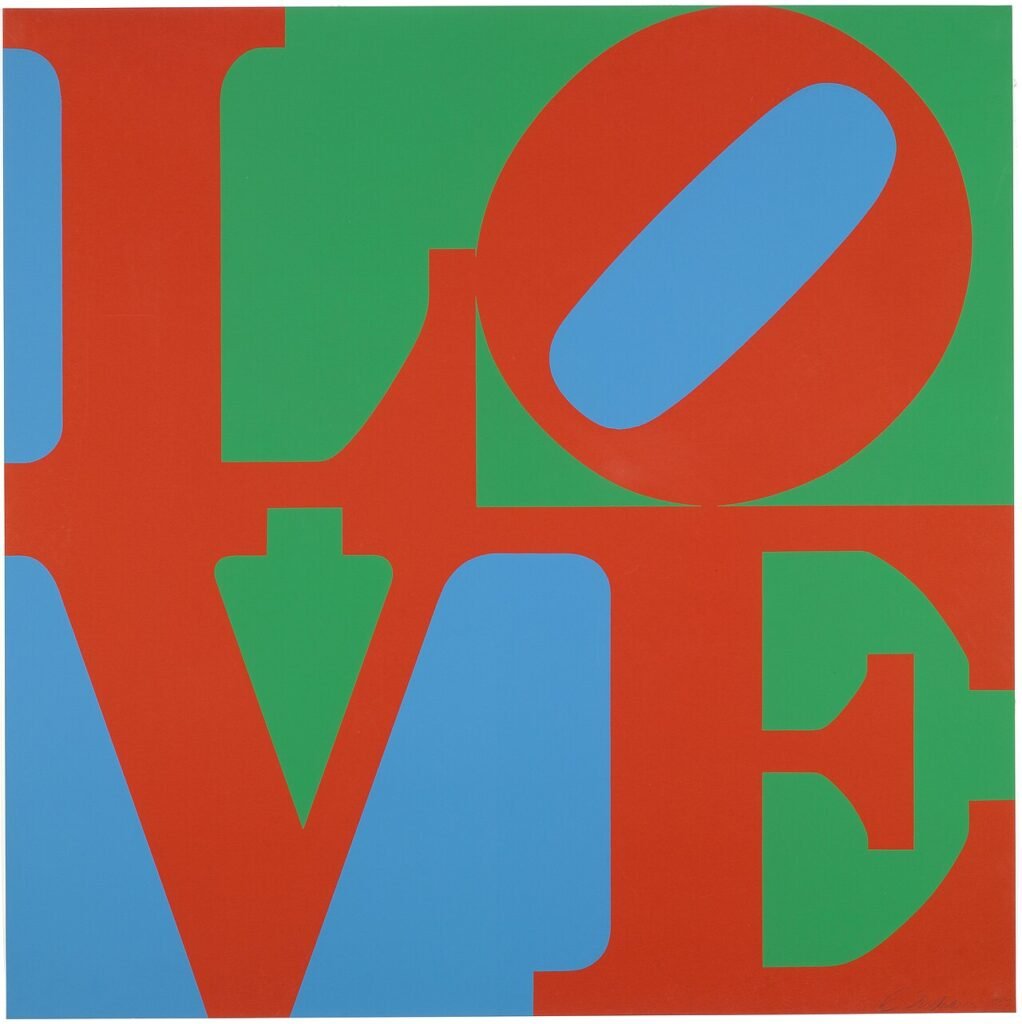
Artists are supposed to want immortality. The trouble begins when one image becomes immortal before they do. Not everyone here literally said, “I regret my masterpiece.” The more interesting story is broader: artists who destroyed important work, resented the image that defined them, rejected what audiences saw in it, or deliberately attacked their own success. Their reactions reveal something uncomfortable about making memorable art: once a work becomes famous, the artist doesn’t entirely own it anymore.
1. Robert Indiana — One Perfect Image Can Swallow Everything Else
Robert Indiana’s LOVE is almost absurdly efficient: four letters, two rows, one tilted O. It migrated from a 1964 Christmas-card design for the Museum of Modern Art into paintings, sculptures, prints, a U.S. postage stamp and endless reproductions. The Whitney later noted that the image’s proliferation—particularly on unauthorized products—eventually “eclipsed” public understanding of the rest of his art.
That’s the darker side of developing a signature. Indiana had built a much richer vocabulary from numbers, signs, language, American identity and personal history, yet one configuration became shorthand for the entire artist.
When you discover an image people immediately recognize as yours, keep developing the ideas around it before the recognizable image becomes a cage.
2. Georgia O’Keeffe — People May See Something You Never Put There
Georgia O’Keeffe’s enormous flowers are among the most recognizable paintings of American modernism. They also attracted persistent sexual interpretations. O’Keeffe strongly resisted the idea that these readings represented what she herself was painting; the Georgia O’Keeffe Museum notes that she bristled at viewers attaching their own associations to her flowers.
The revealing part is that she couldn’t simply correct the interpretation. Once critics had established the erotic reading, it became remarkably durable. Her intentions and the public meaning of the paintings became two different things.
When viewers find a meaning in your work that you didn’t intend, decide whether it actually damages the work before changing the work merely to control the interpretation.
3. Claude Monet — Being Famous Doesn’t Stop You From Thinking a Painting Is Bad
Monet was a ruthless editor of his own work. During the long development of his late garden and water-lily paintings at Giverny, he repeatedly reworked canvases and destroyed pictures he considered unsuccessful. His famous series can look effortless in museums today, but that serenity came out of an unusually severe process of selection.
This changes how you look at repetition in Monet. Painting the same pond, haystack or cathedral wasn’t simply producing variations for a market. Repetition gave him alternatives. He could compare canvases, discover which solution worked and reject the ones that didn’t.
Instead of forcing every promising attempt to become a finished piece, make enough variations that you can afford to discard the weaker solution.
4. Francis Bacon — Destruction Was Part of the Editing Process
Francis Bacon regularly destroyed paintings. He slashed canvases, cut sections out of them and abandoned works that failed his standards. After his death, unfinished and damaged canvases found in his studio made the extent of this practice especially visible.
That ruthlessness makes sense when you look at Bacon’s finished paintings. They often feel spontaneous—faces smeared, bodies distorted, paint dragged across the surface—but spontaneity wasn’t the same thing as accepting whatever happened. Chance produced possibilities; Bacon still decided which accidents deserved to survive.
If accident plays an important role in your process, be just as demanding about selection as you are permissive about experimentation.
5. Michelangelo — He Didn’t Want You to See How He Got There
Near the end of Michelangelo’s life, drawings were deliberately burned. The destruction wasn’t an isolated rumor: surviving documents indicate that he had ordered drawings burned on earlier occasions too. Vasari interpreted this as Michelangelo’s attempt to prevent people from seeing the labor and experimentation behind his seemingly perfect achievements.
It’s a fascinating form of artistic image control. Michelangelo understood that sketches reveal hesitation: repeated contours, discarded poses, corrections and failed solutions. The finished masterpiece says genius; the working drawing says revision.
Today we usually value the opposite. Process can be useful, but displaying every stage of it can also dilute the force of the finished thing.
Don’t assume your audience needs access to every sketch, draft and experiment; sometimes hiding the scaffolding makes the finished work stronger.
6. John Baldessari — Sometimes You Have to Destroy the Artist You Used to Be
In 1970, John Baldessari took paintings he had made between 1953 and 1966 to a crematorium and had them burned. He called the project Cremation Project. Some of the ashes were placed in an urn; some were baked into cookies.
This wasn’t an artist accidentally losing his early work. It was a deliberate break with it. Baldessari was moving away from conventional painting toward the conceptual combination of photographs, language, appropriation and visual jokes for which he became known.
There’s a practical lesson hidden inside the theatrical gesture: previous competence can become an obligation. Once you’re good at making one kind of thing, abandoning it can feel irrational—even when it is preventing the next kind of work.
If your older style is still producing competent work but no longer producing discoveries, try removing its favorite materials or methods from your next project.
7. Gerhard Richter — An Artist’s Archive Is Also an Argument
Gerhard Richter has destroyed paintings throughout his career, including works that had already consumed considerable time and effort. This matters because Richter is also unusually systematic about cataloguing his accepted paintings.
Destruction therefore becomes more than dissatisfaction. It affects what future viewers are allowed to call “the work.” We tend to imagine an artist’s career as everything they produced, but major artists often shape that career retrospectively through destruction, exclusion, repainting and refusal.
The larger principle is useful even if you never burn a canvas. Your portfolio isn’t a storage unit. It’s an argument about what you think matters.
Remove work from your portfolio when it weakens the idea of what you do, even if the individual piece took a long time to make.
8. Banksy — Destroying the Masterpiece Can Make It More Valuable
Banksy produced one of the strangest reversals in recent art history in 2018. Seconds after a version of Girl with Balloon sold at Sotheby’s, a shredder concealed inside its frame activated. Banksy later indicated that the intention had been to destroy the entire image, but the mechanism stopped halfway. The altered work became Love Is in the Bin.
The stunt was especially sharp because Banksy has expressed discomfort with graffiti being absorbed into the commercial art system. But the attempted destruction produced a spectacular contradiction: attacking the commodity created an even more desirable commodity. Love Is in the Bin subsequently sold for £18.582 million in 2021.
You cannot always control whether rebellion itself becomes a style, a brand or something somebody wants to buy.
When making work that criticizes a system, ask whether the form of the work actually escapes that system or merely gives it something new to sell.
9. The Real Secret — A Masterpiece Belongs to Its Audience Too
Put these artists together and an odd pattern appears. O’Keeffe couldn’t completely control what people saw in her flowers. Indiana couldn’t control the proliferation of LOVE. Michelangelo tried to control what posterity saw of his process. Bacon and Richter controlled their legacies by destroying work. Banksy tried to destroy a famous image and accidentally created an even more valuable one.
That may be the real price of making an image that sticks. Before success, the artist controls most of the decisions. After success, museums, critics, collectors, reproduction, parody, money and memory begin making decisions too.
The artist can make the object. The artist cannot completely determine what the culture eventually does with it.
Make the work as precisely as you can, but don’t confuse control over the making with control over what the finished work will eventually mean to other people.
The strange thing about these stories is that destruction, frustration and rejection don’t necessarily diminish the work. Sometimes they explain why the work was powerful in the first place. Great artists aren’t always the best guardians of their greatest hits—and occasionally their urge to escape them is exactly what pushes the next work forward.