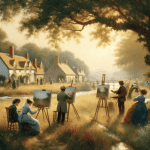
Long before creative retreats became a business model, artists were already escaping cities, renting cheap rooms, sharing meals, arguing about aesthetics, and turning overlooked places into temporary centers of culture.
Many famous movements grew partly from these communities. But the more interesting lessons may come from the colonies that faded, fragmented, or simply stopped attracting attention. Their histories suggest that creative environments are often built from surprisingly ordinary ingredients: affordable space, unusual neighbors, landscape, repetition, and enough distance from the cultural center to experiment.
1. Cheap Space Was Often More Important Than Beautiful Scenery
Many art colonies are remembered through romantic images of cliffs, forests, fishing villages, or picturesque old houses. But economics frequently mattered just as much.
Artists gathered in places such as Newlyn in Cornwall and Provincetown on Cape Cod partly because these communities offered working space and relatively inexpensive living compared with major cultural capitals. Affordability bought artists something aesthetically valuable: time. A painter who could stretch a small amount of money further could stay longer, make more work, and tolerate more experiments that failed.
When choosing where to do creative work, calculate how much uninterrupted time a place buys you, not simply how inspiring it looks.
2. Isolation Worked Best When It Wasn’t Complete
The classic image of the artist colony suggests escape: leave the city, disappear into nature, and make masterpieces in solitude. Historically, the arrangement was usually more complicated.
Successful colonies often combined distance with connection. Artists could withdraw from urban routines while remaining connected to dealers, exhibitions, patrons, schools, railways, or seasonal visitors. Provincetown, for example, was geographically removed from New York’s daily pressures while remaining deeply connected to its artistic networks.
Look for environments that remove everyday distractions without cutting you off from the people and institutions that can eventually help your work circulate.
3. Artists Didn’t Just Find Subjects — They Found Each Other
An artist might initially travel somewhere because of its landscape, architecture, climate, or light. But once several artists arrived, other artists had a completely different reason to follow: the artists already there.
That feedback loop helped turn destinations into colonies. Informal conversations, studio visits, friendships, rivalries, teaching, and shared meals could become as important as the original scenery. The colony itself became creative infrastructure.
If you are choosing between working alone in the perfect setting and working near a few people whose judgment you respect, don’t underestimate the creative value of the people.
4. Local Life Could Become Raw Material — and a Source of Tension
Artists arriving in fishing villages, rural communities, or Indigenous regions frequently treated local people, clothing, occupations, buildings, and customs as artistic subjects. That produced important work, but it could also create an uncomfortable relationship between visitor and resident.
Artists might romanticize lives they did not actually share. A working fishing community could become “picturesque” through a painter’s eyes precisely because the painter did not have to depend on fishing for survival. Looking at colony art this way reveals a useful contradiction: aesthetic distance can sharpen observation while also distorting it.
When borrowing material from a community or culture outside your own experience, ask what your position allows you to notice — and what it might be causing you to misunderstand.
5. The Same Place Could Produce Completely Different Art
An art colony did not necessarily create a unified style. Put ten artists in front of the same harbor and you could get ten different harbors.
That matters because we often assume that originality requires finding untouched subject matter. Art colonies demonstrate almost the opposite. Artists repeatedly painted the same coastlines, streets, people, buildings, and weather while producing distinctly different interpretations. The variable wasn’t always the subject; it was the decisions made about the subject.
Instead of constantly searching for something nobody has depicted before, try working from a familiar subject and make your choices of scale, framing, color, omission, and emphasis do the differentiating.
6. Teachers Could Quietly Create Entire Creative Ecosystems
Some colonies became influential because a respected artist or teacher attracted students. One person established a studio or summer school; students arrived; other artists followed; exhibitions appeared; and eventually a place acquired an artistic reputation.
This is particularly visible in places such as Provincetown, where Charles Webster Hawthorne founded the Cape Cod School of Art in 1899. The lesson is that creative scenes don’t always begin with manifestos or institutions. Sometimes they begin with one person consistently gathering other people around serious work.
If your local creative scene feels nonexistent, start smaller than an organization: establish one recurring critique, workshop, studio afternoon, or working session that gives good people a reason to keep returning.
7. Temporary Communities Could Be More Productive Than Permanent Ones
Many colony experiences were seasonal. Artists arrived for summer, worked intensely, socialized, exchanged ideas, and then returned to their ordinary lives.
That temporary quality may have been an advantage. A limited stay creates urgency. It also allows people to enter a different rhythm without pretending that the alternative life must last forever. Interpretation rather than documented rule: part of the creative power of some colonies may have come precisely from knowing that the experience would end.
Give an experiment a defined season — a week, a month, or a summer — rather than demanding that every promising change become your permanent way of working.
8. Success Could Destroy What Made a Colony Attractive
There is an irony running through the history of creative districts and colonies: artists help make an overlooked place culturally desirable, and that desirability can eventually make the place less accessible to artists.
Tourism grows. Property becomes more valuable. Wealthier visitors arrive. Studios become expensive. The informal, inexpensive conditions that allowed experimentation gradually disappear. Versions of this cycle have occurred far beyond traditional art colonies, from bohemian neighborhoods to contemporary creative districts.
When you discover a productive environment, identify the practical conditions making it work — cost, community, space, quiet, proximity — so you can reproduce those conditions elsewhere if the location itself changes.
9. A Colony’s Greatest Work Might Have Been the Colony
Museums naturally preserve paintings, photographs, sculptures, and objects. They have a harder time preserving a conversation over dinner, an introduction between two artists, an informal critique, or the confidence someone gained after seeing another person’s unfinished work.
That means the influence of a forgotten colony can be larger than its surviving masterpieces suggest. Creative communities transmit methods, relationships, ambitions, and permissions. Their most important product may sometimes have been the network of people who passed through them.
Don’t judge a creative gathering only by what gets finished there; pay attention to the relationships, methods, and unfinished ideas that participants carry into whatever they make next.
Forgotten art colonies challenge the romantic idea that creativity simply appears wherever talented individuals happen to live. Places matter, but so do rent, transportation, teachers, friendships, outsiders, deadlines, meals, arguments, and access to a spare room.
Perhaps that is their most useful secret: you don’t necessarily need to find the next legendary art colony. You can borrow the conditions that made the old ones work.