Artists have a remarkable talent for falling in love with people who are unavailable, destructive, married, manipulative, incompatible—or simply terrible for them.
Of course, calling someone the “wrong person” is partly interpretation, and history rarely gives us a clean villain. But these nine relationships brought obsession, betrayal, rivalry, heartbreak, or impossible choices into artists’ lives—and sometimes directly into their work.
1. Camille Claudel — Auguste Rodin
Camille Claudel met Auguste Rodin while she was still a young sculptor. She became his student, assistant, collaborator, model, and lover. There was one enormous complication: Rodin remained attached to Rose Beuret, the woman who had been his companion long before Claudel arrived and whom he eventually married.
Claudel wanted an artistic identity of her own, but her relationship with the already-famous Rodin made that increasingly difficult. Her sculpture The Age of Maturity has often been interpreted autobiographically as a man being pulled away from a pleading younger woman, although reducing Claudel’s complex work entirely to her romance with Rodin does her a disservice.
When a relationship gives you access to someone else’s world but makes your own identity harder to see, protect the work, friendships, money, and ambitions that remain unmistakably yours.
2. Frida Kahlo — Diego Rivera
Frida Kahlo married Diego Rivera in 1929. She was 22; he was 42. Their marriage included affairs on both sides, divorce, remarriage, and enough emotional turbulence to fill several biographies.
One betrayal was particularly brutal: Rivera had an affair with Kahlo’s younger sister Cristina. Kahlo and Rivera divorced in 1939 and remarried the following year. Yet Rivera was also one of the central intellectual and artistic relationships of Kahlo’s life, which is exactly what makes the story complicated.
Love and compatibility are not the same thing.
When intensity keeps persuading you that a relationship must therefore be good, judge it by the repeated pattern of behavior rather than the strength of the feeling.
3. Edvard Munch — Tulla Larsen
Edvard Munch’s relationship with Mathilde “Tulla” Larsen became one of the most turbulent romances of his life. Larsen wanted marriage; Munch was deeply resistant to it and feared that domestic life would interfere with his art.
Their relationship deteriorated spectacularly. During a confrontation in 1902 involving a pistol, a shot was fired and Munch injured a finger. The precise sequence of events has been recounted differently, so the safest historical conclusion is simply that the relationship ended amid an extraordinary and violent incident.
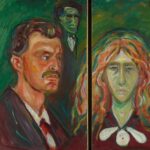
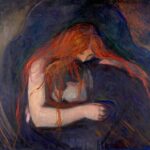
Munch later worked the emotional wreckage of relationships into his art, repeatedly returning to attraction, jealousy, separation, and anxiety.
If the same relationship keeps generating material for your work because it keeps generating misery in your life, don’t confuse artistic usefulness with a reason to stay.
4. Dora Maar — Pablo Picasso
Photographer and artist Dora Maar met Pablo Picasso in the 1930s and became his lover during the period in which he painted Guernica. Maar famously photographed the painting as it developed, leaving an invaluable record of its creation.
But Picasso was still entangled with Marie-Thérèse Walter, and his relationships with women were notoriously complicated and overlapping. Maar also became the model for Picasso’s anguished “Weeping Woman” paintings—a role that has sometimes overshadowed her own substantial achievements as a photographer and artist.
Being turned into somebody else’s muse can be a strange form of disappearance.
If someone celebrates you mainly for what you contribute to their creativity, make sure the relationship leaves enough room for people to recognize what you create yourself.
5. Oskar Kokoschka — Alma Mahler
Oskar Kokoschka’s affair with Alma Mahler began in 1912 and became intensely obsessive. Mahler, the widow of composer Gustav Mahler, eventually ended the relationship.
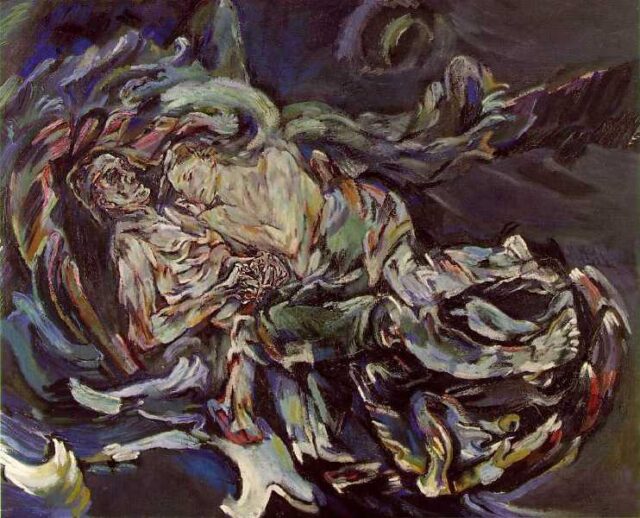
Kokoschka did not take the separation lightly. His enormous painting The Bride of the Wind is closely associated with their relationship. Stranger still, after the breakup he commissioned a life-size doll based on Alma, giving detailed instructions about its appearance. He later destroyed it.
It is one of art history’s more extreme examples of trying to preserve something that had already ended.
When you find yourself trying to reconstruct a lost relationship instead of accepting its absence, put the obsession into the work rather than turning your life into a monument to it.
6. Suzanne Valadon — André Utter
Suzanne Valadon had already lived an extraordinary life—artist’s model, circus performer, self-taught painter, and eventually a respected artist—when she became involved with the much younger painter André Utter.
There was an additional complication: Utter was a friend of Valadon’s son, the painter Maurice Utrillo. Valadon eventually married Utter, and the three artists formed an unconventional and notoriously volatile household in Montmartre.
The relationship lasted for decades but was troubled, and Valadon and Utter ultimately separated. What makes her story particularly interesting is that she continued painting forceful, independent work rather than disappearing into the role of someone’s wife or muse.
When your personal life becomes chaotic, keep one part of your creative practice boringly dependable: the studio, the schedule, the notebook, or whatever reliably gets you back to your own work.
7. Dante Gabriel Rossetti — Elizabeth Siddal
Elizabeth Siddal began as a model associated with the Pre-Raphaelite circle but became an artist and poet herself. Her relationship with Dante Gabriel Rossetti stretched over years of courtship, illness, separation, and eventual marriage.
Siddal died from an overdose of laudanum in 1862. Rossetti famously buried a manuscript containing many of his poems with her. Years later, wanting to publish them, he had the manuscript retrieved when her coffin was exhumed.
It’s a spectacularly Gothic episode, but underneath it is something more recognizable: Rossetti repeatedly transformed private grief into artistic mythology.
When you turn a painful relationship into art, remember that shaping the story can help you understand it—but the beautiful version you create is not necessarily the truth of what happened.
8. Lee Krasner — Jackson Pollock
Lee Krasner recognized Jackson Pollock’s talent early and played a major role in supporting his career. They married in 1945 and moved to Springs, on Long Island, where Pollock created some of his most famous paintings.
But their marriage became increasingly difficult as Pollock struggled with alcoholism and eventually began an affair with Ruth Kligman. In 1956, while Krasner was in Europe, Pollock died in a car crash in which Kligman was a passenger.
For years, Krasner was too often discussed primarily as Pollock’s widow rather than as the formidable Abstract Expressionist painter she was.
Supporting another person’s talent is generous, but never let their career become so large inside your life that your own work survives only in the leftover space.
9. Artemisia Gentileschi — Agostino Tassi
This final example is deliberately different because it should not be romanticized as a tragic love affair.
Agostino Tassi raped the young Artemisia Gentileschi. During the subsequent 1612 trial, Gentileschi endured invasive examination and torture with thumbscrews while maintaining her testimony. Tassi was convicted, although his punishment was not meaningfully carried out.
Older accounts sometimes distorted the episode into a sensational story about seduction or romance. Modern scholarship has done much to restore Gentileschi’s agency and to recognize her as an exceptional Baroque painter rather than defining her solely through what Tassi did to her. Interpretations connecting paintings such as Judith Slaying Holofernes directly to revenge against Tassi are tempting, but they can oversimplify both the painting and the artist.
Be suspicious when biography offers an irresistible explanation for an artwork; use the artist’s life as context, not as a shortcut that prevents you from actually looking at the work.
These stories aren’t really proof that suffering makes better art. That idea has probably excused enough terrible relationships already.
The more interesting pattern is that artists kept trying to turn private confusion into form: Kahlo painted identity and pain, Munch returned to jealousy and separation, Kokoschka monumentalized obsession, and Krasner fought to maintain an artistic identity beside an overwhelming one.
Sometimes the most useful thing an artist can take from the wrong person is not inspiration. It’s a clearer understanding of what should never be surrendered again.