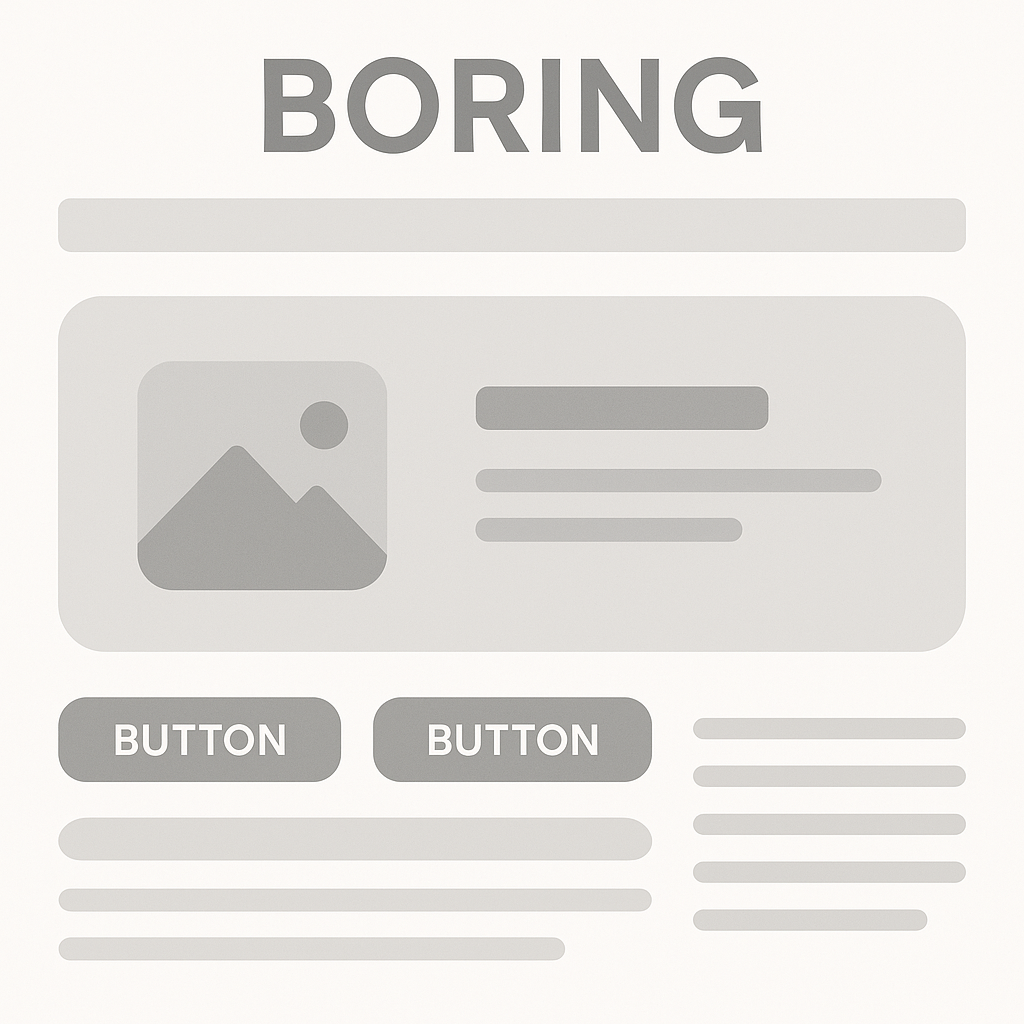
The roots of what is now called “clean design” trace back to mid-20th century Switzerland, where the International Typographic Style, better known as Swiss Style, took shape. Designers such as Josef Müller-Brockmann (1914–1996) were central figures in this movement. They promoted a highly structured approach that emphasized grid systems, sans-serif typefaces, and asymmetrical layouts. The goal was visual clarity, objectivity, and neutrality.
This movement didn’t appear in a vacuum. It was heavily influenced by the earlier Bauhaus school in Germany, founded in 1919, which merged fine art and industrial design. The Bauhaus ethos—“form follows function”—carried over into Swiss Style, reinforcing the idea that decoration was unnecessary and even distracting. Modernist design stripped down visuals to their essentials. This was an era that equated simplicity with rationalism.
By the 1950s and 1960s, the Swiss Style had spread beyond Europe, especially into corporate design. It offered consistency and legibility, two crucial traits for emerging global companies. The minimalist grid became the standard for everything from posters and signage to corporate branding and eventually digital media. The seeds of what would later become the digital “clean” aesthetic were firmly planted in this era.
How Tech Companies Popularized the Aesthetic
While Swiss and Modernist ideals laid the foundation, it was the tech sector that truly popularized clean design in the digital age. Microsoft made an early push in this direction with the release of Windows Phone 7 in 2010, introducing what it called the “Metro” design language. This system rejected shadows, gradients, and textures in favor of flat colors, clean lines, and bold typography. The emphasis was on content over interface.
Apple followed suit in 2013 with the release of iOS 7, marking a dramatic shift in its visual philosophy. Gone were the skeuomorphic icons—digital buttons that looked like leather, glass, or metal. In their place came thin fonts, stark white backgrounds, and pastel color schemes. This move signaled a clear shift away from decorative realism toward digital abstraction.
Google wasn’t far behind. In 2014, it introduced Material Design, a design language built around tactile surfaces, responsive animations, and a bold, flat aesthetic. It aimed to create a consistent look across devices and applications, prioritizing usability and modernity. This move by the three tech giants—Microsoft, Apple, and Google—enshrined clean design as the new digital norm.
Examples of Tech-Driven Clean Design Styles:
- Microsoft’s Metro UI (2010)
- Apple’s iOS 7 redesign (2013)
- Google’s Material Design (2014)
- Airbnb’s flat redesign (2020)
By the mid-2010s, this aesthetic had migrated beyond software and into branding across industries. From banking to fashion, every sector began to echo the clean, tech-inspired visuals. White space became a sign of credibility. Simplicity was no longer a design choice—it was a mandate.
When Clarity Becomes Conformity
Aesthetics Without Personality
The clean design movement began with noble intentions: reduce clutter, enhance usability, and let content take center stage. However, as it became ubiquitous, its original purpose was diluted. Today, clean design often equates to visual sterility. In pursuing neutrality, it has abandoned personality.
Corporate websites, branding, and app interfaces now frequently look indistinguishable. Remove the logos from five modern websites and most users would struggle to identify the brands. White backgrounds, geometric sans-serif fonts like Helvetica or Roboto, uniform spacing, and minimal color schemes dominate. These elements create a sleek appearance but often lack emotional warmth or cultural specificity.
In this atmosphere, design risks becoming generic. What once signaled elegance now signals conformity. What began as a thoughtful reduction of visual noise has turned into a formulaic approach that suppresses individuality. A design may appear professional, but it does little to express the identity, heritage, or values of the company behind it.
The Illusion of Simplicity
Another problem with the clean design ethos is the assumption that simple visuals equal simple experiences. In reality, this isn’t always true. By hiding complexity under a veneer of minimalism, clean design can sometimes make interfaces harder to use rather than easier.
Take, for example, the trend of replacing clearly labeled buttons with ambiguous icons. A minimalist interface might remove all text in the name of aesthetics, leaving users to guess the function of a vague symbol. Flat design has also been criticized for stripping away visual cues that help users understand hierarchy, interactivity, and structure.
The illusion of simplicity can frustrate users. An interface may look clean but behave in unintuitive ways. This undermines the supposed advantage of the style. In many cases, a more visually complex design—with clearly differentiated buttons, shadows for depth, or even subtle textures—could offer a more usable and engaging experience.
Moreover, the obsession with clean design often overlooks cultural and contextual factors. A minimalist aesthetic might be appropriate for a Silicon Valley startup, but it may not resonate with audiences in different regions or industries. Universalizing a single design standard risks flattening out diversity of expression and user expectation.
Why the World Is Pushing Back
Revival of Expressive and Maximalist Design
As with any artistic trend, the dominance of clean design has triggered a backlash. In recent years, designers and brands have begun to explore alternatives—some even deliberately breaking the clean aesthetic’s rules. This resurgence of expressive and maximalist design is gaining traction, particularly among younger creatives and independent brands.
The reemergence of brutalist web design, with its raw layouts, clashing colors, and bold typography, illustrates a desire to reclaim visual texture and authenticity. Brutalism rejects the polished, user-tested perfection of mainstream web design in favor of roughness and rebellion. Though controversial, it has found an audience among users tired of sanitized digital experiences.
Illustration, hand-drawn elements, and analog textures have also made a comeback. Designers are reviving serifs, noise, grain, and layered graphics to bring warmth and humanity back into digital spaces. They’re embracing ornament, imperfection, and narrative—not as distractions, but as vehicles for emotional engagement.
Signs of the Anti-Clean Movement:
- The rise of Neo-Brutalism in web design
- Popularity of “anti-design” on Behance and Dribbble
- Use of analog textures, grain, and distortion
- Revival of retro and maximalist interfaces
This isn’t just aesthetic rebellion; it reflects a philosophical shift. Designers are questioning who gets to define beauty and usability. The clean look, while efficient, is no longer the only valid expression of good design.
How Cultural Flattening Happens Through Design
One of the subtler critiques of clean design is its role in cultural homogenization. When global companies adopt the same visual standards—minimalism, flat icons, sans-serif type—it often erases local design languages. Clean design, in the name of neutrality, can contribute to the erasure of regional identities.
For example, the ornate calligraphy of Arabic branding, the rhythmic patterns of African design, or the colorful intricacy of Indian interfaces often get stripped down in rebrands targeting global markets. In pursuit of “modernity,” visual diversity is sacrificed. What’s left is a bland, international style that looks the same whether you’re in New York, Tokyo, or Dubai.
This design flattening goes beyond aesthetics. It represents a philosophical assumption: that simplicity, neutrality, and minimalism are universally superior. But these values are not culturally neutral—they’re rooted in Western modernist ideology. By prioritizing them, designers may unintentionally contribute to a kind of visual imperialism.
Design should amplify context, not erase it. Local identity, history, and symbolism matter. When stripped away, brands risk becoming culturally disconnected and forgettable.
Reclaiming Character in Visual Design
How to Balance Clarity and Character
It’s possible to create clear, functional designs without sacrificing personality. Designers today are exploring ways to combine structure with soul, marrying usability with uniqueness. The key lies in intentionality: using minimalism as a tool, not a crutch.
Texture, typography, color, and illustration can all reintroduce character without overwhelming a layout. Using a serif typeface instead of the default sans-serif, integrating a hand-drawn logo, or allowing for more organic spacing can make a design feel human without sacrificing clarity.
Instead of relying solely on grids and whitespace, designers are returning to hierarchy, visual rhythm, and storytelling. These elements help guide the user while reinforcing a brand’s identity. In this model, minimalism is not abandoned, but balanced with expressive tools that offer emotional engagement.
Designers can also engage in subtle subversion—injecting personality through microinteractions, thoughtful animations, or easter eggs that surprise and delight users. These touches don’t detract from usability; they enhance memorability.
Designers Who Broke the Mold
Many influential designers have pushed back against the clean design orthodoxy. Stefan Sagmeister, for instance, is known for his provocative and emotionally charged visuals. His work embraces ornament, eccentricity, and surprise—often in direct opposition to the cold efficiency of clean design.
Neville Brody, famous for his experimental typography and design for The Face magazine in the 1980s, rejected the strictures of modernist minimalism in favor of expression and risk-taking. He used design not just to inform, but to evoke.
Jessica Walsh, co-founder of the agency &Walsh, has also made a name for herself by blending high-function digital design with bold, often surreal visual storytelling. Her work illustrates that clarity and creativity are not mutually exclusive.
These figures—and many emerging designers following in their footsteps—demonstrate that visual identity need not be sacrificed at the altar of cleanliness.
Key Takeaways
- Clean design has roots in Swiss and Modernist design principles from the 20th century.
- Tech giants like Microsoft, Apple, and Google solidified its dominance in the 2010s.
- Overuse of clean design has led to visual homogeneity and emotional flatness.
- There is a growing movement toward more expressive, textured, and human design.
- Balance—not rejection—is key to restoring character in visual design.
Frequently Asked Questions
- Is clean design bad?
Not inherently. It becomes problematic when it’s used by default or suppresses identity. - What is the alternative to clean design?
Expressive design styles like brutalism, maximalism, or regionally influenced aesthetics. - Why is clean design so popular in tech?
It’s scalable, fast-loading, and perceived as professional and user-friendly. - Can clean design be culturally insensitive?
Yes, if it erases or overrides local traditions in favor of global uniformity. - How do I add personality without making things cluttered?
Use typography, illustration, or color intentionally—clarity doesn’t require blandness.