Romania’s long-standing tradition of wood carving, particularly in darker hardwoods, is one of the country’s most visually striking and spiritually rich cultural achievements. From the hills of Maramureș to the monasteries of Bucovina, this tradition reflects not only craftsmanship but the deeper soul of a Christian rural people. These carvings are not whimsical folk decorations but solemn expressions of faith, memory, and hierarchy. They carry symbols of eternal truths, often placed at the thresholds of homes and churches where heaven and earth are believed to meet.
The visual language of carved wood in Romania is steeped in Christian theology, ancestral reverence, and cosmic symbolism. These are not anonymous peasant items for tourist admiration, but sacred artifacts shaped by centuries of continuity. Men carved gates for their family homes with the same intention with which they built altars in churches. The care, time, and attention given to each design points toward a culture that values moral order, beauty, and permanence.
The prevalence of darker tones in Romanian wood carving is partially due to the natural aging of walnut, oak, and beech, but also a deliberate choice to create contrast and depth. Smoke from candles and hearths, linseed oil, and hand-rubbing methods over generations darkened the surfaces even further. The result is an aesthetic that is solemn and grave yet full of warmth and light when struck by sunlight or candle flame.
These carved forms continue to shape Romania’s cultural identity. Whether viewed in a village church or preserved in a national museum, they offer a rare continuity with a past where Christianity was not merely professed but carved into the very walls of daily life. The dark wood of Romania holds memory and meaning as surely as any illuminated manuscript or fresco.
Maramureș: The Heart of Wooden Romania
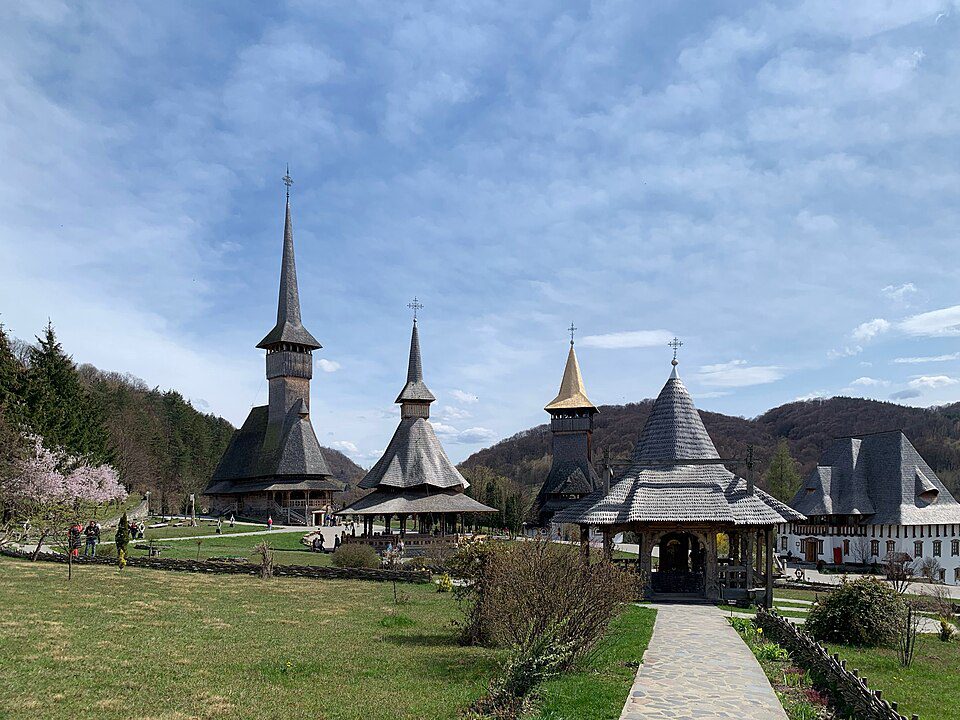
The region of Maramureș, located in northern Romania, remains the beating heart of the country’s wooden tradition. In its villages, wooden architecture is not merely functional but spiritual. Church towers rise like needles above thick forests, their forms echoing both steeples and watchtowers. Here, wood is not an alternative to stone, but a preferred material infused with meaning, humility, and ancestral significance.
The wooden churches of Maramureș are renowned for their harmonious proportions, towering spires, and steep roofs. Constructed between the 17th and 18th centuries, many are now UNESCO World Heritage Sites, including the churches of Bărsana (1720), Ieud Deal (1364 but rebuilt in later centuries), and Poienile Izei (1604). Built without nails, these churches use local oak and fir to create a sacred space that unites heaven and earth in verticality and symbol. The darkened interiors, aged by incense and smoke, preserve Biblical frescoes and intricate carvings.
The Wooden Churches of Maramureș
Each church in Maramureș features a carefully carved portal that leads into a sacred enclosure. Designs include rosettes, twisted ropes, and crosses carved in relief, symbolizing life, eternity, and the Holy Trinity. The doors themselves often tell stories from the Gospels or Old Testament, rendered in stylized forms passed down through local traditions. Walls and ceilings contain wooden beams marked with initials, blessings, or protective symbols.
These churches are not relics of a dead past. They continue to host baptisms, weddings, and liturgies. Local priests and laypeople maintain the wooden structures, understanding them not only as architectural heritage but as living altars. In many cases, the original master carver’s name has been forgotten, in keeping with the Orthodox principle that sacred work should point toward God, not man.
Gates as Guardians of Tradition
Maramureș is equally famous for its massive carved gates, which often stand taller than the homes they guard. These gates, typically built from oak, are adorned with interlaced patterns, symbols of eternity, sun wheels, and depictions of the tree of life. The rope motif, carved in twisted relief, signifies continuity between generations and the unbroken chain of Christian family lineage.
A typical Maramureș gate includes a small covered shelter, under which visitors stand before knocking. This space is symbolically important; it marks a threshold between the outer world and the sanctity of the home. The craftsmanship of these gates was historically a point of pride, often prepared by a groom before his wedding as a demonstration of readiness and virtue. Today, such gates remain in use, cherished by those who still live close to the soil and the old rhythms of life.
Notable Wooden Churches in Maramureș:
- Church of Bărsana (1720) – famous for its high spire and floral motifs
- Church of Poienile Izei (1604) – known for interior Biblical frescoes
- Church of Ieud Deal (originally 1364) – one of the oldest and most revered
- Church of Rogoz (1663) – unique architectural plan and symbolic beams
- Church of Săpânța (1766) – features rare painted elements on exterior walls
Symbolism in the Grain: Carved Theology
Romanian wood carving is rooted in a symbolic vocabulary that pre-dates modern notions of “decorative” art. Each motif holds spiritual meaning, whether derived from Christian theology or older cosmological symbols adapted to sacred use. The designs are often abstract, geometric, and stylized, allowing them to be deeply meditative while remaining culturally recognizable.
The carved tree of life is perhaps the most frequent and powerful symbol found on Romanian gates, beds, and doors. Representing the axis mundi, it connects the heavens, earth, and underworld. In Christian interpretation, the tree also calls to mind both the Tree in the Garden of Eden and the Cross of Christ. The vertical alignment of these carvings mirrors the layout of a church—with heaven above, the earth in the middle, and the foundation of tradition and law below.
The Tree of Life and the Axis Mundi
This carved motif often features a central trunk with symmetrical branches rising upward. It may be flanked by birds, sun wheels, or geometric spirals. In Orthodox Christianity, this image evokes both the continuity of divine providence and the singular sacrifice of the Crucifixion. Found on both churches and household items, it reminds the viewer of the link between everyday life and spiritual ascent.
In rural belief, the tree also protected the household from misfortune. A tree carved into the gate or bed frame functioned not just as art but as a prayer. Carvers selected their designs with care, balancing aesthetic harmony with theological significance. The unity of symbol and material remains a distinctive feature of Romanian Christian craft.
The Rope of Eternity and the Wheel of the Sun
Another enduring motif is the twisted rope, usually carved in spiral relief. This “infinite knot” symbolizes eternity, the unbroken succession of days and generations under God’s rule. Often, it encircles doorways, candle holders, or even wooden columns. It serves both as a frame and as a visual expression of the continuity of time.
The sun wheel, often rendered as a cross within a circle, represents light, resurrection, and the divine order. Though similar to symbols found in pre-Christian Europe, in Romanian carving these wheels are interpreted through a Christian lens. They often appear near altar areas, on gates, or incorporated into icons. Their message is one of hope and divine clarity amid the darkness of the fallen world.
Wood and Worship: The Orthodox Legacy
Wood has long held a sacred role in the Orthodox Christian tradition in Romania. Unlike the grand marble cathedrals of Western Europe, Romanian churches—especially in the countryside—embrace the warmth and humility of wood. This choice is not simply practical; it reflects theological priorities. Wood is organic, tied to the Incarnation of Christ, and speaks to a God who entered the created world, not as a king in a palace, but as a carpenter in a humble village.
Romania’s Orthodox churches incorporate carved wood in nearly every sacred object: iconostases, bishop’s thrones, lecterns, choir stalls, and candle holders. These elements are not ornamental extras but integral to the worship experience. They surround the faithful with visual theology. In some monasteries, such as the 15th-century Putna Monastery founded by Stephen the Great in 1466, carved wooden interiors enhance the solemnity of monastic life while reinforcing hierarchy and order.
The Iconostasis as a Lattice of Heaven
At the heart of every Orthodox church stands the iconostasis—a screen of icons and carvings that separates the nave from the altar. In Romania, these screens are often made of dark walnut or oak, intricately carved with vines, flowers, angels, and interlacing patterns. The purpose is not concealment but revelation—this carved wall becomes a spiritual veil through which glimpses of heaven are offered. The doors in the iconostasis, known as the Royal Doors, are particularly ornate and often include scenes of the Annunciation or the Four Evangelists.
Monasteries such as Voroneț, Humor, and Moldovița, while known for their exterior frescoes, also preserve carved wooden iconostases inside. In parish churches, these icon screens are typically the work of local artisans rather than urban guilds. Passed down through generations, the carving techniques used remain consistent with Orthodox canons, ensuring the sacredness of space is preserved across time.
Choir Stalls, Lecterns, and Thrones
Beyond the iconostasis, carved wood appears in many other sacred furnishings. Choir stalls, where the faithful or clergy stand during long services, are often engraved with protective motifs and scriptural inscriptions. Their high backs and armrests offer physical support but also represent the dignity of worship.
Lecterns used for Gospel readings and bishop’s thrones at the sides of the altar are similarly adorned. Even candle stands are carefully carved, often featuring grapevine motifs to evoke the Eucharist. In many churches, these objects were crafted as acts of devotion, donated by families or brotherhoods who saved for years to commission them. The act of carving was thus both spiritual and communal—a gift to the Church and to God.
Folk Carving in the Romanian Home
Romanian wood carving was never confined to ecclesiastical settings. The same symbols and skills found in village churches reappear in household items that mark the seasons of life—birth, marriage, labor, and death. In rural homes, almost every wooden object bore a mark of craftsmanship: cradles, chairs, beds, spoons, and cupboards were carved with motifs that blended beauty with blessing.
These folk carvings were not kitsch or idle decoration; they functioned as moral and spiritual signposts. The presence of Christian symbols in the home reinforced the faith lived out daily. A cradle might bear carvings of doves and crosses, offering both protection and beauty to a newborn. A chest for storing dowry linens would feature interlaced patterns and prayers carved along the lid.
Dowry Chests and Wedding Pillars
One of the most cherished items in a Romanian household was the dowry chest, given to a bride by her family and often carved by her father or groom. These chests, known as “lada de zestre,” were made of walnut or fir and served as storage for linens, clothing, and sacred items like icons. Carvings on the chest often included the rope of eternity, the tree of life, or prayers in Old Romanian script.
Wedding pillars or carved marriage beams were another traditional feature, sometimes installed at the entryway of the couple’s new home. These would be dated, inscribed with the couple’s names, and feature blessings for fertility, unity, and the protection of saints. Such objects grounded marriage in both tradition and transcendence, marking it as a sacred union under God’s watch.
Tools, Furniture, and Daily Life
Even the most utilitarian objects in Romanian homes carried carved meaning. Wooden spoons were often shaped with care and gifted at significant moments, such as baptisms or the completion of a house. Spinning wheels used by women to prepare wool included floral and vine motifs, tying labor to beauty and symbol.
Stools and beds were made with sturdy joints and adorned with Christian symbols or repeating geometrical patterns. Even the hearth, the center of the home, might have carved beams featuring crosses or phrases of blessing. In this world, nothing was purely functional—everything had a place in the moral and spiritual life of the household.
Traditional Carved Household Items and Their Meanings:
- Cradle – Carved with birds or vines to symbolize life and divine protection
- Dowry Chest – Rope of eternity and Christian symbols representing permanence
- Wooden Spoon – Gifted at baptisms; symbolic of nourishment and care
- Spinning Wheel – Decorated with vines and stars, linking labor with beauty
- Marriage Beam – Inscriptions marking marriage as sacred and lasting
Materials and Methods: The Craft Itself
Romanian wood carving is distinguished not only by its symbolism but also by its precise techniques and choice of materials. Artisans traditionally used native hardwoods such as walnut, oak, and beech—woods that are strong, dense, and capable of holding fine detail. These trees were readily available in the Carpathian forests and harvested with reverence, often in accordance with seasonal and religious calendars. Each species lent its own character: walnut offered dark richness, oak provided structure, and beech was favored for its smooth grain.
Tools were simple yet effective. Traditional carvers relied on chisels, gouges, adzes, and knives—usually hand-forged by local blacksmiths. Without the use of modern electric tools, every line was the result of deliberate human effort. The slowness of the process was seen as a virtue; it allowed for contemplation and prayer. In village communities, carving was not an isolated profession but a seasonal activity performed by farmers, shepherds, and priests in their quieter months.
Staining and Preservation
The dark coloration that characterizes Romanian wood carving is often the result of both time and technique. In many cases, the wood darkens naturally through aging, exposure to smoke, and the absorption of oils from human touch. Smoke from candles and hearth fires would cling to iconostases and ceilings, lending a natural patina over generations. Some families also applied linseed oil or beeswax to preserve the carvings, deepening the contrast between carved recesses and raised surfaces.
In some regions, certain stains or iron oxide compounds were used to achieve a deeper tone deliberately, though the aesthetic remained rooted in subtlety and restraint. The goal was never artificial enhancement but reverent preservation. Even today, when restorers treat old pieces, they take care not to over-clean or strip away the accumulated history that gives Romanian woodwork its spiritual gravity.
Transmission of the Craft
The knowledge of wood carving was passed down through generations, often within families or small religious communities. Boys learned by watching their fathers and grandfathers, first handling scrap wood and eventually taking on sacred commissions. In monastic settings, younger monks were taught the discipline as part of their spiritual formation. Carving was not merely manual labor—it was regarded as a sacred offering, a way to glorify God through the work of human hands.
The names of the greatest village carvers are rarely known, and that anonymity was intentional. Pride was considered a spiritual danger. In some cases, however, a master carver’s style became so distinctive that his work could be recognized by fellow craftsmen. This silent tradition, passed on with humility, helped preserve stylistic integrity and theological depth long before the arrival of formal art academies or folklore institutes.
Survival Under Hard Times
The tradition of Romanian wood carving faced one of its greatest trials during the communist era, which began in 1947 and lasted until the fall of the regime in December 1989. The official atheist ideology promoted by the state sought to erase religious expression from public life. Churches were demolished or closed, clergy imprisoned or surveilled, and sacred symbols suppressed. Yet, wood carving endured — quietly, steadfastly, and with moral purpose.
In villages where traditions ran deep, artisans continued to carve religious motifs, often under the pretense of making “folk art” or “decorative furniture.” These works retained their sacred meaning to those who carved and received them, even if the authorities demanded secular explanations. Homes still bore carved crosses above doorways, and dowry chests continued to include symbols of faith passed off as mere tradition. Under the guise of rural heritage, the truth of Christian belief lived on in wood.
Silent Resistance Through Wood
For many carvers, their work became a form of silent resistance. When church commissions dried up or became dangerous, they turned to carving for the home and for trusted members of their community. Gates, cradles, and candle stands carried Christian symbols that required no explanation for those who understood their meanings. These artisans were not loud dissidents; they were guardians of sacred order.
In some regions, small chapels were secretly maintained or built on private land using traditional materials. Carvings were hidden from public view but revealed during family rites of passage. These acts of spiritual perseverance helped preserve a sense of Christian identity that outlasted the regime’s efforts to erase it. Through wood, a memory of holiness was handed down even when churches were padlocked and hymnals banned.
Hidden Messages in Design
The language of symbols allowed carvers to embed Christian meanings without drawing the attention of the state. A rope of eternity on a gate could be explained as a folk motif, but for the faithful, it remained a reminder of eternal life. The wheel of the sun, while officially interpreted as a peasant design, continued to represent Christ as the Light of the World. Through abstraction and stylization, Romanian craftsmen protected the sacred from desecration.
These coded messages were not invented during communism, but they took on new importance under it. They allowed faith to remain embedded in daily life without provoking retaliation. In this way, wood carving served as both cultural memory and spiritual lifeline — a testimony to truth endured, not merely told.
Romanian Wood Carving Today
Since the fall of communism in 1989, Romania has experienced a revival of interest in its traditional crafts, with dark wood carving regaining its rightful place as a living art form rather than a relic of the past. The re-opening of churches, monasteries, and rural festivals has created a renewed demand for carved gates, altars, and sacred furnishings. Young artisans, often the children or grandchildren of village carvers, are now continuing the tradition, blending historical reverence with practical adaptations for the modern age.
This renewal is visible in both sacred and secular settings. New churches, especially in northern Romania, are often constructed entirely from wood in the old Maramureș style, complete with carved steeples, iconostases, and altar screens. In towns and cities, carved gates and wooden balconies are making a return in residential architecture, not out of nostalgia, but as a declaration of rootedness. Museums such as the Village Museum in Bucharest and the Wood Art Museum in Câmpulung Moldovenesc preserve masterworks while also supporting living artisans through exhibitions and workshops.
Preserving the Sacred Tradition
Several Romanian monasteries have reestablished carving workshops, where novices are trained in traditional woodwork alongside their spiritual formation. These monastic craftsmen often receive commissions from parishes across the country and even from abroad. Their work maintains the same humility and theological depth that marked their forebears, ensuring continuity in both style and spirit.
Government and church institutions have begun to recognize the importance of this sacred art. Grants and competitions for young carvers, though modest, have supported the preservation of tools, techniques, and religious meaning. More importantly, there is growing cultural respect for the idea that Romania’s identity is tied not just to language or land, but to the visual theology etched into wood.
Artisan Families and Modern Workshops
Beyond monasteries, artisan families in villages across Maramureș, Bucovina, and Transylvania are again carving for a wide range of patrons. Some produce custom gates for homes, while others craft large-scale iconostases for diaspora churches in Western Europe and North America. These families operate modest workshops, often attached to their homes, where they use traditional tools alongside modern equipment when necessary.
What unites these contemporary carvers is a shared commitment to continuity. They see themselves not as innovators, but as stewards of a sacred trust. Their adaptations—whether for export, tourism, or urban settings—remain faithful to the original purpose of the craft: to elevate the everyday through moral beauty and order. Through their hands, the legacy of Romania’s carved wood continues to live and speak.
Comparing with Other European Traditions
Within the broader context of European sacred art, Romanian wood carving stands apart in both material and spirit. While much of Western Europe turned to marble, limestone, and gold leaf to express religious grandeur, Romania retained its devotion to wood—humble, local, and alive. This choice was not a mark of poverty but of theological distinction. It reflected a culture that prized inward reverence over outward splendor.
The Gothic and Baroque churches of France, Italy, and Germany were monumental in scale and rich in ornament, often designed to overwhelm the senses. Romanian wooden churches, by contrast, invite intimacy. They are smaller in size, but no less elevated in meaning. Their spires stretch to the heavens not in conquest, but in devotion. Their carvings teach not through grandeur, but through parable.
The Contrast with Western Ornamentation
Western ornamentation often emphasized naturalism, dramatic movement, and illusionistic space. Romanian carving, by contrast, remained symbolic and stylized. A flower might not look botanically accurate, but its meaning—life, fertility, resurrection—was unmistakable to the viewer. Romanian art chose mystery over spectacle, order over novelty.
Moreover, where Western sacred spaces often relied on imported materials and professional guilds, Romanian churches were built by local hands using local wood. This gave rise to a deep unity between builder, place, and faith. The result is an art that feels neither elitist nor primitive, but morally centered—an expression of sacred order rooted in soil and Scripture.
Kinship with Nordic and Slavic Traditions
While distinct, Romanian wood carving shares some kinship with traditions found in Norway’s stave churches and Russia’s rural Orthodox architecture. All three cultures developed woodwork in colder climates, under Christian Orthodoxy (or early Christianity in Norway), and favored symbolism over realism. In each, the carved structure becomes part of the liturgical experience, drawing the viewer toward contemplation rather than distraction.
That said, Romanian wood carving possesses a unique balance between rustic strength and theological depth. Where Russian carving often becomes elaborate and Norwegian work emphasizes structure, Romanian carving thrives on rhythm, repetition, and encoded Christian symbols that link family, nature, and God. It is not simply folk art—it is spiritual architecture, carved in covenant rather than concept.
Conclusion: What the Carvings Still Teach
Romania’s dark wood carvings are more than national heritage—they are living theology, carved into gates, beds, churches, and memory. They remind us that beauty need not be loud, that sacredness can dwell in small villages, and that craftsmanship can be an act of worship. They teach us that true tradition is not static—it is alive, handed down from father to son, from altar to threshold.
In a world that prizes speed, novelty, and mass production, the patience and discipline of Romanian wood carvers offer a rebuke and a lesson. Their carvings call us back to a slower, more meaningful rhythm, where the hand follows the heart, and the pattern follows the eternal. These wooden forms, darkened by time and faith, are sermons carved without words.
They still stand: at the entrance to homes, at the gates of monasteries, and in the hearts of churches. They endure because they were made not just with tools, but with truth. And as long as Romanian wood carving is passed on, it will continue to proclaim—quietly, beautifully—that the sacred still matters.