Tbilisi is not so much a city as it is a layered manuscript—an open palimpsest that reveals its older inscriptions even as new ones are written over them. Few cities in Eurasia so vividly embody the tensions of cultural proximity and imperial competition, the instability of borders, or the resilience of visual languages forged under persistent occupation. To understand the art history of Tbilisi is to follow the thread of a shifting syntax that has, over millennia, woven together the sacred and the syncretic, the native and the foreign, the canonical and the ephemeral.
Situated in the narrow gorge of the Kura River, hemmed by mountains and historically exposed to trade routes, Tbilisi’s geographical location has always determined its artistic complexity. It was never merely a Georgian city, despite being the capital of Georgia for most of its post-antique history. Rather, it has been a node in the tangled network of imperial ambitions—Persian, Arab, Byzantine, Ottoman, and Russian empires all left their imprint here, not just through conquest, but through a more enduring means: visual form. The result is an art historical continuum that cannot be plotted along a linear path but must instead be seen as a series of recursive returns, ruptures, and hybridizations.
From its earliest traces of settlement—fragments of Neolithic pottery, bronze ritual objects, and rock-cut shrines—to its more codified Christian visual traditions, the city’s terrain has been embedded with forms that reflect both continuity and interruption. The introduction of Christianity in the 4th century AD did not fully erase older artistic languages; pagan motifs lingered in ornament, and later Islamic forms would absorb and refract earlier Christian geometries. In this way, the visual culture of Tbilisi has always borne the signature of recontextualization.
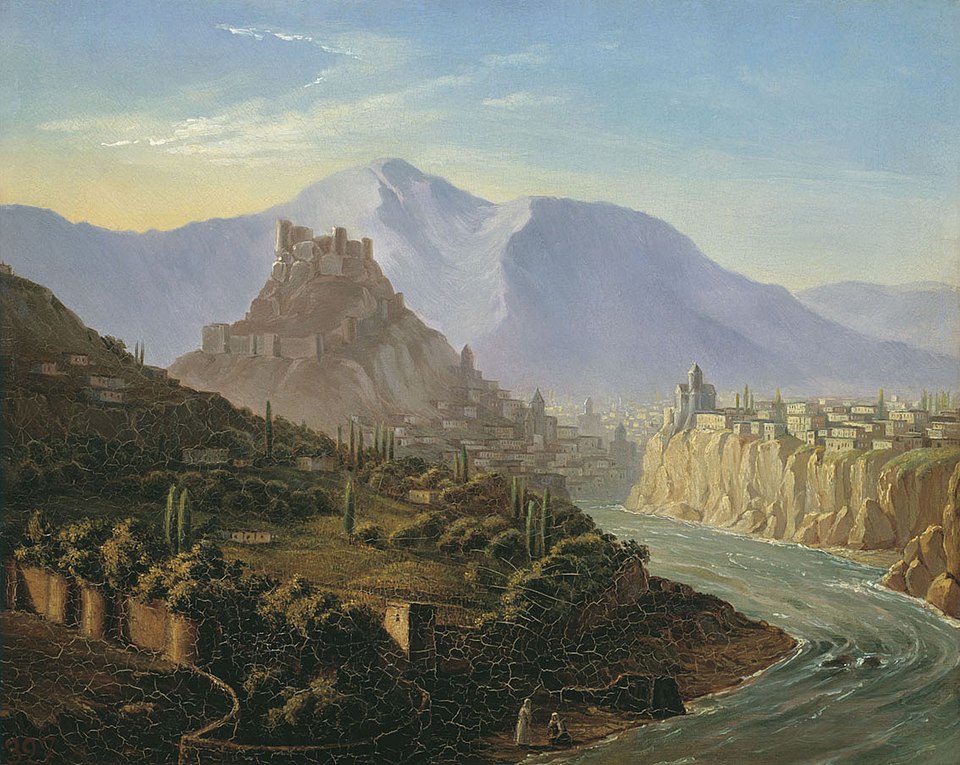
The very topography of the city reinforces this idea of vertical layering and interwoven identity. The medieval Narikala fortress crowns the hillside, an architectural assertion of continuity, yet its ramparts contain stones and techniques from Arab, Georgian, and later Russian renovations. The city’s religious architecture is even more telling: the domed silhouette of the Metekhi Church speaks in a language of early Christian sanctity, while the Persian-style brickwork and decorative mihrab of the Jumah Mosque evoke the city’s Islamic chapters. Sometimes, these buildings coexist side by side; at other times, they are literally built into each other—churches over mosques, houses over churches, palimpsests of stone and intention.
It is crucial to emphasize that Tbilisi’s artistic evolution was not simply reactive—a passive result of foreign imposition. There has always been an indigenous will to style, a deep-rooted formal intuition that recurs in architecture, manuscript painting, liturgical metalwork, and later in secular and modernist genres. Even during periods of harsh external control—Safavid suzerainty or Soviet censorship—Tbilisi’s artists found ways to smuggle meaning into form. This capacity for stylistic survival and coded defiance will be a recurring theme throughout this study.
Indeed, the story of Tbilisi’s art is also one of its artists: unknown medieval iconographers and masons whose names are lost but whose works remain; visionary poets of pigment like Niko Pirosmani, the self-taught primitivist whose flat forms and tavern signboards now fetch reverence in international museums; Soviet-era nonconformists like Avto Varazi, who dared to inject mysticism into sanctioned realism; and post-independence experimentalists navigating the fractured terrain of post-Soviet identity. Each artist, whether embedded in liturgical tradition or resisting official doctrine, adds a phrase to the city’s ongoing visual dialect.
The following sections will proceed both chronologically and thematically, tracing how successive periods of dominance and renewal produced the unique visual vocabulary of Tbilisi. But this introduction serves a methodological purpose as well: to remind us that cities, like texts, do not reveal their meaning in a single read. One must attend to erasures, marginalia, and re-inscriptions. Tbilisi’s art history, then, is not a clear narrative but a haunted and haunting archive—one that resists simplification and demands close, sustained reading.
The Pre-Christian Foundations: Iberian and Colchian Echoes
Before Tbilisi became a Christian city—or even a city in the formal sense—it belonged to a wider matrix of cultural and artistic developments rooted in the ancient kingdoms of Iberia and Colchis. Though the precise date of Tbilisi’s founding remains debated, archaeological evidence suggests that the region was inhabited as early as the 4th millennium BC. These early strata, composed of burial mounds, bronze ritual implements, and geometric ceramics, form the embryonic visual language from which later Georgian art would emerge. If the medieval churches of Tbilisi present a finished grammar, the pre-Christian layers provide the proto-linguistic fragments: isolated motifs, recurring shapes, and symbolic forms whose meanings often remain tantalizingly obscure.
The early kingdoms of Iberia (eastern Georgia) and Colchis (western Georgia) were not artistic backwaters. Both regions participated in broader regional circuits that connected the Caucasus to Anatolia, Mesopotamia, and the Black Sea littoral. Metalwork from this era, especially bronze belts, fibulae, and ritual figurines, reveals a sophisticated command of design and an evident symbolic intent. Iberian bronze statuettes of deer, warriors, and goddesses—extracted from necropolises and hilltop shrines—are marked by a stylized abstraction that both anticipates and diverges from classical Greek and Near Eastern norms. They were not mimetic but emblematic, speaking to a ritual cosmology rather than a narrative realism.
Particularly notable is the funerary art, which offers insight into early religious sensibilities. Tumuli graves in the region, often containing weaponry, jewelry, and imported luxury goods, suggest a class of elite patrons already invested in the semiotics of display. These objects were not merely functional but charged with significance—bronze axes inscribed with solar patterns, ceramic vessels shaped in zoomorphic forms, and amulets likely imbued with apotropaic power. This was a visual culture attuned to the metaphysical dimension of form.
In the region that would become Tbilisi, such objects have been discovered in strata dating to the Late Bronze and Early Iron Ages, roughly 1500–500 BC. The spatial arrangement of these findings indicates ritual spaces that were not yet formal temples but may have functioned as sacred groves or altars. Their iconography is largely non-representational: swirling patterns, spirals, and meanders, which suggest a cosmological logic tied to cyclical time, fertility cults, or solar worship. These are visual languages without texts—non-verbal systems that must be read for their formal insistence rather than decoded in literary terms.
The influence of Colchian visual idioms, more prominent in the western part of modern Georgia, is also evident in early Tbilisi-area artifacts. Colchis, mentioned in classical sources as the destination of Jason and the Argonauts, was famed not merely for its mythical “Golden Fleece” but for its goldsmithing in reality. Intricate repoussé goldwork, often involving figural motifs and floral abstractions, reveals a high degree of technical skill and stylistic integration with both Scythian and Anatolian models. Though Tbilisi lay east of Colchis proper, the trade and cultural exchanges between these zones ensured that elements of Colchian luxury style—its emphasis on curvature, rhythmic line, and naturalistic detail—would seep eastward into the Iberian plateau.
Yet the art of this era was not isolated. By the first millennium BC, the territory of Tbilisi was integrated into larger imperial and cultural systems—first under the Achaemenid Persians and later within the Hellenistic sphere following Alexander the Great’s conquests. From this period, we see the slow emergence of architectural foundations, including early fortifications and settlements that suggest a pre-urban visual planning. Though little survives in the way of monumental architecture, the spatial logic of these early settlements—clustered around water sources, built in tiers on hillsides—foreshadows the organic urban morphology that Tbilisi would later adopt.
The arrival of Hellenistic influence in the region, particularly in the 3rd–1st centuries BC, brought with it new figural paradigms. Fragmentary sculpture, terracotta figurines, and painted ceramics from Iberian sites display an increasing willingness to depict the human body in motion and emotion, a marked departure from the earlier symbolic austerity. In these hybrid works—Greek forms rendered with local sensibility—we see the first instances of cultural syncretism that will become a defining trait of Georgian visual art. It is not merely that Hellenistic art was imported; rather, it was reinterpreted through a local aesthetic grammar that resisted full assimilation.
Equally important during this period was the emergence of Zoroastrian and proto-Mazdean cultic practices under Persian influence. Fire altars, sometimes enclosed within small masonry structures, and the veneration of sacred natural elements—springs, rocks, trees—begin to appear in the archaeological record. These proto-temples are often misread through a later Christian lens, but they belonged to an entirely different symbolic order: one in which fire, light, and cosmic balance structured the logic of worship. Though these forms were later overwritten by Christian architecture, their presence shaped the sacred geography of the city and left residual traces in both toponyms and site orientations.
Thus, before it was Christian, and long before it became the cosmopolitan capital of a modern state, Tbilisi was a liminal zone of artistic entanglement. Its early art was shaped by distance and nearness—by proximity to great empires and by the mountain barriers that ensured a degree of insularity. This paradox—of embeddedness and autonomy—set the stage for what would follow. If the Christianization of Georgia in the 4th century would formalize its visual idiom, it would do so upon a substratum rich with abstraction, ritualism, and cross-cultural resonance.
In the next section, we will examine how this foundation was transformed by the Christian impulse, as sacred architecture and iconography reoriented the city’s visual horizon toward Byzantium while still bearing the residues of its pre-Christian past.
Christianization and the Early Medieval Aesthetic (4th–9th Centuries)
The Christianization of the Kingdom of Iberia in the early 4th century AD marked a profound ontological and aesthetic rupture in the history of Tbilisi. While the precise date remains debated—tradition holds that it occurred under King Mirian III around AD 326, through the efforts of Saint Nino—the effect on visual culture was immediate and transformative. Pagan symbols, solar cults, and abstract ritual geometries gave way to a new semiotic economy, centered on the figure of Christ, the Cross, and the Theotokos. This was not merely a substitution of themes but a complete reconfiguration of artistic intention, spatial articulation, and formal language. Tbilisi, though not yet the royal capital, became a key site for this new religious and visual order.
Christian art in Georgia developed with both autonomy and dependence. On one hand, the Byzantine world exerted a gravitational pull, providing not only theological models but also iconographic typologies and architectural templates. On the other hand, Georgian Christian art preserved a sense of local scale and restraint that distinguished it from the elaborate monumentalism of Constantinople. Nowhere is this more evident than in the early churches that began to define Tbilisi’s sacred landscape in the 5th to 7th centuries.
Among the earliest extant examples is the Anchiskhati Basilica, originally constructed in the 6th century and later renovated. Though modest in scale, its architectural form encapsulates the early Christian aesthetic of Georgia: three-naved, basilican in layout, and clad in local stone, with little external ornament but an intense internal concentration on proportion and spiritual orientation. The Anchiskhati, like other early Georgian churches, avoids the domed central plan characteristic of Byzantine architecture. Instead, it favors longitudinal axes and a chaste geometry that underscores liturgical clarity over decorative elaboration. The choice is not merely functional but theological: the building becomes a directional vessel, a material compass pointing toward eschatological promise.
At the same time, the visual arts associated with liturgy—fresco painting, illuminated manuscripts, and metalwork—began to develop distinctively Georgian characteristics. These early Christian artworks often exhibit a tension between local abstraction and imported figuration. In early frescoes, such as those once adorning the interiors of vanished Tbilisi churches, the human form is rendered with solemn stylization: elongated limbs, almond-shaped eyes, minimal spatial depth. The goal is not naturalism but presence, not narrative immersion but symbolic legibility. These figures are didactic apparitions, not psychological portraits.
Illuminated manuscripts from this period—though many were produced in monastic centers outside Tbilisi proper—nevertheless reached the capital and influenced its scribes and illuminators. One remarkable example is the Adysh Gospels (AD 897), which, although preserved in a highland monastery, reflects the scriptorial culture that animated Tbilisi’s ecclesiastical elite. Its miniatures combine the hieratic stillness of Byzantine prototypes with a raw, expressionistic intensity. The Evangelists, rendered in saturated tones and framed by vegetal ornament, seem to hover at the edge of the numinous. Marginalia—spirals, interlaces, zoomorphic glyphs—reveal the survival of earlier, possibly pagan, visual codes sublimated into Christian grammar.
Architectural sculpture also began to appear during this period, though it remained restrained. Capitals were often carved with stylized crosses, pomegranates, or grapevines—symbols drawn from both scripture and native horticultural imagery. These forms were never merely decorative; they encoded theological meaning in vegetal disguise. The vine, for instance, is both a Christian symbol of the Eucharist and a reference to Georgia’s ancient viticultural heritage. In such dual readings, we glimpse the persistence of cultural memory beneath doctrinal overlay.
The shift to Christianity also altered the spatial and urban logic of Tbilisi itself. Whereas earlier settlements clustered defensively around fortresses and natural altars, Christian urbanism oriented itself around ecclesiastical structures. Churches became the new centers of civic identity. The Metekhi Church, founded—though later rebuilt—on a promontory above the Kura River, exemplifies this shift. Its commanding position speaks to the fusion of religious and political authority: the church as both house of worship and symbol of dynastic power. The elevation of the church above the river also carries metaphysical implications—a topographical metaphor for the ascent from the temporal to the eternal.
At the same time, the spread of Christianity brought new tensions and exclusions. Pagan shrines were not always demolished; often they were incorporated into the Christian sacred landscape, re-occupied and re-signified. Stones from older altars were reused in church foundations. Sacred groves were consecrated anew. The aesthetic effect is one of layered continuity—Christian churches that stand, quite literally, on the bones of their predecessors. In some cases, local saints’ cults emerged in places where pre-Christian deities were once venerated. The art that resulted from these transformations bears subtle traces of ambivalence: crosses that echo sun discs, saints who resemble ancestral protectors, ecclesiastical garments that mimic earlier ritual vestments.
The theological ambition of early Georgian Christianity was mirrored in its linguistic innovation as well. The creation of the Georgian script—traditionally ascribed to the monk Mesrop Mashtots, though more likely a gradual development—was integral to the flourishing of religious art. It enabled the transcription of liturgical texts, the copying of Gospels, and the creation of inscriptions that adorned church walls and reliquaries. Calligraphy in Asomtavruli, the earliest script, itself became a visual art: letterforms monumental and geometric, inscribed in stone and metal as acts of sacred craftsmanship.
By the end of the 9th century, Tbilisi had not only internalized Christian aesthetics but had begun to project its own style outward. Despite being under intermittent Arab rule (from the early 8th century), the city’s ecclesiastical architecture and Christian art did not vanish. On the contrary, they asserted a visual identity in defiance of occupation. This dialectic of internal resilience and external pressure would define Tbilisi’s artistic trajectory for centuries to come.
In the next section, we will turn to that very dialectic: the Persian domination of Tbilisi and the emergence of a decorative visual language shaped by Islamic aesthetics and courtly taste.
The Persian Domination and the Cult of the Decorative (6th–11th Centuries)
To speak of Persian domination in Tbilisi between the 6th and 11th centuries is to engage with a paradox of presence. The Persian empires—Sasanian, then later Islamic dynasties inheriting Persian administrative and aesthetic frameworks—did not merely conquer Tbilisi; they insinuated themselves into its texture. Yet the city did not capitulate aesthetically. Instead, it absorbed and repurposed foreign influences in a process of visual hybridization that transformed the art of the region without effacing its native sensibilities. In this period, the cult of the decorative emerged as a powerful language—one that could communicate across cultural boundaries while concealing local allegiances in form.
By the late 6th century, Tbilisi had become a strategic outpost of the Sasanian Empire. Though formal political sovereignty remained contested—between Byzantium, Persia, and later the Caliphate—Persian artistic norms began to penetrate local material culture. The Sasanian approach to art emphasized pattern over figure, surface over volume, and abstraction over narrative. In architecture, this was reflected in the use of vaults, iwans, and muqarnas; in portable arts, it manifested in silks, metalwork, and carved stucco. Though few full Persian structures survive in Tbilisi from this period, traces endure in fragments—excavated tilework, imported ceramics, and motifs later embedded in Georgian ornament.
With the Arab conquest in the 8th century, Tbilisi became the center of an emirate (the Emirate of Tbilisi), effectively ruled by Muslim governors who reported to the Caliphate but governed with considerable autonomy. This period introduced Arabic epigraphy, Islamic urban planning, and mosque architecture into the city’s fabric. The Friday Mosque (Jumah Mosque) that once stood in the city center—of which only fragmentary descriptions and archaeological traces remain—would have served as both a religious and civic focal point. Its architectural style, though not preserved, can be reasonably inferred from parallels in neighboring regions: a hypostyle hall with arcaded courtyards, brick vaulting, and minimal figural decoration. Calligraphy, arabesques, and geometric pattern were the dominant visual elements—a theological and aesthetic repudiation of Christian figuration.
Yet even in this ostensibly Islamic milieu, Georgian Christian art did not vanish. Rather, it adapted. In ecclesiastical buildings surviving from or built under Arab hegemony, we observe a turn toward the decorative: façades thick with relief carving, borders adorned with stylized rosettes, vines, and braided bands. These are not merely ornamental but strategic. They serve to assert Christian presence in a register that avoids direct iconography, thus evading political provocation. It is a visual diplomacy of survival, where geometry becomes theology by other means.
Perhaps the most remarkable visual synthesis of this period can be seen in metalwork and liturgical objects. Georgian silversmiths and goldsmiths produced crosses, chalices, and book covers that incorporated Persianate vegetal motifs, arabesque borders, and pseudo-Kufic inscriptions. The use of filigree and granulation—a technique perfected in Iranian workshops—was adopted and transformed. In some cases, Christian iconography is framed within Islamic decorative registers, suggesting either a shared workshop culture or a deliberate layering of symbolic codes. These objects, many of them produced for private devotion rather than public display, reveal the persistence of Christian identity even under Islamic political supremacy.
Textiles offer another crucial window into this visual economy. Persian and Central Asian silks, often bearing imperial symbols such as the simurgh (mythical bird) or paired animals flanking a tree of life, circulated widely in the Caucasus. In Tbilisi, these imported fabrics were used both in courtly contexts and in ecclesiastical settings, where they were repurposed as vestments or altar cloths. Georgian artists copied these patterns in fresco backgrounds and manuscript illuminations, creating a visual continuity between local sacred art and broader Eurasian luxury cultures. The result is a distinctive Georgian decorative sensibility: dense, rhythmic, and symbolically saturated.
Architecture, too, reflects this fusion. Though no large-scale mosque survives from the emirate period, later churches in Tbilisi incorporate features clearly indebted to Islamic building practices. The use of alternating stone and brick, the recessed blind arcades, the pointed arch—all suggest a transfer of technical vocabulary. Yet these elements are domesticated within a Christian structural logic. In some cases, Christian churches built in this period or soon after the emirate’s collapse were erected on the ruins of earlier mosques, using the same foundations and materials. This architectural palimpsest is not accidental. It is a deliberate act of visual assertion—an appropriation that overwrites one sacred order with another, even as it retains its structural memory.
This is also the era in which Tbilisi began to assert itself as a courtly center. Though under Arab rule, the city retained a significant Georgian aristocracy, many of whom acted as patrons of the arts. These nobles commissioned churches, icons, and manuscripts that combined cosmopolitan refinement with national sentiment. The so-called “cult of the decorative” that flourished in this period can thus be seen not as a flight from narrative, but as a sophisticated strategy of cultural resilience. Pattern, after all, can carry meaning. In an era where figural imagery could provoke political danger or religious interdiction, abstraction became the vehicle of sacred continuity.
It is important to resist reading this period solely through the lens of oppression or decline. While Tbilisi’s Christian institutions were undoubtedly constrained under Islamic rule, they were not extinguished. On the contrary, they evolved, developing new idioms and subtle tactics of survival. The art that emerged from this time is marked not by silence but by tact—an aesthetic prudence that speaks volumes through structure, rhythm, and repetition.
By the 11th century, with the waning of Arab power and the consolidation of the Georgian Bagratid monarchy, Tbilisi would enter a new phase of artistic efflorescence. But the lessons of the Persian and Arab period would not be forgotten. The visual vocabulary of the Islamic world—its love of pattern, its reverence for calligraphy, its metaphysics of light and geometry—would remain embedded in Georgian art, not as alien imposition, but as absorbed experience.
In the next section, we will examine how these inherited forms found renewed expression in the Georgian Golden Age, as native rulers reasserted political and artistic sovereignty and forged a national sacred style.
The Georgian Golden Age: National Style and Sacred Art (11th–13th Centuries)
The Georgian Golden Age, traditionally located between the 11th and 13th centuries, represents the apogee of medieval Georgian culture—a period during which artistic production in Tbilisi and the surrounding regions achieved a synthesis of native forms and cosmopolitan refinements, unmatched in their ambition and spiritual intensity. Under the Bagratid dynasty, particularly during the reigns of King David IV “the Builder” (r. 1089–1125) and Queen Tamar (r. 1184–1213), Georgia emerged not only as a political power but as a cultural beacon in the Christian East. Tbilisi, reabsorbed into the Georgian kingdom in 1122 after centuries of Arab control, was reimagined as a royal capital and artistic center. Its art from this period expresses a sense of national reawakening—not through nationalist sentiment in the modern sense, but through a confident assertion of a distinctively Georgian sacred style.
This period is marked by the monumentalization of Christian visual culture. Architecture, in particular, underwent a transformation in scale, complexity, and symbolic aspiration. The cathedral of Svetitskhoveli in Mtskheta, though predating this golden era, was restored and emulated; its cross-in-square plan, domed structure, and integration of sculptural decoration became the architectural grammar of ecclesiastical construction throughout Georgia. Tbilisi, newly re-Christianized, participated in this efflorescence with the construction and embellishment of churches that echoed the national idiom while adapting to the city’s unique urban morphology.
Perhaps the most representative form of this era is the domed cruciform church—a plan that reconciles vertical aspiration with horizontal balance. In Tbilisi and its environs, we find churches that embody this ideal: harmonious proportions, rising central domes supported by four piers, apsidal sanctuaries richly decorated with frescoes, and façades encrusted with relief carving. These churches are not ostentatious in the Byzantine manner; their exterior ornament is restrained but highly symbolic, favoring geometric clarity and a liturgical order that mirrors the theological certainties of Georgian Orthodoxy.
Relief sculpture became one of the most distinctive media of this period. The façades of churches were adorned with sculpted crosses, saints, angels, and royal patrons, often placed above entrances or along transitional architectural elements. These carvings exhibit a linear austerity that distinguishes them from the more plastic, naturalistic sculpture of the Latin West. Figures are frontal, hieratic, and enclosed within architectural or vegetal frames—echoing manuscript illumination and textile borders. One sees here the persistence of the decorative impulse refined in the previous Islamic-influenced centuries, now baptized into Christian form.
The interplay between text and image also intensified. Inscriptions in Georgian Asomtavruli or Nuskhuri scripts often accompany sculptural programs, identifying figures, narrating benefactions, or proclaiming theological truths. These inscriptions are not ancillary; they are integral to the visual whole, functioning as both exegesis and ornament. Calligraphy is deployed not only to convey content but to mark space—script as architecture, as scaffolding for meaning.
Fresco painting reached an unparalleled level of sophistication in this period. Churches in and around Tbilisi were adorned with full iconographic cycles: Christ Pantocrator in the dome, narrative scenes in the vaults and walls, rows of prophets and apostles in the lower registers. These frescoes display a palette of luminous earth tones—ochres, lapis, cinnabar—applied with subtle gradation and a deep awareness of sacred dramaturgy. Figures are stylized yet expressive, rendered with elongated proportions and serene gravitas. The iconography follows Byzantine conventions, but with unmistakable local variations: uniquely Georgian saints, inclusion of royal patrons in sacred scenes, and architectural settings that resemble Georgian rather than Levantine forms.
The fusion of the sacred and the royal reached its most potent expression in the reign of Queen Tamar. Though not based in Tbilisi throughout her rule, Tamar’s political and religious authority extended into the city and shaped its artistic identity. Under her patronage, the visual arts became instruments of state theology. Tamar was often depicted in religious settings, not as a worldly monarch but as a quasi-sacred figure—crowned and haloed, sometimes even presented among saints and angels. This blurring of political and sacred representation, though not unique to Georgia, took on a distinctive hue in the Georgian Golden Age, where dynastic legitimacy was explicitly encoded in Christian iconography.
Manuscript illumination paralleled these developments. Gospel books, psalters, and hagiographies were produced in monastic scriptoria and circulated through ecclesiastical and aristocratic networks. While few illuminated manuscripts from this period survive specifically from Tbilisi, the city functioned as a hub through which these objects moved and were displayed. The visual style of these manuscripts mirrors mural painting: crisp outlines, saturated fields of color, symmetrical compositions. Marginal ornament, though abundant, never overpowers the sacred text; decoration is disciplined, anchored in theological function.
Liturgical metalwork flourished alongside painting and architecture. Chalices, censers, gospel covers, and reliquaries were produced with exquisite craftsmanship, often combining silver, gold, niello, and enamel. These objects are deeply emblematic of the era’s aesthetic: they marry technical virtuosity with theological clarity. The Cross, invariably present, is not just a symbol but an organizing device—structuring the visual field, imposing order on ornament. Decorative motifs from earlier Persianate and Hellenistic traditions persist but are subordinated to Christian narrative and sacramental use.
The notion of a “national style” during this period must be approached with care. It is not a style that emerged in opposition to external influences; rather, it is a confluence of forms long in gestation, now rendered coherent by political stability and theological confidence. What defines the Georgian Golden Age visually is not isolation, but integration: an art that is both responsive to the broader Christian ecumene and unmistakably local in material, iconography, and form.
By the early 13th century, Tbilisi had established itself not only as the political heart of Georgia but as one of its chief artistic centers. The city’s churches, icons, and liturgical furnishings from this era speak of a society that had achieved a remarkable equilibrium between power and piety, form and function, tradition and innovation. It was a balance that would not long survive. The Mongol invasions of the mid-13th century would destabilize this carefully cultivated order, forcing Georgian art once again to adapt—to survive through resilience rather than flourish through patronage.
In the next section, we will explore how the Mongol interlude altered the visual culture of Tbilisi, and how the iconographic systems established in the Golden Age endured through formal discipline and spiritual tenacity.
Mongol Interlude and Iconographic Resilience (13th–15th Centuries)
The Mongol invasions of the 13th century brought not only military catastrophe but also a profound and protracted disruption to the cultural life of Georgia. Tbilisi, by then firmly established as the capital and spiritual axis of the Georgian kingdom, became both a strategic prize and a vulnerable conduit for imperial extraction. The entry of the Mongols into the Caucasus in the 1220s—culminating in a more formal integration of Georgia into the Ilkhanate by the mid-13th century—destabilized patronage structures, disrupted monastic economies, and placed ecclesiastical institutions under the duress of tribute, surveillance, and at times direct assault. And yet, amid this epoch of fragmentation and foreign suzerainty, Georgian sacred art in Tbilisi exhibited a remarkable resilience—one defined less by innovation than by disciplined continuity, a fidelity to inherited iconographic systems that refused extinction.
The destruction was neither total nor uniform. Tbilisi suffered sackings and political subordination, but it remained, crucially, a node in the regional economy and a residence of diminished royal authority. Mongol governors exercised direct control, yet they did not impose iconoclastic edicts upon Christian worship; rather, the extraction was fiscal and administrative. This allowed for the continuation of liturgical and artistic production, though under sharply reduced circumstances. The imperial patronage of the Georgian Golden Age evaporated, and the visual culture that persisted did so through the private resources of aristocratic families, monastic enclaves, and individual clerics.
The persistence of ecclesiastical art in this era owes much to the formal rigor already established in Georgian sacred aesthetics. The iconographic canon—honed during the preceding centuries—had developed into a system of theological and spatial meaning that could survive reductions in material resources or shifts in political circumstance. In this sense, the resilience of Georgian art during the Mongol period was not passive but active: a choice to maintain theological and visual coherence under alien rule, to preserve continuity not through exuberance but through concentration.
Frescoes from this era—fewer in number and often more austere—maintain the basic compositional structures of their Golden Age predecessors. Christ Pantocrator continues to preside from domes or apses; the Deësis (Christ flanked by the Virgin and John the Baptist) remains central to altar programs; cycles of the Nativity, Baptism, Crucifixion, and Resurrection are deployed in compressed registers. What changes is not the content but the tone. Figures often appear thinner, more angular; colors shift toward subdued palettes; spatial modeling becomes flatter, more iconic than narrative. This is not artistic decline so much as a recalibration of emphasis—an art stripped of royal exuberance but infused with monastic gravity.
In some instances, especially in smaller chapels and monastic outposts linked to Tbilisi’s clerical class, we find frescoes that verge on the abstract. Bodies dissolve into elongated gestures; faces are stylized to the edge of caricature; ornament takes on an obsessive rhythm, as though seeking transcendence through repetition. Such tendencies may reflect the psychological and spiritual conditions of the time: a theology of endurance, where the image is less an object of contemplation than a bulwark against despair.
Liturgical objects, too, reflect this shift in scale and tone. Metalwork becomes less opulent but no less refined. Silver replaces gold; engraving replaces repoussé; figuration is subordinated to inscription. Chalices from this period often bear donor portraits—not in luxuriant dress, but in penitent or devotional posture. Crosses become more linear, with minimal embellishment. The theology of the Cross as suffering rather than triumph begins to dominate the visual imagination, echoing the broader context of national affliction.
Perhaps most revealing is the treatment of royal imagery. Whereas the Golden Age had elevated monarchs like David and Tamar into haloed, sacralized figures, the Mongol period introduces a visual uncertainty. In the few depictions of rulers from this time—such as those of King David VIII or King Vakhtang III—the regalia is simplified, the posture humble, the face often indistinct. The political ambiguity of semi-autonomous kings under Mongol overlordship is thus mirrored in their visual representation: diminished sovereignty expressed through muted form.
And yet, it would be a mistake to view this period solely through the lens of retreat. The Mongol presence also facilitated certain exchanges. Tbilisi, as a multicultural city within the vast Eurasian network of the Ilkhanate, had access—however limited—to artistic motifs and materials circulating from Iran, Central Asia, and beyond. Chinese ceramics, Persian miniatures, and Central Asian textiles passed through its markets. While Georgian ecclesiastical art remained mostly closed to figural experimentation from these traditions, decorative motifs—such as interlaced arabesques, floral scrolls, and knotwork—found their way into manuscript marginalia, vestment embroidery, and stone carving.
The survival of manuscript production in particular stands as a testament to cultural endurance. Scribes and illuminators continued to copy Gospels, liturgical texts, and homilies, often under difficult conditions. Marginal notes in some manuscripts record prayers for deliverance, lamentations over political chaos, or petitions for the souls of patrons killed in battle. The illuminations themselves become more compressed, less pictorially elaborate, but remain fiercely precise. This precision—a kind of sacred minimalism—offers a counterweight to the grandeur of the Golden Age: the Word, preserved without flourish, protected in humble form.
Monastic networks, though often dislocated or depopulated, continued to function as custodians of the visual tradition. Some monks fled to mountainous regions; others stayed in the urban periphery of Tbilisi, sustaining small communities of study, prayer, and artistic production. These communities became the guardians of iconographic stability, transmitting formal knowledge across generations and protecting sacred images from erasure. Their role in this period cannot be overstated: without their labor, the visual continuity of Georgian Christian art in Tbilisi would likely have been irreparably broken.
By the end of the 15th century, as Mongol authority disintegrated and Georgia fragmented into regional kingdoms, Tbilisi entered a new phase of political marginalization. Yet the iconographic systems that had survived the Mongol era laid the groundwork for future renaissances. The grammar of Georgian sacred art—established before conquest, sustained during occupation, and transmitted through discipline—remained intact. It had weathered foreign domination not by accommodating ideological novelty but by reaffirming theological constancy.
In the next section, we will examine how Tbilisi navigated the competing influences of the Ottoman and Safavid empires in the early modern period, and how its art reflected both the fractures and fusions of a city caught between rival Islamic powers.
Tbilisi Between Ottoman and Safavid Hegemonies (16th–18th Centuries)
The early modern period in Tbilisi’s art history—spanning from the 16th to the 18th century—unfolded under conditions of political bifurcation and aesthetic hybridity. Caught between the imperial designs of the Ottomans to the west and the Safavids to the east, the city experienced repeated cycles of occupation, destruction, and reconstruction. While this era is often treated in political histories as one of Georgian decline, the visual culture of Tbilisi tells a more ambiguous story. In these centuries, Georgian Christian forms did not simply recede under Islamic pressure; rather, they adapted to the shifting tectonics of patronage, theology, and power. The result was an urban and artistic fabric marked by juxtaposition—mosques and churches, Persian miniature aesthetics and Byzantine-derived frescoes, Ottoman spatial logic and Georgian liturgical continuity.
Following the fragmentation of the Georgian kingdom in the late 15th century, Tbilisi became the center of the eastern Georgian kingdom of Kartli. Yet this political autonomy was fragile. By the mid-16th century, Tbilisi was a contested frontier city, alternating between Ottoman and Safavid domination depending on the fortunes of war. The Ottomans first took the city in 1578, instituting a Sunni administrative presence and building mosque infrastructure. The Safavids recaptured it several times throughout the 17th century, embedding Shi‘a religious forms and Persian court aesthetics into the cityscape. Each shift left aesthetic traces, often literally inscribed into the same buildings.
This era saw the construction and reconfiguration of Islamic religious and civic architecture in Tbilisi. While few early mosques survive in intact form—later destroyed or repurposed in the 19th and 20th centuries—historical records and archaeological remnants point to a typology drawn from Persian and Ottoman models. The Friday Mosque (Jumah Mosque) became a focal point of Muslim religious life; rebuilt multiple times, it reflected the shifting overlordship of the region. Persian stucco decoration, Kufic and Naskh calligraphy, tile panels in cobalt and turquoise, and muqarnas cornices marked these sacred spaces. Although these architectural interventions were politically assertive, they also became, paradoxically, part of Tbilisi’s visual plurality. The city was not homogenized but layered.
One of the most striking effects of this period was the development of a hybrid decorative aesthetic that spilled across confessional boundaries. Islamic arabesques and vegetal scrolls, introduced through mosque decoration and imported textiles, began to appear in Christian ecclesiastical ornament. Inscriptions in Arabic were sometimes imitated in pseudo-Kufic on liturgical objects—not to Islamicize Christian artifacts, but as a demonstration of visual fluency in a shared aesthetic register. Manuscript illuminators in Georgian scriptoria borrowed from Persian miniaturist conventions, adopting vivid color palettes, tighter spatial compositions, and an increased attention to patterned surfaces. Even frescoes in churches occasionally incorporated motifs—cloud bands, stylized foliage, flame-like haloes—that bore unmistakable Persian ancestry.
This borrowing was not unconscious mimicry. It reflected the realities of an urban elite and artisanal class that operated in a polyglot and multi-religious context. Georgian princes who served as vassals under Safavid shahs often adopted Persian court customs—dress, etiquette, and artistic patronage—while maintaining their Christian identity. Churches built or restored under their authority reflect this dual allegiance. Exteriors might remain rigorously traditional in form, but interior decoration often spoke in a bilingual visual idiom. For instance, the fresco program of certain chapels—now mostly lost but documented in earlier surveys—presented saints in robes resembling Persian princely garments or framed their heads in aureoles whose stylization borrowed from Safavid manuscript art.
Tbilisi’s role as a trade hub further enhanced this aesthetic syncretism. The city sat at the intersection of caravan routes linking the Persian heartlands, Anatolia, and the Black Sea. With trade came textiles—Safavid silks, Ottoman brocades, Indian cottons—as well as luxury ceramics and miniature paintings. These items circulated in both domestic and ecclesiastical settings. In aristocratic homes, imported objects became markers of cosmopolitan identity; in churches, they were repurposed into vestments, altar cloths, and even reliquary linings. This circulation of material culture blurred the distinction between sacred and secular, local and foreign.
The art of Tbilisi in this period must be understood as an art of negotiation. Christian artists worked within constraints imposed by Islamic rulers, but these constraints did not eliminate agency. Instead, they fostered subtle acts of assertion. A particularly telling example is the use of the cross motif in architectural spolia. In churches damaged during conflict or repurposed by Muslim authorities, crosses were sometimes hidden, defaced, or converted into abstract forms. When Christian patrons restored these buildings in later interludes of autonomy, they often reinstated the cross not in its old place, but in an exaggerated or newly central position—over the entrance, above the dome, embedded into the fabric of the wall. These interventions were neither merely liturgical nor merely aesthetic; they were political acts of visual reclamation.
Despite—or because of—the political instability of the era, religious patronage persisted. Noble families in Kartli, such as the Bagrationi line, commissioned churches and funded monastic scriptoria even when under Safavid suzerainty. The iconography of this period reveals both a desire to maintain doctrinal continuity and a willingness to adapt visual rhetoric. Christ and the Virgin continue to dominate ecclesiastical spaces, but new emphasis is placed on Georgian saints and martyrs—figures whose lives echoed the sufferings and dilemmas of the contemporary polity. These saints are often depicted not in static poses but in motion, bearing weapons, or enduring torment, a shift that reflects a changed spiritual psychology: piety tempered by vigilance, devotion marked by endurance.
One must not underestimate the psychological and theological weight of these images. In a city where the soundscape alternated between Christian liturgy and the call to prayer, and where visual sovereignty changed hands repeatedly, art became a site of identity maintenance. Churches were not merely places of worship—they were archives of memory, monuments to endurance, and, at times, silent arguments against political erasure. Even the repetition of traditional forms—cross-in-square plans, stylized saints, Gospel scenes—became a mode of resistance, a refusal to innovate in the face of imposed change.
By the end of the 18th century, as Persian authority weakened and Russian interest in the Caucasus intensified, Tbilisi’s hybrid visual culture stood at a critical juncture. The old patterns—Ottoman silhouettes, Safavid scrolls, Georgian cross-forms—coexisted uneasily, each bearing the sediment of centuries of conflict and coexistence. This interregnum prepared the city for yet another transformation: its annexation by the Russian Empire and the attendant influx of European academic styles, Orthodox revivalism, and institutionalized artistic production.
In the next section, we will examine how Tbilisi was reimagined as an imperial capital under Russian rule, and how its art shifted from sacred synthesis to secular formalism.
The Russian Annexation and Academic Art (1801–1917)
The Russian annexation of Georgia in 1801 marked a radical reordering of political, cultural, and aesthetic life in Tbilisi. What had for centuries been a border city—defined by its oscillation between Persian, Ottoman, and indigenous Georgian sovereignties—was now absorbed into a centralized imperial framework. This transition was not merely administrative. It entailed a comprehensive recalibration of visual culture, one that shifted emphasis from sacred syncretism to secular formalism. Tbilisi was recast as a provincial capital within a vast European-style empire, and its artistic institutions, practices, and patronage networks were gradually restructured according to the ideals of Russian academicism and imperial orthodoxy.
The most visible transformation occurred in the urban fabric. The traditional organic street layouts, low-slung vernacular houses, and religiously inflected monuments of the old city began to give way to a grid-based plan, neoclassical façades, and civic architecture in the idiom of Petersburgian grandeur. The Russian administration imposed order on the city’s visual and spatial disorder—not simply to modernize, but to assert ideological and aesthetic control. The construction of administrative buildings, theaters, schools, and boulevards all served to inscribe empire onto the cityscape. Tbilisi’s visual horizon was lifted from the sacred dome to the civic cornice.
This was also the period in which art education was formally institutionalized. The founding of the Tbilisi School of Painting and Sculpture in the 1880s introduced a generation of Georgian artists to European academic methods. Russian instructors, many of them trained in St. Petersburg or Moscow, brought with them the canon of classical antiquity, Renaissance composition, and the rigorous techniques of realist representation. Drawing from life, anatomical study, chiaroscuro modeling, and linear perspective—these became the new grammar of artistic literacy. For many young Georgian artists, this was both an emancipation and a displacement: emancipation from the iconographic and decorative constraints of ecclesiastical tradition; displacement from the symbolic world of Georgian visual culture into the epistemology of the European image.
Portraiture flourished in this context. The rise of the urban bourgeoisie—Georgian, Armenian, Russian, and European—created a market for self-representation. Artists trained in the academic style turned their attention to civic notables, aristocrats, and intellectuals. These portraits often adhered to the formal conventions of the Russian realist school: sober backgrounds, psychological introspection, and a careful attention to costume and physiognomy. Yet local elements persisted—embroidered chokhas, carved wooden furniture, or distant hints of the Caucasus landscape behind the sitter. Even within this cosmopolitan mode, artists subtly encoded the specificity of Georgian identity.
Genre painting also emerged as a dominant form, often shaped by ethnographic curiosity and romantic nationalism. Scenes of Georgian village life, tavern interiors, musicians, and dancers—rendered with a mixture of affection, stylization, and sometimes patronizing distance—became popular both among local collectors and Russian officials eager to visualize the imperial periphery. This form of painting often straddled the line between documentation and idealization. It presented Georgia not as a political subject but as a cultural curiosity: picturesque, noble, exotic. The Caucasian type—dark-eyed, spirited, clad in traditional costume—became a staple of imperial visual rhetoric.
This visual anthropology was echoed in the work of Russian artists who traveled to or settled in Tbilisi. Painters such as Vasily Vereshchagin and later Mikhail Nesterov visited the Caucasus and portrayed it with a combination of realist detachment and mystical awe. Their works, while technically masterful, often imposed a Russian sensibility upon the Georgian landscape—transforming Tbilisi’s churches into picturesque ruins, or its people into symbols of romantic wildness. In these images, one finds the dual impulse of the imperial gaze: fascination and control, admiration and appropriation.
At the same time, a countercurrent developed within Georgian artistic circles. Artists such as Gigo Gabashvili and Mose Toidze, though trained in the Russian academic system, began to explore themes that resonated with Georgian history, folklore, and social life. Gabashvili’s large canvases—peopled with market scenes, processions, and portraits of everyday life—combined academic technique with ethnographic intimacy. His approach was not one of condescension but of immersion: a painter who knew his subjects and rendered them not as types but as individuals. Toidze, meanwhile, ventured into history painting, dramatizing episodes from Georgian resistance to foreign rule with theatrical composition and nationalist undertones. Their works, though shaped by the imperial academy, marked the early stirrings of a visual nationalism.
Religious art, meanwhile, did not disappear but was reoriented. The Russian Orthodox Church undertook a program of ecclesiastical building and restoration in Georgia, importing Russian liturgical aesthetics and theological iconography. New churches in Tbilisi were often built in the Russian Revival style, with onion domes, polychrome tiles, and interiors painted in the idiom of late Russian academic iconography. The result was a rupture in the continuity of Georgian sacred aesthetics. Traditional cross-in-square plans and stylized frescoes gave way to more spatially expansive, illusionistic interiors populated by Westernized saints and sentimental Madonnas. While these churches were often lavishly executed, they represented a theological and aesthetic colonization—subordinating the Georgian Orthodox tradition to the visual norms of Petersburg.
In response, some Georgian artists sought to revive native traditions within new forms. Interest in medieval Georgian fresco cycles, manuscripts, and liturgical textiles grew in the late 19th century, often framed within a broader European movement toward national romanticism. This impulse was more than nostalgic. It represented a desire to reconstruct a Georgian visual identity from within, rather than merely adapt to Russian or Western paradigms. Artists and intellectuals began to collect, study, and republish images of Georgian saints, architectural motifs, and ecclesiastical objects. These efforts laid the groundwork for the more radical formal experiments of the early 20th century.
Printmaking and photography also began to influence the visual culture of Tbilisi. Lithographs of historical scenes, caricatures of political figures, and postcards of city views became part of the urban visual economy. Photography, introduced in the mid-19th century, rapidly gained popularity among the bourgeoisie, with studios proliferating throughout the city. These images—portraits, street views, family tableaux—captured a society in flux, suspended between tradition and modernity, between provincial status and metropolitan ambition.
By the eve of the Russian Revolution, Tbilisi had become a city of visual plurality. It was at once an academic stronghold, a site of romantic ethnography, a center of sacred dislocation, and a laboratory of nationalist recovery. The tensions embedded in its visual culture—between empire and nation, between realism and symbolism, between sacred and secular—were poised to erupt. The next generation of artists would break decisively with academicism, turn inward toward myth and memory, and outward toward the European avant-garde.
In the next section, we will examine the rise of café culture, symbolism, and the revolutionary artistic ferment of the early 20th century, as Tbilisi’s bohemian and intellectual circles gave birth to one of the most dynamic episodes in Georgian visual modernism.
Café Culture, Symbolism, and the Blue Horns (1900–1920s)
The early decades of the 20th century brought about an extraordinary moment in the art history of Tbilisi—brief, incandescent, and ultimately overrun by the violent currents of modern geopolitics. Between the twilight of imperial Russia and the dawn of Soviet power, Tbilisi became a magnet for artists, writers, composers, and radical thinkers. This period witnessed the emergence of a distinct urban bohemian culture, fueled by cafés, journals, and salons that turned the city into a crucible of experimental modernism. Visual art in this era broke free from academic canons, turned its gaze inward toward myth, symbol, and dream, and outward toward the tumultuous avant-garde currents sweeping Europe and Russia. At the heart of this ferment was the group known as the Tsisperi Qantsebi—“The Blue Horns”—whose aesthetic and philosophical ideals reshaped the cultural imagination of Georgia.
The context was paradoxical. Politically, Tbilisi stood on the precipice of chaos. The Russian Empire was collapsing; the First World War had shattered all illusions of imperial stability. From 1918 to 1921, the Democratic Republic of Georgia emerged in brief independence, before being crushed by the advancing Bolsheviks. Amid this turbulence, the city itself was swollen with refugees, dissidents, and exiles. Yet, rather than silence artistic production, this instability seemed to ignite it. Tbilisi in these years possessed a charged and precarious energy, an urgency that animated both its aesthetic radicalism and its deep sense of historical melancholy.
Café culture provided the physical and psychic infrastructure for this creative intensity. Establishments such as Fantastique, Argonauts’ Boat, and Kimerioni became more than places of leisure; they were artistic laboratories, nocturnal academies of form and rebellion. Painters, poets, and musicians gathered to debate Nietzsche, recite poetry, sketch impromptu murals, and exchange manifestos. These cafés often doubled as exhibition spaces, with walls covered in paintings, ephemeral installations, and symbolic tableaux. The visual style of these interiors was eclectic: Eastern ornament mingled with Art Nouveau curves, Persian rugs with Cubist figures. The space itself became a collage—of language, image, and dream.
The Blue Horns group, formed in 1915 in Kutaisi and later centered in Tbilisi, played a central role in shaping the artistic ethos of this period. While primarily known for their poetry—hallucinatory, decadent, symbolist—the group exerted considerable influence on visual culture. Their ideals rejected both realist nationalism and socialist didacticism. Instead, they advocated for a mythopoetic vision of art, one rooted in the unconscious, in archetype, and in the sensuous textures of language and form. Painters close to the Blue Horns, such as Lado Gudiashvili and David Kakabadze, absorbed these ideals and translated them into powerful and idiosyncratic visual vocabularies.
Lado Gudiashvili, trained in Tbilisi and Paris, epitomized the synthesis of Georgian myth and European modernism. His early works from this period are marked by fluid line, flattened space, and a palette of dusky reds, purples, and greens. Drawing upon Georgian folklore, medieval frescoes, and Symbolist painting, Gudiashvili created scenes populated by witches, dancers, fantastical beasts, and spectral saints. His female figures—voluptuous, elongated, often adorned in flowing veils—combine eroticism with spiritual ambiguity. The influence of Modigliani, Puvis de Chavannes, and Persian miniature is evident, yet always refracted through a distinctly Georgian sensibility.
David Kakabadze pursued a more constructivist and abstract direction, particularly in his early experiments with geometric form and spatial illusion. Deeply interested in optics, photography, and modernist design, Kakabadze was among the first Georgian artists to explore the non-figurative possibilities of modern art. His paintings from the 1910s and 1920s often depict the Imeretian landscape using a language of faceted planes and chromatic tension, bridging Cézannian structure with Cubist fragmentation. At the same time, he remained committed to integrating native motifs—Georgian architecture, medieval manuscript illumination, folk textiles—into his modernist idiom. For Kakabadze, abstraction was not an abandonment of tradition but its metamorphosis.
Other notable figures of this milieu include Elene Akhvlediani, whose urban scenes and theatrical designs rendered Tbilisi’s architecture in luminous, melancholic tones; and Kirill Zdanevich, whose collaborations with Futurist poet Aleksei Kruchyonykh brought Georgian primitivism into contact with Russian transrationalism (zaum). Zdanevich’s brother, Ilia, was also a key figure in this circle, linking Tbilisi’s avant-garde to the broader Russian and European experimental networks. These artists moved between visual and verbal media with ease, embracing book design, stage set construction, typography, and mural painting as legitimate fields of artistic exploration.
The interdisciplinary nature of this moment cannot be overstated. Painters wrote poetry; poets illustrated books; composers designed sets. The boundaries between media dissolved. Aesthetic experience was total, immersive, synesthetic. At the Kimerioni café, artists painted directly on the walls—Gudiashvili and others creating murals that surrounded patrons with allegorical and oneiric imagery. These works, now lost or destroyed, were ephemeral by design: acts of visual rebellion as performance, as atmosphere, as lived environment.
Yet this period was as brief as it was intense. The Bolshevik takeover of Georgia in 1921 brought with it a new regime of cultural policy—one that would increasingly view this kind of aesthetic autonomy as decadent, bourgeois, or counter-revolutionary. The cafés were shuttered, their walls whitewashed or demolished. Journals ceased publication. Artists were censored, arrested, or compelled to conform. What had been a pluralistic and symbolist explosion of form was soon subjected to ideological streamlining and formal constraint.
Still, the impact of this period on Georgian art cannot be undone. The ideals forged in the cafés and salons of early 20th-century Tbilisi—the commitment to myth, to form, to interdisciplinary play—would echo throughout the 20th century. They provided a counter-tradition to the later demands of Socialist Realism, a subterranean lineage that artists in the postwar and post-Soviet eras would repeatedly return to.
In the next section, we will explore the early Soviet decades, focusing on how Tbilisi became a site of Constructivist experimentation, ideological iconography, and ultimately, aesthetic control under the emerging Socialist Realist doctrine.
Tbilisi as a Soviet Metropolis: Constructivism and Control (1921–1953)
With the Bolshevik conquest of Tbilisi in 1921, the city entered a new era in which its visual culture was subject to the forces of ideological engineering. The brief interlude of avant-garde freedom that had defined the Blue Horns generation was extinguished almost overnight, replaced by a centralized cultural policy that subordinated artistic autonomy to political doctrine. And yet, in the first decade of Soviet power, before Stalinist orthodoxy hardened into its final form, Tbilisi witnessed a dynamic—if often contradictory—confluence of Constructivist experimentation, revolutionary optimism, and administrative violence. The early Soviet period thus oscillated between innovation and suppression, forging an art that was at once forward-looking and brutally constrained.
In the 1920s, the Caucasus was envisioned by the Bolsheviks not merely as a periphery to be administered but as a proving ground for a new civilization. Tbilisi, as the largest city in the Transcaucasian Socialist Federative Soviet Republic (a short-lived union of Armenia, Azerbaijan, and Georgia from 1922 to 1936), became the administrative and symbolic capital of Soviet modernity in the region. Institutions proliferated: art schools were restructured, new publishing houses founded, and worker’s clubs outfitted with visual propaganda. The state set out to remake not only the content of art, but the very conditions of its production and reception.
Central to this process was the emergence of Constructivism—a movement that sought to abolish the boundaries between art and life, rejecting traditional painting and sculpture in favor of industrial materials, functional design, and politically engaged forms. Though the origins of Constructivism lay in Moscow and Petrograd, its principles were rapidly adopted by artists in Tbilisi who had already been exposed to modernist currents. The movement’s Georgian adherents, many of whom had previously engaged with Symbolism or Cubism, now turned toward photomontage, typography, and set design as vehicles of ideological communication.
Among the most notable figures in this milieu was Irakli Gamrekeli, whose work in stage design and graphic art exemplified the Constructivist ethos. His scenographies for the Rustaveli Theatre—particularly his collaborations with playwrights like Sandro Akhmeteli and directors influenced by Meyerhold—transformed the stage into a kinetic architecture of metal, light, and geometric form. These sets did not illustrate drama; they enacted it. Angled planes, elevated platforms, and mechanized props created an environment in which actors became components of a visual and political machine.
Graphic design, particularly posters and book covers, also flourished under Constructivist influence. Artists such as Valerian Sidamon-Eristavi and Ucha Japaridze experimented with bold typographic layouts, diagonal compositions, and the integration of photographic elements. These works, often printed in limited runs and distributed through worker clubs or literacy campaigns, sought to teach as much as to persuade. The visual language was modular, legible, and urgent—designed not for contemplation but for mobilization.
Architecture, too, absorbed the Constructivist impulse. Though the monumental Stalinist style would later dominate, the 1920s and early 1930s saw a wave of experimentation in public building. Structures such as workers’ clubs, publishing houses, and administrative offices were designed in the stripped-down idiom of modernism: flat roofs, glass façades, exposed staircases, and cantilevered forms. These buildings, while often modest in scale, embodied a utopian vision of society reorganized by reason, efficiency, and mass participation. The most ambitious example remains the headquarters of the Ministry of Highways (now often cited as an icon of Soviet modernist architecture), completed later in 1975 but drawing on the interwar ethos of Constructivist spatial thinking.
Yet this window of experimentation narrowed rapidly. By the early 1930s, under Stalin’s consolidation of power, the state moved decisively toward cultural centralization. The doctrine of Socialist Realism, formally articulated in 1934, imposed a new mandate: art must depict reality not as it is, but as it ought to be—heroic, optimistic, didactic. The Constructivist and avant-garde languages were now deemed “formalist,” a dangerous deviation from proletarian clarity. In Georgia, this transition was abrupt and total. Artists were required to join state-controlled unions; curricula were rewritten; exhibitions censored.
In Tbilisi, the pivot to Socialist Realism manifested in every medium. Painting returned to figuration, but now in a genre of staged uplift. Canvases depicted model workers, collective farmers, hydroelectric dams, and Party leaders. The iconography was not complex but exhaustive: smiling peasants, vigorous miners, radiant mothers. Even when executed with technical skill, these images lacked interiority, functioning less as works of art than as instruments of political ritual. The individual artist was now a technician of ideology, their role not to interpret but to affirm.
Artists who had previously engaged in modernist or nonconformist practices were forced either to adapt or to disappear. Some found ways to sublimate their earlier interests into the new idiom—introducing subtle compositional asymmetries or color harmonies into otherwise doctrinaire images. Others retreated into private life, ceasing to exhibit or publishing under pseudonyms. A few, particularly those connected to the pre-Soviet avant-garde, were arrested or executed during the purges of the late 1930s. The fate of artists like Sandro Akhmeteli—director of the Rustaveli Theatre and a key figure in experimental stagecraft—was emblematic: lauded, then liquidated.
Religious art, already displaced by earlier Russian Orthodox interventions, was now subject to outright suppression. Churches were closed, repurposed, or destroyed. Icons were seized, murals painted over. The ecclesiastical visual tradition that had persisted for over a millennium in Tbilisi was not merely neglected—it was actively effaced. The sacred was redefined by the secular: monumental statues of Lenin replaced crosses, and the city’s skyline was reshaped to express the authority of the Party.
And yet, even within these constraints, a distinct Georgian sensibility sometimes surfaced. In the work of painters such as Ucha Japaridze, one sees a tension between the mandates of Socialist Realism and the memory of native form. His portraits and historical scenes often feature architectural details, costume elements, and physiognomies drawn from Georgian heritage. These works, while conforming to ideological demands, carry traces of the cultural substrate they sought to erase.
The built environment of Tbilisi during this era also embodies this dialectic of control and adaptation. Stalinist architecture, with its colonnades, ornamented cornices, and pseudo-classical grandeur, transformed the city’s central avenues. Yet even these structures sometimes incorporate local stone, traditional motifs, or references to medieval Georgian architecture. The visual language of power was totalizing, but never total. Resistance persisted—not in open defiance, but in material nuance.
By 1953, the death of Stalin marked the end of this most rigid phase of aesthetic control. A cautious thaw would soon follow, allowing for the re-emergence of personal expression, metaphysical themes, and even traces of abstraction. But the interwar and wartime decades had indelibly altered the landscape of Georgian art. The rupture with the avant-garde, the suppression of the sacred, and the transformation of the artist into a servant of the state—these had reshaped Tbilisi’s visual identity in profound and often traumatic ways.
In the next section, we will turn to the period of underground resistance and surrealist experiment—tracing how, from the 1950s through the 1980s, artists in Tbilisi developed clandestine strategies to reintroduce mystery, metaphysics, and inner vision into a culture still under surveillance.
Underground Currents: Nonconformist Art and Surrealist Resistance (1950s–1980s)
The post-Stalin decades in Tbilisi witnessed the slow reanimation of artistic individuality after the suffocating decades of Socialist Realism. While the Soviet regime did not loosen its ideological grip entirely, a perceptible shift occurred—a tentative relaxation of orthodoxy that opened space, however narrow, for subversive reinvention. In this liminal space emerged a generation of Georgian artists who worked against, beneath, and around official aesthetics. Their art was not public protest but quiet defiance—smuggled into private apartments, rendered in cryptic symbols, or encoded in visual languages so enigmatic that censors often could not decipher them. Theirs was a surrealist resistance, an art of interiority and dream that reasserted the metaphysical imagination in a city where public imagery had long been reduced to Party dogma and didacticism.
The “Khrushchev Thaw” of the 1950s, initiated in the wake of Stalin’s death and his denunciation in the 20th Party Congress, produced a paradoxical cultural atmosphere. On the one hand, artists and intellectuals were encouraged to explore themes of national history, psychological nuance, and even mild formal experimentation. On the other, the boundaries of permissible expression remained opaque and mutable, with sudden reversals and repressions still common. In Tbilisi, this ambiguity allowed for the emergence of what would become known as the “unofficial” or “nonconformist” art movement—an artistic underground that rejected both the subject matter and formal language of state-sponsored art.
This underground movement was not institutionalized; it was not a school, nor even a coherent aesthetic. It consisted of private circles—studios, kitchens, living rooms—where artists gathered to share work, discuss philosophy, and draw inspiration from forbidden sources. Western art books, smuggled across borders or circulated in translation, introduced ideas from Dada, Surrealism, and Abstract Expressionism. So too did memory—of Georgian medieval art, of pre-revolutionary modernism, of the spiritual inheritance that had survived in liturgical ornament and oral tradition.
One of the key figures of this era was Otar Chkhartishvili, whose works from the 1960s and 1970s blend religious iconography with surrealist distortion. Chkhartishvili’s paintings often feature totemic figures, fragmented bodies, and dream-like landscapes rendered in a palette of muted earth tones. His saints are not triumphant but spectral, their eyes hollow, their gestures ambiguous. These figures do not preach—they haunt. In one of his most emblematic paintings, a cruciform figure floats in a voided architectural space, its limbs dissolving into abstract geometries, its face both mask and wound. The theological overtones are unmistakable, yet never literal—inviting meditation rather than recitation.
Karlo Kacharava, a generation younger, brought a different intensity to the underground scene. A painter, poet, and theorist, Kacharava formed the core of the “10th Floor Group,” a collective that emerged in the late 1980s and positioned itself at the boundary of visual art, literature, and philosophical inquiry. His work is saturated with text, aphorism, and autobiographical symbols. Canvases are crowded with eyes, arrows, labyrinths, and ghostly portraits—suggesting both an encyclopedic consciousness and a desperate interior monologue. Kacharava’s style oscillates between figuration and abstraction, between graffiti and icon. His art is at once deeply local—invoking the ghosts of Georgian history—and profoundly global, shaped by his immersion in German romanticism, Italian metaphysics, and postmodern critique.
The dominant tendency among nonconformist artists in Tbilisi was not to replicate Western styles but to reinterpret them through a local metaphysical grammar. Whereas Russian underground artists of the same period often turned toward conceptual irony or political parody, Georgian nonconformists tended toward mystical interiority. This may reflect deeper cultural strata: the medieval Georgian synthesis of theological vision and decorative abstraction; the literary tradition of allegory and epic; the persistence of a sacral worldview, even under decades of enforced atheism.
The informal exhibition scene was crucial to the survival of this aesthetic. Because state galleries remained hostile to non-realist and especially to spiritually inflected work, artists turned to private spaces. Apartment exhibitions—kvartirniki—became the primary venue for sharing work. In these intimate settings, artists displayed their paintings against living room walls, using kitchen chairs as easels and household lamps as spotlights. These gatherings were not only aesthetic but social, intellectual, and ritualistic. To attend such an event was to enter a parallel polis, a republic of inwardness protected by discretion.
Some artists experimented with materials as well as form. In the absence of proper canvases and paints—often prohibitively expensive or unavailable—painters turned to cardboard, wood, fabric scraps, and found objects. This improvisational materiality became part of the aesthetic itself. A painting rendered on a Soviet ration card, or a sculpture composed of rusted metal and church glass, carried an intrinsic tension between ruin and transcendence. It was not simply a matter of poverty—it was an ontological choice: to find the sacred in the discarded, the eternal in the ephemeral.
Religious themes—long banned from official art—reentered the visual field in complex and allusive ways. Crosses, saints, and liturgical vessels were rendered not as sacred props but as metaphysical questions. Artists invoked Orthodox iconography not as ecclesiastical affirmation but as a symbolic lexicon capable of bearing existential weight. In this period, the icon ceased to be an object of devotion and became instead a site of meditation: fragmentary, obscured, decontextualized, yet still radiant with unspoken meaning.
Women artists, often marginalized in official circles, found greater freedom in the underground scene. Figures such as Tamar Abakelia and later Lia Bagrationi navigated these spaces with works that blended mythology, sensuality, and formal innovation. Abakelia, originally trained as a sculptor, created expressive works that fused bodily form with archetypal symbolism, echoing both ancient fertility figures and avant-garde abstraction. Bagrationi, coming to prominence slightly later, worked with installation and conceptual photography, continuing the underground’s commitment to ambiguity and introspection.
The relationship between this unofficial art and the broader society was complex. These artists did not agitate publicly, nor did they declare themselves dissidents. Their resistance was metaphysical, aesthetic, and private. But it was nonetheless subversive. In a society where every image was supposed to carry a didactic message, the production of images without clear message—of mystery, of melancholy, of sacred suggestion—was itself an act of rebellion.
By the late 1980s, with the crumbling of the Soviet system and the emergence of perestroika, many of these artists began to be exhibited more publicly. Galleries cautiously opened their walls to previously banned forms; foreign curators began to take notice. The 10th Floor Group gained a cult following. But the underground ethos remained intact—a commitment to inwardness, complexity, and symbolic density that refused the simplifications of both Socialist Realism and market spectacle.
In the next section, we will examine the visual culture of Tbilisi in the immediate post-Soviet period, as artists confronted the collapse of institutional structures, the return of national identity discourses, and the raw volatility of a city and a nation undergoing profound transformation.
Post-Soviet Reorientation and National Identity (1991–2000s)
The collapse of the Soviet Union in 1991 marked not only the end of a geopolitical epoch but the implosion of a totalizing visual regime. In Tbilisi, as across the former Soviet sphere, artists awoke to a landscape suddenly unmoored: state commissions evaporated, ideological dictates fell silent, and the institutions that had once both constrained and supported artistic life lay in ruins or disarray. What followed was not a clean liberation but a fractured reorientation—an unstable mixture of euphoria and despair, improvisation and nostalgia, spiritual searching and commercial anxiety. For the artists of Tbilisi, the 1990s and early 2000s were a time of intense experimentation and existential recalibration, as they sought to locate a new image of national identity in a city still haunted by the ruins of empire.
The immediate post-independence years were marked by economic collapse and civil conflict. Electricity was intermittent, food scarce, and inflation rampant. The visual markers of state authority—portraits of Lenin, statues of Soviet heroes, slogans etched into concrete—were removed, defaced, or left to decay. In their place arose a fragmented visual field: torn advertisements, religious icons sold on sidewalks, graffiti scrawled in nationalist or anarchic fervor. The very fabric of the city became a palimpsest of erased certainties and tentative assertions. In this context, the idea of a coherent national style seemed both necessary and impossible—necessary to anchor collective memory, impossible in a world where nothing held fast.
Artists responded in divergent ways. Some turned inward, continuing the introspective, metaphysical trajectory of the underground generation. Others turned outward, engaging directly with the chaos of the street, the collapse of authority, and the sudden intrusion of Western consumer culture. Many worked without studios, without exhibitions, without markets—producing art in conditions of extreme precarity and often for audiences that no longer existed.
A key development in this period was the reemergence of religious imagery—not as covert symbol, as in the Soviet era, but as open affirmation. The Georgian Orthodox Church, long suppressed and marginal, reasserted itself as a dominant cultural force. Churches were reopened or rebuilt; icons restored or newly commissioned; theological discourse once confined to private circles became publicly celebrated. For many artists, this offered a symbolic vocabulary through which to express the continuity of Georgian identity across centuries of foreign rule and ideological rupture. Murals were painted in churches not by anonymous monastics, but by artists trained in secular techniques—blending traditional iconography with modern stylistics.
Yet this re-sacralization of the visual field was not without tension. Some artists embraced the Orthodox revival wholeheartedly, producing works that adhered closely to canonical iconographic systems. Others approached it more obliquely—refracting Christian symbolism through the lens of personal myth, political trauma, or aesthetic abstraction. The challenge was not merely technical or theological; it was historical: how to inhabit a tradition that had been both repressed and romanticized, both broken and weaponized.
This complexity can be seen in the work of artists like Levan Tsutskiridze, whose religious frescoes in newly constructed churches drew on medieval prototypes while infusing them with expressive color harmonies and psychological nuance. His figures—elongated, contemplative, often suffused with melancholy—were not triumphalist but introspective, as if aware of the historical weight their reappearance carried. Other artists, like Gia Bugadze, used religious motifs in more allegorical or critical registers, exploring themes of martyrdom, identity, and loss in a visual idiom that combined medieval references with theatrical stylization.
Meanwhile, a younger generation sought to bypass both Soviet legacy and ecclesiastical revival by turning to the tools of contemporary global art: installation, video, performance, conceptualism. These artists did not ignore tradition, but they engaged it obliquely—through quotation, distortion, or spatial recontextualization. A dilapidated Soviet factory might be turned into a site-specific installation; a medieval hymn looped into an ambient soundscape. The goal was not to illustrate national identity but to probe its fractures, its absences, its haunted corners.
Institutionally, however, the ground was unstable. With the collapse of Soviet cultural infrastructure, there was no immediate replacement. Museums struggled with funding; galleries closed or operated irregularly; state commissions were almost nonexistent. Artists relied on foreign grants, NGO support, or self-financing. The arrival of Western cultural organizations—Goethe-Institut, British Council, Soros Foundation—brought exposure and opportunity but also introduced new frameworks of evaluation: political engagement, social critique, transnational fluency. Georgian artists were now expected to perform not just for the nation but for an international audience increasingly hungry for post-Soviet authenticity.
This tension—between national recovery and global legibility—defined much of the post-Soviet art of Tbilisi. Some artists resisted the instrumentalization of their trauma for foreign consumption; others leveraged it to gain visibility. The line between testimony and branding, between memory and aestheticized misery, became increasingly difficult to draw. Yet out of this ambiguity emerged a body of work that was fiercely original, marked by formal invention and emotional intensity.
The urban landscape itself became both medium and metaphor. In the 1990s, Tbilisi was a city of broken windows, repurposed monuments, and improvised markets. Artists documented these spaces, intervened in them, or mirrored their fragmentation in formal terms. Photographers captured peeling Lenin portraits hanging in stairwells beside new icons of Christ; painters rendered the crumbling city as a metaphysical ruin, a stage set for existential drama. Even as the city began, slowly, to be rebuilt in the 2000s—with foreign investment, glass towers, and real estate speculation—its visual unconscious remained marked by decay and resurrection.
By the early 2000s, new institutions began to emerge: the Tbilisi State Academy of Arts restructured its programs; contemporary art centers such as the Open Society Georgia Foundation began funding exhibitions and residencies; independent galleries appeared. Yet the fundamental question remained: what was the visual identity of post-Soviet, post-imperial, post-traumatic Tbilisi? Was it to be found in the icon, the ruin, the archive, the screen? Or was it to be invented anew, from fragments, without template or tradition?
In the next and penultimate section, we will examine how Tbilisi entered the global contemporary art circuit in the 21st century, as Georgian artists navigated the opportunities and pressures of international recognition, biennial culture, digital media, and diasporic return.
The New Millennium: Contemporary Practice and Global Circuits
The dawn of the 21st century found Tbilisi at a crossroads—no longer a provincial outpost of empire, no longer a beleaguered capital in post-Soviet freefall, but a city tentatively rejoining the global cultural conversation. This reentry did not occur through grand official gestures or state-sponsored revivalism, but rather through a dense network of independent initiatives, diasporic returns, informal collectives, and transnational collaborations. In this new configuration, Georgian artists emerged not merely as local inheritors of a fraught visual past, but as participants in the global language of contemporary art. And yet, the very forces that enabled this participation—mobility, exposure, access to international funding—also introduced new tensions: between authenticity and spectacle, locality and cosmopolitanism, autonomy and instrumentalization.
By the early 2000s, the cultural infrastructure of Tbilisi had begun to stabilize, if modestly. Institutions such as the Tbilisi State Academy of Arts restructured curricula to include courses in contemporary theory and new media. Artist-run spaces—among them Nectar, Gallery Nectar, and Artarea—provided platforms for emerging voices outside the confines of officialdom. International residencies and grants from organizations like the Goethe-Institut, the Open Society Foundations, and various EU cultural programs allowed Georgian artists to study, exhibit, and network abroad. A younger generation, many of whom had trained in Western Europe or the United States, began to return, bringing with them not only new techniques but new modes of curatorial thinking and critical discourse.
A salient feature of this generation was its refusal to resolve identity into a single aesthetic. Rather than choosing between tradition and innovation, local and global, many artists began to stage these dichotomies as the very material of their work. Consider the practice of Andro Wekua, one of the most internationally recognized Georgian artists of the 21st century. Though based in Zurich and Berlin, Wekua’s work draws heavily on the psychic landscape of post-Soviet Georgia. His installations and paintings—populated by spectral figures, architectural fragments, and dreamlike tableaux—reconstruct memory not as narrative but as atmosphere. Wekua’s use of materials—wax, aluminum, resin, concrete—evokes both trauma and transformation, decay and fetishization.
Similarly, the work of Thea Djordjadze operates at the intersection of sculpture, architecture, and installation, often drawing on the textures and spatial logics of vernacular Georgian design while deploying a resolutely abstract, minimalist vocabulary. Djordjadze’s forms—fragile, fragmentary, suggestive—refuse monumentality, offering instead an aesthetic of incompleteness. Her materials—plaster, felt, steel, fabric—invoke the provisional, the intimate, the peripheral. Yet within this modesty lies a powerful assertion of form as thought, of object as memory’s residue.
A younger cohort—working in video, performance, digital media, and social practice—has also gained visibility through participation in international biennials, art fairs, and residencies. Artists such as Giorgi Gago Gagoshidze, Lado Darakhvelidze, and Nino Kvrivishvili interrogate themes of labor, migration, gender, and historiography with formal sophistication and conceptual rigor. Gagoshidze’s films, for example, weave together Marxist critique, personal narrative, and visual anthropology, situating Georgia within broader circuits of global capitalism and post-industrial displacement.
In parallel, a revival of interest in craft, textile, and ornament has emerged—not as nostalgic retrieval, but as critical excavation. Artists like Kvrivishvili rework traditional weaving and embroidery techniques, imbuing them with new temporalities and political resonances. Her works often juxtapose fragments of fabric with archival photographs and historical texts, creating assemblages that function as both memorial and interrogation. In this respect, the decorative becomes discursive; tradition becomes an unstable archive rather than a stable inheritance.
This movement toward interdisciplinary, research-based, and socially engaged art has been facilitated by the rise of curatorial initiatives that position Tbilisi within global networks. The Tbilisi Triennial, launched in 2012 by the Center of Contemporary Art (CCA Tbilisi), and the Tbilisi Architecture Biennial, established in 2018, have drawn international attention to the city’s creative landscape. These events are not mere showcases but discursive platforms, hosting lectures, workshops, and collaborative projects that engage with urbanism, post-socialist space, memory politics, and environmental crisis.
At the same time, a tension has emerged between the local artistic ecology and the demands of international cultural capital. Biennial culture, for all its benefits, imposes certain expectations: legibility in global curatorial terms, alignment with prevailing critical vocabularies, and a marketable articulation of national trauma. Georgian artists, especially those working with themes of conflict, displacement, or religious symbolism, often find themselves caught between authentic expression and the risk of exoticization. This is not a uniquely Georgian problem, but in a country whose identity has been shaped by centuries of imperial gaze, the stakes are acute.
The city itself—its surfaces, textures, and absences—remains a primary medium for contemporary practice. Urban interventions, site-specific installations, and architectural reappropriations abound. The post-Soviet ruin, once a site of abjection, has become a site of aesthetic inquiry. Abandoned Soviet sanatoriums, defunct industrial zones, and decaying modernist landmarks are reimagined as memory palaces, critical theaters, and laboratories of speculative restoration. In these spaces, artists interrogate not only the past but the future—testing new forms of inhabitation, community, and meaning.
Religious imagery, though no longer suppressed, now appears in art not as dogma but as visual idiom—quotable, malleable, and polysemic. Artists may use the icon not to affirm faith but to question its function in public life, to explore its transformation into commodity, or to confront its role in national ideology. This ambivalence is both aesthetic and political. As the Church has become increasingly involved in cultural policy and moral discourse, many artists have responded with irony, allegory, or silent refusal.
The rise of digital media and global platforms has further complicated the landscape. Georgian artists now exhibit in Venice, Berlin, and New York, while simultaneously posting their works on Instagram or collaborating via Zoom. This exposure brings opportunity but also dislocation. Where is the center of Georgian art? In Tbilisi’s informal galleries and squatted spaces? In the residencies of Berlin? In the algorithms of the digital commons? The answer is plural, unstable, and still unfolding.
By the close of the 2000s, Tbilisi had established itself not as a provincial echo of global trends but as a node in the transnational art world—distinctive, elusive, and increasingly influential. Its artists, shaped by trauma and transcendence, by tradition and experimentation, have developed a vocabulary at once cryptic and capacious. They do not offer easy narratives of revival or progress, but instead articulate the ambiguities of history in form: fractured, allusive, luminous.
In the final section, we will consider what this long arc of Tbilisi’s art history tells us about the nature of cultural survival, syncretism, and the city’s role as both threshold and imagination.
Conclusion: Inheritance, Syncretism, and the Future of Tbilisi’s Visual Imagination
Tbilisi’s art history is not a linear chronicle of styles, movements, or imperial impositions. It is a palimpsest—layered, unstable, marked by erasure and re-inscription. From the solar patterns incised on Bronze Age ritual objects to the spectral forms of postmodern installation art, the city’s visual culture has unfolded through acts of translation, resistance, absorption, and invention. Its identity as a cultural threshold—between East and West, empire and periphery, sacred and secular—has not merely shaped its aesthetics. It has defined the very terms of artistic survival.
This continuity-through-disruption is perhaps Tbilisi’s most striking aesthetic achievement. Rarely allowed the illusion of uninterrupted sovereignty, the city has developed a visual resilience—an ability to preserve form without dogma, to absorb foreign influence without subjugation, and to maintain interior depth beneath public opacity. Whether under Arab emirs, Persian governors, Russian administrators, or Soviet bureaucrats, Tbilisi’s artists found ways to express meaning through indirection, to encode theology in ornament, and to preserve memory in architecture and manuscript.
The syncretic nature of its visual imagination is not evidence of cultural dilution, as some nationalists fear, but of cultural literacy. Tbilisi’s artists have long been fluent in multiple symbolic systems: Byzantine iconography and Persian arabesque, Orthodox ritual and Communist monumentalism, modernist abstraction and medieval allegory. This fluency is not eclecticism for its own sake—it is survival by synthesis. A city that has known so many orders must learn to see through and across them. Its artists have done just that, crafting images that shimmer with dual meanings, that speak to the initiated and the stranger alike.
Tbilisi’s visual culture is also marked by its profound relation to sacred time. Even in the most secular or experimental work, there lingers a liturgical cadence—a sense of recurrence, ritual, and the metaphysical weight of form. The medieval cross-in-square church, with its interior frescoes unfolding like a theological cosmos, set a spatial and narrative model that has never entirely vanished. Later styles, whether Symbolist or Surrealist, often return to this structure—not in imitation, but in homage to its compositional logic and its cosmological ambition.
Yet Tbilisi’s art is not nostalgic. Even when it invokes tradition, it does so obliquely—through distortion, layering, irony, or melancholy. The city’s artists rarely reconstruct the past in earnest. Instead, they interrogate it: as archive, as trauma, as possibility. In this sense, Tbilisi’s visual imagination is archaeological rather than utopian. It digs rather than builds. It unearths forgotten idioms, fragments of meaning, and discarded forms, assembling them into images that defy linear narrative or political simplification.
The geopolitical fractures that have so often imperiled the city—wars, occupations, revolutions—have also, paradoxically, protected its art from becoming monolithic. There has never been a single Tbilisi style, and there never will be. The city’s artistic plurality—its movement between icon and installation, between abstraction and allegory, between private devotion and public performance—reflects its condition as a border space. This liminality is not a deficit but a source of energy. It allows for a constant recombination of elements, a perpetual revisioning of form and meaning.
The challenges of the 21st century—urban transformation, cultural commodification, religious reassertion, and global mobility—will test this imaginative resilience. Already, the historic quarters of the city are threatened by gentrification, its sacred sites commercialized, its aesthetic history flattened into heritage branding. The risk is not that Tbilisi will lose its art, but that it will be encouraged to perform it—to present a digestible version of its complexity for tourism, investment, and global spectacle.
Yet there is reason for guarded optimism. The city’s artists, especially its younger generation, remain attuned to these dangers. Their works, whether rooted in local material or immersed in international discourse, resist simplification. They continue to mine the city’s multiple pasts, to reinterpret its visual grammar, and to push its forms into new conceptual terrains. In doing so, they keep alive the paradox that has long defined Tbilisi’s art: a simultaneous inheritance and refusal, a fidelity to the unseen within the visible.
The story of Tbilisi’s art is not one of golden ages interrupted by decline. It is a continuous act of making under constraint, of vision under erasure. It teaches us that cultural endurance is not achieved by purity, but by complexity; not by exclusion, but by incorporation; not by repetition, but by transformation. In this, Tbilisi offers not just a history of art, but a theory of it—an understanding of form as both memory and invention, sediment and spark.
As the city moves forward—under new pressures, into new networks, and toward new uncertainties—its art remains what it has always been: a surface inscribed with histories it refuses to forget, and a portal to meanings that have yet to be fully seen.