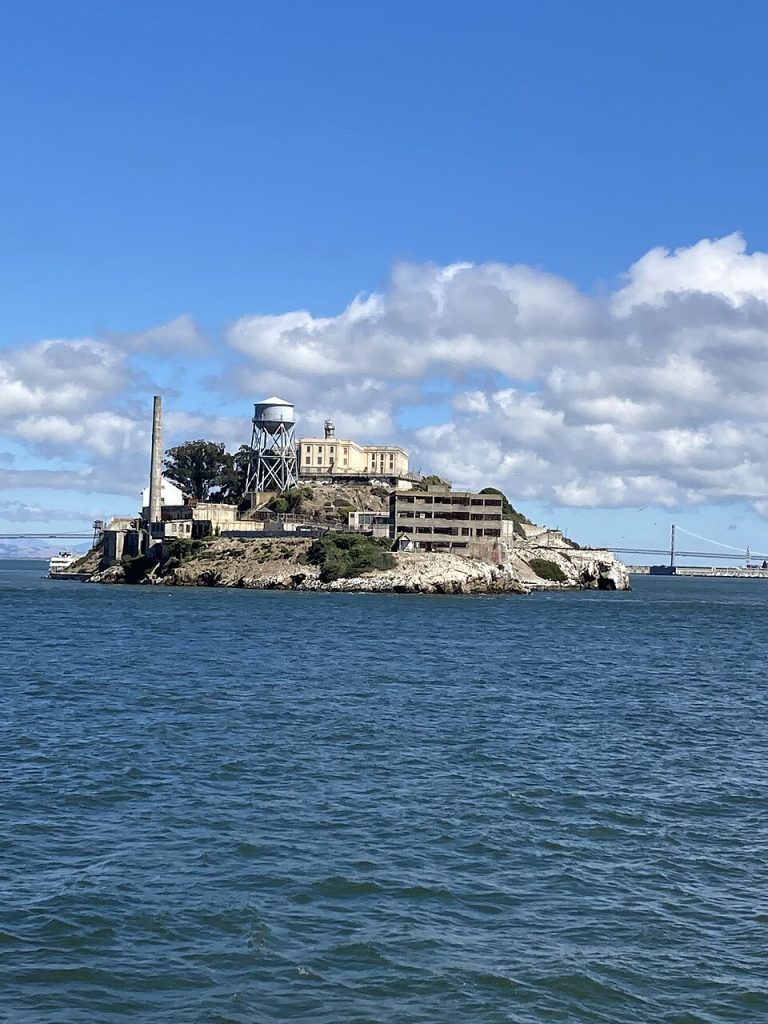
Alcatraz Island is more than just a historical landmark — it’s a fortress of folklore. Rising out of San Francisco Bay like a cold monument to punishment, Alcatraz has long captivated the American imagination. Between 1934 and 1963, it served as a maximum-security federal prison, housing criminals like Al Capone and George “Machine Gun” Kelly. But long after the last prisoner left and the doors were locked, something strange remained.
Stories of hauntings quickly emerged. Visitors reported cold spots, ghostly voices, and mysterious figures wandering abandoned corridors. But buried within these tales is a lesser-known claim — that some murals painted by inmates themselves now appear to show ghostly figures that weren’t part of the original design. These images, now faded and cracked with age, seem to shift, morph, and stare back at viewers.
Are these paranormal manifestations, tricks of the mind, or simply decaying paint playing visual games? In this article, we explore the haunting legacy of Alcatraz’s murals — their origin, their purpose, and the eerie accounts that suggest they may have become haunted windows into the past.
Painting Behind Bars — Art in Alcatraz
Though Alcatraz was built for control, not creativity, art still found a way inside. Some inmates sketched in secret. Others carved. And a rare few painted directly on the prison’s walls. Unlike prisons that actively encouraged rehabilitation through creative outlets, Alcatraz offered almost nothing formally. Still, through informal means and occasional tolerance from guards, a handful of murals came to life inside the bleak concrete structure.
Some of the more widely documented examples included a mural in the dining hall — a patriotic scene said to feature the American flag and a bald eagle. Another appeared in the chapel, painted by an inmate with a background in religious art. Scenes from the Bible were reportedly portrayed in muted tones, stretching across the back wall above the altar. These artworks were often painted with limited materials — cheap brushes, diluted paints, or even makeshift dyes made from soap, food, or powdered stone.
Many of these murals served a purpose beyond decoration. For inmates enduring the psychological weight of confinement, painting was a form of silent resistance. Each brushstroke became a way to reclaim some humanity, to express emotion in an environment that punished emotion.
The Rare Artifacts That Survived
Today, few of these murals survive in any recognizable form. Most were left to decay after the prison closed in 1963. Moisture, mold, and time did their work. Some murals were painted over during facility maintenance or obscured behind modern structures added for public safety.
Photographs and archival notes hint at their former beauty, but direct access is rare. Only a handful of images are preserved in historical records from the National Park Service. In a sense, this loss adds to their mystique. Visitors often walk past flaking patches of wall that once held vibrant scenes, unknowingly brushing shoulders with forgotten art — and possibly something more.
Ghosts in the Murals — Paranormal Reports
While ghost stories on Alcatraz are nothing new, reports linking the murals themselves to unexplained phenomena have become increasingly common in recent decades. These stories generally center around faces or full figures appearing inside the decaying wall paintings, often in areas where no figure had originally existed.
One of the most repeated accounts concerns the former mess hall mural. Tourists claim to see a man’s face peering out from beneath a layer of cracked paint — not a painted figure, but an image that “emerges” when viewed from a certain angle. It has been described as sorrowful, angry, or simply watching, depending on the observer.
In the chapel, similar stories have emerged. Visitors have reported seeing what appears to be a hooded or robed figure standing in the corner of the mural background. Photos taken before and after these sightings reveal no such detail, yet multiple accounts describe the same form, appearing in the same location. Staff members have also heard whispers in the chapel when no one else was around — one even claimed a faint sigh echoed through the space just after a tour group had left.
Faded Faces or Phantom Presences?
The psychological effect of these stories is powerful. Once someone sees a “face” in the wall, they rarely forget it. Paranormal tour guides at Alcatraz have leaned into the legends. On some nighttime tours, guides will quietly point to a faded mural and ask, “Do you see him?” The suggestion alone is often enough to spark sightings.
What makes these stories fascinating is their consistency. While not formally documented by scientific investigators, they follow familiar patterns: cold spots near murals, a sense of being watched, and shifting appearances of faces or forms. For some, these are classic signs of a haunting. For others, they’re compelling psychological phenomena. Either way, the murals are doing more than aging quietly — they’re demanding attention.
Illusion or Apparition? Psychology Meets Paranormal
So what’s really happening when people claim to see faces in paint? One explanation lies in the human mind’s tendency toward pareidolia — a psychological phenomenon where we recognize familiar shapes, especially faces, in random patterns. Think of seeing shapes in clouds or a “man on the moon.” Our brains are hardwired to search for meaning, especially faces, as a survival instinct.
Alcatraz provides a perfect storm of environmental triggers. The lighting is dim. The air is cool. The atmosphere is heavy with history. When people walk through its corridors, they are already emotionally heightened, primed for something unusual to happen. The murals, worn and faded, become ideal surfaces for the imagination to latch onto.
Why Haunted Places Trick the Mind
Haunted locations trigger a specific psychological response known as expectation bias. When visitors enter Alcatraz believing it to be haunted, their senses become more alert, and they unconsciously interpret random stimuli as supernatural. A flicker in the light becomes movement. A chipped shadow in a mural becomes an eye socket.
Group dynamics can amplify this. If one person says, “I see a face,” others are more likely to see one too. It’s the same effect that causes crowds to point at the sky even when nothing is there. The more people believe something is haunted, the more “evidence” tends to appear.
Still, even skeptics admit there’s something eerie about the murals. Rational explanations aside, the emotional weight of the place — combined with the desperate circumstances under which the art was created — gives these walls a haunting power all their own.
The Murals’ Legacy — Art, Trauma, and Interpretation
Even if you dismiss the ghost stories entirely, Alcatraz’s murals still hold a deeper, almost spiritual resonance. They are among the few visual remnants of the emotional lives of inmates — men cut off from the world, from family, and often from themselves. In their isolation, they turned to art. And through that art, they left behind clues to their inner world.
These murals, however small in number or faded in detail, reflect the human cost of incarceration. Some depict biblical scenes, signaling repentance or spiritual hope. Others hint at patriotism, perhaps a longing for redemption. Even abstract or surreal images have been described in reports — haunting, distorted shapes that speak to broken minds.
Preserving Memory Through Decay
Most of the murals are not formally preserved. In fact, some are at risk of being lost entirely due to environmental damage. The National Park Service has focused more on structural maintenance than mural conservation, citing budget limitations and limited public access to the artworks.
But these murals are more than old paint. They are visual time capsules. The ghost stories attached to them only amplify their cultural significance, drawing attention to the fact that even in a place built to erase identity, traces of the human spirit survived.
Artists and historians have called for more proactive preservation efforts. They argue that these murals, haunted or not, deserve protection as part of Alcatraz’s legacy. After all, if a painted wall can stir emotion, prompt mystery, and provoke a sense of the sacred — isn’t that the very definition of great art?
Key Takeaways
- Inmates at Alcatraz painted murals despite harsh conditions, using limited materials and deep emotional motivation.
- Paranormal sightings associated with these murals include ghostly faces, shifting figures, and feelings of being watched.
- Psychological phenomena like pareidolia and suggestion explain many of these ghost sightings, especially in haunted settings.
- Few murals survive today, making their stories and spiritual impact even more compelling.
- Whether one believes in ghosts or not, the murals are haunting reminders of suffering, resilience, and the will to create.
FAQs
1. Did Alcatraz inmates really paint murals on the prison walls?
Yes. While not widely encouraged, a few murals were created by inmates, especially in areas like the mess hall and chapel.
2. What kinds of ghost sightings have been reported near the murals?
People have claimed to see faces or figures in the faded murals, often accompanied by chills or feelings of being watched.
3. Could the ghostly appearances be illusions?
Yes. Experts point to pareidolia, emotional suggestion, and environmental factors like poor lighting as likely causes.
4. Are any of the murals still visible today?
Some faded remnants survive, but most have been lost to time or covered up. Access to surviving works is limited.
5. Has the National Park Service preserved the murals?
Not officially. While the Park Service maintains Alcatraz’s structures, specific mural preservation has not been a major focus.