The Voynich Manuscript stands as one of history’s most tantalizing puzzles. Written in an unknown language and illustrated with strange, otherworldly drawings, it has defied all efforts at translation and explanation. Since its discovery in the early 20th century, scholars, cryptographers, and historians have labored to unlock its secrets, yet it remains stubbornly silent. What makes the Voynich Manuscript so captivating is not only its mystery, but also the craftsmanship and beauty embedded within its pages.
First coming to light in 1912, the manuscript has since attracted countless theories regarding its origins and purpose. Some suggest it is a medical manual, others believe it to be an elaborate hoax, while still others think it contains profound wisdom from a lost civilization. Whatever the truth may be, the manuscript’s story weaves together history, art, faith, and human ingenuity. Every careful brushstroke and every line of its unknown script beckons scholars to dig deeper into its origins.
The very material of the book—vellum made from animal skin—speaks to the traditional craftsmanship of the medieval period. Unlike many modern mysteries manufactured by sensationalism, the Voynich Manuscript carries an aura of authenticity. It reminds us of a time when faith, virtue, and learning were intertwined, and when mysteries were pursued not for fleeting fame, but for the glory of truth. In a world increasingly obsessed with novelty, the manuscript stands as a testament to tradition, beauty, and human curiosity.
As we journey through its history, physical details, and enduring enigma, we gain a better understanding of why the Voynich Manuscript remains an object of fascination. More than a curiosity, it is a relic of a time when knowledge was sacred, and mystery was seen not as a burden, but as a noble invitation to deeper understanding.
The Discovery: Wilfrid Voynich and the Manuscript’s Origins
Wilfrid Voynich was born in 1865 in Telšiai, Lithuania, during a period of great upheaval in Europe. His early life was marked by political struggle; he became involved in revolutionary movements seeking freedom from oppressive regimes. Educated in chemistry, he eventually fled to England in 1890, where he found a new path as a rare book dealer. Voynich’s love of ancient texts and sacred learning led him to amass one of the most fascinating collections of manuscripts ever assembled.
In 1912, while exploring the library of Villa Mondragone, a Jesuit college near Rome, Voynich discovered the strange manuscript that would later bear his name. Tucked among other dusty volumes, the book immediately caught his eye because of its unreadable script and intricate drawings. Believing he had found a work of immense historical value, Voynich purchased the manuscript and began investigating its origins. Early speculation linked the work to the famous medieval philosopher Roger Bacon, born around 1214 AD and renowned for his studies in optics and alchemy.
Voynich’s discovery electrified the scholarly world, with many hoping that the manuscript contained lost knowledge from the medieval Christian era. In keeping with the spirit of noble inquiry that animated the best of European civilization, efforts to decode the manuscript began almost immediately. Voynich himself spent much of the rest of his life attempting to prove its authenticity and historical significance, publishing essays and seeking the aid of leading cryptographers.
Wilfrid Voynich died in New York City on March 19, 1930, leaving the manuscript in the care of his widow, Ethel Voynich, an accomplished novelist and scholar. The manuscript, shrouded in mystery, would continue its journey long after Voynich’s passing, inspiring generations of seekers to take up the noble task he had begun.
Physical Description and Puzzling Features
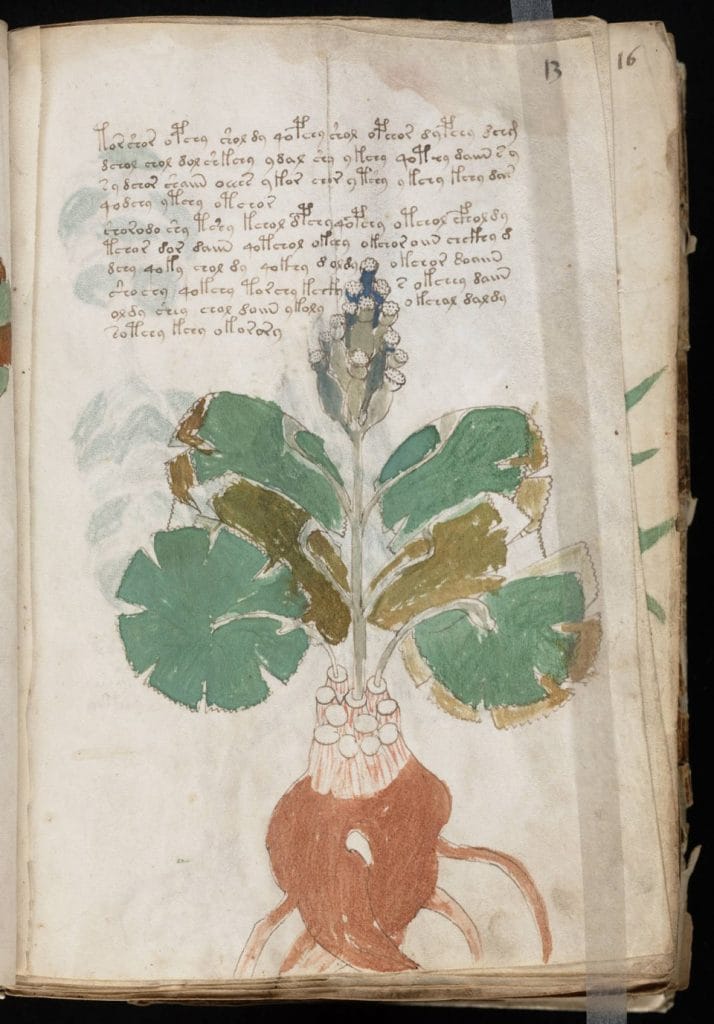
The Voynich Manuscript consists of approximately 240 vellum pages, though evidence suggests that additional pages are missing. Each page is filled with writing in an unknown script, accompanied by detailed illustrations of plants, astronomical diagrams, human figures, and fantastical scenes. The manuscript is divided into several sections, traditionally labeled by scholars as the herbal, astronomical, biological, cosmological, pharmaceutical, and recipes sections. Each part displays its own distinctive style, yet all are unified by the manuscript’s air of enigma.
The script itself is a flowing, elegant hand, remarkably consistent throughout the manuscript. Despite exhaustive efforts, no one has ever conclusively decoded a single word. The writing displays patterns suggesting a genuine language, yet it lacks direct parallels to any known alphabet, medieval or otherwise. Linguists and cryptographers have described its construction as natural, following rules of word construction and syntax, yet still defying comprehension. It stands as a silent testament to either an unknown linguistic tradition or an elaborate puzzle beyond modern understanding.
The illustrations only deepen the mystery. Botanical drawings depict plants that do not exist in known flora, often combining features from various real-world species. Astronomical charts show celestial bodies arranged in unknown systems, while the biological section contains odd scenes of naked women bathing in interconnected pools, often holding tubes that seem to channel fluids between them. There is a strange beauty to these scenes, a testament to the medieval reverence for mystery and the unseen order of creation.
In every page of the Voynich Manuscript, one senses the spirit of a bygone era: a belief in the sacred interconnectedness of all things, the virtue of pursuing hidden knowledge, and the humility to acknowledge that some truths lie beyond immediate comprehension. Its physical craftsmanship alone, with richly detailed miniatures and delicate vellum, speaks of a time when art, science, and faith were not divided, but were facets of a single quest for truth.
Historical Provenance and the Missing Years
Carbon dating conducted in 2009 revealed that the vellum of the Voynich Manuscript was produced between 1404 and 1438 AD. This places its origin firmly in the early Renaissance, a period marked by the recovery of classical wisdom and a Christian reawakening of human reason. Yet despite this scientific anchor, the early history of the manuscript remains shrouded in uncertainty, filled with tantalizing clues and frustrating gaps.
One of the earliest rumored owners was Emperor Rudolf II of the Holy Roman Empire, who reigned from 1576 until his death in 1612. It is said that Rudolf, fascinated by alchemy and the occult, paid 600 gold ducats for the manuscript, believing it to be a work of Roger Bacon. This connection suggests that the manuscript had been regarded as a treasure of ancient knowledge long before Voynich’s discovery. Whether this tradition is accurate or embellished, it situates the manuscript among the highest circles of European learned society.
The next firm historical link comes through Johannes Marcus Marci (1595–1667), a scholar and physician at the University of Prague. Marci sent the manuscript, along with a letter dated 1665 or 1666, to Athanasius Kircher, a Jesuit scholar famed for his attempts to decipher Egyptian hieroglyphs. Marci’s letter claims that Rudolf II once believed the manuscript to have been authored by Roger Bacon, further solidifying the connection to earlier traditions of hidden knowledge.
After centuries of obscurity, the manuscript eventually surfaced again in the early 20th century through Wilfrid Voynich. Upon Voynich’s death in 1930, his widow Ethel preserved it until her death in 1960. Subsequently, rare book dealer Hans P. Kraus acquired the manuscript, but unable to sell it, he generously donated it to Yale University’s Beinecke Rare Book and Manuscript Library in 1969, where it remains today under careful stewardship.
Attempts at Decipherment: Cryptographers and Scholars
William Friedman, born in 1885, was one of America’s greatest cryptographers and a devout believer in traditional order and disciplined inquiry. Having broken Japanese codes during World War II, Friedman turned his formidable talents toward the Voynich Manuscript in the mid-20th century. Despite years of work, Friedman and a team of experts ultimately failed to decode the manuscript, a testament to its extraordinary complexity or perhaps to its otherworldly origin.
Numerous theories about the manuscript’s language have emerged, each more intriguing than the last. Some believe it is a constructed language, invented by a single individual as a secret code. Others suggest that it could represent a lost natural language, obscured by centuries of political upheaval, war, and migration. Despite the rise of powerful computers and modern cryptographic methods, no definitive breakthrough has been achieved.
More recently, artificial intelligence has been employed to detect hidden patterns within the Voynich script. Some algorithms have suggested statistical correlations to known languages like Hebrew or Latin, while others have generated entirely new hypotheses. Yet none of these efforts have yielded a readable translation or identified a coherent meaning behind the text. The manuscript remains what it has always been: an enduring challenge to human pride and an invitation to humility.
The fact that the Voynich Manuscript has withstood the efforts of some of the finest minds, working with the most powerful tools ever created, suggests a sobering truth. Not all knowledge is easily unlocked. In an era obsessed with instant gratification and technological supremacy, the manuscript stands as a reminder of the virtue of perseverance and the sacredness of mystery.
Theories and Speculations About Its Purpose
Speculation about the purpose of the Voynich Manuscript is as varied as it is fervent. One common theory holds that it is a medieval medical textbook, intended for healing the body through herbal remedies and spiritual practices. Another theory sees it as an alchemical manual, rich with secret knowledge accessible only to the initiates of a hidden order. Some scholars have suggested that it is a religious or philosophical work, coded to protect its sacred insights from unworthy eyes.
The authorship of the manuscript remains an equally hotly debated question. While early enthusiasts clung to the theory that Roger Bacon authored it, later scholarship has largely abandoned this idea. Others have posited that it was created by a European apothecary, perhaps a member of a guild who sought to protect his professional secrets. Some even speculate that the manuscript was created by a woman, inspired by the numerous feminine figures within its pages and the traditionally female role in medieval herbal medicine.
There are those who argue that the manuscript could be an elaborate hoax, designed to deceive a wealthy patron or collector. If this were true, it would represent a marvel of medieval craftsmanship and deceit. However, many experts dismiss the hoax theory because of the linguistic complexity and internal consistency of the manuscript, which would have required extraordinary genius and years of effort with no clear financial reward.
Ultimately, the Voynich Manuscript defies easy categorization. It embodies a medieval worldview that saw no contradiction between faith and reason, mystery and order. Whether it was created for healing, worship, or wonder, it remains a symbol of the sacred hunger for truth that has animated Western civilization since its foundation.
The Voynich Manuscript in Modern Culture
Today, the Voynich Manuscript has become a fixture of popular imagination. It has inspired countless novels, films, and television shows, often cast as a mysterious artifact holding the key to ancient wisdom. Works such as “The Rule of Four” and television programs on the History Channel have capitalized on its enigmatic appeal. In every portrayal, the manuscript stands as a symbol of the eternal quest for hidden truths.
Artists and musicians have also drawn inspiration from the Voynich Manuscript’s haunting beauty. Its strange botanical illustrations and mysterious script have influenced contemporary paintings, music albums, and even theatrical productions. In a time when so much art has abandoned craft and reverence, the manuscript reminds modern creators of the virtues of mystery, discipline, and dedication.
Scholars continue to produce facsimile editions, allowing researchers and laymen alike to study its pages in detail. Scientific studies using multispectral imaging and other techniques have revealed new layers of information, yet have still failed to crack the code. The manuscript’s stubborn resistance to analysis only heightens its sacred status among lovers of history and tradition.
Far from fading into obscurity, the Voynich Manuscript grows more prominent every year. In an age increasingly characterized by transience and disillusionment, it serves as a beacon of permanence, reminding us that some mysteries are meant not merely to be solved, but to be revered.
Conclusion
The Voynich Manuscript remains one of the most compelling mysteries of all time. It transcends the academic and touches something eternal within the human soul: the yearning for knowledge, the love of beauty, and the hunger for sacred truth. Its pages, filled with strange characters and fantastical images, continue to call to those who believe that not all things must be immediately comprehended to be profoundly important.
Its history, stretching from 15th-century workshops through the courts of emperors to the libraries of modern universities, forms a golden thread linking the past and present. Every failed attempt at decoding it only reinforces its status as an icon of human perseverance. In a world often dominated by cynicism and ephemeral trends, the Voynich Manuscript calls us back to the noble pursuit of enduring truth.
Perhaps the true purpose of the Voynich Manuscript is not to be decoded, but to inspire generations with its sacred mystery. It represents a time when learning was a duty, mystery was a gift, and truth was a prize worth a lifetime’s pursuit. In that spirit, it will forever endure.
Key Takeaways
- The Voynich Manuscript was discovered by Wilfrid Voynich in 1912.
- It dates to between 1404 and 1438 AD based on carbon dating.
- Despite many attempts, no one has decoded its mysterious language.
- Theories about its purpose range from medical textbook to sacred work.
- It continues to inspire scholars, artists, and seekers worldwide.
FAQs
- Who was Wilfrid Voynich?
A Lithuanian-born rare book dealer who discovered the manuscript in 1912. - When was the Voynich Manuscript created?
Carbon dating places it between 1404 and 1438 AD. - Has anyone decoded the manuscript?
No; despite extensive efforts, it remains unreadable. - Is the Voynich Manuscript a hoax?
Most experts believe the complexity suggests it is genuine, not a hoax. - Where is the manuscript today?
It is housed at Yale University’s Beinecke Rare Book and Manuscript Library.