Nestled in the wild heart of central France, the École de Crozant was more than just a loose collective of painters—it was a visual love letter to the French countryside. Set against the dramatic landscape of the Creuse Valley, this informal group of landscape painters worked from roughly 1850 to 1950, united by their shared admiration for nature’s raw, unspoiled beauty. Though often overlooked in mainstream art history, these artists played a key role in shaping regional painting and preserving a distinctly rural visual identity during a time of growing industrialization. With its rugged cliffs, winding river, and the haunting ruins of the Château de Crozant, this area proved irresistible to generations of plein air painters.
Unlike formal academies in Paris, the École de Crozant was not an institution with teachers, curriculums, or fixed memberships. It emerged organically as artists began flocking to the area, lured by the unique lighting, dramatic terrain, and the solitude it offered. The term “school” was applied retrospectively, describing a group of painters who, though stylistically diverse, shared a commitment to painting the landscapes directly from life. While the movement was not driven by manifestos or art theory, it was grounded in a profound respect for place and a shared devotion to capturing nature in real time.
A Landscape Painter’s Paradise in Central France
The region’s charm was more than aesthetic—it was sensory. The light in Crozant was described by artists as almost mystical, shifting dramatically over the course of a single day. The steep cliffs, carved by the River Creuse and the Sedelle, created a natural amphitheater where the ruins of a medieval castle stood silhouetted against the sky. Artists found inspiration in the mix of rock, water, ruined architecture, and untamed vegetation that gave the place an ancient, almost eternal quality.
Painters working in Crozant were generally part of the post-Impressionist generation, though they maintained their own visual vocabulary. Many worked en plein air, meaning they painted outdoors, directly observing the landscape rather than relying on sketches or studio memory. Their brushwork varied—from the soft, light-touch style of early Impressionism to heavier, more expressive marks that reflected the region’s rugged character. Over a century later, the legacy of their work still lingers in local museums and private collections, quietly telling the story of a region deeply loved and passionately painted.
The Roots of the Movement: Before Crozant
The École de Crozant didn’t emerge from a vacuum. Its development was seeded by artistic shifts in the early 19th century, particularly the Romantic movement’s fascination with wild, untamed nature. French painters like Théodore Rousseau (1812–1867) and Jules Dupré (1811–1889) sought inspiration outside the city, turning their eyes toward the forests, fields, and rural scenes that had been long ignored by academic salons. These early explorations laid the foundation for future generations to look inward—to France’s own countryside—rather than abroad for subject matter.
In the 1830s and 1840s, the Barbizon School, located near the Forest of Fontainebleau, became a magnet for artists craving a return to nature. Their work emphasized natural light, tonal variation, and the humble beauty of local terrain. Camille Corot (1796–1875), though later connected to the Impressionists, spent time in the Creuse region early in his career, and while he wasn’t a formal member of the Crozant group, his atmospheric approach deeply influenced later artists there. His example showed that landscape painting could be both poetic and precise, personal and universal.
From Romanticism to Realism in Rural France
By the mid-19th century, the trend of plein air painting was gaining momentum. Artists no longer saw sketching outdoors as preparation; rather, painting directly from nature became a defining practice. As railway travel became more accessible, more painters began to seek remote destinations to escape the bustling city and find authentic scenes untouched by modernization. The Creuse Valley, with its dramatic elevation changes and isolation, offered exactly that—raw material for spiritual and visual exploration.
This transition from Romanticism to Realism found fertile ground in Crozant. The artists who worked there saw themselves as continuing the work of Rousseau and Dupré, but with a fresh palette and new tools. They embraced color, light, and form with increasing boldness. The shift marked a change not only in aesthetics but in values—favoring local landscapes, personal interpretations, and an organic artistic community over institutional approval or commercial success.
Armand Guillaumin: The Soul of Crozant
If the École de Crozant had a spiritual leader, it was unquestionably Armand Guillaumin. Born in Paris on February 16, 1841, Guillaumin began his artistic education at the Académie Suisse, a progressive alternative to the traditional École des Beaux-Arts. There he met future giants like Paul Cézanne and Camille Pissarro, forming friendships that would shape his career. Yet while they would achieve widespread fame, Guillaumin remained more localized in his influence—known best for his vivid, expressive landscapes and deep commitment to rural France.
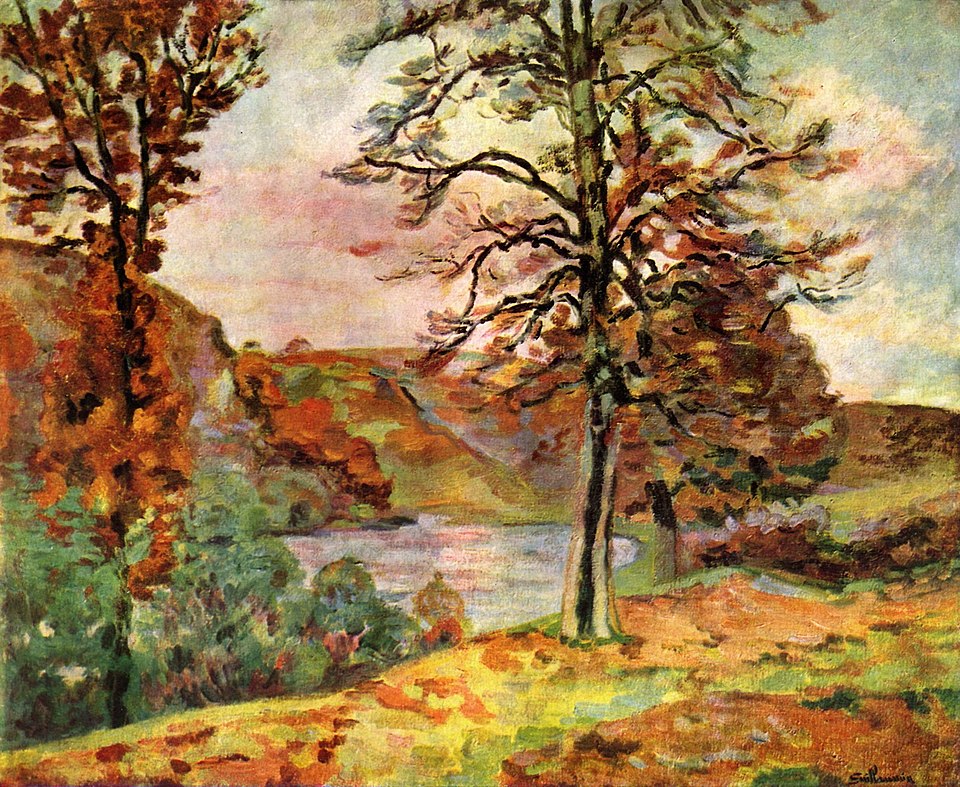
Guillaumin first visited Crozant in the 1890s, and he quickly fell under the region’s spell. He returned year after year, eventually purchasing a house in Saint-Palais in the Creuse. His works from this period are marked by fiery color choices and dynamic brushwork that pushed the boundaries of Impressionism into Expressionist territory. He painted not just what he saw but what he felt—the heat of the sun on the rocks, the shimmer of the river, the cool haze of morning fog. His most celebrated canvases from Crozant, such as The Creuse at Crozant (1895), pulsate with a life rarely seen in landscape art of the time.
Guillaumin’s Bold Colors and Lifelong Dedication
Guillaumin’s connection to Crozant was more than seasonal—it was emotional and lifelong. Even after gaining recognition and exhibiting regularly in the Paris Salons and with the Impressionists, he remained committed to the region. In 1927, he died in Orly at the age of 86, but his legacy lives on through his deeply atmospheric portrayals of the Creuse. His dedication set a precedent, attracting other painters to follow in his footsteps and settle, at least temporarily, in the area.
Though sometimes overshadowed by his better-known peers, Guillaumin was considered a master colorist, praised for his daring use of pigment and compositional freedom. He was awarded the Prix Osiris in 1891, a rare moment of official recognition. His close relationships with Pissarro and Cézanne helped place him within the broader narrative of modern French art, yet his deepest mark was left on Crozant itself. Without him, the movement would likely have remained fragmented and peripheral—he gave it identity, consistency, and color.
Key Figures of the École de Crozant
While Guillaumin was the heart of the movement, he was far from alone. The École de Crozant attracted a wide range of artists, both French and foreign, who found inspiration in the Creuse region. Léon Detroy, born in Chinon in 1857, was one of the most devoted of these. He spent decades painting in and around Gargilesse and Fresselines, often working alongside Guillaumin. Detroy’s vigorous brushwork and intense use of shadow set him apart, and his dedication to painting the same locations in different seasons created a kind of visual diary of the valley.
Another major figure was the Swedish-born Allan Österlind, who settled in Fresselines in the late 19th century. Born in 1855 and trained at the École des Beaux-Arts in Paris, Österlind combined Scandinavian tonal sensitivity with French technique. His watercolor and oil paintings captured the region’s atmospheric depth, especially during winter months. Often painting interiors as well as landscapes, he broadened the scope of the Crozant school, blending figure painting and genre scenes with plein air landscapes.
Lesser-Known Masters of the Creuse
Other names also deserve attention. Paul Madeline (1863–1920), Fernand Maillaud (1862–1948), and Ernest Hareux (1847–1909) contributed significantly to the regional style. Their paintings, often exhibited in Paris, brought the visual language of the Creuse Valley to urban audiences. Many of them belonged to the Société Nationale des Beaux-Arts, allowing them to maintain national careers while staying rooted in regional themes.
Women also participated in the movement, although their contributions have often been underrepresented. Marguerite Delorme, who painted in Gargilesse and the surrounding area, is one of the few female painters known to have worked within the Crozant circle. While records are sparse, her work reflects the same concern with light, mood, and texture found in her male counterparts. The Crozant school may not have been as formally organized as other movements, but it was diverse, dynamic, and deeply engaged with its environment.
Techniques and Themes in Crozant Painting
Artists of the École de Crozant were defined by their methods as much as their location. Plein air painting was not simply a choice—it was a requirement. They often carried their canvases, easels, and paint boxes deep into the gorges and rocky plateaus, hiking for miles to find the perfect vista. The raw physical effort mirrored the artistic intensity required to capture fleeting atmospheric conditions before the light changed. In this setting, precision and spontaneity had to co-exist.
Oil paint was the medium of choice for most, but watercolor and pastel were also common, especially for preliminary studies or lighter treatments of cloud and water. The artists’ brushwork often veered into thick, impasto textures, especially in rocky scenes or when depicting the sunlit cliffs. Many favored a warm, golden palette in the summer and shifted to silvery blues and purples in the winter. The changing seasons provided endless variation, and artists often returned to the same scene multiple times throughout the year to document these changes.
Light, Seasons, and Stone
Common subjects included the Château de Crozant ruins, perched dramatically above the river gorge, and the twisted paths winding through the forested hills. Light was perhaps the most important theme of all—its reflections on water, its glow on stone, its obscurity in fog. Unlike Impressionists who often chased fleeting impressions, Crozant artists sought a deeper mood—an emotional resonance tied to nature’s rhythms. Their paintings weren’t just pretty views; they were visual meditations.
This emphasis on mood and material helped distinguish the Crozant style from mainstream Impressionism. While Monet and Renoir often bathed their scenes in diffused, elegant light, Crozant painters worked with harder edges, bolder contrasts, and more rugged subject matter. Their goal was not to idealize nature but to capture it honestly, with all its harshness and beauty intact. It was art born not from theory, but from dirt, stone, and sky.
The Decline and Rediscovery of the École
Like many regional art movements, the École de Crozant gradually faded from view in the early 20th century. The First World War disrupted lives, travel, and the flow of artists to rural areas. Many key figures were aging or passed away by the 1920s and 1930s, and the rise of new avant-garde movements like Cubism, Dadaism, and Surrealism made the Crozant style seem old-fashioned. The focus of the art world shifted toward abstraction and urban themes, leaving regional landscape traditions behind.
The devastation of the Second World War only deepened the decline. Rural France struggled economically, and many small towns like Crozant and Fresselines saw depopulation and disinvestment. The art of the region was largely confined to local collectors or left forgotten in provincial museums and family estates. For decades, the École de Crozant was considered a footnote in art history—quaint, conservative, and out of step with modern tastes. Academic research virtually ignored it throughout the mid-20th century.
Postwar Forgetting and 20th-Century Revival
But in the 1990s, a revival began. Local historians and art lovers began to reassemble lost works, publish small catalogues, and lobby for recognition of the movement’s cultural significance. The creation of the Musée de la Vallée de la Creuse, located in Éguzon, marked a turning point. Exhibiting works by Guillaumin, Detroy, and others, the museum drew new attention to the regional style. Curators emphasized not only the aesthetic value of the works but their historical importance as a record of pre-modern rural France.
Travelers, too, began returning to the Creuse region, drawn by its unspoiled beauty and the romantic legacy of the artists who had once immortalized it. Art festivals, exhibitions, and publications helped restore the movement’s place in the public imagination. Though still underappreciated compared to larger movements, the École de Crozant is once again seen as a vital chapter in the story of French painting. It is now studied in relation to both national artistic developments and the broader narrative of place-based art.
Why the École de Crozant Matters Today
In today’s fast-paced, urban-dominated art world, the École de Crozant offers something refreshingly grounded. It reminds us that art does not need to be shocking, political, or conceptual to matter. These painters found meaning in the play of sunlight on stone, the rustle of trees in the wind, the hush of misty mornings. Their work speaks to a timeless human desire to slow down, observe, and connect with the land.
Modern art historians are re-evaluating the role of regional schools like Crozant within the larger framework of French modernism. They argue that these painters contributed to the diversity of landscape painting in ways that should be acknowledged alongside their urban contemporaries. Their rejection of industrial themes and abstract theory was not ignorance—it was a deliberate choice to hold onto something enduring. In an era obsessed with novelty, this kind of artistic integrity stands out.
A Forgotten Chapter in French Art History
The École de Crozant also aligns with broader movements toward conservation, heritage tourism, and appreciation of local culture. As visitors explore the ruins of the Château de Crozant or hike along the River Sedelle, they often find themselves tracing the steps of the artists who once painted there. The connection between art and place becomes tangible. Museums and cultural centers across the Creuse are working to protect this legacy, offering workshops, exhibitions, and artist residencies that continue the tradition.
Ultimately, the value of the École de Crozant lies not only in its paintings but in its worldview. These artists believed that truth, beauty, and meaning could be found not in faraway capitals but in the hills and valleys of home. In their brushstrokes, we see not only the contours of a landscape but a way of life—rooted, reverent, and richly alive.
Key Takeaways
- The École de Crozant was a loosely connected group of landscape painters working from 1850 to 1950.
- Armand Guillaumin played a leading role, making Crozant central to his art from the 1890s until his death in 1927.
- The movement emerged from earlier plein air traditions like the Barbizon School.
- Artists used bold color, expressive brushwork, and focused on the dramatic terrain and light of the Creuse Valley.
- A 1990s revival brought attention back to this forgotten but significant regional art movement.
Frequently Asked Questions
- Where is Crozant located?
In the Creuse department of central France, near the confluence of the Sedelle and Creuse rivers. - Who founded the École de Crozant?
It had no formal founder, but Armand Guillaumin is considered its central figure. - What kind of painting style did they use?
Plein air landscape with post-Impressionist influences and bold color use. - Is the École de Crozant still active?
No, but its legacy is preserved through museums and modern artists in the region. - Can I see these paintings today?
Yes, in local museums like the Musée de la Vallée de la Creuse and in private collections.