Long before the rise of classical civilizations, long before the pyramids of Egypt or the temples of Greece, a mobile people roamed the vast grasslands stretching from the Dniester River to the Volga. These were the Yamnaya, horse-herding steppe dwellers who thrived between 3300 and 2600 BC, during what we now call the Early Bronze Age. Despite leaving behind no cities or written records, the Yamnaya fundamentally shaped the linguistic and genetic foundation of much of Europe and South Asia. But while they’re often studied for their migrations and genetic legacy, their artistic and symbolic culture deserves serious attention.
The Yamnaya were nomadic pastoralists, part of the broader Indo-European world before it had a name. Their economy revolved around cattle, horses, and seasonal movement, which meant they didn’t build temples or carve monumental statues. Yet their visual culture survives in other forms — in burial practices, metal objects, ornaments, and symbolic arrangements of grave goods. This sparse but telling evidence offers a unique window into how an early Indo-European people understood death, identity, and the sacred.
Most of what we know about Yamnaya art comes from archaeology, not aesthetics. No literature survives. No wall paintings or sculptures were created in a classical sense. But when viewed through the lens of ritual and material symbolism, their cultural output takes on clearer form. Their burial mounds — called kurgans — serve as enduring monuments, not only to the dead, but to a visual language of status, order, and belief.
Archaeological digs across Ukraine, southern Russia, and Kazakhstan have revealed thousands of these mounds, each containing human remains and symbolic objects: weapons, animal bones, beads, and red ochre. The kurgans weren’t art in the gallery sense, but they embodied the Yamnaya’s concept of continuity, cosmology, and honor. This is where their art history begins — not in carved stone, but in ritualized earth.
Yamnaya Burial Mounds and Symbolic Design
The burial mound, or kurgan, is the central visual and cultural monument of the Yamnaya world. Unlike the tombs of sedentary cultures, which often reflect wealth through architecture, the Yamnaya’s mounds were expressions of sacred continuity, social order, and ancestral memory. A single mound could contain multiple generations of burials, each carefully placed with attention to orientation, position, and associated objects. In this way, kurgans weren’t just grave markers — they were living records of a people’s worldview.
Each kurgan followed a relatively consistent structure across the Yamnaya territory. The dead were typically laid in pit graves dug into the ground and then covered with a mound of soil, often reinforced with stones or wood. Bodies were usually placed in a contracted position, knees bent and drawn toward the chest, and almost always oriented to the west or southwest. Scholars have long speculated on this orientation. One leading theory suggests it was tied to sun symbolism — with the sun setting in the west, this direction may have symbolized a return to the ancestors or the afterlife.
Perhaps the most striking and consistent feature of Yamnaya graves is the use of red ochre, a naturally occurring iron oxide that was sprinkled or layered over the body and grave floor. Red ochre had symbolic meaning for many ancient cultures and has been found in burials as far back as the Paleolithic. In the Yamnaya context, it likely represented life force, blood, or rebirth — fitting symbols for a people who believed death was not an end, but a passage. The visual impact of this element in the grave — a vivid red surrounding a body buried in solemn stillness — is unmistakable and deeply intentional.
The contents of the grave also tell us about symbolic design. Men were often buried with weapons — stone battle-axes, flint daggers, or early metal tools — while women were more likely to have beads, bone ornaments, or spindle whorls. These objects weren’t merely practical or decorative; they marked social identity and status, possibly even roles within ritual or clan hierarchies. The inclusion of items tied to daily life and warfare speaks to a worldview where the individual’s place in society extended beyond death.
Some kurgans contain evidence of complex layering, where older graves were covered and new ones added above them, often within the same mound. This practice indicates a respect for lineage and ancestral continuity. Over time, some of these mounds became central places in the landscape — visible symbols of clan dominance or sacred ground. The very act of creating a kurgan was likely ceremonial, involving the entire community in a sacred task of burial, remembrance, and renewal. These mounds remain the most enduring and visually structured expression of Yamnaya symbolic culture.
Yamnaya Metallurgy and Decorative Objects
If the kurgan was the Yamnaya’s greatest monument, then metal was their finest material. The Yamnaya people were among the earliest to work with copper and bronze, crafting tools, weapons, and ornaments by hand — often with nothing more than stone hammers and open fires. These items weren’t mass-produced or flashy like later Bronze Age treasures, but they show early signs of design, pride, and meaning. When placed in graves, they also spoke silently about status, role, and honor.
The most common metal object found in Yamnaya burials is the flat axe, shaped from copper. It wasn’t just a weapon — it was a symbol. A man buried with such an axe was likely a warrior or tribal leader. The axe’s shape, the care with which it was cast, and its repeated presence in high-status graves all point to its deeper meaning. Other grave finds include flint daggers, pierced animal teeth, and spindle whorls — weights used in spinning thread — which were often buried with women. These objects weren’t ornate, but their placement shows clear symbolic value.
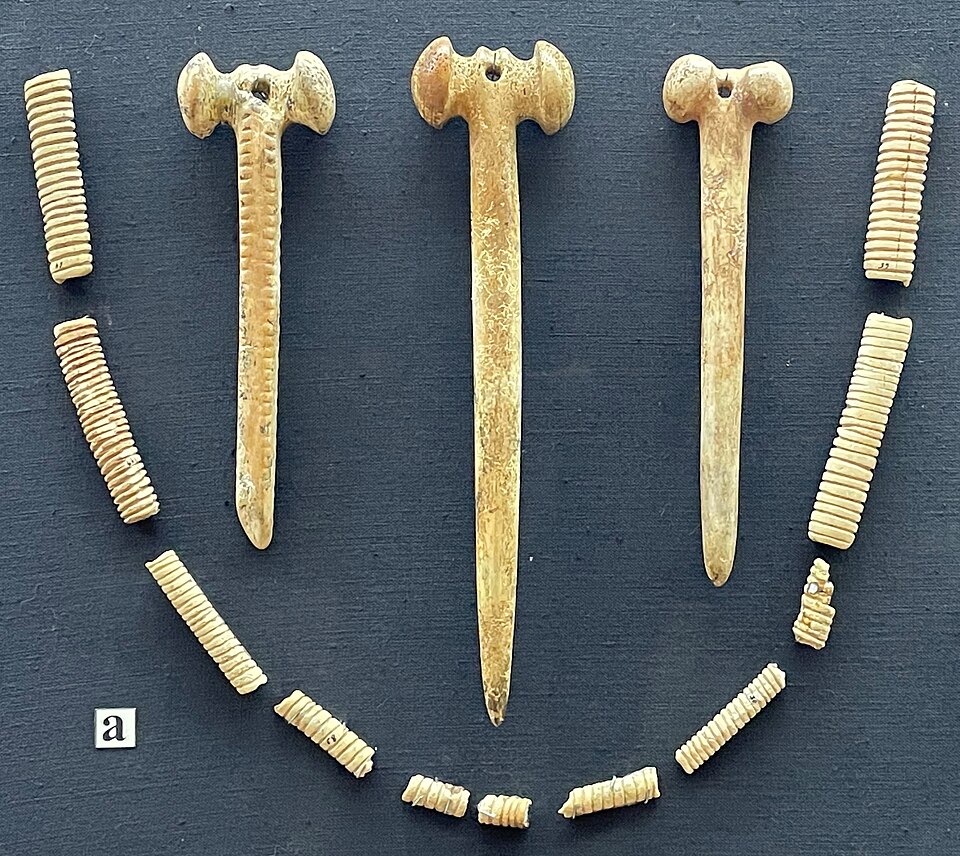
Yamnaya metalworkers also made pins, beads, and simple spiral ornaments, often worn as part of clothing. These were usually made of copper and occasionally bronze, sometimes combined with bone or shell. There’s little decoration — no intricate designs or figures — but there’s skill in how these items were shaped and finished. A pin with a coiled end, for example, shows both practical use and an early eye for form. That’s where art begins: in the choices people make when shaping raw material.
Compared to the rich gold and silver of their Maykop neighbors to the south, Yamnaya metalwork was modest. But that modesty reflects a different world — one where honor and utility were more important than flash, and where art served memory, not vanity. There’s a beauty in that restraint. A plain copper dagger buried carefully beside a man tells us more about Yamnaya values than a jeweled crown ever could.
Most importantly, these items show the Yamnaya weren’t just moving across the steppe — they were crafting and creating, using early techniques of heating, hammering, and casting to turn raw copper into something personal. Even without figures or elaborate patterns, their metalwork speaks. It says, “I lived. I had a place. I mattered.” In that sense, it is art in its oldest form.
Rock Art and Petroglyphs on the Steppe
Across the steppe, from the Ural Mountains to the Caspian Sea, ancient carvings still lie scattered on stone outcrops and cliffs. These are petroglyphs — images scratched or hammered into rock. Many are later than the Yamnaya period, but some may go back far enough to overlap with their time. While we can’t say for certain that the Yamnaya made them, they were part of the same landscape and likely saw and understood the same symbols.
What do these carvings show? The most common images are animals, wheels, and sun-like shapes — circles with spokes or rays. Some show groups of people or what appear to be wagons. These are simple but powerful symbols. A circle with spokes might stand for the sun, a key force in many early Indo-European belief systems. Wagons and horses appear in later Indo-European myth, tied to gods, journeys, and the sky. If these carvings do reflect early Yamnaya beliefs, then they may be the oldest surviving images of a shared myth that spread far across Europe and Asia.
It’s important not to go too far — archaeologists argue about which petroglyphs are truly Yamnaya. The rock art in places like Kazakhstan or southern Russia often comes from cultures that came after the Yamnaya, such as the Andronovo or Srubnaya people. But that doesn’t mean the Yamnaya had no hand in shaping this artistic world. Ideas don’t stop when a people move on — they carry over, they evolve. The fact that sun symbols, wheels, and animals remain central in later steppe art suggests a lasting tradition, likely rooted in the Yamnaya’s time.
If the Yamnaya did make or inspire some of these carvings, it shows they were not just herders and warriors — they were also observers of the world, carving meaning into the land itself. A rock carving isn’t just a doodle. It’s a message across time. Even if we can’t always read it clearly, it still speaks. And in the silence of the steppe, that voice matters.
Yamnaya Textiles, Clothing, and Body Art
No woven garments from the Yamnaya era have survived. Cloth breaks down over time, especially in open steppe conditions, and nothing in their burial environment preserved fibers well enough for recovery. But that doesn’t mean we’re left with nothing. Clues come from textile impressions, bead placements, and tools like spindle whorls — which all help us make educated guesses about what the Yamnaya wore and how they used clothing to mark identity and status.
Spindle whorls found in women’s graves suggest wool spinning, which means woven wool garments were likely worn by both sexes. The Yamnaya herded sheep, so the source of wool was there. Beads, copper pins, and animal teeth were often found near the head, neck, or chest of skeletons, hinting at necklaces, brooches, or sewn-on decorations. These aren’t just trinkets — they served a purpose similar to jewelry in every age: showing who you are, what you value, and perhaps where you belong.
The Yamnaya also likely wore leather belts, woven sashes, and perhaps cloaks or tunics, much like other steppe peoples of later centuries. Bone fasteners and pierced decorations show a sense of style, even if the designs weren’t flashy. Men buried with decorated weapons and pins probably saw their appearance as part of their status — not unlike a uniform or ceremonial dress.
There’s also the question of body decoration. Many scholars believe the Yamnaya may have practiced tattooing or body painting, though no direct evidence survives. The frequent use of red ochre, sometimes layered over the body, clothing, and even the grave walls, suggests that color had ritual importance. Whether the ochre was used only in death or also in life isn’t certain, but its powerful presence in the graves points to a culture that saw the body itself — even in death — as something worth adorning.
So while we don’t have Yamnaya clothing in museum cases, the tools they left behind and the patterns in their graves suggest a visual identity that was both practical and symbolic. What you wore mattered. What you took with you into death mattered even more.
Symbolism in Horse Gear and Wheeled Vehicles
One of the Yamnaya’s most important contributions to world history wasn’t a thing, but a revolution: the domestication of the horse. These people weren’t the first to interact with horses, but they were among the earliest to use them for transport, herding, and status. Alongside this came the use of wheeled carts, a combination that allowed the Yamnaya to move farther and faster than any people before them — and to carry their beliefs and cultural symbols across vast distances.
Horse burials are rare but not unknown in Yamnaya sites. More often, we find horse teeth, bones, and harness pieces, sometimes placed beside a male burial. These animals weren’t just work animals — they were likely considered sacred or tied to social power. Later Indo-European myths — from the Vedic hymns of India to Norse legends — often feature divine horses, sky chariots, and sun wagons. Many scholars believe these myths had deep roots in Yamnaya beliefs, even if they weren’t written down at the time.
The carts themselves, usually four-wheeled and made from wood, are sometimes found in grave pits or referenced through wheel impressions and hardware remains. These wagons weren’t just useful for migration. They had meaning. In some Yamnaya graves, wheels or miniature cart models were buried beside the dead, possibly as symbols of status or as imagined vehicles to the afterlife.
There’s also evidence of symbolic decoration on gear. Though Yamnaya artisans didn’t carve images into metal or wood in the way later cultures did, some leather harness elements and bronze fittings show early shaping and design, sometimes even spiral or circular forms — symbols likely tied to cycles, the sun, or the journey through life and death. The simple act of attaching a shaped ornament to a harness or a cart spoke of a desire to give meaning to motion.
In a mobile society like the Yamnaya, what moved you also defined you. The horse and wagon were more than tools — they were emblems of status, power, and sacred order. Their artistic expression is found not in museums, but in the ground — in where the wheels were buried, how the horses were honored, and how these symbols rode on into Indo-European traditions that followed.
Comparison with Contemporary Steppe Cultures
The Yamnaya didn’t exist in a vacuum. Across the broader steppe and forest-steppe zone, other cultures were building, crafting, and burying in their own ways. Two in particular — the Maykop culture to the south and the Tripolye (or Cucuteni-Tripolye) culture to the west — offer a clear contrast to the Yamnaya’s spare, symbolic art. These differences don’t just show variety; they highlight what made Yamnaya visual expression unique.
The Maykop culture, centered in the North Caucasus around the same time (c. 3700–3000 BC), left behind stunning metalwork: gold and silver vessels, jewelry, figurines, and intricate ornaments. Their burial goods are rich, decorative, and sometimes display animal forms or human figures — things we never find in Yamnaya graves. The Maykop also built elaborate kurgans, but theirs often included ceremonial structures and imported luxury items. Their artistic culture was tied more to the highlands and likely influenced by contact with the Near East.
In contrast, the Tripolye people (c. 4800–3000 BC) were farmers, not herders. They built large settlements, produced highly decorated ceramics, and buried their dead in flat graves or small cemeteries. Their pottery is often painted with spirals, waves, and geometric designs, usually in black, red, or white. While the Yamnaya used grave goods sparingly and avoided figurative decoration, Tripolye culture emphasized pattern and domestic art — suggesting a very different relationship with visual expression.
When these three cultures are placed side by side, a pattern emerges. The Maykop used art to show wealth and ritual complexity. The Tripolye expressed order and fertility through household objects. But the Yamnaya focused on symbolism through simplicity. Their visual culture came through burial structure, object placement, and material choice, not through surface decoration. In a way, their restraint is what speaks loudest.
These differences also show cultural priorities. The Yamnaya weren’t interested in permanence the way settled peoples were. Their art was portable, tied to the body or the burial. Their monuments — the kurgans — were collective and ritualistic, not decorative. And unlike Maykop goldsmiths or Tripolye potters, Yamnaya craftsmen seemed less concerned with style and more with symbolic function. That focus on meaning over ornament is a consistent theme across their archaeological record.
The Yamnaya Legacy in Early Indo-European Art
Though the Yamnaya left no temples, no statues, and no literature, their legacy flows through the art of the Indo-European world. As their descendants moved east into Central Asia and India, west into the Balkans and the Danube, and north into the forests of Europe, they carried with them symbols, ideas, and structures of belief that would influence art for centuries to come.
This influence is hardest to see in the material sense — there are no exact copies of Yamnaya tools or kurgans in later societies — but the patterns are there. The Sintashta culture (c. 2100–1800 BC), which emerged east of the Ural Mountains a few centuries after the Yamnaya, shows a continuation of kurgan burials, horse sacrifice, and chariot use. The Andronovo culture that followed expanded this tradition even further, developing more advanced metallurgy and introducing geometric designs on ceramics and tools. These were not carbon copies, but evolutions of an older visual grammar.
Even in ancient Europe, echoes of the Yamnaya world appear. The Urnfield culture in Central Europe, the Celts, and even early Greek and Italic tribes all show burial customs and symbols — especially those related to the sun, the wheel, and the horse — that line up with older Indo-European mythic patterns. While we must be cautious not to draw a straight line from one grave to another, the continuity of core symbols — the solar wheel, the divine twins, the sacred mount — suggests a shared past, much of it seeded in the Yamnaya age.
Language plays a role here too. Proto-Indo-European, the ancestral tongue of nearly half the world’s languages, likely developed among the Yamnaya and their close kin. And with language came myth, poetry, and oral tradition, all of which shaped how people saw the world — and how they made their art. A sun-disk on a wagon, a spiral engraved on a bronze pin, a twin horse motif on a shield — these are not random. They’re visual echoes of a common story.
In that sense, Yamnaya art isn’t what you hang on a wall. It’s what you carry — in belief, in tradition, and in buried memory. Their greatest creation may have been an invisible one: a shared Indo-European symbolic structure, carried on the backs of riders and the wheels of carts, across continents and into history.
Key Takeaways
- The Yamnaya expressed their beliefs through burial practices, not sculpture or painting, using mounds, red ochre, and symbolic grave goods to show status and ritual meaning.
- Metal tools, weapons, and ornaments were crafted with care and intention, serving as personal symbols rather than purely functional items.
- Rock carvings found across the steppe suggest a wider symbolic tradition, with animals, wheels, and sun symbols possibly reflecting early Indo-European beliefs.
- Clothing, adornments, and possibly body painting or tattooing were used to mark identity, even if no textiles have survived.
- The Yamnaya left a legacy that shaped later Indo-European cultures, not through fine art, but through shared burial customs, mythic symbols, and a mobile worldview expressed in material form.
Frequently Asked Questions
1. What kind of art did the Yamnaya people create?
They didn’t produce traditional art like paintings or statues. Instead, their art is seen in burial mounds, grave goods, metalwork, and symbolic use of materials like red ochre.
2. Are there any cave paintings or carvings made by the Yamnaya?
There are petroglyphs across the steppe, but it’s unclear if the Yamnaya made them. Many are likely from related or later steppe cultures.
3. What materials did the Yamnaya use for tools and ornaments?
They used copper, bone, flint, stone, and animal teeth. Metal objects like axes, pins, and beads were common in graves.
4. How do Yamnaya burial customs reflect their beliefs?
Grave orientation, the use of red ochre, and inclusion of personal objects all point to beliefs about the afterlife, ancestral honor, and cosmic order.
5. Did Yamnaya artistic culture influence later societies?
Yes. Burial traditions, symbolic motifs like wheels and horses, and oral myth structures seen in later Indo-European cultures likely trace back to Yamnaya roots.