When Michelangelo Buonarroti was summoned to Rome in 1505 by Pope Julius II, it wasn’t to paint. The 30-year-old Florentine sculptor had recently completed his celebrated David in Florence (1501–1504), and the Pope wanted him to design a grand tomb. However, that plan changed. In 1508, the Pope commanded Michelangelo to paint the ceiling of the Sistine Chapel—a project the artist tried desperately to avoid. He even accused his rivals, particularly the architect Donato Bramante and painter Raphael, of conspiring against him by recommending him for a task they knew he didn’t want.
Michelangelo wasn’t trained as a painter. His passion was sculpture, and he believed his true calling lay in chiseling marble rather than applying pigment. He even wrote bitterly in letters home, describing how unfit he was for the task. But Julius II was not a man to be denied. Eventually, Michelangelo accepted under pressure, convinced it would be a disaster. By the time he finished in 1512, the work had transformed the artist’s reputation—and Western art itself.
Tensions with Pope Julius II
The relationship between Michelangelo and Pope Julius II was famously stormy. Their personalities clashed: the Pope was proud, authoritarian, and demanding; Michelangelo was stubborn, passionate, and easily offended. Throughout the four-year ceiling project, there were frequent arguments, delays, and even a period when Michelangelo fled Rome altogether. In 1510, after a bitter quarrel over money and progress, he returned to Florence in protest, refusing to continue.
It took personal letters and an envoy from Julius II to bring Michelangelo back. Still, the uneasy peace was marked by ongoing tension. The Pope often interfered, while Michelangelo fiercely guarded his artistic independence. Ironically, despite the quarrels, both men respected each other’s strength. Their conflict forged one of the most significant artistic achievements of the Renaissance.
The Man Behind the Brush
Michelangelo was born in 1475 near Arezzo in Tuscany and raised in Florence—then a hotbed of Renaissance innovation. Though deeply religious, he was not submissive to ecclesiastical authority. He saw his artistic mission as divinely inspired but independent of clerical control. During the Sistine Chapel project, he lived like a hermit, seldom bathing, rarely changing clothes, and often sleeping on-site in the chapel.
He distrusted assistants and famously painted most of the ceiling himself. A perfectionist, he complained of physical agony and spiritual torment in letters to his friends. His deep emotional intensity also spilled into his poetry, where he often criticized the Church’s vanity and corruption. These contradictions made him a difficult but brilliant figure—driven by divine conviction yet critical of human institutions.
Key Traits of Michelangelo’s Working Style:
- Refused assistants for most of the project
- Slept in his clothes; worked long hours alone
- Viewed the project as a divine burden
The Artistry of the Ceiling – Beyond the Obvious
Revolutionary Use of Human Anatomy
Michelangelo’s mastery of human anatomy set the Sistine Chapel ceiling apart from any religious artwork that had come before it. Long before painting the ceiling, he had dissected cadavers in secret at the Santo Spirito hospital in Florence. These studies gave him an unprecedented understanding of muscles, limbs, and physical tension—visible in every figure across the vast fresco.
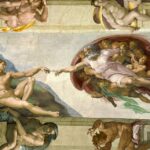
His Biblical characters weren’t depicted as flat or passive. Instead, they burst with energy and volume. Adam’s torso in the Creation of Adam (1511) resembles a classical statue, while the prophet Jeremiah slumps with the weight of divine knowledge in sinewy exhaustion. This celebration of the human body, rooted in classical ideals, shocked some of his contemporaries—but also elevated the ceiling to new artistic heights.
Structure and Stories in the Ceiling
The Sistine Chapel ceiling spans over 5,000 square feet and includes over 300 figures. At the center are nine narrative scenes from the Book of Genesis, arranged chronologically from the Separation of Light from Darkness to Noah’s Drunkenness. The most iconic image, The Creation of Adam, remains one of the most recognized works in art history. The dramatic moment where God and Adam’s fingers nearly touch is both spiritual and profoundly human.
Surrounding these panels are seven prophets and five sibyls—pagan women said to have prophesied Christ’s coming. This blending of classical and Christian imagery was highly unusual and daring. Above the architectural cornices sit 20 athletic nude males known as ignudi, along with ancestors of Christ and symbolic medallions. The fresco’s design achieves both symmetry and narrative complexity, making it a masterpiece of theological storytelling.
Innovations in Fresco Technique
Unlike many painters of his time, Michelangelo painted in buon fresco, applying pigment directly onto fresh, wet plaster. This technique required speed and precision, as corrections were almost impossible. He painted in small patches called giornate—Italian for “a day’s work”—each one corresponding to the amount he could finish before the plaster dried.
To execute this massive undertaking, Michelangelo designed a custom wooden scaffold suspended from the chapel walls, allowing him to reach the 68-foot-high ceiling without damaging the floor below. Contrary to the myth that he painted while lying flat, he worked standing, craning his neck upward for hours each day. He even wrote a humorous sonnet describing his beard full of paint and his back bent like a bow. This physical endurance, paired with his artistic brilliance, helped turn a daunting commission into a revolutionary work of art.
Symbolism, Subtext, and Controversy
Hidden Messages and Anatomical Symbols
In recent decades, researchers have proposed that Michelangelo embedded anatomical references into the Sistine Chapel’s imagery. The most cited example is the Creation of Adam, where the shape enclosing God and the angels closely resembles a human brain. Scholars such as Dr. Frank Meshberger (1990) have argued that Michelangelo used this structure to symbolize divine intellect, linking God’s gift of life to the power of human reason.
Another possible anatomical symbol lies in Separation of Light from Darkness, painted in 1511. Art historians have noted that the folds around God’s neck resemble a cross-section of the human brainstem. While these interpretations remain debated, they align with Michelangelo’s fascination with anatomy and his desire to blend science, faith, and art. Whether intentional or not, the images invite deeper inquiry into the mind of a man who saw no contradiction between bodily form and spiritual truth.
Subtle Critiques of Church Corruption
Though commissioned by the Pope, Michelangelo didn’t shy away from inserting personal views into his work. The inclusion of sibyls—pagan figures—alongside Hebrew prophets was highly unconventional. It hinted at a broader, more inclusive vision of divine truth. Some of the prophets, like Jeremiah and Zechariah, are depicted in weary, even skeptical poses, perhaps reflecting the artist’s own doubts or criticisms.
During this period, Michelangelo also wrote scathing poems against Church extravagance and clerical hypocrisy. While the ceiling does not include overt attacks, his vision avoids glorifying the institution. Instead, it uplifts human struggle, redemption, and divine creativity. In contrast to the grandeur expected by Church authorities, Michelangelo offered a profoundly personal and at times somber meditation on mankind’s place in the cosmos.
Nudity and Theological Debate
One of the most contentious aspects of the Sistine Chapel ceiling was Michelangelo’s use of nudity. Nearly all figures, including prophets, ignudi, and Biblical characters, are rendered with exposed musculature. For Michelangelo, the nude body was not obscene—it was a reflection of God’s perfect creation. He once declared that the human form was “the most perfect work of God.”
Despite this conviction, later Church officials disagreed. After the Council of Trent (1545–1563), which launched the Catholic Counter-Reformation, many deemed the nudity indecent. In 1564, the same year Michelangelo died, artist Daniele da Volterra was ordered to paint loincloths over the genitalia in The Last Judgment on the chapel’s altar wall. He was mockingly dubbed “Il Braghettone” (“The Breeches Maker”). The ceiling itself largely escaped this censorship, preserving Michelangelo’s bold artistic vision.
Symbols Interpreted in the Sistine Chapel:
- God inside a brain = divine reason
- Jonah over the altar = foreshadowing Christ
- Ignudi (nude youths) = angelic purity or pagan vitality?
Legacy, Influence, and Restoration
Impact on Western Art
Michelangelo’s ceiling altered the course of Western painting. Before its unveiling in 1512, large-scale frescoes had not reached such levels of anatomical realism or emotional gravity. Artists from Raphael to Rubens, and later Caravaggio and even Salvador Dalí, studied the ceiling’s figures and compositions. The frescoes became a standard for narrative complexity and technical mastery.
The Creation of Adam, in particular, influenced generations of painters, sculptors, and even theologians. More than just an image, it became a symbol of divine spark, human dignity, and artistic genius. With this single commission, Michelangelo transformed himself from a sculptor to a universal master of all media, embodying the ideals of the High Renaissance.
The Long Road to Restoration
For centuries, the Sistine Chapel ceiling darkened under layers of candle soot, humidity, and previous “restorations” that dulled the colors. By the 1980s, the frescoes were barely visible in their original clarity. Between 1980 and 1994, a monumental restoration effort was undertaken by the Vatican Museums and Japanese sponsors. Each section was meticulously cleaned, revealing brilliant blues, rich pinks, and golden hues long thought lost.
The restoration was not without controversy. Some critics argued that over-cleaning may have stripped away Michelangelo’s final touches or a secco details (dry application after plaster dried). However, the general consensus celebrated the renewed visibility of Michelangelo’s original palette. For the first time in centuries, viewers could experience the ceiling closer to how it looked in 1512.
Today’s Debates and Reverence
The Sistine Chapel ceiling remains a flashpoint for debate and admiration. Scholars continue to argue over hidden meanings, anatomical metaphors, and the balance between classical and Christian elements. Tourists from around the world flock to the Vatican to stand beneath Michelangelo’s vision—often unaware of the physical and spiritual pain that produced it.
The ceiling is still used during papal ceremonies, including the conclave to elect new Popes. Yet for many visitors, it’s not the Church authority it represents that inspires awe—it’s the unrelenting brilliance of a single man who, against his own instincts, painted something immortal. Michelangelo’s ceiling is more than decoration. It’s a spiritual drama in pigment, a Renaissance sermon in color and flesh.
Key Takeaways
- Michelangelo was forced into the Sistine Chapel project despite preferring sculpture.
- The ceiling combines Genesis stories with pagan and Biblical figures in daring ways.
- His use of anatomy, color, and structure transformed fresco painting.
- Symbolic messages, possibly anatomical, may be hidden in the artwork.
- A 1980s–1990s restoration revealed vibrant colors and renewed global attention.
Frequently Asked Questions
- Why did Michelangelo not want to paint the Sistine Chapel?
He saw himself as a sculptor and believed painting was beneath his skill set. - How long did it take to complete the ceiling?
The project lasted from 1508 to 1512, with some interruptions due to illness and disputes. - What is the most famous image on the ceiling?
The Creation of Adam, where God and Adam nearly touch fingertips. - Was Michelangelo the only artist who worked on it?
He completed nearly all of it alone, refusing significant help. - Is the ceiling today as Michelangelo left it?
Mostly yes, aside from minor restorations and some altered nudity on the altar wall.