The modern city of Mumbai began as a cluster of swampy islands in the Arabian Sea, but it was ambition—imperial, mercantile, and artistic—that transformed it into a place where images carried uncommon weight. For centuries, Bombay has been a city made and remade through acts of visual imagination: maps, murals, exhibition halls, and painted gods. Long before it became the commercial engine of modern India, it was a staging ground for the creation of a distinct visual culture—shaped by foreign rule, local adaptation, and a steady influx of people with stories to tell and images to make.
From Colonial Port to Cultural Conduit
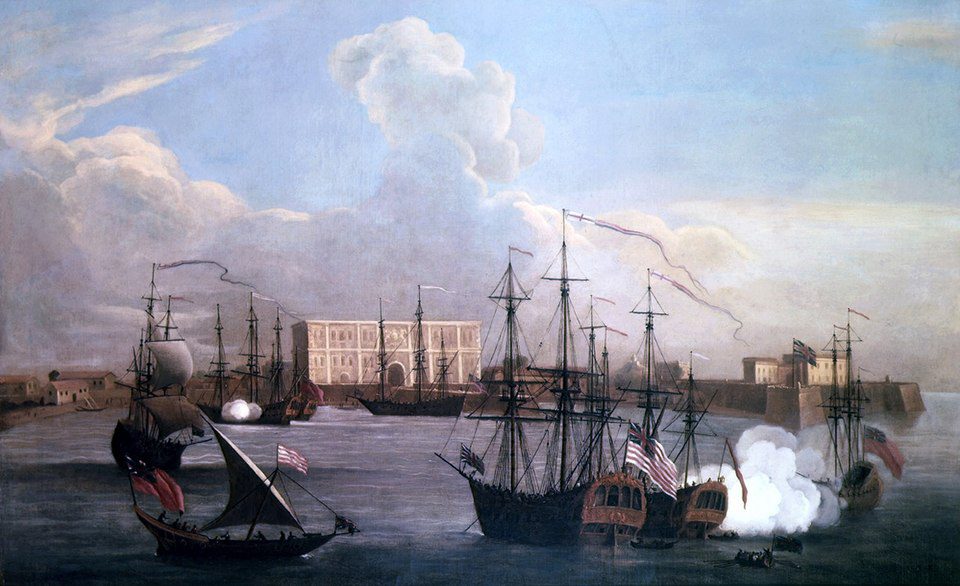
When the Portuguese handed Bombay over to the British in 1661—initially as part of Catherine of Braganza’s dowry—the city had yet to acquire any artistic infrastructure. What it had, and what would prove crucial, was its geography. Bombay’s natural harbor, one of the finest on India’s west coast, gave it strategic and commercial importance far beyond its early population size. By the late 18th century, it was emerging as a linchpin of the East India Company’s expanding maritime empire. This rapid transformation from village to port city required more than docks and warehouses. It demanded symbols, narratives, and visual systems that could project power, rationalize rule, and help make sense of the sprawling, multi-ethnic society taking shape there.
Art, in this context, was never merely decorative. It was used to consolidate influence and organize knowledge. Topographical drawings of the city’s growing infrastructure—forts, causeways, marketplaces—were disseminated as markers of control. Ethnographic portraits categorized the city’s diverse inhabitants: Marathas, Parsis, Bene Israelis, Konkani Muslims, Tamil migrants. Early watercolors by British officers or itinerant artists often served a quasi-scientific function. Even when such works trafficked in romanticism or exoticism, they were part of a larger enterprise of understanding Bombay through its appearances.
One of the most ambitious visual projects of this period was James Wales’s portrait of Nana Fadnavis, the Peshwa court’s chief strategist, made in the 1790s during diplomatic missions in western India. Though not a Bombay native, Wales’s encounter with the Maratha elite through British channels set a precedent: that Bombay would often play host to artistic transactions between empires and local elites, each seeking to capture or control the image of the other.
Mapping the Early Artistic Infrastructure
It wasn’t until the mid-19th century that Bombay’s artistic institutions began to take root in earnest. The foundation of the Sir Jamsetjee Jeejebhoy School of Art in 1857 (initially called the Bombay School of Art) marked a turning point. Established in the same year as the Indian Rebellion, the school reflected the British administration’s desire to mold Indian craftsmanship into a tool of empire-friendly modernity. But from the beginning, the school also attracted students and teachers with different ambitions—those who sought not only to refine decorative skills but to shape a national aesthetic.
The city’s first public art exhibitions were held in this period as well, typically in conjunction with the Bombay Art Society (founded in 1888). These events showcased the work of students, amateurs, and professionals, ranging from watercolors of local scenery to oil portraits in the academic style. While much of the content was determined by European taste, it was also in Bombay that some of the earliest hybrid styles began to emerge: realist oil painting techniques married to Hindu iconography, Mughal miniature motifs scaled up to life-size.
By the turn of the 20th century, Bombay had become one of the few cities in India where an aspiring artist could hope to receive formal training, exhibit their work, and find patrons—sometimes foreign, often local. The Parsi business class, in particular, emerged as an important patron group, commissioning portraits and investing in cultural institutions that reflected both their cosmopolitanism and their desire for respectability within the colonial hierarchy.
Three physical spaces illustrate this transformation:
- The J.J. School campus, which evolved from a crafts-training facility into a serious center for pictorial art, architecture, and design.
- The Bhau Daji Lad Museum, opened in 1872 as Bombay’s first museum and filled with objects and images that mapped the city’s cultural terrain.
- Elphinstone College, whose fine Indo-Saracenic architecture housed some of the earliest systematic art education in the city.
Each of these was not just a building, but a site where Bombay’s evolving identity was being articulated—through exhibitions, debates, curricula, and daily studio work.
Bombay’s Double Identity: Imperial and Indigenous
Perhaps the most persistent tension in Bombay’s art history is its dual role as both imperial outpost and indigenous crucible. Artists working in the city had to navigate the expectations of colonial bureaucrats, the tastes of wealthy Indian patrons, and their own internal conflicts about form, content, and purpose. These tensions did not resolve—they intensified.
Consider the case of M.V. Dhurandhar, trained at the J.J. School, who became its first Indian principal. His early work was rooted in Victorian academicism—mythological scenes rendered in Western perspective—but he gradually incorporated more localized themes and a bolder palette. To some critics, this was mimicry in nationalist drag; to others, it was a canny reappropriation of visual language.
The city’s status as a trade hub also meant it was unusually porous to foreign ideas. European engravings, Japanese prints, and Persian miniatures all circulated in Bombay long before such cosmopolitanism became a pan-Indian norm. The city’s bazaars and studios reflected this. A chromolithograph stall might sell Krishna alongside Queen Victoria; a Parsi theater set might draw on Italianate perspectives while staging a Zoroastrian epic. The visual culture of Bombay was not pure, but promiscuous—borrowed, bent, and reinvented.
An unexpected glimpse of this layered aesthetic comes from something as prosaic as the calendar art of the 1910s. Printed cheaply and distributed widely, these images often depicted Hindu gods, nationalist heroes, or moral allegories. Though produced in bulk, they drew on fine art traditions: Ravi Varma’s oil paintings, Mughal miniatures, even British portraiture. In Bombay, the line between popular and high art was always thinner than critics liked to admit.
And that porousness continues to define the city’s relationship with art. Bombay—now Mumbai—is still a place where gallery openings jostle with billboard painters, and where global curators walk past pavement artists without contradiction. It’s a city built on the unstable but productive tension between tradition and experiment, public and private, spectacle and skill.
That tension, far from diminishing, would become more pronounced with the city’s explosive modernization in the 20th century. As new ideologies, styles, and audiences entered the frame, Bombay’s art scene did not simply evolve—it fractured, regrouped, and declared itself anew. The legacy of those early visual experiments still shadows every brushstroke in Mumbai’s studios and every image pinned to the city’s complex walls.
The Colonial Canvas: Art Under the British Raj
By the mid-19th century, Bombay had become a showcase city for British imperial ambitions—a living monument to the supposed civilizing mission of the Raj. Its visual culture was increasingly shaped by that mission: mapped, categorized, taught, and displayed through a colonial lens. But even as British artists and administrators sought to impose their aesthetic order, Indian artists began to assert their own agency within that structure, navigating—and at times undermining—the imposed frameworks. The result was a complex, layered visual language: part pedagogy, part resistance, and part adaptation.
The Role of Art Schools in Social Engineering
The establishment of the Bombay School of Art (later named the Sir J.J. School of Art) in 1857 was not coincidental. That same year, the British Raj was born from the ashes of the East India Company’s rule, following the violent upheaval of the Indian Rebellion. To the British administration, art was not simply about beauty or creativity—it was a means of moral and cultural control. The J.J. School was conceived as both a practical training center and a site of ideological reprogramming. Indian craftsmen, many of whom had inherited artisanal skills from family guilds or religious traditions, were now encouraged to produce work that met British standards of realism, symmetry, and utilitarian form.
Instruction emphasized the European academic tradition: figure drawing from plaster casts, studies in perspective, anatomy, and proportion. But what the school offered in technique, it often suppressed in expression. Traditional Indian forms—whether the symbolic abstraction of Mughal miniatures or the decorative intricacy of temple carvings—were considered backward, even decadent. British administrators saw themselves as rescuing Indian artisans from stagnation by introducing them to “modern” artistic values, which meant, in practice, Victorian neoclassicism.
One of the key figures in this pedagogical project was Lockwood Kipling, father of Rudyard Kipling and principal of the J.J. School in the 1860s. He was both a reformer and a preservationist. While he emphasized drawing and industrial design for export markets, he also championed the documentation of Indian crafts. His dilemma—how to modernize without destroying—was never resolved, and his legacy is similarly mixed. He helped preserve several Indian craft traditions by incorporating them into the school’s curriculum, yet he also framed them in a way that made them palatable to European collectors, stripping them of ritual function and cultural autonomy.
This paradox ran through the entire colonial art education system. It claimed to elevate, but often condescended; it preserved forms, but diluted meanings. In Bombay, as elsewhere, the art school became a kind of theatre where colonial power was both enacted and questioned.
Watercolors, Portraits, and the Imperial Gaze
While students at the J.J. School labored over charcoal studies, British artists and officers stationed in Bombay produced an entirely different kind of art—part souvenir, part surveillance. These works, often in watercolor or engraving, depicted landscapes, public buildings, and native “types.” They were bound into albums, printed in gazetteers, or sent home to London to inform and reassure colonial audiences.
Edward Lear, better known today for his nonsense poetry, spent time in Bombay in the 1870s, painting harbor views and architectural studies. His works, like those of his contemporaries, combined technical precision with a detached romanticism. The city was made to appear picturesque, its poverty idealized, its people exotic but manageable. In these works, the urban disorder of Bombay—the slums, the disease, the clashes—was airbrushed into quiet dignity. This was not the city as it was, but the city as it needed to appear in order to justify the British presence.
More intimate were the portrait commissions, especially of elite Indians who had allied themselves with the colonial system. Wealthy Parsis, Hindu bankers, and Muslim administrators sought to be painted in European styles: three-quarter profile, sober attire, oil on canvas. These portraits were acts of aspiration, of strategic mimicry. To be painted like a British gentleman was to claim a place in the colonial hierarchy. But such mimicry was never total. Many Indian patrons insisted on incorporating religious symbols, family heirlooms, or localized dress elements—reminders that they were not merely colonial subjects but autonomous actors.
One of the most striking examples of this hybrid portraiture comes from Pestonji Bomanji, a Parsi artist trained at the J.J. School and later celebrated for his mastery of European technique. His 1890 portrait Feeding the Parrot shows a Parsi woman in a richly detailed domestic interior, her sari rendered in meticulous oil brushwork, the birdcage an emblem of restrained elegance. Though painted in the European tradition, the subject matter and composition remain deeply rooted in Indian social space. It is a painting that defies easy categorization—neither subservient nor subversive, but suspended in the charged middle ground that Bombay artists came to occupy.
Indian Artists in a British System
If the 19th-century colonial art scene in Bombay was dominated by British ideals, it was also quietly reshaped by Indian artists who mastered the system and then bent it to their will. These painters understood that navigating the structures of colonial art institutions did not preclude invention. Instead, they used the very tools handed down by empire—oil paint, linear perspective, studio techniques—to reframe their own cultural narratives.
Raja Ravi Varma, though not a Bombay resident, had a profound influence on the city’s art scene. His visits to Bombay in the 1880s to oversee printing of his lithographs at the Ravi Varma Press helped transform the visual culture of the city. His chromolithographs of gods and epic scenes found their way into Bombay households, calendar shops, and bazaar stalls. By using Western oil techniques to depict Indian mythological subjects, he created a new visual idiom that straddled tradition and modernity. While critics now debate whether his style diluted Indian aesthetics or democratized them, there is no denying the revolutionary nature of his project.
Following in his wake were Bombay-based painters like M.V. Dhurandhar and A.X. Trindade, both of whom taught at the J.J. School. Dhurandhar, in particular, became known for his mythological paintings that adopted dramatic chiaroscuro and precise draftsmanship. His works were popular with both colonial audiences and Indian elites, though they were often more complex than they first appeared. In paintings such as Lady With a Fruit Basket, there’s a subtle tension between the classical pose and the intimate, distinctly Indian setting—a dissonance that many viewers missed.
A mid-career surprise in this period was the appearance of bilingual artistic critique—often published in Bombay’s multilingual newspapers. In English, Gujarati, and Marathi, art criticism began to emerge as a serious discourse, not just reportage. The 1895 review of the Bombay Art Society’s annual exhibition in The Bombay Gazette, for instance, praised Indian artists for surpassing their British counterparts in originality and sensitivity, noting that “it is no longer a question of training, but of vision.” This was more than local pride; it marked a shift in the city’s cultural self-image.
By the dawn of the 20th century, Bombay’s art world was still shaped by British institutions, but it was no longer a colonial echo chamber. Indian artists had not only learned the rules—they had started to rewrite them. The imperial gaze remained powerful, but it was now met by a gaze of equal intensity and growing confidence. Bombay’s visual culture had entered a new, volatile phase—poised between obedience and defiance, discipline and creativity.
The Sir J.J. School of Art: Crafting a National Style
For over a century, the Sir Jamsetjee Jeejebhoy School of Art has stood not merely as an academic institution, but as a crucible where the visual identity of modern Indian art was both forged and contested. Located in the heart of colonial Bombay, the school became a space where students and faculty grappled with the contradictions of imperial art education—absorbing European techniques even as they searched for forms of expression that reflected their own cultural ground. In this dense and often difficult process, a new national style began to emerge: neither purely traditional nor slavishly Western, but something deliberate, hybrid, and unique to its time and place.
Founding Myths and British Patronage
The school’s origins are inextricably tied to the figure of Sir Jamsetjee Jeejebhoy, a Parsi merchant-philanthropist who donated vast sums toward public works in Bombay during the 19th century. His name adorns hospitals, halls, and, most enduringly, the art school that opened in 1857 under the patronage of the British government. Initially intended to promote mechanical drawing and industrial design, the school was conceived within the logic of empire: Indian craftsmen would be retrained to serve imperial industries, producing goods that met British aesthetic standards for export.
The early curriculum was steeped in utilitarian values. Ornamentation had to be rational, drawing had to be accurate, and art had to be useful. But even this highly structured program held within it the seeds of disruption. As students progressed beyond basic design into painting, sculpture, and architecture, they began to exceed the narrow intentions of their colonial instructors. The very act of mastering Western perspective, anatomy, and chiaroscuro gave them tools to reinterpret their own visual traditions with new precision and authority.
The school’s physical architecture also revealed its ideological tensions. The original buildings were designed in a Victorian Gothic style, yet over time Indo-Saracenic elements were incorporated—Mughal arches, Rajput domes, and Persian tile work. This hybrid form mirrored the school’s evolving purpose: not a simple transmitter of British aesthetics, but a battleground for aesthetic negotiation.
Lockwood Kipling and the Artisan Revival
Few figures encapsulate the complexities of the school’s early history better than John Lockwood Kipling, who served as professor of architectural sculpture and later principal. Arriving in Bombay in 1865, Kipling was part of a wave of British educators who believed in the civilizing power of art, but he also had a genuine respect for Indian craftsmanship. He worked closely with local artisans, organized exhibitions of decorative arts, and advocated for the preservation of traditional Indian techniques that were disappearing under industrial pressure.
Yet Kipling’s version of preservation was also a form of control. Traditional Indian arts—whether in wood, metal, textile, or clay—were stripped of their ritual or communal significance and recontextualized as objects for display. Artisans were encouraged to adapt their motifs to suit Western tastes, and their output was often directed toward colonial exhibitions or museums rather than local markets.
Three kinds of projects typify Kipling’s era:
- Decorative panels and friezes created by students and artisans under his supervision, which combined Islamic geometric patterns with British architectural frameworks.
- Copies of Ajanta frescoes, made painstakingly for British institutions and World Fairs, often regarded by critics at the time as evidence of India’s “lost glory”—a narrative that subtly implied modern India needed Western guidance to revive itself.
- Craft training for export, including wood carving and inlay work, which prioritized marketable objects over culturally embedded ones.
Nevertheless, Kipling helped institutionalize a respect for Indian material culture at a time when the dominant narrative was one of decay and inferiority. His influence endured well into the 20th century, setting the groundwork for a new kind of art pedagogy—one that sought to blend technique with tradition.
Technical Training and the Birth of Bombay Modernism
By the early 20th century, the school had begun to produce a new generation of Indian artists who were no longer content to simply imitate European styles. They had absorbed the academic training, but they wanted more: to speak with a visual language that felt at once modern and culturally resonant. This aspiration gave rise to a uniquely Bombay strain of modernism—technically sophisticated, intellectually restless, and often self-consciously Indian.
M.V. Dhurandhar, one of the school’s most famous alumni and later its principal, exemplifies this shift. Trained in academic realism, he initially produced mythological paintings that echoed the style of Ravi Varma. But over time, his work developed a distinctive idiom: scenes of urban life, women at leisure, nationalist allegories, and religious rituals rendered in precise line and luminous color. He taught hundreds of students to paint like Europeans—but also to look like Indians.
Dhurandhar’s influence was complemented by A.X. Trindade, a Goan Christian painter whose dark, expressive portraits broke with the decorative conventions of the time. Trindade’s work often emphasized mood and psychological depth, using rich earth tones and textured brushwork. His self-portraits, full of introspection and defiance, were unlike anything else being produced in colonial India. Though technically indebted to Rembrandt and Courbet, Trindade’s subject matter—rooted in Bombay’s multicultural environment—could only have emerged in this city.
Students trained under these artists began to explore themes far removed from the official curriculum: rural poverty, spiritual longing, political tension. A 1914 student exhibition catalog included works on famine, factory strikes, and devotional icons—subjects that reflected the pressures and passions of a rapidly urbanizing society. The technical competence was still there, but the content had shifted.
A surprise moment of modernist clarity occurred in 1926, when the school staged an internal exhibition focused on abstraction and stylization—a daring move at a time when realism was still the default. Students adapted Mughal miniatures, Buddhist cave art, and tribal motifs into semi-abstract forms. The faculty was divided; some called it undisciplined, others saw in it the future. In hindsight, this episode foreshadowed the more radical departures that would soon define Bombay’s art scene.
By the 1930s, the Sir J.J. School had become a strange and potent mixture: a colonial institution that had inadvertently nurtured a nascent nationalist aesthetic; a center of academic discipline that now hosted acts of quiet rebellion; a training ground that had birthed both museum artists and street illustrators.
It was this uneasy vitality that made the school—and Bombay more broadly—so central to the history of Indian art. The city’s modernism was not utopian or abstract; it was pragmatic, experimental, and deeply shaped by the city’s composite character. And that spirit, once ignited in the J.J. School’s studios and corridors, would spill far beyond its gates—into galleries, salons, newspapers, and ultimately, into the movement that would define postcolonial Indian art.
Painters of the Raj and Their Legacies
As the 19th century gave way to the 20th, Bombay’s art world found itself pulled in two directions: toward the academic realism that had become a lingua franca of elite artistic practice, and toward a burgeoning cultural nationalism that demanded a visual vocabulary capable of representing Indian life on its own terms. This tension was embodied in the work of a generation of painters who had emerged from colonial training systems but refused to remain confined by them. In their studios and exhibitions, one could trace the uneven emergence of a modern Indian art—still tethered to the Raj’s visual grammar, but increasingly attuned to the anxieties and aspirations of a society on the verge of political awakening.
Raja Ravi Varma and the Print Revolution
Though not a Bombay native, Raja Ravi Varma exerted an outsized influence on the city’s visual culture, particularly through the mass reproduction of his work in lithographic prints. Born into an aristocratic family in Kerala in 1848, Varma trained in oil painting under British tutors and rapidly gained acclaim for his portraits of Indian royals and mythological scenes. His fusion of Western realism with Hindu iconography—Saraswati in three-quarter profile, Lakshmi with chiaroscuro drapery—was unprecedented.
Varma’s relationship with Bombay was primarily mediated through the Ravi Varma Press, established in the city in 1894. With the assistance of German technicians and Parsi entrepreneurs, the press began churning out thousands of chromolithographs based on Varma’s paintings. These images, inexpensive and vibrantly colored, found their way into middle-class homes, street shrines, bazaars, and even colonial offices. Bombay became the distribution center for a new kind of visual literacy: gods, goddesses, and epic scenes rendered not in miniature or mural, but in European-style realism—available to buy, frame, and venerate.
This mass production marked a turning point in Indian art history:
- It democratized access to art, allowing even lower-income households to own images that had once been confined to palaces and temples.
- It changed devotional practices, replacing older woodcuts and hand-painted icons with polished, illusionistic forms.
- It shaped nationalist visual culture, as figures like Arjuna, Rama, and Shivaji were reimagined in heroic, Europeanized forms that resonated with modern audiences.
Varma’s influence in Bombay was not confined to the marketplace. His paintings were exhibited at the Bombay Art Society, debated in local journals, and used as models in art schools. But his popularity was double-edged. To critics like E.B. Havell and later members of the Bengal School, Varma’s style was decadent—an imitation of the West masquerading as Indian art. In Bombay, however, he was seen not as a copyist but a creator of a new vernacular, one that united technique with emotion, myth with mass appeal.
M.V. Dhurandhar’s Mythological Allegories
If Ravi Varma was the pioneer, M.V. Dhurandhar was the institutional anchor. Born in 1867 and educated at the Sir J.J. School of Art, Dhurandhar became the school’s first Indian head and one of its most influential figures. His work built on Varma’s innovations but moved them further into the realm of allegory, nationalism, and daily life. His canvases, often large and lush, combined meticulous realism with narrative ambition: gods walked among Bombay’s citizens, and mythological tropes were recast in urban idioms.
One of his best-known paintings, Rani of Jhansi (c. 1905), is emblematic of his style. The queen, sword raised, is rendered with anatomical accuracy and dramatic lighting, but the setting brims with stylized vegetation and a heightened theatricality. It is both portrait and symbol, grounded in technique but driven by cultural politics.
Dhurandhar was also a prolific illustrator, contributing to textbooks, calendars, and journals. His visual imagination was capacious—able to handle myth, humor, satire, and everyday realism with equal deftness. His drawing manuals were widely used, and his students included many of the key figures of early 20th-century Indian art. In that sense, he was less a solitary artist than a visual architect, helping to construct the visual scaffolding of Indian nationalism.
Yet Dhurandhar, like Varma, was not immune to critique. His paintings were seen by some as too decorous, too faithful to British academic models. The criticism often missed the subtle subversions in his work. In a painting like Lakshmi in the Market, the goddess of wealth sits among vegetable sellers and tradesmen—not on a lotus, but on a Bombay pavement. It is a quietly radical image: sacred figures brought into the secular world not to be diminished, but to be reclaimed.
Pestonji Bomanji and the Parsi Elite
While Varma and Dhurandhar navigated the overlap between mythology and modernity, Pestonji Bomanji (1851–1938) charted a different path. A member of Bombay’s Parsi community and a student of John Griffiths at the J.J. School, Bomanji became one of the most technically gifted portraitists of his time. His style was unapologetically realist, influenced by the Pre-Raphaelites and academic European painting, but his subjects were unmistakably Indian—often drawn from his own community.
His best-known work, Parsi Lady Feeding Her Parrot (c. 1885), is a masterclass in interior detail: the sari’s fabric glints under soft lamplight, the parrot’s feathers are minutely observed, and the woman’s expression is both serene and reserved. The painting celebrates domestic life, but also offers a window into the aspirations of Bombay’s Parsi elite, who saw in art a mirror of their own modernity.
Bomanji’s portraits of civic leaders, philanthropists, and legal luminaries now hang in institutions like the Bombay High Court and the Asiatic Society library. These works served a dual function. They affirmed the sitter’s status and accomplishment, but they also performed a subtle political act: placing Indian faces in the frames once reserved for colonial governors.
Among Bomanji’s achievements was his success in winning accolades at the Bombay Art Society, which had long favored British artists. His medals were more than personal honors; they signaled the entry of Indian artists into spaces of institutional authority. By the early 1900s, he was on the jury for major exhibitions—a rare position for an Indian in that era.
His influence was felt in three primary ways:
- Technical mentorship, as younger artists studied his brushwork and composition in exhibitions and critiques.
- Cultural documentation, through portraits that doubled as historical records of Bombay’s rising professional classes.
- Institutional legitimacy, helping to shift the Bombay Art Society’s center of gravity from colonial deference to Indian participation.
Bomanji’s legacy is not easily categorized. He was neither a nationalist firebrand nor a radical innovator. But his quiet precision and consistent excellence made him a foundational figure in Bombay’s portrait tradition—and a reminder that modern Indian art was not born only in rebellion, but also in mastery.
The legacy of these Raj-era painters is not just in their canvases, but in the way they helped reshape the role of the artist in Indian public life. They expanded the definition of what art could do and who it was for. They navigated colonial constraints not with slogans, but with images—complex, skillful, and enduring. And they laid the groundwork for the radical transformations that were still to come, as a new generation of artists prepared to discard the rules altogether.
The Bombay Art Society and the Rise of the Salon Scene
In the early 20th century, Bombay’s art world shifted from the solitary spaces of studios and schools to the more public, performative realm of exhibitions. The founding of the Bombay Art Society in 1888 marked the institutional birth of this transformation. Over the next several decades, the society helped foster a salon culture that reshaped how art was created, judged, and consumed in the city. Artists jostled for awards and critical notice; patrons walked through cavernous exhibition halls with the gravity of connoisseurs; and art itself became more than a private act—it became a public spectacle, embedded in the civic rhythm of Bombay.
Competitive Exhibitions and Artistic Prestige
From its inception, the Bombay Art Society saw itself as more than just a club or an exhibition committee. It modeled itself after European academies and aimed to bring structure, hierarchy, and publicity to the city’s fragmented art scene. Its annual exhibitions, first held in makeshift venues and later in grander halls, drew artists from across the subcontinent and even from abroad. Judged by panels of experts—initially dominated by British officials and later by a growing number of Indian art professors—these shows quickly became career-defining events.
In theory, the society was open to all schools and styles. In practice, it rewarded a particular visual discipline: technical mastery, narrative clarity, and moral sentiment. Paintings that demonstrated academic training in anatomy, light, and proportion tended to win prizes. Genre scenes, historical epics, and portraits of dignitaries were preferred over abstraction, experimentation, or political themes.
Yet within these limits, Indian artists found room to maneuver. For many, the annual show was the only platform where their work could be viewed by large audiences, critiqued by peers, and purchased by collectors. The structure encouraged ambition. Artists labored for months on single canvases, pushing themselves to achieve a visual authority that would register even from across a crowded gallery.
Three painters who rose through the society’s ranks illustrate this dynamic:
- Hemen Mazumdar, whose sensuous women in translucent saris were both controversial and technically admired, earning medals even as critics questioned his choice of subject.
- A.X. Trindade, whose moody, brooding canvases forced the society to reconsider the expressive possibilities of oil painting beyond mere mimicry.
- K.K. Hebbar, a later entrant, who in the 1940s began pushing against the formal limits of salon painting, incorporating movement, stylization, and eventually abstraction.
These artists didn’t always align with each other ideologically, but they shared a dependence on the society’s infrastructure: its juries, its publicity, and the audience it gathered each year.
Negotiating Realism and Indian Identity
One of the unresolved questions of the salon era was what constituted “Indian” art. The society’s exhibitions often struggled with this, encouraging Indian subject matter rendered in European technique. This created a paradox: a painting of Krishna in academic realism might win a prize, but a stylized, miniature-inspired version might be deemed “insufficiently developed.” Artists responded with strategic negotiation—blending, concealing, even smuggling in traditional forms under the cover of acceptable themes.
For instance, Abalal Rahiman, a Kolhapur-based painter who exhibited frequently in Bombay, created devotional images that looked like Western religious paintings at first glance: centralized figures, glowing light, soft modelling. But closer inspection revealed the compositional structures of Marathi temple art, the symbolic use of flora, and the absence of linear perspective in certain spatial zones. He was speaking in two languages at once.
In parallel, artists began to reinterpret everyday Indian life in salon-friendly idioms. Scenes of village life, monsoon celebrations, and street performers became popular themes. These were not radical in content, but they served a quiet cultural function: asserting the richness of Indian daily life as a worthy subject for formal painting. Bombay’s Parsi painters, too, contributed to this aesthetic domestication, with interiors full of marble floors, potted ferns, and introspective family members—settings that spoke of cultural transition more than colonial submission.
This period also saw an increase in women as subjects in salon painting. Whether as Radha figures, widows, dancers, or mothers, women began to dominate the visual field—not as allegories alone, but as social types. Though often idealized or eroticized, these images also created a shared visual lexicon of femininity in modern India, one that would later be taken up and revised by women artists themselves.
A moment of surprise came in the 1920s, when an amateur painter named Rustom Siodia, a self-taught Parsi art collector, submitted a miniature-inspired painting to the society’s exhibition. Though dismissed by the judges, the work drew crowds and a small critical following. The press called it “too crude, yet too knowing.” This episode exposed the gap between academic taste and public appetite, and pointed toward the more pluralistic future of Indian art.
The Urban Middle Class as Art Patrons
As exhibitions grew in scale and prestige, so too did their audience. Bombay’s expanding middle class—comprising lawyers, clerks, merchants, and civil servants—began to engage with art not just as decoration, but as a form of civic and cultural participation. Visiting the Bombay Art Society’s annual exhibition became a social event. Newspapers previewed the shows, children’s groups were brought in on educational tours, and reviews debated the merits of individual works with increasing seriousness.
This middle-class patronage brought both opportunity and constraint. On the one hand, it gave artists a viable local audience. Paintings no longer had to be sold to princely patrons or European officials—they could find homes in the modest flats and offices of Bombay’s rising professional class. On the other hand, this audience had tastes shaped by colonial education and bourgeois aspiration. They favored the legible, the refined, and the morally upright. An oil portrait of a revered grandfather was more likely to sell than a cubist reinterpretation of a mythological figure.
Still, the emergence of this patron base was a foundational shift. Art was no longer the preserve of the few. It had entered the civic bloodstream. Local philanthropists began sponsoring prizes at the Art Society shows; industrialists like the Tatas and Godrejs started collecting works by Indian artists. In turn, the society expanded its offerings to include lectures, sketching clubs, and eventually scholarships for students.
By the late 1930s, Bombay had a working infrastructure for art:
- An annual exhibition circuit, with built-in publicity and prizes.
- An audience trained to appreciate academic painting, but increasingly curious about newer styles.
- A new generation of Indian artists, many from outside the metropolis, who came to Bombay not just for training but for exposure.
This was the world that the next generation of artists—those who would form the Progressive Artists’ Group in 1947—would both inherit and revolt against. The salon scene gave them the tools, the context, and the reasons to break away. But it also gave them something to surpass: a model of visual order, civility, and prestige that felt, by the end of World War II, increasingly inadequate to the ruptures and demands of a newly independent India.
Art Deco Dreams: Modernism and Material Aspiration
If the Bombay Art Society gave the city’s artists a stage, it was the city itself—its skyline, cinemas, cafés, and homes—that gave form to their imagination. Nowhere is this clearer than in the Art Deco movement, which swept through Bombay between the 1930s and 1950s, transforming it into one of the world’s most vibrant Deco cities, second only to Miami in surviving architecture. But in Bombay, Art Deco was not merely an imported style; it was a visual language of ambition. It reflected the aspirations of a newly confident urban class, who sought not only comfort and efficiency but also a distinctly modern aesthetic—one that fused Western glamour with Indian urbanity.
Cinemas, Apartments, and Stylized Ornament
Art Deco in Bombay began in the cinema and radiated outward. The 1933 opening of Regal Cinema marked a turning point. Designed by Charles Stevens and equipped with air-conditioning, elevators, and a striking streamlined façade, Regal was more than a theatre—it was an icon. Its rounded corners, geometric motifs, and black-and-gold interiors set the tone for what Deco would mean in the Bombay context: polished, urbane, optimistic.
Other cinemas soon followed: Eros, Metro, Liberty, each more extravagant than the last. Their names alone—evoking myth, speed, and freedom—spoke to an emergent culture of visual excess. The cinema was not only where people went to watch films; it was where they went to experience modernity in architectural form. The lobby murals, terrazzo floors, brass detailing, and glowing signage all served to immerse the viewer in an environment of movement and spectacle.
Yet Deco did not stop at the box office. The style quickly migrated to domestic and commercial buildings across south Bombay. Marine Drive, Churchgate, Oval Maidan—these neighborhoods became showrooms of Deco design. Apartment blocks like Soona Mahal, Kamal Mansion, and Zaver Mahal featured stepped terraces, sunburst grills, lotus balconies, and ziggurat frames. The names etched into their facades—Majestic, Empress Court, Sunshine, Palm Court—spoke to Bombay’s self-image: cosmopolitan, poised, and forward-looking.
In these structures, form and ornament were inseparable. Unlike earlier colonial architecture, which often emphasized weight and monumentality, Deco was sleek, horizontal, and rhythmic. Ventilation grilles became stylized peacocks; window moldings recalled Egyptian motifs; building corners curved like the prow of a ship. Architects drew inspiration not just from Paris or New York, but from Bombay’s own cultural mash-up of cultures and climates.
This era produced three key design hybrids unique to the city:
- Tropical Deco, which adapted streamline forms to the local climate with wide verandas, chhajjas (projecting eaves), and internal courtyards.
- Indo-Deco, which inserted Hindu or Islamic motifs—kalash pots, temple towers, jaali screens—into the otherwise Westernized Deco vocabulary.
- Cinema-Deco, where the themes of motion, fantasy, and luxury found their apotheosis in neon signage and oversized murals of stars and gods.
Architectural Hybridity in 1930s Bombay
What made Bombay’s Deco unique was not just its fidelity to international trends, but the hybrid spirit with which it adapted them. Architects like G.B. Mhatre, Master Sathe, and Claude Batley—many of them trained in the Sir J.J. School’s architectural program—did not treat Deco as a rigid stylebook. Instead, they reworked its elements to speak to Indian aesthetics, climates, and materials.
Consider the entrance to Eros Cinema: its soaring tower and scalloped canopy recall both Manhattan skyscrapers and Buddhist stupas. Or look at Ram Mahal in Churchgate, with its stylized chhatris crowning a Deco body—a visual pun that fused Rajput form with machine-age silhouette. These were not accidents or kitsch fusions; they were conscious designs for a city that saw itself as both Indian and international.
Even public buildings participated in this visual experiment. The New India Assurance Building, constructed in 1936, combined Deco geometry with classical pilasters, while the Air India building on Nariman Point (built slightly later) echoed the vertical lines and maritime motifs of Deco alongside national emblems. In these spaces, one sees a deliberate negotiation between tradition and progress, echoing the debates occurring simultaneously in the city’s art schools and literary salons.
This hybridity extended beyond buildings into furniture, textile, signage, and graphic design. Deco-inspired motifs appeared on railings, elevator doors, gateposts, and even matchboxes. The look of the city was changing, and with it, the public’s expectations about how art could intersect with daily life.
An unexpected case study is the Bombay suburban train timetable from the 1940s, which featured Deco-style fonts, illustrative borders, and stylized railway motifs—evidence of how deeply the movement had permeated even bureaucratic forms.
Deco as a Symbol of Secular Glamour
More than an aesthetic, Deco in Bombay was a social signal. It was aspirational without being aristocratic, stylish without being exclusionary. For a generation of upwardly mobile Indians—especially Parsis, Christians, Jews, and educated Hindus—Deco offered a way to embody modernity in form, fashion, and address. To live in a Deco apartment or visit a Deco cinema was to participate in a shared dream of elegance and progress.
This secular glamour found its clearest articulation in the illustrated advertisements of the time. Ads for shaving cream, saris, refrigerators, and cigarettes used Deco graphics to project sophistication. Women posed in streamlined interiors with jazz records and rotary phones; men in sharply cut suits read English newspapers under Art Deco sconces. These images did not reflect the average Bombay household—they reflected Bombay’s self-image, or more precisely, its ambitions.
There was, however, an inherent contradiction. Deco in Bombay emerged in the same decades as the independence struggle, a time of intense political mobilization, economic hardship, and rising inequality. While nationalist leaders spoke of khadi and self-reliance, Deco buildings celebrated imported technology and consumer desire. This tension did not go unnoticed.
Mahatma Gandhi reportedly disliked Bombay’s Deco glamour, seeing it as evidence of bourgeois decadence. Yet others, like Jawaharlal Nehru, saw in it a possible bridge: a way to align Indian aesthetics with modern technological society. In this sense, Deco became a screen onto which multiple ideologies were projected.
What remains remarkable is how little of this tension reduced the clarity or confidence of Bombay’s Deco language. It continued to evolve—through the post-war years, into early Nehruvian modernism, and even into the language of Bollywood set design.
Today, when walking through the city’s Deco precincts, one still encounters that mix of optimism and ornament. The buildings stand not only as monuments to an aesthetic era, but as echoes of a cultural moment when Bombay dared to imagine itself as sleek, cinematic, and radically modern.
The Progressive Artists’ Group: A Radical Rebirth
In December 1947, just four months after India gained independence, six young painters gathered in Bombay and signed a manifesto. They called themselves the Progressive Artists’ Group (PAG), and their aim was nothing less than a reinvention of Indian art. Rejecting both colonial academicism and sentimental nationalism, they envisioned a bold, pluralistic modernism—international in form, yet fiercely Indian in spirit. Their work exploded old binaries: East and West, sacred and profane, tradition and innovation. What emerged was not just a style, but a movement that would change the trajectory of Indian art forever.
F.N. Souza and the Unforgiving Line
At the center of the group’s founding was Francis Newton Souza, a volatile, brilliant painter whose work seemed to bleed and burn with intensity. Born in Goa in 1924 and expelled from the Sir J.J. School of Art for political insubordination, Souza brought a dangerous energy to Bombay’s genteel art scene. He wrote scathing critiques of India’s artistic establishment, lambasted the decorative tendencies of Bengal School revivalism, and demanded an art that could express “the nakedness of life.”
Souza’s paintings from this period are unmistakable: distorted heads, crucifixions, brothel interiors, fevered self-portraits. His lines are raw and surgical, often carved into thick pigment with palette knives or bare fingers. He once described his own style as “acid on metal.” But beneath the violence of his technique lay a profound moral vision. Souza’s figures are not merely grotesque—they are metaphysical, haunted, condemned. They reflect a postcolonial anxiety, a sense that liberation had not yet translated into meaning.
In his 1955 work Birth, a large canvas showing a nude woman crouched in a fleshy, abstracted interior, Souza melds Christian iconography with Indian sensuality, Freudian tension, and cubist fragmentation. The painting scandalized conservative critics and fascinated international curators. When Souza moved to London in the late 1950s, he became the first Indian painter to gain a serious European following—showing at Victor Musgrave’s Gallery One and receiving praise in The Times.
But Bombay was where he invented himself, and where the Progressive Artists’ Group first took shape as an uncompromising voice in a country too ready to mythologize its past.
M.F. Husain’s Horsemen and Human Dramas
If Souza was the PAG’s firebrand, Maqbool Fida Husain was its populist visionary. Born in Pandharpur in 1915 and trained as a billboard painter for Bombay’s flourishing film industry, Husain brought to the group a kinetic, expansive sense of storytelling. His canvases galloped with motion: horses, drummers, women, warriors, and gods rendered in bold contours and flat planes of color. He used the pictorial shorthand of street painters—stylized eyes, angular limbs, vibrant colors—but charged it with modernist urgency.
Husain’s early works, such as Zameen (1955), drew from rural life, mythological epics, and urban spectacle, fusing them into images that were both allegorical and personal. He often worked in series: Ramayana sequences, circus scenes, cityscapes. His recurring use of the horse became emblematic—not merely of speed or virility, but of history in motion, power made elegant. The horse, in Husain’s hands, became a totem of continuity and rupture.
Despite—or perhaps because of—his unorthodox style and his refusal to adhere to any sectarian aesthetic, Husain became the most publicly recognized Indian painter of the 20th century. He wore his signature barefoot look and wielded his charisma as deftly as his brush. His works appeared on magazine covers, postage stamps, and later in auction houses around the world.
Yet his greatest legacy was not in sales or celebrity. It was in the way he made modern art legible to a wider public without simplifying it. His forms were abstracted but readable, his themes local but unprovincial. Husain helped dismantle the idea that modern art was a foreign imposition. In his work, modernism was as native as a rangoli pattern or a kathakali mask—only louder, faster, and alive to the city’s roar.
Modernism Without Apology
The Progressive Artists’ Group was more than Souza and Husain. Its original cohort also included S.H. Raza, K.H. Ara, H.A. Gade, and S.K. Bakre—each with a distinct style, each resisting orthodoxy in different ways. What bound them together was not a single technique or ideology, but a shared impatience with inherited forms.
S.H. Raza, for instance, began with expressionist landscapes and eventually moved toward deeply symbolic geometric abstraction—developing the “bindu” motif that came to define his late career. K.H. Ara painted sensuous still-lifes and nudes that drew from both French impressionism and Indian folk idioms. Gade, a schoolteacher by profession, depicted Bombay’s tenements and chawls with thick impasto and Fauvist color. Bakre, the group’s only sculptor, introduced modernist sculpture to India with abstract, textural works that drew comparison to Brâncuși and Henry Moore.
Their first group exhibition in 1949, held at the Bombay Art Society Salon, drew a stunned but intrigued audience. Critics accused them of nihilism, obscenity, even madness. The group’s name—“Progressive”—was itself a provocation, a challenge to a society still tethered to decorative nationalism or Victorian gentility.
But their timing was prescient. Post-independence India was asking new questions: What should Indian culture look like now? How could artists participate in building a secular republic without reverting to myth or colonial mimicry? The PAG answered not with manifestos but with form. They made modernism Indian not by imitation but by absorption—refracting global styles through local bodies, landscapes, and histories.
Three defining traits set the PAG apart:
- They were urban, secular, and multilingual, drawing from Bombay’s pluralism rather than any one regional school.
- They rejected didacticism, refusing to serve either nationalist or religious ideologies.
- They understood the global art market, using exhibitions, catalogs, and international networks to position themselves beyond India’s borders.
By the time the group officially dissolved in 1956, its members had already reshaped the terms of debate. Modern Indian art no longer needed to justify itself as “authentically Indian” or “appropriately modern.” It could be jagged, erotic, moody, minimal, grotesque, cosmic—whatever the artist required.
Their influence was catalytic. Later generations of artists—Tyeb Mehta, Akbar Padamsee, Nasreen Mohamedi, Bhupen Khakhar—all passed through the door the PAG had blown open. Even those who rejected the group’s style absorbed its ethos: the belief that Indian art could speak in its own voice, with no apologies and no intermediaries.
In retrospect, what the Progressives created was not a style or a school, but a new kind of artistic subjectivity—one born in Bombay, but attuned to the world. Their rebellion was not destructive. It was generative. And it made Bombay not just the capital of Indian art, but its laboratory.
Gallery Culture and the Making of a Market
By the mid-20th century, Bombay was no longer just a city of artistic production—it had become a city of art circulation. What began in schools, studios, and salons now moved into the commercial realm: white-walled galleries, critical reviews, private collectors, and institutional exhibitions. This shift was not simply logistical—it was ideological. Art became something that could be sold, debated, archived, and professionally represented. In Bombay, a new infrastructure arose to support this transformation, giving rise to India’s first modern art market, and reshaping the relationship between artists, audiences, and capital.
Chemould, Pundole, and Jehangir Art Gallery
The beating heart of this new gallery culture was a small but ambitious set of institutions, many of which opened within walking distance of each other in South Bombay during the 1950s and 60s. Each one played a distinct role in creating a viable ecosystem for contemporary Indian art.
Jehangir Art Gallery, inaugurated in 1952 near Kala Ghoda, was founded with philanthropic backing from Sir Cowasji Jehangir and built by architect G.M. Bhuta in a clean-lined modernist style. Crucially, Jehangir was not a commercial gallery in the strict sense—it functioned more as a public exhibition hall. It allowed young, unknown artists to rent space, put up their work, and address audiences directly. Its low-cost, open-access model made it the testing ground for Bombay’s emergent visual culture. A painter could go from obscurity to attention in a single show here. It was a civic platform, more than a commercial enterprise.
In contrast, Gallery Chemould, founded in 1963 by Kekoo Gandhy, was unapologetically commercial—and radically influential. Located initially on the premises of Chemould Frames on Princess Street, it began as a frame shop that moonlighted as an exhibition space. Gandhy, a Parsi businessman with a deep interest in art, began showing works by modernists like M.F. Husain, Tyeb Mehta, and Bhupen Khakhar. He did more than hang their paintings—he cultivated them, introducing their work to buyers, critics, and foreign curators. Chemould was India’s first gallery to operate like an international dealer: promoting artists over time, maintaining long-term relationships, and negotiating prices with consistency and tact.
Pundole Art Gallery, opened by Kali Pundole in 1963, followed soon after. Located just off Flora Fountain, it quickly became the city’s most serious venue for modern Indian painting, offering solo shows, curated retrospectives, and critical discourse. Pundole’s strategy was more traditional than Chemould’s—less experimental, but grounded in strong aesthetic judgments and an ability to connect artists with serious collectors. The gallery became known for its support of abstraction, showing works by S.H. Raza, V.S. Gaitonde, and other members of what was now loosely seen as India’s modernist canon.
Together, these three venues formed a triangulated infrastructure:
- Jehangir offered access, visibility, and institutional dignity.
- Chemould offered vision, risk-taking, and long-term patronage.
- Pundole offered credibility, seriousness, and market structure.
They turned Bombay into a city where art was not only made—it was bought, sold, reviewed, and historicized.
Dealers, Critics, and the New Bourgeoisie
With the rise of galleries came the rise of intermediaries: dealers, critics, curators, and collectors, all of whom began to shape the narrative and value of Indian art in new ways. These figures did not merely facilitate sales—they curated reputations, influenced prices, and helped define which artists mattered.
Kekoo Gandhy, for instance, was famous for his tireless advocacy. He gave artists stipends, organized foreign residencies, and even stored unsold works at personal expense. He helped facilitate Tyeb Mehta’s first trip to New York and connected Bhupen Khakhar’s outsider sensibility with global queer discourse. His framing shop-turned-gallery became a node in a larger web of influence that stretched from Bombay to London, Paris, and New York.
Critics played their part as well. Journals like Marg, Times of India, and later Art India began publishing reviews, essays, and artist profiles that attempted to build a language of modern Indian criticism. Rudi von Leyden, Mulk Raj Anand, and later Geeta Kapur offered serious engagement with contemporary work, linking it to global movements while insisting on local particularity.
These developments paralleled the emergence of a new class of Indian art buyers: industrialists, bureaucrats, lawyers, and doctors, often English-educated and culturally ambitious. For these collectors, owning a Husain or Raza was not just aesthetic—it was symbolic. It signaled modern taste, cosmopolitan identity, and a certain kind of postcolonial success. The home became a gallery, and the gallery became a place of social performance.
Three types of buyers emerged in this era:
- Corporate collectors, like Air India and the Tatas, who bought in volume and displayed works in office lobbies and boardrooms.
- Private intellectuals, who bought selectively and engaged deeply—people like Ebrahim Alkazi, the theatre director whose personal collection rivaled national holdings.
- Aspiring professionals, who treated art as both cultural investment and social statement, often focusing on affordable works by emerging artists.
This expansion of patronage not only helped sustain individual careers; it began to create a monetary logic around contemporary art. Prices rose, markets matured, and art became a more viable profession for younger generations. It was a subtle but radical change from the previous era, where artists often relied on teaching jobs, side gigs, or sheer luck.
How Bombay Became a National Art Capital
By the late 1960s, Bombay had emerged as India’s undisputed art capital. It was the only city with a complete ecosystem: schools, galleries, critics, patrons, collectors, and a steady influx of artists from across the country. Delhi had institutions, Calcutta had heritage, Baroda had pedagogy—but Bombay had momentum.
This was not just about geography or money. Bombay’s cultural pluralism—its Parsi philanthropists, Jewish gallerists, Catholic painters, Muslim miniaturists, and Hindu mythmakers—created a space where no single style or ideology could dominate. Its secularism was lived, not declared. The city’s pace, density, and openness to reinvention mirrored the very nature of modern art itself.
Artists who had once left Bombay for Paris or New York now returned, drawn by the city’s growing legitimacy and audience. Tyeb Mehta, after years abroad, came back in the 1970s and painted some of his most iconic canvases—Kali, Trussed Bull, Diagonal Series—in a Bombay studio. Gaitonde, reclusive and severe, worked quietly on his abstract landscapes while dealers and collectors debated their metaphysical force.
Even performance and installation art began to find footholds. Experimental venues like Gallery 7, Sakshi Gallery, and later Project 88 began pushing the definition of what could be exhibited. The 1992 Bombay riots and the 1993 serial bomb blasts cast a long shadow over the city’s confidence, but they also triggered a wave of socially engaged, politically astute work by younger artists who had grown up in the gallery system.
In this atmosphere, art ceased to be peripheral. It became part of Bombay’s cultural identity, as integral as cinema, cricket, or finance. The painter was no longer a solitary figure; she was a professional, a symbol of the city’s cosmopolitan promise.
Film Posters, Bar Signs, and Bazaar Aesthetics
For all its galleries and critics, Bombay has always been a city of visual excess. Nowhere is this more vivid—or more ignored by the formal art world—than in its informal street culture: film hoardings, liquor shop signage, political banners, barber shop murals, rickshaw paintings, and devotional calendars. These images may not have hung in galleries, but they dominated the visual landscape. They shaped how the city saw itself and how its inhabitants saw one another. In many ways, this popular visual culture was the city’s most honest mirror—vulgar, hybrid, commercial, and utterly magnetic.
Art on the Street and the Screen
Bombay’s cinema industry—soon to be known globally as Bollywood—created an insatiable appetite for images. From the 1940s through the 1980s, hand-painted film posters and billboards towered over roads, plastered railway stations, and lit up cinema halls. Unlike in the West, where posters were often designed by in-house marketing teams, Bombay’s film art was outsourced to a small guild of street painters, many of whom worked in modest shops near Grant Road, Dadar, and Lalbaug.
These artists, often trained in sign-painting or calendar art, developed a distinct visual idiom: heroic proportions, melodramatic poses, split-compositions for ensemble casts, and saturated palettes that bordered on the psychedelic. Faces were rarely photographic likenesses. They were idealized types, conveying rage, lust, grief, or justice with operatic intensity.
One of the legendary names in this genre was Babanrao Painter, whose work in the 1950s and ’60s shaped the look of blockbusters like Mughal-e-Azam and Mother India. His studio worked at an enormous scale—painting cloth hoardings that spanned entire building façades. With each film release, the city’s visual identity was rewritten in larger-than-life portraits and explosive typefaces.
Three signature tropes defined this cinema aesthetic:
- The Split Poster, where the protagonist’s benign half and vengeful half are shown side-by-side—often with a dagger or teardrop dividing them.
- The Smeared Sky, a background of storm clouds or fire that conveyed moral crisis as much as weather.
- The Clenched-Fist Figure, often with one hand holding a rifle or trident, the other reaching toward a faint image of a mother or goddess in the corner.
These posters were not art in the institutional sense, but they shaped the visual literacy of millions. For many Bombayites, especially those outside elite cultural circles, the first confrontation with painting came not in a museum but on a cinema hoarding. These images taught a generation to read symbols, to decode gesture, and to appreciate the power of scale.
The Popular and the Painterly
Beyond cinema, Bombay’s visual culture spilled into the most unexpected spaces. A visit to a neighborhood liquor shop in the 1970s might reveal a hand-painted panel of Bacchus-like men drinking under banana trees, signed not by an artist but by “Raju Arts.” Barber shops had mural-style portraits of film stars with improbable haircuts. Auto repair garages featured Shiva wielding a wrench or Hanuman leaping across a spark plug.
This was not kitsch—it was vernacular visual communication. These images were not made to last or to be studied. They were functional, ephemeral, but full of coded meaning. Each one said something about the space it inhabited: who it welcomed, what it offered, how it wanted to be seen.
Perhaps no object exemplifies this better than the matchbox. In the 1950s and 60s, Indian matchbox covers became miniature canvases of vernacular design: tigers, wrestlers, lighthouses, locomotives. Bombay’s small print shops and sign painters often moonlighted in this format, creating bold, colorful motifs that combined commercial messaging with raw graphic invention.
An unexpected highlight in this world was the rise of calendar art—especially devotional calendars that featured gods, saints, and politicians in digitally composited heaven-scapes. While Ravi Varma’s legacy loomed large, by the 1980s this form had exploded into something far more eclectic. You could find Lakshmi standing on a banknote, Sai Baba blessing a skyscraper, or Nehru superimposed over a nuclear plant. These images circulated in truck cabins, grocery shops, offices, and bedrooms—providing both comfort and spectacle.
This aesthetic was not just tolerated by the art world—it was eventually mined by it. Artists like Bhupen Khakhar, Gulam Mohammed Sheikh, and later Atul Dodiya and Chitra Ganesh began incorporating these elements—flatness, icon layering, painted lettering—into their “high art” practice. They didn’t mock these sources; they quoted them with precision and affection, often to comment on how modernity, faith, and fantasy collided in Indian life.
Graphic Design as Urban Semiotics
By the late 20th century, Bombay’s visual culture was no longer just hand-painted—it was increasingly designed. The rise of offset printing, flex banners, and desktop publishing software changed the city’s look overnight. Yet even in this shift, the aesthetic codes of earlier decades persisted.
Political posters were one key domain. Every election season, walls were wallpapered with slogans, hero-worship portraits, and party symbols: the Congress hand, the Shiv Sena bow-and-arrow, the BJP lotus. These posters borrowed heavily from cinema and mythology. A candidate might be rendered with divine light radiating from his head; a party logo might be accompanied by flames, tigers, or maps of undivided India. This was visual politics, not just publicity.
Street signage, too, became an urban dialect. Metal type in Devnagari, Urdu, and Gujarati, often painted with custom flourishes, turned shopfronts into semiotic jungles. A paan shop in Byculla might display a painted mouth biting into a lime; a tailoring store in Dadar might feature a stylized needle threading a sari border.
This chaotic typographic world served multiple functions:
- It localized identity: every neighborhood had a visual language attuned to its demographic makeup.
- It flattened hierarchy: religious icons shared space with beauty cream ads and restaurant menus.
- It made art public again: not in the museum, but on the wall, the cart, the packet, and the vehicle.
One curious case in this landscape is the rise of truck art—vehicles adorned with phrases like “Horn OK Please” and visual motifs including lotuses, birds, and mountains. While more associated with North India, Bombay’s transport fleets often included regional visual signatures: Dabbawala logos, sea-themed motifs, and Marathi proverbs in multicolor script. The trucks became moving murals—mobile galleries of a visual culture that remained defiantly outside the art market.
Ironically, by the 2000s, these informal aesthetics had become so powerful that designers and advertisers began mimicking them. The “vernacular” became a trend. Boutique cafés in Bandra hired painters to fake Bollywood-style signage. Luxury fashion brands borrowed street fonts for campaigns. What had once been dismissed as crude now re-entered the formal world—only this time, with curated irony.
In Bombay, the boundary between art and image has never held firm. The city speaks in pictures—huge, loud, layered, and constantly remade. If the galleries and schools offer one lineage of Indian modernism, the hoardings and matchboxes offer another: messier, more democratic, and deeply woven into daily life.
Women Artists and the Domestic Frame
Bombay has long been a city of thresholds—between wealth and poverty, spectacle and solitude, tradition and transgression. But perhaps no threshold has been more quietly negotiated, and more radically redrawn, than the one between the public world of art and the private realm of the home. For much of the 20th century, Indian women were largely absent from the formal art establishment. Yet within the private spaces they inhabited, and eventually beyond them, they developed distinctive modes of visual thought that altered not only what Indian art looked like, but what it could mean.
In Bombay, where middle-class women were gaining new freedoms but still bound by domestic expectations, art offered both a refuge and a tool—a way to assert presence without necessarily declaring rebellion. What began as quiet acts of creation in the margins became, over time, central contributions to the city’s artistic legacy.
Amrita Sher-Gil’s Influence from Afar
Although Amrita Sher-Gil (1913–1941) never lived in Bombay, her shadow fell heavily across its studios and salons. Trained in Paris but disillusioned by European modernism’s distance from Indian life, Sher-Gil returned to India in the 1930s and began producing paintings that married Cézanne’s structure with the earthy gravitas of Indian village life. Her early death at 28 gave her an aura of tragic genius, but her influence outlived her short career.
In Bombay, women artists who came of age in the 1940s and ’50s viewed Sher-Gil as both a permission and a warning. She had dared to paint the female body with intelligence and sensuality, to reject genteel themes for scenes of labor and sorrow, to insert herself unapologetically into her art. Her example emboldened a generation of women to explore their own narratives—even if they did so more quietly.
One of the earliest was Pilloo Pochkhanawala, a Parsi sculptor and one of the first Indian women to work in welded metal. Her abstract forms, often derived from natural growth patterns or bodily curves, resisted easy categorization. Her studio, located in a rented Bombay flat, doubled as a salon for young artists, writers, and dancers. In this space—half domestic, half radical—new conversations about form, gender, and politics took shape.
What Pochkhanawala modeled was not just a style, but a practice: one in which the boundaries between homemaking and artmaking could be deliberately blurred, then transcended.
The Studio as a Feminine Space
By the 1960s and ’70s, a handful of women artists in Bombay were carving out formal spaces for themselves, often in ways that reimagined the very nature of the studio. Nasreen Mohamedi, one of the most singular figures in Indian art, created her stark, meditative line drawings in near-monastic solitude, often working at night in small, meticulously ordered rooms. Her work, composed of grids, arcs, and delicate ink lines, was abstract to the point of silence—but in its restraint, it offered a profound critique of the excesses of masculine modernism.
Mohamedi rarely exhibited in her lifetime. Her drawings were private, almost diaristic. Yet they were not minor. Today, her work is housed in the Metropolitan Museum of Art and the Tate. In her notebooks, filled with poetry, photographs, and architectural musings, one finds a visual philosophy shaped by both Islamic aesthetics and the constraints of her own domestic life. Her studio was not a gallery-facing space. It was a chamber of inner architecture.
At the other end of the spectrum was Anjolie Ela Menon, who, while based largely in Delhi, exhibited frequently in Bombay and built a following there. Her paintings of female nudes, melancholic figures, and half-mythic tableaux were more figurative and accessible—but they, too, centered the domestic sphere. Her canvases often suggested rooms without walls, stories without explicit narration. The female body in her work was neither decoration nor victim. It was simply present—looking back, undaunted.
Perhaps the most overlooked figures were the many part-time women artists who continued to work out of homes, balancing family obligations with studio practice. These women rarely received critical attention, yet their work appeared in the annual shows of the Bombay Art Society, in group exhibitions at Jehangir Art Gallery, and in small, local collectives. Some painted to earn, others to document, still others as a private act of survival.
A quietly radical case was Gieve Patel, a doctor by training and not a woman—but whose paintings in the 1980s and ’90s often returned obsessively to images of women washing, sitting, working—capturing the invisible rhythms of feminine labor. While not part of a feminist movement per se, Patel’s work insisted on the dignity and psychic presence of domestic spaces, long dismissed as artistically inert.
Gieve Patel and Representing Women’s Worlds
Patel’s repeated use of the window motif—women seen from behind, glimpsed across a courtyard, or framed in half-open shutters—echoed the ambivalence many women artists felt about visibility. These were not idealized muses or allegorical figures. They were women in mid-action, unposed, absorbed in their own lives. In this, Patel shared sensibilities with artists like Nalini Malani, who explicitly challenged both patriarchy and political repression through large-scale, often unsettling installations.
Malani, who moved to Bombay in the 1960s, began her career painting but soon expanded into video, performance, and immersive environments. Her multimedia works addressed themes of female trauma, myth, and violence—invoking figures like Medea and Sita in fragmented, flickering layers. She painted on reverse glass, projected animations onto walls, and flooded rooms with dissonant sound. Her work was not subtle—but it was necessary.
In Malani’s installations, the domestic was no longer gentle or hidden. It was a site of memory, abuse, inheritance, and resistance. Her 2002 work Mother India: Transactions in the Construction of Pain explicitly linked personal and national trauma, interrogating how the female body becomes a metaphor in male-dominated politics.
This strand of politically charged, gender-conscious work only grew stronger into the 21st century. Artists like Rekha Rodwittiya, Arpita Singh, and Nilima Sheikh—though based in different cities—found enthusiastic audiences in Bombay’s galleries. Their themes—love, grief, aging, labor—were rendered in lush, contradictory styles that defied easy classification.
The city, too, began to respond. The Cymroza Art Gallery, opened in 1971 by Parsi artist Pheroza Godrej, became a platform for women’s exhibitions, artist talks, and experimental shows. In time, private collections and institutional shows began to reflect the gendered shifts in Bombay’s art world, albeit slowly.
By the 1990s, Bombay was home to dozens of women artists, many with international reputations. Yet their work continued to explore—and often trouble—the line between home and world, intimacy and spectacle. The domestic frame had not disappeared; it had been rewritten as a site of artistic autonomy.
Contemporary Bombay: Tension, Expansion, Collision
Contemporary art in Bombay is not a scene—it is a collision zone. A place where slum aesthetics and luxury branding jostle for wall space; where digital media merges with ritual objects; where global biennales, local riots, caste politics, and climate anxiety all find expression—often on the same canvas. The city’s once cohesive narrative of modernist ambition has fractured into multiple, overlapping realities. Yet this fragmentation has not diminished Bombay’s role in the Indian art world. If anything, it has intensified its relevance. In this sprawling, stressed, overstimulated city, art continues to function not only as representation, but as resistance, adaptation, and proposition.
Global Shows and Local Audiences
In the early 2000s, Bombay re-entered the global art conversation with a new kind of urgency. India’s growing economy, combined with a spike in interest from international curators and collectors, thrust the city’s contemporary artists into biennales, art fairs, and museum collections. Suddenly, Bombay artists were showing at Venice, Documenta, Frieze, and the Asia-Pacific Triennial. Their work engaged with international debates—migration, capitalism, technology—but remained rooted in a specific, volatile urban experience.
Jitish Kallat, for example, emerged as one of the defining figures of this moment. His mixed-media installations, photographs, and sculptures addressed the city’s contradictions with wit and unease. In Public Notice 2 (2007), he recreated Gandhi’s 1930 speech on the eve of the Salt March using fiberglass bones, laying them across the floors of the Chicago Art Institute as a chilling statement on forgotten ideals and physical cost. In Bombay, his work often riffed on the architecture of density: flyovers, chawls, road signs, all reimagined as surreal, haunted artifacts.
At the same time, Subodh Gupta, though based in Delhi, found eager collectors and curators in Bombay for his sculptures made from tiffin boxes, steel utensils, and milk pails—objects that symbolized India’s economic migration and aspiration. His work played well to the city’s dual identity: materially exuberant, yet freighted with memories of scarcity.
While these artists enjoyed international visibility, the question of local audience engagement remained fraught. High-profile shows at Chatterjee & Lal, Chemould Prescott Road, and Project 88 attracted cosmopolitan viewers—curators, collectors, critics—but remained disconnected from broader publics. The democratizing impulse of Jehangir Art Gallery or the Art Society salons had given way to a more elite, rarified model of art consumption.
Yet this was not the whole story. Parallel spaces began to emerge that challenged this exclusivity. Artist-run initiatives like Clark House Initiative, Dharavi Art Room, and The Guild foregrounded community engagement, urban research, and critical pedagogy. These were not just galleries—they were laboratories for rethinking what art could do in a city as contested as Bombay.
One especially charged moment came with the 2012 edition of the Kochi-Muziris Biennale, where many Bombay artists participated. While technically based in Kerala, the biennale’s informal, decentralized ethos resonated with Bombay’s younger generation—who saw in it a platform that bypassed both market and academia. It wasn’t just about visibility; it was about legibility on one’s own terms.
Slum Aesthetics and the Politics of Representation
No contemporary discussion of Bombay art is complete without confronting the city’s spatial crisis. With over 60% of its population living in informal settlements, Bombay’s geography is one of radical compression. Artists who engage with this reality face a dilemma: how to represent marginal spaces without aestheticizing poverty or flattening the people who live within it?
Shilpa Gupta, a conceptual artist whose work spans video, installation, and text, addresses this dilemma obliquely. Her work often centers on borderlines, both literal and psychological. In There is No Border Here, a series of interactive maps and sound works, Gupta examined how boundaries—geographic, religious, emotional—are drawn and redrawn in the South Asian imagination. While not focused solely on slums, her interest in liminality speaks directly to the lived experience of millions in Bombay’s shifting, undocumented spaces.
By contrast, Sudarshan Shetty creates sculptural environments that fuse the industrial with the ritualistic: gears and gods, motors and mandalas. His work channels the city’s strange alchemy of decay and worship, entropy and reverence. In pieces like Love (2006), a mechanized dining table repeatedly opens and closes with no guests in sight—both a haunting metaphor for urban alienation and a satire of aspirational emptiness.
And then there is Dharavi, the vast informal settlement often mythologized as “Asia’s largest slum.” Rather than being represented by others, Dharavi increasingly produces its own images. Photography collectives, children’s art initiatives, and local graffiti crews now contribute to the city’s visual discourse. The Dharavi Art Room, co-founded by Aqui Thami and Himanshu S, runs workshops that allow young girls to photograph, paint, and narrate their own realities—subverting the voyeurism often directed at them.
This inversion—where the subject becomes the image-maker—is one of the most important developments in contemporary Bombay. It undermines the assumption that artistic authority lies only with the trained or institutionally endorsed. It allows for a pluralism of voices, not merely of style.
Three new aesthetic tendencies now dominate this field:
- Material proximity, where artists use found objects, recycled materials, or refuse from their immediate environments—plastic, metal, cloth, electronics.
- Participatory practice, in which the art process includes communities or viewers as active collaborators rather than passive recipients.
- Narrative reappropriation, where dominant myths—of development, progress, cosmopolitanism—are deconstructed through personal or marginal perspectives.
These tendencies suggest a city not just full of artists, but full of artistic possibility—waiting to be seized, redirected, or subverted.
New Media, Old Narratives
If the material basis of art has shifted—from canvas and bronze to screen and sensor—the city’s core concerns have not. Contemporary Bombay artists continue to grapple with the same forces that animated their predecessors: migration, identity, violence, memory, space. What has changed is the medium and the scale.
Tejal Shah, for instance, merges performance, video, and queer activism in works that refuse to separate the personal from the political. Her 2013 video installation Between the Waves featured hermaphroditic centaur figures wandering post-apocalyptic landscapes—part science fiction, part ritual dream. Shah’s work is not illustrative of Bombay, but it emerges from its pressure points: gender, identity, urban collapse.
Digital artists like Rohini Devasher and Sahej Rahal explore time, myth, and ecological anxiety through software, VR, and robotic forms. Devasher’s drawings and videos—often inspired by astronomy and weather—transform data into poetic speculation. Rahal’s performances, in which he appears as a shamanic figure conjuring ruins and relics, suggest a city caught between archaeological excavation and cybernetic prophecy.
What unites these artists is not a shared style, but a shared tension—between futurity and fatigue, between the urge to document and the need to dream.
Meanwhile, the market has adjusted. Art India, now a leading journal of South Asian art criticism, publishes regular profiles on new media work. Auction houses like Saffronart and Pundole’s include video, installation, and photography in their catalogs. Institutions like the CSMVS Museum and TARQ Gallery have begun collecting contemporary work seriously.
The city itself has begun to function as a distributed exhibition—not just through art festivals, but through public commissions, abandoned buildings repurposed as project sites, and hybrid spaces like Khoj Bombay (a spin-off of Delhi’s long-standing Khoj International Artists’ Association). Here, art is not a product, but a process. Not a thing to be bought, but a situation to be entered.
Preservation, Patronage, and the Future of the City’s Art
Bombay’s artistic past is as unstable as its skyline. Buildings vanish overnight, galleries move, archives molder, and artists migrate—drawn by opportunity or driven by frustration. Yet despite this volatility, the city remains a central site of artistic reinvention. If its past has been shaped by experiment and collision, its future will depend on preservation—of memory, of materials, of spaces—and on patronage that is neither nostalgic nor exploitative. The city’s art scene stands at a threshold: caught between privatized success and collective fragility, between global capital and local neglect. What survives will depend less on institutions than on intention.
The Role of Private Foundations
In the absence of consistent public funding for the arts, Bombay’s contemporary art infrastructure relies heavily on private foundations, philanthropists, and collectors. This model, while capable of agility and ambition, carries its own risks: curatorial direction can become susceptible to market trends, donor tastes, or institutional branding. Still, many of these organizations have stepped into the vacuum with creativity and care.
The Kiran Nadar Museum of Art, though based in Delhi, has increasingly supported Bombay-based artists and projects, organizing retrospectives, funding catalogues, and participating in local exhibitions. Tata Trusts have funded arts education and conservation programs, particularly in partnership with older institutions like the CSMVS Museum (formerly Prince of Wales Museum). Meanwhile, Godrej Culture Lab—founded by Parmesh Shahani—hosts experimental events that fuse literature, performance, and visual art, often spotlighting queer and marginalized voices.
But perhaps the most influential example is the JSW Foundation, which has supported everything from art residencies in Alibaug to heritage preservation in Mumbai’s Fort district. Their approach—supporting both avant-garde initiatives and architectural conservation—points toward a future in which art and urbanism are increasingly linked.
These foundations do more than write checks. They help shape what counts as important, what gets preserved, and what is remembered. In a city that often forgets even its own masterpieces, such selective memory carries enormous power.
Heritage versus Development
Nowhere is Bombay’s conflicted relationship with the past more visible than in its architectural landscape. Art Deco apartments, colonial-era studios, and early modernist buildings face demolition daily—victims of unchecked real estate development, structural neglect, or bureaucratic apathy. Preservation efforts exist, but they are fragmented, reactive, and often too late.
In 2018, South Mumbai’s Art Deco and Victorian Gothic ensemble was named a UNESCO World Heritage Site—an overdue recognition of the city’s unique hybrid architecture. Yet this accolade has done little to stop the erosion of the very fabric it celebrates. Many Deco buildings remain inhabited but deteriorating, their owners caught between renovation costs and rising rents.
The Kala Ghoda precinct, once the artistic core of the city, now hosts a yearly arts festival that draws crowds but struggles to protect the very galleries, bookshops, and studios that gave it meaning. The area’s transformation into a cultural “brand” has produced a strange paradox: more visibility, less intimacy.
The battle lines are often hidden in legal documents and zoning maps. Buildings like Strand Book Stall, Samovar Café, and Ramanand Chatterjee’s press have already disappeared—closed not by cultural disinterest but by landlord evictions and commercial pressure. With each closure, a piece of Bombay’s artistic memory erodes.
Yet resistance persists. Architect and activist Abha Narain Lambah has led conservation efforts across Mumbai, advocating for adaptive reuse rather than demolition. Independent collectives like Art Deco Mumbai document threatened buildings and lobby for protective legislation. These efforts may not halt the tide, but they force the city to see what it is losing—to treat built history as part of the creative continuum.
Where Does Bombay Go From Here?
The future of Bombay’s art scene will depend on how it balances contradiction. It must remain open to the world while rooted in its own material realities. It must make room for new voices without repeating the exclusions of the past. It must preserve not only objects and buildings, but practices—teaching, collaboration, informal mentorship, intergenerational exchange.
Three challenges will shape the coming decades:
- Access and affordability: Rising real estate prices make it nearly impossible for young artists to live and work in the city. The absence of subsidized studio spaces or public grants means that many talents never emerge or are quickly lost to exhaustion.
- Institutional support: While galleries and festivals flourish, the city lacks robust public institutions for contemporary art. A permanent modern art museum remains unrealized. Archival facilities for preserving paper, film, and digital art are rudimentary at best.
- Ecological pressure: Climate change, flooding, and environmental degradation threaten both physical infrastructure and artistic practice. The sea that once framed the city’s visual poetics now encroaches unpredictably, destabilizing what can be built, stored, or imagined.
Yet Bombay remains stubbornly generative. Artists continue to arrive—from Baroda, Bangalore, Shillong, Colombo—drawn by its energy, its contradictions, its ghosts. New technologies—AR, machine learning, blockchain—are being folded into old obsessions: memory, myth, form. Young collectives like Bombay Underground, Tifa Working Studios, and HH Art Spaces offer new models of sustainability—shared housing, co-created works, traveling exhibitions.
The city’s creative metabolism remains high, if uneven. In a decade, today’s emerging artists may be national icons—or they may be gone, priced out or burned out. The only certainty is that Bombay will keep generating images, and those images will continue to reflect its deepest conflicts and most enduring dreams.
To walk through Bombay is to walk through a city that paints itself daily and forgets itself nightly. Its art is not just made—it is lived, erased, contested, and remade. That is its tragedy. That is its brilliance.
Conclusion: The City That Paints Itself
Bombay’s art history is not a neat chronology—it’s a field of shifting tensions, layered like pigment: colonial ambition overlaid with nationalist reinvention, cosmopolitan elegance daubed onto political fracture, private rebellion traced within public spectacle. From British watercolors and academic realism to Art Deco fantasies, revolutionary manifestos, and the clamor of the bazaar, the city has produced not a singular style but a visual temperament—restless, adaptive, insistent.
What sets Bombay apart is not just its density of artists, galleries, or collectors, but the way art functions here as a survival mechanism. In a city where space is contested and identity unstable, art becomes a mode of inscription—on walls, on bodies, on memory. Its artists have never had the luxury of working in ideological purity or physical comfort. They paint in apartments that flood, sculpt in workshops that double as kitchens, curate shows with borrowed lights and unpaid bills. And yet they persist—not in spite of the city, but through it.
The legacy of Bombay’s art is not only in museums or auction catalogs. It is in the faded murals on cinema façades, in the matchbox designs of vanished printers, in the stencil graffiti outside abandoned mills. It is in the arguments of gallery openings, the ink of small literary magazines, the smell of linseed oil in a third-floor flat in Dadar. These are not footnotes—they are the archive.
To ask where Bombay’s art is going is to misunderstand its nature. It does not go—it swells, splinters, erupts, and returns. It has no center, only pulses. Some beat in Kala Ghoda or Bandra, others in Bhandup or Dharavi. The city teaches its artists to move, to adapt, to disappear and resurface. It gives them everything and nothing at once.
And still, they draw. Still, they paint. Still, they see.