The land that would become Missouri held beauty long before it bore a name. Centuries before statehood, or even the arrival of permanent European settlements, the region was alive with visual codes, symbolic craftsmanship, and material culture shaped by both necessity and imagination. These early expressions of art were not born in academies or salons, but in mounds, river crossings, workshops, and churches—forms of making bound tightly to belief, survival, and trade.
Cahokia and the Mississippian Eye
At the center of what is now the American Midwest once stood the sprawling city of Cahokia, just east of present-day St. Louis. Between roughly 1050 and 1350 AD, this metropolis flourished with a population rivaling or surpassing that of medieval London. Its residents—the Mississippian people—left behind no alphabet or written histories, but their monumental earthworks and ritual objects carried visual intelligence of startling sophistication.
Among the most enigmatic of these is the Ramey Tablet, a thin piece of stone engraved with a symmetrical design—part geometric abstraction, part esoteric map. Scholars have interpreted its imagery variously as cosmological, mnemonic, or symbolic. Its mirrored design and crisp linework echo elements found in shell gorgets and copper plates from the broader Mississippian world, suggesting a shared visual language spanning hundreds of miles.
What makes the Ramey Tablet remarkable is not only its aesthetic quality, but its ambiguity of function. It was not a tool, a weapon, or an obvious ritual object. Its beauty exists outside of utility, hinting at an early distinction between decoration and expression. It might be the earliest surviving piece of art made in what would become Missouri—an object to be seen, pondered, and remembered.
Frontier Devotion and the French Colonial Hand
By the mid-18th century, the French had established a string of outposts and small settlements along the Mississippi, including Ste. Genevieve, the oldest permanent European settlement in Missouri. Among the French Catholic settlers and missionaries, religious art took a central role, not as museum pieces but as vital tools for worship and identity.
One surviving example—a wooden devotional carving from the 1780s—depicts a simplified Virgin Mary, rough-hewn yet expressive. The piece was likely carved by a settler or parish artisan rather than a trained sculptor. It is compact, made to be portable, and worn smooth by decades of handling. The carving demonstrates how religious belief translated into tangible forms on the frontier—adaptable, humble, and emotionally potent.
This object, housed today in the Missouri History Museum, represents a rare case where the European tradition of sacred art intersects with the pragmatism of survival. There was no marble, no grand cathedral space, but there was still reverence—and with it, the urge to give physical shape to the invisible.
Silver and Smoke: The Art of Exchange
Alongside sacred images came secular trade, and with it, a new category of hybrid object: the ornament of exchange. French traders brought goods into the region—textiles, weapons, beads, and metalwork—and bartered with Osage and other tribes who already had deep traditions of body adornment and symbolic display.
A surviving trade silver cross, dated to the late 18th century, shows how European religious forms became entangled with indigenous visual systems. These cruciform pendants were made by French silversmiths, designed to be both familiar and adaptable. To the French, the cross was a symbol of Christianity. To many Osage recipients, it could represent not only alliance but continuity with their own symbology—its four points resonating with the cardinal directions and cosmological order.
The trade cross does not merely illustrate coexistence; it embodies the negotiation of aesthetics, where different symbolic systems converge without dissolving into one another. In this way, Missouri’s earliest art forms often belong to two worlds—neither wholly native nor fully European, but something made in the friction between them.
Clay, Flame, and the Hands of the Unnamed
Further south, on the edge of Spanish Missouri in the late 18th century, ceramic fragments from rural kilns tell another story. One redware shard unearthed near Cape Girardeau, dated to around 1800, bears the fingerprints of its maker—not figuratively, but literally: shallow indentations from where the clay was handled and shaped before firing.
These utilitarian vessels—mugs, jugs, cooking pots—were not meant to last centuries. Yet their survival as fragments reveals the aesthetic impulse even in routine labor. Some carry slip-decorated bands or scalloped edging, modest attempts to embellish the everyday. Unlike high-gloss porcelain from the East Coast, Missouri’s early ceramics were earthy, asymmetrical, and local—expressive of a land still defining itself.
The process mattered as much as the product. Redware production involved:
- Clay extraction from riverbanks, often with complex preparation to remove impurities
- Hand-building or wheel-throwing in rudimentary sheds or open-air yards
- Open-pit or wood-kiln firing, with variable results depending on weather and technique
Each step was both labor and intuition. The finished wares, however plain, radiated the presence of the maker. In an age before mass production, each piece carried an identity, however unrecorded.
The Invisible Aesthetic: Memory, Loss, and Continuity
What binds these disparate early artifacts is not style but spirit: the shared urge to mark, to shape, to decorate, to carry meaning beyond function. Missouri’s pre-state art history is defined not by individual genius but by collective anonymity, where the names are lost but the gestures remain.
And yet, the aesthetic traditions that began here—geometric abstraction, symbolic exchange, pragmatic ornament—did not vanish. They echo in later Missouri art, resurfacing in quilt patterns, folk sculpture, and even the formal compositions of 20th-century painters. The territory’s first art was not a prologue; it was a quiet, persistent voice, still humming beneath the noise of modernity.
Next came the settlers, the academies, the painters and patrons. But long before any of them, someone bent over a piece of red clay or carved a spiral into a stone tablet and made something for no reason other than that it meant something.
Chapter 2: Settlement and Skill – Pioneer Artists and Craft Traditions
In the first half of the 19th century, as Missouri transformed from a frontier outpost into a formally organized state, it was not paintings or sculptures that dominated its visual culture. It was furniture, pottery, textiles, and sacred architecture—art born not in studios but in cellars, kitchens, and backwoods workshops. These crafts, practiced by immigrant artisans and settlers across the state, were neither anonymous nor crude. They reflected distinct patterns of taste, material availability, cultural inheritance, and evolving local identity.
The Craftsman as Settler: Shaping Wood and Identity
In the rolling hills of central Missouri, particularly around Lexington and Boonville, woodworking flourished during the decades before the Civil War. Settlers arriving from Kentucky, Virginia, and Tennessee brought with them techniques and traditions of cabinetmaking that adapted swiftly to their new landscape.
One especially well-preserved walnut sideboard from the Lexington area, made circa 1840–1860, exemplifies this aesthetic. The wood is local—black walnut felled nearby—and the construction reflects a transitional style: Federalist symmetry softened by emerging Victorian ornamentation. Dovetail joints, rounded corners, turned legs, and subtle inlays show a level of refinement not often associated with frontier life.
This sideboard, and others like it, occupied a central place in the home. It was not only a storage unit but a signifier of status and stability, often passed through generations. These pieces were not mass-produced; each was idiosyncratic, shaped by the tools available and the skills of the maker. They embodied a vernacular confidence—work that did not ask permission from coastal taste-makers but was beautiful and functional in its own right.
Jugs, Crocks, and the Missouri Kiln Tradition
While furniture shaped the interiors of Missouri homes, pottery shaped the essentials of everyday survival. Stoneware kilns, especially in Boonville, St. Charles, and southeast Missouri, operated with minimal machinery and maximum labor. Clay was dug, cleaned, thrown, fired, and sometimes decorated, all within a few miles’ radius. Most of what they produced was practical: salt-glazed jugs, storage crocks, and churns.
One surviving salt-glazed jug from Boonville, dated to the 1830s or 1840s, features a cobalt blue floral motif—a flourish of unnecessary but unmistakable beauty on an otherwise utilitarian object. The jug’s form is thick and weighty, made to endure. Its glaze has blistered slightly with age, revealing the unpredictable chemistry of frontier kilns.
Missouri’s pottery differed from East Coast or imported European wares in key ways:
- It was thicker and more rugged, suited to long winters and rough transport.
- Decoration was minimal but deliberate, often limited to a single motif or maker’s mark.
- Many potters were itinerant or family-based, with skills passed directly rather than through formal apprenticeship.
This tradition persisted well into the late 19th century, forming a material lineage that can still be traced through shards and survivors in attics and auction lots across the state.
Church Light: Stained Glass and the Immigrant Parish
As Missouri towns grew and communities organized around religion, churches became some of the first structures built with aesthetic ambition. And while few could afford imported furnishings, many congregations invested in stained glass, often in simplified or locally made forms.
The St. Ferdinand Catholic Church in Florissant, established in the early 19th century, underwent several renovations through the 1850s and 1860s. Among its furnishings were stained-glass windows of modest scale—made not by European ateliers but by regional craftsmen using colored glass, leadwork, and painted details. These windows borrowed from Gothic Revival forms but were adapted to simpler frames and brighter palettes, reflecting both devotional intent and available resources.
In many rural Catholic and Lutheran churches, stained glass served several purposes:
- It functioned as teaching imagery, conveying biblical stories to largely illiterate congregants.
- It established continuity with European heritage, particularly for German and Irish immigrants.
- It provided a sense of sanctity and permanence in newly built towns.
These works were not signed, and most makers are unknown. But they demonstrate an early Missouri principle: art was not for leisure—it was for presence, reverence, and the building of place.
Textiles and the Female Hand
Though often dismissed as “domestic” or “decorative,” Missouri’s early textiles were profound acts of both labor and expression. Among the most revealing are embroidered samplers, made by girls and young women as both educational exercises and devotional objects. One example in the State Historical Society of Missouri’s collection, stitched around the 1840s, includes not just alphabets and Bible verses, but Missouri-specific references—such as local flora, family initials, and hand-stitched maps of the county.
These samplers, usually executed on linen with dyed wool or silk threads, were:
- Didactic, used to teach literacy and moral values alongside technical skill.
- Genealogical, often including family names and local events.
- Artistic, composed with a surprising variety of stitches, color pairings, and framing devices.
Though the identities of the young stitchers have largely faded, their works remain as durable as the redware jugs and walnut sideboards of their male counterparts. Here, too, was a mode of making rooted in education, care, and cultural transmission—not in rebellion or statement, but in mastery.
A Visual Culture of Self-Reliance
These early craft traditions—pottery, furniture, stained glass, textiles—constitute a vernacular art of conviction rather than experimentation. Missouri’s early artisans did not seek to innovate; they sought to serve. But in serving, they created an artistic language grounded in rhythm, precision, and understated flair.
Missouri was never artistically empty. What it lacked in cosmopolitan exhibition spaces, it compensated for with thousands of hands at work—turning walnut, kneading clay, cutting fabric, and letting light through colored glass.
Each object remains a trace of skill made visible. And as the 19th century progressed, that skill would evolve into painting, architecture, and institutions. But the roots of it—sturdy, unpretentious, and often beautiful—lay in the simple belief that the things you make should last.
Chapter 3: The View from the River – Missouri in 19th‑Century Landscape Painting
In the middle of the 19th century, the rivers of Missouri were more than transit routes. They were stages, mirrors, and margins—places where work met nature, where stillness met motion. The Missouri and Mississippi Rivers didn’t just shape the land; they shaped how it was seen. And no one captured this evolving visual relationship more memorably than George Caleb Bingham, whose paintings of river life turned muddy banks and wooden flatboats into luminous American iconography.
The River as Setting and Symbol
Bingham was not a transplant but a Missourian through and through. Born in Virginia in 1811, his family settled near Franklin, Missouri, in the 1810s, where he later worked as a craftsman, legislator, and eventually, an artist of national repute. His earliest paintings were portraits, but by the mid-1840s, he turned his full attention to the state’s great artery—the Missouri River—and to the men who worked it.
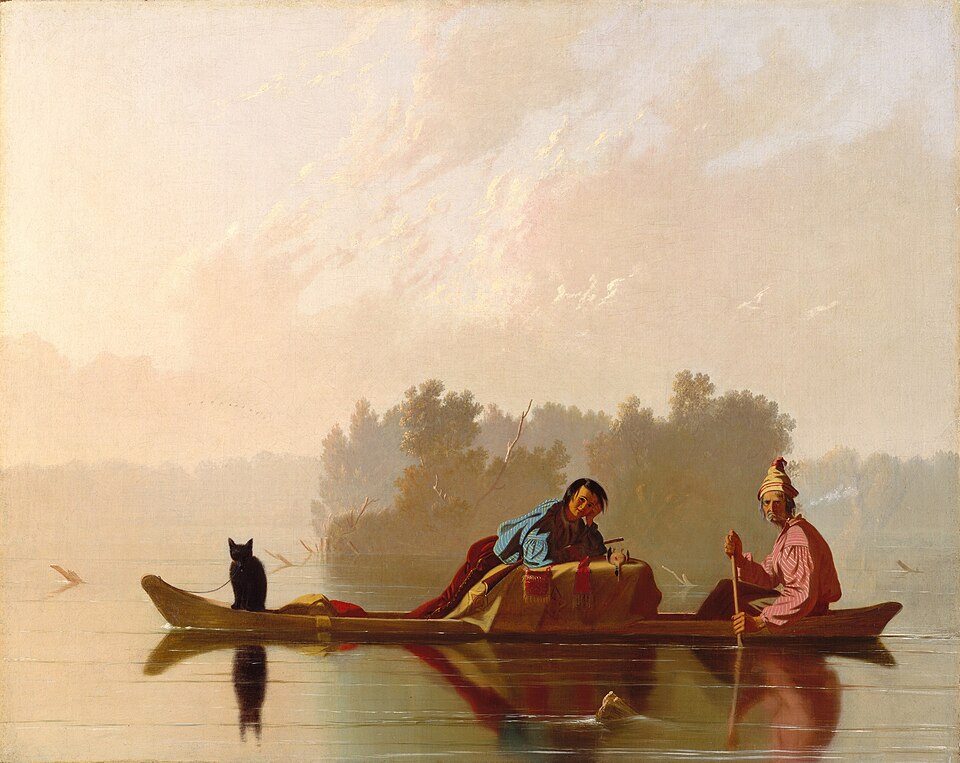
In Fur Traders Descending the Missouri (1845), Bingham offers a quietly mythic scene. A man, his son, and a tethered black bear sit in a canoe gliding over glassy waters. The composition is horizontal, balanced, and serene, with soft lighting and a sense of suspended motion. This is not the chaotic, dangerous West imagined by Eastern romantics. It is contemplative, almost classical. The fur trader is rendered with nobility, the boy with innocence, and the bear with domestic strangeness. Everything in the painting is symbolic, yet nothing feels overt.
This work, now housed in the Metropolitan Museum of Art, marked Bingham’s arrival as a major voice in American painting—and as a pioneer in Midwestern landscape art that neither imitated European precedent nor sought validation from the Eastern seaboard.
Missouri as America’s Middle Vision
Bingham followed with a string of paintings that embedded human activity within the river’s expanse. In Boatmen on the Missouri (1846), a group of men relax on a flatboat while the land rolls away behind them. The human figures are individualized—stoic, playful, weary—but the landscape dominates. Light is used sparingly but precisely: to highlight skin, shirt, and waterline; to guide the eye across the canvas in a slow arc, much like the motion of the river itself.
Bingham’s genius was his refusal to treat Missouri as background. It was always setting with agency, place as participant. In his world, geography isn’t passive—it shapes the rhythm of labor, the character of its inhabitants, and the way time flows.
This approach set Bingham apart from painters of the Hudson River School. While they painted grandeur and untouched wilderness, Bingham painted humanized landscapes—inhabited, worked, known. His vision was distinctly Missourian: practical but poetic, democratic in subject but elevated in form.
Flatboats and Floating Cards: Everyday Mythology
In Raftsmen Playing Cards (1847), Bingham captured a different mood—casual and almost comic. A group of rough-hewn men sit around a makeshift table atop a timber raft, laughing, drinking, and gambling. The setting is familiar: broad river, wooded banks, diffused sunlight. But the tone is rowdier, looser, with less compositional serenity and more narrative energy.
Here, the river is still present but slightly receded. It holds the raft but does not dominate the canvas. Bingham, in effect, paints a floating genre scene, a slice of life untethered from land, tradition, or polite society. Yet even this looseness is carefully constructed—clothing textures, hand gestures, and glances are finely balanced, and the scene’s mischief never turns anarchic.
Bingham’s river paintings formed what art historian Angela Miller once described as “a middle vision”—neither romantic nor realist in the strictest sense, but something uniquely rooted in civility, landscape, and local types. His figures were not caricatures, nor idealized heroes. They were legible, grounded, and convincingly American.
An Unexpected Harmony: Nature and Commerce
What might surprise modern viewers is how comfortably Bingham combines natural beauty with economic purpose. The river is not wilderness; it’s a workplace. And yet, there’s no aesthetic conflict. In Bingham’s world, commerce and landscape are reconciled—a man can trap beavers or ferry goods and still belong within a lyrical, painterly scene.
This harmony was perhaps reflective of Missouri’s political and cultural moment. As a border state, Missouri was a place of transition—not just geographically but ideologically. Bingham himself served in the Missouri General Assembly and painted political subjects alongside his river scenes. His art reflects a deep engagement with the middle position Missouri occupied—not radically progressive, not reactionary, but cautious, adaptive, and internally rich.
The boats in his paintings drift not toward manifest destiny or industrialization, but toward something gentler: a local poetics of movement, where life floats as much as it strives.
The Broader Influence and Lasting Image
Bingham’s river works were widely exhibited in the 1840s and 1850s, finding audiences in New York and Philadelphia. But they never lost their Missouri sensibility. They carried the slow clarity of its waters, the brightness of its afternoons, the balance of open land and worked space. He set a standard for regional artists who followed—not in style necessarily, but in seriousness of vision.
In many ways, these paintings continue to define how Missouri remembers itself. The fur trader, the raftman, the card players, and boatmen are not just figures of the past. They became archetypes, standing for a time when river life meant self-sufficiency, community, and constant motion.
The rivers still run, but their role has changed. Today they are borders, hazards, and freight corridors. But in Bingham’s time, they were lifeblood and frame—a place to see and be seen, to move and to rest, to labor and to dream.
Chapter 4: The Artist as Observer – Bingham, Powell, and the Missouri Gaze
Missouri in the mid-19th century offered its artists something rare: a rapidly changing land with the power to still look timeless. At the intersection of political rhetoric, myth-making, and everyday labor, the painters who emerged from or passed through the state developed a distinct visual language—not idealizing the West, nor moralizing the East, but observing the world with disciplined clarity. They were not chroniclers in haste. They watched, they composed, and they placed the figure in conversation with the land.
Bingham’s Precision of Seeing
George Caleb Bingham had already established himself as a master of river genre scenes by the mid-1840s. But his deeper contribution came from how he handled observation itself. In paintings like Fur Traders Descending the Missouri (1845), Bingham does not merely depict a fur trapper and his son. He composes a silent exchange between viewer and subject: a glance returned, a motion suspended. It is as if the scene waits to be understood, but never insists on interpretation.
Unlike many of his contemporaries, Bingham resisted theatricality. His figures are lit by even light, their gestures calm, their gazes direct. He did not crowd his compositions or infuse them with overt symbolism. Instead, he trusted that something elemental about Missouri—its flat rivers, its leaning trees, its unadorned characters—would carry meaning without needing to shout.
This approach became his hallmark. In paintings such as The County Election (1852) or Verdict of the People (1855), Bingham handled civic subject matter with the same restraint. A raised hand, a casual lean, a sidelong glance: these were his forms of commentary. In this way, Bingham created a uniquely Missourian method of political painting—one rooted not in editorializing, but in attentive neutrality.
Powell’s Monumental Distance
In contrast, William Henry Powell brought to Missouri subjects a grander, more theatrical sensibility. Though not a native Missourian, Powell was commissioned to paint Discovery of the Mississippi by De Soto for the U.S. Capitol Rotunda in the 1840s. He completed the work in 1853, and it was installed in 1855. The scene—Hernando de Soto encountering the river in 1541—is a display of historical spectacle: conquistadors in gleaming armor, native figures reacting in various poses of awe or resistance, and the river stretching out as a sublime, exotic landscape.
Powell’s painting reflects the official tone of its commission. It was meant not for reflection, but for state grandeur. Yet it remains one of the earliest significant national artworks to depict the Mississippi River with such scale, and by extension, brings Missouri into the symbolic geography of American destiny.
Where Bingham focused on river men and town hall gatherings, Powell delivered national myth through historical tableau. His gaze was elevated, metaphorical, and deferential to imperial themes—less an observer and more a narrator working at the government’s request.
But even here, the landscape plays its part. The river becomes a character, wide and hazy, marking not just a discovery but a crossing between eras. Powell’s painting may be set in 1541, but its significance in the 1850s—when Missouri was wrestling with its future status in the Union—is unmistakable.
Meeker’s Stillness and Swamp Light
Another painter drawn into Missouri’s orbit was Joseph Rusling Meeker, active in St. Louis and known for his depictions of the Louisiana bayou. Although most of his iconic scenes come from farther south, Meeker’s style and training reflect his time in Missouri, and his contribution to what might be called a Missouri Luminism—a patient, reverent treatment of light, water, and stillness.
Unlike Bingham, Meeker was less interested in narrative. His paintings focus on isolated trees, quiet pools, and the reflective surfaces of southern wetlands. But the aesthetic—calm surfaces, frontal compositions, muted palettes—resonated with viewers in Missouri who recognized the humid stillness, the complexity of backwater spaces, and the restrained elegance of inland landscapes.
What Meeker brings to the Missouri gaze is a visual modesty: an unwillingness to embellish, and a reverence for the overlooked. His paintings are not dynamic, but they are never dull. They reward the viewer who stays, who listens, who waits.
Hinchey and the Local Event
Observation took yet another form in the work of William James Hinchey, an Irish-born painter who settled in Missouri and became a vivid documentarian of the state’s public life. His painting of the dedication of the Eads Bridge in 1874, for instance, shows a crowd gathered for a local milestone—the completion of the first bridge to span the Mississippi River at St. Louis.
Hinchey’s painting is not monumental in the Powell sense, nor lyrical like Meeker, but grounded in place and event. He captured local architecture, clothing, weather, and character types with immediacy. In this sense, Hinchey carried forward Bingham’s principle: to show the people of Missouri not as types or symbols, but as participants in their own time.
What makes Hinchey notable is his embrace of public life as spectacle, but not as fantasy. He viewed the artist’s role as witness rather than interpreter, giving his works a historical weight even when their aesthetic ambition remained regional.
The Missouri Gaze: Still, Observant, and Uneasy
Across these painters—Bingham, Powell, Meeker, Hinchey—a common thread emerges: the Missouri artist as a still observer. Whether capturing a quiet river scene, a historical encounter, a swamp at dusk, or a bridge ceremony, these works do not reach outward. They wait. They ask the viewer to look and keep looking.
Missouri in the 19th century was a state both central and uncertain—poised between East and West, between slavery and union, between rural life and urban ambition. Its painters absorbed this tension not by confronting it head-on, but by cultivating a disposition of close seeing: not detachment, but watchfulness.
This gaze—clear, composed, and quietly political—laid the foundation for Missouri’s future art: skeptical of fashion, wary of dogma, and anchored in the realities of land, light, and the people who live by them.
Chapter 5: Institutions Take Root – Academies, Fairs, and Civic Collections
Art, in Missouri’s early statehood years, was often made in kitchens, storefronts, and backrooms. But as the 19th century matured, so too did the state’s ambition to shape a more formal cultural identity. The scattered workshops and personal sketchbooks of earlier decades began to coalesce into institutions—schools, fairs, libraries, and museums—that brought art into public view and gave Missouri’s visual culture its first sustained infrastructure.
This shift did not happen suddenly. It unfolded gradually, as educators, businessmen, civic leaders, and artists themselves began to recognize the value of permanence, collection, and instruction. What emerged was a unique regional ecosystem: not beholden to New York or Chicago, but grounded in Missouri’s own mix of mercantile wealth, educational reform, and civic pride.
The Mercantile Imagination: St. Louis Before the Academies
Long before any formal art school existed in Missouri, one of the earliest centers of visual culture was the Missouri Historical Society and the St. Louis Mercantile Library, founded in 1846. Though primarily literary and commercial in focus, the library housed paintings, engravings, busts, and landscape views, making it Missouri’s first semi-public art display space.
Merchants and professionals who supported the library often loaned or donated artworks depicting historical figures, steamboats, and Mississippi River scenes. It wasn’t art for art’s sake—it was art in the service of memory and civic standing. Portraits of local mayors, panoramas of riverfront activity, and engravings of national heroes helped codify a shared visual language for a growing city.
More importantly, this early collecting helped develop the notion that art belonged in civic life, not just in private parlors or churches. When St. Louis began discussing the need for a public museum and fine arts school in the 1870s, it did so with an existing, if modest, precedent.
The St. Louis School of Fine Arts: Ambition Becomes Institution
The real turning point came in 1879, when Washington University in St. Louis established the St. Louis School and Museum of Fine Arts, later a forerunner to both the Saint Louis Art Museum and the Sam Fox School of Design & Visual Arts. This was a bold move for a Midwestern city—at the time, very few American universities had associated fine arts academies.
From the beginning, the school emphasized technical skill, classical training, and public access. Classes in drawing, anatomy, and sculpture were offered to both aspiring professionals and interested amateurs. Instructors were often trained in Europe, but the focus remained practical: how to draw a figure accurately, how to shape a clay bust, how to observe color and light.
The school also maintained a small museum, exhibiting copies of classical statuary, engravings of European masterpieces, and gradually, original American works. These displays served both pedagogical and civic purposes—they gave students reference points, and they gave the city a sense of participation in cultural modernity.
The early decades of the School of Fine Arts were also deeply influenced by the city’s economic class. Benefactors like Wayman Crow and Charles Parsons, businessmen with cultural leanings, supported the school not out of bohemian idealism, but because they saw it as a pillar of refinement in an expanding urban world.
The Fair as a Temporary Museum
Even as schools laid foundations, fairs and expositions provided a more dramatic, if fleeting, stage for Missouri’s artistic development. Most notably, the 1904 Louisiana Purchase Exposition, or St. Louis World’s Fair, created the most ambitious art exhibition the state had ever seen.
Held in Forest Park and spread over hundreds of acres, the fair included a massive Art Palace, filled with European loans, American masterworks, and contemporary academic painting from dozens of countries. Visitors could see canvases by Bouguereau, Sargent, and Courbet alongside newer work by American painters and sculptors.
Though temporary, this display had a permanent consequence. The Palace of Fine Arts, built for the exposition, would become the Saint Louis Art Museum, one of the leading civic museums in the United States. Its original collection—augmented by gifts and loans from the fair—gave the institution a level of seriousness from its inception. It was not a provincial gallery. It was born of global display.
And perhaps more importantly, the fair sparked a mass public appetite for art. Hundreds of thousands passed through the galleries in 1904, many for the first time. Exposure to this range of work—old and new, European and American, academic and decorative—cemented the idea that art was not merely elite. It could be part of the city’s common experience.
State Fairs and Regional Art Competitions
Not all institutional growth came from the cities. Missouri’s State Fair, first held in Sedalia in 1901, continued and expanded a long-standing tradition of regional craft and fine art competitions. For decades before that, county and agricultural fairs had included painting and sculpture categories alongside prize livestock.
These exhibitions were modest—landscapes, still lifes, needlework, and woodcarving—but they were serious. Prizes were awarded, reputations made, and local talent given rare visibility. For many artists, especially those outside of St. Louis and Kansas City, the fair was their only chance to be publicly exhibited.
Three features of these rural exhibitions stood out:
- They were non-academic: judges valued clarity, labor, and recognizability over style or innovation.
- They were interdisciplinary: quilts, weavings, and even hand-decorated farm tools were judged alongside oil paintings.
- They fostered civic competition: towns took pride in the number of ribbons their artists won.
This democratization of art—outside of formal schooling, yet grounded in skill and pride—remains a distinctive feature of Missouri’s cultural development.
Collections as Cultural Anchors
As the century drew to a close, civic museums, fairs, and university schools were not just displaying art—they were creating taste. Through acquisition, curation, and education, these institutions influenced what Missouri valued visually. Portraits of local leaders hung alongside copies of Roman busts. Landscapes of the Missouri River sat near reproductions of the Alps.
This blend of local reference and global aspiration helped define the character of Missouri’s institutional art: grounded, ambitious, and rarely pretentious.
By 1900, the state had transformed its artistic life. What began in scattered objects and isolated studios had evolved into a network of institutions capable of training artists, educating the public, and preserving works for future generations.
Missouri was still far from being a capital of American art. But it no longer needed to be told what art was. It had begun to define its own.
Chapter 6: Art in the Gilded Age – Cosmopolitanism and Local Identity
As the 19th century waned, Missouri’s cultural profile began to shift. The rough pragmatism of the pioneer years gave way to a new kind of ambition—one marked by polish, refinement, and the pursuit of national recognition. Missouri was no longer merely a place where things were made; it aspired to be a place where art could be taught, shown, and taken seriously on its own terms.
The Gilded Age, with its rapid urbanization and wealth accumulation, brought with it a taste for display and sophistication. In Missouri’s cities—particularly St. Louis and Kansas City—art moved from the periphery to the drawing room, from the trade fair to the gallery. This era did not abandon the handmade or the vernacular. Rather, it sought to elevate them by aligning local skill with broader artistic movements emerging in Europe and on the American East Coast.
Berninghaus and the St. Louis Art World
No figure better illustrates Missouri’s dual commitment to regional identity and national aspiration than Oscar E. Berninghaus, born in St. Louis in 1874. Trained at the St. Louis School of Fine Arts, Berninghaus was exposed early to both European academic methods and the directness of American Realism. His early works—commercial illustrations, urban street scenes, and portraits—reflected the visual culture of a city still finding its aesthetic footing.
But Berninghaus’s eye was restless. He became fascinated by the West, traveling to New Mexico in the late 1890s and becoming a founding member of the Taos Society of Artists in 1915. Despite his relocation, Berninghaus always retained ties to St. Louis. His dual career—as a Missouri-trained artist and a Southwestern painter—demonstrates how Gilded Age artists from the Midwest were no longer isolated. They moved in national circles, participated in exhibitions across the country, and contributed to new definitions of American art.
What Berninghaus carried with him from Missouri was a clear sense of form, a respect for the figure, and a measured handling of color—all typical of the St. Louis school’s training. Even as he painted adobe villages and desert riders, the structural discipline of his early Missouri work remained visible.
Arts and Crafts: The Decorative Hand Returns
While some artists sought cosmopolitan careers, others turned inward—finding value in restraint, utility, and tradition. The Arts and Crafts Movement, which began in England under the influence of William Morris, found fertile ground in Missouri around the 1890s. It resonated with the state’s existing love for craftsmanship and its lingering pioneer ethos.
The movement emphasized:
- Handcraft over industrial production, favoring the individual artisan.
- Honest materials, especially wood, glass, ceramic, and iron.
- Functional beauty, where form followed use without sacrificing grace.
Missouri artisans responded instinctively. In towns like St. Joseph and Springfield, furniture makers began producing simple but elegant chairs, sideboards, and cabinets. Potteries experimented with matte glazes and subtle decoration, often borrowing from both Japanese aesthetics and American folk design. Stained-glass windows in churches and private homes took on Arts and Crafts geometry—bold outlines, natural motifs, and ambered light.
This wasn’t resistance to modernity. It was a redefinition of it, rooted in the belief that modern life didn’t require disconnection from the past. Missouri, with its rich tradition of functional artistry, didn’t need to import this movement. It already understood its values.
Kansas City Awakens
In Kansas City, the Gilded Age marked the beginning of an artistic infrastructure that would flower fully in the 20th century. The city, boosted by railroads and stockyards, began to see itself as more than a logistical hub. Cultural institutions sprang up in the early 1900s, and private patrons started collecting and exhibiting work locally.
Though the Kansas City Art Institute would not rise to prominence until later, the groundwork was laid in this period through art societies, gallery shows, and imported exhibitions. Artists with training in New York or Chicago returned home to paint their surroundings—not with nostalgic sentiment, but with seriousness.
Kansas City’s early art scene shared a key trait with its St. Louis counterpart: a focus on place. While Eastern painters sought allegory or idealism, Missouri artists of this period found meaning in what was near—the way light fell on limestone buildings, the curve of a road through harvested fields, the character of people known rather than imagined.
The Middle Tone of Gilded Age Missouri
Missouri’s Gilded Age art stood apart not because it was radically innovative, but because it struck a middle tone—between realism and decorativeness, between aspiration and restraint. The state produced few radicals, but many serious practitioners, people who viewed art as a discipline, not a stage for personality.
There was an unspoken rule in much of Missouri’s artistic production at this time: Do not overreach. Let the craft speak. Let the subject remain close. Let the materials show themselves.
And yet, despite this restraint, Missouri was not provincial. Its artists exhibited in Chicago, Philadelphia, and New York. Its schools sent students abroad. Its museums acquired work from Paris and Munich. But in doing so, they preserved a tone that was neither derivative nor defiant—just Missouri in character: measured, practical, and quietly ambitious.
A Foundation for the 20th Century
By the turn of the century, Missouri had developed a layered visual culture. On one side stood craftsmen and decorative artists, reviving pre-industrial traditions and embedding beauty in utility. On the other stood painters like Berninghaus, who took their Missouri training to national stages without severing their roots.
And between them stood the institutions: schools, libraries, fairs, and civic collections that continued to grow, quietly absorbing new ideas while preserving older ones.
The Gilded Age gave Missouri something it had not yet fully possessed: confidence in its own aesthetic future. That confidence would be tested—and in many ways redefined—in the turbulent decades to come. But it would never entirely fade.
Chapter 7: The 1904 St. Louis World’s Fair – Showcase and Turning Point
In the spring of 1904, St. Louis became the focal point of a spectacle unlike any the United States had seen before. The Louisiana Purchase Exposition, commonly called the 1904 World’s Fair, transformed Forest Park into a temporary city of exhibition halls, state pavilions, industrial displays, and artistic galleries that drew millions of visitors over seven months. For the first time, Missouri played host to a gathering that presented not only technological and scientific achievement, but also a vast panorama of visual art from across the United States and around the world.
The exposition was conceived to commemorate the centennial of the Louisiana Purchase, the vast territorial acquisition that had ultimately included the land that became Missouri. By the time it opened, however, the fair’s ambition had broadened far beyond regional celebration. Organizers envisioned it as a global exhibition, showcasing the cultural accomplishments of dozens of nations alongside developments in agriculture, industry, and science.
At the heart of the fair’s cultural program was the Palace of Fine Arts, a grand classical building designed specifically to exhibit works of art. Unlike the majority of the fair’s temporary structures, the Palace was constructed to last. During the exposition it stood with long flanking wings that housed thousands of paintings, sculptures, prints, and decorative objects. The building was both a statement of civic aspiration and a practical venue for presenting art in a way that no visitor to St. Louis had experienced before.
Inside its galleries were exhibited works from Europe, Asia, and the Americas—older academic paintings and sculptures alongside contemporary creations from the late 19th and early 20th centuries. The scale of the display was staggering: estimates from the time speak of roughly eleven thousand works of art being shown in the Fine Arts section alone. Visitors who had never traveled beyond the Mississippi River suddenly found themselves face to face with masterpieces from Paris, London, and beyond, as well as with the most recent paintings being produced in American cities.
For Missouri’s cultural life, the fair represented a profound shift. In the decades before 1904, visual art in the state had been encountered primarily in modest public collections, state fairs, church interiors, and private homes. Now, in one place and within a matter of weeks, local viewers could see the breadth of artistic practice from multiple continents. The experience was as educational as it was spectacular, providing local artists, students, and patrons with points of comparison, technical benchmarks, and a broader sense of what visual art could be.
When the fair concluded in December of that year, most of the temporary buildings were dismantled. But the Palace of Fine Arts endured and was repurposed as a civic museum. Within a few years it became the Saint Louis Art Museum, a permanent institution dedicated to collecting and exhibiting art for public benefit. Its initial holdings included many works associated with the fair, either acquired directly or given as gifts in its aftermath. Over the ensuing decades, the museum’s collection expanded to encompass American paintings and sculpture, European works, Asian art, and decorative arts, all housed within the classical limestone and marble interior first built for the World’s Fair.
The transformation of the Palace from temporary exposition building to standing civic institution was a defining moment in Missouri’s art history. For the first time, the state possessed a museum with the depth and breadth of collection necessary to stand alongside those in major Eastern cities. It provided a venue for ongoing exhibitions, lectures, educational programs, and critical engagement with art that was not contingent on a fair or festival calendar.
Beyond the museum itself, the fair’s broader legacy was the way it helped legitimize art as part of public life in Missouri. Tens of thousands of fair visitors saw visual art displayed with seriousness and scale, and many carried those impressions into their communities afterward. For aspiring artists, exposure to international work at the fair offered a kind of informal education that could shape careers. For patrons and civic leaders, it reinforced the idea that art belonged not only in private collections but in public space and communal discussion.
In the years that followed, the impact of 1904 could be felt in growing art societies, more ambitious exhibitions at local fairs, and increased enrollment in art classes. The fair helped accelerate a cultural confidence that Missouri had begun to cultivate in the preceding decades. And through the Saint Louis Art Museum, the state gained a permanent reminder of what that confidence had achieved: a place where art could be seen, studied, and appreciated every day of the year, not just during the brief months of an exposition.
Chapter 8: Between the Wars – Regionalism, Realism, and Missouri’s Middle Path
The years between World War I and World War II were unsettled in nearly every dimension of American life, and Missouri was no exception. The state’s cities and countryside felt the widening economic disparities, the cultural anxieties of modernization, and the pull between tradition and innovation. In its art, these pressures found a distinctive expression—a realism grounded in observation, a regionalism grounded in place, and a pragmatic restraint that reflected Missouri’s long‑standing artistic temperament.
This era did not see a singular movement sweep through the state, but rather a constellation of overlapping tendencies: artists committed to depicting local life with fidelity, civic projects that brought art into public spaces, and an educational culture that both embraced national currents and preserved regional identity. The result was a visual culture that became, in its own terms, neither provincial nor avant‑garde, but deeply rooted in what might be called the Missouri middle path—an art alive to context and character rather than ideology or abstraction.
Regionalism’s Local Face
As the 1920s gave way to the economic convulsions of the 1930s, American art saw the rise of Regionalism, a movement that privileged recognizable locales and everyday people over the abstract experiments of the urban avant‑garde. In Missouri, this movement resonated strongly because it aligned organically with existing artistic values: clear imagery, narrative legibility, and a preference for subjects drawn from everyday life.
Artists working in this vein were not necessarily doctrinal about Regionalism, but many shared its priorities. They painted farms and small towns, river towns and city streets, capturing moments that revealed the texture of ordinary experience. A preoccupation with light, landscape, and honest human presence tied these works together more than any explicit manifesto. In Missouri’s landscape—its broad plains, meandering rivers, and working communities—Regionalism found fertile ground. It allowed painters to depict not mythic scenes of frontier adventure or European allegory, but the land as lived and known.
This emphasis on the everyday—fields, houses, workers, neighbors—did not romanticize hardship so much as dignify it. Works from this period often emphasize compositional balance and careful observation rather than dramatic flair. The eye is invited to note detail—the way sunlight slants across a barn wall, the stance of a figure at rest, the quiet geometry of road and field—yet nothing is exaggerated or melodramatic. There is a calm insistence that what is ordinary is worthy of attention.
Realism, Craft, and the Human Scale
Alongside Regionalism ran a powerful current of Realism, rendering subjects with fidelity to their material presence. In Missouri, the Realist strain did not fully reject modern influences, but it insisted that art serve as witness to lived experience. Portraits captured individual character without caricature; still lifes presented objects with clarity and weight; urban scenes showed streets not as symbols but as inhabited spaces.
The training provided at Missouri’s art schools during this period reinforced this orientation. Students were taught to draw from life, to understand anatomy and perspective, and to approach their subjects with a disciplined eye. The pedagogy emphasized craft and observation over abstraction for abstraction’s sake. This was not a lack of engagement with broader currents; rather, it was a conscious choice to take visual literacy seriously. Works from the period demonstrate a command of technique that allows the material world to emerge convincingly, without turning everyday subjects into spectacle.
The influence of this approach is visible in the works of painters who chose to remain in Missouri or return after training elsewhere. Their compositions frequently center figures within clearly defined spaces, articulating a sense of place that is particular—Missouri town, riverbank, farmstead—yet universally accessible. The emphasis remains on seeing the world as it is and shaping that vision with care.
Public Art and the New Deal
The economic crisis of the 1930s brought federal arts programs to Missouri, as it did across the country. Under initiatives designed to provide work for artists during the Great Depression, painters and sculptors were commissioned to create murals, public sculptures, and other works for post offices, schools, and government buildings. These projects were grounded in the principle that art should be part of everyday civic life, not confined to private collections or elite galleries.
Murals often depicted local history, labor, or industry—scenes that would resonate with the communities in which they were placed. In Missouri towns, these works could be found in the lobbies of municipal buildings and public institutions, large in scale but rooted in local reference. They did not lean toward abstraction; rather, they portrayed workers in fields and factories, students in classrooms, and community life in accessible, narrative form.
This integration of art into public space reflected the broader ethos of the period: democracy not only as a political ideal but as an aesthetic principle. Art was not distant; it was woven into daily life, visible in the places where most people encountered the world.
The Ste. Genevieve Art Colony: A Quiet Nexus
In the early 1930s, a unique development took place in southeastern Missouri that encapsulated the state’s interwar artistic currents. The Ste. Genevieve Art Colony emerged around the town of Ste. Genevieve, drawing painters who were captivated by the region’s pastoral landscapes, historic architecture, and quiet rhythms. The colony was not a formal school, but an informal community where artists worked, exchanged ideas, and exhibited together.
What distinguished this colony was its emphasis on observation and environment. Painters came for the light—subtle, shifting, intimate—and stayed to explore the interplay between building and field, shadow and water, figure and setting. The work produced there was not spectacular in scale, but deeply attuned to nuance. It reflected a sensibility that valued region as more than backdrop; it was the canvas upon which life unfolded.
The colony’s existence, though relatively brief, demonstrated that Missouri could be an artistic destination, not merely a place to pass through. It reinforced the idea that art rooted in local experience need not be parochial; it could articulate universal feeling through particular detail.
A Middle Path in Turbulent Times
Between the wars, Missouri’s art neither chased radical break with tradition nor sought refuge in nostalgic idealization. Instead, it found a middle path—an unflashy but sincere engagement with the world as it appeared. Its strength lay in restraint: the careful observation of light and form, the dignified portrayal of work and community, the integration of art into public life.
This was not a quiet retreat from innovation, but a commitment to clarity and context. When abstraction was gaining prominence elsewhere, Missouri’s artists continued to refine their craft and expand their visual vocabulary within grounded, observable contexts. Their works serve today as records of a place and time—documents of lived experience expressed through disciplined making.
Though often overlooked in broader histories that privilege more dramatic artistic revolutions, the art of this period warrants close attention. It reveals a culture that negotiated complexity with seriousness: neither euphoric about progress nor resigned to inertia, but attentive to detail, respectful of tradition, and open to collective experience. In its own way, the art of Missouri between the wars embodied the state’s evolving identity—rooted in place, informed by national currents, and shaped by the everyday realities of American life.
Chapter 9: The Studio and the State – Thomas Hart Benton and His Circle
In the turbulent decades between the Great Depression and the Second World War, one artist came to define Missouri’s public image in paint: Thomas Hart Benton. Born in Neosho, trained in Paris and Chicago, and active for decades across the Midwest, Benton was more than a painter. He was a populist mythmaker, a cultural provocateur, and, crucially, an educator. His work connected Missouri’s artistic traditions to national debates about identity, form, and the purpose of art.
By the mid-1930s, Benton had become both a symbol of American Regionalism and a flashpoint for critics. His paintings stirred admiration and controversy in equal measure, combining classical technique with vigorous storytelling, muscular forms with pointed social commentary. But nowhere was his vision more fully realized—or more deeply entangled with state power—than in his murals for the Missouri State Capitol, completed in 1936.
The Capitol Murals: Missouri on the Wall
Commissioned as part of a state-funded public art initiative, Benton’s mural cycle in the Capitol in Jefferson City is among the most ambitious and confrontational works of American art from the 1930s. The sprawling frescoes, painted directly onto the walls of the building’s House Lounge, depict Missouri’s complex and sometimes painful history: Native American displacement, river trade, slavery, civil war, political strife, farming, industry, education, and labor.
Rather than offering a sanitized tableau of heroic figures and golden horizons, Benton showed contradictions and tensions. Scenes of lynching, corruption, and hard labor are placed side-by-side with depictions of progress and innovation. The effect is cumulative: a state not as an ideal, but as a struggle—a place formed by conflict, effort, and endurance.
The mural provoked immediate reactions. Some lawmakers were appalled at Benton’s unvarnished portrayal of historical violence and working-class life. Others praised the work as honest and necessary. What’s undeniable is that Benton brought a vision to the Capitol that no previous state-sponsored artwork had dared: art as mirror, not monument.
Visually, the mural reflects Benton’s characteristic approach—strong diagonals, densely populated scenes, muscular anatomy, and a rhythm that feels sculptural. Every panel pulls the eye into motion, emphasizing not just history’s content but its momentum. The people of Missouri are not frozen in veneration; they are in motion, in labor, in conflict.
The Teacher in Kansas City
After completing the Capitol murals, Benton accepted a teaching post at the Kansas City Art Institute, where he would remain for nearly a decade. His move to Kansas City marked a new phase in his career—not just as a maker, but as a mentor. In the studio classroom, Benton demanded discipline, precision, and clarity. He urged his students to look closely, draw consistently, and find meaning in the physical world rather than in abstract theory.
His philosophy of art education was rooted in accessibility. Benton believed that art should reflect lived experience, that it should speak to its viewers, and that it should require no arcane interpretive framework to be understood. This pedagogical stance put him at odds with the emerging modernist currents on the East Coast, where abstraction and psychoanalytic symbolism were gaining ground.
Yet Benton’s studio was no ideological gulag. His students were encouraged to develop their own voices, even as they absorbed his rigorous standards of draftsmanship and composition. One of those students would go on to help redefine American painting: Jackson Pollock, who studied under Benton before moving to New York and becoming the most famous Abstract Expressionist of his generation.
From Narrative to Gesture: Benton’s Lingering Influence
Pollock’s later paintings—swirling, non-representational, immense in scale—could hardly be more different from Benton’s murals. And yet, if one looks closely at Pollock’s early work, the connection is unmistakable: a love of rhythmic motion, a compositional energy that pushes outward from the canvas, a visceral engagement with form.
What Pollock inherited from Benton was not merely technical instruction, but an ethos of commitment—a belief that painting should be fully embodied, fully expressive, and fully engaged with the world, even if the terms of that engagement changed. Benton, for all his traditionalism, was not a conservative in temperament. He embraced controversy, distrusted academic gatekeeping, and painted with fervor.
This influence extended beyond Pollock. A number of Benton’s students went on to become significant regional artists in their own right. They carried forward his interest in local subject matter, narrative composition, and the dignity of manual labor. Though the art world after World War II moved toward abstraction and cosmopolitan themes, the Benton circle continued to produce work grounded in place and community.
The Public Eye and the Political Edge
Benton’s art during this period also reflected his increasing engagement with public life. He illustrated books, painted murals for industry and commerce, and took an active role in debates about the direction of American art. He opposed what he saw as the elitism of modernism and championed an art that served ordinary people.
This populist stance earned him allies and enemies. Critics accused him of nostalgia, chauvinism, even propaganda. But Benton remained committed to the idea that art must be rooted in something—geography, history, labor—and that its highest purpose was to reveal character, not posture.
Missouri, for its part, remained at the center of Benton’s imagination. Whether painting the Ozarks, the river towns, or the state’s conflicted political past, he treated his home not as a symbol but as a subject: specific, complex, and ever in motion.
A Legacy in Form and Principle
By the time Benton left the Kansas City Art Institute in the 1940s, he had reshaped the cultural landscape of Missouri in ways that continue to resonate. He showed that public art could be serious, difficult, and honest. He demonstrated that studio teaching could produce not only skilled artists but independent thinkers. And he gave Missouri an artistic vocabulary that was unapologetically its own.
His murals still hang in the Capitol. His name still stirs strong opinions. But more importantly, his impact remains visible in the way Missouri’s art institutions continue to value both tradition and inquiry, both skill and story.
For all his contradictions, Benton never strayed far from the Missouri ideal: an art that is grounded, energetic, and willing to look the world in the eye.
Chapter 10: Postwar Divergence – Abstraction, Tradition, and Academic Art
The end of World War II marked a watershed moment for Missouri’s artistic culture. Returning veterans, federal education programs, shifting institutional priorities, and new global influences all contributed to a postwar artistic landscape that was more varied, more fractured, and more ambitious than anything the state had previously known. Artists who had once looked to Benton or Bingham as guideposts now found themselves navigating a field increasingly shaped by divergent aesthetic commitments: between figuration and abstraction, between local life and international form, between teaching and personal vision.
Missouri’s art world in the decades following 1945 was not defined by any single movement. Instead, it was characterized by dissonance and expansion—a widening of styles, media, and ambitions. Art was no longer seen primarily as public narrative or regional identity. It could be pure form, private symbol, political comment, or philosophical exercise. In this environment, Missouri artists responded in diverse ways: some doubled down on realism, others embraced modernism, and many straddled the line between the two.
Trova and the Sculptural Mind
Among the most prominent and controversial figures of the postwar period in Missouri was Ernest Trova, a self-taught artist from St. Louis who emerged in the late 1950s and gained national recognition in the 1960s for his Falling Man series. Trova’s work—sculptural, repetitive, and formally sleek—stood at a stark remove from Benton’s human dramas. His figures were not individuals with names or narratives; they were emblems, stripped down to their essentials, often mechanistic in their posture.
The Falling Man became Trova’s signature motif: a truncated male form, often shown tilting forward or descending in space, rendered in polished metal or bold outlines. It was a symbol, he said, of modern man’s perfect imperfection. Critics debated whether Trova was exposing vulnerability or celebrating control, but the works undeniably had presence—cold, elegant, and unsettling.
Trova was also instrumental in reshaping Missouri’s institutional art landscape. In the 1970s, he donated a substantial body of work to what would become the Laumeier Sculpture Park, helping to establish a new kind of public space for contemporary outdoor sculpture in the region. His vision was not grounded in tradition or storytelling but in form, repetition, and conceptual engagement—marking a decisive turn away from the midcentury Regionalist inheritance.
The Persistence of Place: Realist Voices
Yet while abstraction gained prominence, it did not sweep away older commitments. Many Missouri artists continued to work in representational modes, finding in their surroundings not limitations, but endless subjects. Wilbur Niewald, based in Kansas City, exemplified this path. A painter of portraits, landscapes, and still lifes, Niewald remained committed throughout his life to direct observation. He painted what was in front of him, with discipline and clarity, convinced that seeing the world carefully was itself a form of resistance to superficiality.
Niewald’s paintings—quiet, focused, often modest in scale—reflected not nostalgia but persistence. They rejected the spectacle of gesture or theory in favor of quiet attention. In his cityscapes and interiors, there is no sentimental haze, only structure, light, and form rendered with care.
Similarly, Stan Masters, a watercolorist based in Kirkwood, produced realist scenes that captured the texture of Missouri life—empty train stations, quiet residential streets, overgrown yards. His works are saturated with light and solitude, devoid of gimmick, and deeply connected to the rhythms of the state. Masters painted what others overlooked, revealing the poetic potential of stillness.
These artists were not resisting modernism out of conservatism. They were choosing a fidelity to place and practice that modernism often neglected. Their paintings function as counterpoints—not in opposition to abstraction, but as parallel expressions of seriousness and discipline.
Academic Art and the Postwar Classroom
The postwar decades also saw the consolidation of academic art departments in Missouri as training grounds for future artists. With the expansion of public universities and the GI Bill, more students pursued formal instruction in art than ever before. The University of Missouri in Columbia, the Kansas City Art Institute, and various state colleges offered programs that combined studio practice with art history and theory.
This institutionalization had mixed consequences. On one hand, it provided stability, resources, and professional pathways. On the other, it often led to tensions between creative exploration and bureaucratic structure. Some faculty members worked as active artists, while others gravitated toward administration or pedagogy. The best programs managed to maintain an ethos of experimentation within the academic frame.
One notable example of continuity was Glenn Gant, a Regionalist painter and Kansas City Art Institute faculty member whose work remained tied to the Benton tradition. Gant’s landscapes and figurative compositions were composed with narrative clarity, but his technique evolved subtly under the influence of modernist simplification. He was a bridge figure—grounded in the past but open to the formal challenges of a changing field.
Meanwhile, artists like Arthur Kraft blurred genre boundaries, working in painting, drawing, and sculpture with a sensibility that veered between figuration and surrealism. Kraft’s work was expressive and idiosyncratic, not easily classified, and reflective of a postwar art culture increasingly willing to tolerate—and even reward—eccentricity.
Division or Pluralism?
The postwar divergence in Missouri art was not a fracture so much as a proliferation. Multiple visual languages coexisted: geometric abstraction, photorealism, narrative figuration, minimalist installation. Museums and galleries showed a range of work, and artists formed informal collectives, loose alliances, or worked in solitude. No single school or movement could claim dominance.
This pluralism had its challenges. Missouri artists often struggled for national visibility, particularly in an art world increasingly centered in New York and Los Angeles. But they also benefitted from a kind of insulation. Freed from the market pressures and ideological fashion of the coasts, many Missouri artists pursued long-term investigations, slow refinements, and deeply personal vocabularies.
The result was a postwar artistic culture that could not be reduced to headlines or movements. It was divergent in form, but united in seriousness—a constellation of practices rooted in craft, observation, and an ongoing conversation between past and present.
Looking Inward Without Retreat
Missouri’s postwar art was never insular, but it was introspective. It asked what it meant to make art in a place not defined by fashion or fame. Some chose abstraction and conceptual form; others held fast to figuration and place. Some pursued teaching as a form of influence; others retreated from institutions to preserve autonomy. What they shared was a belief that art mattered—that it demanded effort, skill, and sincerity.
As the century moved on and new movements emerged, Missouri’s postwar artists left behind a record of choices—diverse, deliberate, and reflective of a state never quite at the center of the art world, but never far from its deeper concerns.
Chapter 11: Art Beyond the Cities – Rural Galleries, Craft Schools, and Outsider Artists
Missouri’s artistic history has often centered on its two major cities—St. Louis and Kansas City—where institutions, academies, and collectors created the conditions for sustained artistic production and public display. Yet outside these urban cores, another story has unfolded, quieter but no less vital: the development of rural galleries, craft schools, and the emergence of self-taught artists whose work challenged conventional boundaries of art and audience.
In these less publicized spaces, art was often rooted not in theory or formal training, but in community, repetition, tradition, and—at times—obsession. The artists and institutions that flourished beyond the cities did not reject sophistication; they simply defined it on different terms. Their work reveals a version of Missouri’s visual culture that is dispersed, local, and deeply tied to place—one that often escapes art historical notice, but which remains essential to the state’s full artistic character.
The Self-Made Vision of Jesse Howard
Among the most striking examples of rural Missouri art is the work of Jesse Clyde Howard, a self-taught artist who lived and worked on the outskirts of Fulton, Missouri. Howard, a former sign painter and laborer, spent the latter decades of his life turning his 20-acre property—known locally as “Sorehead Hill”—into an overwhelming, densely packed environment of text-covered signs, found-object sculptures, and painted warnings.
Howard’s art was driven by a fierce sense of personal grievance, religious certainty, and civic frustration. He painted long proclamations in hand-lettered script—equal parts scripture, political tirade, and autobiography—on salvaged wood and metal. He adorned his property with these signs, creating a kind of open-air archive of dissent and belief.
For years, he was dismissed as a crank or eccentric. Yet beginning in the late 1960s, artists and curators began to take notice of his work. Howard’s pieces were included in national exhibitions of so-called “outsider” or “visionary” art, where they were recognized for their raw clarity and idiosyncratic intensity. What had been overlooked as rant became recontextualized as art—a body of work driven by inner necessity, unmediated by convention.
Howard never identified as an artist in the academic sense. He produced no sketches, gave few interviews, and sold little. Yet his work speaks in a distinct visual language—one of repetition, rhythm, and spatial logic governed entirely by his own internal order. His presence in the art world remains a reminder that important art can arise not from training or intention, but from persistence and belief.
Craft Revived: Education in the Hands
While Howard’s art emerged in solitude, other efforts in rural Missouri were communal and educational. In the 20th century, especially after World War II, the American craft revival reached deep into Missouri’s smaller towns, inspiring schools, workshops, and cooperatives that treated handwork not as hobby, but as a discipline.
One of the most enduring examples is the Craft Alliance Center of Art and Design, founded in 1964 in St. Louis but with roots that extended into statewide craft education. While its main facility was urban, its network of teachers, students, and alumni helped foster a broader culture of respect for functional and decorative arts throughout the state.
Ceramics, fiber arts, metalwork, and woodworking all found new audiences in Missouri’s rural regions, where traditions of handmaking had never fully vanished. What the craft movement brought was a shift in framing: quilts, bowls, forged tools, and woven textiles were now being seen not only as useful, but as aesthetic statements. Form was no longer merely subordinate to function.
Workshops in regional colleges, cooperative galleries, and community centers helped sustain this movement. They trained new generations of craftspeople and encouraged exhibition of their work not just in fairs or storefronts, but in curated shows. This meant that a handmade wooden chair or a wheel-thrown ceramic bowl might appear alongside oil paintings and sculpture in the same regional exhibition—a quiet but meaningful act of artistic leveling.
The Regional Museum as Cultural Anchor
In many Missouri towns, especially in the north and west of the state, regional art museums have served as vital cultural institutions, sustaining local artistic life and offering a platform for both historical and contemporary work. The Albrecht-Kemper Museum of Art, located in St. Joseph, is one such example. Founded in the mid-20th century and expanded over time, the museum houses a strong collection of American art while also providing space for exhibitions by Missouri artists past and present.
Unlike larger city museums, these regional institutions tend to focus on accessibility and community engagement. Their programming often includes juried shows, solo exhibitions by local artists, and historical surveys that foreground Missouri’s own contributions to American visual culture. They do not position themselves as avant-garde outposts, but rather as custodians of regional memory and platforms for ongoing creativity.
Such museums also offer stability. In towns where commercial galleries are rare and university programs limited, they become focal points for art education, preservation, and public conversation. Their curators and directors often act as advocates for artists who might otherwise go unseen, maintaining the links between art production, civic identity, and public life.
Beyond the Canon: A Rural Vocabulary
The art that has emerged from Missouri’s rural areas defies easy categorization. It includes painted signs and religious altarpieces, abstract ceramics and figurative quilts, realist portraits and mythic wood carvings. What unites this work is not a style or medium, but a shared emphasis on making—on the physical act of transforming material into meaning.
This emphasis carries certain aesthetic values: clarity of form, integrity of material, visible labor. It resists both irony and detachment. In place of commentary, it often offers devotion—to task, to memory, to place. While many of these works may appear modest at first glance, they reward close attention with texture, skill, and a quiet intelligence grounded in practice rather than performance.
In this way, rural Missouri has sustained a form of art-making that is neither naïve nor academic, but something more elusive: rooted, personal, and enduring.
A Parallel History
Too often, the history of art in America is told through cities—New York, Chicago, Los Angeles—and through movements—Abstract Expressionism, Pop, Minimalism. But the work that has emerged from Missouri’s countryside suggests a parallel history, one that values continuity over rupture, devotion over innovation, and locality over spectacle.
This is not a history of rejection. Rural Missouri’s artists and institutions have never been isolated. They are in conversation—with cities, with craft traditions, with national movements. But they have their own terms, and they have insisted on them with remarkable consistency.
As contemporary art continues to globalize and dematerialize, the steady hum of creative work outside the spotlight becomes more important, not less. The rural artists, craft schools, and regional museums of Missouri offer not an alternative to art history, but a grounding—one that keeps hands moving, materials speaking, and places remembered.
Chapter 12: Late-Century Consolidation – Museums, Markets, and Legacy
By the final quarter of the 20th century, Missouri’s art culture had moved from a developmental phase into a period of consolidation. What had been tentative became institutional. What had once been regional in focus became increasingly engaged with national and international currents. The state’s major museums matured, its art schools produced multiple generations of working artists, and its collectors began to shape local markets with a sophistication that rivaled older cultural centers.
This was not the era of an artistic movement so much as the era of cultural infrastructure. The questions were no longer about whether Missouri could sustain artistic ambition, but about how its institutions would manage that ambition—how they would curate, educate, and preserve in a rapidly globalizing art world.
Nelson-Atkins and the Strengthening of Kansas City
In Kansas City, the Nelson-Atkins Museum of Art entered a phase of active expansion during the 1970s and 1980s. Under the leadership of curators and directors such as Ralph T. Coe—known as Ted Coe—the museum sharpened its focus on American art while also broadening its global holdings. Coe, who had a particular interest in Native American art and American material culture, helped reposition the museum from a primarily Eurocentric institution to one that reflected a more layered, textured account of American identity.
At the same time, the museum continued to deepen its holdings in painting and sculpture, placing Kansas City in a stronger position to draw national attention. The museum’s architecture and curatorial strategy emphasized clarity, access, and scholarship—fostering a model that could educate a broad public without sacrificing intellectual rigor.
The Nelson-Atkins did not chase trends. It built carefully, acquiring major works, investing in conservation, and developing education programs that extended into schools and neighborhoods. Its late-century exhibitions highlighted both canonical artists and lesser-known figures, always with an eye to how local audiences could enter the broader narrative of American art.
St. Louis: Collection, Continuity, and Civic Identity
On the eastern side of the state, the Saint Louis Art Museum was undergoing a parallel evolution. Having begun its life in the Palace of Fine Arts from the 1904 World’s Fair, the museum had grown into a civic pillar by the late 20th century. Its American and modern art collections were strengthened through a combination of private donations, strategic acquisitions, and a commitment to curatorial excellence.
Saint Louis’s position as a city of layered identities—industrial, Catholic, German-American, black, white, working-class, and elite—shaped the museum’s late-century programming. Exhibitions ranged from 19th-century American luminists to postwar abstraction, always seeking to balance local relevance with scholarly seriousness.
The museum also expanded its education initiatives, offering lectures, film series, family programming, and artist residencies. These were not superficial efforts at outreach; they were seen as integral to the museum’s mission in a moment when public institutions across the country were reevaluating their social roles.
In the process, the Saint Louis Art Museum became something rare in American life: a museum that both preserved historical excellence and adapted to shifting civic dynamics without losing its sense of purpose.
The Role of the Artist-Collector
One of the most distinctive features of Missouri’s late-20th-century art scene was the influence of artist-collectors—figures who both produced and preserved art. Ernest Trova, already a nationally recognized sculptor by the 1970s, played a major role in this dynamic.
Trova’s decision to donate a substantial body of his work to the establishment of Laumeier Sculpture Park in St. Louis created one of the most significant outdoor sculpture venues in the country. The park, combining open space with curatorial ambition, allowed large-scale works to be displayed in direct relationship to the land—an ideal complement to Trova’s own practice, which was increasingly concerned with form, repetition, and spatial rhythm.
Laumeier was not merely a vanity project. It reflected a new model of artist-led institutional development, one in which individual creators shaped the platforms where their work—and that of others—could be encountered on new terms. By the end of the century, the park had expanded to include works by national and international artists, positioning St. Louis as a node in the broader conversation around sculpture and land art.
Art Schools as Legacy Engines
As museums expanded, Missouri’s art schools matured into powerful engines of continuity. The Kansas City Art Institute, in particular, maintained a strong influence over the state’s artistic identity. With faculty who had trained in diverse schools—European ateliers, New York studios, Midwestern universities—the Institute emphasized both technical discipline and conceptual flexibility.
Throughout the 1980s and 1990s, the Art Institute’s alumni and faculty exhibitions became indicators of larger artistic currents within the state. Artists trained there often remained in Missouri, teaching at colleges, exhibiting in local galleries, and anchoring the broader community. Others moved to larger markets but carried their Missouri training with them, helping disseminate the region’s values: seriousness, clarity, and a refusal of easy spectacle.
Smaller programs at state colleges also played a role in this ecosystem, particularly in curating regional exhibitions, publishing catalogs, and sustaining local talent through residencies and teaching appointments.
Market Development and the Collector Class
During this same period, Missouri’s private collectors—many of them professionals, entrepreneurs, or patrons without formal art training—began to shape the state’s art economy. In St. Louis and Kansas City, corporate and private collections acquired works not just as decoration, but as deliberate statements of civic pride and cultural engagement.
This activity fostered a small but significant art market in both cities. Commercial galleries, art fairs, and co-op spaces allowed artists to show and sell work without leaving the state. Though never as commercially frenzied as coastal markets, Missouri’s scene offered artists something often more valuable: time, attention, and room to grow.
Several collectors began to specialize in particular media—ceramics, prints, regional painting—and worked with museums to develop exhibitions that reflected these strengths. The result was a porous boundary between public and private collections, where ideas and works circulated in a way that strengthened the overall cultural fabric.
Legacy as a Living Framework
By the end of the 20th century, Missouri’s art institutions had moved past their early questions of legitimacy. The state’s museums, schools, and collectors had demonstrated staying power. They had created frameworks within which serious artistic practice could thrive, often far from the glare of national trends but never out of step with deeper artistic concerns.
Missouri did not seek to invent a new avant-garde. Instead, it worked to refine and sustain a culture where art could be made with care, taught with seriousness, and exhibited with intelligence. Its legacy in this period is not dramatic revolution, but deliberate stewardship—a model of cultural life built on continuity, integrity, and public trust.
Chapter 13: Missouri’s Art Today – Living with the Past
Missouri’s artistic present is not a clean break from its past. Instead, it is a layered continuation—a complex inheritance made visible in its galleries, public art, museums, and studio practices. The state’s artists, curators, and educators move forward not by discarding tradition, but by engaging with it directly, often deliberately. This is not a state looking over its shoulder, but one that works with long memory.
The diversity of visual art across Missouri today resists summary. In Kansas City, St. Louis, and a constellation of smaller towns, contemporary artists are experimenting with new media, responding to global themes, and reworking old forms. They do so in dialogue with institutions that are better resourced than in decades past, and with audiences that are more visually literate, though not necessarily more predictable. Missouri has become, in its own quiet way, a place where contemporary art can happen with both seriousness and independence—without always chasing the coasts or courting art-world fashion.
The Institutional Present: Flexible, Experimental, Engaged
Contemporary art institutions in Missouri have adapted to this moment with a kind of institutional humility. Instead of dictating taste, many museums now aim to facilitate conversation, encourage risk, and reflect a broader field of practice. The Contemporary Art Museum St. Louis, for instance, operates without a permanent collection, focusing entirely on rotating exhibitions of living artists. Its programming—ranging from large-scale installations to intimate solo shows—often features both international names and emerging regional voices.
Across the state in Kansas City, the Kemper Museum of Contemporary Art has taken a complementary path. With a permanent collection that spans from the mid-20th century to the present, and a strong commitment to solo exhibitions, the Kemper balances critical depth with public accessibility. Its space is open, its architecture welcoming, and its programming designed to stimulate repeat engagement rather than one-time visits.
These museums, alongside smaller institutions like the Daum Museum of Contemporary Art in Sedalia and Laumeier Sculpture Park in the St. Louis suburbs, present Missouri art audiences with options that would have been unthinkable a generation ago. There is no longer a single “center” for contemporary art in the state. Instead, there are multiple points of access—each shaped by local audiences, curatorial priorities, and artist networks.
Artists and Continuity: Inheritance with Teeth
Many of Missouri’s most notable living artists operate with a clear awareness of what came before. They quote, invert, or build upon older forms, not out of nostalgia but out of respect. The state’s printmaking scene, for example, carries forward the narrative intensity and visual clarity of earlier Midwestern traditions. Artists like Tom Huck, known for large-scale, grotesque, and satirical woodcuts, explicitly cite figures such as George Caleb Bingham in both technique and theme—even as they parody modern excess, consumerism, and cultural absurdities.
Huck’s studio practice, based in and around St. Louis, has become a reference point for the “Outlaw Printmakers,” a loosely defined group of artists who push traditional printmaking into contemporary terrain. Their work is rooted in process, black line, and bold image-making—echoes of Benton and Bingham transposed into a louder, faster age.
Elsewhere, the legacy of Ste. Genevieve’s early 20th-century art colony continues in quieter ways. The Ste. Genevieve Art Center, a regional hub for exhibitions and instruction, carries forward the town’s long-standing reputation as a site of rural artistic focus. Its exhibitions frequently mix contemporary work with references to the area’s history, suggesting that place and practice remain closely linked in Missouri.
Public Work and Private Legacy
The tradition of public sculpture remains robust, anchored by institutions such as Laumeier Sculpture Park. Since its founding in the late 20th century, the park has evolved from a single-artist legacy into a major site for outdoor contemporary work, including installations, land-based projects, and community-based pieces. The scale of Laumeier offers artists physical and conceptual room to operate—connecting form to site without compromise.
Other public art projects in Missouri’s cities, such as urban murals, transit installations, and neighborhood commissions, reflect a shifting understanding of audience. Art is no longer confined to interior space. Missouri’s artists increasingly expect to engage viewers in movement, in transit, or in casual encounter. These works rarely adopt the didactic tone of earlier civic murals. Instead, they operate in quieter registers—gestural, symbolic, or abstract—asking viewers to notice, return, and reframe.
Meanwhile, private collectors—many of them now supporting contemporary artists from within the state—continue to shape local markets and museum exhibitions. Collecting has become more transparent, more deliberate, and more involved. Rather than mere acquisition, collecting in Missouri today often involves curating, commissioning, and collaborating, further dissolving the old boundaries between artist, institution, and audience.
Working in the Shadow of National Narratives
Missouri artists today work in the shadow—but not under the thumb—of the national art world. They are aware of the prevailing conversations: global crisis, identity, media saturation, economic strain. Yet the best among them resist easy alignment with trend. Their work tends to be more materially grounded, more attentive to the dynamics of community and place.
This resistance is not ideological. It is practical. Missouri’s geography and cultural disposition have long encouraged artists to operate independently. They do not make work to be fashionable, but to endure and function—whether through teaching, showing, or building a long-term practice.
The consequence of this is a scene that is difficult to generalize, but rich in distinct approaches. Some artists continue to paint directly from observation; others work in conceptual modes; still others revive traditional forms with subversive energy. What they share is an understanding that history matters, but so does reinvention.
The Present as a Living Archive
Today, Missouri’s art is not one thing. It is plural, local, experimental, historical, and forward-facing all at once. Museums curate the past with fresh attention. Artists rework inherited methods. Craft continues to matter. So does concept. The state’s cultural institutions, no longer in the shadow of their founding decades, act not as guardians of taste but as collaborators in a dynamic, ongoing project.
That project is still anchored in Missouri’s most enduring traits: seriousness, skill, curiosity, and a belief that the things we make—paintings, pots, buildings, images—carry weight. Even in a century shaped by speed and forgetting, Missouri’s art scene continues to reward attention, repetition, and memory.