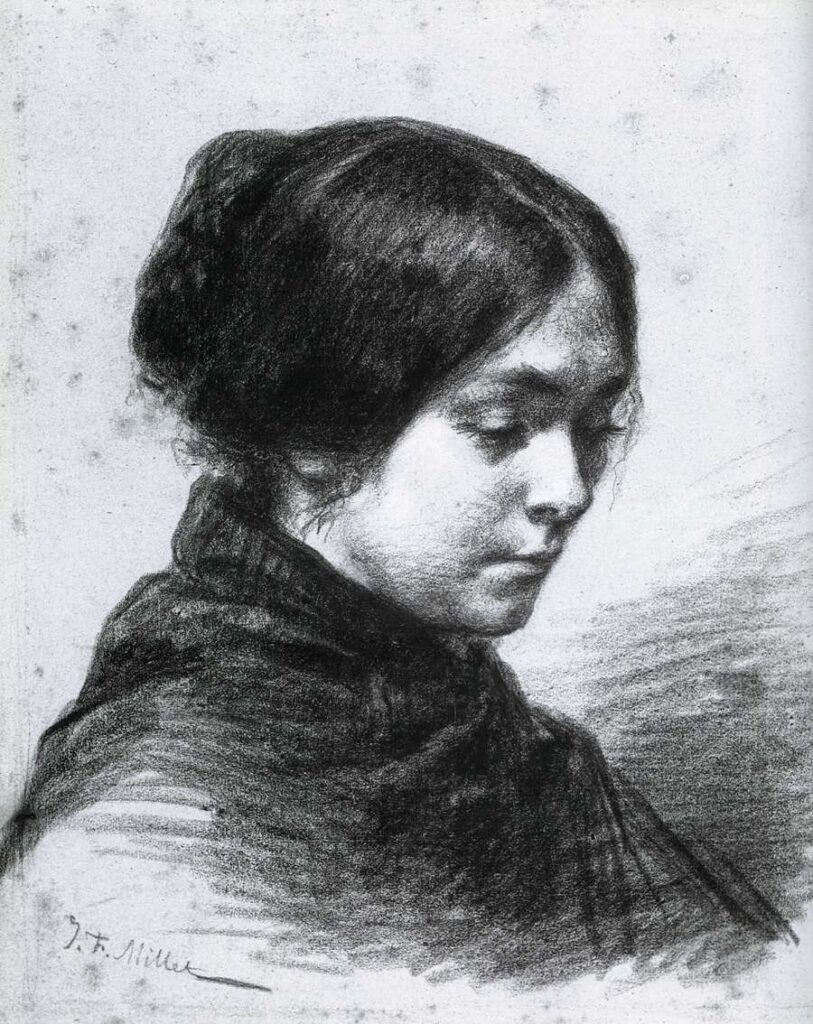
The love story of Jean-François Millet and Catherine Lemaire Millet begins not in salons or grand estates, but in the soil of rural France. It is a story shaped by hardship, faith, and steady devotion rather than dramatic romance. Born on October 4, 1814, in the small hamlet of Gruchy in Normandy, Millet grew up surrounded by fields, livestock, and the rhythms of peasant life. That early environment would later define both his art and the kind of partnership he would build.
Millet’s work is often remembered for its solemn dignity, but behind that quiet power stood a life equally grounded in simplicity. Catherine Lemaire Millet, his second wife, shared in that grounded existence. She was not a figure of public acclaim, yet her presence shaped the stability of Millet’s home and career. Their relationship reflected the same themes seen in his paintings: endurance, humility, and quiet strength.
The simplicity and strength of a shared life
Their marriage was not one built on wealth or comfort, but on shared responsibility and mutual reliance. In a time when France was undergoing social and political change, they remained rooted in traditional values and family life. Catherine helped anchor Millet during uncertain years, offering consistency while he pursued a difficult artistic path. Together, they created a household that mirrored the rural scenes he painted.
This love story stands apart because it avoids spectacle and instead highlights the power of everyday commitment. While Millet gained recognition later in life, his private world remained modest. Catherine’s role was never public, yet it was essential. Their shared life shows how enduring love often grows strongest in the quietest places.
Jean-François Millet’s Early Life and Formative Years
Jean-François Millet’s early life was deeply tied to the land and traditions of Normandy. Born into a farming family, he spent his childhood working alongside relatives who depended on the soil for survival. This upbringing instilled a strong work ethic and a deep respect for labor. It also shaped his artistic vision, which would later focus on the dignity of rural workers.
His talent for drawing was recognized early, and he received initial training in Cherbourg around 1833. By 1837, Millet moved to Paris to study at the École des Beaux-Arts under Paul Delaroche. The transition from rural life to the capital was difficult, both financially and emotionally. He struggled to adapt to academic expectations while staying true to his roots.
From Norman fields to artistic ambition
Millet’s early career in Paris was marked by uncertainty and hardship. He attempted to gain recognition through portraits and mythological subjects, which were more commercially viable at the time. However, these works did not fully satisfy his artistic instincts. He remained drawn to the lives of ordinary people, even when it offered little financial reward.
These formative years shaped not only his art but also his personal character. He developed resilience in the face of rejection and financial strain. That resilience would later define his marriage to Catherine. His early struggles laid the foundation for a life where love and labor were inseparable.
Catherine Lemaire Millet: The Woman Behind the Artist
Catherine Lemaire Millet remains a quieter figure in history, with fewer documented details than her husband. What is known suggests she came from a modest background, consistent with Millet’s own rural origins. Historical records confirm that she married Millet in 1845, following the death of his first wife. Beyond these facts, much of her personality must be carefully inferred from context.
She became the central figure in managing the household and raising their children. Millet and Catherine would go on to have nine children together, creating a busy and demanding home life. Her role required discipline, patience, and emotional strength. These qualities allowed Millet to continue working despite financial instability.
Strength, stability, and quiet influence
Responsible historical speculation suggests that Catherine’s influence was steady rather than dramatic. There are no letters or memoirs that describe her inner thoughts in detail. However, the stability of Millet’s later life strongly implies her importance. She likely provided the emotional grounding that allowed him to endure long periods of struggle.
Her contributions were practical but deeply meaningful. She managed daily life so that Millet could focus on painting. In many ways, her work was as essential as his, though far less visible. Their partnership reflects a traditional division of roles that supported long-term stability.
Love Forged Through Loss and Second Chances
Before his marriage to Catherine, Millet experienced profound personal loss. He married his first wife, Pauline-Virginie Ono, in 1841. Tragically, she died in 1844, leaving Millet widowed at a young age. This event marked a turning point in his emotional life.
The grief he experienced likely influenced his outlook on relationships and family. While direct records of his emotional state are limited, it is reasonable to infer that this loss deepened his appreciation for stability. When he married Catherine in 1845, it represented not just a new beginning, but a necessary foundation for rebuilding his life. Their union was grounded in both emotional need and practical necessity.
From grief to enduring partnership
The early years of their marriage were far from easy. Financial difficulties persisted, and Millet struggled to gain consistent income from his art. Catherine faced the challenge of maintaining a household under these conditions. Their shared hardships strengthened their bond over time.
Rather than weakening under pressure, their relationship grew more resilient. They learned to depend on one another in meaningful ways. This period set the tone for the rest of their marriage. It was a partnership defined by perseverance rather than comfort.
A Shared Life in Barbizon: Partnership in Hardship
In 1849, Millet and his family moved to the village of Barbizon near the Forest of Fontainebleau. This move proved to be a defining moment in both his career and personal life. Barbizon became a center for artists interested in nature and rural subjects. For Millet, it offered inspiration but not immediate financial success.
Life in Barbizon was marked by poverty and uncertainty. The family often struggled to afford basic necessities. Catherine played a crucial role in keeping the household functioning during these difficult years. Her ability to manage scarce resources was vital to their survival.
Building a home amid poverty and artistic struggle
During this period, Millet created some of his most famous works, including The Gleaners in 1857 and The Angelus around 1857–1859. These paintings reflected the very life he and Catherine were living. They depicted labor, faith, and endurance with quiet dignity. The emotional tone of these works suggests a deep connection to his own experiences.
Their household was large, with nine children requiring care and attention. Despite the challenges, they maintained a sense of unity. Catherine’s role as a stabilizing force cannot be overstated. Together, they built a life that balanced hardship with purpose.
Love Reflected in Art and Everyday Life
Millet’s paintings often focus on themes of family, labor, and rural devotion. These subjects were not abstract ideas but reflections of his daily life. The presence of strong, working women in his art may be influenced by Catherine’s role in his home. While direct evidence is limited, this interpretation aligns with the broader context of his work.
His figures are often shown in quiet moments of labor or prayer. These scenes suggest a respect for simple, honest living. Catherine’s influence can be seen in the emotional tone of these works. They carry a sense of calm endurance rather than dramatic intensity.
The quiet presence behind the canvas
Responsible speculation suggests that Catherine’s presence shaped the emotional atmosphere of Millet’s art. Her steady support likely allowed him to focus on themes that required patience and observation. The domestic life they shared provided constant inspiration. It grounded his work in real experience rather than imagination.
Their shared values of humility and faith are reflected throughout his paintings. These qualities give his work a timeless quality. The connection between life and art is clear. Their love story lives on through the scenes he created.
Legacy of Devotion: Their Final Years and Lasting Impact
In his later years, Millet began to receive greater recognition for his work. By the 1860s and early 1870s, his reputation had grown both in France and internationally. Despite this success, his lifestyle remained modest. Catherine continued to manage the household as she always had.
Jean-François Millet died on January 20, 1875, in Barbizon at the age of 60. His death marked the end of a life shaped by perseverance and artistic dedication. Catherine survived him, though detailed records of her later years are limited. She played a role in preserving his legacy through the family.
A love that endured beyond recognition
Their marriage stands as an example of enduring partnership. It was not defined by public admiration but by private commitment. Even as Millet’s fame grew, their relationship remained grounded. This contrast highlights the authenticity of their bond.
Their story continues to resonate because it reflects universal values. Love, resilience, and shared purpose define their legacy. Catherine’s quiet strength remains an essential part of that story. Together, they created a life that continues to inspire.
Key Takeaways
- Jean-François Millet was born on October 4, 1814, in Normandy and grew up in a farming family
- He married Catherine Lemaire Millet in 1845 after the death of his first wife in 1844
- The couple had nine children and lived much of their life in Barbizon from 1849
- Catherine played a crucial role in managing the household during financial hardship
- Their partnership influenced the emotional depth and themes of Millet’s artwork
FAQs
- Who was Jean-François Millet?
A French painter known for depicting rural life and peasant labor in the 19th century - When did Millet marry Catherine Lemaire?
They married in 1845, one year after the death of his first wife - How many children did they have?
Jean-François Millet and Catherine had nine children together - Where did they live most of their lives?
They lived in Barbizon, France, starting in 1849 - Did Catherine influence Millet’s art?
While not directly documented, her role in his life likely shaped the themes of his work