Few artistic marriages of the Dutch Golden Age combined love, family, business, and creativity as closely as the union of Jan Steen and Grietje van Goyen. Their story unfolded during one of the most remarkable periods in European art history, when painters, merchants, brewers, and craftsmen helped transform the Dutch Republic into a center of culture and commerce. While Jan Steen became famous for his lively scenes of everyday life, humor, and family gatherings, his wife Grietje stood at the center of his personal world for two decades.
Their marriage joined two artistic families. Steen was an ambitious young painter from Leiden. Grietje was the daughter of the distinguished landscape painter Jan van Goyen, one of the most respected artists of his generation. The relationship connected master and pupil, father-in-law and son-in-law, business associates and family members. It also placed Grietje at the heart of a household that would become one of the most productive artistic environments of the seventeenth century.
The surviving records reveal only fragments of Grietje’s life. Like many women of her era, she left few written documents behind. Yet her presence can be traced through marriage records, baptismal entries, family connections, and the paintings in which she likely appeared as a model. Through those sources, a picture emerges of a woman who shared in the triumphs and struggles of a famous artist.
Their story is not merely a romance. It is also a story about family loyalty, economic hardship, artistic ambition, and perseverance. Together they experienced prosperity and debt, raised a large family, moved repeatedly across Holland, and witnessed dramatic changes in the Dutch art market. Their marriage helped shape the career of one of the greatest genre painters in European history.
How Jan Steen Met Grietje van Goyen
Jan Steen’s Early Training Under Jan van Goyen
Jan Havickszoon Steen was born in Leiden around 1626 into a prosperous Catholic family involved in the brewing trade. His father owned the tavern known as the Red Halbert, giving the young Steen firsthand exposure to the colorful social life that would later appear in many of his paintings. Although he attended Leiden’s Latin School and briefly studied at Leiden University in 1646, his true interests lay in painting.
During his artistic training, Steen studied under several established masters, including Nicolaes Knüpfer and Adriaen van Ostade. By the late 1640s, however, he had entered the orbit of Jan van Goyen, the renowned landscape painter who lived and worked in The Hague. Van Goyen was among the most influential landscape artists in the Dutch Republic. His atmospheric river views and coastal scenes were admired throughout the country.
Working in Van Goyen’s studio offered Steen far more than technical instruction. It introduced him to a successful artistic household where painting functioned as both a profession and a family enterprise. Van Goyen’s home on the Bierkade in The Hague served as a workplace, residence, and meeting point for artists and patrons. It was within this environment that Steen came to know Van Goyen’s daughter Margriet, known within the family as Grietje.
The connection appears to have deepened quickly. Steen not only worked for Van Goyen but eventually lived in the family household. Such arrangements were common in the seventeenth century, particularly when apprentices became trusted assistants. Close daily contact naturally brought the young painter and Grietje together.
Courtship and Marriage in The Hague
Jan Steen and Margriet van Goyen were married on 3 October 1649 in The Hague. The marriage united two Catholic families at a time when Catholics occupied a complicated position within the predominantly Protestant Dutch Republic. Shared religious traditions likely strengthened the connection between the families.
For Steen, the marriage brought important personal and professional advantages. Van Goyen was already a celebrated artist with an established reputation and a broad network of patrons. Becoming his son-in-law placed Steen within one of the leading artistic circles in Holland. Such family ties often played an important role in artistic careers during the seventeenth century.
For Grietje, the marriage joined her future to a young painter whose career was still developing. Although Steen would eventually become one of the most beloved Dutch artists, his future success was far from guaranteed in 1649. The art market could be unpredictable, and many painters struggled financially despite their talent.
The newly married couple remained connected to Van Goyen’s household and workshop for several years. Those early years of marriage provided stability, artistic opportunity, and family support. They also laid the foundation for a partnership that would endure through prosperity and hardship alike.
Marriage, Family Life, and Daily Challenges
Building a Household Together
The marriage of Jan and Grietje produced a large family. Contemporary sources and later records generally indicate that they had eight children together. Raising such a family required constant work and organization, especially in a household where artistic production remained a primary source of income.
The couple’s first known child, Thadaeus, was baptized in The Hague on 6 February 1651. Another child, Eva, was baptized on 12 December 1653. Records confirm several additional children, although not all birth dates survive. Like many families of the era, the Steens faced the realities of high infant mortality and uncertain medical care.
Family life in the seventeenth-century Dutch Republic revolved around the household. Homes functioned as workplaces, schools, and centers of social activity. Children learned practical skills from parents and relatives. In artistic families, sons and daughters often assisted with studio tasks from an early age.
The busy atmosphere of the Steen household likely resembled the energetic scenes found in many of Jan Steen’s paintings. Meals, celebrations, music, visitors, and children filled daily life with activity. Yet beneath the humor and lively conversation stood the serious responsibility of providing for a growing family.
Financial Pressures and Frequent Moves
Despite his artistic talent, Jan Steen experienced recurring financial difficulties. Around 1654 he moved with his family to Delft, where he took over the brewery De Slang, or “The Snake.” The venture reflected both opportunity and necessity. Brewing offered an additional source of income beyond painting.
Unfortunately, success proved elusive. The brewery failed to generate substantial profits. Conditions worsened dramatically on 12 October 1654 when the Delft gunpowder magazine exploded. The disaster killed more than one hundred people and devastated large sections of the city. Economic activity suffered, and the local art market declined sharply.
For Grietje, these setbacks meant adapting repeatedly to changing circumstances. She managed a growing household while her husband attempted to balance artistic work with commercial ventures. Such responsibilities demanded resilience and practical judgment.
The family moved several times during the following years. They lived in Delft, Warmond, Haarlem, and eventually Leiden. Each move brought challenges but also opportunities. Through all these transitions, Grietje remained a constant presence beside her husband as he continued producing paintings that gradually enhanced his reputation.
Grietje’s Influence on Jan Steen’s Art
Wife, Model, and Source of Inspiration
Jan Steen frequently drew inspiration from the people closest to him. Friends, relatives, and family members appeared throughout his work. According to the Mauritshuis, Grietje herself served as a model in a number of paintings. This practice was common among Dutch artists, who often relied on family members rather than hired models.
Using familiar faces offered important advantages. Expressions appeared more natural. Gestures seemed convincing. The artist could work comfortably with subjects who understood his methods and schedule. Grietje’s participation helped create the sense of authenticity that became one of Steen’s greatest strengths.
Many of Steen’s paintings feature wives, mothers, musicians, revelers, and household figures whose identities cannot always be determined with certainty. Art historians have suggested that some of these women may represent Grietje. In several cases, however, definitive identification remains impossible, and caution is necessary.
What can be said with confidence is that Grietje occupied an important place within Steen’s artistic world. She shared his daily life, witnessed the creation of hundreds of paintings, and participated in the household environment from which many of his most memorable scenes emerged.
The Reality Behind the “Jan Steen Household”
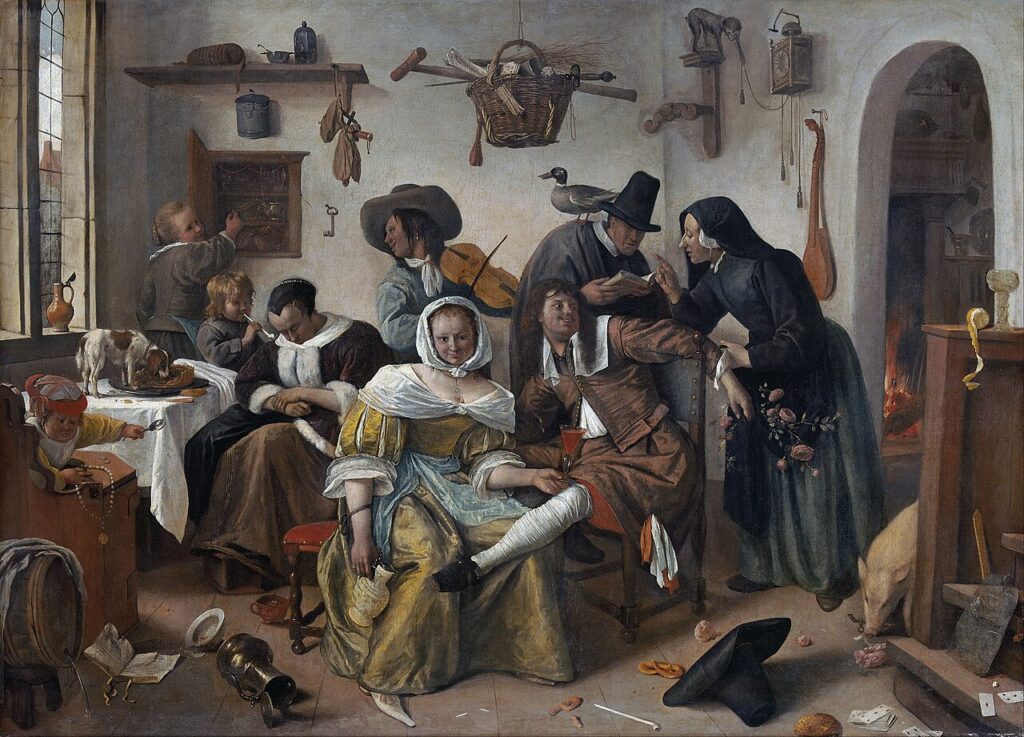
The Dutch language eventually produced a phrase that survives today: a “Jan Steen household.” The expression refers to a chaotic home filled with noise, clutter, and disorder. It developed because so many of Steen’s paintings portray lively families, celebrations, taverns, and domestic confusion.
Later writers often assumed these scenes reflected the artist’s own behavior. The eighteenth-century biographer Arnold Houbraken portrayed Steen as a drinker and practical joker whose paintings supposedly mirrored his personal life. This image remained influential for generations.
Modern scholarship paints a more balanced picture. Steen was a highly skilled professional who managed a substantial artistic career. Producing hundreds of paintings required discipline, planning, and technical mastery. The apparent disorder in his paintings often served moral, humorous, or symbolic purposes rather than documentary ones.
Grietje’s role helps illustrate this distinction. Far from representing chaos, she helped sustain a large family through years of uncertainty. The marriage endured approximately twenty years, suggesting stability and commitment rather than constant disorder. The famous scenes of merrymaking should therefore be understood primarily as artistic creations rather than literal records of household life.
Loss, Legacy, and the Enduring Story of Jan and Grietje
Grietje’s Death and Its Impact
In 1669, after roughly two decades of marriage, Grietje van Goyen died. The loss marked a turning point in Jan Steen’s life. By this time the family had spent years in Haarlem, where Steen produced many of his most celebrated works.
The death came during a difficult period. Steen’s father died the following year in 1670. Within a short span, the artist lost both his wife and a parent. Such events would have affected any family, but they were especially significant for a man responsible for numerous children.
After Grietje’s death, Steen eventually returned to Leiden. The move brought him back to the city of his birth and closer to family connections that could provide support. Yet the absence of the woman who had shared so much of his adult life must have been deeply felt.
Although Steen remarried in April 1673, marrying Maria van Egmont, Grietje’s place in his story remained unique. She had accompanied him through the formative decades of his career, from ambitious young painter to recognized master of Dutch genre painting.
Their Place in Dutch Golden Age History
The marriage of Jan Steen and Grietje van Goyen occupies a distinctive place in Dutch art history. It united two important artistic families and created a bridge between generations of painters. Through Jan van Goyen, Steen gained access to valuable artistic networks. Through Steen, the Van Goyen family became linked to one of the most celebrated genre painters of the century.
Several aspects of the marriage influenced Steen’s development:
- Access to Jan van Goyen’s workshop and experience
- Connections to patrons and collectors
- A supportive artistic household
- Family members who served as models
- Long-term personal stability during crucial career years
Their story also highlights the often-overlooked role of women in artistic households. Grietje did not leave behind paintings bearing her signature. Yet her contributions as wife, mother, model, and partner helped sustain an environment in which artistic achievement became possible.
Today, Jan Steen’s paintings hang in major museums throughout the world. Visitors admire their humor, observation, and humanity. Behind many of those works stands the quieter story of Grietje van Goyen, whose life intersected with one of the Dutch Golden Age’s most gifted artists. Their marriage remains a reminder that great art often grows from family bonds, shared struggles, and enduring affection.