When people think of the great painters of the Dutch Golden Age, they often imagine celebrated artists surrounded by wealthy patrons, ambitious apprentices, and the vibrant energy of seventeenth-century Holland. Yet behind many artistic careers stood individuals whose contributions rarely made it into history books. Such was the case with Lysbeth Reyniers, the second wife of the renowned portrait painter Frans Hals.
Unlike the dramatic romances associated with some artists, the story of Frans Hals and Lysbeth Reyniers is not one of passionate letters, public declarations, or scandalous affairs. Instead, it is a story of partnership, resilience, family, and endurance. Their marriage lasted nearly half a century and survived the many challenges of raising a large household while navigating the uncertain fortunes of an artist’s career.
Although historical records reveal only fragments of their personal relationship, those fragments paint a compelling picture of a couple who built a life together during one of the most fascinating periods in European history.
A Widower in Need of Help
By the middle of the second decade of the seventeenth century, Frans Hals had already established himself as a promising painter in Haarlem. Born around 1582 or 1583, Hals was developing the lively portrait style that would eventually make him one of the most celebrated artists of the Dutch Golden Age.
His personal life, however, suffered a devastating loss. Around 1610, he had married Anneke Harmensdochter. The couple had children together, but tragedy struck when Anneke died in 1615, leaving Hals a widower with young children to care for.
The death of a spouse in seventeenth-century Europe created practical as well as emotional challenges. Childcare, household management, and economic survival were deeply interconnected. For a working artist who spent long hours in the studio, maintaining a household alone would have been extremely difficult.
It was during this period that Lysbeth Reyniers entered his life.
Historical records indicate that Lysbeth worked in the Hals household, helping care for the children left behind after Anneke’s death. She was considerably younger than Hals and came from a modest background. Her father worked as a fishmonger, a respectable but ordinary profession within Haarlem society.
What began as a practical arrangement would eventually develop into a lifelong partnership.
The Beginning of Their Relationship
The exact details of how Frans and Lysbeth fell in love are lost to history. No surviving letters describe their courtship, and neither left behind personal memoirs. Nevertheless, official records reveal important clues.
In February 1617, Frans Hals and Lysbeth Reyniers married in Spaarndam, a village near Haarlem. The location of the marriage is significant. Couples sometimes married outside their home city for various reasons, and records suggest that Lysbeth was already pregnant at the time of the wedding.
Their daughter Sara was born soon afterward.
Modern readers may interpret this circumstance as evidence of a whirlwind romance, but it is important to understand the social realities of the seventeenth century. Marriage frequently followed practical considerations alongside affection. Widowers often remarried relatively quickly, particularly when young children were involved.
Yet practicality alone cannot explain a marriage that endured for nearly fifty years.
Whatever their initial motivations, Frans and Lysbeth remained together through decades of prosperity, hardship, family growth, and old age.
Building a Large Family
One of the strongest indications of the stability of their relationship is the size of the family they created together.
Frans and Lysbeth had at least eight children. Combined with children from Hals’s first marriage, their household became remarkably large. In an era before modern conveniences, managing such a family required extraordinary effort.
Life in seventeenth-century Haarlem revolved around both work and home. The boundaries between professional and domestic spaces were often blurred. Artists commonly operated workshops within their residences, meaning children, apprentices, clients, and family members could all share the same environment.
Lysbeth’s role within this world was likely substantial.
While historical records seldom document the daily contributions of wives, women often managed finances, supervised household activities, organized food supplies, cared for children, and provided support for family businesses. For an artist such as Hals, whose success depended on maintaining relationships with patrons and completing commissions, a stable home life was invaluable.
Although her name appears only occasionally in surviving documents, Lysbeth was undoubtedly central to the functioning of the Hals household.
Frans Hals’s Career and Household Life
During the early decades of their marriage, Frans Hals enjoyed considerable professional success.
Haarlem was one of the most important artistic centers in the Dutch Republic. Wealthy merchants, civic organizations, military officers, and regents commissioned portraits to celebrate their achievements and social status. Hals became famous for his energetic brushwork and his ability to capture personality and movement.
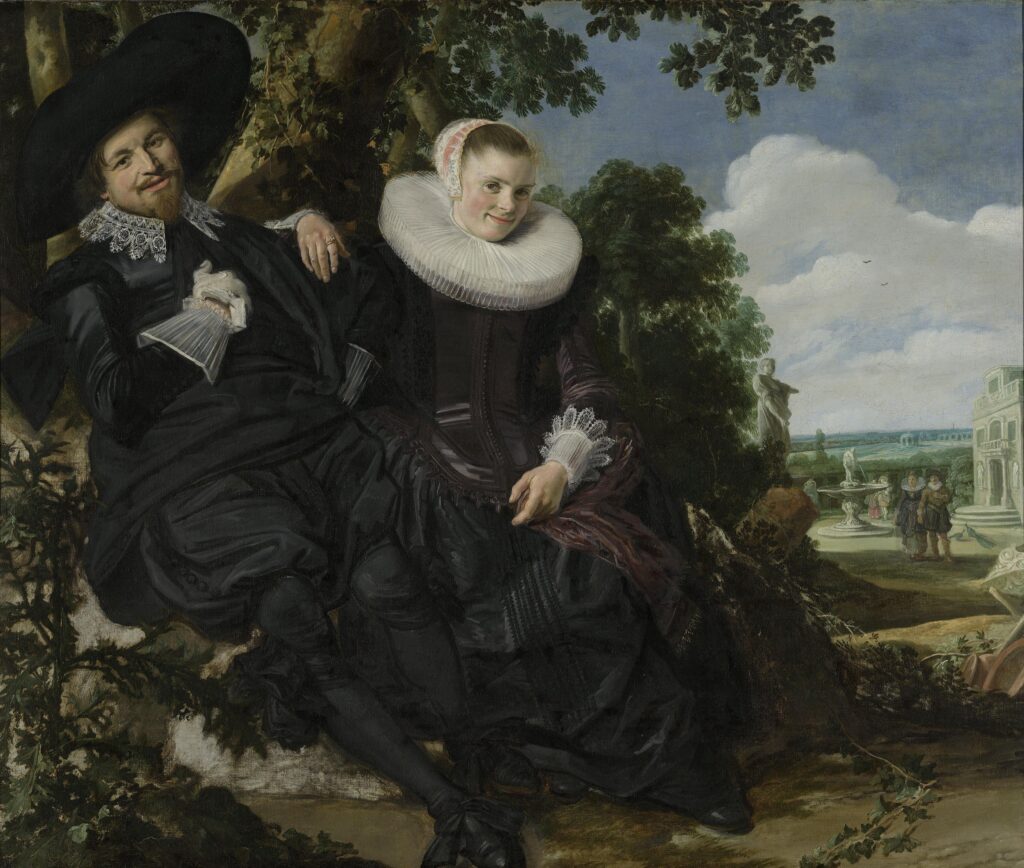
His portraits differed from many of his contemporaries. Rather than presenting stiff and formal figures, Hals often depicted his sitters with warmth, confidence, and a sense of life. Smiles, animated expressions, and spontaneous gestures became hallmarks of his style.
As his reputation grew, so did the demands on his time.
Behind the scenes, Lysbeth was raising children and helping maintain a household that likely bustled with constant activity. Apprentices entered and left the studio. Patrons arrived for sittings. Family members required attention and care.
The image of the solitary artistic genius rarely reflects historical reality. Most successful artists depended upon extensive support networks, and Frans Hals was no exception.
Financial Troubles and Hard Times
Despite his artistic accomplishments, Frans Hals struggled financially throughout much of his life.
This apparent contradiction surprises many people today. Modern audiences often assume that famous artists were wealthy during their lifetimes. In reality, artistic success did not always guarantee financial security.
Records reveal repeated debts, legal disputes involving money, and periods of economic hardship. At various points, Hals found himself facing significant financial pressures. These problems became particularly severe during his later years.
For Lysbeth, these difficulties would have been deeply personal.
Financial hardship affects entire families, not just individuals. Managing food, clothing, housing, and daily expenses for a large household required careful planning. Economic uncertainty likely placed enormous strain on the family.
Yet there is no evidence that the marriage collapsed under this pressure.
Instead, Frans and Lysbeth appear to have faced these challenges together. Their continued partnership during difficult times suggests a relationship built upon commitment and mutual dependence rather than convenience alone.
Separating Myth from Reality
For many years, stories circulated suggesting that Frans Hals mistreated his wife.
These claims appeared in various historical accounts and were repeated by some writers. However, modern scholarship has demonstrated that the accusations stemmed from confusion involving another Haarlem resident who shared the same name.
Researchers examining municipal records concluded that the allegations cannot be reliably connected to the painter.
This correction is important because it significantly changes our understanding of Hals’s domestic life. Without those accusations, the surviving evidence presents a very different picture.
There are no verified records of abuse, separation, scandal, or major conflict between Frans and Lysbeth. While historians cannot claim that their marriage was perfect, there is simply no reliable evidence of the dramatic dysfunction that earlier stories suggested.
Instead, what emerges is the image of a long-lasting marriage that weathered ordinary human challenges over many decades.
Life in Haarlem
To appreciate the relationship between Frans and Lysbeth, it helps to understand the city in which they lived.
Seventeenth-century Haarlem was a thriving center of commerce, culture, and industry. The Dutch Republic was experiencing extraordinary economic growth, and Haarlem benefited from trade, manufacturing, and artistic production.
The city was filled with craftsmen, merchants, brewers, textile workers, and artists. Streets bustled with activity. Markets attracted buyers and sellers from across the region. Churches and civic institutions played important roles in community life.
For women such as Lysbeth, daily responsibilities were demanding. Running a household required significant labor. Meals had to be prepared from scratch. Clothing needed repair and maintenance. Children required constant supervision.
Modern conveniences did not exist.
Against this backdrop, the longevity of the Hals marriage becomes even more impressive. Their relationship survived not only emotional and financial challenges but also the physical demands of everyday life in the seventeenth century.
Growing Old Together
Perhaps the most remarkable aspect of the relationship between Frans Hals and Lysbeth Reyniers is its duration.
Their marriage began in 1617 and lasted until Hals’s death in 1666. Nearly five decades passed between their wedding and the artist’s final years.
During that time, Europe changed dramatically. Wars came and went. Political leaders rose and fell. Economic conditions fluctuated. Artistic styles evolved.
Within their own household, children were born, grew up, and eventually established lives of their own.
The couple experienced the full cycle of family life together.
While surviving records rarely reveal emotional details, longevity itself tells an important story. Many marriages ended prematurely because of disease, childbirth complications, or other dangers common in the seventeenth century. Frans and Lysbeth shared a lifetime that was unusually long by the standards of their era.
Their partnership endured through youth, middle age, and old age.
The Final Years
By the 1660s, Frans Hals was elderly and struggling financially.
Ironically, the artist now regarded as one of the greatest painters of the Dutch Golden Age spent his final years in modest circumstances. Municipal authorities provided financial assistance, helping support him during old age.
Lysbeth remained by his side.
The records do not describe dramatic scenes or emotional farewells, but they reveal a couple who had spent nearly fifty years together. They had raised children, navigated hardships, celebrated successes, and built a shared history stretching across generations.
When Hals died in 1666, he left behind not only a remarkable artistic legacy but also a family shaped in large part by his long marriage to Lysbeth Reyniers.
A Love Story Hidden in Plain Sight
The relationship between Frans Hals and Lysbeth Reyniers may lack the dramatic elements often associated with famous historical romances. There are no surviving love letters, secret affairs, or sensational scandals.
Yet perhaps that is precisely what makes their story compelling.
Most marriages throughout history were not defined by extraordinary moments. They were defined by daily acts of commitment, responsibility, sacrifice, and support. The available evidence suggests that Frans and Lysbeth shared exactly that kind of partnership.
She entered his household at a moment of vulnerability, helping care for children who had lost their mother. He offered stability and family life in return. Together they created a home that endured for decades despite economic uncertainty and the challenges of raising a large family.
While Frans Hals achieved immortality through his paintings, Lysbeth’s contributions remained largely invisible. Nevertheless, her presence shaped the environment in which one of the Dutch Republic’s greatest artists lived and worked.
In the end, their story reminds us that behind many celebrated achievements stand relationships that history barely records. The paintings of Frans Hals continue to hang in museums around the world, admired for their vitality and brilliance. Yet behind those masterpieces was a marriage that lasted nearly fifty years—a quiet, resilient partnership that deserves to be remembered alongside the art itself.