Few love stories in the history of art are as moving, complicated, and influential as the relationship between Egon Schiele and Wally Neuzil. Their partnership lasted only a few years, yet it left a lasting mark on some of the most memorable works of Austrian Expressionism. Wally was far more than a model standing quietly in a studio. She was Schiele’s companion, supporter, confidante, and artistic collaborator during one of the most important periods of his career. Together they faced public criticism, financial uncertainty, and personal sacrifice. Their story combines artistic ambition, devotion, heartbreak, and tragedy in a way that continues to fascinate historians more than a century later.
When people think of Schiele today, they often picture the intense portraits and emotionally charged figures that made him famous. Yet many of those images would not exist without Wally Neuzil. Her face appears repeatedly throughout his work, becoming almost inseparable from his artistic identity during the years they were together. Understanding their relationship provides a deeper understanding of Schiele himself and reveals the remarkable woman who stood beside him as he transformed into one of the twentieth century’s most important artists.
How Egon Schiele Met Wally Neuzil
Vienna’s Avant-Garde Art World in 1911
In 1911, Vienna was one of Europe’s most exciting cultural capitals. The city was alive with new ideas in art, architecture, literature, and music. Traditional artistic conventions were increasingly challenged by younger painters who wanted to explore emotion, psychology, and modern life. Among these emerging talents was Egon Schiele, born on June 12, 1890, in Tulln, Austria.
By the time Schiele met Wally Neuzil, he had already attracted attention as a promising young artist. He had studied at the Vienna Academy of Fine Arts but found its conservative approach restrictive. Inspired by Gustav Klimt and the Vienna Secession movement, Schiele sought a more personal and expressive style. His work quickly became known for its raw emotional power and unconventional treatment of the human figure.
Walburga “Wally” Neuzil was born on August 18, 1894. Although many details of her early life remain less documented than those of Schiele, historians know that she became associated with artistic circles in Vienna while still a young woman. Around 1911, she entered Schiele’s life and soon became much more than a professional model.
The Beginning of Their Relationship
The exact circumstances of their first meeting are not fully documented, but by 1911 Wally had become both Schiele’s model and romantic partner. Their relationship developed quickly. Unlike many artists’ models of the period, Wally became deeply involved in Schiele’s everyday life.
The young couple soon chose an unconventional path. Rather than maintaining a strictly professional relationship, they lived together and traveled together. In the conservative society of early twentieth-century Austria, such arrangements often attracted criticism. Nevertheless, both appeared willing to ignore social expectations.
For Schiele, Wally arrived during a critical stage of his development. He was still establishing his reputation and had not yet achieved the financial security or recognition that would come later. Wally entered his life not when success was guaranteed, but when uncertainty remained the dominant reality.
More Than a Model
Many discussions of Wally focus on her appearance in Schiele’s paintings and drawings. Yet reducing her role to that of a muse overlooks her importance. She shared his daily struggles and supported him through periods of instability that might have discouraged a less devoted companion.
Artists often depend on trusted individuals who understand their ambitions and accept the sacrifices required to pursue them. Wally appears to have filled that role. During the years they spent together, Schiele’s artistic confidence grew dramatically. His style became increasingly distinctive, and his work attracted greater attention from collectors and critics.
The relationship was built on more than romance. It was also a partnership grounded in mutual trust. Wally repeatedly posed for difficult and emotionally demanding works. Through her willingness to participate in Schiele’s artistic experiments, she became one of the most recognizable figures in Austrian art.
Wally’s Influence on Schiele’s Art
The Face of Schiele’s Most Powerful Works
Wally appears in numerous drawings, watercolors, and paintings created between 1911 and 1915. Her distinctive features made her immediately recognizable. Her reddish hair, expressive eyes, and strong facial structure provided Schiele with a subject capable of conveying a wide range of emotions.
Unlike many academic portraits of the period, Schiele’s depictions of Wally emphasized psychological presence rather than conventional beauty. He sought to capture mood, vulnerability, confidence, and individuality. As a result, his portraits of Wally often feel intensely personal.
Art historians frequently note that Schiele returned to her image again and again during these years. This repetition reflected not merely convenience but familiarity. Few people spent more time in his company, and few understood his artistic goals as thoroughly.
As Schiele’s style evolved, Wally remained a constant presence. Her image became intertwined with some of the artist’s most important creative breakthroughs. Through these works, her face entered art history.
Artistic Collaboration and Trust
Creating expressive portraiture requires more than technical skill. It also requires trust between artist and subject. The remarkable emotional depth visible in Schiele’s portraits of Wally suggests a relationship built upon familiarity and openness.
The pair spent long periods working together. Wally understood Schiele’s creative process and appears to have accepted the unusual demands it placed upon both of them. Such cooperation allowed him to push artistic boundaries in ways that would have been difficult with less committed sitters.
Their partnership helped create a body of work that remains among the defining achievements of Austrian Expressionism. Wally’s contribution was not measured in brushstrokes, but her presence shaped the final result. Without her participation, many of Schiele’s most memorable images would likely look very different.
The relationship demonstrates how artistic achievement often emerges through collaboration. While only one name appears on the canvas, important works frequently depend upon the dedication of multiple individuals working toward a common goal.
The Creation of Portrait of Wally Neuzil
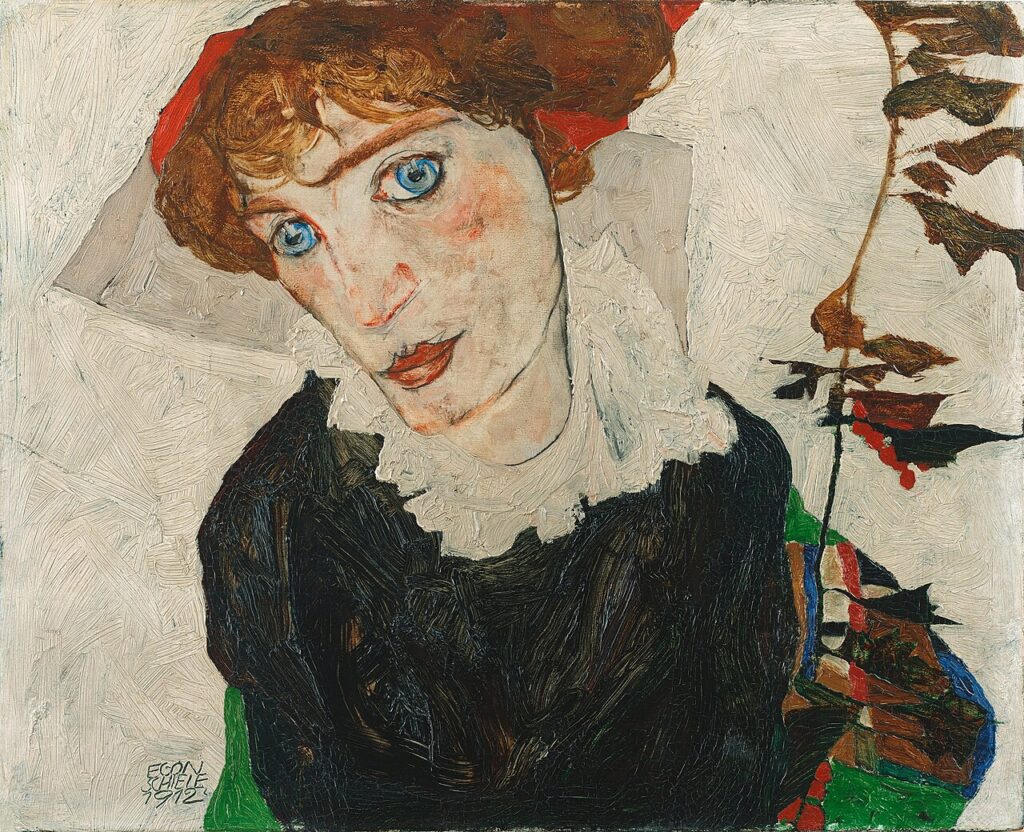
Among all the works associated with their relationship, none is more famous than Portrait of Wally Neuzil by Egon Schiele, painted in 1912. The painting is executed in oil on wood and measures 32 by 39.8 centimeters. Today it is housed in Vienna’s Leopold Museum.
The portrait captures Wally in a direct and unforgettable manner. Her head turns slightly toward the viewer while her gaze remains steady and self-assured. Schiele avoided unnecessary background details, focusing attention entirely on the subject.
The painting’s emotional power comes partly from its simplicity. There are no elaborate settings or distracting elements. Instead, viewers encounter a vivid personality rendered with remarkable intensity. More than a century later, the portrait remains one of the artist’s most celebrated works.
Its significance extends beyond aesthetics. The painting serves as a visual record of one of the most important relationships in Schiele’s life. Through it, Wally continues to be remembered not only as a model but as a central figure in the artist’s personal and creative journey.
Key Ways Wally Influenced Schiele’s Art
- She served as his principal model during crucial developmental years.
- She appeared in many of his most recognizable works.
- She provided emotional support during professional struggles.
- She helped sustain his artistic ambitions during periods of uncertainty.
- She became one of the defining visual symbols of his artistic identity.
Scandal, Exile, and Life Outside Vienna
Leaving Vienna Together
The couple eventually left Vienna in search of greater freedom. One destination was Krumau, now known as Český Krumlov, a town with family connections to Schiele through his mother’s side. He hoped the quieter environment would provide inspiration and fewer distractions.
The move did not produce the peaceful refuge he expected. Local residents often viewed the couple’s unconventional lifestyle with suspicion. Their living arrangements and social habits differed from prevailing norms, attracting criticism and gossip.
Despite these challenges, Schiele continued working intensely. The landscapes and portraits produced during this period demonstrate his ongoing artistic growth. Wally remained at his side throughout these transitions.
Eventually, the pair relocated again, this time to Neulengbach, west of Vienna. Unfortunately, new difficulties soon emerged.
Neulengbach and Schiele’s Arrest
In 1912, Schiele became involved in a legal case that remains one of the most discussed episodes of his life. Authorities arrested him in Neulengbach, and he spent time in detention while charges were investigated.
Although many aspects of the case have been debated by historians, what remains clear is that the experience deeply affected him. His imprisonment interrupted his work and exposed him to public scrutiny at a particularly vulnerable moment in his career.
Throughout the ordeal, Wally remained loyal. Rather than distancing herself from controversy, she continued to support him. Such loyalty was significant given the social pressures surrounding the case.
The episode strengthened the impression that their relationship extended far beyond convenience. Difficult times often reveal the strength of personal bonds, and Wally’s conduct during this period demonstrated considerable commitment.
A Relationship Tested by Hardship
Financial pressures accompanied public criticism. Success did not arrive overnight for Schiele, and the couple frequently faced uncertainty regarding income and living arrangements.
Yet these challenges also coincided with important artistic developments. Schiele’s reputation gradually expanded, attracting increasing interest from collectors and supporters. The years of struggle were laying the foundation for future recognition.
Wally witnessed this transformation firsthand. She experienced both the setbacks and the achievements. Her presence during these formative years gave her a unique place in Schiele’s story.
By the middle of the decade, however, changes were beginning to emerge that would alter the course of their lives.
Why Schiele Left Wally and Their Tragic End
The Decision to Marry Edith Harms
In 1915, Schiele made a decision that permanently changed his relationship with Wally. He chose to marry Edith Harms, a young woman from a respectable middle-class family living near his studio.
The choice surprised many observers and remains one of the most controversial episodes in discussions of Schiele’s personal life. For years, Wally had stood beside him through hardship and uncertainty. Yet as his career advanced, he appears to have sought a different future.
Historians have often interpreted the decision as reflecting a desire for greater social stability. Marriage to Edith offered advantages that differed from the unconventional relationship he had shared with Wally.
Whatever his motivations, the decision brought an end to one of the most important partnerships of his life.
Wally’s Reaction and Departure
The separation marked a turning point for both individuals. After four years together, Wally and Schiele went their separate ways. The break was final.
Many scholars view this moment as one of the most emotionally significant episodes in Schiele’s biography. The woman who had accompanied him through years of artistic experimentation and personal struggle was suddenly absent from his daily life.
One of the key works associated with this period is Death and the Maiden (1915), painted by Schiele. The painting has often been connected by scholars to the end of the relationship and the emotional upheaval surrounding it.
Whether viewed through biography or art history, the separation remains one of the defining events of Schiele’s early adulthood.
Wally’s Final Years and Lasting Legacy
After the relationship ended, Wally pursued a different path. During the First World War, she served as a nurse. Her life, however, would be tragically short.
On December 25, 1917, Wally Neuzil died from scarlet fever at the age of twenty-three. Her death occurred just one year before Schiele himself died during the influenza pandemic of 1918.
For many years, Wally remained overshadowed by the fame of the artist she had inspired. Gradually, however, historians and curators began paying greater attention to her own story. Exhibitions and research projects helped restore her place within the history of modern art.
Today, she is increasingly recognized as an individual whose influence extended beyond the role of model. She was a partner, supporter, and participant in one of the most important artistic careers of the early twentieth century.
The Lasting Legacy of Wally Neuzil
- Principal companion during Schiele’s formative artistic years.
- Subject of many significant drawings and paintings.
- Inspiration for Portrait of Wally Neuzil (1912).
- Loyal supporter during public controversy and imprisonment.
- Increasingly acknowledged as an important historical figure in her own right.
Conclusion
The story of Egon Schiele and Wally Neuzil is both inspiring and heartbreaking. Their relationship lasted only a few years, yet it shaped the course of Schiele’s career and left a lasting mark on art history. Wally stood beside him when success was uncertain, supported him during controversy, and became the face of many of his most powerful works.
The surviving portraits reveal more than artistic skill. They preserve the memory of a woman whose presence profoundly influenced one of Austria’s most important modern painters. While Schiele’s fame continued to grow after his death, Wally’s contribution was slower to receive recognition.
Today, the enduring image of Wally in Schiele’s art reminds viewers that great creative achievements often emerge from relationships as much as individual talent. Their story remains one of art history’s most memorable examples of love, sacrifice, ambition, and loss.
Key Takeaways
- Wally Neuzil was Egon Schiele’s companion, model, and closest supporter from 1911 to 1915.
- She appeared in many of Schiele’s most important drawings, watercolors, and paintings.
- Portrait of Wally Neuzil (1912) remains one of the defining images of Austrian Expressionism.
- Wally remained loyal during Schiele’s legal troubles and years of financial uncertainty.
- Their separation in 1915 ended one of the most influential relationships in Schiele’s life and art.
FAQs
Who was Wally Neuzil?
Wally Neuzil (1894–1917) was an Austrian model and the longtime companion of artist Egon Schiele. She played a major role in both his personal life and artistic development.
How long were Egon Schiele and Wally Neuzil together?
They were together from approximately 1911 until the spring of 1915, when Schiele ended the relationship and later married Edith Harms.
What is the most famous painting of Wally Neuzil?
The most famous portrait is Portrait of Wally Neuzil (1912), painted by Egon Schiele and now housed in the Leopold Museum in Vienna.
Why did Egon Schiele leave Wally Neuzil?
In 1915 Schiele decided to marry Edith Harms. Historians generally believe he sought a more socially conventional marriage as his career and public standing advanced.
What happened to Wally Neuzil?
After separating from Schiele, Wally served as a nurse during the First World War. She died of scarlet fever on December 25, 1917, at the age of twenty-three.