Dante Gabriel Rossetti entered the world on May 12, 1828, in London, England. He was the son of Gabriele Rossetti, an Italian poet and political exile, and Frances Polidori, the sister of Lord Byron’s physician. His family’s intellectual and artistic inclinations influenced his development from a young age. Raised in a home filled with books, art, and poetry, Rossetti was educated at King’s College School and later enrolled in the Royal Academy of Arts.
The early Victorian period was marked by deep social divisions and moral rigor, particularly regarding the role and virtue of women. Strict codes of modesty and respectability governed public life, and deviation from these norms led to ostracism. Artists often lived at the margins of this rigid society, especially those who associated with models of working-class backgrounds. This tension between artistic expression and societal standards defined much of Rossetti’s career.
In 1848, Rossetti co-founded the Pre-Raphaelite Brotherhood alongside William Holman Hunt and John Everett Millais. They sought to return to the rich detail and moral earnestness of art before Raphael, rejecting the academic formula of the Royal Academy. Their ideals initially focused on spirituality, nature, and truthfulness in representation, but over time, sensuality and psychological complexity became central.
Rossetti’s circle included poets, painters, and critics, many of whom viewed women more as ideals than as individuals. This idealization often clashed with the reality of human relationships. It was into this world of conflicted morals and aesthetics that Fanny Cornforth later entered, forever altering Rossetti’s art and affections.
Victorian Society and the Role of Women
In mid-19th century England, a woman’s worth was closely tied to her chastity, class, and obedience. Respectable women did not pose for paintings, particularly not for works depicting mythological or sensual subjects. Those who did were often models, actresses, or milliners—trades seen as bordering on improper.
Rossetti, like other artists of his time, required models who could bring emotion and presence to the canvas. These women were rarely from high society. Their public association with unmarried male artists carried a heavy social cost, regardless of whether the relationship was romantic or professional.
The contradiction of idealizing women as muses while condemning them socially was a widespread hypocrisy. While aristocratic women could be lionized for their refinement, the working-class women who inspired artists often remained anonymous or maligned. Fanny Cornforth was one such figure—beautiful, loyal, and talented, but branded as coarse by critics.
Rossetti’s career unfolded in this complicated environment. His choices in muses reflected his rebellion against these norms, but the consequences were real, especially for the women who loved him.
Rossetti’s Early Life and Artistic Roots
Rossetti’s early training in both literature and art gave him a dual voice as a painter and poet. His first major painting, The Girlhood of Mary Virgin (1849), featured his sister Christina Rossetti as the model and his mother as St. Anne. The work marked a departure from conventional religious painting, emphasizing domestic realism and symbolic detail.
In 1850, Rossetti painted Ecce Ancilla Domini! with Elizabeth Siddal as the Virgin Mary. The painting caused controversy for its sensual overtones. Siddal became central to his life and art, both as a muse and later as his wife. Rossetti’s brother, William Michael Rossetti, noted how profoundly Dante’s relationships influenced his work.
Between 1850 and 1856, Rossetti’s themes shifted increasingly toward medieval romance, sensuality, and myth. His work began to emphasize female beauty as a vehicle of mystery and desire. These years established the foundation for his later obsession with the female form, and particularly with Cornforth.
His association with the Oxford Union murals and the design work for Morris, Marshall, Faulkner & Co. also deepened his artistic reach. Yet amid these rising opportunities, Rossetti’s personal life grew increasingly complicated—a prelude to the tumultuous years with Cornforth.
- The Girlhood of Mary Virgin (1849)
- Ecce Ancilla Domini! (1850)
- Beata Beatrix (unfinished by 1862)
- Oxford Union Murals (1857)
- Founding of Morris & Co. (1861)
Fanny Cornforth: Background and Beauty
Fanny Cornforth was born as Sarah Cox in 1835 in Steyning, Sussex. The daughter of a blacksmith, her early life was rooted in working-class simplicity. She moved to London in the early 1850s, likely working first as a maid and later in the fringes of theatrical and modeling circles. Her striking appearance—voluminous golden hair, a curvaceous figure, and confident demeanor—set her apart from the typical fragile ideal of Victorian femininity.
By the time she met Rossetti in 1856, Cornforth had adopted the name “Fanny,” possibly to create a more alluring or professional persona. She quickly became one of his favorite models. In contrast to Elizabeth Siddal’s willowy and ethereal appearance, Fanny embodied a more sensual and robust form of beauty, reminiscent of Renaissance paintings.
Rossetti’s attraction to her was immediate and intense. Friends and observers noted her laughter, openness, and ease around men—traits that scandalized polite society but endeared her to Rossetti. He later described her as “jolly and lovable,” a rare public compliment in his otherwise guarded remarks about personal matters.
Despite her modest background, Cornforth possessed a natural poise before the camera and canvas. Her ability to hold expressions of languid sensuality helped shift the tone of Rossetti’s paintings from spiritual allegory to intimate portraiture.
From Blacksmith’s Daughter to London Model
Sarah Cox likely received little formal education. The move to London was a common choice for young women of her class seeking better wages. There is no clear record of how she became involved in modeling, but theater programs and artistic circles often intersected, providing opportunities.
In an era when social climbing was nearly impossible for working-class women, modeling for a famous artist was one of the few ways to gain visibility. Yet this visibility came with risk. Being known as a model—and especially a mistress—could ruin a woman’s reputation permanently.
Cornforth lived near Rossetti’s studio by the late 1850s, and their closeness raised eyebrows. She became more than a model; she was his companion and confidante, managing household affairs and shielding him from the public.
Her pride in her role was evident. She kept letters, posed with dignity, and even preserved clippings and items tied to Rossetti’s work. In private, she was treated as a muse and partner, though society refused to acknowledge her place.
Meeting Rossetti and Becoming a Muse
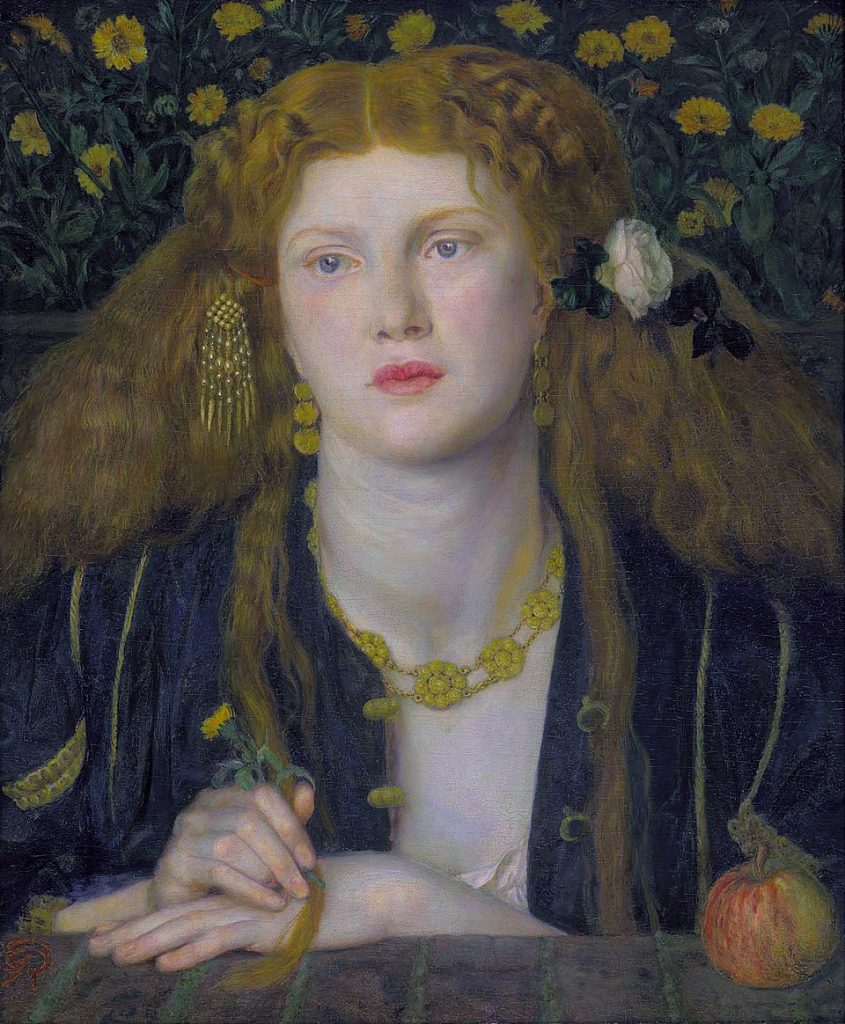
Their first recorded sitting was in 1856 for Bocca Baciata (“The Kissed Mouth”), a pivotal painting that inaugurated a new style in Rossetti’s career. With Cornforth as the model, Rossetti abandoned the stiff Gothicism of earlier works and embraced warmth, color, and physical allure.
Bocca Baciata set a precedent for the lush, dreamlike portraits Rossetti would produce over the next two decades. Cornforth’s presence marked the dawn of Rossetti’s “flesh-and-blood” ideal, a distinct shift from the pious and pale figures of his earlier period.
Over the next several years, Cornforth appeared in Fair Rosamund (1861), Lucrezia Borgia (1860–61), and other important canvases. Her image became synonymous with earthly love, bodily pleasure, and indulgence—everything Victorian society mistrusted in women.
Rossetti’s biographers and friends have often downplayed Cornforth’s role, but letters and surviving sketches reveal that she inspired some of his most important aesthetic transformations. Her legacy lives on in these masterpieces.
The Passionate Years: Art and Intimacy
Rossetti and Cornforth shared more than a professional connection. By the early 1860s, they were living together, and their personal relationship had deepened into something resembling a domestic partnership. Though they never married—Rossetti was legally wed to Elizabeth Siddal until her death in 1862—Cornforth was his closest companion during a crucial phase of his career. Their bond was marked by mutual affection and artistic collaboration.
Cornforth’s influence can be seen not only in Rossetti’s paintings but also in his poetry. While Siddal inspired his more melancholic verses, Cornforth fueled his sensual and corporeal imagery. Rossetti himself described her as a “bracing tonic,” and even when he later grew distant, he did not fully sever their connection. She was a grounding presence amid his bouts of depression and drug use.
Their shared life was not publicly acknowledged. Though friends and fellow artists such as Ford Madox Brown knew of the relationship, few discussed it openly. Rossetti kept up appearances when necessary but returned to Cornforth’s home and presence time and again. Their passion was real, but constrained by societal disapproval and his conflicted affections.
In the late 1860s, Rossetti’s style became increasingly opulent and dreamlike. Cornforth’s features—full lips, heavy eyelids, golden hair—dominated his female portraits. These works, though sometimes criticized in their own time, would later be recognized as masterpieces of the Aesthetic movement.
Muse and Mistress
Cornforth’s role in Rossetti’s life blurred the lines between model, muse, and mistress. She sat for him hundreds of times throughout the late 1850s and 1860s, forming the very image of his shift in aesthetic ideals. The paintings featuring her are among the most tactile and sensuous in his oeuvre, steeped in warm flesh tones, thick hair, and rich fabrics. Though dismissed by his later biographers, her physical presence carried a lasting impact.
Rossetti painted Fair Rosamund in 1861, using Cornforth’s form to tell the legendary tale of Henry II’s mistress. The figure in the painting—voluptuous, idle, and deep in reverie—became a recurring archetype in Rossetti’s art. Cornforth’s body was not hidden in allegory but celebrated in its fullness. This marked a bold deviation from Victorian prudery and suggested a deeper intimacy between artist and subject.
During these years, Cornforth also helped run Rossetti’s household. She managed his meals, sorted correspondence, and helped entertain his guests. Despite her rough accent and lack of formal education, she held her own in a circle filled with writers, critics, and painters. Visitors often commented on her good humor and wit, even if they were reluctant to speak of her in print.
Their relationship was not without tension. Rossetti’s affections were fickle, and he never offered her public acknowledgment or financial security. But in private, she was essential to his comfort and creativity—something he would come to rely on as his health declined.
Paintings That Tell Their Story
Bocca Baciata (1859) was the first painting to fully embody Rossetti’s new direction. The phrase, meaning “the kissed mouth,” was drawn from Boccaccio and evoked themes of experience and desire. Cornforth’s flushed cheeks and heavy-lidded gaze shocked Victorian audiences but delighted Rossetti, who saw her as a true embodiment of sensual beauty.
In Lucrezia Borgia (1860–61), Cornforth posed as the infamous Renaissance noblewoman known for scandal and ambition. The painting, rich in detail and symbolism, reflected Rossetti’s interest in femme fatales—women who embodied power as well as beauty. Cornforth, who had to fight for her place in Rossetti’s world, fit the role perfectly.
One of the most revealing paintings is Found, a work Rossetti began in 1854 and never completed. It depicted a fallen woman being rescued by a former lover—an allegory of sin and attempted redemption. Cornforth served as the model for the woman in distress. The fact that Rossetti never finished the piece suggests his ambivalence toward the moral implications of such narratives.
These works—rich, layered, and emotionally conflicted—form a silent testimony to their shared life. Cornforth was not merely a passive sitter but a living presence, shaping the direction of Rossetti’s vision in an era dominated by moral contradiction.
The Shadow of Elizabeth Siddal
Elizabeth Siddal’s presence loomed over every stage of Rossetti’s relationship with Fanny Cornforth. Born in 1829, Siddal had been Rossetti’s first great muse and later became his wife in 1860. She died tragically young on February 11, 1862, after an overdose of laudanum—an event that devastated Rossetti and colored his remaining years with grief and guilt. Her memory lingered not only in his heart but in his art, as he painted her posthumously in works like Beata Beatrix.
Rossetti’s obsessive mourning for Siddal complicated his relationship with Cornforth. Although Fanny had been with him before Siddal’s death and remained with him after, she was always in the shadow of the woman he had legally married. When Rossetti buried a book of his poems with Siddal’s body at Highgate Cemetery in 1862, it was a deeply symbolic act—placing his soul-literature in the grave alongside his lost love.
In a dramatic and morbid episode, Rossetti had Siddal’s grave exhumed in October 1869 to retrieve the buried manuscript. Encouraged by his agent Charles Augustus Howell, Rossetti overcame his initial reluctance. The event scandalized many, and Rossetti later suffered from the shame of it, even though the recovered poems became a major publication in 1870. Cornforth remained by his side during this period, offering loyalty and comfort despite the insult of being excluded from such momentous events.
The contrast between Siddal and Cornforth was stark. Siddal was frail, melancholic, and ethereal—suited to Victorian ideals of the tragic muse. Cornforth, by contrast, was robust, humorous, and grounded. In many ways, they represented opposite poles of Rossetti’s desire: the spiritual and the sensual. He could not relinquish either and thus kept them both, in life and memory, tangled in conflict.
Siddal’s Death and Rossetti’s Guilt
Siddal’s health had been declining for years, due to both tuberculosis and her increasing reliance on laudanum, an opium-based medicine. After a stillbirth in 1861 and ongoing marital strain, she fell into deeper depression. Her death in 1862 was officially ruled accidental, but many suspected suicide—though Rossetti insisted otherwise to avoid scandal and protect her memory.
Rossetti spiraled into a deep emotional and creative crisis. He retreated from public life and immersed himself in painting. Though Cornforth was present during this time, she was never allowed to replace Siddal in his public narrative. Rossetti could not reconcile the two relationships, and guilt over Siddal’s death haunted him until his own end.
He paid tribute to Siddal again in Beata Beatrix, begun around 1864. The work depicted her as a saintly figure experiencing a spiritual rapture at the moment of death. It was not completed until years later, and its creation coincided with Rossetti’s most intimate years with Cornforth—a cruel irony.
Friends noted that Rossetti’s letters and conversations were increasingly filled with remorse. His drinking worsened, and he began relying on chloral hydrate to sleep. Through all of it, Cornforth stayed—unacknowledged but indispensable.
Cornforth’s Unofficial Role
Even as Rossetti mourned Siddal, Cornforth remained his caretaker and emotional support. She managed his day-to-day life at Cheyne Walk in Chelsea, where they lived from 1862 onward. She kept the home running, protected his privacy, and served as the silent witness to his torment. Yet despite this loyalty, she was never given public credit.
In Rossetti’s social circle, Cornforth was treated as a tolerated embarrassment. She was not invited to major exhibitions, literary events, or private dinners hosted by his more respectable friends. He avoided being seen in public with her, even though she was with him in private nearly every day.
Her sacrifices were considerable. Cornforth gave up her own reputation, social standing, and any chance at marriage to remain with him. She was mocked in letters by other Pre-Raphaelites—William Allingham referred to her as “Elephant,” a cruel nickname mocking her fuller figure and brash manner.
Still, Cornforth endured it all. She cataloged Rossetti’s artworks, preserved his letters, and helped sell his paintings when money grew tight. Her love was practical, not poetic, but it was no less real.
Life at Cheyne Walk: Love Behind Closed Doors
From 1862 onward, Fanny Cornforth lived with Rossetti at 16 Cheyne Walk in Chelsea—a grand house near the Thames that became his retreat from the public eye. Their life together unfolded behind closed doors, hidden from polite society. Though Rossetti welcomed guests from the art world into his home, Fanny’s presence was kept largely in the background. Still, she managed the household with diligence and consistency, playing the role of de facto housekeeper, companion, and nurse.
The Cheyne Walk years were among Rossetti’s most prolific artistically, yet also his most troubled emotionally. Fanny remained a constant source of order in an increasingly disordered life. Rossetti surrounded himself with exotic animals—including a wombat and a toucan—and filled the house with paintings, tapestries, and medieval curiosities. Fanny brought a domestic steadiness to this aesthetic chaos, ensuring that meals were served, rooms cleaned, and his erratic moods tolerated.
By this point, Rossetti’s reliance on chloral hydrate had grown severe. The drug, often taken with alcohol, worsened his insomnia and paranoia. In these darker years, Fanny helped manage both his personal decline and the preservation of his career. She communicated with patrons and collectors, helped oversee the sale of his art, and even sat for new works well into the 1870s, such as Lady Lilith and The Blessed Damozel.
Despite her efforts, Rossetti increasingly withdrew. He grew ashamed of Fanny’s presence, not because she failed him, but because she reminded him of his sins, his losses, and his bodily desires. His correspondence with friends became erratic, and he began keeping later muses at arm’s length, preferring solitude and hallucination to genuine connection. Through it all, Fanny stayed.
Rossetti’s Declining Health and Isolation
By 1872, Rossetti’s physical and mental health had declined sharply. He suffered from insomnia, hallucinations, and increasing dependency on chloral hydrate, which he had started taking in 1866. His eyesight weakened, and he grew suspicious of those around him, sometimes accusing close friends of betrayal. The once-sociable artist became reclusive and erratic.
Rossetti’s health crises coincided with professional setbacks. Though his art remained in demand, critics began to lose patience with the repetition of his themes. Friends such as William Bell Scott and Hall Caine expressed concern about the state of his mind. Attempts at recovery, including trips to Scotland and convalescence in the countryside, failed to restore his former vigor.
Fanny Cornforth remained at Cheyne Walk, keeping the house intact and protecting Rossetti’s fragile routines. She watched as younger models and hangers-on entered the scene, often for brief periods. Despite being the most consistent presence in his life, she found herself gradually shut out of his inner circle.
As Rossetti’s strength faded, the few who still had access to him noted his despair and regret. His obsession with the past—especially with Siddal—haunted his final years. Yet Cornforth never abandoned him, even when his behavior turned cruel or neglectful. She remained a guardian of the world they had built together.
Domestic Devotion in Private
Though the outside world dismissed her, Cornforth was entirely indispensable within the home. She prepared meals, managed staff, fed Rossetti’s strange pets, and ensured his studio remained operational. When he suffered breakdowns, she soothed him. When he was too weak to write, she took dictation or helped communicate with friends and art dealers.
Their private rituals formed a kind of common-law marriage, though it was never formally acknowledged. Friends visiting Cheyne Walk often found Cornforth answering the door, managing the daily schedule, or assisting Rossetti in the studio. William Bell Scott wrote that she was “the only one who could calm his wild fits.”
Fanny showed remarkable dedication. She cared for Rossetti without the support or recognition granted to wives. She maintained records of his art sales and managed money during times when his own spending had become erratic. Even when she was insulted or pushed aside, she continued to serve him faithfully.
She preserved a scrapbook of clippings, sketches, and letters related to his work, understanding the value of his legacy even as her own was ignored. This practical devotion—quiet, constant, and unthanked—was a rare act of moral fidelity in a society that often looked the other way.
Examples of tasks Cornforth did for Rossetti
- Kept financial records and receipts of art sales
- Fed and cleaned up after his collection of pets
- Maintained the cleanliness of Rossetti’s studio
- Acted as hostess when collectors visited
- Preserved letters, sketches, and correspondence for posterity
The Scorn of the Pre-Raphaelite Circle
Though Fanny Cornforth was a central figure in Rossetti’s personal and artistic life, she was never accepted by his peers. Within the Pre-Raphaelite circle, she was often ridiculed, dismissed, or outright excluded. Her working-class origins and uninhibited manner made her a subject of mockery among men who preferred muses like Elizabeth Siddal or Jane Morris—women who fit a more ethereal, refined ideal. The contrast between Cornforth’s earthy presence and the cultivated image of other models was too great for the prejudices of Victorian taste.
Rossetti himself was complicit in her marginalization. Though he relied on her loyalty and labor, he did little to shield her from social insults. In letters, some of his friends referred to her with crude nicknames, focusing on her weight or lack of sophistication. Even Ford Madox Brown, who was generally more tolerant than others, rarely mentioned her except in dismissive terms. Their disdain was not based on her actions, but on her class and comportment.
Fanny’s exclusion was systematic. She was not invited to events, not included in family gatherings, and not consulted in decisions regarding Rossetti’s estate. Despite living with him for two decades, she was kept at arm’s length when it came to the official record of his life. When biographies were written after Rossetti’s death, she was reduced to a footnote or cast as a distraction from his “true” inspirations.
Yet none of these men were present in the way she was. None cooked for him, cleaned his linens, nursed his illnesses, or managed his daily needs. Their condescension was rooted in pride and propriety, not in merit or virtue. Cornforth bore their contempt with remarkable restraint, perhaps knowing that history would one day judge more fairly.
Seen as Vulgar and Unworthy
The charges leveled against Cornforth were not moral failings, but violations of class expectations. She laughed too loudly, spoke too plainly, and did not attempt to mimic the speech or manners of the upper class. In a time when self-effacement was demanded of women, especially those in compromising positions, Cornforth’s confident presence was interpreted as vulgarity.
Rossetti’s social world was filled with artists and critics who romanticized women’s suffering but recoiled from women who displayed strength. Cornforth’s robustness—her physicality, her practicality, her humor—stood at odds with the limp delicacy of Victorian ideals. Because she did not fit their fantasy, they saw her as a threat to the artist’s reputation.
This hostility was not private. When Rossetti’s circle wrote to one another, they often referred to Cornforth as a “nuisance” or a “blot” on his legacy. Their language betrayed a fear that her influence made him less serious, less tragic, and less respectable. The irony is that her presence made his later work possible and his life survivable.
Cornforth responded to these insults not with retaliation but with perseverance. She kept showing up, kept doing the work, and kept loving Rossetti. Her endurance—despite the social scorn—was a kind of quiet rebellion against the hierarchies of the age.
The Role of Class and Respectability
Class distinctions in Victorian England were rigid and unforgiving. Rossetti, though not a gentleman by birth, aspired to a certain intellectual class status. He surrounded himself with fellow artists, critics, and patrons who valued refinement and discretion. Cornforth, by contrast, had no pedigree, no schooling, and no genteel pretense. She was what she was—and that was unforgivable in a society that prized appearances above substance.
Other muses, such as Jane Morris, were similarly involved with artists outside of wedlock, yet they were treated with romantic reverence. Morris’s tall frame, subdued demeanor, and classical features made her palatable to high society. Cornforth’s buxom figure, flirtatious gaze, and unapologetic spirit made her easy to scorn.
This double standard reveals much about the era’s moral structure. Beauty was permitted so long as it came with silence and submission. Cornforth’s crime was not impropriety, but visibility. She was too real, too present, and too necessary to ignore—so they mocked her instead.
Respectability was a social performance, and Cornforth never auditioned for the part. She remained true to herself even when it cost her dignity in the eyes of others. Her plainspoken virtue, lived daily in acts of care and loyalty, spoke louder than the false pieties of her critics.
The Sad Final Years
As Rossetti’s physical and mental health continued to deteriorate in the late 1870s, the atmosphere at Cheyne Walk grew increasingly grim. He suffered frequent bouts of paranoia, worsening insomnia, and digestive problems caused by long-term chloral hydrate and alcohol abuse. Though Cornforth remained with him throughout this decline, their relationship became increasingly strained. She remained faithful, but his growing bitterness and seclusion wore heavily on them both.
In 1881, Rossetti suffered a stroke while staying at the country home of his friend William Graham. He never fully recovered. At the urging of his family and close friends—particularly his brother William Michael Rossetti—he was taken to Birchington-on-Sea in Kent, a quieter seaside town, in March 1882 in hopes that the coastal air might help. Cornforth did not accompany him. Though she had been by his side for two decades, she was left behind, replaced by more “respectable” companions in his final days.
Rossetti died on April 9, 1882, at age 53. Present at his deathbed were his mother, his siblings, and a few trusted friends. Fanny Cornforth received no invitation to say goodbye, nor was she mentioned in any of the official obituaries. Despite her long years of loyalty, she was effectively erased from the public record. William Michael later ensured that the more acceptable Siddal and Morris were emphasized in memoirs and retrospectives.
After Rossetti’s death, Cornforth was left without income, protection, or a home. She tried for a time to sell his artwork and manage the remaining assets he had not bequeathed to others. But with no legal standing and few allies, she quickly found herself sliding into poverty. Her story, once entwined with one of England’s most celebrated artists, turned tragic.
Rossetti’s Death in 1882
By the time Rossetti died, he was a shadow of his former self—physically frail, spiritually weary, and artistically spent. The promise of his youth, the brilliance of his verse, and the boldness of his early paintings had all been dulled by a life of excess, sorrow, and haunting memories. His burial took place at All Saints Church in Birchington-on-Sea, where his grave was marked with modest fanfare compared to his fame during life.
Fanny Cornforth’s absence from his funeral was not accidental—it was deliberate. His family had long viewed her as a blot on his name. They ensured that her presence would not interfere with the sanitized legacy they hoped to promote. Letters between William Michael and others reveal a coordinated effort to minimize her role in both Rossetti’s art and his personal life.
Rossetti left no will that directly provided for Cornforth. Instead, his estate passed to family and close male friends. She received a few items but nothing that could sustain her. In a cruel irony, the woman who had helped him complete paintings, cataloged his work, and preserved much of his correspondence was left out of the record-keeping altogether.
This deliberate erasure of Cornforth was not unique. Many women like her—muses, caretakers, companions—were excluded from Victorian histories in favor of more respectable figures. But among those who knew the truth, there was no denying that she had been essential.
Cornforth’s Decline and Poverty
The years following Rossetti’s death were harsh. Cornforth attempted to sell some of the drawings and personal items she had collected, but with little success. Without Rossetti’s name to lend her protection, she faced the full brunt of Victorian social rejection. She moved several times, each time to cheaper and less respectable lodgings, eventually settling in Shepherd’s Bush.
By the 1890s, her health was failing. Friends reported signs of mental confusion and memory loss. In 1905, she was committed to the Graylingwell Asylum in Chichester under her birth name, Sarah Hughes (having taken the surname of a man she had briefly lived with). The admission record listed her as suffering from dementia. She had no family and no funds to provide comfort in her final years.
Cornforth died in February 1909 at the age of 74. She was buried in a pauper’s grave without a marker. The woman who had inspired some of the most iconic paintings of the 19th century died forgotten by nearly everyone who had once known her. Her death went unremarked in the press, and no Pre-Raphaelite associates stepped forward in her memory.
Yet in death, as in life, her image endured. Her face still stared out from the walls of the Tate, the Ashmolean, and the Delaware Art Museum—silent witnesses to a life that, while unhonored in her time, had shaped an era of British art.
Artistic Legacy: More Than a Model
Though Fanny Cornforth was long dismissed by scholars and critics, her legacy has slowly been reexamined and reclaimed in modern times. She was far more than a passive model; she was a key force in shaping Rossetti’s vision during a pivotal phase of his career. Without her, the sensual, richly colored works of his middle and late period may never have taken the form they did. Her contribution was not just physical but emotional and practical—anchoring Rossetti in moments of both creative triumph and personal despair.
During the decades she worked with Rossetti, Cornforth helped him move away from the spiritualized, austere images of earlier Pre-Raphaelite works. Her presence introduced a new aesthetic: one rooted in warmth, realism, and corporeal beauty. The shift in Rossetti’s portrayal of women—from the willowy and tragic to the lush and magnetic—coincided with Cornforth’s emergence as his muse. This transformation left a permanent mark on British art, influencing not only his peers but future generations of Symbolist and Aesthetic painters.
Art historians have noted that Rossetti’s later paintings, such as Lady Lilith (1868), Monna Vanna (1866), and The Blue Bower (1865), all bear Cornforth’s unmistakable features. Her golden hair, voluptuous figure, and confident gaze became synonymous with Rossetti’s new feminine ideal. These works, once controversial, are now among the most admired in the Pre-Raphaelite canon.
Despite this, recognition of Cornforth’s role remained minimal until the late 20th century. It was only through the efforts of independent researchers, feminist art historians, and museum curators that her name began to reappear. Today, her story is seen not as a scandal, but as a necessary correction—a restoration of truth to an art history long shaped by class bias and respectability politics.
A Face That Changed Victorian Art
Cornforth’s visual impact on Rossetti’s work was profound. She offered a physical type that challenged conventional ideals of beauty in her time: bold, full-bodied, and unabashedly sensual. Victorian society clung to images of women as fragile and wan—symbols of chastity and sacrifice. Cornforth brought something else: pleasure, vitality, and unapologetic presence.
This shift was not merely stylistic but ideological. In embracing Cornforth’s look, Rossetti rejected the spiritualized muse and embraced a more earthly woman. The women in his later paintings are not merely symbols—they are embodied, real, and often confront the viewer with a gaze that asserts rather than pleads. That boldness came directly from Cornforth’s own character.
Painters beyond Rossetti took note. The influence of his new style—pioneered with Cornforth—can be seen in the work of later artists like Edward Burne-Jones and John William Waterhouse. Her impact extended even into the decorative arts, inspiring fabrics, book illustrations, and jewelry design rooted in sensuality and opulence.
While Cornforth’s name was rarely attached to these developments, her image was everywhere. The repetition of her features across Rossetti’s canvases helped solidify an aesthetic revolution, quietly undermining Victorian constraints on beauty and propriety.
Recognition and Reassessment Today
In recent decades, scholars have begun to confront the long-standing marginalization of women like Cornforth. Rather than viewing her as a mere mistress or servant, modern research has emphasized her agency, endurance, and centrality to Rossetti’s work. Biographers like Jan Marsh and Lucinda Hawksley have explored her life in detail, revealing the complexity of her role in the Pre-Raphaelite circle.
Exhibitions at major institutions such as the Tate and the Ashmolean Museum have started to name Cornforth explicitly in wall labels and catalogs, crediting her properly as a muse and collaborator. Her name now appears in academic journals, exhibition notes, and footnotes once dominated by Siddal and Morris.
These reassessments have also challenged the Victorian cult of idealized suffering. Cornforth, unlike Siddal, was not a tragic figure in the romantic sense—she did not pine, waste away, or embody spiritual agony. Instead, she lived fully, worked hard, and endured cruelty with courage. In many ways, her story is more human and more heroic.
The art world is beginning to recognize that muses are not just decorative bodies, but individuals with histories, choices, and dignity. In the case of Fanny Cornforth, the delay in recognition is a testament to how long it takes to undo injustice—but her legacy, once neglected, is now being honored.
Conclusion: Love, Loyalty, and Loss
The relationship between Dante Gabriel Rossetti and Fanny Cornforth defied the norms and expectations of their time. It was neither a respectable Victorian marriage nor a fleeting studio affair—it was something more enduring, more complicated, and ultimately more human. For over twenty years, Cornforth stood beside Rossetti as lover, model, housekeeper, secretary, nurse, and friend. In return, she received no title, no security, and very little public respect. Yet she stayed.
Theirs was a love hidden in plain sight. It was written not in wedding records or shared tombstones, but in brushstrokes, sketchbooks, and household ledgers. In portraits where her golden hair glows under jewel-toned fabrics. In the unseen labor of mending his clothes, managing his appointments, and protecting his peace when his mind began to fail. Though their names were never joined by law, their lives were bound in a deeper and more difficult way.
Rossetti’s divided affections—between the memory of Elizabeth Siddal and the living presence of Fanny Cornforth—reflect a broader Victorian conflict between idealism and reality, spirit and flesh, beauty and shame. He could never reconcile the two women who shaped him most. But in his art, they coexist. Siddal appears as the dream, the ghost, the sacred figure. Cornforth appears as the muse of touch, of presence, of longing. Both are immortal, but only one was there when he needed someone most.
Fanny Cornforth deserves to be remembered not with embarrassment or pity, but with honor. She loved a man who could never fully love her back, and yet she did not falter. She endured mockery, poverty, and abandonment with quiet strength. Her face changed the course of English painting, and her hands carried one of its greatest artists to the end of his days. In a world that forgot her, she never forgot him. And in that devotion—unadorned, unacknowledged, but unwavering—there is something sacred.