Albert Bierstadt was born on January 7, 1830, in Solingen, Prussia. When he was still a small child, his family moved to the United States and settled in New Bedford, Massachusetts in 1833. The town was active and practical, shaped by the whaling industry, but Bierstadt showed an early interest in drawing rather than trade. As a young man, he even worked as a drawing instructor, which gave him both income and confidence in his abilities.
In 1853, he traveled back to Europe to study painting in Düsseldorf, Germany. There, he learned how to build detailed landscapes and organize large compositions with care. The training was not strictly formal, but it exposed him to serious artists and disciplined techniques. He also saw how European painters built reputations, something he would later apply in America. These years abroad helped shape both his style and his ambition.
When Bierstadt returned to the United States in 1857, he was ready to pursue painting more seriously. His big opportunity came with his western travels, especially his 1859 journey through the Rocky Mountains. He made sketches and notes that later became the basis for major studio works. One of the best known is The Rocky Mountains, Lander’s Peak (1863, oil on canvas, Metropolitan Museum of Art, New York), which helped secure his reputation.
By the early 1860s, Bierstadt had become one of the most successful landscape painters in the country. He presented his works in dramatic exhibitions, sometimes showing a single painting in a darkened room with special lighting. This approach drew large crowds and strong sales. While some critics questioned his showmanship, it worked, and it placed him at the center of American art.
Personality, Reputation, and Social Circles
Bierstadt was not only talented but also socially aware. He understood that connections mattered just as much as skill. He spent time among writers, patrons, and influential figures in cities like New York. He knew how to present himself and his work in a way that attracted attention and respect.
In the early 1860s, he became associated with a group of writers that included Fitz Hugh Ludlow. Ludlow was a journalist and author with a growing reputation. The two men shared interests in travel and exploration, which brought them together both socially and professionally. Their connection would later play an important role in Bierstadt’s personal life.
In 1863, Bierstadt and Ludlow traveled together on a western expedition. The journey was long and demanding, but it created a strong bond between them. Traveling through unfamiliar landscapes required trust and cooperation, and the experience deepened their acquaintance. It also placed Bierstadt firmly within a network that blended art, literature, and adventure.
Within these circles, personal and professional relationships often overlapped. It was common for friendships to grow through shared travel and repeated social gatherings. It was in this setting that Bierstadt met Rosalie, the woman who would become his wife and a central figure in his life.
Rosalie Osborne: Background and First Marriage
Who Was Rosalie Ludlow Osborne?
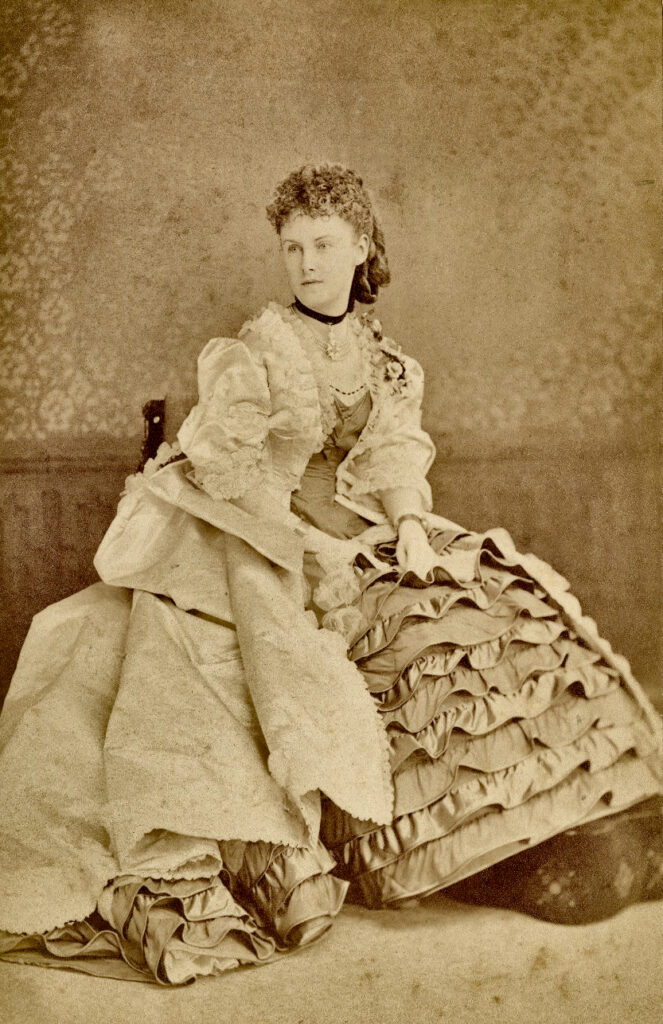
Rosalie Osborne was born in 1841 into a well-established New York family. She grew up in a cultured environment where education and social awareness were expected. This background prepared her to move comfortably within the same circles as artists and writers. She was known for her poise and intelligence, qualities that made her noticeable in social settings.
In 1864, she married Fitz Hugh Ludlow. At the time, Ludlow was already known for his book The Hasheesh Eater (1857), which had brought him attention as a writer. Their marriage connected Rosalie directly to a lively literary world. It also introduced her to people like Bierstadt, who were part of overlapping cultural networks.
Rosalie was more than just a companion to her husband. She took part in conversations and social life with confidence. Her presence added to the atmosphere of the gatherings she attended. Those who met her often noted her calm manner and thoughtful engagement.
At first, her life seemed secure and promising. She was married to a recognized writer and surrounded by creative individuals. However, this stability did not last, and the realities of her marriage began to change over time.
Marriage to Fitz Hugh Ludlow and Its Struggles
Fitz Hugh Ludlow was a talented but complicated man. Born in 1836, he achieved literary success early, but his life was not steady. His work often required travel, and his health was not always strong. These factors placed pressure on his marriage to Rosalie.
By the mid to late 1860s, the relationship had become strained. The couple spent increasing amounts of time apart, and their lives began to move in different directions. While separation was not uncommon in certain social circles, it still carried emotional and social weight.
During this same period, Bierstadt remained connected to Ludlow. Their earlier travels and shared interests kept them in contact. Through this connection, Bierstadt and Rosalie continued to see one another. Over time, their acquaintance grew into something more personal.
The exact details of their interactions during these years are not fully recorded. What is clear is that Rosalie’s marriage was already breaking down before her relationship with Bierstadt became central. This context is important in understanding the sequence of events that followed.
Fitz Hugh Ludlow died on September 12, 1870, in Geneva, Switzerland. His death brought a formal end to the marriage, but the emotional separation had begun earlier. For Rosalie, it marked both a loss and a turning point.
A Controversial Love: Bierstadt and Rosalie
How Albert Bierstadt Met Rosalie Osborne
Albert Bierstadt likely met Rosalie in the early 1860s through his friendship with Fitz Hugh Ludlow. At the time, New York’s cultural world was relatively small, and individuals in artistic and literary circles often crossed paths. Gatherings, dinners, and shared acquaintances created many opportunities for introduction.
The 1863 expedition to the American West strengthened Bierstadt’s connection to Ludlow. While Rosalie did not take part in the journey, it brought Bierstadt further into Ludlow’s personal life. After the trip, their social interactions continued, and Bierstadt remained a familiar presence.
Over time, Bierstadt and Rosalie came to know each other better. Their shared environment encouraged conversation and repeated contact. These interactions were likely gradual, developing over months and years rather than through a single dramatic moment.
It is important to note that their relationship grew within an already complicated situation. Rosalie’s marriage was under strain, and Bierstadt was closely connected to her husband. This overlap made their growing closeness difficult to ignore.
Relationship During Rosalie’s First Marriage
By the late 1860s, Rosalie and Ludlow were no longer living as a close couple. Their separation created space for new relationships to form. During this time, Bierstadt and Rosalie’s connection became more significant.
There is no detailed record describing exactly how their relationship changed during these years. However, the timing of later events suggests that their bond had already formed before Ludlow’s death. Their continued association indicates that they found something meaningful in each other’s company.
The situation required discretion. Social expectations were strict, and reputations could be easily damaged. Both Bierstadt and Rosalie had reasons to avoid public attention to their private lives. Despite this, their relationship endured.
Rather than being sudden, their connection appears to have developed steadily. It was shaped by shared experiences, mutual respect, and the circumstances around them. By the time events moved forward, their relationship was already established.
Marriage After Ludlow’s Death
Fitz Hugh Ludlow died on September 12, 1870. Less than a year later, on May 14, 1871, Albert Bierstadt and Rosalie were married. The timing did not go unnoticed, and it drew some quiet attention in social circles.
- 1863: Bierstadt and Ludlow travel together in the American West
- Late 1860s: Rosalie and Ludlow live separately
- September 12, 1870: Ludlow dies in Geneva
- May 14, 1871: Bierstadt marries Rosalie
Despite the circumstances, the marriage itself proved stable. It was not a brief or uncertain union. Instead, it lasted for more than twenty years, suggesting a strong and lasting partnership.
Their marriage brought together two people who had already experienced difficulty. For Rosalie, it offered a new beginning. For Bierstadt, it added a personal foundation to a life that had been focused largely on work and ambition.
Marriage, Illness, and Emotional Legacy
Life Together as Husband and Wife
After their marriage in 1871, Albert and Rosalie Bierstadt built a life that combined travel, social activity, and artistic work. They spent time in Europe, where Bierstadt continued to study landscapes and maintain connections with collectors and fellow artists. These trips were not rushed. They often stayed for extended periods, allowing them to take part in cultural life abroad.
Their home life reflected Bierstadt’s success. They lived comfortably and entertained guests from artistic and social circles. Rosalie played an important role in this setting. She helped maintain the household and contributed to the atmosphere of their gatherings.
During the 1870s and 1880s, Bierstadt continued to paint, though the art world was beginning to change. New styles were gaining attention, and tastes were shifting. Even so, he remained a respected figure, and his earlier success continued to support his reputation.
Their relationship appears to have been steady. Rosalie accompanied Bierstadt on travels and remained involved in his life. Together, they formed a partnership that lasted through both strong and uncertain periods.
Rosalie’s Illness and Final Years
In the later years of their marriage, Rosalie became ill with tuberculosis. At the time, this disease was widespread and difficult to treat. Doctors often recommended travel to warmer climates, believing that it could improve a patient’s condition.
Following this advice, the Bierstadts spent time in the Bahamas. The goal was to provide Rosalie with a more favorable environment for recovery. These trips were not simple vacations. They were attempts to manage a serious illness with the limited medical knowledge available at the time.
Despite these efforts, her condition did not improve. The illness progressed, and her strength declined over time. Bierstadt remained by her side, supporting her through these difficult years.
Rosalie died on March 1, 1893. Her death marked the end of a long and important chapter in Bierstadt’s life. It was a personal loss that came after more than two decades of marriage.
Emotional Impact on Bierstadt
After Rosalie’s death, Bierstadt’s life became quieter. He continued to paint, but his work no longer held the same place in the art world. New movements had taken hold, and his style was no longer at the center of attention.
The loss of his wife added to this period of change. He had relied on her companionship for many years, and her absence was significant. While records do not describe his private emotions in detail, the timing suggests that her death affected him deeply.
In 1895, Bierstadt remarried. His second wife was Mary Hicks Stewart, a wealthy widow. This marriage brought him some stability in his later years, though it did not replace the long partnership he had shared with Rosalie.
Albert Bierstadt died on February 18, 1902, in New York. Looking back, his life was shaped not only by his art but also by his relationships. His marriage to Rosalie stands out as a central part of his personal story, one that unfolded over many years and through changing circumstances.
- Their relationship began during a complicated time
- Their marriage lasted more than twenty years
- They traveled widely and shared a social life
- Rosalie’s illness shaped their later years
- Her death left a lasting mark on Bierstadt’s final decade
Their story is not one of sudden drama, but of gradual change. It reflects the realities of 19th-century life, where personal choices were shaped by both private feelings and public expectations. In the end, their relationship remains a meaningful part of understanding the man behind the paintings.
Key Takeaways
- Albert Bierstadt rose to fame in the 1860s through large-scale Western landscapes, building both artistic and financial success.
- Rosalie Osborne first married writer Fitz Hugh Ludlow in 1864, but their relationship weakened by the late 1860s.
- Bierstadt and Rosalie likely grew close during her separation, leading to their marriage on May 14, 1871, less than a year after Ludlow’s death.
- Their marriage lasted over twenty years and included travel, social life, and shared cultural circles.
- Rosalie’s death from tuberculosis on March 1, 1893, marked a turning point in Bierstadt’s later life.
FAQs
- When did Albert Bierstadt marry Rosalie Osborne?
He married Rosalie on May 14, 1871, following the death of her first husband in 1870. - Who was Rosalie’s first husband?
Rosalie was first married to writer Fitz Hugh Ludlow, known for The Hasheesh Eater (1857). - Did Albert Bierstadt and Fitz Hugh Ludlow know each other?
Yes, they were acquainted and traveled together on a western expedition in 1863. - How long were Bierstadt and Rosalie married?
They were married for over twenty years, from 1871 until her death in 1893. - What happened to Bierstadt after Rosalie died?
He continued painting, remarried in 1895 to Mary Hicks Stewart, and lived until 1902, though his artistic prominence declined in his later years.