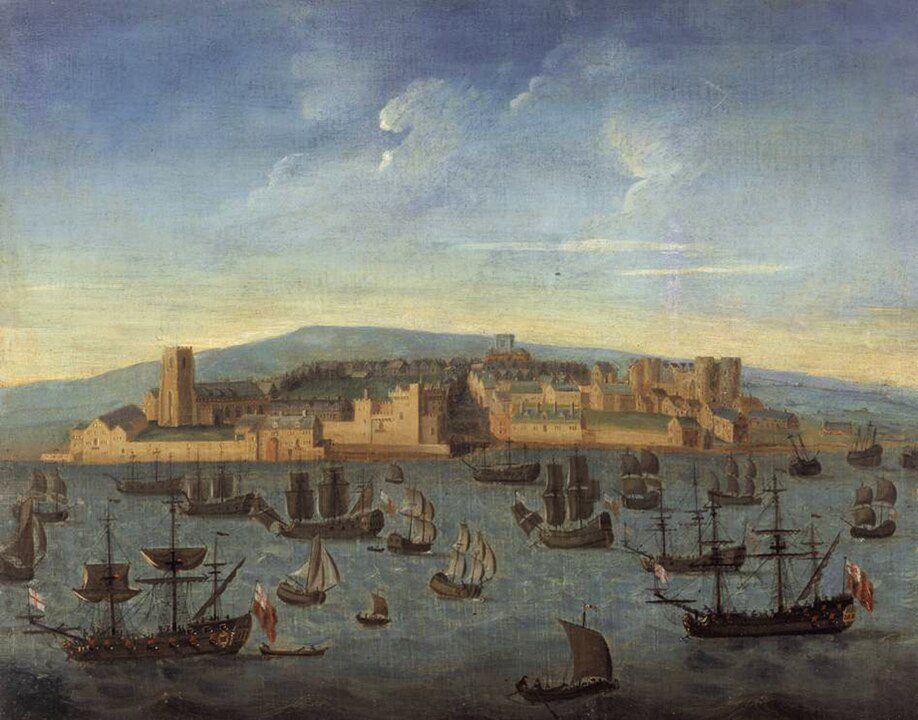
To write an art history of Liverpool is to chart a narrative shaped not solely by canvases and galleries, but by the unquiet tides of empire, trade, migration, and civic ambition. Unlike cities whose aesthetic identity grows organically from aristocratic patronage or national institutions, Liverpool’s visual culture emerges from its peculiar status as both provincial and international, marginal and central. This is a city where Georgian grandeur jostles with soot-black warehouses, where Victorian civic confidence met the moral ambiguities of wealth built on the Atlantic slave trade, and where art has always reflected both aspiration and unrest.
The city’s cultural distinctiveness lies in its geography and its history. As one of the great ports of the British Empire, Liverpool stood at the crossroads of global commerce throughout the 18th and 19th centuries. With the ebb and flow of ships came not only goods—cotton, sugar, tobacco—but also ideas, images, objects, and people. This confluence forged a complex visual terrain: the opulence of mercantile wealth met the rough surfaces of industrial modernity; the provincial desire for cultural legitimacy contended with a stubborn insularity. The result is a city that has repeatedly asserted its artistic character against the centripetal force of London’s dominance.
Liverpool’s art history is not a smooth chronological arc but a series of jagged peaks and fertile valleys. There have been moments of intense creativity and institutional growth, such as the founding of the Liverpool Academy in 1810 or the establishment of the Walker Art Gallery in 1877. But these were often followed by periods of cultural inertia, shaped by economic downturns, political neglect, or shifting artistic currents. At other times, the city has served as an unwitting crucible for new forms, whether in the gritty realism of post-war painters or the conceptual provocations of its late-20th-century avant-garde.
Crucially, Liverpool’s identity as a working-class city, scarred by economic deprivation and social unrest, has deeply informed its artistic output. Where London’s art scene often orbits elite markets and institutional power, Liverpool’s has been defined by resistance, resilience, and a sense of art as public necessity rather than luxury. This ethos is evident not just in the visual themes explored by local artists—urban decay, memory, marginality—but in the very structures through which art has been produced and exhibited. Artist-led collectives, community centres, and alternative spaces have long played a role equal to, and sometimes more vital than, museums or academic institutions.
Equally important is the way Liverpool’s artistic imagination has been shaped by its connections to the wider world. It is no coincidence that many of its most vital art movements have coincided with moments of transnational dialogue. The port city’s ties to Africa, the Americas, and the wider Atlantic world mean that its visual culture often carries echoes of the diasporic and the displaced. Yet these influences are never absorbed passively; they are metabolized into a distinctly Liverpudlian idiom, often raw, oppositional, and resistant to categorization.
If Liverpool’s art history has at times been overlooked in the broader narrative of British art, it is because it refuses to conform to the dominant scripts. It is not the story of royal commissions, avant-garde salons, or cosmopolitan sophistication in the Parisian mode. It is instead a history of regional strength, stubborn provincialism, local pride, and the uneasy beauty of a city whose fortunes have risen and fallen with the tides.
This deep dive begins, then, not with a single masterpiece or figurehead, but with an environment—a city forged in contradiction, whose aesthetic legacy must be read against the smoke-streaked skies of industry, the grandeur of civic ambition, and the ever-present sound of water.
Georgian Foundations and the Rise of Merchant Patronage
In the 18th century, Liverpool’s transformation from a modest fishing town to a vital node in the Atlantic economy set in motion not only vast shifts in trade, population, and architecture, but also the formation of its earliest visual culture. This was a period when money spoke with new confidence, and in Liverpool, that money came increasingly from maritime commerce—first with Ireland and continental Europe, then with Africa, the Americas, and the West Indies. As fortunes rose from sugar, tobacco, and the human misery of the transatlantic slave trade, so too did the desire to display wealth through the visual arts.
Unlike the landed gentry of southern England, Liverpool’s emergent elite was composed of merchants, shipowners, and speculators. Their patronage of the arts was not based on ancient lineage or academic refinement, but on civic pride, Protestant ethics, and social aspiration. They commissioned portraits not only as personal commemorations but as public declarations of legitimacy. They built houses in the Palladian style and filled them with paintings, prints, and exotic artefacts brought back from global voyages. Their collecting was as much about constructing a local identity as it was about taste—an identity rooted in industry, maritime enterprise, and an unspoken complicity with imperial power.
One of the earliest manifestations of this new patronage class was the increasing demand for portraiture. Artists like Richard Wright, born in Liverpool in 1723, found steady work among the merchant elite. Wright, though best known for his maritime scenes, also painted portraits that encapsulated the sober dignity and commercial success of his sitters. His seascapes, meanwhile, stood as emblems of Liverpool’s maritime power—galleons and merchantmen not simply as subjects of aesthetic interest but as assertions of global reach. In these works, the local and the imperial merged into a single visual rhetoric.
In parallel with individual commissions came the rise of public art initiatives, albeit in embryonic form. There was no state-funded academy or formal institution yet, but public taste was being shaped by exhibitions, print culture, and the growing availability of classical and continental imagery through engravings. Subscription-based clubs, such as the Society of Artists (which briefly emerged in the 1760s), brought together gentlemen collectors, amateur connoisseurs, and practicing artists, laying early groundwork for a civic art culture.
Importantly, these early decades saw Liverpool’s architectural language shift in tandem with its artistic ambitions. The city’s urban fabric transformed as Georgian townhouses, customs buildings, and dockside infrastructure took shape under the influence of Palladian and neoclassical design. The use of architectural ornament—reliefs, sculptures, carved facades—suggests a city beginning to understand art as an expression of civic stature. The neoclassical style, with its claims to order, discipline, and rationality, was particularly resonant for a mercantile society eager to assert its place within the hierarchy of British towns.
Art in this context was not a leisurely pastime. It was a mechanism of self-fashioning. Liverpool’s visual culture in the Georgian era was both aspirational and defensive—a bid to overcome its perceived provincialism, to rival the cultural capitals of the South, and to create a localized canon of taste. This tension is particularly evident in the reliance on itinerant artists from London or further afield. While Liverpool did produce its own painters, the city often relied on the importation of artistic skill, just as it imported goods and fashions from elsewhere. The insecurity of provincial status, coupled with a desire for validation, led to a culture that was eclectic, outward-looking, and often imitative, though not without its own native energy.
This foundational period also raises questions about the ethics of art patronage in Liverpool. Much of the capital that funded early collecting and architectural projects came directly or indirectly from the slave economy. The city was Britain’s leading slaving port by the late 18th century, and this grim reality underpinned much of the wealth displayed in portraits and homes. While art itself does not always reveal this origin explicitly, the context cannot be ignored. The grandeur of a merchant’s portrait or the elegance of a neoclassical doorway must be read not merely as symbols of civic pride but as artefacts of a deeply compromised economy.
Yet even within this morally ambivalent framework, one finds genuine artistic achievement and the emergence of a local style. Artists like George Stubbs, though primarily associated with London and rural patrons, was born in Liverpool in 1724. His anatomical studies and equine portraits demonstrate the intellectual seriousness that could emerge from provincial origins. Though Stubbs left the city for the capital, his early training in Liverpool speaks to the presence of a rudimentary but functioning artistic infrastructure.
By the end of the Georgian period, Liverpool had become something more than a trading post: it was a city with a cultural ambition that would soon crystallize into institutional form. The seeds of the Liverpool Academy were already planted in the clubs, societies, and informal networks of this period. More importantly, a tradition of civic art patronage had taken root—one driven not by aristocratic legacy but by mercantile success, civic competition, and the peculiar alchemy of a port city caught between the provincial and the global.
The next chapter of Liverpool’s art history would see this patronage formalized, professionalized, and brought into open contest with the cultural dominance of London.
The Liverpool Academy and Provincial Ambition
The founding of the Liverpool Academy of Arts in 1810 marked a pivotal moment in the city’s cultural maturation—a formal assertion that Liverpool, buoyed by its economic might and growing civic confidence, could become a serious center of artistic production and exhibition. This institution did not arise in a vacuum; it emerged from decades of merchant patronage, amateur societies, and the increasing visibility of art as a public good rather than a private indulgence. Yet the establishment of the Academy also revealed the tensions that would shape Liverpool’s artistic identity for much of the 19th century: the tension between regional pride and metropolitan influence, between imitation and innovation, between commerce and culture.
At its inception, the Liverpool Academy was conceived in the mold of London’s Royal Academy but with a pronounced provincial edge. While the Royal Academy was aristocratic in temperament, guarded in its hierarchies, and beholden to metropolitan taste, the Liverpool Academy was resolutely bourgeois, civic-minded, and determined to create its own sphere of influence. It offered annual exhibitions, prizes, and lectures, and quickly became one of the most significant art institutions outside of London. Its exhibitions were grand affairs, drawing submissions from across the British Isles and even attracting luminaries such as J.M.W. Turner, whose involvement lent the Academy considerable prestige.
But the Liverpool Academy was more than a local imitation of the Royal Academy. It functioned as a platform for regional artists to present themselves on equal footing with their London counterparts. The Academy’s annual exhibitions often included hundreds of works—portraits, landscapes, genre scenes, and historical tableaux—and were open to a broad public. This inclusivity was ideological as well as practical. The Academy’s founders sought to democratize art, not in the modern populist sense, but as a civic instrument, capable of refining public taste and demonstrating Liverpool’s cultural parity with the capital.
This ambition was mirrored in the caliber and diversity of artists it attracted. Painters such as William Gawin Herdman, a native Liverpudlian, emerged as key figures in the Academy’s circle. Herdman was both an artist and a chronicler of the city’s changing streetscape, producing hundreds of watercolors and illustrations that documented Liverpool’s transformation during the industrial age. His work, while often topographical, carried a deep sense of local allegiance—a visual archive shaped by civic pride rather than aesthetic detachment. Herdman’s career, and others like his, helped forge an artistic identity rooted not in the cosmopolitan abstraction of the capital but in a direct, observational engagement with the local environment.
Still, the Academy was not immune to conflict. The question of its artistic direction—should it emulate the standards of the Royal Academy, or forge a path of its own?—generated frequent debate. A central point of tension lay in its jurying process. Decisions about which works were included in exhibitions often revealed fault lines between academic conservatism and newer, more experimental tendencies. These conflicts reached a crisis point in the 1850s when a schism occurred over the Academy’s treatment of Pre-Raphaelite works.
The Pre-Raphaelite Brotherhood, with its radical emphasis on naturalism, medievalism, and moral seriousness, had a difficult relationship with the Liverpool Academy. While artists such as William Holman Hunt and Dante Gabriel Rossetti exhibited in Liverpool, their reception was mixed. The Academy, despite its self-styled independence, often fell back on academic orthodoxy, and its jurors were reluctant to embrace the Pre-Raphaelites’ departure from conventional techniques and subjects. This culminated in a public dispute in 1850 when Holman Hunt’s Valentine Rescuing Sylvia from Proteus was poorly hung and sidelined in the exhibition, prompting protests from critics and artists alike.
This incident, though seemingly minor, was emblematic of the Academy’s larger dilemma: its desire to assert regional authority while remaining tethered to the cultural gravity of London. It wanted to lead but was wary of taking risks; it wished to distinguish itself but feared marginalization. The episode with the Pre-Raphaelites signaled a loss of artistic boldness that would, over time, undermine the Academy’s centrality. By the late 19th century, the Academy’s influence waned, supplanted in part by newer institutions such as the Walker Art Gallery, which would come to represent a more public, more enduring expression of Liverpool’s artistic ambition.
Nonetheless, for several decades, the Liverpool Academy functioned as the city’s primary art institution. It created an infrastructure of exhibition, criticism, and education that allowed regional artists to emerge and gave the public sustained access to high-quality visual culture. Its exhibitions were widely reviewed in national newspapers, and its prestige was such that its medal and prize recipients often went on to secure national recognition.
Moreover, the Academy helped consolidate the idea of Liverpool not merely as a trading city, but as a cultural actor in its own right. Through lectures, public debates, and exhibitions, it cultivated a civic aesthetic—one rooted in public engagement, regional identity, and institutional legitimacy. Even its limitations are instructive: they reveal the precarious balance required to sustain artistic ambition outside the capital, and the particular difficulties faced by regional institutions attempting to assert autonomy within a centralized cultural hierarchy.
In the end, the Liverpool Academy’s story is one of bold beginnings and hesitant continuities. It opened a space for art in a city defined by commerce, but it struggled to keep pace with the artistic revolutions of its time. Yet without it, the later emergence of more dynamic institutions—from the Walker to the Bluecoat—would not have been possible. It laid the groundwork for a culture of artistic seriousness in a city that refused to remain culturally peripheral.
Romantic Landscapes and Maritime Visions
If the Liverpool Academy provided the institutional skeleton for the city’s 19th-century artistic life, then it was in the realm of landscape and maritime painting that its emotional and aesthetic soul found expression. As Liverpool grew into the principal port of the British Empire, its artists turned toward the sea—not merely as a backdrop for commercial might, but as a locus of Romantic reflection, national identity, and personal vision. These paintings were not parochial imitations of metropolitan taste; they emerged from the city’s unique position at the intersection of industrialism, nature, and empire.
The Mersey estuary, with its shifting light, changing tides, and ever-present fog, became a subject of enduring fascination. Local artists repeatedly returned to the harbor, the docks, and the seascape—not to celebrate mercantile triumphalism alone, but to explore mood, transience, and the sublime. The river’s expanse, simultaneously beautiful and threatening, offered a perfect metaphor for Liverpool itself: powerful, restless, on the edge of the known and the unknown. Artists working within the Romantic tradition found in this environment an abundance of symbolic possibilities.
Among the earliest and most prominent painters of maritime Liverpool was Richard Wright (1723–ca. 1775), whose seascapes won acclaim in both provincial and London circles. His works depicted dramatic naval engagements, merchant ships battling storms, and bustling harbors populated with sails and masts like a forest of ambition. Though he frequently painted imaginary or idealized scenes, Wright grounded his compositions in observational acuity, capturing the atmospherics of light and weather with convincing immediacy. His success, culminating in exhibitions at the Royal Academy and commissions from aristocratic patrons, demonstrated that Liverpool-trained artists could command a national audience without abandoning their regional specificity.
As Romanticism took firmer hold in the early 19th century, the maritime theme was enriched by philosophical and poetic overtones. Samuel Austin, a watercolorist active in the 1820s and 1830s, infused his scenes with quiet melancholy and reflective calm. His depictions of the docks and harbor were not simply topographical records but meditations on solitude and passage. In paintings such as The Pier at Liverpool or A View of the Mersey, the focus is often on the vastness of sky and water, with ships reduced to fragile silhouettes. Austin, like many of his contemporaries, responded to the estuary not just as a commercial site, but as a spiritual and aesthetic phenomenon.
But perhaps the most emblematic figure of this period was William Gawin Herdman (1805–1882), a native Liverpudlian whose artistic and documentary legacy remains unmatched in scope. Herdman was a relentless chronicler of Liverpool’s transformation, producing thousands of watercolors, sketches, and engravings of the city’s evolving topography. His renderings of the waterfront, the developing streets, and the city’s changing architectural face serve as both artistic statements and urban archaeology. While not as emotionally saturated as the great Romantic painters, Herdman’s work captures the tension between permanence and change—between the slow rhythms of the natural world and the rapid incursions of industrial development.
What is notable about Liverpool’s Romantic landscape and maritime tradition is its resistance to grandiosity. Where painters in London or the Lake District might indulge in the drama of nature’s excess—the thunderous waterfall, the vertiginous cliff—Liverpool’s artists often focused on the gentle drama of estuarial light, the meditative quiet of a ship at anchor, or the domestic intimacy of harbor scenes. Even when addressing the more theatrical aspects of the sea—stormy skies, shipwrecks, or military exploits—their tone is often elegiac rather than heroic. This restraint, shaped by the city’s Protestant mercantile ethos and its proximity to the laboring realities of port life, gives the school its particular character.
The influence of national figures such as J.M.W. Turner also shaped the city’s artistic climate, but again, local artists tended to respond on their own terms. Turner’s visits to the North West, including his sketching tours along the Mersey, inspired local painters to experiment with light, atmosphere, and abstraction. Yet few adopted his full stylistic vocabulary. Instead, they absorbed his emphasis on mood and transience while maintaining a fidelity to local forms and familiar places. This tension between innovation and observation defines much of Liverpool’s Romantic output.
Maritime painting also intersected with other genres during this period. Portraiture, for instance, increasingly incorporated seafaring motifs: a merchant’s likeness might include a globe, a sextant, or a window opening onto a distant shore. Similarly, genre scenes of dockworkers, fishwives, and shipbuilders blurred the lines between realist documentation and romantic idealization. These hybrid images testified to the city’s dual identity as both an industrial powerhouse and a place of deep aesthetic potential.
One cannot overlook the ideological substratum of this work. As Liverpool’s economic success became inseparable from its role in empire and slavery, the sea served as both mirror and mask. Maritime paintings could glorify British naval prowess, affirm imperial expansion, or quietly elide the darker realities of global trade. Yet they could also offer moments of ambiguity. The foggy estuary, the ship lost on the horizon, the turbulent water under changing skies—these were images that allowed for ambivalence, doubt, and a poetic distance from commercial certainty.
By mid-century, as the industrial revolution altered the visual and sonic character of the city, this earlier Romantic tradition began to give way to new styles: more realist, more socially engaged, and often more critical. But the legacy of this period endured. The visual lexicon developed by Wright, Austin, Herdman, and their peers—the light on the Mersey, the silhouette of ships at dusk, the inward gaze of watercolors—would echo in the city’s art for generations. These were not simply pretty pictures of ships and sunsets. They were meditations on impermanence, on mobility, and on the strange beauty of a city always on the threshold between land and sea.
Victorian Liverpool: Philanthropy, Public Art, and Urban Decoration
The Victorian era witnessed Liverpool’s zenith as an imperial port and commercial metropolis. Its population soared, its docks multiplied, and its urban footprint expanded with the confident sprawl of a city at the heart of global trade. In cultural terms, this period was marked by an unprecedented intensification of public art, civic ornament, and institutional philanthropy. The transformation of Liverpool into a Victorian city was not merely a matter of brick and industry—it was also a deliberate aesthetic project, shaped by architects, artists, donors, and civic leaders who understood that urban grandeur required more than economic muscle. Art was no longer the private adornment of the merchant class alone; it was becoming a public duty.
Central to this transformation was a new ideology of civic culture, one inextricably linked to the ethos of Victorian philanthropy. Wealthy industrialists and merchants, many of them Nonconformists or self-made men, now turned their attention from personal patronage to public benefaction. Inspired by both religious moralism and a growing sense of civic pride, they began to invest in projects designed to elevate public taste and improve the moral character of the urban populace. Art galleries, museums, libraries, and statues were funded not simply as displays of wealth, but as visible signs of Liverpool’s refinement, ambition, and modernity.
At the heart of this philanthropic surge stood the conviction that art could ennoble the city—that beauty was not a luxury but a necessity for an urban population increasingly estranged from nature, tradition, and moral certainty. The urban poor might live in overcrowded slums, but they could walk past allegorical sculptures, gaze upon historical murals, or visit free galleries. In this way, public art became a surrogate for the redemptive functions once attributed to religion. It was a form of civic liturgy, aimed at cultivating decorum, piety, and social order through the visual field.
This vision found material expression across Liverpool’s burgeoning cityscape. The St George’s Plateau, completed in the 1850s, became the symbolic center of the city’s civic identity. Flanked by the monumental neoclassical St George’s Hall—a building whose architectural ambition rivaled any in London—the area was soon adorned with an array of public statues, commemorating figures such as Queen Victoria, Prince Albert, William Ewart Gladstone, and the Earl of Beaconsfield. These statues were more than tributes; they were embodiments of civic virtue and imperial pride, rendered in bronze and stone for public contemplation.
The aesthetics of this period were eclectic but heavily influenced by classicism and high Victorian historicism. Sculptors like Thomas Thornycroft and George Frampton contributed to the city’s visual fabric, producing works that combined allegorical symbolism with nationalistic sentiment. Reliefs, friezes, and pediments on public buildings often depicted scenes from British history or the triumphs of commerce and industry, linking Liverpool’s local story to a grander imperial narrative.
Simultaneously, architecture became a key site of artistic intervention. Liverpool’s public buildings, particularly those erected during the boom decades of the mid- to late-19th century, were conceived not merely as functional structures but as Gesamtkunstwerke—total works of art. The neoclassical grandeur of St George’s Hall, the Gothic flamboyance of the University of Liverpool, the Venetian Gothic of Oriel Chambers, and the lavish interior of the Philharmonic Dining Rooms all exemplify this blending of form, ornament, and ideological intent. Every capital was carved, every frieze considered, every arch a gesture toward the city’s claim to cultural modernity.
The city’s churches and cemeteries, too, became sites of artistic expression. The Anglican and Catholic hierarchies competed through architecture and decoration, commissioning stained glass, mosaics, and stonework that turned religious buildings into public art galleries of a kind. At Anfield Cemetery and Toxteth Park Cemetery, the design of chapels, gates, and memorials revealed a Victorian fascination with death as a subject not only of piety but of aesthetic contemplation. These were civic necropolises as much as they were burial grounds—testaments to memory, lineage, and taste.
In this civic-artistic milieu, the line between high and low art began to blur. Decorative ironwork, elaborate shopfronts, gaslight posts, and tiled facades extended the domain of art into the everyday. This was not mere ornamentation; it was a visual pedagogy aimed at refining the citizen through immersion in beauty. The Artizans’ Dwellings Act of 1875 even encouraged aesthetic considerations in working-class housing design. Such efforts, though paternalistic, testify to a belief in the transformative power of art on public life.
Importantly, this explosion of civic art and decoration did not occur in an ideological vacuum. It was underpinned by deeply held beliefs about class, morality, empire, and national identity. Public statues promoted loyalty to the crown and the virtues of the ruling class. Murals and friezes often valorized industry while obscuring its social costs. Galleries encouraged admiration for classical and Renaissance art, while largely excluding works that depicted poverty, labor, or dissent. Even philanthropy itself, though generous in form, reinforced social hierarchies by casting the working class as passive recipients of bourgeois enlightenment.
Yet for all its contradictions, this period laid the institutional foundations of Liverpool’s cultural life. It was during these decades that the city acquired the infrastructure—museums, galleries, art schools, commissions—that would support its artists and audiences into the 20th century. The very idea of Liverpool as a city of art owes much to this Victorian moment, when civic pride and cultural ambition aligned to produce a landscape rich in visual symbolism.
Moreover, the public art of Victorian Liverpool has proved remarkably durable. Statues, friezes, and civic buildings continue to define the city’s aesthetic identity. They are not merely relics of a past age; they remain part of the living fabric of the city, markers of its self-understanding and its contested memory. Whether admired or critiqued, preserved or repurposed, they form a palimpsest through which one can trace the ambitions, anxieties, and contradictions of a city that sought to make art its mirror and its monument.
Walker Art Gallery and the Canon of the North
Among the most enduring legacies of Liverpool’s Victorian artistic ascendancy is the foundation of the Walker Art Gallery—an institution whose scale, ambition, and intellectual seriousness established it as one of the most important regional museums in Britain. Opened to the public in 1877, the Walker was not simply a container for art but a civic statement: a monument to taste, education, and the legitimacy of Liverpool’s claim to cultural centrality. Known in its own time as “the National Gallery of the North,” the Walker represented a new paradigm of municipal art—a form of urban self-fashioning through aesthetic authority.
The Gallery’s origin lies in the philanthropic impulse of Andrew Barclay Walker, a local brewer and mayor, who funded the construction of the building and whose name it still bears. Though Walker himself was not an artist or critic, his gesture was emblematic of a larger Victorian ideal: the belief that public institutions could civilize and elevate the masses. That the gallery was established in a commercial city rather than an aristocratic or academic center only heightened its ideological resonance. Liverpool, it seemed, could now claim a canon of its own.
From the outset, the Walker was envisioned not as a provincial echo of London’s National Gallery, but as a competitor—if not in scale, then in seriousness. Its early collection strategy was both pragmatic and idealistic. Curators acquired works that represented the prevailing academic and historical traditions: history painting, portraiture, moralizing genre scenes, and the landscapes of both classical and Romantic sensibility. The collection rapidly grew through a mixture of bequests, targeted purchases, and competitions. The Gallery’s governing committee—composed of aldermen, collectors, artists, and philanthropists—emphasized educational purpose and public accessibility, ensuring that the institution was more than a private club for connoisseurs.
At the center of its early success was its commitment to contemporary British art. The Walker became a key patron of Victorian narrative painting, acquiring major works by William Powell Frith, John Everett Millais, Edward Burne-Jones, and Frederic Leighton. These paintings were not merely decorative or didactic; they were visual essays on moral and historical themes, often rendered with a technical finesse and emotional gravity that sought to rival literature and theater in their cultural significance. Works such as Frith’s The Derby Day or Millais’s Isabella offered both narrative pleasure and symbolic complexity, engaging the viewer as both spectator and moral interpreter.
Equally significant was the Gallery’s early embrace of the Pre-Raphaelites, whose complex relationship with institutional authority elsewhere made Liverpool an unlikely haven. Unlike the Royal Academy, which initially resisted the Brotherhood’s aesthetic radicalism, the Walker welcomed their medievalism, luminous color palettes, and symbolic rigor. By acquiring works from Rossetti, Hunt, and Holman Hunt, the Gallery aligned itself with the intellectual vanguard of British painting, positioning Liverpool as a more progressive and receptive node in the national artistic network.
Yet the Walker’s ambitions were not confined to British art. From its earliest years, the Gallery began to acquire continental European works, especially from the Dutch Golden Age and the Italian Renaissance. These acquisitions were calculated: to place Liverpool within a broader European lineage, and to assert that its citizens deserved access to the same artistic heritage as those in the capital. Paintings by Murillo, Rubens, and Rembrandt were not just trophies; they were part of a visual curriculum, designed to elevate taste and instill historical consciousness in a rapidly modernizing population.
In architectural terms, the Gallery itself was designed to mirror its contents. The building, in classical style, drew from the language of Greco-Roman temples and civic monuments, emphasizing order, rationality, and permanence. Its portico, columns, and coffered ceilings all spoke to the Gallery’s function as a secular cathedral of art—a place where the urban masses might be initiated into a pantheon of cultural refinement. Inside, the arrangement of galleries followed a didactic logic, leading the viewer through successive stages of artistic development, moral allegory, and stylistic evolution.
The Walker was also a pioneer in art education, particularly through its close relationship with the Liverpool School of Art and its later iterations. Through lectures, catalogues, and collaborations with schools, the Gallery fostered a culture of visual literacy that extended beyond passive viewing. Art was treated as something to be studied, questioned, and contextualized, not merely admired. The early catalogues published by the Gallery stand as documents of serious curatorial ambition, combining formal analysis, historical commentary, and biographical detail in ways that would influence museum practices nationwide.
By the end of the 19th century, the Walker had established itself as a national institution in all but name. Its collection of Victorian painting was among the finest in the country. Its exhibitions attracted wide audiences and critical acclaim. And its pedagogical mission had taken firm root in the cultural consciousness of Liverpool. But its significance extended beyond numbers or masterpieces. What the Walker represented was the possibility of a regional canon—a northern visual tradition that could both draw from and stand apart from the central narrative of British art.
The 20th century would bring new challenges to this vision. Modernism, war, and economic decline would all shift the terms of artistic value and public engagement. Yet the foundations laid by the Walker ensured that Liverpool remained a city in which art was not an afterthought or an exotic luxury, but a vital element of civic life. The Gallery’s walls still bear witness to a period when the aesthetic and the civic were imagined as part of the same moral and cultural project—a period when the North, for a moment, laid claim to the canon.
Modernism and the Mersey: Between the Wars
The interwar years marked a period of complex realignment in the cultural life of Liverpool. While the late Victorian and Edwardian eras had consolidated a vision of civic grandeur underwritten by realism, historicism, and the morally charged narratives of high academic painting, the decades following the First World War introduced a new aesthetic vocabulary. Modernism, with its fragmentations, its abstraction, and its challenge to established form, slowly began to permeate British art. Yet in Liverpool, this movement unfolded under peculiar constraints—geographical, institutional, and psychological. The result was a muted, hesitant modernism, filtered through the city’s residual attachment to traditionalism and its deeply engrained realism.
Unlike London, which had become a hub for artistic experimentation through the activities of the Bloomsbury Group, the Omega Workshops, and émigré artists from Europe, Liverpool remained largely peripheral to the intellectual ferment of the avant-garde. Its institutional base—anchored by the Walker Art Gallery and the Liverpool School of Art—was conservative in outlook. The curriculum emphasized technical proficiency, observational drawing, and the moral seriousness of art. The avant-garde was regarded with suspicion, even derision, as the domain of decadence or metropolitan frivolity. In such a climate, the absorption of modernist ideas occurred more through individual idiosyncrasy than collective movement.
Nevertheless, the city did produce a generation of artists whose work reflected the tensions of the time—between figuration and abstraction, between regional identity and international aspiration. Chief among these was George Jardine (1900–1970), a painter whose career straddled the interwar and post-war periods. Educated at the Liverpool School of Art, Jardine developed a style that combined modernist structure with a muted palette and a continued concern for recognizable form. His works often depicted urban and industrial landscapes—docks, factories, railway lines—rendered in compositions that echoed the geometric discipline of Cézanne or the planar severity of early Cubism, but never tipping fully into non-representation. Jardine’s art was, in many respects, symptomatic of the regional modernism that emerged in cities like Liverpool and Glasgow: restrained, formal, and deeply engaged with place.
Alongside Jardine, artists such as William C. Penn and Philip Connard found limited success in articulating modern idioms within the city’s cultural constraints. Their works often remained tethered to landscape and portraiture, but with a newfound freedom of brushstroke, distortion of perspective, or intensity of color that signaled the loosening of academic orthodoxy. These were not revolutionaries, but transitional figures—bridges between the Edwardian consensus and the later, more radical ruptures of post-war British art.
Liverpool’s engagement with modernism during this time was also shaped by its physical and social reality. The economic decline that followed the war, compounded by industrial unrest and mounting unemployment, left little appetite for artistic experimentation. The working class, still largely excluded from institutional art, found its visual culture in cinema, mass advertising, and illustrated magazines—media that modernist critics often viewed with suspicion but which, in retrospect, carried a powerful vernacular aesthetic. The grandiose civic ideals of the previous century rang hollow in a city of shuttered warehouses and growing poverty.
Yet in architectural terms, Liverpool did flirt with modernist innovation. The interwar years saw the construction of several significant buildings in the Art Deco and International Style, most notably the India Buildings (1924–32), designed by Herbert Rowse, and the Philharmonic Hall (1939), a striking exercise in modern functionalism. These buildings, with their sleek lines, stripped ornamentation, and emphasis on volume and space, represented a new aesthetic order—one grounded in rationalism and technological progress. Their presence in Liverpool signaled that the city, however cautiously, was beginning to absorb the stylistic language of modernity.
This architectural modernism, though often imported and institutional, created a visual and spatial context in which modernist art could begin to make sense. The clean lines of Rowse’s facades, the sculptural minimalism of new war memorials, the emerging interest in industrial form—all contributed to a visual environment that tacitly prepared the ground for aesthetic shifts. But this groundwork was fragile. There was no equivalent of the London Group, no radical manifestos, no schools of abstraction. Instead, modernism arrived as a whisper, not a shout.
The Walker Art Gallery, for its part, remained mostly ambivalent toward these changes. While it hosted some exhibitions of contemporary art, its acquisitions policy continued to favor 19th-century masters and Edwardian genre painting. This conservatism was not unique—many British museums hesitated to embrace modernism—but in Liverpool it had a particular resonance, reinforcing the city’s self-image as a bastion of traditional seriousness, immune to the perceived ephemerality of avant-garde movements.
Yet this cautious approach belies the deeper undercurrents that were beginning to reshape Liverpool’s artistic life. The interwar period witnessed the growth of private galleries, small societies, and informal networks that operated at the margins of institutional culture. The Sandon Studios Society, founded in 1905, persisted into the interwar years as a rare forum for artistic debate and alternative exhibition. It provided a space for artists who did not fit the dominant academic mold, offering modest but meaningful resistance to aesthetic orthodoxy.
Moreover, the period’s intellectual life was marked by increasing exposure to European developments. Through journals, imported catalogues, and travel, Liverpool’s artists and critics began to encounter the work of Matisse, Picasso, and the Bauhaus. While this exposure rarely translated into direct stylistic imitation, it did seed a more general awareness of art as an arena of formal and philosophical experimentation. The notion that painting could be autonomous, abstract, or expressive rather than mimetic or moral began to find adherents, even in the city’s traditionally conservative circles.
In retrospect, the interwar years in Liverpool represent a moment of quiet reconfiguration—a time when the city’s artistic institutions, though largely resistant to rupture, could no longer entirely ignore the centrifugal force of modernism. The changes were not spectacular, but they were real: a loosening of form, a questioning of inherited styles, a gradual shift in the understanding of what art could be.
This period also left Liverpool poised for the more radical transformations that would follow in the post-war decades, when modernism would finally take root not only in elite institutions but also in the vernacular culture of music, design, and mass media. For now, however, the Mersey remained a symbol of continuity—a river flowing through a city not yet ready to sever its ties with the past, but increasingly aware that the future could not be held at bay.
Post-War Realism and the Liverpool School
The decades following the Second World War witnessed the emergence of a distinct artistic ethos in Liverpool—one rooted in observation, social critique, and a fidelity to the everyday. In contrast to the formal abstraction gaining ascendancy in the London art world, many Liverpool artists turned toward a form of realism that was neither nostalgic nor decorative, but exacting, unflinching, and morally serious. This movement, which came to be known informally as the “Liverpool School,” did not coalesce around a single manifesto or leader. Instead, it was defined by a shared sensibility: a commitment to the human figure, to the urban environment, and to the rigorous depiction of social reality.
This realism emerged in a context of post-war austerity and industrial decline. The Liverpool of the 1950s and 60s was a city in flux—bombed, battered, and increasingly marginalized in the national economy. Its once-prosperous docks were now shadows of themselves, and its civic confidence had given way to urban decay, unemployment, and housing crisis. For artists working in this environment, aesthetic detachment was untenable. Art had to reckon with the material facts of life: crumbling streets, weary faces, the numbing sameness of post-war housing blocks, and the quiet dignity of working-class survival.
At the center of this movement stood George Jardine, whose career had begun between the wars but came into fuller focus in the 1950s. Jardine’s work, deeply rooted in the urban landscape of Liverpool, offered not romanticized street scenes but meditations on structure, light, and silence. His canvases, often depicting industrial buildings, street corners, or unpopulated expanses of urban space, eschewed sentimentality. Instead, they captured a sense of suspended time, of waiting, of endurance. The buildings in his paintings were not mere backdrops but protagonists—embodying the scars of war, the burden of history, and the brutal poise of architectural form.
Jardine was not alone. Another crucial figure was Arthur Ballard (1915–1994), a painter and draughtsman whose commitment to the human figure marked him as both traditional and radical. Ballard studied at the Liverpool School of Art before teaching there for many years, becoming an influential mentor to a generation of young artists. His work, though resolutely figurative, bore traces of psychological intensity and formal experimentation. Portraits, nudes, and studies of the body were rendered with sensitivity and an almost forensic attention to structure. Ballard’s realism was never simply visual—it was anatomical, emotional, existential.
Ballard’s influence extended far beyond his own practice. As a teacher at the Liverpool College of Art, he mentored students who would later achieve fame in other fields, most notably Stuart Sutcliffe, the “fifth Beatle” and an accomplished painter in his own right. Under Ballard’s tutelage, Sutcliffe began to explore expressive figuration influenced by German Expressionism, eventually developing a painterly vocabulary that moved toward abstraction before his premature death. Ballard also taught John Lennon, whose visual work—though overshadowed by his music—revealed a sharp line, a satirical eye, and a grounding in Ballard’s disciplined approach to form.
Beyond the College, the post-war decades saw the growth of a number of artist-run groups and societies committed to representational painting. These included the Merseyside Group of Artists and the Sandon Studios Society, which continued its quiet advocacy for artistic independence. Exhibitions were held in modest venues—community centers, libraries, and church halls—where realism still commanded attention, and where abstraction was often viewed with suspicion. There was a defiant provincialism in this milieu, not of ignorance but of conviction: a belief that art should speak directly to lived experience rather than chase fashionable innovation.
What united many of these artists was a commitment to drawing—not as preparatory exercise but as an autonomous form. The pencil, the charcoal, the etching needle: these were instruments of close observation, of truth-telling. In an age of conceptual turn and gestural abstraction, Liverpool’s realist tradition maintained that the artist’s eye and hand still mattered—that technique was not elitist, but ethical.
This fidelity to form found architectural echoes in the city itself. The post-war rebuilding of Liverpool, while often maligned for its brutalist excesses and urban incoherence, created a visual environment of stark lines, modular repetition, and raw materiality. Artists like Jardine and Ballard responded to these conditions not with despair but with formal curiosity. Concrete blocks, exposed girders, and prefabricated units were not aesthetic failures, but subjects worthy of study. In this sense, post-war realism in Liverpool did not oppose modernity; it recorded it, analyzed it, rendered it visible.
Yet this realism was never naïve. It did not pretend to neutral objectivity or depoliticized form. Rather, it carried within it a quiet critique: of dehumanizing architecture, of bureaucratic indifference, of cultural centralization. Liverpool’s realism was oppositional not in slogans, but in its refusal to look away. Where metropolitan art often celebrated speed, fragmentation, and irony, the artists of the Liverpool School insisted on slowness, coherence, and sincerity.
Their work rarely found favor with national critics, many of whom dismissed provincial realism as retrograde. But within Liverpool, these painters commanded respect, and their influence endured. The realism of the 1950s and 60s laid the groundwork for later artistic developments that would similarly grapple with locality, memory, and materiality. In their commitment to place and to the human figure, these artists created a visual record of a city undergoing profound transformation. Their realism was not backward-looking—it was a form of witness.
In retrospect, the Liverpool School offers a model of regional resistance to aesthetic orthodoxy. It reminds us that modernity does not always announce itself with rupture, and that tradition can be a site of quiet innovation. In the hands of Jardine, Ballard, and their peers, realism became a language not of retreat, but of reckoning.
The 1960s: Pop, Counterculture, and the Beatles Effect
The 1960s were a decade of seismic cultural upheaval across Britain, but nowhere did the shockwaves of social, artistic, and musical transformation converge with more intensity—or paradox—than in Liverpool. This was the decade in which the city, long defined by its docklands, chapels, and provincial self-consciousness, exploded into international consciousness through the phenomenon of The Beatles. What followed was a peculiar kind of cultural realignment: Liverpool became a synonym for modern British cool, a focal point of pop modernity. Yet the city’s visual art scene, though animated by the same ferment, responded with its own distinct rhythms—more ambivalent, more local, and more intellectually self-questioning than the manic optimism of its musical counterpart.
The key problem—and possibility—of Liverpool in the 1960s was the sudden and irreversible shift in its cultural image. Once seen as an industrial backwater with a fading maritime economy, Liverpool was recast as a city of youthful vitality, rebellious charm, and creative invention. The Beatles were at the center of this metamorphosis, but the transformation extended beyond music. Liverpool became a symbol of a newly democratized, urban, northern England—one in which regional accents, working-class identities, and provincial origins could now occupy the center of national and even global culture.
Visual art, however, responded in more muted and conflicted tones. While London was swept up in the hard-edged spectacle of British Pop Art—driven by figures like Peter Blake, Richard Hamilton, and David Hockney—Liverpool’s painters remained hesitant to fully embrace the glossy consumerism and ironized surface of the movement. Instead, the city produced a form of vernacular Pop, grounded not in American iconography or advertising fetishism, but in local narratives, comic irony, and the textures of working-class life.
The most striking example of this divergence is found in the career of Stuart Sutcliffe. Originally a student of the Liverpool College of Art, Sutcliffe was a promising painter before he joined the early Beatles as their original bassist. His aesthetic trajectory was profoundly shaped by his time in Hamburg, where he encountered the post-war German Expressionist tradition, particularly the work of the “Tachists” and Art Informel. Sutcliffe’s paintings from the early 1960s are raw, gestural, and emotionally fraught—far removed from the slick appropriations of commercial iconography that characterized much of British Pop. His death in 1962, just before The Beatles’ global breakthrough, lent his work a mythic quality: the painter who might have offered Liverpool a visual modernism as radical and idiosyncratic as its music.
Meanwhile, the Liverpool College of Art became a crucible of interdisciplinary experimentation. Its faculty, notably Arthur Ballard, encouraged rigorous drawing and critical engagement with European modernist traditions. Yet its students, many of whom would go on to careers in design, music, and media, increasingly blurred the lines between visual art and popular culture. Among them was John Lennon, whose visual sensibility—sharp, surreal, and darkly humorous—manifested both in his early sketches and later multimedia ventures. While Lennon’s music rightly dominates his legacy, his time at the College points to the porous boundary between fine art and pop culture that Liverpool incubated in these years.
Institutions also responded, albeit cautiously. The Bluecoat Chambers, Britain’s oldest arts centre, began to shift its focus from craft and applied arts to more experimental practices. Throughout the 1960s, the Bluecoat hosted exhibitions that explored conceptual, performance, and installation work, often by artists connected to the broader countercultural milieu. While these efforts were modest in scale compared to the activities of London’s ICA or the nascent happenings at Hornsey, they signaled a growing appetite in Liverpool for art that reflected the decade’s conceptual volatility and political unrest.
Yet the full embrace of Pop Art as a dominant mode never quite materialized in Liverpool. The city’s ambivalence toward mass culture was rooted not in ignorance but in its deeper economic and social context. Unlike London, which was riding the wave of post-war affluence and suburban expansion, Liverpool in the 1960s was already experiencing the early signs of deindustrialization, demographic decline, and infrastructural decay. Pop Art’s celebration of commodified glamour and consumer fantasy rang hollow in a city where unemployment was rising and the physical cityscape was visibly crumbling. Liverpool artists, even those influenced by pop aesthetics, rarely engaged with the idiom in celebratory terms.
Instead, we find a visual language that is ironic, melancholic, and locally inflected. Photographers such as Edward Chambré Hardman, whose career spanned into the early 60s, continued to document the urban fabric with a formal dignity that resisted both nostalgia and romanticism. Later photographic work by Tom Wood and Ken Grant, while emerging in the following decades, owed something to this tradition—a documentary realism that treated Liverpool not as a backdrop for stylized narratives, but as a subject in itself, dense with contradiction and meaning.
Even as the city became globally famous, its artists remained introspective. The Beatles’ global reach, rather than igniting a boom in Liverpool’s visual art scene, created a strange disjunction: the city was now seen as a cultural capital, but its local institutions lacked the infrastructure, funding, or critical networks to translate this visibility into lasting artistic momentum. Galleries remained under-resourced; connections to London’s commercial and curatorial elite were weak; and many of the city’s most ambitious artists left for the capital or for Europe.
And yet, this disjunction—between appearance and reality, image and infrastructure—would come to define Liverpool’s artistic modernity. The 1960s established a template for cultural ambivalence: the city would be celebrated for its creative energy while its artists labored in relative obscurity. The Liverpool art scene became, in a sense, an analogue of the band that made the city famous: rooted in locality, shaped by formal discipline, but driven toward forms that defied easy categorization.
By the end of the decade, the utopian optimism of the early 60s had begun to wane. The counterculture splintered, economic malaise deepened, and the institutions of civic culture entered a period of stasis. Yet the imprint of the 1960s remained indelible. Liverpool had tasted cultural centrality, and its artists had begun to articulate a form of visual modernity that, while overshadowed by its musical counterpart, laid the groundwork for future experimentalism.
In the next phase, it would be conceptualism—not Pop—that pushed Liverpool’s art scene into radical new territory, often through ephemeral gestures and international dialogues that bypassed the traditional structures of art history altogether.
Conceptualism and the Transatlantic Avant-Garde
In the decades following the 1960s, Liverpool’s visual art scene underwent a quiet revolution—less visible than the fame of the Beatles, less institutionally celebrated than the Walker’s Victorian legacy, but arguably more radical in its implications. This was the era in which conceptual art, with its rejection of aesthetic surface and embrace of immaterial process, found a surprising foothold in a city defined by labor, history, and civic ornament. While the international art world shifted toward performance, systems theory, minimalism, and language-based practice, Liverpool—long seen as a provincial outpost—began to host some of the most daring experiments in British conceptualism, often through fleeting encounters, temporary installations, and porous links to the transatlantic avant-garde.
The Bluecoat Chambers—by this point well-established as an alternative arts center—emerged in the 1970s as a key node in this new network of ideas. Its programming increasingly embraced experimental media: installation, live art, film, and text-based practice. What made the Bluecoat distinctive was not simply its openness to new forms, but its deliberate positioning against the conventions of institutional art. In contrast to the Walker’s monumentalism or the Liverpool Academy’s academic residue, the Bluecoat became a laboratory for inquiry. Its exhibitions eschewed the commercial logic of galleries and the didacticism of museums. Instead, it invited process, temporality, and critical play.
It was within this context that Liverpool attracted figures from the wider conceptual movement, both British and international. John Latham, one of Britain’s most important conceptual artists, exhibited in Liverpool during this period and engaged directly with its community of thinkers and students. Latham’s practice—marked by its anti-materialist metaphysics, its iconoclastic use of books as sculptural material, and its resistance to institutional authority—resonated in a city where official culture had long been viewed with skepticism. His ideas, particularly the concept of “event structure” and time-based ontology, found sympathetic interlocutors among Liverpool’s small but dedicated cadre of conceptualists.
Equally significant was the presence—however brief—of Yoko Ono, whose ties to Liverpool through her relationship with John Lennon created a symbolic and intellectual bridge to the New York avant-garde. Ono’s Fluxus-influenced practice, emphasizing indeterminacy, participation, and ephemerality, aligned naturally with the experimental ethos that was beginning to take hold in the city’s arts community. Though Ono never lived in Liverpool, her exhibitions and installations—especially those involving audience interaction—had an outsized influence on how the city’s younger artists thought about space, authorship, and the role of the viewer.
This period also saw the rise of performance art in Liverpool, often blending visual, theatrical, and musical elements in ways that defied categorization. These performances—staged in non-traditional spaces such as warehouses, pubs, and abandoned buildings—frequently invoked the city’s industrial heritage, its religious tensions, and its political marginality. The aesthetic was raw, provisional, and often confrontational. Artists used their bodies, voices, and found materials to interrogate the very conditions of cultural production in a city undergoing economic collapse and urban blight.
Within this milieu, the Liverpool Polytechnic (formerly the College of Art) became a fertile ground for conceptual pedagogy. Faculty members introduced students to continental philosophy, semiotics, and systems theory, moving the discourse of art away from technique and toward theory. The influence of figures like Joseph Kosuth, Lawrence Weiner, and Lucy Lippard—though often encountered only through photocopied texts and bootleg slides—filtered into classrooms, critiques, and informal discussions. This intellectual turn did not produce a unified style, but it profoundly altered the language of art in Liverpool, giving rise to a generation for whom the idea took precedence over the object.
Yet Liverpool’s version of conceptualism remained deeply inflected by local realities. Unlike the disembodied, often neutral tone of high conceptualism in New York or Düsseldorf, Liverpudlian conceptual art carried the residue of place. The city’s decline—its ruined architecture, its vanished industries, its unemployed youth—offered a physical and psychological terrain for art that could not be clean or weightless. Even works that engaged with abstract systems or theoretical models were haunted by history. The detritus of empire, the ghost of the Atlantic trade, the hollow grandeur of municipal buildings: these were not simply metaphors; they were materials.
Many artists began to treat the city itself as a medium. Site-specific interventions became increasingly common, often ephemeral and undocumented. An action might consist of rearranging paving stones in an alleyway, projecting film loops onto derelict warehouses, or leaving chalk inscriptions in public squares. These gestures, while modest in scale, carried dense symbolic weight. They reimagined Liverpool not as a backdrop, but as a palimpsest—a layered text to be read, disrupted, and reconfigured.
Despite the richness of this activity, recognition was slow in coming. Conceptualism in Liverpool remained largely invisible to the national art press, which was more interested in the glamour of London or the institutional modernism of Glasgow. Funding was erratic, documentation was sparse, and many works disappeared without trace. But this very marginality became, paradoxically, a source of strength. Artists were free to experiment without market pressure or institutional overdetermination. The city’s cultural peripherality allowed for a kind of radical autonomy.
By the late 1980s, however, this autonomy began to erode. The Thatcher government’s aggressive defunding of arts institutions, combined with the monetization of contemporary art in the global market, created a new set of pressures. Some artists left the city, seeking support elsewhere. Others turned toward more socially engaged or community-based practices, setting the stage for the participatory turn that would define the Liverpool Biennial in the decades to come.
Still, the legacy of Liverpool’s conceptual moment remains vital. It established a model of artistic practice that was intellectually rigorous, materially inventive, and deeply attuned to place. It demonstrated that even in a city overshadowed by its musical fame and economic decline, radical art could thrive—quietly, briefly, and with enduring consequence.
In the following chapter, that legacy would find institutional form in the artist-led spaces and experimental programming of the Bluecoat, which would evolve into one of Britain’s most important centers for contemporary art outside London.
The Bluecoat and the Evolution of the Artist-Led Space
If Liverpool’s conceptual moment in the 1970s and early 1980s represented an era of intellectual radicalism and anti-institutional experimentation, then the Bluecoat stands as the crucial vessel through which those impulses were institutionalized, extended, and given sustained architectural and curatorial form. As Britain’s oldest arts centre, housed in a Grade I-listed Queen Anne building dating from 1716, the Bluecoat is both a historical monument and a contemporary laboratory. Yet its importance lies not merely in its antiquity or continuity, but in its ability to absorb, adapt, and regenerate the ethos of artist-led practice within an evolving urban and artistic context.
By the 1980s, the Bluecoat had decisively transformed from a modest arts and crafts venue into a centre for cutting-edge contemporary art. This shift was not cosmetic—it marked a reconfiguration of institutional purpose. The centre’s management, many of whom emerged from Liverpool’s own art and music scenes, adopted a curatorial philosophy that was at once international in outlook and rooted in the city’s socio-economic realities. The Bluecoat became a place where artists could test ideas, present work without commercial compromise, and enter into dialogue with audiences in ways not possible within the confines of state museums or commercial galleries.
This artist-led ethos was not simply a matter of governance; it was structural. The Bluecoat operated as a multi-use facility, housing studios, galleries, performance spaces, and retail areas, all under one roof. This architectural hybridity enabled a fluid exchange between disciplines—visual art, music, dance, literature, and social activism—mirroring the pluralism that characterized post-conceptual practice more broadly. In doing so, the Bluecoat anticipated the “interdisciplinary turn” of the 1990s and 2000s, positioning itself as a prototype of the contemporary arts centre before the model became ubiquitous.
Crucially, the Bluecoat’s curatorial programming in this period emphasized process over product, context over autonomy, and engagement over spectacle. Exhibitions were frequently collaborative, discursive, and time-based. The institution provided crucial support to artists experimenting with installation, performance, video, and relational aesthetics—practices that, at the time, lacked substantial institutional footholds in Britain outside a few London venues. This made the Bluecoat one of the few platforms where artists working in these modes could encounter an attentive, critically literate audience.
One of the defining features of the Bluecoat’s activity was its commitment to commissioning new work, particularly from emerging and mid-career artists. These commissions were often tailored to the architectural idiosyncrasies of the building itself, encouraging site-specific responses that foregrounded questions of history, memory, and institutional critique. This was not a space for the white-cube neutrality of Chelsea or Cork Street; it was a space of echoes, creaks, and architectural interruptions. Artists had to negotiate with the building as much as with their own ideas.
Moreover, the Bluecoat fostered a genuine commitment to internationalism, but not in the facile, prestige-driven mode common to biennials and blockbuster exhibitions. Instead, it sought out connections with artist-run spaces and cultural organizations across Europe, North America, and the post-colonial world. Exchange programmes, residencies, and transnational collaborations became a regular part of its programming. These efforts helped integrate Liverpool’s art scene into wider networks of experimental practice, even as the city itself remained economically and politically marginalized.
What distinguished the Bluecoat during this era was its refusal to equate professionalism with conformity. It sustained a critical space in which experimental practice could flourish without the soft coercions of state funding metrics or market validation. This required constant negotiation—between risk and sustainability, autonomy and access, critique and audience development. The Bluecoat did not always succeed in balancing these pressures, but its willingness to endure them testifies to its institutional maturity and philosophical seriousness.
By the 1990s and early 2000s, as contemporary art became increasingly professionalized and marketized, the Bluecoat found itself in a peculiar position. Its model—once marginal, even utopian—was now widely imitated. Arts centres across Britain and Europe adopted similar interdisciplinary structures, and funding bodies began to prioritize “community engagement,” “cross-cultural dialogue,” and “audience outreach”—all principles long embedded in the Bluecoat’s DNA. Yet rather than ossify into a brand or dilute its mission, the institution doubled down on its historical strengths.
A significant renovation and expansion project, completed in 2008, modernized the building’s facilities while preserving its architectural character. The new galleries, studios, and public spaces allowed for larger exhibitions and more ambitious commissions, while the central courtyard became a focal point for social and cultural exchange. Importantly, the renovation did not gentrify or sterilize the Bluecoat. It remained a site of contradiction: part historical monument, part experimental platform; both an elite cultural site and a porous civic commons.
Through all this, the Bluecoat never abandoned its commitment to artist-led practice. This commitment is not reducible to a management structure or a curatorial style; it is a deeper ethic of trust, risk, and intellectual openness. It means letting artists lead not only in the making of work, but in the framing of questions, the structure of exhibitions, and the configuration of institutional roles. It means resisting the instrumentalization of art—whether by political agendas, funding criteria, or commercial logic.
In the history of Liverpool’s visual culture, the Bluecoat represents a rare continuity: an institution that has managed to evolve without betraying its founding spirit. It embodies the possibilities of the artist-led space not as an oppositional niche, but as a durable and generative model. Its success is not measured in attendance figures or media coverage, but in the seriousness of the work it enables and the quality of the conversations it sustains.
The next phase of Liverpool’s artistic development would see these values tested and expanded through the emergence of the Liverpool Biennial—an ambitious, city-wide festival that sought to integrate contemporary art into the very fabric of urban life, with results that would be as transformative as they were contentious.
Biennial Visions: Reinventing the City through Art
The inauguration of the Liverpool Biennial in 1999 signaled a bold new phase in the city’s visual culture—one that fused international ambition with local reinvention, public spectacle with curatorial experimentation. Conceived at the turn of the millennium, the Biennial sought to recast Liverpool as not merely a city with a rich artistic past, but as a contemporary node in the global network of art capitals. It was a wager on culture as a tool of urban transformation: a belief that the city’s derelict spaces, its post-industrial melancholy, and its storied past could be reanimated through the energies of contemporary art.
This strategy was not unique to Liverpool. Across Europe and North America in the 1990s, cities increasingly turned to art biennials and cultural mega-events as engines of regeneration. From Berlin to Bilbao, culture became a surrogate for industrial vitality—a way to attract tourism, stimulate property development, and rebrand declining cities as creative hubs. But Liverpool’s case was particularly charged. Its economic decline had been severe, its population loss dramatic, its physical infrastructure visibly scarred. The Biennial arrived not as an embellishment, but as an intervention—an attempt to inscribe new meaning onto the urban palimpsest.
From the outset, the Liverpool Biennial distinguished itself by rejecting the conventional biennial model based on white-cube exhibitions and art-fair bombast. Instead, it embraced site-specificity, public space, and the city itself as medium. The idea was not merely to install art within Liverpool, but to make the city an active participant in the production and reception of contemporary art. Empty warehouses, abandoned office blocks, derelict shops, and underused public squares became venues for installations, performances, and ephemeral gestures. The goal was not only to democratize art, but to force a confrontation between the artwork and the urban condition.
This ethos was visible in the early editions of the Biennial, particularly those curated under the direction of Lewis Biggs, who emphasized integration with the city’s existing arts infrastructure. The Bluecoat, FACT (Foundation for Art and Creative Technology), Tate Liverpool, and independent artist-run spaces all became collaborators, lending the Biennial an unusual degree of local rootedness. This polycentric model contrasted with the more centralized, brand-heavy approach of Venice or Documenta. It allowed for curatorial heterogeneity, thematic openness, and genuine experimentation.
Artists commissioned for the Biennial were often invited to respond directly to Liverpool’s history and material fabric. The city’s imperial legacy, its maritime economy, its role in the slave trade, and its radical political traditions all became sites of inquiry. Fiona Banner, Lara Favaretto, Doug Aitken, and Theaster Gates are among the many artists who have used Liverpool’s buildings and streets not as inert stages but as complex interlocutors. The best projects did not merely decorate the city—they interrogated it.
One early and emblematic intervention was Antony Gormley’s “Another Place” (2005), a series of life-sized cast-iron figures embedded in the sand along Crosby Beach. Though not technically part of the Biennial, the work captured its spirit: site-specific, melancholic, and physically immersed in the landscape. Gormley’s figures, submerged and revealed by the tides, seemed to embody Liverpool’s own rhythm of emergence and recession, its oscillation between visibility and marginality.
Another significant example was the 2004 Biennial, which featured Yayoi Kusama’s “Ascension of Polka Dots on the Trees”, transforming the civic square outside St George’s Hall into a surreal forest of red-dotted trunks. Here, the collision of playfulness and Victorian monumentality created a productive tension. The installation did not erase the weight of the city’s past—it reanimated it with estranged wonder.
The Biennial also consistently sought to expand the definition of art. Alongside traditional media, it embraced socially engaged practice, digital art, and performative interventions. Artists worked with local communities, staged events in domestic settings, and created projects that unfolded over months or years. This temporal elasticity was crucial: the Biennial was not merely a two-month event, but a structure of sustained engagement. Its legacy was not only in the objects it exhibited, but in the relationships it forged.
Yet this ambition was not without friction. The Biennial’s entanglement with urban regeneration strategies inevitably invited critique. Some saw it as a tool of gentrification, instrumentalizing art for property development and middle-class tourism. Others questioned the ethics of spectacle in a city still struggling with poverty and inequality. Was contemporary art—however experimental—capable of redressing structural decline? Or was it merely glossing over it with ephemeral gestures?
These questions intensified in the 2010s, as debates over cultural funding, institutional ethics, and the politics of public space became more urgent. Artists and curators alike wrestled with the paradox of critical art operating within systems of municipal boosterism and neoliberal redevelopment. The Biennial was increasingly required to balance its avant-garde credentials with its civic obligations—to be both radical and palatable, disruptive and digestible.
The curatorial strategies evolved accordingly. Later editions of the Biennial, such as 2018’s “Beautiful World, Where Are You?” and 2021’s “The Stomach and the Port”, explored themes of migration, ecological crisis, and post-industrial transformation with greater nuance and philosophical depth. The 2021 edition, shaped by the pandemic, embraced decentralization and tactility, foregrounding sculpture, sound, and bodily experience over spectacle. Artists like Teresa Solar, Ebun Sodipo, and Diego Bianchi used the city not just as backdrop, but as material—dirty, broken, vital.
Importantly, the Biennial has helped catalyze a broader ecosystem of contemporary art in Liverpool. Artist-led initiatives, popup galleries, and critical publications have proliferated in its wake. The presence of international curators, collectors, and critics has created new networks of visibility and opportunity for local practitioners. Even when its ambitions have outpaced its resources, the Biennial has reoriented the cultural geography of the city.
It has also, perhaps inadvertently, altered Liverpool’s self-image. No longer just the city of The Beatles and football, Liverpool now sees itself—at least intermittently—as a place where contemporary art matters. This shift is both symbolic and infrastructural. Art has been re-inscribed into the city’s visual vocabulary: not just in murals and sculptures, but in the way people move through space, attend to buildings, and imagine their relation to history.
The Liverpool Biennial, then, is not just a recurring exhibition. It is a form of cultural urbanism: an ongoing experiment in how art can inhabit, interpret, and perhaps even remake a city. It is not immune to contradiction, and it has not solved the structural dilemmas of post-industrial Liverpool. But it has created a space—imperfect, contested, generative—in which those dilemmas can be seen, thought, and felt.
The next chapter will turn to the aesthetics of memory, ruin, and regeneration: how artists have grappled with the visible scars of economic collapse and the slow, uncertain labor of rebuilding a visual culture out of fragments.
Post-Industrial Aesthetics: Memory, Ruin, and Regeneration
To understand the art of Liverpool in the late 20th and early 21st centuries, one must reckon with the visual language of loss. The collapse of the docks, the dismantling of industry, and the slow erosion of civic infrastructure left behind not merely a social crisis, but a landscape of profound symbolic potency. In this terrain of derelict warehouses, shuttered factories, and vacant lots, artists found not only subjects but a vocabulary—a way of thinking and seeing shaped by fragmentation, historical residue, and the impossibility of restoration. The aesthetics of post-industrial ruin came to define much of Liverpool’s contemporary visual art, producing work that was at once elegiac, forensic, and formally inventive.
This aesthetic turn did not emerge from a romanticization of decay, but from a confrontation with its material and historical realities. Unlike the picturesque ruins of the 18th century—castles and abbeys offered up as emblems of sublime transience—Liverpool’s ruins are freighted with the specifics of economic violence. They are not markers of ancient time, but of recent policy. Their erosion is not natural but political, the outcome of deindustrialization, capital flight, and systematic neglect. In the face of this, artists developed a practice of looking that was neither nostalgic nor utopian. They turned instead to documentation, transformation, and memorialization.
One of the earliest and most consistent chroniclers of Liverpool’s post-industrial condition is Tom Wood, whose photographic work from the 1970s onward constitutes a major visual archive of the city’s social and architectural decline. Though better known for his portraits of working-class life—captured on buses, in pubs, on football terraces—Wood’s lens also lingered on the environment itself: the cracked pavements, the boarded windows, the voids where communities once stood. His images are neither sentimental nor voyeuristic. They are durational: the slow accumulation of a gaze that refuses to turn away.
This approach finds a sculptural analogue in the work of Theaster Gates, whose interventions in Liverpool during the Biennial editions of the 2010s introduced an international discourse on ruin and black aesthetics to the city’s material fabric. Gates, though Chicago-based, approached Liverpool with an anthropological sensitivity—his installations drew on the physical detritus of the city’s disused spaces, embedding them with sonic, archival, and ritualistic elements. His work framed decay not as absence but as potential: a site where memory could be activated through artistic labor.
Equally compelling are the practices of Liverpool-based artists who have worked directly with the city’s architectural remains. Installations that incorporate salvaged brick, steel, or concrete echo the methods of Arte Povera but are grounded in a local specificity. The materials are not symbols of universal entropy; they are pieces of a civic body in decline. The 2013 installation Residual Matter by artist-architect duo Rosa and Kiran, for example, involved the reconstruction of a demolished tenement wall within a gallery space—reconstructed not as simulacrum but as fragment, its cracks and char marks left visible. Visitors were invited to touch the wall, to listen to recordings of former tenants recounting its past. The work blurred the line between artifact and monument, presence and ghost.
This practice of material witness extends into sound and film. The work of Mark Leckey, though often associated with London and the art market, bears the indelible trace of his Wirral upbringing and the psychic landscapes of Merseyside. His seminal video piece Fiorucci Made Me Hardcore (1999)—an assemblage of found footage documenting British subcultures—has been read as a meditation on memory, class, and the ephemerality of cultural space. Though not specific to Liverpool, the piece captures the texture of post-industrial time: jump cuts, degraded VHS signals, bodies moving through forgotten clubs, now vanished.
Other artists have turned to cartography and data as tools for engaging with urban erasure. The collective Assemble, though more architectural in orientation, has worked in Liverpool’s Granby Four Streets, collaborating with local residents to rebuild housing stock while incorporating design, ceramics, and artistic elements into the regeneration process. Their Turner Prize-winning work blurred the boundary between art and activism, producing an aesthetics of repair that resisted both the fetishization of ruin and the totalizing logic of urban renewal. In this context, art became a mode of civic practice—a way to re-inhabit the city without erasing its scars.
The notion of regeneration is itself fraught. In many official contexts, it denotes economic revitalization, gentrification, and the influx of capital. But in Liverpool, artistic regeneration has often worked in a counter-direction. Rather than smoothing over the wounds of decline, it has sought to render them visible, legible, and even livable. Artists have created temporary museums in condemned houses, projected films onto the shells of churches, painted murals on demolition hoardings. These gestures do not solve the city’s problems, but they produce a kind of civic poetics: a language for thinking about how ruins can be sites of meaning rather than merely of loss.
This engagement with the post-industrial does not always produce solemnity. There is also wit, defiance, and formal audacity. One thinks of the 2008 project Art in Empty Spaces, which repurposed dozens of unused buildings for exhibitions, installations, and performances. The absurdity of art cohabiting with rot became a generative tension. In a city where investment often arrived too late or in the wrong form, artists occupied the interval—creating in the gaps, the pauses, the ruins.
Yet this aesthetic carries risks. The romanticization of decay is a persistent danger, particularly for visiting curators or photographers who treat Liverpool as a canvas for post-industrial chic. The line between critique and exploitation is thin. Artists from within the city, more often than not, have walked that line with care, developing practices rooted in long engagement, ethical complexity, and material specificity.
In many ways, the post-industrial aesthetic has become Liverpool’s default visual mode. It informs the Biennial, it shapes the curation of public sculpture, it haunts the work of emerging painters and filmmakers. But it is not static. Increasingly, artists are using this language to imagine futures—not utopian blueprints, but speculative afterlives: what might grow from rubble, what forms of care might emerge from collapse, what modes of seeing might survive the erasure of place.
Thus, the art of ruin in Liverpool is not merely melancholic. It is attentive. It is architectural and archival, tactile and critical. It holds the past not as a burden, but as a set of materials—uneven, cracked, but still capable of being shaped.
In the final section of this study, we will turn to Liverpool’s contemporary art scene as it stands today: diverse, precarious, energized, and poised between history and invention.
Contemporary Art in the North West: New Currents and Challenges
As the second decade of the 21st century drew to a close, Liverpool’s art scene had become a terrain marked by complexity, vitality, and contradiction. The city no longer bore the isolation of the post-war years, nor the self-conscious peripheralism of the late 20th century. Instead, it occupied a fragile position of semi-centrality—respected but not dominant, institutionally equipped yet economically precarious, energized by new generations of artists but burdened by unresolved tensions between legacy, capital, and independence. The contemporary moment in Liverpool is defined not by cohesion, but by multiplicity: of voices, spaces, and strategies for survival.
One of the most striking features of Liverpool’s current art ecology is the persistence—and evolution—of artist-led initiatives. In contrast to London’s hyper-professionalized gallery system or Manchester’s increasingly institutional model, Liverpool continues to foster an art scene driven by collectives, co-operatives, and studio complexes. Spaces such as The Royal Standard, OUTPUT Gallery, Bidston Observatory Artistic Research Centre, and The Well Studio operate with minimal resources but considerable autonomy. They prioritize experimentation, community, and critical discourse over marketability, reflecting a broader trend toward rethinking what an art institution can be.
These organizations form a counter-institutional infrastructure, one that sustains artists outside the purview of commercial galleries or state-backed museums. Their programming is often eclectic, their spaces provisional, but their intellectual seriousness is undeniable. They serve as sites for conversation as much as exhibition—places where work is tested rather than displayed, where failure is permissible, and where art exists as a form of inquiry rather than a product. This ethos is rooted in Liverpool’s longer history of artist-run activity, but it has taken on new urgency in an age of funding cuts, property speculation, and pandemic-era instability.
The Liverpool Biennial, though larger in scale and global in scope, continues to shape the conditions under which local artists operate. For some, it offers visibility and opportunity; for others, it represents an institutional apparatus that remains stubbornly detached from the day-to-day realities of artistic production in the city. This ambivalence is instructive. It reflects not cynicism but a critical maturity: an awareness that biennials, like cities, contain contradictions that cannot be easily resolved.
Alongside these independent spaces, Liverpool’s established institutions have sought to remain relevant in an increasingly fractured cultural field. Tate Liverpool, the northern outpost of Britain’s flagship museum of modern and contemporary art, has faced particular pressure to reconcile its national identity with its local responsibilities. Its exhibitions often oscillate between crowd-pleasing retrospectives and more regionally embedded programming, but its location on the Albert Dock and its historic role in Liverpool’s cultural regeneration make it a potent—if contested—symbol of the city’s aspirations. Recent renovation plans and strategic realignments reflect a broader institutional reckoning: what does it mean for a national museum to inhabit a post-industrial, economically marginalized, culturally rich city?
Meanwhile, the Bluecoat, FACT, and the Open Eye Gallery continue to offer platforms for new work, digital practice, and photographic experimentation. Each has carved out a niche—FACT with its emphasis on technology and immersive media; Open Eye with its documentary and socially engaged photography; Bluecoat with its continued commitment to artist-led curation. These institutions do not merely coexist; they intersect in programming, audience, and ethos. Together, they create a porous and adaptive network—one less interested in curatorial orthodoxy than in responsiveness to artistic need.
A notable development in recent years has been the re-politicization of artistic practice in Liverpool. This is not the didactic protest art of earlier decades, but a more nuanced and multifaceted engagement with questions of identity, migration, ecology, and urban displacement. Artists such as Kiara Mohamed, Frances Disley, and Harold Offeh have produced work that is at once formally inventive and socially resonant, exploring the intersections of race, gender, and belonging without sacrificing aesthetic complexity. These practices reflect a shift in the city’s demographic and cultural makeup—a new generation of artists less tethered to the mythologies of Merseybeat or maritime heritage, and more attuned to global flows and local ruptures.
Yet challenges persist. The city’s art schools—particularly Liverpool John Moores University’s School of Art and Design—struggle with the same pressures faced by higher education across the UK: marketization, over-enrollment, and diminishing studio space. Young artists graduate into a landscape defined by precarity, with few pathways to professional sustainability. Studio rents, while still lower than in London, have begun to rise. Funding streams are inconsistent. And the cultural sector remains vulnerable to political winds that can shift suddenly and destructively.
There is also the question of audience. While Liverpool boasts a vibrant community of practitioners, curators, and critics, its broader public engagement remains uneven. The lingering legacy of cultural stratification—wherein art is seen as something alien or inaccessible—has not been entirely dispelled by decades of institutional outreach. Efforts to bridge this gap are ongoing, but they require more than programming; they demand structural change in education, urban planning, and cultural policy.
Nonetheless, what distinguishes Liverpool’s contemporary art scene is its resilience—not as a sentimental trope, but as an operational fact. The city has never enjoyed the concentrated wealth or media saturation of the capital. It has rarely been in fashion, and its artists have learned to work in conditions of relative neglect. But this has bred a kind of conceptual toughness, an ability to improvise, adapt, and endure. The absence of a dominant style or orthodoxy is not a weakness; it is the condition of plurality, a freedom to explore multiple forms without the pressure of metropolitan coherence.
As Liverpool enters a new phase of post-pandemic urban recovery, the role of artists and art institutions will again be tested. Will they be used to market the city to investors and tourists, or will they continue to articulate its contradictions, its histories, and its possibilities? The answer, as always in Liverpool, will be complicated, contested, and fiercely debated. But the city’s history suggests that its art will continue to be made—in studios, on walls, in temporary spaces and permanent collections—with a seriousness that resists spectacle and an intelligence that refuses simplification.
In this, Liverpool remains what it has always been: not a periphery, but a vantage point—oblique, historical, and necessary—for rethinking the terms under which art is made, seen, and remembered.
Peripheral Power and the Question of Legacy
To write an art history of Liverpool is to wrestle with paradox. It is a history shaped by greatness and neglect, visibility and marginalization, resilience and loss. Liverpool has never held uncontested sway over the British art narrative, yet its contribution is irreducible. Its legacy lies not in the smooth ascension of a dominant school or the global fame of individual painters, but in its capacity to hold contradiction: a port city that has served as a conduit for imperial commerce and transnational exchange, a site of both aesthetic ambition and civic desolation, a city whose art has often been created in the shadow of institutional forgetfulness—and in defiance of it.
The notion of peripheral power becomes essential in understanding Liverpool’s place in the wider topography of British and international art. Peripherality is typically understood as deficiency: a lack of access, visibility, prestige. But in Liverpool, peripherality has often functioned as a condition of freedom. Free from the demands of the London art market, unshackled from the academic orthodoxies of Oxbridge and Bloomsbury, Liverpool’s artists and institutions have been able—at key moments—to pursue lines of inquiry and modes of making that would be untenable elsewhere. From the stubborn realism of the Liverpool School to the ephemeral gestures of conceptual practice, from Bluecoat’s artist-led evolution to the speculative urbanism of the Biennial, Liverpool has cultivated a space where autonomy and experiment are possible, though never easy.
This autonomy, however, is double-edged. For much of the 20th century, it translated into neglect. Artists worked in isolation, unsupported by collectors, unrecognized by critics. Institutional memory was patchy; works disappeared into private hands or were lost. The absence of a comprehensive visual archive or a strong commercial ecosystem meant that Liverpool’s contributions were often overlooked in national surveys, omitted from art historical canons. To recover this history is not simply an act of cultural restitution—it is an acknowledgment of how center and periphery are constructed, maintained, and sometimes subverted.
One must also reckon with the moral ambiguities embedded in the city’s visual culture. The grandeur of its Victorian statuary, the opulence of the Walker’s 19th-century collection, the classical ornament of its civic architecture—all bear the mark of wealth generated by empire, by slavery, by extractive capitalism. Liverpool’s public art is thus not merely decorative; it is infrastructural, ideological. Its legacy must be read critically, not through condemnation or celebration, but through a rigorous accounting of how power inscribes itself in stone, canvas, and spatial form.
Yet art in Liverpool has also functioned as counter-memory. From the documentary photographs of Tom Wood to the street-level performances of post-industrial conceptualists, from Stuart Sutcliffe’s lost paintings to Theaster Gates’ resurrection of dereliction as ritual, artists in this city have worked not to embellish history but to contest it. The art made here often arises from conditions of difficulty—economic austerity, cultural marginality, institutional precarity—but transforms those conditions into aesthetic resources. In doing so, Liverpool’s artists have developed a unique ethics of making: one that values patience over spectacle, process over product, locality over fashion.
This ethic persists today, even as the city is drawn into new global circuits of cultural production. The presence of the Biennial, the expansion of digital platforms, and the growing recognition of regional voices within national institutions have all increased Liverpool’s visibility. Yet the danger now is instrumentalization—the reduction of art to economic development, tourist branding, or symbolic compensation for structural failure. Artists and institutions must continually guard against being conscripted into narratives that flatten their complexity.
Legacy, then, is not a matter of canonization. It is a set of open questions. How can Liverpool sustain its artist-led culture without capitulating to market logic? How can its institutions remain porous and critical, rather than monumental and self-replicating? How can the city’s past—its imperial wealth, its radical politics, its working-class visuality—be reckoned with in ways that are artistically generative rather than rhetorically obligatory?
Perhaps most importantly, what does Liverpool teach us about the geographies of art? It teaches that serious art can emerge far from centers of power; that the periphery is not a silence, but a different kind of speech. It teaches that art history must be attentive to cities like this—cities where aesthetic labor is inseparable from civic trauma, where making art is both a cultural act and a form of endurance.
In the end, the art history of Liverpool cannot be neatly concluded. It is an open archive, a layered cartography of images, spaces, and practices that resist finality. Its power lies not in having produced a canonical movement or a fixed identity, but in having sustained a culture of thought and image amid the conditions of economic instability and historical weight. It is a history worth knowing not because it exemplifies British art, but because it expands what British art has been—and could be.
Liverpool endures, as it always has, not by aligning with the center, but by drawing strength from its edge.