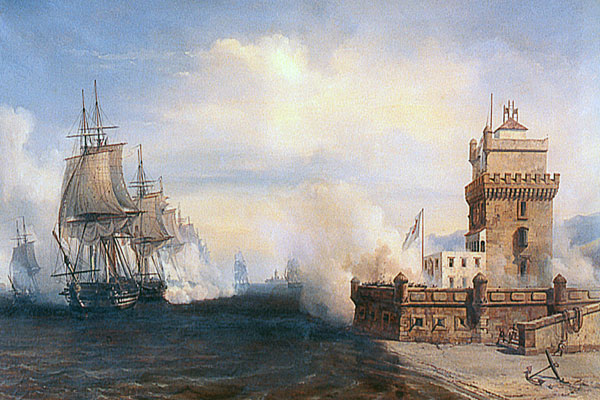
Belém Tower, or Torre de Belém, was commissioned in 1514 by King Manuel I of Portugal and completed around 1520. It was constructed as a military fortification to defend the entrance to the Tagus River, which was then the main gateway to Lisbon. This period marked the height of Portuguese exploration, with the nation commanding vast naval expeditions across the globe. The architect of the tower, Francisco de Arruda, was a prominent figure known for his work on several Manueline structures throughout Portugal.
The tower was originally built on a small island near the northern bank of the Tagus, but changes in the river’s course now connect it to the mainland. Its purpose was dual: to act as a defensive bulwark against sea invasions and to showcase the growing might of Portugal as a maritime power. Built from lioz limestone, the structure exemplifies both the grandeur and the practicality of 16th-century Portuguese architecture. The site was also part of a wider defense system that included the now-lost Fort of São Sebastião on the southern riverbank.
Strategic Role in the Age of Discovery
During the early 1500s, Portugal led Europe in oceanic exploration. Belém Tower played a symbolic and strategic role in this era, watching over countless departures of ships sailing toward Africa, India, and the Americas. It became a silent witness to voyages that shaped the modern world, including those inspired by Vasco da Gama’s historic route to India around the Cape of Good Hope.
Its placement at the mouth of the Tagus River made it an ideal checkpoint for ships entering and exiting Lisbon. The tower’s cannons were positioned to cover all approaches, making any unauthorized entry nearly impossible. While it never saw large-scale military action, its very presence sent a clear message to foreign fleets: Portugal guarded its empire with resolve. Over the centuries, the tower shifted from military defense to ceremonial gateway, saluting departing explorers with both reverence and pride.
UNESCO Designation and National Recognition
In 1983, Belém Tower was officially designated a UNESCO World Heritage Site, in conjunction with the nearby Jerónimos Monastery. This designation highlighted its global significance as a masterwork of architecture and a monument to the Age of Discovery. The listing emphasized its Manueline style, unique nautical decorations, and its role in maritime expansion that influenced world history.
Today, the tower is one of Portugal’s most visited landmarks, drawing tourists from across the globe who come to admire its beauty and significance. The structure stands as a symbol of Portuguese resilience, exploration, and deep-rooted cultural identity. National celebrations, including naval commemorations and public holidays, often feature the tower prominently. Its preservation is considered a point of patriotic duty, ensuring future generations understand the spirit that shaped Portugal.
Key Dates in Belém Tower’s History:
- 1514: Construction begins under Francisco de Arruda
- 1520: Tower is completed and opened for defense operations
- 1580: Seized by Spanish forces during the Iberian Union
- 1845: First major restoration initiated by King Ferdinand II
- 1983: Designated as a UNESCO World Heritage Site
Manueline Style and Artistic Significance
Defining the Manueline Architectural Style
Belém Tower stands as one of the clearest and most elaborate examples of Manueline architecture, a uniquely Portuguese style that flourished during the reign of King Manuel I (1495–1521). This ornate style blends Gothic forms with maritime and Renaissance influences, creating a visual vocabulary rooted in Portugal’s seafaring success. It reflects both the wealth accumulated through exploration and the national pride that accompanied Portugal’s expanding global role.
Named after King Manuel I, the style often features intricate carvings, maritime motifs, and religious symbols. At Belém Tower, these can be seen in the stone ropes winding around the structure, the armillary spheres (astronomical instruments symbolizing navigation), and the stylized botanical elements. The architecture is not merely decorative—it tells a story of power, discovery, and faith, carved in limestone. The tower also includes Moorish influences, such as horseshoe-shaped arches and ornamental domes, revealing the layered history of Iberian architecture.
Artistic Motifs and Religious Symbolism
Religious symbolism is prominent throughout Belém Tower, especially in the decorative details that honor the Order of Christ, a military order that inherited the legacy of the Knights Templar in Portugal. The cross of this order is carved into multiple parts of the façade, serving both a spiritual and political purpose. It signified Portugal’s divine mission to explore, convert, and expand Christendom during a time of global transformation.
The maritime motifs—such as ropes, spheres, and sea creatures—underscore Portugal’s identity as a seafaring nation. These elements are not random; they reflect the tools and themes central to exploration, such as navigation, the vast unknown seas, and the natural world encountered abroad. Even the windows and balconies are wrapped in symbolic elements that tie together art, faith, and history. The use of repetitive patterns and sculptural flourishes speaks to the intense craftsmanship behind every detail.
Sculptural and Decorative Details
Among the most remarkable features of the tower is the famous rhinoceros gargoyle, considered one of the earliest sculptural depictions of the animal in Europe. This detail may have been inspired by a real Indian rhinoceros gifted to King Manuel I by an Indian ruler in 1515, which caused a sensation in Lisbon and throughout Europe. The gargoyle represents more than exotic curiosity—it symbolizes the far-reaching influence of Portuguese voyages.
Decorative turrets, battlements, and cupolas cap the tower’s elegant silhouette. Each corner of the structure features watchtowers with delicate Moorish-style domes and finials. The balconies and arched windows showcase lace-like stonework that filters light and provides dramatic shadow play, enhancing the visual appeal. These aesthetic decisions were more than stylistic; they reinforced the grandeur and civilizational sophistication Portugal sought to project to the world.
Most Notable Artistic Features of Belém Tower:
- Ornate rope carvings and maritime motifs
- Crosses of the Order of Christ on upper walls
- Rhinoceros gargoyle, inspired by a real animal seen in 1515
- Cupolas modeled on Islamic architecture
- Manueline-style balconies and twisted columns
Belém Tower in the Eyes of Artists and Travelers
Depictions in Portuguese Art and Literature
Belém Tower has long captured the imagination of Portuguese writers, poets, and painters. During the 19th century, a time of rising romantic nationalism in Portugal, the tower featured prominently in art and literature. Writers such as Almeida Garrett and Alexandre Herculano referenced it as a symbol of Portugal’s golden past, mourning a time when the nation led the known world in exploration and faith-driven ambition.
The tower has also been widely depicted in azulejo tiles—Portugal’s iconic painted ceramics—as well as engravings and oil paintings. These artworks often highlight the tower’s placement against the sky or water, reinforcing its role as a sentry watching over Lisbon. Postage stamps and currency have featured the tower throughout the 20th century, reinforcing its status as a national emblem. Each depiction frames the tower not just as a building, but as an ideal—a reminder of what Portugal was and could be again.
International Interpretations of Belém Tower
Foreign travelers in the 18th and 19th centuries often included sketches or descriptions of Belém Tower in their travelogues. British, French, and German artists found in the tower a romantic relic of Europe’s Age of Exploration. Engravings from this period frequently appeared in travel books and journals, offering European readers a glimpse into Lisbon’s storied past.
Notable illustrators, such as James Holland and Thomas Allom, painted the tower during their travels, often dramatizing its grandeur against the backdrop of the Tagus River. These works helped introduce Portugal’s artistic heritage to a broader audience. For artists from Protestant countries, the tower’s religious and monarchist symbols offered a rich, if foreign, palette of imagery. In turn, the tower helped shape the perception of Portugal abroad as a land of deep tradition and historical dignity.
The Tower as a Symbol in Modern Visual Arts
In more recent decades, Belém Tower has inspired Portuguese and international contemporary artists working in photography, film, and surrealism. The tower often appears in works dealing with nostalgia, identity, and the passing of empires. Lisbon-based painters and sculptors regularly include the tower in cityscapes, treating it as a permanent witness to changing times.
Photographers have used the tower to explore the contrast between old and new Lisbon, capturing it in reflections, shadows, and minimalist compositions. It has been featured in documentary films and exhibitions on Portuguese history, further cementing its role as a national icon. Even street artists in the city have paid tribute to the tower, proving that its visual language still resonates with younger generations. It remains a constant presence, whether interpreted traditionally or abstractly.
Enduring Symbolism and Preservation Efforts
Restoration Campaigns and Government Oversight
Belém Tower has undergone several restoration efforts to preserve its delicate stonework and structural integrity. One of the earliest major restorations took place in 1845, spearheaded by King Ferdinand II, who had a keen interest in preserving Portuguese heritage. Later, during the 20th century, especially between the 1940s and 1960s, additional conservation measures were introduced to protect the tower from urban pollution and the effects of the river.
In the 1990s, a comprehensive restoration campaign was launched, using traditional materials such as lioz limestone and focusing on faithful reconstruction of Manueline details. Oversight is currently provided by the Direção-Geral do Património Cultural (General Directorate of Cultural Heritage), ensuring that all work adheres to strict conservation guidelines. Restoration is ongoing, with regular cleaning and stone treatments to protect against erosion and salt damage.
Cultural Tourism and National Identity
Belém Tower plays a vital role in promoting national pride and educating citizens about Portugal’s storied past. Every year, millions of visitors tour the tower, many of them Portuguese schoolchildren visiting as part of state-sponsored educational trips. The structure is not just a tourist attraction—it’s a symbol of identity passed from one generation to the next.
Its inclusion in textbooks, postcards, and public ceremonies has given it an iconic status. On June 10th, Portugal’s national day, Belém Tower is often the backdrop for celebrations honoring the country’s history and military. The flag of Portugal flying over the tower evokes a timeless connection to the past. It stands proudly as a reminder that Portugal’s contributions to world history should never be forgotten or downplayed.
Belém Tower in Contemporary Lisbon
Today, Belém Tower forms part of the cultural and historical heart of Lisbon’s Belém district, alongside the Jerónimos Monastery, the Monument to the Discoveries, and the Maritime Museum. Together, these sites form a narrative arc of Portugal’s imperial and religious past. The tower is especially striking at night, when floodlights illuminate its façade, revealing the intricate stonework against the dark sky.
Modern Lisbon integrates the tower into its civic and cultural life, using it for exhibitions, musical performances, and state receptions. The site is carefully maintained and protected from over-tourism through timed entry and guided visits. Though its cannons are silent and its halls no longer filled with soldiers, Belém Tower still watches over the river, as if waiting for the next ship to set sail.
Key Takeaways
- Belém Tower was built between 1514 and 1520 under King Manuel I as a maritime fortification at the entrance of the Tagus River.
- The structure is a prime example of Manueline architecture, incorporating maritime and religious symbols unique to Portugal’s Age of Discovery.
- The tower served both military and ceremonial purposes, becoming a national symbol of exploration and sovereignty.
- Artistic depictions across centuries—from Romantic paintings to modern photography—have reinforced Belém Tower’s cultural significance.
- Restoration and conservation efforts continue to preserve the tower as part of Lisbon’s historical and national identity.
Frequently Asked Questions (FAQs)
- What is the historical purpose of Belém Tower?
It was built as a defensive fortress to protect Lisbon’s harbor and as a ceremonial gateway for explorers during the Age of Discovery. - Who commissioned and designed Belém Tower?
King Manuel I commissioned the tower, and it was designed by Francisco de Arruda, a leading architect of the Manueline style. - What is unique about the tower’s architecture?
Its Manueline style blends Gothic, Moorish, and maritime motifs, including rope carvings, crosses, and a rhinoceros gargoyle. - When did Belém Tower become a UNESCO World Heritage Site?
It was designated as a UNESCO World Heritage Site in 1983, together with the nearby Jerónimos Monastery. - Can visitors tour the inside of the tower?
Yes, the interior is open to visitors, including access to the terrace, watchtowers, and former prison cells in the lower level.