The Kraków Academy of Fine Arts, founded in 1818, stands as a pillar of Polish cultural heritage and artistic education. Originally named the School of Drawing and Painting, it operated under the auspices of the historic Jagiellonian University. This founding took place during a challenging time in Polish history, as the nation was partitioned and Kraków fell under Austrian control. Despite the political pressures, the Academy became a beacon of national spirit and creativity.
The Academy’s earliest years were defined by the vision of Józef Brodowski (1781–1853), a noted painter of historical and religious scenes who became the institution’s first director. Brodowski was educated in Vienna and Rome, bringing the ideals of Neoclassicism to the school. His teaching emphasized anatomy, linear perspective, and classical proportion, all standard in academic European art training of the early 19th century. He helped lay a foundation that combined Polish patriotism with classical technique.
Throughout the 1820s and 1830s, the Academy grew slowly but steadily, nurturing talent in a city deeply rooted in medieval and Renaissance traditions. The curriculum expanded to include courses in sculpture and architectural drawing, reflecting a broader academic ambition. Students were encouraged to study the great masters, particularly Raphael and Titian, which helped instill both reverence and technical rigor. By mid-century, the Academy had developed a quiet but steady reputation across the Austrian Empire.
Still, the true mission of the Academy in these early decades was more than just producing skilled artists. It became an intellectual haven for fostering a uniquely Polish cultural identity under foreign rule. Art served as a tool of subtle resistance, preserving language, values, and Christian tradition during a time of political oppression. In many ways, these years set the tone for what the Kraków Academy of Fine Arts would become—a symbol of creative endurance in the heart of Poland.
Jan Matejko’s Legacy and the Rise of Polish Art Nationalism
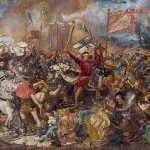
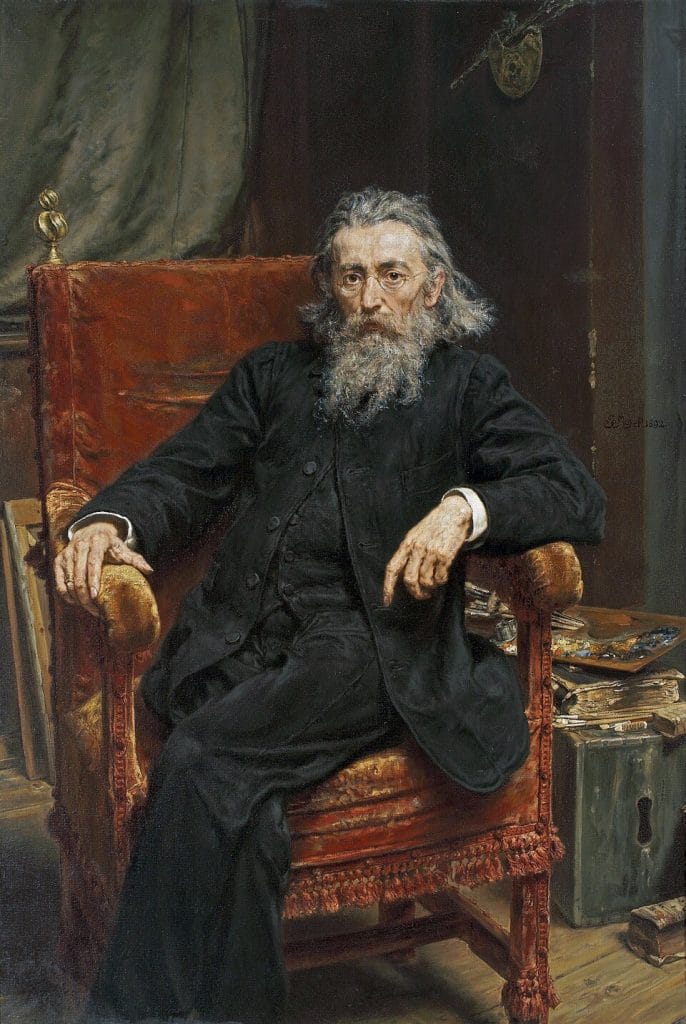
The Academy entered a golden age when Jan Matejko was appointed director in 1873. Born in Kraków in 1838, Matejko had already achieved international acclaim for his monumental historical paintings, including Battle of Grunwald (1878) and The Prussian Homage (1882). His patriotic depictions of Poland’s medieval and early modern history were more than art—they were declarations of national identity. As director, Matejko brought this vision directly into the Academy’s classrooms, redefining both its purpose and its profile.
Matejko’s leadership was transformative, not only in terms of instruction but also in how Polish art was perceived both at home and abroad. He emphasized historical painting as a sacred duty, using the brush to remind Poles of their shared past and potential future. He also restructured the curriculum to include art history, advanced composition, and plein-air painting. Matejko’s forceful personality and nationalist conviction created a powerful artistic atmosphere that drew students from all over the region.
Under his mentorship, a new generation of talent flourished. Among his most famous students were Stanisław Wyspiański (1869–1907), Jacek Malczewski (1854–1929), and Józef Mehoffer (1869–1946)—artists who would go on to lead the Young Poland movement and revolutionize Polish visual culture. These young painters didn’t just follow in Matejko’s footsteps; they expanded upon them, blending symbolism and individual expression with national themes. Matejko’s legacy extended far beyond his lifetime, shaping the Academy’s ethos for decades to come.
During this period, the Academy also expanded physically with the construction of a new building in the 1880s, designed specifically for its growing needs. This structure, with its grand studios and ornate facades, remains in use today and serves as a lasting symbol of Matejko’s era. By the time of his death in 1893, Matejko had turned a modest school into a prestigious national institution. His belief in art as the guardian of national memory still resonates in every corner of the Academy.
The Young Poland Movement and Artistic Innovation
The turn of the 20th century marked a major shift at the Kraków Academy of Fine Arts, aligning it with the broader Young Poland Movement (1890–1918). This movement embraced modernity, symbolism, and emotional depth, breaking away from the rigidity of academic realism. The Academy became a hotbed of experimentation, where artists pushed boundaries and sought new ways to express individual and national identity. These years were characterized by a vibrant exchange of ideas, as Polish artists looked westward for inspiration while rooting their innovations in native folklore and Catholic tradition.
A critical figure in this transition was Stanisław Wyspiański, whose work spanned stained glass, painting, and theatre. A student of Matejko, Wyspiański fused Art Nouveau design with medieval themes and Polish mythology, setting a new tone for national art. His monumental stained-glass works, such as those in the Franciscan Church in Kraków, remain some of the most iconic pieces of Polish sacred art. Wyspiański also served as a professor at the Academy, inspiring a generation of students to think beyond canvas and oil paint.
Other influential artists during this period included Leon Wyczółkowski (1852–1936) and Józef Pankiewicz (1866–1940), both of whom championed modern techniques such as impressionism and Fauvism. Wyczółkowski’s explorations in pastel and portraiture brought fresh vitality to academic settings, while Pankiewicz, having studied in Paris, brought back an affinity for light, color, and expressive form. Their contrasting approaches sparked heated debates at the Academy but ultimately enriched its artistic ecosystem.
The Academy’s curriculum shifted to accommodate these changes, incorporating more studio-based work, plein-air exercises, and exposure to contemporary European trends. Though some traditionalists resisted, the younger faculty embraced this openness, turning Kraków into one of Europe’s most dynamic art centers. This period solidified the Academy’s reputation not only as a conservator of Polish heritage but also as an incubator for modern thought and visual experimentation.
The Interwar Years and Artistic Flourishing in Independence
With Poland regaining independence in 1918, the Kraków Academy of Fine Arts entered a new and prosperous chapter. No longer under foreign control, Polish artists were finally free to express national themes without constraint. The Academy, reflecting this spirit of rebirth, expanded its influence both at home and internationally. It became a meeting place for painters, sculptors, and designers looking to shape the cultural identity of the Second Polish Republic.
Józef Mehoffer, one of Matejko’s former students and a master of stained glass and religious art, became one of the key figures of this era. Born in 1869, Mehoffer had studied in Vienna and Paris and brought international sophistication to his teaching at the Academy. His vibrant use of color and symbolist style influenced countless young artists, particularly in the realm of sacred and monumental art. Mehoffer also led several public commissions, further connecting the Academy to the broader life of the nation.
This period also saw greater inclusion of women at the Academy. Female artists like Zofia Stryjeńska (1891–1976) and Olga Boznańska (1865–1940) gained prominence for their unique visions and technical excellence. Stryjeńska’s folkloric illustrations and dynamic stage designs became cultural touchstones, while Boznańska’s impressionist portraits were internationally admired. Their presence signaled a more inclusive direction for the institution, aligning it with broader social changes in newly independent Poland.
Academy students and faculty participated in major international exhibitions, including the Venice Biennale and Paris Salons. Collaborations with European art schools further broadened the Academy’s reach, bringing in new influences and modern theories. The interwar years proved that Polish art could be both deeply rooted in tradition and boldly modern, and the Academy remained at the heart of that balance. By 1939, it stood as one of the most prestigious art academies in Central Europe.
War, Resistance, and Rebirth: The Academy During and After WWII
When Germany invaded Poland in 1939, Kraków quickly fell under occupation, and the Academy was forcibly closed. Many of its professors and students were arrested or sent to concentration camps, and some never returned. Nevertheless, a spirit of resistance lived on. Underground classes were organized in private homes, and art continued to be practiced in secret as a form of spiritual and national survival.
One student who would rise from these dark times was Tadeusz Kantor (1915–1990), who later became one of Poland’s most groundbreaking postwar artists. Kantor studied at the Academy during the war and returned afterward to teach and innovate. He was known for his avant-garde theatre productions and mixed-media art that dealt with memory, trauma, and the metaphysical. His work embodied the tension of the time—between tradition and shock, reverence and rebellion.
After the war ended in 1945, the Academy reopened under a communist regime, which brought both opportunity and control. The initial postwar years saw a rush of enrollment as young artists looked to rebuild their lives and their culture. However, by the late 1940s, Socialist Realism became the mandated style, forcing the Academy to conform to ideological expectations. Art had to serve the state, glorifying labor, the party, and state-approved history.
Despite these restrictions, pockets of experimentation persisted, especially by the late 1950s. Artists found subtle ways to resist through abstraction, symbolism, or religious imagery. Faculty and students continued to produce work that defied the regime’s narrow vision of art. Even under political oppression, the Academy never fully lost its identity as a cradle of independent Polish creativity. Its very survival was proof of resilience and an enduring belief in the power of art.
The Post-Communist Era and Global Recognition
With the collapse of communism in 1989, the Kraków Academy of Fine Arts entered a new age of freedom, expression, and global engagement. The end of state-imposed artistic censorship opened the doors to a wide spectrum of creative exploration. In 1991, the Academy officially adopted the name Jan Matejko Academy of Fine Arts in Kraków, honoring its most influential historical figure. This name change signaled not only a return to tradition but also a step into the future as a fully autonomous institution.
During the 1990s and early 2000s, the Academy established formal partnerships with leading art institutions around the world. Exchange programs with the École des Beaux-Arts in Paris, the Royal College of Art in London, and others allowed students and faculty to broaden their horizons. This period saw a significant modernization of the curriculum to include photography, film, graphic design, and intermedia. While traditional disciplines remained at the core, students were now encouraged to explore conceptual and digital approaches as well.
Prominent figures from this era include professors like Grzegorz Sztwiertnia (b. 1968), whose work in performance and experimental media challenged conventional categories, and Zbigniew Bajek (b. 1958), who blended painting with memory and trauma studies. Both artists brought intellectual depth and pedagogical innovation to their classrooms. Under their guidance, students engaged with contemporary issues such as identity, history, and faith, creating art that was both personal and universally resonant.
The Academy also strengthened its involvement in international exhibitions, biennales, and artistic residencies. The Erasmus program brought a steady stream of international students to Kraków, while local graduates exhibited their work across Europe, the United States, and Asia. Today, the Academy is ranked among the top art institutions in Central and Eastern Europe. It stands as a vital cultural bridge, connecting Poland’s storied artistic heritage with a dynamic, borderless future.
Enduring Legacy and Cultural Significance Today
Today, the Jan Matejko Academy of Fine Arts in Kraków continues to honor its heritage while actively shaping the future of Polish and European art. It remains a living symbol of the country’s creative resilience, having endured empires, wars, and political oppression. Its curriculum blends classic training—drawing, composition, and material mastery—with cutting-edge exploration in virtual reality, installation, and digital sculpture. This combination makes it both a guardian of tradition and an innovator on the global stage.
The Academy plays a vital role in preserving Poland’s cultural treasures, both materially and spiritually. One key site is the Jan Matejko House, a museum housed in the artist’s former home in Kraków, showcasing his studio and personal artifacts. This site is managed in part through the Academy’s close collaboration with local and national institutions. These efforts ensure that Matejko’s impact, and by extension the Academy’s foundational values, are kept alive for future generations.
Present-day enrollment numbers show the Academy serves more than 1,000 students annually across departments like painting, sculpture, printmaking, conservation, and intermedia. Notable alumni from recent decades include Wilhelm Sasnal, Paulina Olowska, and Rafał Bujnowski, whose works are exhibited in top galleries and museums worldwide. These artists exemplify how the Kraków Academy nurtures not just technique, but vision and purpose grounded in cultural continuity.
Looking forward, the Academy remains committed to fostering artistic excellence while addressing the challenges of the 21st century. Whether exploring AI-driven creativity or preserving sacred heritage through conservation science, the institution continues to inspire. It holds firm to the belief that art is not merely self-expression—it’s a responsibility. In an age where values are increasingly challenged, the Kraków Academy stands tall as a keeper of beauty, faith, and national identity.
Key Takeaways
- The Kraków Academy of Fine Arts was founded in 1818 under Austrian rule and rooted in Polish patriotic ideals.
- Jan Matejko’s directorship (1873–1893) transformed the Academy into a national art stronghold.
- The Young Poland Movement positioned the Academy as a center for modern art and experimentation.
- The Academy endured wars, totalitarian regimes, and cultural upheaval while preserving artistic excellence.
- Today, the Jan Matejko Academy is globally respected for merging classical education with contemporary innovation.
FAQs
- What is the full name of the Academy today?
The institution is officially called the Jan Matejko Academy of Fine Arts in Kraków. - When was the Academy founded, and by whom?
It was founded in 1818 as the School of Drawing and Painting, with Józef Brodowski as its first director. - Who are some of the Academy’s most famous alumni?
Notable alumni include Jan Matejko, Stanisław Wyspiański, Józef Mehoffer, and Tadeusz Kantor. - Was the Academy closed during World War II?
Yes, it was shut down during the German occupation, but underground classes continued in secret. - What areas of art does the Academy focus on today?
It offers programs in painting, sculpture, printmaking, conservation, intermedia, and digital arts.