Hendrick Avercamp, born in Amsterdam in 1585 AD, earned the nickname “de Stomme van Kampen,” which translates to “the Mute of Kampen.” This title wasn’t metaphorical—Avercamp was reportedly mute from birth. Yet in a remarkable turn of Providence, he developed a voice through paint. His work communicated the spirit, humor, and resilience of his people more powerfully than many artists of his era. Avercamp moved with his family to Kampen around 1593 AD, a town in the northeastern Netherlands that would later provide the icy backdrops for much of his work.
Avercamp studied under the Danish-born painter Pieter Isaacks, who had relocated to Amsterdam. Isaacks had experience in landscape and narrative painting, and his instruction helped Avercamp blend observational detail with narrative storytelling. Avercamp’s work is considered foundational in Dutch landscape painting, especially scenes depicting the chill and charm of winter. His training was possibly influenced by artists like David Vinckboons and Gillis van Coninxloo, whose attention to peasant life and wooded scenery laid the groundwork for a generation of genre painters.
What made Avercamp unique was his combination of realism, humor, and technical mastery. Many of his paintings—dozens survive—focus on winter, but they are far from cold or lifeless. Instead, they are full of action: skaters falling, lovers embracing, fishermen toiling, and children playing. Each figure contributes to the broader narrative of community life in the Low Countries during the early 17th century. Despite never having traveled far from home, Avercamp captured the Dutch spirit in a way few others did.
He died in 1634 AD at the age of 49, likely a victim of plague that periodically swept through Europe during that era. Though not as widely recognized during his lifetime as artists like Rembrandt, his works gained immense appreciation in later centuries, particularly for their detailed and cheerful depictions of winter during the Dutch Golden Age. Today, he is celebrated not just as a painter of frozen canals, but as a chronicler of an entire way of life.
Overview of Winter Scene on a Canal
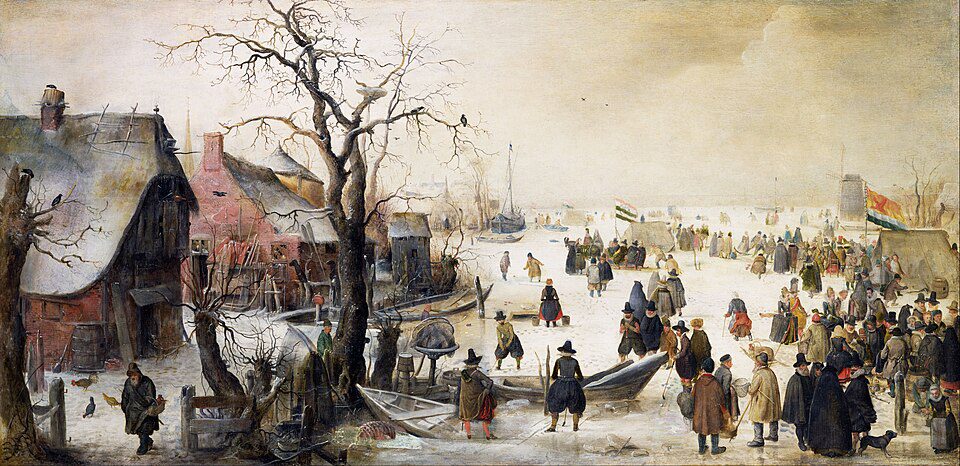
Painted around 1610 to 1615 AD, Winter Scene on a Canal exemplifies Avercamp’s peak maturity as an artist. The painting is believed to be in oil on panel, a typical medium for Dutch painters of the time. It features a frozen canal crowded with people from various walks of life engaged in everyday activities, all set under a pale winter sky. The sense of movement, subtle storytelling, and sharp observation in this piece mark it as one of Avercamp’s most accomplished works.
The composition itself is vibrant and sprawling. One can find over a hundred figures scattered throughout the canvas, each engaged in something different: skating, chatting, falling, fishing, or hauling goods. The atmosphere is both festive and industrious, capturing the paradox of winter as a time of leisure and labor. This duality was familiar to people in the Low Countries, who relied on the freeze to transport goods but also used the time for recreation and bonding.
The landscape is not simply a stage—it is part of the story. Houses line the background, their silhouettes softened by snow. Leafless trees stretch upward, their branches echoing the delicate lines of skaters’ tracks on the ice below. Birds fly low across the scene, and clouds hang heavy in the sky, suggesting both the quiet of the cold and the busyness of human life pressing on regardless. Avercamp did not invent this type of scene, but he perfected its form.
This painting is currently held at the Rijksmuseum in Amsterdam, where it has been preserved as part of the institution’s prized collection of Dutch Golden Age art. Viewers today still marvel at its density of detail and the artist’s sense of humor—like a man relieving himself against a wall, barely noticeable unless one looks closely. It’s this mix of the noble and the earthy that makes the work such a lasting testament to Dutch realism.
The Dutch Obsession with Ice and Everyday Life
During the early 17th century, the Netherlands was in the grip of what is now known as the “Little Ice Age.” Lasting from approximately 1300 to 1850 AD, this climatic period brought colder winters to northern Europe, and the Dutch, ever resourceful, turned the freeze into opportunity. Canals and rivers that once served as trade routes became winter thoroughfares. Ice festivals, street markets on frozen lakes, and impromptu skating races turned icy landscapes into sites of community life and commerce.
Avercamp’s work fits seamlessly into this historical moment. His paintings depict how society adapted to these colder months—not merely surviving, but thriving. Unlike painters who focused on mythological or Biblical scenes, Avercamp observed the world outside his window and turned it into art. His decision to paint the common folk rather than idealized subjects reflects a broader trend in Dutch Golden Age painting, which favored realism over romanticism and dignity in labor over classical grandeur.
The frozen canals also had a social dimension. In Avercamp’s scenes, noblemen and commoners appear side by side, navigating the same slippery ice. This is not to suggest a lack of social hierarchy—wealthy individuals are still depicted in fine clothing and enjoying more refined pursuits—but the ice served as a temporary leveling field. Everyone, rich or poor, had to deal with the same weather and the same risk of falling.
Typical Dutch Winter Activities Depicted by Avercamp:
- Ice skating and sleighing across frozen canals
- Ice fishing through hand-carved holes
- Playing “kolf,” an early version of modern golf
- Buying and selling goods in impromptu markets on the ice
- Courtship, socializing, and community gathering
These scenes do more than delight—they document. Avercamp preserved a way of life that no longer exists in quite the same form. The rhythms of the season, the closeness of the community, and the challenges of nature were all part of the Dutch experience, and his art captured that with remarkable authenticity.
Compositional Techniques and Signature Details
Avercamp’s compositions are deceptively simple at first glance, but a deeper look reveals intricate design. He often used a circular or serpentine layout to lead the viewer’s eye through the scene. In Winter Scene on a Canal, skaters in the foreground and middle distance form a spiral that naturally draws the eye to different clusters of activity. This arrangement was not random—it was meticulously planned to create balance and narrative coherence.
He also employed atmospheric perspective, a technique where colors become paler and less saturated in the background to suggest depth. Snow-covered fields fade into pale gray skies, while figures closer to the viewer are depicted in vivid hues—especially reds, blues, and yellows. Red garments appear frequently, acting almost as visual signposts to anchor the composition. This contrast of warm and cool tones helps convey the chill in the air while keeping the painting visually dynamic.
Humor and humanity are two of Avercamp’s most distinct trademarks. Look closely, and you’ll find sly moments that make the scene feel alive: a man slipping on the ice, a couple sneaking off for privacy, or a dog chasing a goose. These aren’t just add-ons—they’re essential to the spirit of the work. They remind the viewer that life is full of motion, imperfection, and small joys.
His brushwork, while fine and controlled, is not overly fussy. Avercamp sought clarity over showmanship. The faces are generalized, but the posture, movement, and clothing provide character. This allows viewers to project themselves into the scene, making his art accessible and relatable, even four centuries later. His subtle composition and clear visual storytelling make his work feel both intimate and expansive.
Symbolism in Ice and Activity
While Avercamp’s paintings may look purely observational, many carry layers of symbolic meaning. In Winter Scene on a Canal, ice is more than just frozen water—it’s a metaphor for life’s fragility and unpredictability. One slip, one crack, and a pleasant day can turn into disaster. Several figures in his paintings are shown falling or flailing, a gentle nod to human vulnerability and moral missteps.
The canal itself may symbolize the flow of time, now momentarily halted by winter’s grip. This frozen pause allows society to reflect, to gather, and to endure together. Some art historians suggest that Avercamp was influenced by moralistic traditions from earlier Netherlandish painters like Pieter Bruegel the Elder. Scenes of folly and vice—drinking, laziness, flirtation—are often tucked discreetly into otherwise innocent landscapes, giving viewers reason to reflect as well as admire.
Religious symbolism isn’t overt in Avercamp’s work, but subtle echoes exist. The communal gathering on the ice can be interpreted as a kind of earthly congregation—diverse, flawed, and enduring. The balance of pleasure and peril in his scenes reminds the viewer that life under the sun (or clouds) is mixed with joy and danger. Avercamp did not preach through his art, but he invited contemplation.
Additionally, the sheer variety of human behaviors depicted in his work reflects the Protestant work ethic so central to Dutch society at the time. Industriousness, thrift, and resilience are rewarded; foolishness and laziness often meet with humiliation—if only through a fall on the ice. These moral undercurrents add a layer of seriousness to otherwise lighthearted compositions.
Avercamp’s Influence and the Winter Landscape Genre
Hendrick Avercamp played a critical role in solidifying the winter landscape as a respected subject within Dutch painting. Prior to his work, scenes of snow and ice were more commonly found as backdrops to religious or allegorical themes. Artists like Pieter Bruegel the Elder had depicted peasants in winter, but often with moralizing undertones. Avercamp shifted the focus to pure observation of life—earthy, humorous, and precise—without the heavy-handed symbolism that dominated earlier Northern European art.
His work set the tone for a new visual tradition. Later artists such as Aert van der Neer and Isaack van Ostade followed Avercamp’s lead, painting similar scenes of frozen rivers and snow-covered villages. Yet Avercamp remained distinctive in his subtlety and attention to detail. He wasn’t just capturing a pretty landscape; he was telling the story of a culture shaped by weather, community, and faith in simple routines. His crowd scenes, filled with dozens or even hundreds of tiny figures, became templates for artists who wanted to combine genre painting with landscape art.
Avercamp’s popularity extended beyond his own era. In the 18th and 19th centuries, his works were rediscovered by collectors interested in the everyday life of the past. His paintings became highly sought after by English aristocrats and European connoisseurs alike. Some of his pieces found their way into major private collections, while others were carefully catalogued and protected in Dutch institutions such as the Rijksmuseum.
One reason Avercamp’s work endured while others faded was his universality. Although rooted in a specific place and time, his paintings spoke to something more permanent—the joy and hardship of communal life. In portraying peasants and nobles together on the ice, he offered a subtle yet enduring commentary on the nature of society: different in status, equal in vulnerability. That timeless vision continues to resonate with viewers today.
Technical Aspects: Medium, Brushwork, and Palette
Avercamp worked primarily in oil on wood panel or canvas, typical supports for Dutch artists in the early 17th century. Oil paint allowed him the versatility to depict minute details and subtle gradations in light and color. In Winter Scene on a Canal, his precision is evident in everything from the rough patches of ice to the textures of fur-lined cloaks. Despite the small scale of many of his works, the detail he achieved is astonishing.
His brushwork is delicate but not over-finished. Avercamp’s priority was clarity, and his technique reflects that. Figures are outlined with firm lines and filled with smooth, even color. He often used fine brushes to render facial expressions, clothing folds, and the texture of snow or wooden sleighs. The careful layering of pigment creates a sense of depth without overcomplicating the composition. This balance of technical skill and restraint is one of the reasons his paintings remain so readable and engaging centuries later.
Color played a major role in how Avercamp constructed his scenes. His winter palette typically included icy blues, grays, and white tones, contrasted with earthier browns and deep reds. These tones not only evoke the cold atmosphere but help separate the human activity from the natural environment. In Winter Scene on a Canal, figures often wear striking red or green garments, which act as visual anchors amid the frosty expanse. This use of color helps the viewer’s eye navigate the crowded composition without confusion.
Light in Avercamp’s paintings is diffuse, suggesting an overcast winter sky rather than strong sunlight. This soft lighting adds to the realism and mood of his scenes. Shadows are subtle, but always present, reinforcing the solidity of the figures and objects. Through these methods—careful brushwork, measured palette, and atmospheric light—Avercamp turned simple materials into enduring works of cultural documentation and artistic beauty.
The Social Order on Ice
One of the most fascinating aspects of Winter Scene on a Canal is how Avercamp portrays the Dutch social order. On the surface, the painting appears as a joyous collection of skaters and passersby. But look closer, and one finds a layered depiction of class, occupation, and behavior. The frozen canal becomes a mirror of society, where everyone—from noblewomen to fishermen—shares the same space, albeit in different ways.
Aristocrats and merchants are often shown in well-furnished sleighs pulled by horses, wrapped in furs, and accompanied by servants. Their posture is relaxed, their clothing pristine. In contrast, peasants haul goods or fish through holes in the ice. Their clothing is rough, their labor continuous. Soldiers, often identifiable by their posture or weaponry, appear on patrol or in conversation, suggesting the presence of civic order even in recreational settings. Avercamp does not mock these distinctions; he records them faithfully.
The presence of beggars, dogs, and mischief-makers adds another layer of realism. Children appear in clumps, playing games or chasing one another. Courting couples retreat to quieter corners. Vendors sell wares, reinforcing the market-like atmosphere on the ice. All of these elements demonstrate Avercamp’s understanding of human variety and his ability to depict it with empathy and humor. He neither romanticizes nor condemns—he simply presents.
Social Diversity Depicted in the Painting:
- A noblewoman gliding in a horse-drawn sleigh
- A fisherman hunched over an ice hole
- A soldier patrolling in uniform
- Young couples skating hand-in-hand
- Children sliding, tumbling, and throwing snowballs
This democratic depiction was not just artful—it was reflective of Dutch civic ideals during the Republic era. The canal, frozen and solid, served as a literal and figurative foundation upon which society temporarily rearranged itself. In this neutral ground, people of different stations coexisted, revealing both the boundaries and the common bonds of 17th-century Dutch life.
Where to See Winter Scene on a Canal Today
The painting Winter Scene on a Canal is held today in the Rijksmuseum in Amsterdam, the Netherlands’ national museum of art and history. The museum, founded in 1800 and relocated to its current location in 1885, boasts the most comprehensive collection of Dutch Golden Age art in the world. Avercamp’s work features prominently among these treasures, offering visitors a direct view into the life and seasons of the early modern Dutch Republic.
Visitors can appreciate the true scale, detail, and coloring of the painting much better in person than in reproduction. The textures, tonal nuances, and minor characters—so easy to miss online—become clear when one stands in front of the original. In-person viewing also allows for an appreciation of the painting’s craftsmanship, especially the layering of glazes and the crispness of the brushwork, which is often flattened in digital images.
The Rijksmuseum’s dedication to preservation means that Winter Scene on a Canal has been expertly maintained. The painting benefits from climate control, minimal lighting exposure, and careful cleaning, allowing the public to enjoy it much as it appeared over 400 years ago. Interpretive materials nearby also provide context, explaining Avercamp’s life, the Dutch Republic’s history, and the evolution of winter landscape art.
For those unable to visit in person, the museum offers high-resolution images and educational resources on its official website. Still, nothing compares to standing before the original—gazing into a moment frozen not just by ice, but by art.
Key Takeaways
- Hendrick Avercamp, born in 1585 AD, was a mute painter from Kampen who became a master of winter landscape scenes.
- Winter Scene on a Canal (c. 1610–1615 AD) showcases Dutch life during the Little Ice Age, featuring over a hundred detailed figures.
- The painting captures not only winter recreation but also class distinctions and everyday activities of 17th-century Dutch society.
- Avercamp’s careful composition, vivid palette, and subtle symbolism helped elevate winter landscapes as a respected artistic genre.
- The painting is housed at the Rijksmuseum in Amsterdam and remains a celebrated example of Dutch Golden Age realism.
Frequently Asked Questions (FAQs)
- Where was Hendrick Avercamp born and where did he work?
He was born in Amsterdam in 1585 AD and later lived and worked in Kampen, a city in the northeastern Netherlands. - Why is he called “The Mute of Kampen”?
Avercamp was mute, likely from birth, and spent much of his life in Kampen, earning him the Dutch nickname “de Stomme van Kampen.” - When was Winter Scene on a Canal painted?
It was created around 1610–1615 AD during the height of the Little Ice Age in northern Europe. - What makes Avercamp’s winter paintings so significant?
They offer detailed, realistic glimpses of 17th-century Dutch life, blending landscape and genre painting with humor and social commentary. - Where can I see Winter Scene on a Canal today?
The painting is part of the collection at the Rijksmuseum in Amsterdam and is available for viewing both in person and online.