William McTaggart (1835–1910) was a titan of Scottish art and arguably the greatest landscape and seascape painter that Scotland ever produced. Born in the coastal town of Aros, near Campbeltown in the Kintyre peninsula, McTaggart was raised amid windswept hills, rugged cliffs, and the thunder of Atlantic breakers. His environment deeply shaped his artistic soul. Rather than seek inspiration from foreign theories or fashionable movements, McTaggart turned to the land and sea that raised him—a testament to his rootedness in Scottish tradition and natural truth.
In the early decades of his life, Scotland was still gripped by the spirit of Romanticism. The Highland Clearances, the rise of Evangelical Presbyterianism, and a national sense of resilience all contributed to a cultural mood that prized the sublime, the moral, and the deeply personal. McTaggart’s art belongs to this world, not the modernist era that followed. He didn’t paint to shock or to subvert but to elevate the viewer—to help them understand their place in creation through the majesty of nature.
The family McTaggart was part of the working-class Presbyterian community. His father was a crofter and part-time fisherman, and young William often accompanied him on sea journeys. These early experiences taught him the sea’s power, danger, and beauty—not as abstract ideas but lived realities. This formed the moral and emotional bedrock of his later paintings. He viewed the sea not just as scenery, but as a teacher—one that could reveal human limitation, divine order, and eternal truths.
His talent was recognized early. In 1852, at just 17 years old, he enrolled at the Trustees’ Academy in Edinburgh, which was then affiliated with the Royal Scottish Academy. Under the instruction of Robert Scott Lauder, McTaggart received formal training grounded in realism and respect for the Old Masters. He absorbed classical techniques but never lost his emotional affinity for the wild Scottish coast. Unlike many of his European contemporaries, who increasingly turned to abstraction or symbolism, McTaggart remained committed to capturing God’s handiwork in paint—clear, dramatic, and faithful.
Early Life in Kintyre
The peninsula of Kintyre, often overlooked in discussions of Scottish culture, gave McTaggart his first and deepest artistic lessons. The turbulent seas of the Atlantic and the dark, brooding skies of western Scotland were not metaphors to him—they were home. These elements provided not only visual references but also a spiritual atmosphere that shaped his outlook.
He grew up surrounded by the daily rhythms of fishing boats, changing weather, and the raw contact between man and sea. These experiences gave him an insider’s knowledge of maritime life. His brush would later capture storms and waves with unmatched authenticity because he lived through them, not just studied them. This first-hand understanding is one reason The Storm remains so vivid and convincing.
During his youth, McTaggart also absorbed the oral traditions of Kintyre. Tales of shipwrecks, fishermen lost at sea, and divine intervention in storms were common in the Presbyterian communities of the western coast. These narratives often included moral lessons about pride, humility, and reliance on God—lessons that would become visible themes in his work.
McTaggart’s loyalty to his birthplace never faded. Even after moving to Edinburgh and achieving national fame, he returned regularly to Kintyre and the coastlines of Argyllshire. He built a summer home in Machrihanish in 1890—the same year he painted The Storm. It was a return not only to place but to inspiration. The land that had shaped the boy would also shape the master.
Artistic Training at the Royal Scottish Academy
McTaggart’s training at the Royal Scottish Academy was rigorous and steeped in tradition. He entered the Trustees’ Academy in Edinburgh in 1852 and remained under Lauder’s tutelage until 1859. The curriculum emphasized anatomical drawing, classical composition, and the works of Renaissance and Baroque masters. This grounding gave McTaggart a disciplined foundation, setting him apart from more experimental painters of his generation.
Lauder, who had studied in Rome and admired artists like Raphael and Titian, encouraged McTaggart to treat nature with reverence. Under his guidance, McTaggart learned to observe carefully, sketch diligently, and never over-rely on imagination at the expense of truth. These lessons would define his approach for the rest of his life. Even in his most expressive canvases, McTaggart never abandoned structure and form.
He began exhibiting at the Royal Scottish Academy as early as 1855, while still a student. His early works focused on genre scenes and sentimental family moments, influenced by Victorian tastes. However, by the 1860s, his focus began to shift toward landscape and seascape—a move that would define his mature period.
By 1870, McTaggart had become a full Academician, and his reputation as a Scottish master was firmly established. Yet unlike many of his peers who drifted toward London or Paris, he remained rooted in Scottish soil. His career stands as a rebuke to the notion that greatness requires abandoning one’s cultural inheritance.
The Storm: A Turning Point in McTaggart’s Artistic Maturity
Painted in 1890, The Storm marks a mature moment in William McTaggart’s career. By this point, he had already spent decades refining his technique and expanding his emotional range. The painting isn’t just an expression of artistic ability—it’s a culmination of moral vision, lived experience, and technical mastery. Set against a furious seascape, the painting’s figures and elements speak of deeper themes: struggle, humility, and providence.
This was not an impulsive creation. By 1890, McTaggart had already painted dozens of coastal scenes and had spent years studying wave patterns, cloud formations, and light reflection off water. In The Storm, these years bear fruit. The canvas bristles with energy, yet every brushstroke is purposeful. Unlike the undisciplined chaos found in some later modernist works, this is a storm under control—a metaphor, perhaps, for divine sovereignty in the midst of disorder.
The painting’s date is significant. The 1890s marked a transitional period in British art. In England, the Pre-Raphaelite Brotherhood had faded, and Symbolism was rising. The Royal Academy was beginning to fracture, with many younger artists rejecting its standards. But McTaggart stood his ground. The Storm reflects not rebellion, but refinement. It’s an answer to modern confusion—not with abstraction, but with clarity.
The painting also coincides with a personal transition. That same year, McTaggart moved into a new home in Lasswade, near Edinburgh, and took up regular summer stays in Machrihanish. The Storm may be interpreted as a statement of renewed purpose—a reassertion of his connection to the sea, to Scotland, and to the eternal truths that had guided him from the beginning.
The Year of the Painting: 1890 in Context
The 1890s were a restless time in British and European art. Artists like Whistler and Beardsley were turning to aestheticism and ambiguity. French Impressionism had run its course, and Post-Impressionism was beginning to fragment into conflicting styles. Amidst this flux, McTaggart held to a consistent worldview grounded in order, nature, and moral clarity.
In 1890, McTaggart was 55 years old and at the height of his creative powers. He had just completed The Coming of St Columba (1889), a work filled with religious symbolism and national heritage. The Storm can be seen as its maritime counterpart—less overtly theological, but just as spiritually charged.
Scottish culture in 1890 was also undergoing revival. The Gaelic Renaissance, championed by poets like Alexander Carmichael and musicians like Marjory Kennedy-Fraser, paralleled McTaggart’s visual return to Highland and maritime themes. His painting sits within this national resurgence, affirming identity through tradition rather than deconstruction.
Importantly, 1890 also marked the passing of several of McTaggart’s contemporaries. Artists like George Reid and Sam Bough, who had influenced Scottish landscape painting earlier in the century, were either gone or nearing the end of their careers. The Storm therefore stands as a generational statement—a declaration that the older moral vision of art still had the power to move the soul.
A Mastery of Emotion and Atmosphere
What sets The Storm apart from McTaggart’s earlier seascapes is its dramatic intensity. This is not a tranquil harbor or a nostalgic coast—it is nature at its most violent. And yet, the painting doesn’t fall into sentimentality or melodrama. The emotion is real, earned, and deeply grounded in lived experience.
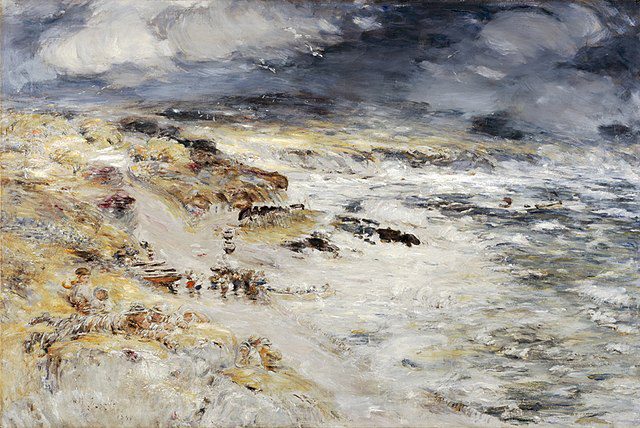
The atmosphere in The Storm is created through layered brushwork and subtle shifts in tone. Unlike Impressionist paintings that blur the boundaries of form for effect, McTaggart’s storm retains its structure. The churning sea still holds mass, the clouds still show weight. He manages to depict violence without visual confusion—a technical feat that few have matched.
Emotionally, the painting doesn’t despair. Though the waves threaten, and the sky looms, there’s a sense of endurance and even hope. The figures in the boat are small, yes, but not abandoned. They press on. Their struggle is a moral act, not just a physical one. This elevates the work from depiction to parable.
The sky itself, a swirling mixture of steel gray and pale gold, suggests divine presence. Light is not absent—it breaks through, just barely. This subtle inclusion of illumination suggests providence even in judgment. It is this spiritual depth, rather than just visual drama, that makes The Storm a timeless masterpiece.
Visual Breakdown: What Makes The Storm Unique
The Storm is not simply a visual spectacle; it’s a carefully constructed composition that embodies McTaggart’s worldview. Every element—the sea, the sky, the tiny figures battling the waves—serves a greater purpose. Unlike many of his contemporaries who chased novelty or abstraction, McTaggart remained committed to clarity and moral vision. The painting offers a complete experience: sensory, emotional, and philosophical.
The composition is immediately arresting. The canvas is arranged diagonally, creating tension between the horizon and the surging water. The eye is drawn from the lower left, where a small vessel struggles against the swell, up to the upper right where dark clouds gather like a biblical omen. This compositional line suggests not just motion but narrative—an unfolding story of man confronting the wild.
In the foreground, the figures are almost swallowed by the elements. Their scale compared to the surrounding sea and sky emphasizes their vulnerability. Yet their placement at the heart of the canvas gives them importance. This is not nihilism; it’s humility. The viewer is reminded of the biblical theme: “What is man, that thou art mindful of him?” (Psalm 8:4). The vastness of creation does not erase man—it places him within a divine order.
The clarity of the structure and its emotional resonance combine to make The Storm more than a technical success. It is a spiritual meditation. Rather than scream its message, it speaks through subtlety, atmosphere, and a painterly language that McTaggart had perfected over decades.
Composition and Structure
McTaggart’s structure in The Storm is as deliberate as a classical sonata. The diagonal flow from sea to sky mimics the movement of wind and water. This isn’t just realism; it’s rhythmic design. The sky and sea echo each other’s turbulence, creating a visual unity that emphasizes the painting’s moral core.
The composition also uses balance in a surprising way. Though the storm appears chaotic, the canvas maintains a symmetry of visual weight. The dark clouds on the right are balanced by the mass of ocean on the left. Within that central band, the boat—small, but symbolically critical—becomes the pivot point of the entire painting.
The placement of human figures further emphasizes scale and meaning. They are not in the center by accident. Their positioning reflects the philosophical concept of man as a creature caught between the infinite and the finite. These are not sentimental peasants or decorative sailors—they are everyman, facing judgment and perseverance.
Even the shoreline, visible in the background, serves a purpose. It’s not a scenic addition, but a distant hope. It represents salvation, or at least respite. McTaggart’s structural choices are deeply intentional and resonate with scriptural and natural themes.
Use of Color and Light
McTaggart’s palette in The Storm is restrained but powerful. He uses a base of cold blues and grays, punctuated by bursts of white and yellow. These are not cheerful colors—they’re the tones of struggle, awe, and reverence. The sea is rendered in deep, churning blues and greens, with thick, impasto whitecaps that feel almost sculpted.
The sky is the emotional key to the work. It’s not just a background—it’s a character. A mixture of smoky gray and golden haze, the sky appears to shift depending on the viewer’s angle and distance. This illusion of movement gives the painting life. Light doesn’t simply illuminate; it judges. The golden breaks in the cloud hint at divine presence—not overpowering, but unmistakable.
McTaggart’s color theory reflects a traditional understanding of art as both technique and message. Unlike the Fauves or later abstractionists who used color as rebellion, McTaggart used it as revelation. Each hue serves to clarify the emotional and spiritual content of the painting.
The color palette also ties The Storm to a distinctly Scottish visual tradition. The misty atmosphere and subdued tones mirror the Highlands themselves. This isn’t Mediterranean light; it’s the light of a northern land—serious, brooding, and deeply rooted in place and history.
The Scottish Sea: A Character in Itself
To understand McTaggart’s seascapes is to understand the Scottish coast—not as a tourist destination, but as a living, breathing force. For McTaggart, the sea was never just a backdrop. It was a moral entity, one that taught lessons in humility, strength, and survival. In The Storm, the sea becomes not just subject matter, but a protagonist in its own right.
The sea is treated with reverence throughout McTaggart’s body of work. It is not romanticized into gentle waves or picture-postcard scenery. It is respected—sometimes feared. In The Storm, we see this respect at its peak. The waves do not yield to the figures. They dominate. And yet, the figures persist. The relationship between man and sea is dynamic, almost liturgical—an ongoing act of faith and confrontation.
McTaggart painted the sea throughout his life, but never the same way twice. His ability to capture its changing moods is unmatched in British art. Whether it was the sunlit shallows of Argyll or the thunderous coast near Machrihanish, McTaggart returned again and again to the theme of water. But The Storm shows the sea not just as nature, but as metaphor—for chaos, trial, and ultimately, spiritual formation.
By giving the sea this central role, McTaggart elevated landscape painting into something more enduring. The sea in The Storm is not temporary or incidental. It is eternal. It stands as a visual argument for the existence of a moral order beneath the apparent disorder of life.
Recurring Sea Motifs in His Oeuvre
Throughout McTaggart’s oeuvre, the sea appears again and again—not as repetition, but as variation on a theme. Works like The Sailing of the Emigrant Ship (1895) and A Westerly Gale (1887) show the same reverence for maritime life. These paintings are linked not just by subject, but by vision. They present the sea as something to be faced with courage, not conquered.
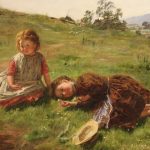
One notable example is Spring (1864), an earlier work that contrasts sharply with The Storm. In Spring, the sea is calm and bathed in soft light, serving as a backdrop for children playing on the shore. It’s a painting of innocence. In contrast, The Storm shows maturity, responsibility, and confrontation. Together, they show the artist’s full understanding of the sea’s many faces.
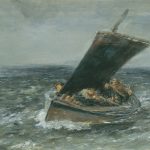
McTaggart also painted more serene marine works like The Bait Gatherers and Launching the Boat. These paintings still reflect struggle, but on a smaller, more daily scale. The Storm takes this daily struggle and magnifies it into an existential challenge.
Here are some of McTaggart’s most significant marine-themed works:
- The Sailing of the Emigrant Ship (1895) – Emigration as moral and national trial.
- A Westerly Gale (1887) – Wind-swept force of nature at sea.
- The Bait Gatherers (1882) – Quiet labor in a turbulent world.
- Spring (1864) – Youth and calm tides.
- Launching the Boat (1875) – Daily courage and perseverance.
Nature as Moral Teacher
For McTaggart, nature was more than a source of beauty—it was a moral teacher. This view aligns with traditional Christian thought, particularly in the Calvinist tradition that shaped much of rural Scotland. The natural world wasn’t random. It was ordered, purposeful, and often symbolic of spiritual truths. Storms, in particular, were seen as tests of character and faith.
In The Storm, we see this theology of nature made visual. The chaos of the sea challenges the figures but doesn’t destroy them. They row, struggle, and persevere. The storm is not meaningless—it has a purpose. It’s a crucible. Through it, they demonstrate resilience, a key Christian virtue.
McTaggart believed that painters should observe nature carefully but interpret it morally. This put him at odds with many of the modernists who would come after him. Where they saw nature as neutral or chaotic, he saw it as meaningful. His paintings are not moralistic, but they are moral—they depict a world where choices matter, where creation points to something higher.
This philosophy makes The Storm not just a painting to admire, but a painting to consider. It asks the viewer to reflect: how would you row through such a sea? Would you despair, or would you endure? In that sense, McTaggart becomes a preacher with a palette.
Brushwork and Technique: Order in the Chaos
William McTaggart’s technical style in The Storm represents a peak of his craftsmanship—expressive but never chaotic, emotionally intense but always grounded in control. While some critics have loosely linked him to the French Impressionists, McTaggart’s approach is fundamentally different. Where the Impressionists prioritized fleeting moments and subjective light, McTaggart maintained a spiritual and moral purpose behind every brushstroke. His technique may look spontaneous, but it is the result of decades of disciplined observation and intention.
The Storm showcases his signature handling of paint: thick, rapid strokes that suggest movement and texture, but never devolve into abstraction. The sea churns with layered impasto that gives the water physical depth. The sky swirls with blended hues that mimic clouds rolling through the upper atmosphere. Yet, unlike Monet or Pissarro, McTaggart’s use of broken color never loses sight of form. There is an underlying architecture to the storm—waves rise and fall with believable weight and direction.
McTaggart often painted outdoors, directly confronting the elements he depicted. This practice, known as plein air painting, was common among landscape artists, but few were as determined as McTaggart to capture the force of nature firsthand. He frequently returned to the western coast of Scotland with sketchbooks and portable easels, creating preliminary studies that would later inform major canvases like The Storm. These studies were not just exercises in light and shadow; they were acts of devotion to the world he saw as divinely ordered.
His brushwork should not be mistaken for wildness. It is a controlled energy, much like the sea itself. Each stroke serves the composition and contributes to the story. His technique, especially in this painting, marries freedom and discipline—a rare balance that places McTaggart among the most honest painters of nature in British art history.
Controlled Energy in the Brushstroke
The term “controlled energy” describes McTaggart’s mature style perfectly. His brushstrokes in The Storm feel spontaneous and alive, yet every mark is placed with clear intent. The painting does not rely on precision but on resonance—the way movement and force are suggested without strict realism. Waves crash, clouds swirl, boats tilt—not because they are meticulously detailed, but because they are convincingly rendered in spirit.
This approach contrasts with English painters like John Constable, whose skies were often idealized and carefully composed. McTaggart embraced the unpredictable. However, unlike modern abstractionists who turned unpredictability into a virtue, McTaggart’s chaos is always within a greater natural and spiritual order. The storm may be violent, but it is not meaningless. His strokes suggest danger, but never despair.
When examining the sea foam or the sky in The Storm, one sees how McTaggart layered paint to build volume. He used both palette knives and stiff brushes, creating surfaces that seem to rise off the canvas. These textures don’t just describe water—they evoke it. The result is a painting that doesn’t just show the sea; it lets the viewer feel its power.
This is not experimentalism for its own sake. McTaggart wasn’t interested in technique as a gimmick. His aim was always to serve the subject, to use the tools of painting to communicate moral and emotional truths. In this way, his style retains its integrity, even as it pushes the limits of realism.
Layering, Texture, and Surface Depth
Texture is a critical component of McTaggart’s visual language, especially in The Storm. He often worked on a toned ground and layered his paint using both transparent glazes and thick impasto. The combination of these methods created an extraordinary surface depth—especially effective in conveying the volume and motion of water. His layering process wasn’t just about aesthetics; it was about drawing the viewer into the physicality of the scene.
In this painting, the ocean is built up in waves of thick pigment. Whites are applied last and heaviest, capturing the cresting foam with almost sculptural density. These tactile elements help the sea feel truly alive—massive, weighty, and impossible to ignore. Meanwhile, the sky, while less textured, achieves atmospheric depth through subtle blending and glazing. Hints of pale yellow beneath smoky gray give the illusion of distant light breaking through stormclouds.
McTaggart’s attention to layering shows a commitment to tradition even while embracing painterly expression. He understood the craft of painting at a fundamental level. He didn’t abandon older methods—he advanced them. This dedication to surface complexity links him to earlier British painters like Turner, but with a more restrained and moral tone.
His textures are not distractions. They are a vehicle for meaning. In The Storm, the rough surfaces reinforce the painting’s themes of turmoil and resistance. The physical act of laying down paint becomes a metaphor for the moral act of enduring hardship. The painting doesn’t just show a storm—it enacts it.
Philosophical and Religious Undertones in The Storm
One of the most overlooked aspects of William McTaggart’s work is its philosophical and religious depth. The Storm is not merely a landscape or seascape—it is a meditation on man’s place in a fallen yet meaningful world. It reflects a distinctly Presbyterian worldview that saw nature as both a reflection of God’s majesty and a tool for moral instruction. McTaggart never painted without purpose, and that purpose often had theological roots.
McTaggart was raised in a Scottish Presbyterian household, and while not overtly evangelical in his adult life, he retained a deep sense of divine order and human humility. The sea, in his worldview, was not just a natural force—it was a mirror of God’s power and an agent of moral testing. In The Storm, we see small figures confronting immense natural danger. They are not crushed, but they are clearly dwarfed. This visual hierarchy reflects a moral truth: man is not sovereign; God is.
The lack of romantic sentimentality in the painting supports this interpretation. Unlike the works of some English Romantic painters who idealized nature or dramatized human suffering for effect, McTaggart avoids theatricality. His painting is sincere, not sensational. The storm is real. The figures are not heroes or martyrs—they are faithful laborers. Their courage lies not in grandeur but in endurance.
This spiritual dimension gives The Storm its lasting power. The painting speaks to universal themes—fear, faith, perseverance, and grace. It offers no easy answers, no superficial comforts. But it does suggest meaning, and perhaps even redemption, within the storm. This is a worldview that affirms life, even in its most difficult moments.
Providential Interpretation of Nature
In McTaggart’s moral universe, nature was not a neutral background but a means through which God communicated. This belief, rooted in Scottish Calvinism, saw every storm, every wind, every wave as potentially significant. Nature was not something to be conquered or romanticized—it was to be feared, respected, and interpreted through a biblical lens.
The Storm aligns with this view perfectly. The painting doesn’t just depict inclement weather—it shows a test. The men in the boat are not merely rowing; they are enduring, perhaps even being judged. The sea rises like a divine force, not just a meteorological event. The figures, though tiny, represent humanity’s constant struggle to navigate God’s creation with humility and grit.
This concept of providence is not oppressive. It’s reassuring. The storm is terrible, but it has meaning. It is not random. In enduring it, man demonstrates faith, courage, and submission to a higher will. McTaggart doesn’t depict the storm as evil, but as morally instructive. It’s the kind of worldview that once underpinned Scottish life and art—a worldview sadly missing in much modern painting.
The hint of light in the sky—subtle but undeniable—suggests divine mercy. Even in judgment, there is grace. Even in trial, there is guidance. McTaggart’s spiritual maturity allows him to express these truths without preaching. The painting becomes its own kind of sermon—quiet, but unforgettable.
Human Figures as Symbols of Submission
The human figures in The Storm may be small, but they are central to the painting’s message. They are not ornamental. Their struggle is the focal point. In contrast to the towering waves and swirling clouds, these men remain fixed on their task—rowing against the current, laboring under pressure. They are images of stoic virtue.
McTaggart’s depiction of these figures avoids sentimentality. They are not posed dramatically or shown in unrealistic heroism. Instead, they reflect the quiet dignity of real working men—fishermen or sailors who knew the sea, feared it, and respected it. Their presence in the painting anchors its theological message: man does not command nature, but he can endure it through faith and perseverance.
These men represent a vanishing type—ordinary Scots whose lives were marked by hardship, duty, and unpretentious piety. In the late 19th century, industrialization and urbanization were already changing the Scottish way of life. McTaggart’s painting, while not nostalgic, captures the nobility of that older tradition. These are men shaped by both sea and Scripture.
Their placement in the center of the canvas reinforces their moral significance. Though visually overwhelmed, they are the heart of the painting. They remind us that true strength lies not in domination, but in fidelity. Their submission to the sea is not surrender—it is spiritual realism.
Reception and Legacy of The Storm
When The Storm debuted in 1890, it was immediately recognized as a profound achievement. Critics in Scotland praised its emotional depth, technical skill, and philosophical weight. The Royal Scottish Academy, long supportive of McTaggart’s work, featured the painting prominently. It was seen not only as a remarkable seascape but as a reaffirmation of traditional artistic values at a time when the art world was veering toward abstraction and rebellion.
Unlike many modernist works of the time, which demanded interpretation through obscure theory, The Storm spoke directly to the viewer. Its clarity of theme, combined with its dramatic intensity, made it accessible without being simplistic. Scottish reviewers saw it as a patriotic and spiritual success—elevating the national landscape to the level of moral allegory. McTaggart was not merely a technician of paint; he was an interpreter of divine order through nature.
In London, the reception was more reserved. English critics, increasingly enamored with the art of the Continent, did not know how to place McTaggart. He was too original to be labeled a traditionalist, yet too grounded to be considered avant-garde. Some likened him to Turner, though this comparison missed the distinctly Scottish elements of his vision. Nevertheless, The Storm earned quiet admiration among collectors and museum curators who valued skill over sensation.
In the decades following his death in 1910, McTaggart’s influence persisted—particularly in Scotland, where younger artists like James Guthrie and George Henry acknowledged his mastery. While the 20th century saw a shift toward conceptual and political art, The Storm remained a cornerstone in discussions of maritime and moral landscape painting. It continues to inspire artists and viewers who believe art should reveal truth, not obscure it.
Critical Reception in 1890 and After
The painting’s initial reception in Edinburgh was warm and respectful. Scottish newspapers such as The Scotsman and The Edinburgh Evening News published favorable reviews, noting McTaggart’s continuing power to “translate the grandeur of nature into paint.” While not described in modern superlatives, the language of the reviews reflected awe, noting that the painting “stirs the conscience as well as the eye.”
In academic circles, the painting earned McTaggart even greater recognition. The Royal Scottish Academy placed The Storm among the highlights of its 1890 exhibition. Some art historians, such as James Caw (who would later publish Scottish Painting, Past and Present in 1908), identified The Storm as a pivotal work in the transition from romantic to expressive landscape art—though still rooted in traditional form.
Critics in England were less enthusiastic. While publications like The Art Journal acknowledged McTaggart’s technical ability, they failed to grasp the painting’s philosophical depth. Some dismissed it as “regionally interesting” or “old-fashioned,” unaware that its spiritual seriousness would outlast many of the fads then emerging in London salons.
Yet The Storm endured. Its reputation grew not through controversy, but through continued reverence. By the mid-20th century, as Scottish cultural pride reawakened, the painting became a symbol of enduring values—faith, family, land, and the sublime. Modern critics may struggle to categorize it, but the public has never ceased to be moved by it.
Enduring Influence on British Landscape Painting
McTaggart’s influence on British and particularly Scottish painting cannot be overstated. His technical freedom combined with moral clarity created a template for younger artists who wanted to break from rigid academicism without abandoning purpose. While many 20th-century movements drifted into irony or nihilism, the McTaggart legacy continued through painters who valued substance over style.
The Glasgow Boys, a loosely associated group of artists active in the late 19th and early 20th centuries, were influenced by McTaggart’s use of color and atmosphere. Painters like George Henry and E.A. Walton adopted aspects of his expressive brushwork and tonal range, although their thematic focus shifted toward rural life and portraiture. Still, McTaggart’s commitment to truth in nature echoed through their work.
Later artists such as Joan Eardley—though far removed from McTaggart’s Presbyterian worldview—nonetheless admired his honest depictions of coastal Scotland. His technical choices in rendering wind, water, and weather remained unmatched and studied long after his death.
In contemporary art schools across Scotland, The Storm is still examined not just as a historical piece but as a living example of how painting can reflect eternal truths. Whether in discussions of texture, atmosphere, or thematic depth, McTaggart remains a guidepost for those seeking beauty that uplifts, rather than shocks.
Comparing The Storm to Other Works by McTaggart
The Storm is frequently regarded as the apex of McTaggart’s marine paintings, yet it must be seen in the context of a larger body of work to appreciate its full depth. McTaggart’s artistic journey spanned over five decades, and his treatment of the sea evolved dramatically during that time. From idyllic coastal scenes to sweeping allegories of nature’s might, his work covers a wide emotional and thematic spectrum.
Early in his career, McTaggart painted scenes that were tender, even sentimental. Works like Spring (1864) and By the Sea (1867) featured children, gentle light, and tranquil beaches. These images, while technically refined, lacked the moral urgency and intensity that later defined his mature seascapes. They reflected the Victorian taste for domesticity and innocence.
In the 1880s, McTaggart began to shift. Paintings like Launching the Boat (1882) and A Westerly Gale (1887) introduced more tension and movement. The brushwork became looser, the skies more dramatic, and the compositions more ambitious. This period represents a transition—a pivot away from domestic themes and toward metaphysical ones. Nature, once a setting, became the subject.
By the time he painted The Storm in 1890, McTaggart had reached full artistic and spiritual maturity. The sentimentality was gone. What remained was elemental power, moral confrontation, and theological subtlety. Compared to his other marine works, The Storm stands out not just in scale, but in purpose. It doesn’t merely depict an event—it communicates a conviction.
Early Romantic Works vs. Mature Style
McTaggart’s earliest works exhibit a romantic charm common in mid-Victorian art. Children on the beach, families gathering shells, or women looking wistfully out to sea dominate his 1860s output. These works, while skillful, were largely within the expectations of the era. They were paintings of affection, not awe.
As he grew older, McTaggart became less interested in surface sentiment and more concerned with essence. His palette darkened, his skies widened, and his figures became smaller in proportion to nature. The turning point appears to have been the death of several close family members in the 1870s and 1880s, which deepened the emotional gravity of his work.
His mid-career pieces retained technical charm but began to display a brooding spiritual tone. Works like The Emigrants (1883) and The Sailing of the Emigrant Ship (1895) show this shift. The human stories remained, but they were now surrounded by vast, sometimes menacing, natural forces. McTaggart’s romanticism matured into realism—not in form, but in moral weight.
By 1890, with The Storm, McTaggart had shed the last vestiges of his early sentimentalism. He painted not to please the eye, but to challenge the soul. It was a progression from charm to challenge—from pretty scenes to profound statements.
Final Period: Introspection and Brooding Seas
The final decade of McTaggart’s life was marked by deep introspection. Between 1890 and his death in 1910, his work became more atmospheric, more emotionally intense, and more daring in composition. While he never abandoned realism, he leaned heavily into expressive brushwork and symbolic content.
Paintings from this period, such as Washed Ashore (1892) and Stormy Sea (1903), carry the same emotional weight as The Storm. But none quite reach its balance of visual power and spiritual clarity. The Storm remains the most complete realization of his vision—a synthesis of theology, technique, and national identity.
In this period, McTaggart also withdrew somewhat from the public scene. He focused on painting from his home in Lasswade or during summers in Machrihanish. His solitude contributed to the solemnity of his late work, much of which was not widely exhibited until after his death.
While modern critics may prefer his earlier, more “accessible” works, there is no doubt that his late paintings carry the full weight of his life experience and philosophical convictions. The Storm is the hinge between these two worlds—still dynamic and public, yet deeply personal and final.
Where to See The Storm Today
For those who wish to experience McTaggart’s vision firsthand, The Storm is housed at the Scottish National Gallery in Edinburgh. This prestigious institution has long been a guardian of Scotland’s artistic heritage, and McTaggart’s presence within its walls affirms his importance to the national story. Seeing The Storm in person reveals subtleties that reproductions cannot capture—particularly the texture, luminosity, and scale of the work.
The Storm is an oil on canvas, measuring approximately 45 x 60 inches. Its scale allows viewers to be enveloped by the drama of the scene. The painting is displayed prominently among other 19th-century Scottish masterpieces, and it continues to draw attention for its emotional gravity and painterly mastery. Visitors frequently note how the painting’s atmospheric power seems to extend beyond its frame, pulling the viewer into its turbulent world.
The gallery staff have carefully preserved the work, ensuring that the canvas and pigments remain stable for future generations. Special lighting and climate control contribute to the piece’s longevity, and detailed curatorial notes help visitors understand McTaggart’s life, techniques, and themes. The painting has not been loaned frequently, as its centrality to the collection makes it a year-round highlight of the gallery’s offerings.
Beyond The Storm, the Scottish National Gallery contains a number of McTaggart’s other works, allowing viewers to trace the artist’s progression and thematic interests over time. A single visit provides not only an aesthetic experience but also a journey into the soul of a painter who viewed nature as both a challenge and a spiritual calling.
Current Location and Access
The Storm can be found in the Royal Scottish Academy Building, part of the National Galleries of Scotland complex located on the Mound in central Edinburgh. Open year-round, the gallery welcomes both tourists and scholars. Admission is free, in line with the gallery’s mission to make Scotland’s heritage accessible to all. Photography is permitted in certain areas, though visitors are encouraged to experience the works without distraction.
The painting hangs in Gallery Room 12, among works by other major Scottish artists such as Sir David Wilkie and Sir William Allan. Its placement near these figures highlights McTaggart’s standing as a national icon, particularly in the realm of landscape and moral painting. Visitors typically spend longer viewing The Storm than neighboring works, a testament to its emotional pull.
Interpretive signage near the painting explains its creation, themes, and technical composition. Audio guides and printed catalogues provide further insights. Gallery educators frequently include The Storm in guided tours and lectures, often using it to contrast traditional landscape painting with more experimental modern pieces elsewhere in the building.
For those unable to visit in person, high-resolution images of The Storm are available on the National Galleries of Scotland website. While no digital reproduction can match the physical experience, these images help expand access to McTaggart’s work and encourage appreciation of his legacy across the world.
Related Works in the Same Collection
The Scottish National Gallery holds a number of McTaggart’s key pieces beyond The Storm, making it the best single location to study his development as an artist. Among these are Spring (1864), Launching the Boat (1875), and The Sailing of the Emigrant Ship (1895). Together, these works illustrate the evolution of McTaggart’s themes from pastoral charm to philosophical depth.
Spring is displayed alongside Victorian genre paintings and shows McTaggart’s early skill with light and composition. It presents children on a peaceful shore, capturing a sense of innocence that would later give way to more serious themes. It is valuable for understanding the contrast between McTaggart’s youthful optimism and the sober maturity of The Storm.
Launching the Boat depicts laborers preparing for a voyage, rendered with atmospheric perspective and a developing freedom in brushwork. This piece bridges the gap between his sentimental and moral periods, showcasing the painterly technique that would later be fully realized in The Storm.
The Sailing of the Emigrant Ship is perhaps the most emotionally charged of his non-marine works. The scene deals with Scottish emigration—a painful but significant part of national history. The sea in this painting is a symbol of departure, uncertainty, and destiny. When viewed together with The Storm, it deepens our understanding of how McTaggart used the ocean as a symbol of transition and trial.
Other McTaggart works held by the gallery include:
- Spring (1864) – Children at play by the shore, symbolizing innocence.
- Launching the Boat (1875) – Preparation for hardship and duty at sea.
- The Emigrants (1883) – Departure as a rite of passage.
- The Sailing of the Emigrant Ship (1895) – Loss, journey, and faith.
- Washed Ashore (1892) – Death and remembrance on the Scottish coast.
Final Reflections: A Conservative Lens on The Storm
In an age when modern art often favors ambiguity, irony, or outright confrontation, The Storm stands as a quiet, forceful rebuttal. It does not need theory to be understood. It does not need controversy to command attention. It draws its power from timeless elements—nature, struggle, humility, and faith. McTaggart’s painting is not simply a picture of a storm; it is a representation of enduring values in a world increasingly adrift.
There is no political posturing here. No attempt to redefine art through shock or novelty. The Storm is conservative in the best sense: it conserves something essential about the human condition and our relationship with creation. The painting reflects the belief that nature is not merely scenery but a teacher—a mirror in which we see both our frailty and our potential for courage.
McTaggart’s commitment to truth, beauty, and craftsmanship puts him in direct contrast with much of the art that would follow in the 20th century. He rejected both empty realism and nihilistic abstraction. His work was never about himself—it was about the world, the sea, the spirit. This humility, so rarely found in modern creative circles, is what makes The Storm resonate with viewers over a century later.
For those who long for art that uplifts rather than unsettles, The Storm offers a vision rooted in reality and reverence. It speaks to the traditional belief that beauty and order are not human inventions, but reflections of divine reality. McTaggart captured this belief in oil and canvas, and in doing so, gave Scotland—and the world—a masterpiece of enduring moral force.
Rejecting Modernist Decline
William McTaggart’s work, particularly The Storm, stands firmly against the rising tide of modernist and postmodernist deconstruction. He did not paint to provoke or destabilize. He painted to clarify, to affirm, and to remind. While others in his time began to question the very nature of beauty and truth, McTaggart preserved them with brush and palette.
This conservatism was not regressive. It was principled. He saw the sea not as a blank canvas but as a revelation. He saw painting not as expression of ego but as a vocation—a calling to represent the good, the true, and the beautiful. In this sense, McTaggart was not just a painter. He was a steward of cultural memory and spiritual insight.
In today’s fragmented and ideologically driven art world, McTaggart’s work is more relevant than ever. It offers a reminder that art can be both challenging and coherent, emotional and ordered. The Storm does not shy away from darkness, but it places that darkness within a greater framework of meaning.
By resisting the aesthetic decay of his time, McTaggart preserved a tradition that still speaks. He did not need manifestos or polemics—his paintbrush was his testimony.
What We Can Learn from McTaggart Today
Modern viewers—especially those weary of art’s drift into the meaningless or vulgar—can draw lasting lessons from McTaggart’s approach. He teaches that greatness in art does not come from novelty but from sincerity. That beauty is not a trick of the eye but a mirror of reality. That tradition is not a chain but a root.
From McTaggart we also learn that art can be both national and universal. His paintings are deeply Scottish, yet they resonate with anyone who has faced hardship or wondered about their place in the world. His mastery of sea and sky reflects an inner mastery—a settled belief in order and providence.
Most importantly, The Storm encourages viewers to embrace the challenge of life with courage and humility. The storm may rage, the boat may shake, but the journey continues. It is a profoundly hopeful vision—not naive, but grounded in enduring truth.
In our time, when much of culture is adrift, McTaggart reminds us to row forward with conviction. He reminds us that art, like life, must be shaped not by fashion, but by faith.
Key Takeaways
- William McTaggart’s The Storm (1890) is a masterpiece of spiritual, technical, and national significance.
- The painting reflects McTaggart’s traditional Presbyterian worldview, emphasizing humility and providence.
- The Storm stands apart from modernist trends by upholding order, clarity, and moral vision.
- McTaggart’s technique combines expressive brushwork with disciplined structure, rooted in direct observation of the Scottish coast.
- The painting remains on display at the Scottish National Gallery, where it continues to inspire and instruct.
FAQs
- Where is The Storm currently displayed?
It is housed in the Scottish National Gallery in Edinburgh, part of the Royal Scottish Academy Building. - What year was The Storm painted?
William McTaggart completed The Storm in 1890, during the mature period of his career. - What are the themes in The Storm?
The painting explores themes of human struggle, divine providence, and the moral force of nature. - Was McTaggart influenced by the French Impressionists?
While his technique shows some similarities, McTaggart’s vision was deeply moral and rooted in Scottish tradition, making him distinct from the Impressionists. - Can other works by McTaggart be viewed in the same gallery?
Yes, the Scottish National Gallery holds several of his key paintings, including Spring, The Sailing of the Emigrant Ship, and Launching the Boat.