In a quiet yet cunning composition, The Fortune Teller by Georges de la Tour offers more than a mere scene from daily life—it is a moral parable cloaked in the garments of genre painting. Created around 1630, this work challenges the viewer to look beyond surface appearances and confront the subtle dangers of deceit and human vanity. The painting features a youthful, well-dressed man caught in an act of gullibility while a group of women slyly relieves him of his purse. In this single moment, de la Tour weaves together themes of duplicity, seduction, and blindness to moral consequence.
Unlike many grand religious or mythological scenes from the Baroque period, The Fortune Teller chooses a mundane setting to convey its warning. But this modesty is deceptive. Much like the figures within it, the painting conceals greater truths behind its quiet façade. The stillness of the scene belies a layered complexity that rewards careful observation. Each gesture and glance serves a purpose, guiding the viewer to the deeper implications at play.
For centuries, this painting sparked curiosity and debate, with even its attribution once called into question. Originally believed by some scholars to be a work of Caravaggio, it wasn’t until the mid-20th century that the painting was correctly credited to Georges de la Tour, a master of light and shadow from the Lorraine region of France. Today, it resides in the Louvre Museum in Paris, where its subtle brilliance continues to intrigue art lovers and historians alike.
De la Tour’s vision offers a quiet yet commanding reminder: evil does not always come in a blaze of fury—it can be soft-spoken, charming, even beautiful. In an age like our own, when discernment is often overlooked in favor of sentiment, The Fortune Teller compels us to watch more carefully, to trust less easily, and to see with eyes tuned to truth rather than flattery.
Who Was Georges de la Tour? A Painter of Shadows and Light
Georges de la Tour was born on March 13, 1593, in the town of Vic-sur-Seille, in the duchy of Lorraine—a region then independent but later annexed by France. His upbringing in a Catholic household during the tumultuous era of the Thirty Years’ War (1618–1648) would deeply shape both his worldview and his art. Though little is documented about his early training, he was likely influenced by Caravaggisti circulating in Northern Europe, particularly through print reproductions and regional artists influenced by the Italian master.
De la Tour’s personal life, while less documented than his artistic output, reflects the values of a man rooted in traditional faith and social order. He married Diane Le Nerf in 1617 and settled in Lunéville, where he remained for much of his career. There, he became an official painter to King Louis XIII, who granted him patronage—a significant honor that helped elevate his reputation during his lifetime. Despite this royal recognition, his work faded into obscurity following his death in 1652, only to be rediscovered in the 20th century.
What sets de la Tour apart from his contemporaries is his restrained and meditative approach to the Baroque style. While many Baroque painters favored theatricality and movement, de la Tour’s works are often hushed, introspective, and composed with mathematical precision. His use of tenebrism—strong contrasts between light and dark—owes something to Caravaggio, but de la Tour’s application of this technique feels more serene and controlled.
Importantly, de la Tour’s deeply Catholic faith influenced his choice of subjects and their presentation. Many of his paintings focus on saints, beggars, and moments of spiritual reflection. He rejected courtly glamour in favor of moral clarity, portraying the meek and the morally tested rather than the triumphant or the grandiose. This spiritual dimension, infused with realism and humility, defines his work, including The Fortune Teller, which outwardly avoids religious iconography yet carries a distinct moral undertone rooted in Christian teaching.
Setting the Scene: The Composition and Its Players
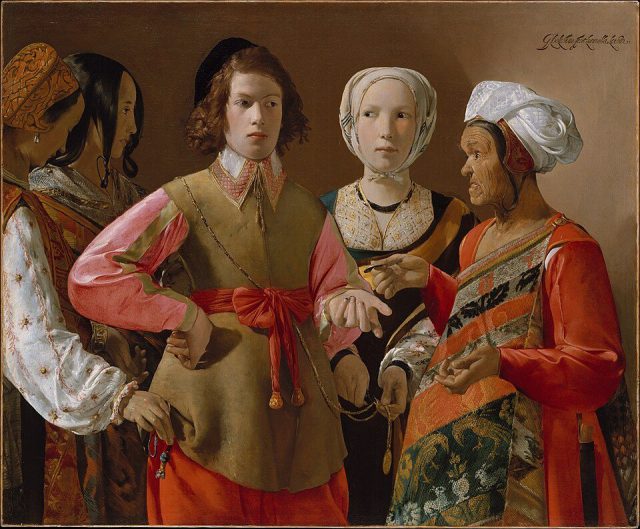
At first glance, The Fortune Teller appears to be a simple genre painting—a snapshot of life from 17th-century France. The canvas, measuring approximately 101 by 123 centimeters, draws the viewer into a seemingly ordinary interaction. A finely dressed young man, clad in vibrant clothing that suggests wealth and inexperience, stands entranced by an older woman reading his palm. The composition is tightly packed, emphasizing physical closeness and psychological tension.
The characters surrounding the young man are not what they seem. Flanking him are three women, each elaborately dressed and each complicit in a carefully orchestrated theft. One woman subtly cuts the purse from his belt, another deftly pulls it away, while the third looks out at the viewer as if to silently implicate us in the scene. The palm-reading is merely a ruse, a distraction that allows the real crime to unfold unnoticed by the victim.
Costuming plays a crucial role in the painting’s narrative. The young man’s outfit, complete with a plumed hat and lavish fabric, indicates his social standing and perhaps his naiveté. In contrast, the women’s richly colored but somewhat gaudy dresses hint at their profession and intentions. The older fortune teller wears a headscarf and simple robe, grounding her as both a figure of mystery and deception.
The arrangement of the figures and the deliberate use of light focus attention where it matters most: on the sleight of hand being performed. There is no extraneous background, no landscape or architectural detail to dilute the viewer’s gaze. Everything is immediate and human, reinforcing the moral gravity of what might otherwise be dismissed as a trivial street con.
Symbolism and Suspicion: What’s Really Happening?
While The Fortune Teller depicts a literal theft, its deeper message lies in the realm of spiritual and moral caution. The fortune teller serves as more than just a character; she is a symbol of false prophecy, a reminder of the dangers of trusting appearances over substance. Her calm demeanor masks her complicity in the theft, reflecting a warning common in Christian teachings: be wary of those who flatter and promise hidden knowledge.
The theft happening behind the young man’s back is not just about money—it represents the loss of innocence, wisdom, and discernment. He is not merely a fool; he is a cautionary figure for anyone tempted to trust strangers with their future. The deceptive smiles of the surrounding women, particularly the one who looks out at the viewer, suggest complicity not only among the thieves but potentially within society at large. This is a warning about the thin veneer of civility and the ever-present potential for moral decay.
De la Tour’s subtle use of symbolism reinforces the deeper layers of the narrative. The darkness surrounding the figures represents ignorance and danger. The fortune teller’s hand gesture mimics traditional benedictions seen in religious art, perhaps mocking the role of spiritual advisor. The viewer is left to ponder whether the man deserves his fate or whether he is simply an unlucky victim. Either way, the message is clear: spiritual blindness invites danger.
Symbolic Elements in “The Fortune Teller”
- The contrast of light and shadow
- The concealed theft
- The youthful naiveté of the subject
- The richly adorned but morally bankrupt women
- The ambiguous expression of the fortune teller
The painting’s enduring power lies in its quiet moralism. Without a single word or gesture of judgment, it reveals the folly of trusting appearances, especially in a world where vice can dress itself as virtue. As with many of de la Tour’s works, the lesson is not shouted—it is whispered, waiting for a discerning soul to hear it.
The Influence of Caravaggio Without the Chaos
De la Tour’s work is frequently compared to that of Michelangelo Merisi da Caravaggio (1571–1610), and with good reason. Both artists made extensive use of tenebrism, the dramatic contrast of light and dark to heighten emotion and focus attention. However, where Caravaggio’s paintings often burst with tension and violence, de la Tour’s compositions are controlled, meditative, and marked by a profound stillness.
Caravaggio, active mainly in Italy, brought a raw physicality and rebellious energy to his religious and secular subjects. He painted with unflinching realism and was known as much for his turbulent personal life as for his art. By contrast, de la Tour’s temperament and technique reflect a more reflective spirit. His figures are often serene, even when engaged in acts of sin or contemplation. The chaos of life is present, but it is subdued and internalized.
In The Fortune Teller, this distinction becomes particularly evident. A similar scene painted by Caravaggio, The Cardsharps (c. 1594), is more animated and theatrical, with visible action and reaction between figures. De la Tour’s version, by contrast, feels frozen in time. The figures are still, their movements deliberate, and their emotions buried beneath a calm exterior. This gives de la Tour’s painting a moral weight that transcends mere drama.
Moreover, de la Tour’s focus on moral allegory through genre scenes demonstrates a deeper alignment with traditional Christian values. His works consistently offer instruction without spectacle, favoring quiet reflection over sensationalism. This makes his interpretation of Baroque realism more introspective and ultimately more spiritually grounded than that of his more famous Italian counterpart.
Baroque Moralism: A Glimpse into 17th-Century Values
To fully understand The Fortune Teller, one must see it through the moral and religious lens of 17th-century France. This was the age of the Counter-Reformation—a vigorous reaffirmation of Catholic doctrine in the face of Protestant challenges. Art was expected to serve not just aesthetic purposes but moral ones as well. Though not overtly religious, The Fortune Teller aligns with the era’s moralistic goals by portraying vice in a way that encourages reflection and correction.
During this time, genre scenes depicting everyday life were increasingly popular, yet they were rarely just about daily routines. They carried lessons, often targeting vanity, greed, lust, or sloth. De la Tour, raised in this environment and working under Catholic patronage, used his technical precision to illustrate these themes with quiet authority. His paintings were sermons without pulpits—visual reminders of the need for virtue in a corrupt world.
The painting criticizes both the deceivers and the deceived. The young man, led by his vanity and curiosity, falls prey to flatterers. The fortune teller and her accomplices are figures of vice, preying on the morally weak. Yet unlike modern art that often revels in ambiguity or celebrates the transgressive, de la Tour’s painting offers a clear message: sin might be subtle, but its consequences are real. This mirrors traditional Christian ethics that emphasize personal responsibility and vigilance.
In a time when much of Europe was being torn apart by war, religious conflict, and political uncertainty, de la Tour’s works offered stability—a visual appeal to reason, order, and spiritual truth. He did not need to depict angels or saints to deliver a sacred message. Through the clothing of common folk and the quiet danger of human folly, he reminded his viewers of the timeless values that ground civilization: truth, prudence, humility, and discernment.
From Obscurity to Louvre Fame: Rediscovering the Painting
Despite its present home in the Louvre, The Fortune Teller spent centuries forgotten, misattributed, or simply dismissed. After de la Tour’s death in 1652, interest in his work waned as tastes shifted toward more flamboyant French painters like Charles Le Brun. By the 18th century, much of de la Tour’s work was either lost, unsigned, or wrongly credited to more prominent names, including Caravaggio and various Dutch genre painters.
It wasn’t until the early 20th century that art historians, including Hermann Voss and Charles Sterling, began to systematically reassemble de la Tour’s legacy. The Fortune Teller, in particular, was once believed to be the work of Caravaggio due to its dramatic use of light and the realism of its figures. It was only after thorough stylistic and archival research—comparing known signed works by de la Tour with this painting—that scholars confirmed its rightful attribution in the 1950s.
Today, The Fortune Teller is housed in the Musée du Louvre in Paris, where it draws considerable attention as one of de la Tour’s few known genre scenes. Unlike his candlelit religious compositions, this work shows daylight and interaction between several figures, offering a unique insight into the broader range of his talents. The Louvre acquired it in 1960, further legitimizing de la Tour’s return to the canon of great French painters.
Reasons “The Fortune Teller” Was Misattributed
- Similar chiaroscuro technique used by Caravaggio
- Depiction of ordinary people in a dramatic moral scene
- Lack of signature or clear provenance
- Realistic style common among multiple schools
- Rediscovered during a broader reevaluation of Baroque art
The painting’s journey from obscurity to masterpiece underscores the dangers of overlooking tradition in favor of passing fashion. Just as the young man in the painting failed to see what was right before him, the art world nearly missed one of the most profound voices of the French Baroque. Its rediscovery serves as a lesson in humility and the need for cultural memory grounded in truth rather than novelty.
Visual Techniques: Stillness, Suspense, and Storytelling
One of the most striking aspects of The Fortune Teller is its use of stillness to generate tension. In a time when many Baroque artists emphasized motion and emotional outbursts, de la Tour’s figures seem almost frozen, as if caught mid-thought rather than mid-action. This deliberate calm heightens the sense of suspense, allowing the viewer to feel the danger before it erupts into full awareness.
De la Tour’s palette is limited but deliberate. Warm earth tones dominate the canvas, lending a quiet dignity to even the most questionable characters. There is no bright red to scream danger, no divine light to sanctify the scene. Instead, every color and shade is used to support the moral ambiguity and subtle unfolding of deceit. This muted color scheme is characteristic of de la Tour’s larger body of work, most of which communicates through silence and suggestion rather than spectacle.
The artist’s tight composition forces intimacy between the viewer and the scene. The closeness of the figures, their interlocking gestures, and the direct gaze of the woman on the right all serve to pull us in. There is no room for escape, no wide-open background to distract us. The painting demands that we see, and in seeing, that we judge—not just the characters, but our own susceptibility to appearances.
It’s worth noting that even the lighting is suggestive. Though not as dramatically candlelit as de la Tour’s religious works like St. Joseph the Carpenter (c. 1642), there is still a strong directional light that highlights key details—the face of the young man, the hands of the thieves, and the knowing look of the onlooker. These are the narrative beacons that guide us to the truth concealed in this moment of deception.
Interpretations Over Time: A Painting That Provokes
Interpretation of The Fortune Teller has varied widely over time, but one thread remains consistent: its moral clarity. Traditionalist scholars see it as a cautionary tale about spiritual blindness and the perils of vanity. The young man represents the soul seduced by the world’s distractions, while the fortune teller and her cohorts stand in for sin cloaked in charm. This reading aligns closely with the religious worldview of de la Tour’s era.
Some modern commentators have proposed alternative interpretations, seeing the work through lenses such as feminism or class conflict. However, these readings often impose 20th- and 21st-century concerns onto a painting clearly created within a framework of Christian morality and timeless values. De la Tour was not critiquing economic inequality or gender roles—he was pointing out moral failure, both individual and societal.
There are also psychological readings that see the painting as an exploration of human perception and awareness. From this angle, the painting becomes a meditation on what we choose to see and what we ignore. The direct gaze of the female thief toward the viewer invites introspection: are we merely observers, or are we complicit in a culture that tolerates or even rewards deception?
Ultimately, The Fortune Teller resists easy categorization because it engages eternal themes: trust, truth, vanity, and moral decay. These are not matters tied to a particular century or ideology but are part of the permanent human condition. That is what gives de la Tour’s painting its enduring power. Its message is as relevant today as it was nearly 400 years ago.
Conclusion: A Warning Hidden in Beauty
The Fortune Teller is more than an art historical curiosity—it is a mirror held up to the human soul. Georges de la Tour, in his quiet brilliance, created a work that speaks not just to the eye, but to the conscience. The painting’s serene surface conceals a spiritual earthquake: the corruption of innocence, the fragility of trust, and the ease with which we are deceived when we seek comfort over truth.
This painting reminds us that danger does not always come with warning signs. Sometimes it arrives in rich fabrics, gentle voices, and pleasant smiles. The moral lesson embedded in The Fortune Teller is especially urgent in times when cultural discernment is low and appearances are prized above character. De la Tour compels us to question what lies beneath the surface, to measure actions rather than words.
In a world where moral relativism increasingly clouds judgment, The Fortune Teller stands as a stark call to moral clarity. It reminds us of the importance of vigilance—not paranoia, but prudence; not fear, but wisdom. These are values that built civilizations and held them together in times of trial.
For anyone who still believes that art should uplift the spirit, sharpen the mind, and reinforce eternal truths, The Fortune Teller is a masterclass. It challenges us not just to look, but to see—to discern the good from the flattering, the true from the false, and the eternal from the fashionable. And in that, Georges de la Tour remains as vital now as he was in 1630.
Key Takeaways
- The Fortune Teller by Georges de la Tour was painted around 1630 and presents a moral allegory through a genre scene.
- Georges de la Tour was a deeply Catholic French Baroque painter influenced by Caravaggio but known for his calm and meditative style.
- The painting critiques vanity and deception using subtle symbolism and tightly composed storytelling.
- Misattributed to Caravaggio for decades, it was correctly identified as de la Tour’s work in the mid-20th century.
- Its message remains relevant today, offering a timeless lesson about trust, vigilance, and moral clarity.
FAQs
- Where is The Fortune Teller currently located?
It is housed in the Louvre Museum in Paris, France. - When was Georges de la Tour active as a painter?
He was active mainly from the 1610s until his death in 1652. - Why was the painting misattributed to Caravaggio?
Due to stylistic similarities such as tenebrism and realistic genre subjects. - Is there religious symbolism in The Fortune Teller?
Yes, though subtle, the painting carries Christian moral themes about deception and spiritual blindness. - What makes this painting significant in art history?
It blends masterful technique with timeless moral insight, offering a rare genre scene from de la Tour’s body of work.