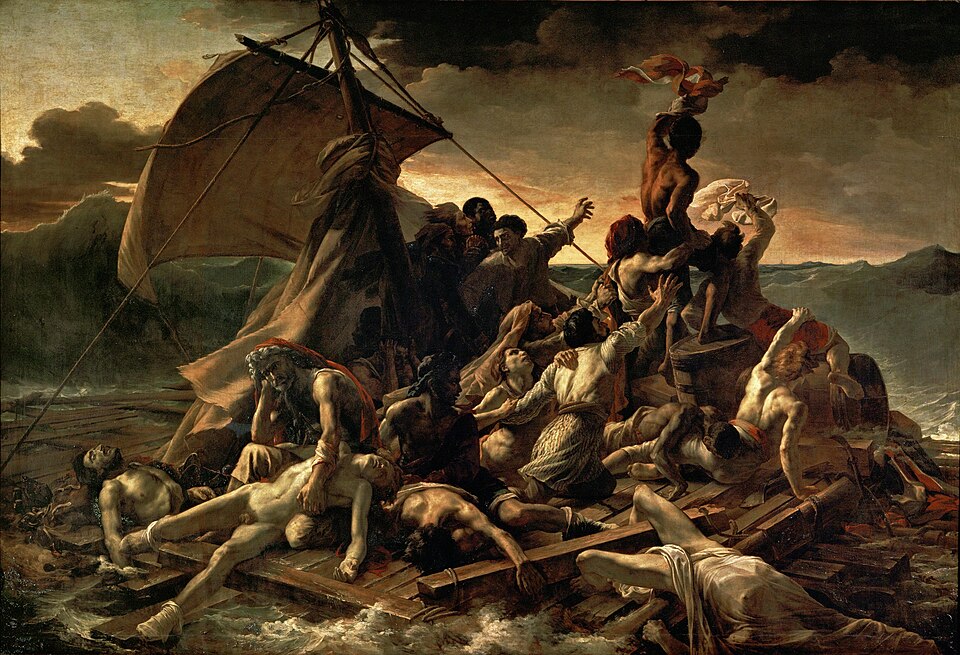
In the halls of the Louvre, among the splendor of France’s artistic legacy, one painting looms with emotional gravity unmatched by any gilded portrait or biblical scene. Théodore Géricault’s The Raft of the Medusa is not just a depiction of tragedy—it is tragedy itself, suspended in paint. Completed in 1819, the monumental canvas captures the final moments of desperation for a group of shipwreck survivors abandoned by their own government. For many viewers in post-Napoleonic France, the painting was as much a mirror as a monument.
Théodore Géricault, a young and ambitious painter, created the work not as an allegory or myth but as a direct confrontation with a recent and scandalous maritime disaster. While the canvas overflows with human agony and hope, it also conveys a daring message of political criticism. Painted just three years after the wreck of the French frigate Méduse, Géricault’s masterpiece bypassed idealism and turned toward realism and raw human emotion.
What gives this painting its power is not just its size—though it spans over 23 feet across and nearly 17 feet high—but its honesty. The viewer is drawn in not to witness a glorified death but to share in the brutal experience of those left to die by an incompetent regime. Géricault combined anatomical accuracy, eyewitness testimony, and his own sense of dramatic composition to make something both disturbing and unforgettable.
While the world has changed dramatically since the early 1800s, the themes of The Raft of the Medusa remain hauntingly relevant: abandonment, survival, and the consequences of political failure. The story behind the work, the man who painted it, and the aftermath of its unveiling form one of the most compelling chapters in the history of art.
Why Géricault Still Matters
Théodore Géricault’s bold realism, moral conviction, and refusal to conform marked him as one of the defining voices of French Romanticism. In a time when many artists still painted mythological scenes and sanitized historical epics, Géricault turned his gaze toward the harsh realities of modern life. His work remains a testament to art’s potential to challenge, not just reflect, society.
Overview of the Painting’s Historical Power
The Raft of the Medusa did more than capture a moment; it sparked national outrage and artistic revolution. In rejecting academic constraints, Géricault created a work that fused moral anger with technical brilliance. Its enduring place in the Louvre attests to its unmatched impact.
The Real Story Behind the Raft
On July 2, 1816, the French frigate Méduse ran aground off the coast of present-day Mauritania in West Africa. Bound for Senegal, the ship was part of a convoy transporting French officials to re-establish colonial control following the fall of Napoleon. At the helm was Captain Hugues Duroy de Chaumareys, a Royalist who had not sailed in over 20 years—appointed not for merit, but loyalty to the restored Bourbon monarchy. His poor navigational skills led the ship directly into a sandbank in the Banc d’Arguin.
Of the 400 people aboard the Méduse, only about 250 managed to abandon ship in a disorganized evacuation. A raft was hastily constructed for 147 men and one woman who could not fit into the overcrowded lifeboats. The raft, originally meant to be towed, was soon cut loose—either intentionally or through incompetence—by the lifeboat occupants. Adrift with little food or water, the survivors suffered dehydration, starvation, insanity, and violence. After 13 horrific days, only 15 remained alive when they were rescued on July 17 by the ship Argus.
The French government tried to bury the incident, but two survivors—Jean-Baptiste Savigny, a surgeon, and Alexandre Corréard, an engineer—published an account in 1817 titled Narrative of a Voyage to Senegal. Their testimony exposed not only the horror of the shipwreck but the corruption and cronyism that led to it. Public outcry was swift, and the scandal embarrassed the Bourbon government.
Géricault was captivated by the story and saw in it the seeds of a powerful and damning visual narrative. He wasn’t interested in embellishment or patriotic gloss; instead, he sought to depict the brutal truth of what had occurred—a truth France’s ruling elite would have preferred to forget.
The Méduse Shipwreck Incident
The Méduse left Rochefort, France on June 17, 1816, headed for Saint-Louis, Senegal. Captain Chaumareys ignored navigational warnings and veered too close to the African coast. By June 28, the ship had struck ground. Panic and disorder ruled as the officers tried to organize evacuation, but the lack of lifeboats forced over 150 people onto an unseaworthy raft.
Survivors’ Testimonies and Public Reaction
Savigny and Corréard’s published memoir described cannibalism, mutiny, and desperate suffering on the raft. Their testimony sparked outrage in the French press, particularly among liberals and those critical of Bourbon mismanagement. The scandal helped fuel the growing Romantic movement, which favored emotion, truth, and individual experience over hollow tradition.
- Key Facts About the Wreck (Bullet List):
- Date of grounding: June 28, 1816
- Total passengers: Approximately 400
- Raft survivors: Only 15 out of 147
- Captain: Hugues Duroy de Chaumareys
- Cause: Incompetence and political favoritism under Bourbon rule
Théodore Géricault — Artist and Outsider
Jean-Louis André Théodore Géricault was born on September 26, 1791, in Rouen, France. Raised in a prosperous bourgeois family, he showed early artistic talent and moved to Paris in his teens to study under the classical painter Pierre-Narcisse Guérin. At first, he focused on military subjects and equestrian scenes, blending dynamic energy with academic composition. But he soon chafed at the constraints of the Neoclassical tradition.
Géricault’s early career was marked by boldness and defiance. In 1812, he debuted his Officer of the Imperial Horse Guards Charging at the Salon, earning praise for its vitality and technical strength. Yet despite his success, he remained dissatisfied with formulaic academic painting. After a stint in Italy from 1816 to 1817, he began to embrace themes of suffering, struggle, and human fragility—signaling his turn toward Romanticism.
His personal life was equally turbulent. Géricault had a passionate affair with his uncle’s young wife, which resulted in the birth of a child. The scandal was kept quiet, but it weighed heavily on him and contributed to the brooding intensity that marks his later works. He also suffered from frequent bouts of depression and physical injury, notably a fall from a horse that left him with chronic pain.
Despite his talent, Géricault always felt like an outsider. He distrusted the Academy, spurned easy success, and sought instead to confront viewers with uncomfortable truths. In this sense, The Raft of the Medusa was the logical culmination of his ideals—an unflinching look at suffering, painted not to please but to provoke.
Early Life and Academic Training
Géricault trained at the École des Beaux-Arts and studied under Guérin, who emphasized classical technique. But he was more interested in Rubens and Michelangelo, drawn to their muscular forms and psychological intensity. This foundation gave him the skills to challenge tradition with confidence.
Rebellion Against the Academy and Artistic Norms
Unlike many of his peers, Géricault refused to tailor his work to institutional tastes. He admired English painters like George Stubbs and John Constable, whose works emphasized realism over rhetoric. His rebellious nature set the tone for later French Romantics who followed in his footsteps.
Composition and Technique — Building the Raft
Géricault’s method of preparation for The Raft of the Medusa was nothing short of obsessive. He constructed a full-scale model of the raft in his studio and used it as a staging ground for compositional studies. He collected the testimonies of survivors, visited hospitals and morgues to study corpses, and even brought severed limbs into his studio to ensure anatomical accuracy.
The final composition is a sweeping pyramid of despair and hope. In the lower half of the canvas, corpses lie strewn across the raft, lifeless and pale. Above them, struggling men try to rise, culminating in the figure of a muscular African man waving a piece of cloth to signal a passing ship. This visual ascent—from death to hope—gives the work its dramatic tension and moral resonance.
Géricault paid particular attention to light and movement. He used a restricted palette of browns, grays, and deep reds, adding only hints of blue in the distant sea and sky. The lighting is chiaroscuro—harsh contrasts between light and dark that heighten the emotional impact. The figures are muscular, distorted, contorted, yet rendered with scientific precision.
This was not mere imagination—it was reconstruction. Géricault approached the subject with the seriousness of a historian and the intensity of a dramatist. Every hand, foot, and face on the raft tells a story, and all were painted to reflect both physical reality and moral truth.
Use of Light, Color, and Movement
The palette is dark and somber, reinforcing the gravity of the subject. Movement flows diagonally upward, drawing the eye from the dead to the living, from the past to possible rescue. Géricault’s brushwork is controlled yet expressive, balancing emotion with structure.
Realism and Anatomical Study in the Studio
Géricault studied cadavers at the morgue of the Hôpital Beaujon and conducted dissections with medical professionals. He also posed models on his raft replica, using them to recreate moments of despair and struggle with precision. His goal was to strip away illusion and paint only the truth.
Symbolism and Political Undertones
While The Raft of the Medusa is rooted in historical fact, it operates powerfully as a political statement. Géricault may not have issued public manifestos, but his choices in subject, composition, and emphasis left no doubt about his condemnation of Bourbon incompetence. The painting exposed not only a maritime disaster but the moral bankruptcy of a restored monarchy more concerned with appearances than accountability.
At the heart of the painting is the raft itself—a drifting, broken symbol of France in 1816. The survivors are not triumphant heroes; they are emaciated and broken, struggling to survive after being abandoned by those in command. The canvas offers no glorified nationalistic message. Instead, it delivers a powerful visual rebuke to those who allowed such a tragedy to occur. The painting became, in essence, a form of protest.
One of the most striking figures is the black man at the apex of the pyramid, waving a tattered cloth in desperate hope. Far from being a background character, Géricault placed him in the most powerful position in the composition. Some historians believe this placement was deliberate—an indictment of colonial cruelty and an acknowledgment of dignity and heroism among the marginalized. In an age when racial hierarchies were unquestioned in official discourse, Géricault’s decision to center a black man was bold and morally charged.
The message was unmistakable to viewers in 1819. Géricault had broken the boundaries of acceptable subject matter, not with abstract philosophy but through concrete, recent, and shameful reality. In doing so, he gave Romantic art a new purpose: not to distract or flatter, but to reveal, accuse, and demand truth.
The Fallen Monarchy in Metaphor
The drifting raft represents a leaderless, rudderless France, adrift after the fall of Napoleon and under the questionable leadership of King Louis XVIII. The Bourbon monarchy’s appointment of unqualified loyalists like Captain Chaumareys mirrored the systemic decay Géricault sought to depict. The raft becomes a symbol of national betrayal.
Racism, Heroism, and the Central Black Figure
The choice to feature a black man as the signaler, possibly modeled after a real Senegalese survivor, was revolutionary for its time. Rather than marginalize him, Géricault portrayed this figure as the bearer of hope, muscular and central, undermining prevailing racial attitudes of early 19th-century Europe.
Public Exhibition and Critical Reception
The Raft of the Medusa was unveiled at the Paris Salon of 1819, France’s most prestigious art exhibition. The response was immediate and polarized. Some critics hailed the painting’s daring realism and technical mastery, while others recoiled at its graphic subject matter and unconventional approach. Regardless of opinion, no one could ignore it.
Unlike the biblical or mythological scenes that filled the Salon, Géricault’s canvas confronted the public with a contemporary political scandal. The sheer size of the painting ensured that it couldn’t be overlooked—it dwarfed viewers and confronted them with the raw aftermath of bureaucratic failure. Conservative critics called it inappropriate, vulgar, even unpatriotic. Supporters, especially those sympathetic to reform, hailed it as a necessary national reckoning.
Interestingly, the painting did not win any medals from the Salon jury. But it did succeed in drawing massive crowds, and Géricault’s reputation grew both in France and abroad. The English press, in particular, praised the work when it was later exhibited in London in 1820. It sparked discussions about art’s role in society—was it meant only to please the eye, or could it speak moral truth?
The painting’s popularity led to further editions of Savigny and Corréard’s narrative and helped keep public attention on the scandal. Géricault had achieved what many artists of his time only dreamed of: he had made a work that not only endured but mattered.
The 1819 Paris Salon Debut
Held in the Louvre’s Salon Carré, the exhibition placed Géricault’s painting among the finest works of the day. Its controversial content attracted both outrage and acclaim. Some viewers were moved to tears; others demanded it be removed. It was the most talked-about work in the entire show.
Press Reaction and Viewer Response
Critics such as Étienne-Jean Delécluze criticized the lack of decorum, while others praised the courage and humanity of the scene. British critics, less burdened by royalist allegiance, were generally more favorable. The public, especially students and younger artists, flocked to see it.
Influence on Romanticism and Beyond
Géricault’s Raft of the Medusa became a landmark in the development of French Romanticism, a movement that emphasized emotion, individual struggle, and the sublime over classical restraint. The painting’s emotional intensity, moral urgency, and dynamic form helped set the tone for a generation of artists. Chief among those influenced was Eugène Delacroix, who served as a model for one of the raft’s figures and went on to become the foremost French Romantic painter.
Romanticism was not merely a style—it was a revolt against Enlightenment rationalism and the sterile conventions of Neoclassicism. Géricault’s masterpiece exemplified that revolt. By embracing the tragic, the contemporary, and the emotionally raw, he gave Romanticism its full visual vocabulary. The result was a new kind of art—personal, political, and deeply moving.
Writers and poets also responded to the painting. Victor Hugo, in particular, echoed many of its themes in works like Les Misérables, exploring the plight of the outcast and the moral failure of institutions. The painting’s reach extended into literature, theater, and even 19th-century politics, becoming a kind of visual shorthand for state betrayal and individual suffering.
Even outside France, the work resonated. English artists admired its truthfulness, and American painters later adopted its emotional storytelling in their own explorations of history and moral crisis. Géricault had planted the seed for a century of art that would no longer hide from suffering but illuminate it.
Impact on Delacroix and Contemporaries
Delacroix was deeply inspired by Géricault’s courage and commitment to realism. His own Liberty Leading the People (1830) carries the same revolutionary fire and emotional urgency. Others, including Ary Scheffer and Honoré Daumier, likewise embraced socially engaged themes.
Legacy in 19th-Century French Romanticism
Géricault’s work became a cornerstone of Romantic art education. Teachers used the painting to show how composition, drama, and ethics could merge. The raw emotional truth of the raft became a model for those disillusioned with academic constraints.
A Closer Look — Key Figures in the Painting
Every figure on Géricault’s raft tells a story. Rather than creating generic types, he portrayed individuals at specific stages of despair or hope. Each body, gesture, and facial expression contributes to the narrative arc, from death and despair to the distant glimmer of salvation. Géricault arranged the composition with a painter’s eye and a dramatist’s instinct, building a human pyramid of agony and aspiration.
The lower half of the canvas is littered with corpses, limbs twisted and skin pale with death. Some of the dead are being mourned, while others are simply discarded. Just above them, a cluster of men tries to rise, lifting a fainting body or turning their eyes toward the horizon. At the very top, a man stands upright and waves a cloth to a ship barely visible on the horizon—a moment of fragile hope in a sea of suffering.
Among the most powerful details is the faint light in the far distance, where the ship Argus has appeared. Yet, Géricault chose not to show it clearly. The raft’s occupants are unsure if they have truly been seen. That ambiguity heightens the tension—rescue is possible, but not guaranteed. This uncertainty makes the painting more powerful than a simple salvation narrative.
It’s also important to note how Géricault used racial imagery in a way that was deeply unusual for the time. The central black figure—based on a model named Joseph, a Haitian man living in Paris—is strong, dignified, and pivotal to the composition. He does not serve the others; he leads. In a period dominated by colonialism and racial prejudice, this was an extraordinary artistic choice.
The Hope-Bearer and the Dying
The man waving the cloth is often interpreted as the final beacon of faith, signaling a passing ship as his fellow survivors collapse below him. This figure anchors the entire composition, directing the viewer’s eye and emphasizing the fragile line between life and death. The corpses below, some already decomposing, are reminders of what rescue too late looks like.
Racial Themes and Representation
Géricault’s decision to make a black man the symbol of hope subverted common visual tropes of the time. Instead of being depicted as a servant or victim, this man is the moral and visual climax of the scene. His prominent role likely reflects Géricault’s abolitionist leanings and interest in human dignity over racial hierarchy.
Current Location and Preservation
Today, The Raft of the Medusa is housed in the Louvre Museum in Paris, where it hangs in the Denon Wing alongside other giants of French Romanticism. It remains one of the most visited and discussed paintings in the entire museum, drawing attention not only for its scale but for the story it tells. The Louvre acquired the painting shortly after Géricault’s death in 1824, recognizing its monumental importance.
Over the years, the canvas has undergone several restorations to protect it from the ravages of time. Given its massive size—491 cm × 716 cm (approximately 16 feet by 23 feet)—and the detail packed into every inch, preservation is no small task. Art conservators have carefully maintained the color balance, repaired canvas damage, and cleaned the surface to preserve Géricault’s original intentions.
Its placement in the museum is intentional. Visitors encounter the painting after passing through a corridor of Neoclassical and Renaissance works, making The Raft of the Medusa a striking contrast. The shock of its realism, its dark palette, and its human anguish jolts the viewer into a different emotional register. It continues to educate, provoke, and inspire.
Few paintings have maintained such power for over 200 years. Whether viewed by students, scholars, tourists, or artists, the impact is almost universal. Géricault’s masterpiece stands as a warning and a memorial—a grim testament to suffering and an indictment of cowardice dressed as leadership.
Display at the Louvre Museum
Displayed in Room 700 of the Louvre’s Denon Wing, The Raft of the Medusa is often surrounded by school groups, art historians, and curious travelers. The room is dimly lit to preserve the painting but carefully arranged to ensure the emotional force is not lost. It commands the entire wall, impossible to overlook.
Restoration and Conservation Efforts
Major restorations took place in the 20th century, including surface cleanings and revarnishing in 1954 and 1980. Conservators used historical documentation to ensure fidelity to Géricault’s original vision. Preventative conservation now includes controlled humidity and light levels, as well as regular inspections.
- Key Facts About the Painting (Bullet List):
- Title: The Raft of the Medusa
- Artist: Théodore Géricault
- Year: Completed in 1819
- Medium: Oil on canvas
- Current Location: Louvre Museum, Denon Wing, Room 700
Conclusion — The Raft as Enduring Symbol
The Raft of the Medusa is not merely a painting; it is a national reckoning rendered in oil. Théodore Géricault created it not for praise but for posterity—to force France to confront a tragedy it wanted to forget. Two centuries later, it continues to haunt viewers with its honesty, scale, and moral gravity.
The themes it addresses are timeless: What happens when leadership fails? What is the value of a single human life in the face of institutional indifference? These questions, painted into every muscle and shadow of Géricault’s raft, are just as relevant now as they were in 1819. The painting speaks not only to the France of Louis XVIII, but to any society that turns its back on responsibility and justice.
Romanticism has produced many masterpieces, but none more viscerally human than this one. Géricault took the Romantic ideal of expressing deep feeling and fused it with rigorous research and moral purpose. He didn’t just paint emotion—he documented suffering with forensic detail and compositional brilliance.
In the end, The Raft of the Medusa stands as both warning and witness. It tells the story of a group of men left to die—but also of an artist who refused to let their suffering be forgotten. In doing so, Géricault ensured that his painting would live on, a permanent indictment of cowardice and a tribute to courage amid catastrophe.
Romanticism’s Cry of Conscience
This painting encapsulates the soul of Romanticism—emotional honesty, political rebellion, and human dignity. Géricault moved Romantic art beyond literature and poetry, placing its deepest concerns on canvas for all to see.
What Géricault Teaches the Modern Viewer
The lessons are clear: leadership matters, truth must be told, and art can be a moral force. Géricault reminds us that beauty is not always pleasant—and that sometimes, it must confront us with what we would rather not see.
Key Takeaways
- The Raft of the Medusa is based on a real 1816 French naval disaster caused by political favoritism and incompetence.
- Théodore Géricault conducted extensive research, including morgue visits and survivor interviews, to create the painting.
- The composition uses dramatic lighting and a pyramid structure to move the viewer’s eye from death to hope.
- The painting was both praised and condemned at its 1819 debut, igniting debates about art, politics, and truth.
- Today it remains one of the most important works of Romanticism, housed permanently in the Louvre Museum.
FAQs
- What event inspired The Raft of the Medusa?
It was inspired by the 1816 shipwreck of the French frigate Méduse off the coast of West Africa. - Why did Géricault choose this subject?
He saw it as a powerful condemnation of the corruption and incompetence in the Bourbon monarchy. - Who is the black man at the top of the raft?
He was modeled after a Haitian man named Joseph and represents hope, strength, and moral dignity. - Where is the painting now?
It is located in the Louvre Museum in Paris, specifically in the Denon Wing. - How big is the painting?
It measures approximately 16 feet high and 23 feet wide (491 cm × 716 cm).