Luca Signorelli, born around 1445 in the Tuscan town of Cortona, was one of the most inventive and skilled painters of the Italian Renaissance. He trained under the great Piero della Francesca, a master of perspective and geometry, whose influence would leave a lasting mark on Signorelli’s structured compositions and spatial awareness. Signorelli’s work spans the late 15th and early 16th centuries, a transformative period in Italian art, when artists began emphasizing naturalism, anatomy, and human psychology. While he is best remembered for his large-scale fresco cycles, particularly those in the San Brizio Chapel in Orvieto Cathedral, his contributions to portraiture are lesser-known but equally significant.
In the world of Renaissance art, Signorelli carved a unique niche with his focus on the muscular human form. He gained particular fame for his depictions of the nude male body, rendered with anatomical precision that foreshadowed Michelangelo’s later achievements. Giorgio Vasari, the biographer of Renaissance artists, praised Signorelli for his mastery of foreshortening and lifelike figures. This commitment to physical realism was not limited to religious themes; it also permeated his rare but powerful portraits, which offered psychological depth in addition to physical likeness.
Signorelli worked across central Italy, with commissions in cities like Florence, Arezzo, Loreto, and Perugia. His ability to adapt to the regional styles of these artistic centers while maintaining his distinctive visual language made him a sought-after figure. Around 1499, he began the frescoes in Orvieto, a monumental task that solidified his reputation as a master of narrative and drama. Despite his fame during his lifetime, Signorelli’s recognition waned in later centuries, especially compared to contemporaries like Botticelli and Raphael. However, recent scholarship has revived interest in his work, including lesser-known pieces like Portrait of a Man.
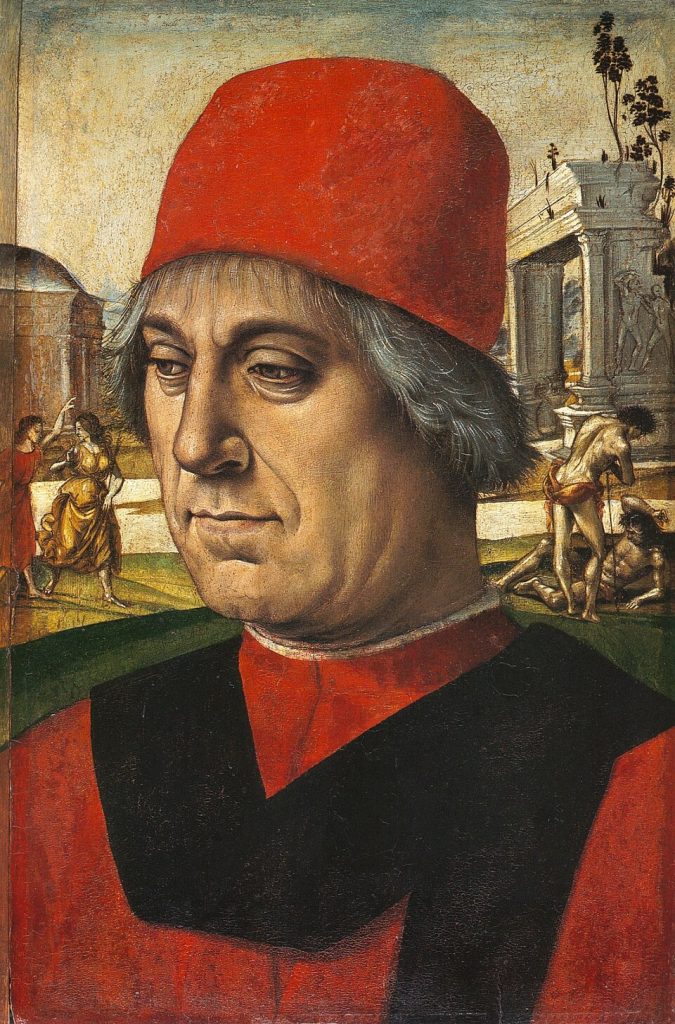
Among Signorelli’s known oeuvre, only a few independent portraits survive, and Portrait of a Man is one of the most enigmatic. It is widely accepted as an authentic work by Signorelli, dating from the 1490s—a period when he was at the height of his creative powers. The painting’s restrained emotion and introspective quality reflect the Renaissance shift toward individualized identity in art. Though it lacks the grandeur of his larger commissions, the portrait reveals Signorelli’s talent for conveying character through subtle details.
Other Major Works by Luca Signorelli:
- The Damned Cast into Hell, Orvieto Cathedral fresco cycle (c. 1499–1504)
- The Resurrection of the Flesh, Orvieto Cathedral
- Madonna and Child with Saints, Galleria degli Uffizi, Florence
- Martyrdom of Saint Sebastian, Pinacoteca Comunale, Città di Castello
- Flagellation of Christ, Civic Museum of Sansepolcro
A Mysterious Identity: Who Is the Man in the Portrait?
The identity of the sitter in Portrait of a Man has long puzzled art historians. The subject is unknown—his name lost to history—and unlike many commissioned portraits of the time, there are no clear symbols or inscriptions to offer clues. This anonymity is not unusual in 15th-century Italian portraiture, particularly when the painting was meant for private reflection rather than public display. However, the intensity of the man’s gaze, combined with the high quality of the painting, suggests he was a figure of some importance, possibly a Florentine nobleman, merchant, or patron.
Some scholars have suggested the man could be a fellow artist or an associate of Signorelli, given the intimacy and lack of idealization in his features. There are no known preparatory drawings or documents that connect the painting to a particular individual, which adds to its aura of mystery. The sitter’s dark clothing, modest haircut, and direct gaze imply a sober character, perhaps someone involved in civic life or academia rather than courtly affairs. The absence of heraldic symbols or luxurious accessories further supports the idea that the sitter valued intellect and character over social display.
This ambiguity fits into a broader trend in Renaissance portraiture, where likenesses began to focus more on inner psychology than external status. During the second half of the 15th century, artists increasingly sought to capture the essence of a person rather than merely record their wealth or rank. The result was a new kind of portrait: one that invited viewers into the private world of the sitter. Signorelli’s Portrait of a Man fits this mold, encouraging viewers to engage with the subject’s introspective expression rather than his social identity.
There is also the possibility that this portrait was part of a pair—a diptych featuring the sitter and perhaps a wife or a patron saint. While no companion piece has been identified, many Renaissance portraits were designed in this format. Such an arrangement would have made the painting part of a devotional or commemorative space, possibly in the sitter’s home. Until further documentation emerges, the man’s identity remains speculative, yet the quality of the painting ensures his anonymous presence endures through the centuries.
Visual Analysis: Composition, Color, and Expression
The painting presents a half-length portrait of a man against a neutral, warm-toned background. He turns slightly to his right, gazing calmly yet intensely toward the viewer. His face is marked by a strong jaw, high cheekbones, and thoughtful eyes. There’s a subtle furrow in his brow, adding to the sense of inward contemplation. His hair is brown and cut short, framing a face that conveys both determination and restraint.
The clothing is simple—perhaps a black doublet with a high collar—devoid of rich embroidery or ornamentation. This simplicity directs the viewer’s attention to the man’s face, which is rendered with a level of precision and care typical of Signorelli’s mature period. The color palette is subdued, dominated by earthy browns, soft blacks, and warm flesh tones. These hues give the portrait a timeless quality, unburdened by trends or fashion, and emphasize the sitter’s stoic demeanor.
Light plays a subtle but important role in shaping the face and hands. Signorelli uses gentle chiaroscuro to give volume to the features, creating a three-dimensional effect without over-dramatizing the contrast. The modeling of the cheekbones, nose, and neck demonstrates Signorelli’s anatomical knowledge, gained through years of studying the human form. Compared to the flatter portraits of earlier decades, this painting shows a move toward realism and depth, hallmarks of the High Renaissance.
Stylistically, the work invites comparisons to portraits by contemporaries such as Piero della Francesca and Botticelli. Like Piero, Signorelli creates a sense of quiet monumentality; like Botticelli, he maintains an elegance in the sitter’s bearing. However, Signorelli diverges in his emphasis on psychological engagement. The subject’s gaze is not passive; it meets the viewer squarely, suggesting a dialogue rather than a display. This emotional presence is what elevates the portrait beyond mere likeness.
Date and Medium: Pinpointing the Painting’s Origins
Art historians generally date Portrait of a Man to the early 1490s, around 1492 to 1495, a period when Signorelli was active in central Italy before beginning the Orvieto frescoes. This timing is based on stylistic analysis, particularly the restrained color palette and the naturalistic modeling of the face, both of which align with Signorelli’s works from the same phase. The portrait shows a maturity in technique and an introspective mood that would later evolve into his more theatrical religious compositions.
The painting is executed in tempera on a wooden panel, a common medium before oil painting became widespread in Italy. Tempera, made by mixing pigments with egg yolk, allowed for crisp lines and luminous tones but required a steady hand and quick execution due to its fast drying time. Signorelli would have used fine brushes to layer thin strokes of color, especially in the rendering of facial contours and hair texture. The result is a smooth, matte finish that preserves the vibrancy of the hues over centuries.
Measuring approximately 48 by 36 centimeters (about 19 by 14 inches), the painting is intimate in scale, suggesting it was meant for personal viewing rather than public exhibition. Its dimensions and lack of narrative content imply a private setting, possibly a study or chapel room. This was a common practice among educated patrons of the period, who commissioned portraits as mementos, heirlooms, or expressions of personal devotion.
Tempera as a medium also reflects a transitional moment in Italian painting. While artists in Venice and northern Europe were already adopting oil paint for its flexibility and richness, central Italian painters like Signorelli continued to work in tempera well into the 1490s. This choice underscores both traditional craftsmanship and a focus on clarity and structure. In Portrait of a Man, the medium contributes to the painting’s quiet dignity and lasting visual impact.
Florentine vs. Umbrian Influence in Signorelli’s Style
Signorelli’s artistic development was shaped by both Florentine and Umbrian traditions, and these dual influences are evident in Portrait of a Man. From Florence, he absorbed the linear precision and intellectual rigor of artists like Filippo Lippi and Andrea del Verrocchio. From Umbria, he inherited a softer approach to light and form, as seen in the works of Perugino and Pinturicchio. The result is a balanced style that combines structure with subtlety—a hallmark of central Italian Renaissance art.
In this portrait, the Florentine influence emerges in the strong outline of the figure and the clear architectural logic of the composition. The sitter is firmly placed within a shallow space, his body grounded and symmetrical. This approach echoes the Florentine emphasis on rational design and human-centered space. Signorelli’s training under Piero della Francesca, who worked extensively in Florence, further reinforced his commitment to geometric order and measured realism.
At the same time, the painting reflects the Umbrian preference for harmony and gentle transitions. The soft shading around the eyes, mouth, and hands tempers the portrait’s structural clarity with a sense of warmth and humanity. There is no harsh contrast, no dramatic flair—only a quiet confidence in the sitter’s presence. This blending of stylistic traits gives the portrait its unique character: neither overly idealized nor bluntly realistic, but strikingly authentic.
Signorelli’s mobility also played a role in shaping his hybrid style. His work in places like Arezzo, Loreto, and Perugia exposed him to various regional preferences and techniques. By the time he painted Portrait of a Man, he had fully integrated these lessons into a mature personal style. The painting thus stands not only as a document of one individual but as a synthesis of Renaissance ideals across central Italy.
Where Is It Now? The Painting’s Journey to the Uffizi
Today, Portrait of a Man is housed in the renowned Uffizi Gallery in Florence, Italy. The Uffizi is one of the world’s most important collections of Renaissance art, and this painting is part of its significant holdings of 15th-century portraiture. While not always among the most prominently displayed works, Signorelli’s portrait has earned renewed scholarly attention in recent decades. Its inclusion in the Uffizi underscores its artistic and historical value, even as its creator remains better known for grand frescoes than for intimate likenesses.
The painting entered the Uffizi’s collection in the 18th century, although the exact date of acquisition remains unclear. Early inventory records list it among a group of works transferred from Medici holdings or acquired through regional donations. It may have been part of a noble family’s private collection before making its way to Florence. Over time, as curatorial practices evolved and attribution techniques improved, the painting was definitively credited to Luca Signorelli based on stylistic comparison and pigment analysis.
Modern conservation has helped preserve the work for future generations. The panel has undergone cleaning and stabilization to address age-related issues like cracking and pigment fading. The portrait now benefits from controlled lighting and climate within the museum, ensuring the vibrancy and structure of the tempera medium remain intact. Recent exhibitions at the Uffizi have occasionally featured the portrait, especially in shows exploring Renaissance portraiture or Signorelli’s broader legacy.
The painting holds a quiet yet significant place among other masterworks in the Uffizi’s portrait gallery. Surrounded by more famous names like Botticelli, Raphael, and Leonardo, Signorelli’s Portrait of a Man offers a more introspective counterpoint. It doesn’t dazzle with gold or mythological allegory—it impresses with psychological nuance and painterly discipline. Visitors who linger often find themselves captivated by the direct gaze and quiet authority of the unknown man from Cortona.
Other Notable Renaissance Portraits in the Uffizi Gallery:
- Portrait of a Young Man by Sandro Botticelli
- Duke of Urbino and Battista Sforza by Piero della Francesca
- Self-Portrait by Raphael
- Portrait of a Man with a Medal by Botticelli
- Portrait of Eleonora of Toledo by Bronzino
Portraiture in the Italian Renaissance: Cultural Significance
Portraits in 15th-century Italy were more than visual records—they were declarations of identity, intellect, and social status. As the Renaissance brought humanism to the forefront, individuals from the nobility, merchant class, and intellectual circles began commissioning portraits to assert their presence in a changing world. The rise of city-states like Florence and Venice, where wealth was increasingly based on commerce and education, created a new demand for personal representation in art.
Portrait of a Man fits into this evolving tradition. Unlike the grand altarpieces or fresco cycles that dominated public religious spaces, portraits were often private objects. They hung in studies, family chapels, or bedchambers, serving as constant reminders of lineage, virtue, or personal ideals. The sitter’s serious demeanor and modest dress reflect values of self-restraint, learning, and inner strength—virtues highly esteemed during the Renaissance, particularly in civic-minded regions like Tuscany.
This cultural shift also influenced the way artists approached their subjects. Instead of flat, symbolic depictions, painters sought to capture mood, thought, and individuality. Artists like Leonardo da Vinci and Antonello da Messina explored the subtleties of expression and the soft gradations of skin and fabric. Signorelli, while grounded in a more linear tradition, shared this interest in realism and psychological depth. His Portrait of a Man doesn’t idealize or flatter—it invites reflection.
In some cases, portraits also served political or marital functions. They might be exchanged before an arranged marriage, used in diplomatic exchanges, or commissioned to commemorate civic achievements. Though we do not know the context behind Portrait of a Man, its form and tone suggest a private purpose, perhaps intended as a personal keepsake or an assertion of social dignity. In every brushstroke, Signorelli reflects the Renaissance belief that each person holds a unique place in the moral and social order.
Signorelli’s Legacy: Why This Work Still Matters
Though he never achieved the posthumous fame of Michelangelo or Raphael, Luca Signorelli left a profound legacy that art historians are increasingly eager to rediscover. His anatomical studies directly influenced Michelangelo, who is believed to have seen Signorelli’s frescoes in Orvieto while planning the Last Judgment in the Sistine Chapel. Signorelli’s fearless treatment of the human body, as well as his ability to fuse classical themes with emotional force, place him among the pivotal artists of the High Renaissance.
In Portrait of a Man, we glimpse a quieter side of this master—a personal, reflective study that contrasts with his apocalyptic visions and theological drama. This painting, though modest in scale, shows his range and subtlety. It proves that Signorelli was not only a dramatist of divine narratives but also a keen observer of human character. Such portraits help complete our understanding of the artist, showing that he could shift from grandeur to intimacy without losing depth.
The portrait also remains important in discussions about regional variation in Renaissance art. While Florentine and Venetian artists often dominate the narrative, Signorelli’s blend of central Italian styles reveals how innovation also thrived in places like Cortona, Orvieto, and Arezzo. His willingness to experiment within established forms gave his work a distinctive flavor—intellectually engaged, technically exacting, and emotionally compelling.
Modern scholarship continues to elevate Signorelli’s status, and works like Portrait of a Man are central to that reevaluation. Digital cataloging, pigment analysis, and X-ray imaging have reinforced the painting’s attribution and provided insights into its creation. As museums and academic institutions broaden their focus, this portrait stands as a prime example of a Renaissance artist expanding the boundaries of what portraiture could be.
Scholarly Debates and Attribution Issues
Like many works from the 15th century, Portrait of a Man has not been immune to questions of attribution. While most experts now accept it as an autograph work by Signorelli, this consensus took time to build. Earlier inventories and catalogues sometimes attributed the painting to less prominent contemporaries or anonymous workshops. The absence of a signature, which was typical for the period, made such confusion more likely, especially before systematic provenance research and technical imaging.
Key to the painting’s current attribution is stylistic comparison with other confirmed works by Signorelli. The portrait shares close similarities in facial structure, brushwork, and palette with figures in his frescoes in Orvieto and Loreto. For example, the sitter’s intense gaze resembles the prophet figures in the San Brizio Chapel, particularly in how the eyes and brow are modeled. In addition, the crisp outlines and smooth shading align with Signorelli’s known techniques during the 1490s.
Technical analysis has also helped clarify authorship. Infrared reflectography and X-ray scans have revealed underdrawings consistent with Signorelli’s hand—firm, confident lines typical of a master painter rather than a workshop assistant. Pigment sampling further supports this, showing a mixture of earth tones and lead-based whites that match materials used in his other panel works. These findings have largely quieted previous doubts, although new evidence could always emerge.
The painting has also sparked debate over the sitter’s status and the context of the commission. Was he a scholar, a patron, or even a self-portrait? While the latter theory lacks strong support, some have speculated that Signorelli may have painted close acquaintances in similar poses. With no written documentation, these interpretations remain speculative but reflect the continued scholarly interest in unlocking the painting’s secrets.
Final Thoughts: The Lasting Enigma of Signorelli’s Man
Portrait of a Man may not be the most famous painting of the Renaissance, but it quietly captures the era’s defining themes: individuality, dignity, and the subtle power of the human face. In a period teeming with gods and saints, this lone figure—anonymous, reflective, restrained—reminds us that every person has a story worth telling. The sitter looks out not as a symbol or a type, but as a real man shaped by his world, his time, and his own thoughts.
For Signorelli, the painting represents an artistic balancing act. He draws from the monumental ideals of classical art while embracing the intimate realism of the modern age. His brushwork is precise but not mechanical; his colors are muted but not dull. This tension between order and emotion, structure and soul, is what gives the portrait its enduring power. It asks us not to admire from a distance but to meet the subject’s gaze and wonder.
As more viewers and scholars take the time to engage with this portrait, its relevance continues to grow. It stands not only as a testament to Signorelli’s range but also to the quiet revolution of Renaissance portraiture. In an age increasingly defined by spectacle, Portrait of a Man offers a moment of calm reflection—an encounter with a face from five centuries ago that still feels startlingly present.
Ultimately, the painting is a mystery that refuses to fade. We may never know the man’s name, his profession, or his fate. But thanks to Signorelli’s art, we are granted a glimpse into his world—a world where human dignity, captured in tempera and wood, still speaks across the centuries.
Key Takeaways
- Luca Signorelli, a master of anatomy and drama, painted Portrait of a Man in the early 1490s.
- The identity of the sitter is unknown, adding mystery and scholarly intrigue to the work.
- The painting demonstrates a fusion of Florentine clarity and Umbrian softness in style.
- Housed in the Uffizi Gallery, the portrait reflects Renaissance values of individuality and introspection.
- Modern technology and research affirm the painting’s attribution and elevate its art historical significance.
FAQs
- Where is Portrait of a Man by Signorelli currently located?
It is part of the permanent collection at the Uffizi Gallery in Florence, Italy. - What medium did Signorelli use for this painting?
The portrait was painted in tempera on a wooden panel, a common technique of the period. - Is the identity of the man in the painting known?
No, the sitter’s identity remains unknown, though he was likely a contemporary of Signorelli. - Why is Signorelli’s work important in Renaissance art?
He influenced major artists like Michelangelo and helped bridge early Renaissance techniques with High Renaissance ideals. - How has modern research helped understand the painting?
Tools like X-ray and pigment analysis have confirmed Signorelli’s authorship and revealed underdrawings typical of his style.