Mont Sainte-Victoire rises quietly over the Provençal landscape, a limestone giant that became the muse of one of modern art’s most foundational painters. Paul Cézanne returned to this motif again and again in his later years, producing over thirty paintings and numerous sketches of the mountain between 1882 and his death in 1906. Among these, the version painted between circa 1902 and 1906, now in the Philadelphia Museum of Art, stands out as a pivotal work that demonstrates Cézanne’s departure from Impressionism and his visionary step toward modern abstraction. This painting doesn’t merely capture the landscape—it transforms it into a structured meditation on form, color, and visual truth.
This painting reveals a man in conversation with nature, but not in the fleeting, spontaneous way of the Impressionists. Instead, Cézanne sought permanence—he once said, “I want to make of Impressionism something solid and lasting like the art in the museums.” This piece showcases that ambition. It reflects his unique method of observing the natural world with a disciplined eye, reducing it into simplified shapes while preserving its living essence.
Its influence echoes far beyond its canvas. Pablo Picasso once described Cézanne as “the father of us all,” crediting his analytical approach as the bridge to Cubism. This late-period painting reveals the tension between observation and construction—a key tenet in modern art’s evolution. This is not merely a French hillside scene. It’s a cornerstone of how we see, understand, and abstract the world in visual language.
Unlike most Impressionist landscapes, which seek to capture a moment’s light or emotion, Mont Sainte-Victoire (ca. 1902–1906) offers something enduring. It invites the viewer to witness Cézanne’s process of reordering reality, hinting at the future of 20th-century painting. In this sense, the mountain becomes both a literal and symbolic landmark in the history of Western art.
Who Was Paul Cézanne? A Life in Color and Form
Paul Cézanne was born on January 19, 1839, in Aix-en-Provence in southern France, where he would spend much of his life and which would later feature prominently in his paintings. His father, Louis-Auguste Cézanne, was a successful banker who hoped Paul would pursue law—a future Cézanne resisted. He briefly attended law school in Aix before relocating to Paris in 1861 to chase his dream of becoming a painter. There, he formed a lasting friendship with writer Émile Zola, a fellow Provençal and passionate voice in support of the avant-garde. Though close in their youth, Cézanne and Zola would later fall out when Zola’s novel L’Oeuvre (1886) portrayed a failed artist, whom Cézanne suspected was based on him.
Early in his career, Cézanne struggled to gain acceptance. Rejected multiple times by the Paris Salon, his dark, heavy early works—marked by expressive brushstrokes and brooding themes—were far from the luminous, atmospheric canvases favored by academic judges. But his outlook changed in the 1870s when he came under the influence of Camille Pissarro. The older Impressionist encouraged Cézanne to lighten his palette and paint outdoors. Cézanne adopted this practice but remained distinct from his peers, emphasizing underlying structure rather than fleeting effects.
By the 1880s, Cézanne’s mature style began to emerge. He returned permanently to Aix-en-Provence in 1886, the same year his father died and left him financially independent. This liberation allowed Cézanne to focus on painting with increasing dedication and innovation. It was during this period that Mont Sainte-Victoire became a dominant motif in his work, reflecting his belief that an artist must “treat nature by the cylinder, the sphere, the cone.”
Although he gained little recognition during most of his life, Cézanne began to earn serious acclaim in the final decade before his death in 1906. In 1895, art dealer Ambroise Vollard organized Cézanne’s first solo exhibition in Paris, finally bringing him the attention of collectors and younger artists. His work began to influence a new generation of painters, from Henri Matisse to Pablo Picasso, who saw in Cézanne a revolutionary force—the precursor to both Fauvism and Cubism.
The Importance of Mont Sainte-Victoire in Cézanne’s Work
Mont Sainte-Victoire, which rises over 1,000 meters above the Aix-en-Provence countryside, became Cézanne’s most iconic subject in his later years. The mountain, a familiar landmark from his youth, began appearing in his paintings as early as 1870. But it wasn’t until the 1880s that it became a central theme in his work. For Cézanne, this mountain wasn’t merely picturesque—it symbolized permanence, structure, and order, all values he sought to convey through his art.
Unlike Impressionist artists who often moved from subject to subject in search of changing light and mood, Cézanne returned to the same motifs repeatedly. Mont Sainte-Victoire offered him a perfect fusion of natural beauty and geometric form. Its triangular silhouette, juxtaposed against the horizontal valley below and the curving arcs of roads and trees, provided a visual grammar that suited his goal of simplifying nature into forms. In this mountain, he found both creative challenge and spiritual stability.
Between roughly 1882 and 1906, Cézanne painted Mont Sainte-Victoire over 30 times, not including watercolors and sketches. Some of these paintings were done from his family’s estate at Jas de Bouffan; others were composed from the hill of Les Lauves, where he later built a studio. The mountain became an anchor in his evolving style, moving from more naturalistic depictions to increasingly abstracted and geometric interpretations. These paintings form a kind of visual diary, chronicling the maturation of Cézanne’s vision.
Here are some facts about his Mont Sainte-Victoire series:
- Painted over 30 times between 1882–1906
- Main vantage points: Jas de Bouffan and Les Lauves
- Techniques ranged from oil painting to watercolor
- Explored balance between geometric form and natural observation
A Closer Look: Composition and Structure of the 1902–1906 Painting
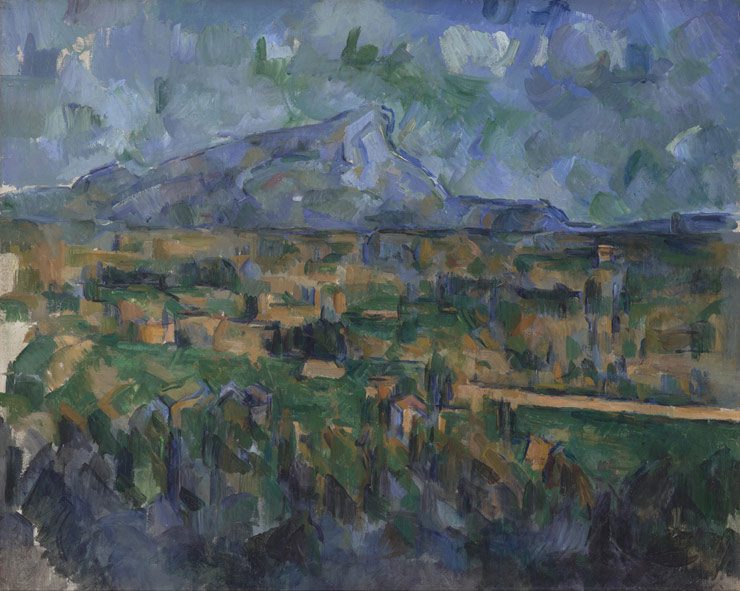
The version of Mont Sainte-Victoire held at the Philadelphia Museum of Art shows Cézanne at the peak of his abstract and structural experimentation. Painted between circa 1902 and 1906, this work features bold simplification of forms, subtle spatial ambiguity, and a complete integration of color and structure. The mountain itself looms in the background, rendered in soft purples and blues, while the middle ground is dominated by olive trees, rooftops, and a rhythmic viaduct arching through the valley.
Cézanne constructs the scene using overlapping horizontal and vertical planes, organizing the natural world into simplified visual units. This is especially evident in the blocky trees and flattened fields, which dissolve into patches of color rather than distinct objects. The mountain’s peak emerges from a matrix of brushstrokes, not as a photorealistic object but as a presence—unshakable, monumental, and abstracted. It anchors the painting not only visually but conceptually.
A key feature in this version is the railway viaduct cutting across the landscape. Its geometric form and light-colored arches contrast with the soft, hazy contours of the surrounding terrain. Far from disrupting the natural order, the viaduct enhances it, offering a man-made echo of the mountain’s majesty. This coexistence of nature and structure is central to Cézanne’s vision in his final years.
The painting no longer concerns itself with depth in the traditional sense. The foreground, middle ground, and background feel compressed, held together by a unified surface pattern of color and brushstroke. Cézanne is no longer documenting a view—he’s constructing a new way to perceive space, one that would profoundly influence the next generation of modern artists.
Light, Color, and Brushwork: Cézanne’s Visual Language
Cézanne’s use of color in this late Mont Sainte-Victoire reflects the full maturity of his visual philosophy. Rather than rely on traditional perspective or contour lines, he built space through color modulation. The brushstrokes—short, thick, and directional—act like bricks, giving the canvas a sculptural solidity. This was a deliberate move away from Impressionism’s fleeting sensations and toward a deeper, more enduring truth.
The palette in the Philadelphia version is soft but assertive. Earthy ochres, muted greens, silvery blues, and purples construct the land and mountain, while the sky glows with a quiet vibrancy. These aren’t naturalistic colors—they’re expressive tools that create spatial rhythm and visual harmony. The colors don’t describe light falling on form; they are the form.
Cézanne’s signature brushwork in this period became more mechanical and systematic. Each mark reinforces the next, with little blending or transition. Rather than dissolve forms into light and atmosphere, as Monet or Renoir might have done, Cézanne used his strokes to build volume and structure. The result is a mosaic-like surface where every area of the canvas holds weight and attention.
Critics and artists who saw these late works recognized their power. The brushwork, especially, fascinated Pablo Picasso and Georges Braque, who borrowed Cézanne’s method of reducing visible forms into interlocking color planes. This painting, with its gentle shifts and architectural stability, taught them that painting could analyze as well as imitate—a lesson that would shape Cubism and the visual revolutions that followed.
Painting from Nature: Cézanne’s Method and Studio Practice
Cézanne’s intense relationship with Mont Sainte-Victoire was grounded in habit and geography. By the time he painted the version now in Philadelphia, he had moved to the Les Lauves hill north of Aix-en-Provence. There, in 1902, he constructed a modest studio that overlooked the countryside. From this vantage point, he could observe the mountain daily under changing conditions, studying how its form remained while its appearance shifted.
He often worked en plein air, but he wasn’t a traditional plein air painter like the Impressionists. Cézanne did not aim to capture a single moment in time. Instead, he painted slowly, over multiple sessions, sometimes spanning weeks or months. He returned to the same view again and again—not to replicate it, but to understand it, deconstruct it, and then rebuild it on canvas according to his evolving logic of color and form.
His tools were straightforward: oil paints, flat brushes, a restricted palette, and a lightweight easel. But his method was meticulous. He laid down each brushstroke with deliberation, allowing the white of the canvas to show through in places and treating every element—sky, mountain, trees, and buildings—with equal compositional weight. Unlike more theatrical artists of his time, Cézanne approached painting as a kind of visual problem-solving.
Cézanne’s outdoor painting routine included:
- Vantage points such as Les Lauves overlooking the Arc Valley
- Working during consistent light for structural clarity
- Using flat, stiff brushes to control directionality
- Repeating the same motif to uncover deeper visual order
His method ultimately reflected his personality—reclusive, analytical, and deeply committed to the long game. He wasn’t interested in capturing the world’s surface, but in revealing its bones. That’s why Mont Sainte-Victoire, seen so many times through his eyes, becomes something larger than a mountain—it becomes a mirror of Cézanne’s lifelong quest to make sense of nature through art.
Mont Sainte-Victoire and the Rise of Modernism
Cézanne’s Mont Sainte-Victoire (ca. 1902–1906) marks more than just a personal artistic breakthrough—it represents a critical turning point in the history of modern art. The painting’s approach to structure, form, and space signaled a shift away from the naturalism of the 19th century toward the abstraction that would define the 20th. Where Impressionists blurred edges and dissolved solid forms in light, Cézanne brought those forms back with a new vocabulary rooted in geometry and mass. He showed that a landscape could be both deeply observed and deeply constructed.
Artists like Pablo Picasso and Georges Braque studied Cézanne’s work obsessively, particularly his Mont Sainte-Victoire series. They saw in his layering of shapes and flattening of perspective the seeds of Cubism. In fact, by the early 1910s, Picasso and Braque were actively deconstructing form into cubes, cones, and spheres—echoing Cézanne’s mantra that nature should be treated in those very terms. This late version, with its faceted hillsides and rhythmic brushstrokes, shows that transformation in full bloom.
This painting and others like it also began to redefine what a painting could be. Cézanne moved beyond the Renaissance ideal of linear perspective and atmospheric illusion. Instead, he allowed space to be ambiguous and the picture plane to assert itself. Backgrounds and foregrounds began to flatten and overlap. Trees, buildings, and mountains became modular components in a larger, dynamic system—a visual syntax that modernists would later expand into full abstraction.
Moreover, Cézanne’s influence extended beyond Cubism. His approach to color as form deeply impacted Henri Matisse and the Fauves, while his analytical mindset laid a foundation for later movements like Abstract Expressionism and Minimalism. Mont Sainte-Victoire (Philadelphia version) didn’t just change how landscapes were painted—it changed how painters saw, thought, and constructed their world on canvas.
Reception, Legacy, and Influence on Future Generations
Although Cézanne’s genius is widely recognized today, he spent most of his career on the margins of the art world. When this version of Mont Sainte-Victoire was painted, he was finally gaining recognition but still remained aloof from the Paris art scene. The Académie des Beaux-Arts and the Paris Salon had rejected his work for decades. It wasn’t until dealer Ambroise Vollard’s 1895 solo exhibition that Cézanne’s significance began to be acknowledged by collectors and younger artists.
By the early 20th century, his studio in Les Lauves became a pilgrimage site for younger painters. Henri Matisse, André Derain, and Maurice de Vlaminck saw Cézanne as the link between Impressionism and a bolder, more expressive future. Pablo Picasso and Georges Braque took this admiration further, incorporating Cézanne’s logic of construction into the foundation of Cubism. In effect, Cézanne became the common ancestor of several of modernism’s most radical movements.
The painting now resides in the Philadelphia Museum of Art, which acquired it in 1933. Its inclusion in a major American collection helped introduce Cézanne’s late style to a broader international audience. The painting remains a key example in museum galleries, art history textbooks, and exhibitions on the birth of modernism. Visitors are often struck by how much this quiet, seemingly simple landscape conveys about the evolution of Western painting.
Today, Mont Sainte-Victoire continues to inspire artists across disciplines. Its subtle strength, spatial ambiguity, and visual intelligence remain touchstones for painters, designers, architects, and thinkers. As Cézanne sought a visual language of permanence in an age of change, his mountain stands as a symbol of artistic clarity and courage.
Cézanne’s Spiritual and Philosophical Vision of Nature
Though Cézanne was not overtly religious, his approach to nature had a spiritual, almost metaphysical dimension. He once wrote that art should give “a sense of something eternal.” In this version of Mont Sainte-Victoire, painted near the end of his life, that idea becomes visible. The mountain becomes more than a landform—it’s a symbol of timeless stability amid the transience of the human experience. In his patient study of its contours and changing light, Cézanne engaged in a form of artistic meditation.
There is a philosophical underpinning to his work that resonates with 19th-century ideas of perception and truth. Influenced by ideas from Kant and Spinoza, Cézanne believed reality was not just what we see, but how we perceive and interpret it. His paintings reflect this philosophy: the mountain is not copied but reconstructed using a visual logic rooted in observation and geometry. The result is not a picture, but a new experience of seeing.
This version of Mont Sainte-Victoire reveals that idea most clearly. There is no narrative, no human presence, and no atmospheric drama. Just light, color, and form—arranged with patience and precision. It invites contemplation, not consumption. The mountain seems eternal, not because it is painted realistically, but because it is painted truthfully.
In this way, Cézanne’s work transcends style. It becomes a quiet form of devotion—not to religion, but to the deeper structures of the natural world. For viewers willing to slow down and look carefully, Mont Sainte-Victoire offers more than a view—it offers a vision of permanence in an ever-changing world.
Conclusion: Why Mont Sainte-Victoire Still Matters
More than a century after its creation, Mont Sainte-Victoire (ca. 1902–1906) remains a beacon for artists, historians, and art lovers. Its quiet force continues to shape how we understand the possibilities of painting. Cézanne’s ability to find structure in nature—and to express that structure without abandoning its beauty—is what sets this work apart. He didn’t destroy tradition; he reshaped it from the inside, offering a new way to see.
The painting’s endurance comes from its subtle balance of opposites: observation and construction, movement and stillness, nature and geometry. It stands at the crossroads of 19th-century realism and 20th-century abstraction, a transitional moment frozen in paint. That’s what makes it so compelling—it holds within it both the past and the future of art.
In a world increasingly dominated by speed and surface, Cézanne’s patient vision offers something refreshing. He reminds us that deep seeing takes time, that beauty can emerge from careful observation and disciplined practice. His mountain is more than a landscape—it is a philosophy rendered in brushstrokes.
The mountain still stands outside Aix-en-Provence, just as Cézanne left it, but also transformed through his eyes. For those who view the painting today, whether in person or in print, it offers a moment of clarity—a reminder of what art can do when it seeks truth and permanence over spectacle.
Key Takeaways
- Paul Cézanne painted Mont Sainte-Victoire over 30 times between the 1880s and 1906, turning it into his most iconic subject.
- The Philadelphia Museum of Art version (ca. 1902–1906) showcases his mature style—structured, abstract, and influential to modernism.
- Cézanne used short, layered brushstrokes and color modulation to create volume and structure, not just depict scenery.
- This painting influenced Cubism, Fauvism, and Abstract Expressionism, laying groundwork for 20th-century visual thinking.
- The mountain serves as a philosophical and visual anchor, symbolizing permanence, structure, and Cézanne’s pursuit of artistic truth.
Frequently Asked Questions
- Where is Cézanne’s Mont Sainte-Victoire (ca. 1902–1906) located?
It is in the collection of the Philadelphia Museum of Art, acquired in 1933. - How many times did Cézanne paint Mont Sainte-Victoire?
He painted the mountain over 30 times between 1882 and 1906, in oil and watercolor. - What makes this version of the painting significant?
It reflects Cézanne’s late style and played a crucial role in influencing Cubist and modernist painters like Picasso and Braque. - Did Cézanne work outdoors or in a studio?
Both. He painted outdoors around Aix-en-Provence and later from his Les Lauves studio, built in 1902. - Why did Cézanne return to this motif so often?
He saw the mountain as a visual and spiritual challenge, perfect for exploring geometry, form, and visual order in nature.